
Hybrid event planning gets flattened too often into one lazy idea, “put the room on a stream”. That's not hybrid, it's a compromise that usually leaves one audience under-served and the other disengaged.
In the UK, that mistake is especially costly because the market is still anchored in live attendance. The UK meetings and events market recorded 2.02 million in-person events in 2024, within a total of 2.7 million events and 516 million attendees, and in-person events still made up 73.7% of total event volume, while in-person attendees accounted for 73.2% of attendee volume, according to the Meeting & Event Barometer report. That means hybrid delivery has to work inside a strongly face-to-face ecosystem, not outside it.
For organisers shaping the next campaign calendar, it helps to watch how experiential formats are being used to pull both audiences into one joined-up experience. If you want a practical benchmark for how live activation and event strategy can work together, explore upcoming campaigns from Mick-Mar Inc. and compare the mechanics with your own plans.
Beyond the Livestream Rethinking Hybrid Events
The first thing to reject is the old shorthand that hybrid means in-person with a livestream. That model centres the room and treats the online audience like a passive audience buffer, which is exactly how events end up feeling split in two.
The better definition is operational, not technical. Hybrid event planning is the work of designing one event concept for two distinct audiences, with the physical audience and the virtual audience both getting a clear reason to turn up, participate, and return. In the UK, that matters because the live event remains the core commercial unit, venue choice and on-site logistics still drive a lot of the budget, and the virtual layer only works when it supports the live room rather than sitting beside it.
The market data backs that up. With 73.7% of UK event volume still being in-person in 2024, hybrid should be treated as a way to extend and sharpen the live experience, not replace it Meeting & Event Barometer. That changes the planning mindset. You're not filming an event, you're building a shared programme that happens to have two delivery modes.
A useful rule is simple.
Practical rule: if a moment only works for one audience, it needs a deliberate counterpart for the other audience, not a shrug and a replay later.
That's where a lot of planning fails. Organisers overspend on cameras and under-design the experience. They assume the virtual audience will tolerate whatever's left after the room has been looked after. In practice, that erodes engagement, weakens brand perception, and makes the event feel like two products stitched together badly.
For UK planners, the goal is cohesion with distinction. The event should feel like one campaign, one message, one brand moment. But the route into that moment has to be designed for the people in the room and the people joining remotely.
Laying the Foundations for Hybrid Success

Hybrid event planning starts long before venue holds, production quotes, or platform demos. The foundation is clarity, and the first version of that clarity is deciding what success looks like for each audience. If the room needs sales conversations, brand immersion, and sponsor visibility, the virtual side may need content access, audience interaction, and a simple route to follow-up.
The strongest brief I've seen always names the audiences separately. Not “delegates”, but on-site decision-makers, remote prospects, press, speakers, VIPs, or whatever groups really matter. That segmentation shapes everything, from registration fields to agenda timing to whether a session needs live Q&A or a moderated chat.
Set the runway before you set the run-of-show
For complex UK events, a 6 to 12 month planning runway is the sensible benchmark, because the event has to be designed, tested, and reworked for two attendance modes EIFL checklist. A rushed hybrid build tends to expose weak venue internet, poor speaker prep, and a confusing audience journey. None of those are fixed by adding more software at the end.
Registration needs to capture participation mode early. Ask people whether they're attending in person or online, then plan technical support, accessibility, and comfort needs around that declared choice EIFL checklist. That sounds basic, but it's the difference between a sensible operations plan and guesswork on show day.
Budget and governance need to be decided together
Hybrid budgets break when the tech is treated as a lump sum instead of a planned set of line items. Put governance around the budget early, define who owns venue costs, platform costs, staffing, and broadcast quality, then keep those decisions visible through the project. If the event has stakeholders from marketing, sales, events, and leadership, a clear budget split stops last-minute lobbying from crushing the experience.
For broader timing discipline, a strong event timeline framework helps teams map milestones without losing the detail that hybrid requires. A useful planning reference is the PSW Events event planning timeline, especially if you're aligning content deadlines, supplier booking, and rehearsal windows across multiple stakeholders.
The key lesson is boring but vital. Decide the audiences, define the outcomes, declare the participation mode, and lock the runway. Every other decision gets easier after that.
Designing Your Dual-Audience Experience
A good hybrid event doesn't feel like two separate rooms. It feels like one story told through two different lenses. The best way to get there is to design parallel agendas, not one agenda with a livestream bolted on.
Take a launch conference as an example. The in-person audience might arrive to a physical welcome, sponsor zone, networking drinks, and a keynote on stage. The virtual audience can't be asked to sit through dead air, so their path needs its own rhythm, perhaps a focused welcome, a moderated discussion, and a fast route into interaction. The content can still be shared, but the experience has to respect the format.
Where the agendas should meet and where they shouldn't
The strongest hybrid programmes deliberately mark convergence points and divergence points. A keynote, product reveal, or senior Q&A might be shared live. A coffee break, exhibitor networking, or hands-on demo zone may need a different treatment for each audience.
A physical networking session with canapés can run at the same time as a virtual breakout session moderated around a topic the online cohort cares about. That's not a consolation prize. It's the online version of useful networking, built for the attention span and environment people have at home or in the office.
The data suggests planners are already moving in that direction because hybrid expands reach. In a 2024 survey of 1,000 planners, 80% said hybrid events deliver greater reach and engagement than other event types, and other industry compilation figures reported 71% higher registration and 50% better attendance rates than purely in-person events Eventify. That doesn't mean every event should be hybrid. It means when you choose it, the experience design has to earn the extra complexity.
Use interactive attractions to unify the room and the stream
A lot of UK events can do more. Interactive attractions give both audiences a shared object of attention, not just a shared slide deck. A racing simulator with a live leaderboard works because the in-room crowd can compete on-site while the virtual audience follows the scores, watches the action, and joins commentary in real time.
I've seen the same principle work with other competitive or participatory moments. The point isn't the gadget. The point is that the attraction creates a reason for remote guests to care about what's happening on the floor. It gives the host something to talk about, gives sponsors something visible to support, and gives both audiences a common reference point.
Both audiences need something they can talk about afterwards. If only the room gets the memorable moment, the online side becomes an archive, not an audience.
That's why the most effective hybrid experiences feel active. They create momentum, give people a role, and make the event easier to remember because it offered participation, not just transmission.
Selecting Your Technology and AV Stack
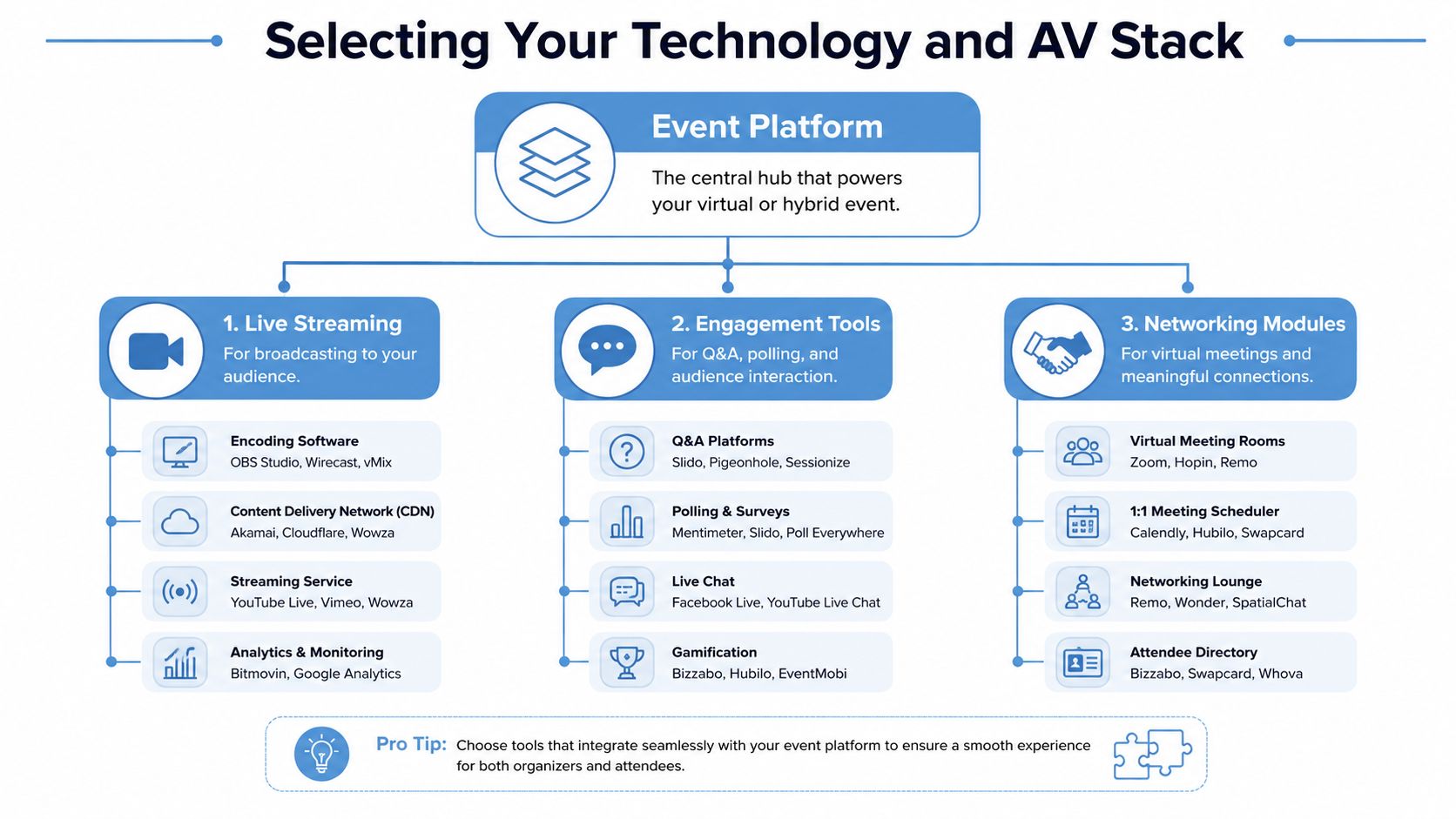
Technology should follow the experience design, not lead it. Too many teams start by asking which platform has the most features, then try to force the event into the software's shape. That usually creates noise, not value.
The core stack has three jobs. The event platform is the virtual venue. Streaming carries the signal out of the room. AV captures the sound and picture properly in the first place. If any one of those is weak, the whole hybrid build feels compromised.
A UK methodology is to allocate 10 to 15% of the total budget specifically to AV as separate line items, not a vague bucket Converve. That budget line protects the broadcast experience. It also forces a proper discussion about cameras, microphones, lighting, mixing, and staffing before anyone signs off a slick-looking proposal that can't be delivered cleanly.
Ask the right questions before you sign
Platform demos can be misleading if they focus on features that don't matter to your format. Ask whether the platform supports your exact session flow, your moderation model, your networking needs, and your reporting requirements. Then ask the production partner how they'll manage cues, backups, and speaker handovers, not just whether the stream will go live.
It's also worth matching the stack to event scale rather than vendor theatre. A small executive roundtable and a large exhibition keynote need very different production discipline. The right system is the one that supports the audience journey you've already designed, not the one with the flashiest sales deck.
Don't confuse visibility with control
The biggest technical mistake I see is teams assuming the platform will solve engagement on its own. It won't. A platform can host Q&A, chat, polling, and networking tools, but someone still has to run them properly and keep the virtual audience informed.
For teams comparing event systems, the PSW Events event coordination software page is a useful reminder that operational coordination matters as much as the broadcast itself. The software only works when the roles, cue points, and escalation paths are defined in advance.
Operational note: if the tech partner can't explain how they'll handle speaker failure, audio drop-outs, or a broken scene change in plain English, keep looking.
One more practical point. If the room is well lit but the camera feed is poor, the virtual audience experiences a different event altogether. Hybrid AV is not decorative. It is the delivery mechanism for half your audience.
Mastering Logistics and Inclusive Execution

Execution is where a lot of elegant planning gets exposed. The event can have a strong strategy and a decent platform, yet still feel chaotic if staffing, cueing, and attendee support aren't disciplined. Hybrid makes that more obvious because one team has to serve two live experiences at once.
The staff structure has to be deliberate. The on-site MC should not be expected to monitor chat. The virtual host should not be guessing when a session changes. The AV lead should not also be the person resetting polling or chasing speakers. Every role needs a job, and every job needs a backup.
Rehearse the handovers, not just the slides
Cue-to-cue rehearsals matter because hybrid events fail at transitions, not usually at the headline moments. A speaker who is brilliant in the room can still fail virtually if the handover is late, the mic isn't live, or the virtual audience doesn't know what's happening. Run the event with both teams present and check how each moment lands across the two feeds.
Branding should also be consistent across physical and digital touchpoints. The registration page, holding slides, venue signage, host script, and on-screen graphics should all feel like the same event. If the room looks premium and the online interface looks generic, the split will be obvious to everyone.
Accessibility has to be designed in, not added afterwards
Accessibility is where hybrid planning gets serious. Best practice is to build access from the start by collecting needs during registration, offering multiple participation modes like voice and chat, and appointing enough staff to support both on-site and online attendees with disabilities GC Copernicus. That means accessibility is not just a captioning question. It's a staffing, process, and communication question.
A few things should be standard.
- Collect access needs early: Ask attendees what they need during registration, then brief speakers and suppliers accordingly.
- Offer multiple ways to participate: Voice, chat, and anonymous questions give people options when speaking live isn't practical.
- Support both audiences properly: Don't leave the virtual side to one overstretched producer while the room gets the full team.
- Rehearse access flows: Test how a speaker joins remotely, how a question is prioritised, and how technical support reaches the attendee.
For venues, volunteers, and suppliers, clarity is everything. The team should know who owns accessibility checks, who handles health and safety for the live element, and who acts when a speaker, delegate, or remote guest hits a barrier.
A strong contingency framework helps too. The PSW Events event risk assessment template is a good reminder that risk planning should be practical, not theoretical. Hybrid events reward teams that plan for failure before anything goes wrong.
Measuring Success and Planning for Contingencies
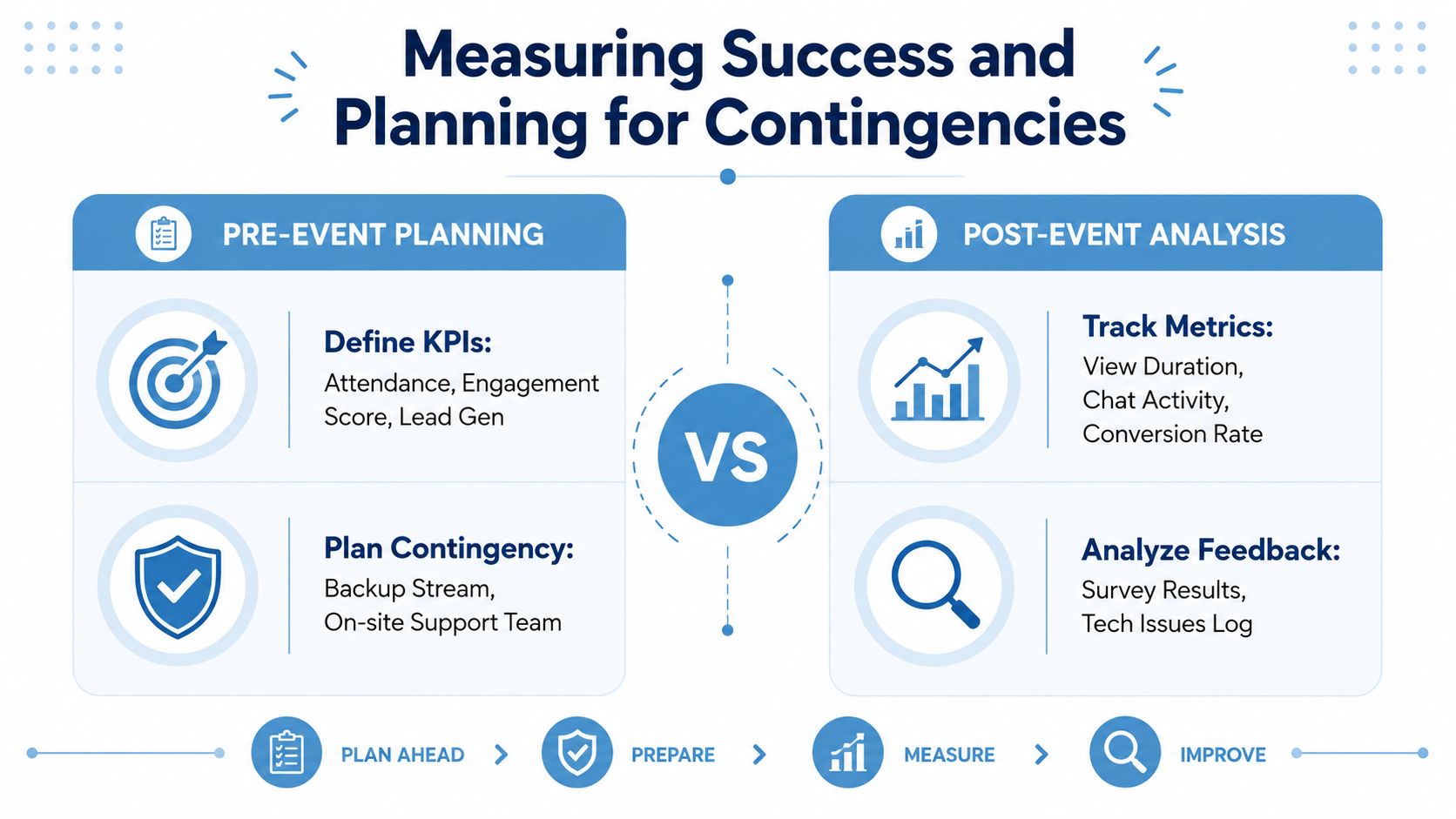
A hybrid event isn't successful because it looked busy. It's successful because both audiences did what you wanted them to do. That means the measurement model has to separate the cohorts, then bring the data back together in a way that shows what worked.
The trend in hybrid measurement is moving from broadcasting content to closed-loop measurement. That means setting separate goals and audience-specific KPIs, integrating with a CRM before the event, and treating the event-tech stack as part of the measurement system rather than a bolt-on Gable. Once you do that, the event becomes easier to evaluate properly.
Measure behaviour, not just attendance
For the live audience, useful signals include dwell time, booth conversations, session flow, and lead capture. For the virtual audience, watch session engagement, chat activity, poll participation, content downloads, and replay interaction. The exact mix depends on the event objective, but the principle stays the same. Measure what each audience could realistically do, then compare against the goal you set for them.
If sales or marketing teams want ROI, they need more than a registration count. They need to know which cohort engaged, which content moved them, and what happened after the event. Without that, hybrid becomes a visibility exercise rather than a commercial one.
Build the contingency plan around people, not hope
Contingencies should be specific. If the internet fails, who switches to backup connectivity? If a speaker doesn't arrive, who fills the gap and with what content? If the platform glitches, what message goes to attendees and who sends it?
What works: a named escalation chain, a backup stream, and one person with authority to make the call fast.
What doesn't: assuming the technical partner will “sort it” while the rest of the team keeps presenting as if nothing happened.
The best teams test their backup routes during rehearsal. They don't just ask whether the stream can fail over. They check who will tell the audience, who will cue the speaker, and who will keep the session on track while the issue is being fixed.
Measurement and resilience belong together because the same disciplined team usually delivers both. If you can see the event clearly, you can improve it. If you've planned the failure points properly, the audience probably won't notice the strain when something goes wrong.
PSW Events brings the sort of practical event delivery that makes hybrid work, from interactive attractions to on-site installation and staffing. If you're planning a conference, exhibition, activation, or brand moment that needs both audiences fully engaged, visit PSW Events and speak to a team that understands how to turn hybrid event planning into something people remember.