
Your event brief is nearly signed off. The venue is booked, the sponsor wants a visible football moment, and the marketing team needs something that attracts people without turning the stand into a queue for a specialist simulator. Then someone suggests a football dart board, and the practical questions arrive quickly. Will it fit? Is it safe indoors? How many people can use it? Can it generate useful engagement rather than a few photographs?
A football dart board can work exceptionally well, but only when the format, footprint, staffing and measurement plan match the event. The large inflatable version is visually powerful, while a compact board may suit a tighter exhibition stand. Neither should be booked from a product photograph alone.
Why Event Planners Are Choosing Football Dart Boards
At a busy corporate event, the strongest attraction often isn't the most technically complex one. It's the activity that a passer-by understands immediately, feels comfortable trying, and can watch while waiting for a turn. Football dart boards sit in that useful middle ground. They combine the familiar target structure of darts with the broad appeal of football, while replacing sharp darts with footballs designed to adhere to the target surface.
That makes the experience easier to explain than a full sports simulator. A visitor doesn't need a handicap, a club membership or prior knowledge of football tactics. They can step up, take a turn and compare their score with a colleague. The turn-based format also gives spectators something to follow, which matters on exhibition stands and in fan zones where visual energy helps pull people away from the main aisle.

The attraction is accessible by design
Football remains a strong cultural entry point for UK audiences, but the activity doesn't depend on athletic performance. A participant can compete through accuracy, patience and a little friendly pressure. That opens the game to people who might avoid a penalty shootout, reaction test or simulator because they don't see themselves as sporty.
The wider darts audience also supports the choice of a darts-based format. YouGov reports that 9% of Britons follow darts, compared with 8% for snooker and 3% for diving. Among darts followers, 51% said they watch darts on television regularly, evidence that the sport now has a meaningful place in mainstream UK leisure culture. These figures come from YouGov's UK darts audience data.
That doesn't mean every event needs a darts theme. It does mean the format has a recognisable competitive language, including turns, scores, targets and finals. A brand can add its own prize, message or team challenge without asking visitors to learn a complicated ruleset.
Practical observation: The board attracts attention, but the operator creates engagement. A clear invitation, visible scoring and a short explanation usually matter more than adding extra features.
Where it fits in an event plan
For a fan zone, football darts can act as a low-barrier participation point between larger attractions. At a corporate away day, it can provide a simple team competition that doesn't require everyone to play at once. On a product launch or exhibition stand, it can create a natural reason to stop, participate and discuss the brand.
The limitation is equally important. Football darts isn't a complete event strategy by itself. Without a host, queue plan and follow-up mechanism, it may produce activity without useful business outcomes. Treat it as an engagement platform, then decide what each turn should achieve, whether that's a conversation, a lead, a prize entry or a shareable moment.
Understanding Football Dart Board Specifications and Gameplay
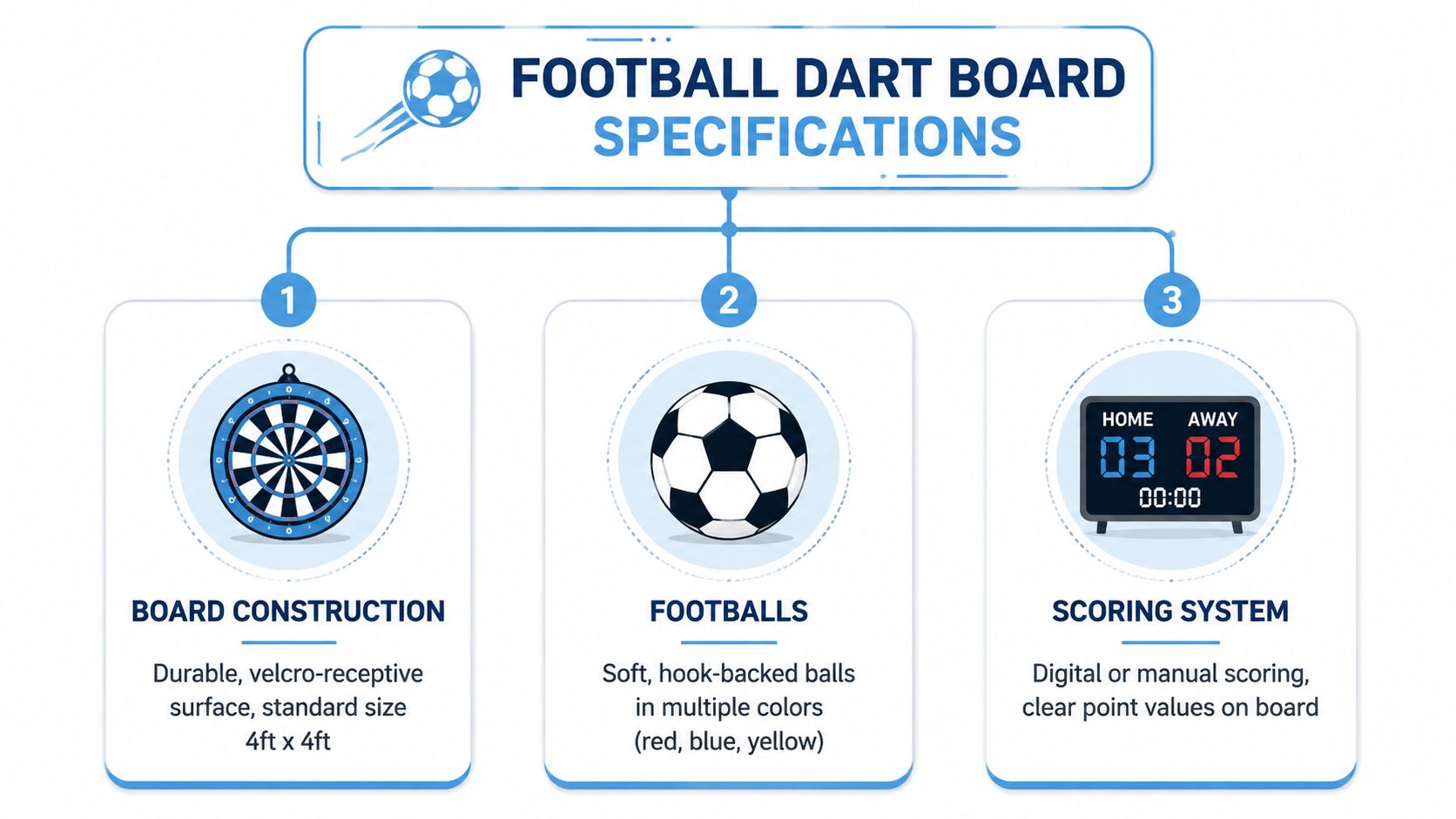
The phrase “football dart board” covers more than one format. Before speaking to a supplier, establish whether you need a compact target board for controlled indoor play or a large inflatable installation designed to dominate a leisure or event area.
A standard football darts board is commonly specified at about 46 cm in diameter, according to Masters of Games' football darts board specification. That gives planners a useful sense of the target itself, but it doesn't describe the full operating footprint. The surrounding throwing area, player position, retrieval space and spectator route must be planned separately.
Measure the board like a darts installation
For a regulation UK dartboard, the bull centre is installed 1.73 metres above the floor, as set out in the BDO darts games rules. The standard throw line sits 2.37 metres from the front of the board, while the diagonal measurement from the bull to the oche is 2.93 metres for checking an installation across an uneven surface, as described by Darts501's setup guidance.
Those measurements are useful even when the event product is branded or adapted. They give the production team a reference for height, throwing position and scoring consistency. A regulation board has a diameter of 47.08 cm, while UK rules specify an overall board diameter of 451.0 mm, plus or minus 3.0 mm, with the inner bull at 12.7 mm, the outer bull at 31.8 mm, and the treble and double ring geometry at 107.4 mm and 170.0 mm from the bull centre respectively. The detailed dimensions and installation checks appear in the UKDA playing rules.
For event use, the diagonal check is particularly valuable when a temporary floor, platform or outdoor surface isn't perfectly level. A board can look correctly positioned while the playing distance is subtly wrong.
Use a simple game format
A published football darts ruleset gives each player three darts per shot on goal. Successful hits on the football target advance play, and the match is decided by the side with the most goals after seven shots on goal, with sudden death if required, according to the DARTSKINS penalty shootout rules.
For corporate events, keep the explanation short. State how many attempts each person has, how points or goals are counted, and what happens in a tie. If a digital leaderboard is part of the experience, confirm whether the supplier provides it or whether you need to arrange an electronic leaderboard separately.
Event Use Cases Where Football Dart Boards Excel
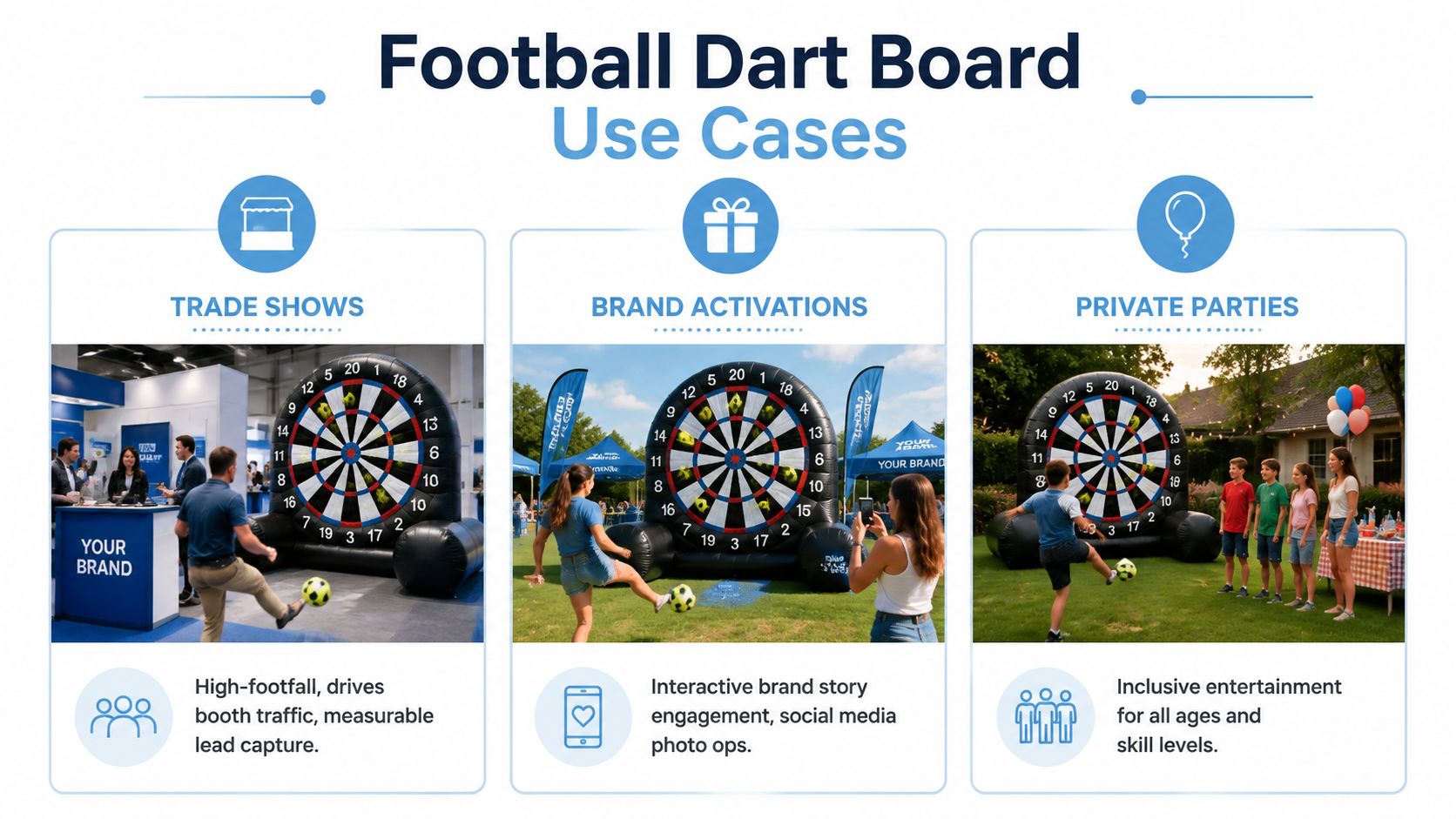
The attraction performs best when the event needs visible participation without a long learning curve. A trade show stand, a fan zone and a private celebration may all use the same board, but they shouldn't use the same operating plan.
At a trade show, the board should support a conversation rather than interrupt it. The host can invite visitors to take a short turn, record a score and connect that score to a prize draw or product discussion. The game becomes a reason to enter the stand, while the staff member controls the transition from play to enquiry.
Match the format to the audience
Exhibitions and conferences favour a compact, highly managed setup. The operator should be able to reset the balls quickly, keep the queue inside the stand boundary and direct participants towards a clear next step. A large inflatable can work at a spacious exhibition, but it may consume valuable floor area and draw spectators away from the sales team if the layout isn't designed carefully.
Fan zones can support a more theatrical installation. The board provides a visible challenge that families, friends and mixed-age groups can understand quickly. It works particularly well as one element in a wider sports area, alongside attractions such as football simulators, Batak-style reaction games or an electronic scoring feature. The football interactive games range offers useful context when comparing football-themed activities for a wider event footprint.
Team-building days benefit from structured competition. Split attendees into teams, publish a running score and give the host a reason to keep the competition moving. The game shouldn't reward only the strongest footballers. Use pairs, rotating roles or a team total so that accuracy, encouragement and tactical choices all have a place.
Where it outperforms alternatives
Football darts has a lower explanation burden than a simulator. It also gives spectators a clear visual target, unlike some reaction games where the result is meaningful mainly to the person playing. That combination makes it useful for footfall capture and social content.
It isn't automatically the best choice for every brief. A simulator may be better when the brand story depends on detailed performance data or immersive graphics. Batak-style games can suit a high-energy reaction challenge. Football darts is strongest when the brief calls for quick participation, public competition and broad audience comfort.
At venues such as ExCeL London, Manchester Central and SEC Glasgow, the practical question is rarely whether people will understand the activity. It's whether the supplier can integrate the board into access routes, stand rules, staffing and the venue's safety process.
Hire Versus Buy Decision Framework
The decision between hiring and buying isn't mainly about the headline product price. It's about how often the board will be used, who will operate it, where it will be stored and who carries responsibility when something needs repairing or replacing.
| Factor | Hire | Buy |
|---|---|---|
| Event frequency | Suits occasional activations, exhibitions and private events | Suits venues, agencies and brands with recurring use |
| Storage | Supplier retains the equipment between bookings | Buyer needs secure, dry storage for the board, balls and accessories |
| Transport | Often arranged as part of the booking | Buyer manages transport, vehicle access and handling |
| Setup | Can include delivery, installation and an operator | Buyer needs trained staff or a separate setup service |
| Maintenance | Supplier normally manages condition and repairs | Buyer carries responsibility for inspection and upkeep |
| Branding | Ask whether temporary graphics or branded accessories are available | Permanent or repeat-use branding may be more practical |
| Risk management | Confirm insurance, method statements and operating controls | Buyer must maintain suitable documentation and cover |
Hire for flexibility
Hire is usually the cleaner choice for a one-off conference, seasonal campaign or exhibition where the board won't have a confirmed future booking. It also suits planners who need several attractions across different venues, because the supplier can advise on format and handle delivery, installation and collection.
The booking conversation should cover more than availability. Ask for the packed dimensions, access requirements, setup time, surface limitations, anchoring method, weather plan, replacement-ball process and operator provision. If the event is branded, confirm whether the graphics are applied to the board, the balls, the scoreboard or the surrounding structure.
Buy for controlled repeat use
Purchase can make sense for a venue, production company or brand with a regular activation calendar. Ownership may offer more control over availability and customisation, but it also creates an operational obligation. Someone must inspect the equipment, organise storage, arrange transport and ensure each event has suitable staff and documentation.
The hidden burden is often storage rather than maintenance. Inflatable equipment needs a dry, protected location, and the complete kit may include blowers, anchors, balls, scoring equipment and branded components. A board that sits unused between events still occupies space and needs a system for checking its condition before deployment.
Procurement rule: If you can't name the storage owner, transport plan and trained operator, you haven't finished the buy-versus-hire assessment.
For either route, request a written scope. It should state what the supplier provides, what the venue must provide, how branding is approved, who supervises participants and what happens if weather or access conditions make the planned installation unsuitable.
Space Requirements and Venue Setup Guidelines
Space is where football dart board bookings succeed or fail. The board may fit on paper, yet the event can still become unsafe if spectators stand behind the throwing position, balls roll into a service route or the operator can't retrieve equipment without crossing the queue.
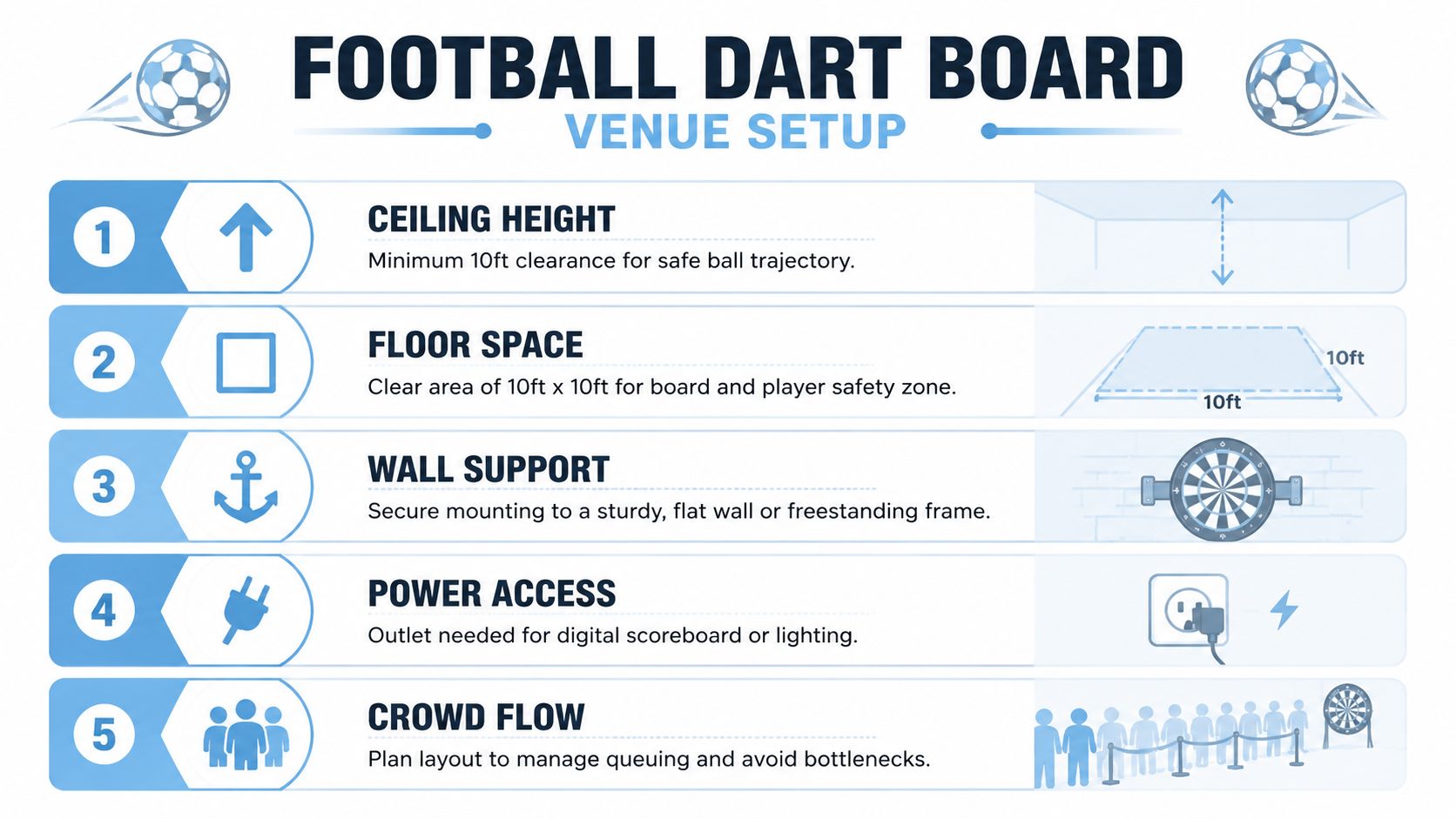
Published UK specification sheets for larger inflatable boards commonly require a 15 ft by 15 ft footprint or similar operational area. One example lists a unit measuring 13 ft wide, 8.2 ft deep and 13.5 ft high, with a required space of 15 ft by 15 ft, as shown in the supplier specification for an inflatable football dart board. Other UK listings show smaller formats with 12 ft by 12 ft-type requirements, as well as installations reaching 27 ft, so planners must request the exact model specification rather than rely on the product category.
Survey the venue before booking
Start with a scaled floor plan. Mark the board, player position, operator station, queue, spectator area and retrieval route. Then check the full height against the venue's ceiling, lighting rigs, sprinklers, banners and temporary structures. A listed unit height is not the same as a safe usable clearance, particularly in a marquee or exhibition hall with suspended equipment.
For a hard-standing installation, confirm how the supplier anchors the inflatable and whether the venue permits those fixing methods. On grass, check ground condition and access for delivery equipment. Outdoor plans also need a weather contingency. Wind, rain and wet surfaces can affect anchoring, ball handling and participant footing, so a responsible plan should identify when the attraction will be paused, moved or removed.
The publicly available venue-fit guidance for football dart boards reflects the broader planning gap in this market. Product pages often provide a footprint, but planners still need to resolve clearance, supervision, anchoring and audience management with the supplier and venue.
Build safety into the layout
Use a visible boundary between the player and spectators. Keep bags, cables and drinks outside the playing area, and position the operator where they can stop play quickly. Mixed-age audiences need active supervision, even where the balls are soft, because enthusiasm can lead participants to throw before the area is clear.
A practical pre-event checklist includes:
- Access route: Confirm door widths, lift dimensions, loading restrictions and the route from unloading point to the final position.
- Surface condition: Check that the floor or ground is level, clean and suitable for the proposed equipment.
- Clearance: Reserve space for players, spectators, queueing and ball retrieval, not just the board footprint.
- Power: Establish whether the blower, lighting or digital scoreboard needs a dedicated outlet and how cables will be protected.
- Weather plan: Agree the decision-maker, pause procedure and alternative indoor position before guests arrive.
Safety principle: Never make the audience the clearance zone. If spectators must stand in the player or retrieval path, the layout needs redesigning.
Branding Integration and Lead Capture Strategies
A football dart board becomes commercially useful when the brand appears throughout the interaction without making the game feel like a form-filling exercise. Branding can sit on the board surround, footballs, score display, prize mechanic and photography point. The strongest activations make those elements feel like part of the competition.
Start with the visual hierarchy. The target must remain easy to read from the aisle, while the sponsor message should be visible in photographs and on the scoreboard. Branded footballs can support colour consistency, but they shouldn't make the target harder to see. If the board is heavily customised, ask the supplier for artwork dimensions and approval deadlines before the event build.
Design the journey around the turn
The player journey should have four simple stages:
- Invite: A host explains the challenge in one short sentence.
- Play: The participant takes the agreed number of attempts.
- Record: The operator enters the score or adds it to a visible leaderboard.
- Continue: The participant scans a QR code, joins a prize draw, visits a product station or nominates a colleague.
That structure keeps the activity moving while giving the marketing team a defined point for data capture. A trade show team might request permission to follow up after a score submission. A product launch could connect a high score with an exclusive demonstration or content download. A staff event might use team names rather than personal data, keeping the emphasis on competition and participation.
The lead capture approach for events should be agreed with the marketing and compliance teams before the stand opens. Decide what information is necessary, how consent is recorded and who owns the resulting data. Don't ask an operator to improvise those decisions in a busy queue.
Make repeat play intentional
A single score can create a moment, but a tournament creates a reason to return. Use timed leaderboards, team challenges or scheduled finals to spread engagement across the event. Display the current benchmark clearly, but avoid a structure that makes casual participants feel they can't compete.
Social sharing works best when the photo is immediate. Position the branded backdrop, score and participant in the same visual frame where possible. Give the host a natural prompt, such as inviting the player to nominate a colleague, rather than forcing every participant into a scripted post.
Measure the activity against the campaign objective. Track participation, qualified conversations, consented leads, prize entries, repeat visits and content interactions separately. That produces a more useful assessment than only reporting how many footballs were kicked.
Making the Case for Football Dart Boards as Strategic Assets
The strongest budget case for football darts is not that it looks fun. It's that the format can perform several jobs at once: attract passers-by, create a visible challenge, accommodate people with different confidence levels and give staff a natural opening for conversation.
That makes it a credible supporting asset for an exhibition stand and a possible primary draw in a fan zone or leisure setting. The choice depends on the event objective. If the organiser needs deep product demonstrations, the board should draw people towards a staffed consultation area. If the aim is broad participation and atmosphere, the installation can sit as a headline activity within the wider event footprint.
Measure the outcome, not just the queue
A useful evaluation framework separates activity from business value:
- Reach: How many people stopped, watched or entered the area?
- Participation: How many completed a turn?
- Engagement: How long did conversations continue after play?
- Conversion: How many visitors submitted a qualified enquiry, consented to follow-up or attended a demonstration?
- Recall: What did participants remember about the brand after the event?
Football darts won't automatically produce those outcomes. The host, layout, prize, data journey and follow-up process determine whether the attraction remains a novelty or becomes a measurable engagement asset. For campaigns that need carefully defined geographic audiences before or after the event, planners can also review direct mail targeting solutions as part of the wider activation plan.
The format is particularly defensible when a brief calls for a low-barrier football experience, quick explanations, public competition and flexible audience participation. It is less suitable when the main objective depends on immersive simulation, detailed player analytics or a quiet one-to-one consultation.
A sensible decision is therefore straightforward. Use football darts as the primary attraction when visibility and participation are the priority. Use it as a supporting activity when lead quality, product education or a larger simulator experience must remain central. In both cases, define the measurement plan before the equipment arrives.
PSW Events can supply and manage interactive football and sports attractions for exhibitions, conferences, brand activations, team-building days, fan zones and private celebrations, including planning, branding, logistics, installation, staffing and health and safety support. To match a football dart board format to your venue, audience and engagement goals, visit PSW Events and discuss the brief with the team.