
A UK flight simulator ranges from about £26 for consumer software to over £60,000 for a full-motion installation. The right model depends on whether you're hiring for an event, buying a system, or booking an experience.
You may be a marketing lead who needs a simulator quote for a Thursday product launch, an aviation enthusiast comparing cockpit systems, or a gift buyer looking for a supervised session. Three suppliers can return three wildly different figures because they're pricing different products, not necessarily overcharging for the same one.
The practical answer to flight simulator cost is therefore a decision, not a single price. Buy when you'll use the equipment repeatedly and can absorb maintenance. Hire when you need a reliable activation without owning the risk. Book an experience when you want access to a professional simulator without paying for the asset.
Why UK Buyers Search for Flight Simulator Cost
A Thursday product launch can produce three simulator quotes that look wildly different. One may cover equipment time only. Another may include delivery, setup, crew, displays, insurance and venue support. The lower figure is often the narrower scope, not better value.
Three different buying jobs
The first reader is the buyer. Training organisations, aviation enthusiasts and venues considering ownership must budget for the equipment, installation, software, servicing, floor space and future use. A purchase decision depends on utilisation as much as the headline price. An expensive rig that sits idle can cost more commercially than a hired simulator used only when required.
The second is the hirer. Corporate planners, agencies and exhibition organisers usually need a reliable activation for a defined period. They are buying an outcome, such as footfall, dwell time, lead capture or guest engagement. Hire usually places transport, crew and much of the operational responsibility with the supplier, but the quote still needs checking for minimum hire periods, VAT, insurance and venue access.
The third is the experience buyer. Consumers and gift purchasers pay for a supervised session, often with an instructor or operator. They compare the venue, aircraft type, session length, supervision and credibility of the experience. Ownership economics are irrelevant to that purchase.
Procurement rule: compare like with like. A game, a venue session and a branded event activation are different products with different cost structures.
Why the search results look chaotic
The phrase flight simulator cost covers consumer software, supervised experiences, hire packages and complete installations. Consumer listings cluster around the price of a new game, while professional systems sit on a separate commercial ladder. The same search returns both because the buying job changes.
Professional event pricing also depends on what arrives with the simulator. Staffing, transport, setup time, technical support, minimum booking periods, VAT, insurance and venue requirements can alter the quote substantially. Ask for an itemised scope before comparing suppliers.
Professional pricing sits on a different ladder, which the next section breaks down tier by tier. For event procurement, the practical question is whether to buy an asset for repeated use, hire an operated attraction, or book access to an existing experience.
What a Flight Simulator Costs in the UK by Tier
Start with the use case, then select the tier. A home user needs software and perhaps controls. A training provider may need a fixed-base cockpit. An event organiser needs a delivered, operated attraction, not a box of hardware.
The cost ladder
Consumer software is the lowest-cost route, as covered above, but it doesn't provide the branding, throughput or managed operation an event requires.
Experiential sessions occupy the next layer. UK providers publish short-session and training-style experiences from £45 per hour for self-fly hire to £99 per hour with an instructor, based on Semet Aviation's published prices. Another London provider lists a 40-minute DA42 simulator session at £260, while its instructor-led aircraft rates run from £330 to £438 per hour, as shown on Flight Training London's price page. Booking wins when you want access without capital expenditure.
Fixed-base hire is more suitable for venue use and supervised activity. One UK supplier lists £110 per hour, £130 with an operator, and £170 with an instructor, as published by Deeside Flight Simulators. The staffing choice changes the price directly, so specify whether your brief needs basic hire, an operator or instruction.
Full-motion use moves sharply upwards. UK guidance places fixed-base sessions around £100 to £150 per hour, compared with £400 to £600 per hour for full-motion systems, because the motion platform, fidelity and support requirements add complexity. Pilot Prep's UK simulator guide explains that distinction. For a public activation, only pay for motion when the physical sensation supports the audience experience or campaign objective.
Commercial ownership reaches the highest levels. Published UK systems range from £13,000 plus VAT to £65,995 for a Full F-16 simulator, with other listed systems at £18,500 and £26,000. If you are assessing a dedicated asset, compare full-motion flight simulator options by capability and utilisation, not just by purchase price. Ownership also leaves you responsible for storage, maintenance, staffing and downtime, while hire transfers much of that operational burden to the supplier.
UK Flight Simulator Cost Tiers at a Glance
| Tier | Typical Product or Service | UK Price Range (ex VAT) | Best Suited For |
|---|---|---|---|
| Consumer software | Flight simulation game | About £26.63 to £141.99 | Home users and enthusiasts |
| Venue experience | Self-fly or instructor session | £45 to £260 | Gift buyers and casual users |
| Fixed-base simulator | Venue or supervised hire | £100 to £170 per hour | Training and compact activations |
| Full-motion session | High-fidelity simulator time | £400 to £600 per hour | Premium experiences and specialist training |
| Commercial system | Dedicated simulator asset | £13,000 plus VAT to £65,995 | Training providers, venues and serious operators |
The table works only when the tier matches the job. Buying consumer software will not solve an exhibition brief. Hiring a full-motion system for a private home session may be unnecessary spend. For events, request an itemised quote covering transport, setup, operation, VAT, insurance and minimum booking requirements before comparing headline rates.
The Cost Drivers Behind the Price Tag
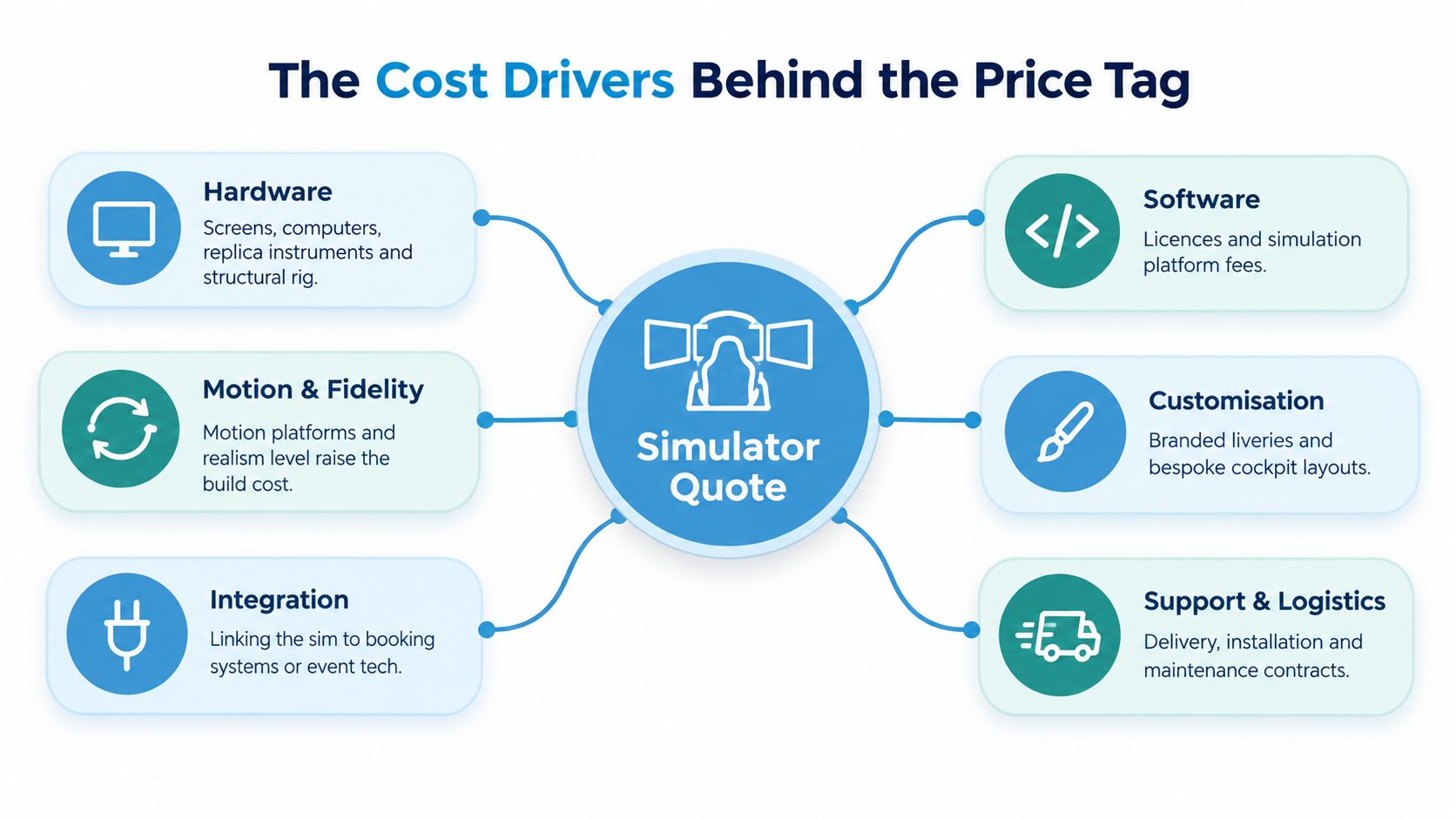
A quote rises because someone has added capability, labour or risk. Ask suppliers to separate those components. You'll then see whether you're paying for a genuine requirement or a package feature that doesn't support your event.
Hardware and motion
Hardware is usually the biggest build cost. Screens, computers, replica instruments, controls, the cockpit shell and structural frame determine what guests see and touch. A simple visual setup can support a short branded interaction, while an aircraft-specific cockpit demands more fabrication and specialist components.
Motion and fidelity add another layer. A moving platform needs mechanical systems, control software, safety procedures and technical oversight. It also affects venue requirements, including access, floor loading, power and operating clearance. For a guest activation, motion can be compelling, but it isn't automatically the best use of budget.
Software and customisation
The software licence determines the simulated environment, aircraft and visual content. Consumer software is relatively accessible, while professional databases, approved systems and bespoke interfaces can require a very different commercial agreement. Ask whether the quote includes the licence for the whole booking period or only a standard platform.
Customisation includes branded liveries, aircraft graphics, user interfaces, mission scenarios and leaderboard integration. A generic simulator can be cost-effective, but a launch campaign may justify a branded cockpit or customised challenge. The supplier should state what is included in the artwork rounds, testing and onsite changes.
Staffing, integration and operations
Staffing is the line planners most often underestimate. An operator may manage the controls and reset the scenario. An instructor adds a higher level of supervision. A technician may be needed for setup, troubleshooting or a moving platform. The published equipment rental rates for event planning show why you need to distinguish equipment from personnel.
Logistics includes transport, loading, rigging, installation, dismantling, venue access and power. A compact simulator may arrive through a standard access route, while a larger rig can require timed loading, a lift plan and additional crew. Location can change the quote even when the simulator itself stays the same.
Insurance covers operational exposure, public interaction and equipment risk. Moving platforms generally require more careful safety management than static systems. Confirm the liability cover, excess, exclusions and whether the supplier's policy applies to your venue and guest format.
Ask for an itemised quote: equipment, crew, transport, setup, branding, insurance, VAT and cancellation terms should each appear separately.
Hire vs Buy for UK Events and Activations
For most UK activations, hiring is the rational choice. You're paying for a controlled period of use, while the supplier carries the equipment, storage, transport and technical burden outside your booking.
A corporate-event package illustrates the point. One UK listing prices motion simulator hire at £1,995 including the simulator, a 50-inch screen and stand, as shown by 4-Events' flight simulator hire offer. That isn't automatically comparable with instructor-led full-flight time, because the package scope differs. It does show how event pricing bundles AV and presentation hardware rather than charging only for cockpit minutes.
Apply the decision to your brief
Hire wins when frequency is low. One launch, a trade show or a short campaign doesn't justify tying up capital in a specialist asset. You'll also avoid finding storage and paying for maintenance between events.
Buy becomes credible when utilisation is sustained. A venue, training provider or agency with recurring demand can control branding, availability and guest flow more effectively with owned equipment. But it must budget for installation, servicing, software, repairs, insurance and competent operators.
Brand control can favour ownership. If the same cockpit appears repeatedly across a campaign, ownership offers deeper control over its visual identity and operating format. Hire can still support branding, but the supplier must approve technical changes and schedule the work.
Venue flexibility usually favours hire. A supplier can advise on access, transport and setup for each location. An owner must solve those problems internally, often with a rig that wasn't designed for constant movement.
Hire vs Buy Decision Matrix for UK Simulators
| Factor | Hire | Buy |
|---|---|---|
| Capital | Operating spend tied to a booking | Large upfront investment |
| Availability | Supplier calendar controls dates | Owner controls access |
| Logistics | Often managed within the package | Owner arranges transport and setup |
| Staffing | Crew can be supplied | Owner recruits or contracts operators |
| Branding | Agreed customisation | Greater long-term control |
| Maintenance | Supplier responsibility within terms | Owner responsibility |
| Storage | No permanent storage required | Dedicated space required |
| Best fit | One-off and occasional activations | Repeated, sustained utilisation |
For a supplier-led activation, flight simulator hire for events is easier to defend because the quote can cover delivery, setup and operation in one commercial scope. My recommendation is direct: hire for most campaigns under ten events a year. Consider buying only when you have a clear utilisation plan, suitable premises and an internal owner for the asset.
Reading the UK Market Before You Spend
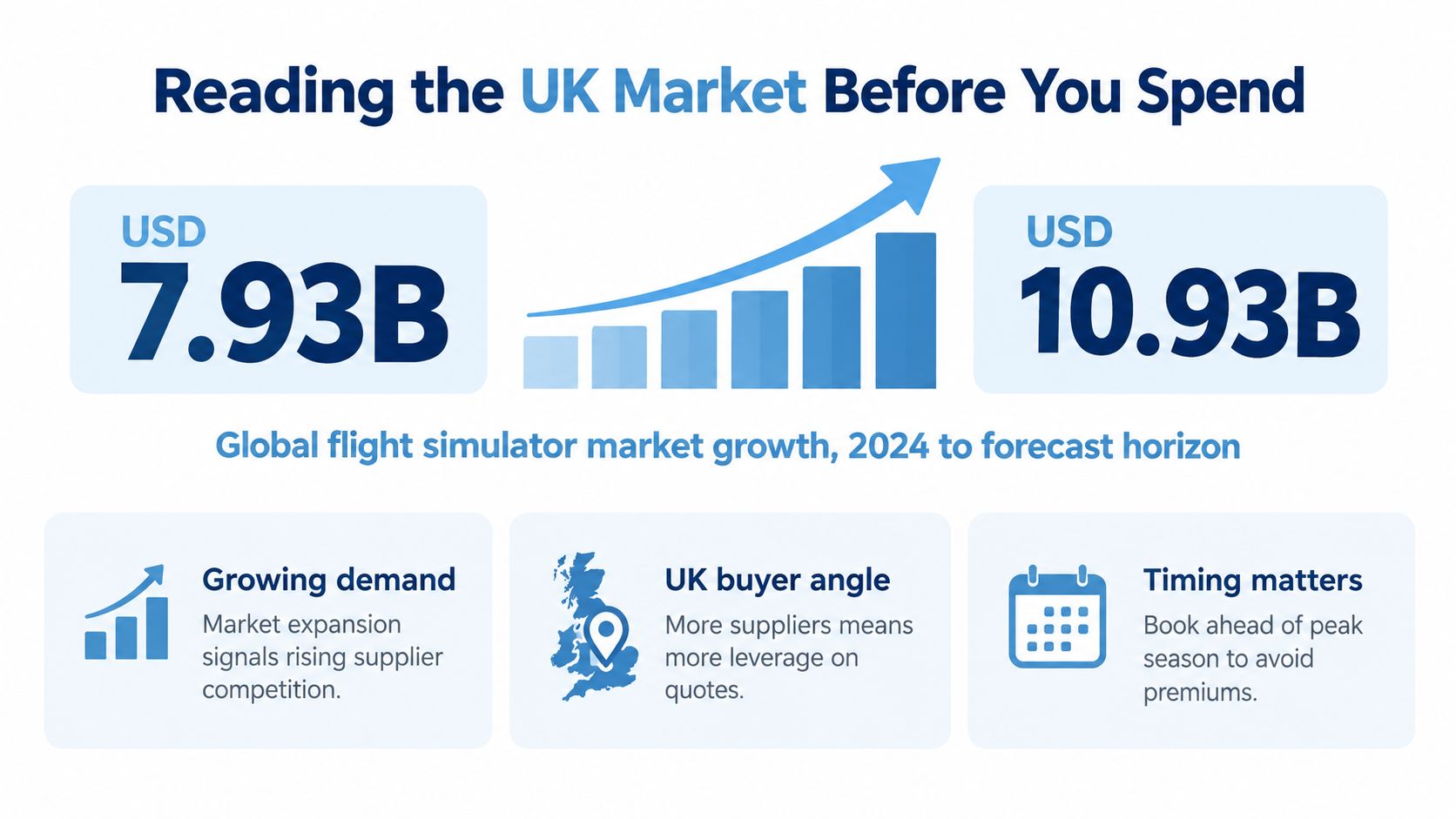
Market growth matters only when it changes a purchasing decision. The UK projection places the flight simulator market at $371.6 million in 2026, rising to $522.4 million by 2031, with a projected 7.0% CAGR, according to the UK flight simulator market forecast. That signals a layered market with continuing demand across consumer, training and commercial applications.
What this means for a UK planner
Growing demand doesn't mean every supplier will charge the same. It means popular motion rigs, experienced operators and qualified engineers can become difficult to schedule during busy periods. The practical constraint is often people and equipment availability, not the simulation software.
That's why hire remains sensible for a one-off activation or a recurring campaign that doesn't justify ownership. The supplier absorbs the capital cost, engineering knowledge and operational risk. You buy access to a functioning attraction, rather than becoming responsible for the entire technical stack.
A purchase needs sustained utilisation. If the simulator sits unused between occasional events, depreciation, storage and maintenance undermine the apparent saving. A venue or training organisation with reliable demand can make a different calculation, especially when it controls its own schedule and customer pipeline.
Procurement actions that protect the budget
- Enquire early: For high-demand dates, start discussions 8 to 12 weeks ahead so you can compare availability rather than accept the only remaining option.
- Ask about peak pricing: Require suppliers to identify any peak-season surcharge before approval.
- Challenge unusually low quotes: Treat any quote under £1,500 for a motion rig as a red flag until you confirm whether transport, crew, insurance, setup and VAT are excluded.
- Specify the operating model: State whether you need self-fly access, an operator or instructor-led sessions.
The best quote isn't the lowest headline figure. It's the one that survives a line-by-line comparison and still delivers the guest experience your brief requires.
Three Realistic UK Budget Scenarios
A board-ready budget starts with the guest journey, not the simulator specification. Decide how many people need to participate, how long each interaction lasts and what the venue supplies. Then build the quote around throughput, staffing and access.
Scenario A, a compact trade-show stand
A small corporate stand with one motion rig, two operators and a single event day needs a controlled package. A defensible working budget is £4,500 to £6,500 including VAT, transport and venue power.
The spread usually comes from the rig specification, travel distance, setup window and whether the operators remain onsite for the full period. Ask the supplier to confirm whether the quoted day begins at guest opening or includes access, testing and breakdown.
Scenario B, a two-day consumer activation
A two-day event with two rigs, branded interface elements, queuing control and merchandise needs more than two equipment rates. The working budget is £9,000 to £14,000, with a £1,200 contingency reserved for approved changes or onsite requirements.
Here, throughput and crowd management often matter more than maximum realism. Two well-operated systems can serve the brief better than one premium rig surrounded by a queue. The brand team should also approve artwork and user-flow requirements before the supplier finalises the technical plan.
Scenario C, a premium product launch
A premium launch using a full-motion Boeing 737-style rig, AV integration, hostesses, insurance and overnight crew accommodation can require £18,000 to £28,000. This is a production, not just a hire.
The supplier needs a detailed schedule covering delivery, build, testing, guest operation, content integration and removal. Overnight accommodation and crew travel can move the total even when the simulator day rate stays unchanged.
UK Flight Simulator Hire, Three Budget Scenarios
| Line Item | Scenario A: Trade Show | Scenario B: Brand Activation | Scenario C: Premium Launch |
|---|---|---|---|
| Simulator and equipment | Included within total | Included within total | Included within total |
| Crew and operators | Two operators | Operators for two rigs | Hostesses, operators and technical crew |
| Transport and setup | Included within total | Included within total | Includes extended production logistics |
| Branding and AV | Limited stand presentation | Branded UI and queuing system | Full AV integration |
| Insurance and venue requirements | Allowance included | Allowance included | Expanded production allowance |
| VAT and contingency | Included in stated range | Includes £1,200 contingency | Allowance included |
| Defendable working total | £4,500 to £6,500 | £9,000 to £14,000 | £18,000 to £28,000 |
These are planning scenarios, not supplier quotes. Use them to expose missing line items, then require each vendor to price the same scope. A cheap equipment rate can become the expensive option once staffing, delivery, VAT and venue obligations appear.
Common Mistakes and Smart Ways to Control Cost
The most avoidable overspend happens before the supplier sends the final invoice. Planners request “a flight simulator” without defining the rig class, guest flow or operating hours, then compare incomplete quotes as if they were like for like.
Errors that inflate the quote
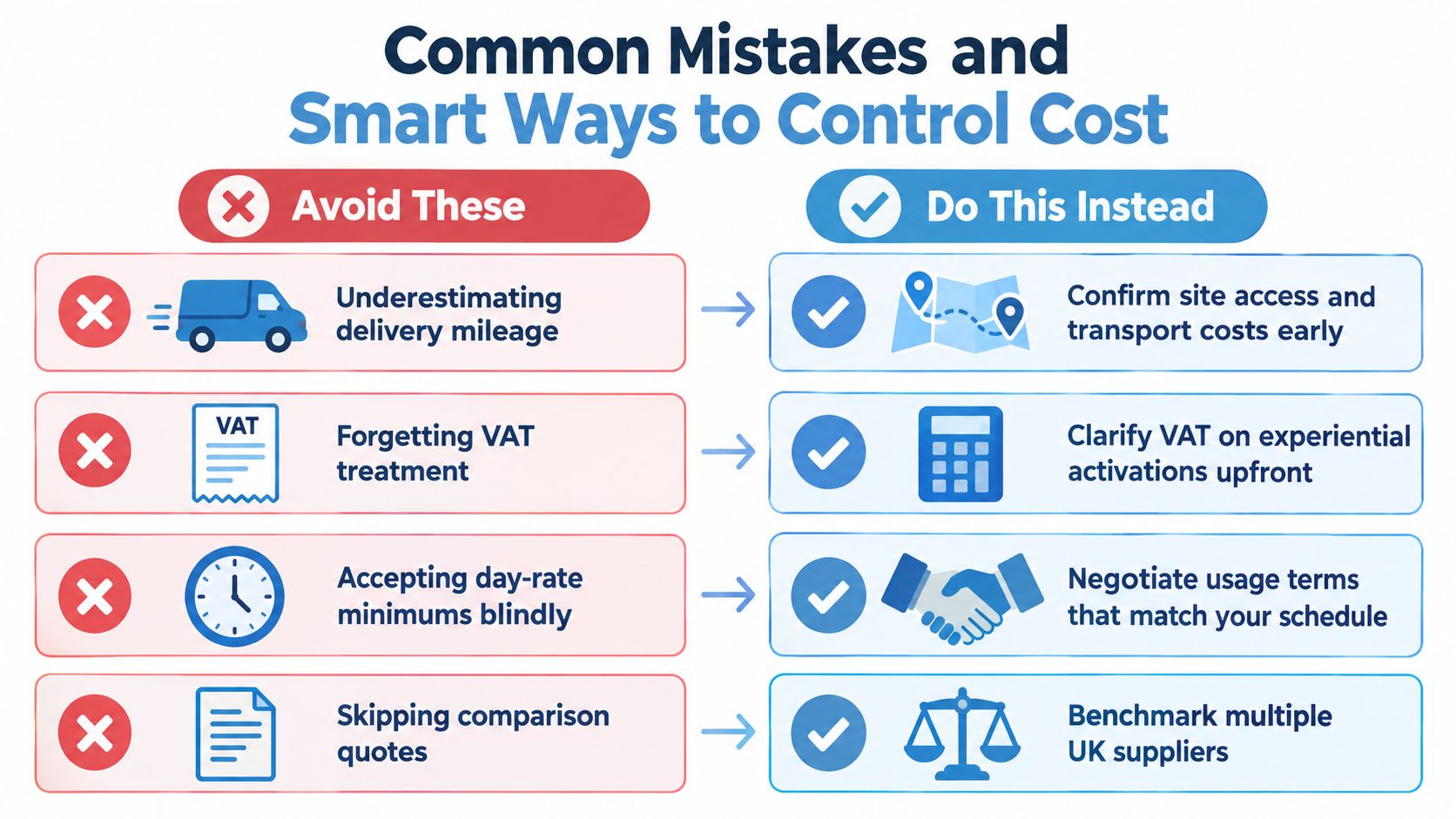
Delivery mileage gets missed when the venue is confirmed late. Provide the exact address, loading route, access times, parking restrictions and lift information at enquiry stage.
VAT treatment creates confusion around experiential activations. Ask whether every line is VAT-inclusive or ex VAT, and identify which costs the venue or agency will recharge.
Day-rate minimums can make a short guest schedule expensive. Challenge the minimum and ask whether the supplier can offer a package based on access, setup and actual operating time.
Duplicate staffing is another common leak. The venue may provide a marshal while the supplier includes one, or the agency may book hosts separately without clarifying responsibilities. Put the staffing plan in writing.
Don't assume the newest aircraft model or the most dramatic motion platform creates the best value. For short guest sessions, fast resets, clear branding and a confident operator can matter more than maximum technical fidelity.
Take this checklist into the supplier meeting:
- Rig class: fixed-base, motion or full-flight?
- Guest throughput: how many flight hours and resets are included?
- Staffing ratio: who operates, instructs, marshals and troubleshoots?
- Venue access: what are the delivery, power and floor requirements?
- Insurance excess: who pays if equipment or venue property is damaged?
- Payment milestones: when are the deposit, balance and approved extras due?
- Cancellation terms: can a cancelled booking be reallocated to another date?
PSW Events provides flight simulator hire with planning, branding, logistics, installation, onsite staffing and health and safety support, with package pricing confirmed against the event requirements. Visit PSW Events with your venue, dates and activation brief, and ask for an itemised UK quote that separates simulator capability from the commercial extras.