
You're booking an attraction for an exhibition, the floor plan is nearly signed off, and someone asks how many leads it will generate. Meanwhile, the venue needs power requirements, your registration form still hasn't been tested, and nobody owns the queue. Those aren't separate problems. They're all part of the experience your attendees will judge.
What Event Management Experience Really Means
Say a visitor walks onto an exhibition floor, spots the right zone, queues for two minutes and plays a short game. They pick up a useful product fact and leave remembering the brand. In this hypothetical journey, someone has designed every transition, including what happens while the visitor waits.
Event management experience is the planned sum of what an attendee sees, does, feels and remembers from arrival to departure, delivered by the organiser rather than left to chance.
Think of a theatre. The performance matters, but so do the box office, ushers, lighting, signage and intervals. A brilliant show doesn't cancel out an inaccessible booking system or an unexplained delay outside the auditorium.
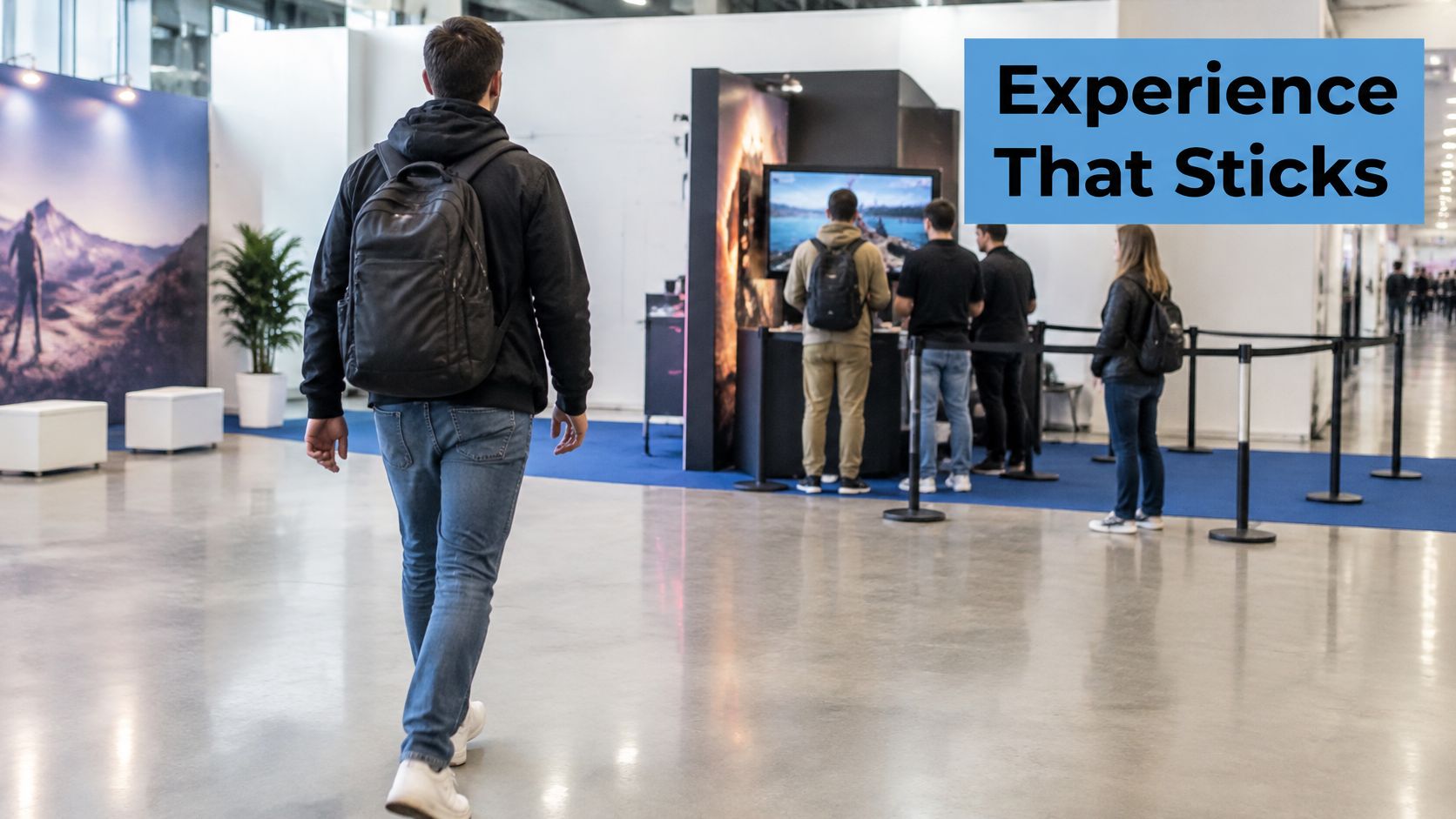
Running the event versus designing the experience
Running an event means getting the equipment installed, doors open and programme delivered. Managing its experience means deciding why a visitor should enter, what makes participation comfortable and what they should take away. You need both, but a completed production schedule doesn't prove that the audience received anything worthwhile.
The scale makes these decisions commercially important. VisitBritain's business-events analysis records 6.8 million inbound business visits to the UK in 2024, with meetings, incentives, conferences and exhibitions accounting for 38%, approximately 2.6 million trips and £2.8 billion in spending, while incentive and team-building activities accounted for 194,000 visits and £213 million in spending.
Those are inbound visits, not a count of every domestic event attendee. They nevertheless show why organisers need to treat content, suppliers, audience movement and hospitality as connected responsibilities.
Start with the attendee's reason for being there. A procurement manager might want a useful comparison; a staff team might want shared achievement without forced performance. Neither objective is satisfied merely because the equipment worked.
Apply a blunt test before approving an idea: if the attraction and staffing were removed, would the attendee still have a reason to engage? If the answer is no, clarify the underlying value before adding spectacle.
The Seven Components That Shape Every Experience
Experience design sets the intent. Audience insight, journey mapping, content, venue arrangements, staff training and measurement translate it into delivery. The practical checks below turn that hierarchy into responsibilities someone can sign off.
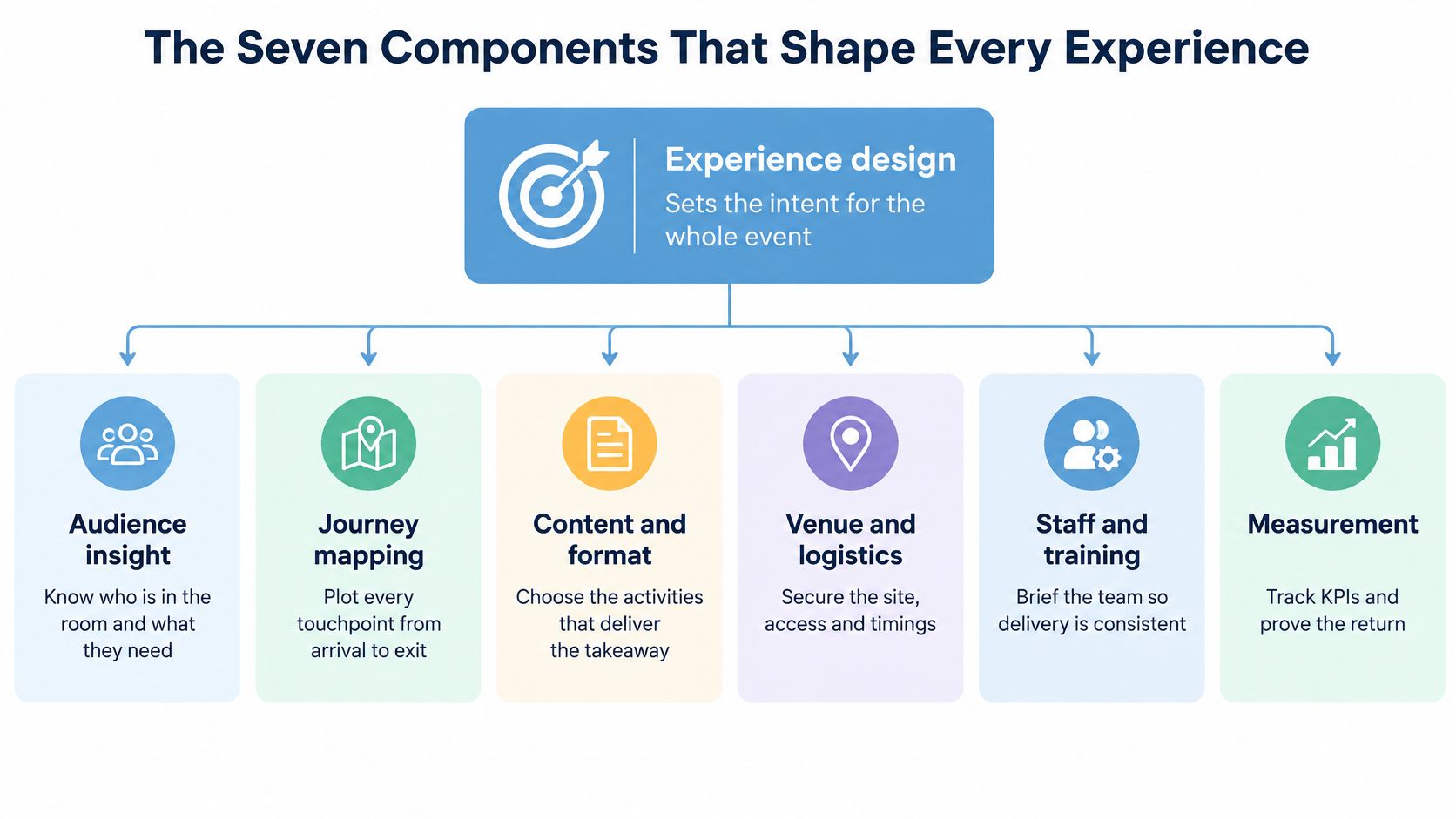
Seven components of event management experience
| Component | Core question | What to verify before launch |
|---|---|---|
| Experience design | What should the attendee feel, do and remember? | One stated takeaway and a mapped journey from arrival to exit |
| Attractions | Will people engage without constant supervision? | Test run with real users, clear rules, queue plan |
| Logistics | Can the set-up be delivered and powered on time? | Site plan, power requirements, delivery and set-up window |
| Staffing | Who runs the attraction, and how well do they know it? | Rota, training on each piece of equipment, briefing sheet |
| Safety | Are risks identified and controlled for set-up, live running and breakdown? | Written risk assessment, steward positions, exclusion zones |
| Branding | Is the brand visible from the queue and the play area? | Sightlines, signage, on-screen and staff messaging |
| Data capture | What is recorded, and does the attendee understand and agree? | Consent wording, data retention rule, match to KPIs |
An attraction should be understandable without staff repeatedly explaining its basic premise. That doesn't mean leaving equipment unsupervised: operators still need to manage safe use and adaptations. Put rules and a visible leaderboard where waiting visitors can see them, and give spectators something useful to watch.
Branding also needs to work outside the screen. Check the view from the queue, the approach aisle and the exit. Our approach to immersive experience design starts with how those touchpoints support the intended takeaway.
Accessibility must be dependable
The Attitude is Everything State of Access report found that 61% of disabled respondents described live events as somewhat or very accessible, yet nearly 80% said accessibility provisions weren't something they could actively rely on, and 56.1% identified booking or ticketing systems as a barrier.
A ramp doesn't answer whether someone can complete the booking form, tolerate the briefing environment or participate from a seated position. Test the full journey with disabled users before launch. Publish practical access information, including sensory conditions, available adaptations and a named contact.
Offer quieter participation and alternative competition formats without making attendees explain personal circumstances in front of a queue. Train staff to offer choices discreetly rather than decide what someone can do.
Data capture is an attendee interaction
A compulsory marketing form can spoil an otherwise welcoming activity. Separate participation from optional follow-up, explain what each field is for and provide an accessible alternative to a touchscreen.
Collect only what the next action needs. If the sales team can't explain how it will use a field, remove it rather than make attendees work harder.
Building Safety and Crowd Control Into the Plan
In the UK, organisers hold health and safety responsibilities across set-up, live operation and breakdown, with HSE's event-management guidance requiring arrangements to control risks, coordinate work, inform staff and contractors, establish competence, monitor compliance and review controls.
That duty doesn't disappear when a supplier brings its own paperwork. Integrate contractors' assessments into a phased programme so delivery crews, operators and venue staff understand the same sequence of work. Our event health and safety planning belongs in that production process, not in an isolated folder.
Assess the attraction and its surroundings
The HSE crowd-safety guide hosted by Dorset Council sets out the following risk-assessment sequence and explains that capacity must account for entry time, exit time and emergency evacuation time.
- Identify hazards. Walk the proposed queue and attraction footprint, looking for trailing cables, moving equipment, pinch points and obstructed exits.
- Decide who may be harmed and how. Include installers, operators, spectators, children and attendees who need more space or assistance.
- Evaluate risks and additional precautions. Decide whether barriers, revised positioning, different operating rules or additional supervision are needed.
- Record findings. Mark controls on the site plan and put responsibilities into the operating briefing.
- Prioritise remaining hazards. Resolve significant outstanding issues before opening, rather than accepting them because installation is complete.
A venue's headline occupancy figure isn't an attraction's operating capacity. Leave room for people to approach, wait, watch and leave without competing for the same passage.
Control the queue while the event is live
HSE's crowd-control guidance says attractions must not block pedestrian routes, organisers should anticipate surges around exciting activity, and staff need suitable instruction, supervision and communication.
Place stewards where they can see queue growth, not behind a screen. Mark exclusion areas clearly and agree who can pause play when spectators spill into circulation space. Give volunteers the same relevant safety information as paid staff.
Practical rule: Record how often each check happens, who owns it and how they confirm the control is working.
A tick beside “queue checked” is weak evidence. A named steward confirming that the marked exit route remains unobstructed is an operational check someone can act on.
Measuring Experience Through KPIs and ROI
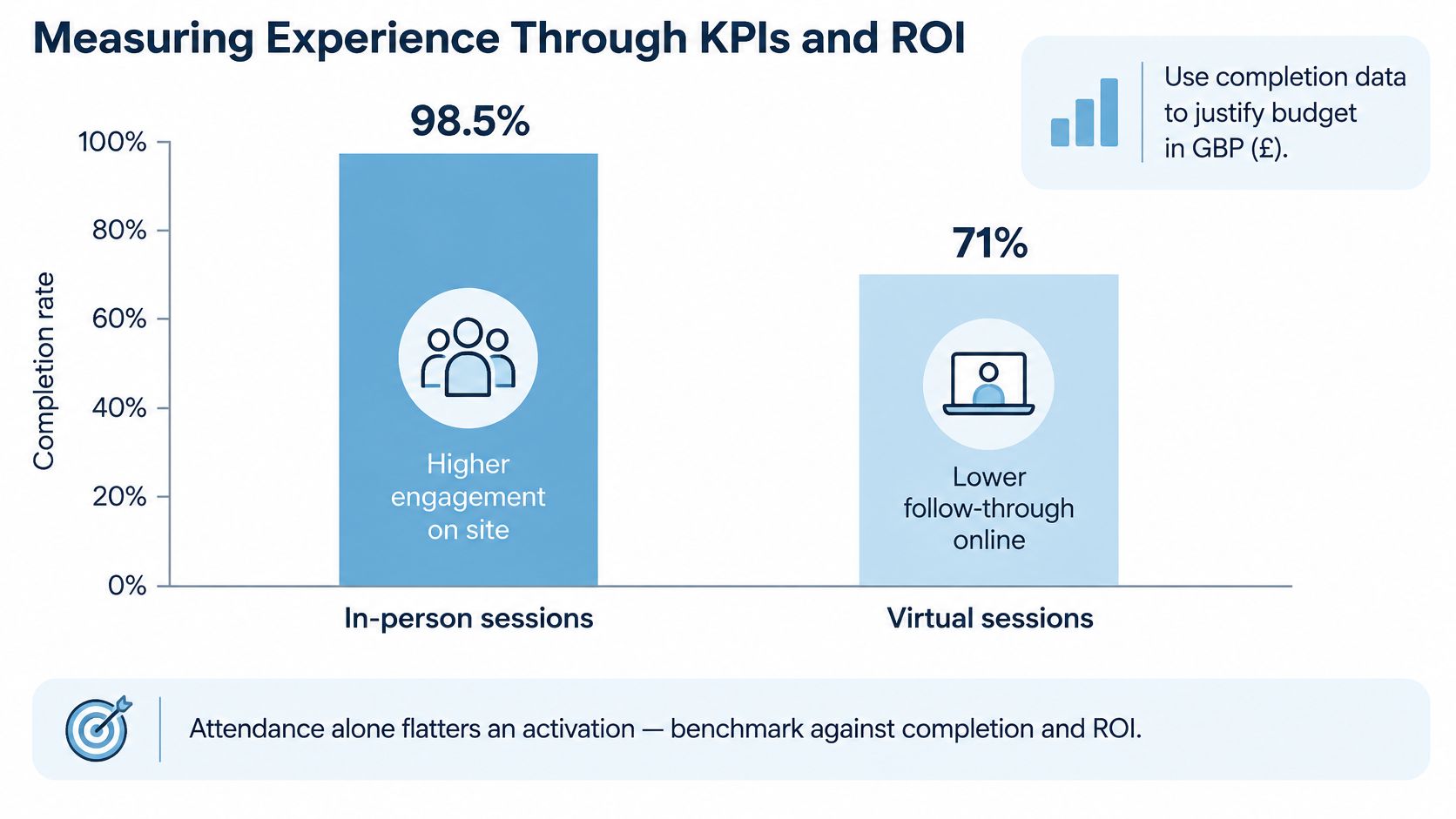
Attendance alone flatters an activation. People may cross a branded zone without noticing the message, while a smaller group may complete an activity and request a relevant conversation.
Format matters too: Live Group's audience report reports approximately 98.5% completion for in-person sessions versus about 71% for virtual sessions. Those benchmarks aren't targets for an exhibition game, and they don't establish that physical attendance alone causes stronger engagement.
Separate attention, involvement and intent
Define footfall as entry into a clearly marked zone. Define qualified engagement separately, using relevant audience criteria and a meaningful completed action. Conversion then measures the agreed next step, not every badge scanned.
Core KPIs for experience and ROI measurement
| KPI | How to calculate | Decision it informs |
|---|---|---|
| Footfall | Unique visitors entering the zone per hour | Placement and opening hours |
| Participation ratio | Minutes of active participation divided by programmed minutes | Whether the attraction creates involvement |
| Completion rate | Completed sessions divided by started sessions | Friction in rules, queue or game length |
| Average dwell time | Total time in zone divided by unique visitors | Engagement depth and staffing needs |
| Lead-capture rate | Opted-in participants divided by completed participants | Quality of the conversion moment |
| Repeat participation | Visitors playing more than once divided by unique players | Appeal and competitive hooks |
| Cost per qualified interaction | Total activation cost divided by qualified interactions | Value for money against alternatives |
| Event ROI | (Attributable value minus cost) divided by cost | Whether to rebook or redesign |
For participation ratio, define the observation window and whether you're measuring a session or an individual. Don't combine simultaneous players' minutes with a single programme-time denominator and present the result as a comparable engagement percentage.
If technical reporting informs your dashboard, Purple Access's explanation of sampling choices for traffic reports is useful context for questioning collection methods. Network traffic isn't a substitute for a count of unique, engaged attendees.
A hypothetical measurement funnel
Suppose 1,200 visitors pass a branded zone, 400 play, approximately 33% of footfall, and 280 complete, or 70% of players. If 210 completers opt in, the completer lead-capture rate is 75%.
Compare that illustrative result with a 6% opt-in rate among watch-only visitors, using a separately recorded watch-only denominator. Don't assume everyone who passed the zone watched, and don't interpret the difference as proof that playing caused an opt-in: participants may already have been more interested.
Agree the definition of a qualified interaction before opening. Otherwise, the team can make almost any result look successful afterwards.
For experiential marketing ROI, use (attributable value minus cost) divided by cost. Agree the attribution window and lead-value rule beforehand, and distinguish modelled pipeline value from realised revenue.
Timestamp records, separate unique visitors from repeat plays, and report by session or audience segment. Pair consent-based follow-up with a short product-understanding question so a busy leaderboard doesn't become your only evidence.
Vendor Selection Criteria That Separate Partners From Suppliers
Start with scope, not the equipment photograph. We offer service levels from dry hire, where no operator is required, through to full event management; the right choice depends on who can competently own delivery.
Our full event management service includes online planning meetings, site visits to help create site plans, power and utility requirements, on-day management and staffing. Put those responsibilities beside the quote so you're comparing equivalent work rather than equipment prices alone.
Vendor selection criteria for event experience delivery
| Criterion | What to ask | Red flag |
|---|---|---|
| Scope of service | Is this dry hire or full event management? | Scope unclear or only equipment listed |
| Site planning | Who visits the site and produces the site plan? | No site visit or plan offered |
| Power and utilities | How are power and utility needs confirmed in writing? | Left to the client without a check |
| Staff competence | How is each operator trained on the equipment? | Training described as ad hoc |
| Insurance and H&S | Which insurances and risk assessments are in place? | No written risk assessment |
| Data and consent | How is data stored, shared and deleted? | Data shared with third parties without notice |
| Accessibility | How are booking, queues and staffing made accessible? | Accessibility limited to a generic statement |
| Late bookings | Can you cover an event booked the day before? | Hard refusal without alternatives |
Read the limitations, not just the promises
Dry hire can be sensible when your team has the competence and time to operate the equipment. It's false economy when your marketing staff spend the event troubleshooting instead of speaking to attendees. Our staff receive full training from our management on every piece of equipment we house.
A refusal of a late booking isn't itself unsafe or unprofessional. Treat an unexplained refusal without alternatives as a service limitation, while respecting a provider that identifies a genuine staffing, transport or safety constraint.
For international comparisons, One Dynamics' guide to choosing a team building provider Singapore offers another procurement context. Keep UK venue requirements and responsibilities central to a UK booking.
Put accountability in writing
Clarify contractor involvement before committing. We never offer a customer's event to a third party, and we tell the customer if we bring someone in to work alongside us.
Request references from comparable event formats, relevant insurance documentation and a written responsibility schedule. Name the planning, logistics and on-day contacts, including who can authorise changes. A confident sales conversation isn't a substitute for those answers.
Case Examples and a Worked ROI Calculation
These are hypothetical scenarios, not reported results. They illustrate how to turn an appealing activity into an operational and commercial plan.
Trade-show simulator
A branded driving simulator occupies a 3-metre stand over two days, with 2,000 expected zone visitors. The proposed targets are 30% participation and 70% completion, giving 600 players and 420 completers.
The plan keeps circulation clear, displays rules and a leaderboard to the queue, and gives a steward a two-minute waiting cap. Once that cap is reached, the steward pauses admissions rather than letting the queue expand; follow-up opt-ins are measured among completers.
Corporate team challenge
An incentive activity involves 80 staff in a timed team game. It includes a seated play station, a quieter first session and an access statement issued beforehand.
Record completion and staff feedback by session. That comparison can identify whether the format worked for different participants without treating attendance as evidence of inclusion.
Worked ROI
Suppose a £6,000 activation produces 210 opt-in leads, all meeting a qualification rule agreed beforehand. At an illustrative £40 per qualified lead, attributable value is £8,400.
ROI = (£8,400 minus £6,000) divided by £6,000 = 40%.
With 90 qualified leads, the same rule gives £3,600 in value and negative 40% ROI. This is modelled lead-value ROI, not realised profit, which is why qualification and valuation must remain fixed.
A Practical Event Experience Checklist
Use this as a working schedule, not a promise that every event needs the same lead time. Assign a named person to each role, and don't close an item until its evidence is available to the people delivering it.
Twelve weeks or more before the event
- Set the outcome: Write the objective, intended audience and single takeaway in language the delivery team can use. [Owner: Marketing lead]
- Approve the economics: Confirm the budget, KPI definitions and attributable-value rule before supplier selection. [Owner: Budget holder]
- Review access: Test the booking flow and proposed activity with disabled users, then record changes and unresolved questions. [Owner: Accessibility lead]
- Check dependencies: Identify venue approvals, purchasing deadlines and any activities that depend on another supplier's work. [Owner: Event producer]
Four to six weeks before the event
- Complete the technical pack: Sign off the site plan, power requirements, delivery route and equipment list. [Owner: Production manager]
- Approve operating controls: Complete the risk assessment and confirm emergency arrangements with the venue. [Owner: Safety lead]
- Allocate people: Finalise the staffing rota, relief cover and operator briefings. [Owner: Staffing manager]
- Approve capture wording: Confirm consent language, access permissions and deletion responsibilities. [Owner: Data lead]
For office celebrations involving separate hospitality suppliers, BeeHive Mobile Bar's explanation of a bartender-only service for office celebrations is useful when checking service boundaries. Make responsibility for stock, equipment and clearance explicit rather than assuming one contractor covers everything.
One week before the event
- Reconcile changes: Confirm timings, delivery windows, venue restrictions and on-site contacts against the latest documents. [Owner: Logistics lead]
- Issue one current pack: Withdraw outdated plans and distribute the approved version to everyone who needs it. [Owner: Event producer]
- Confirm contingencies: Agree what happens if equipment, connectivity or an expected operator becomes unavailable. [Owner: Production manager]
On the day
- Test before opening: We arrive with enough time for equipment to be set up and tested at least half an hour before the event starts. [Owner: Installation lead]
- Brief the team: Rehearse operating rules, adaptations, stop procedures and escalation contacts. [Owner: Event manager]
- Inspect movement: Position stewards and verify queue routes and exclusion zones. [Owner: Crowd-management lead]
- Test capture: Submit a test record and confirm that consent and timestamps are recorded correctly. [Owner: Data lead]
Afterwards
- Reconcile records: Remove duplicates and distinguish repeat activity from unique participation. [Owner: Analyst]
- Gather feedback: Send a short survey where consent permits and include access questions. [Owner: Audience lead]
- Close the evaluation: Calculate agreed KPIs and ROI, then assign changes for the next event. [Owner: Marketing lead]
Turn the Checklist Into a Provider Brief
Write a one-page brief before approaching providers. Clear constraints help them propose something deliverable rather than guess what you mean by an engaging event.
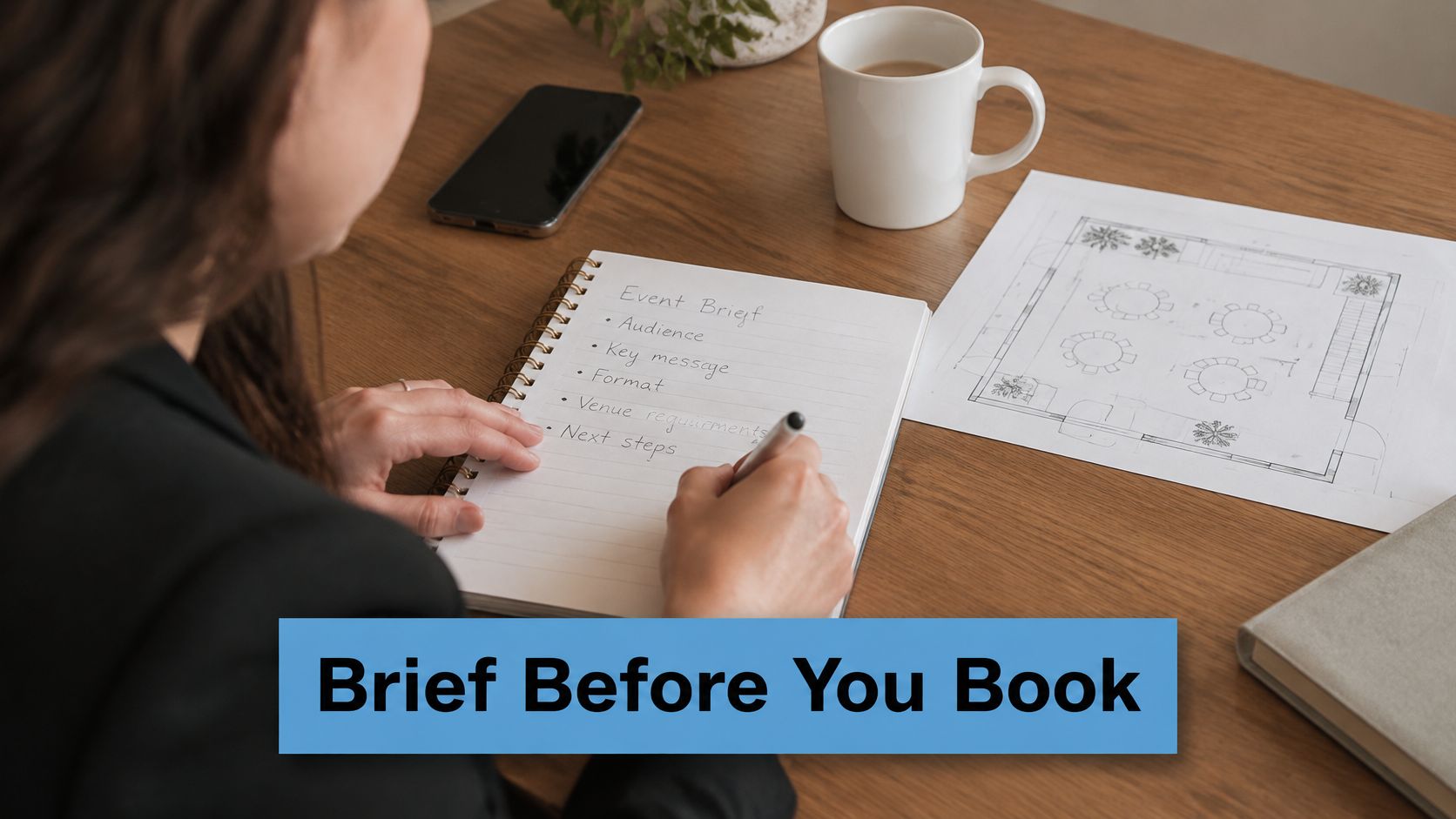
Include these fields:
- Purpose: Objective and single attendee takeaway.
- Audience: Who's attending, expected numbers and participation needs.
- Location: Venue, site contact and access route.
- Timings: Event dates, opening hours, set-up and breakdown windows.
- Constraints: Available power, usable space and delivery limits.
- Evaluation: Reportable KPIs and the agreed attributable-value rule.
- Access information: What attendees will receive before the day.
Send it to two or three providers and score their written responses against the same criteria. Don't select the cheapest response until you understand what it leaves with your team.
After equipment or a package is chosen, we collect final location, timing and site-contact details through an online booking information request or by phone. In most cases, our Logistics team contacts the customer the week before for a final run-through and changes.
We can almost always cater for an event even when contacted the day before, with late enquiries discussed case by case rather than refused by default. Draft your brief this week, shortlist three providers and hold the decision until each confirms its scope in writing.
PSW Events offers corporate entertainment and event management across the UK, with planning, logistics, installation and staffing to support the attendee journey. Visit PSW Events with your brief to discuss an attraction and delivery scope that match your audience, access needs and measurement plan.