
The corporate box is booked, the invitations are out, and guests are already asking which entrance to use. Meanwhile, a client's train has changed, the catering team needs dietary confirmations, and your sales director wants to know who's hosting the most important account. The sporting action hasn't started, but much of the hospitality experience has already been decided.
What Sports Event Hospitality Actually Delivers
Sports event hospitality is the complete guest journey, not just a premium seat. It brings together ticketing, hosted interaction, catering, branding, activation and guest handling. A good seat can't compensate for unclear arrival instructions, an absent host or a programme that leaves guests waiting instead of enjoying themselves.
Start by separating the outcomes you want. They're related, but they aren't interchangeable.
- Commercial return means creating the right conversations and giving account teams a credible opportunity to develop relationships.
- Guest experience means making participation comfortable, accessible and well organised, from accepting the invitation to getting home.
- Brand impact means ensuring guests understand who hosted them and why the experience was relevant, without turning the occasion into a sales presentation.
Buy against a purpose
The wider economic case is substantial. UK Sport's Value of Events 2023 reporting states that £10.8 million of UK Sport and government investment supported 16 major sporting events, generating £373 million in direct UK economic impact, with a reported 6:1 direct return on investment. That reported return shouldn't be read as the simple ratio between those headline figures, or as a forecast for an individual corporate programme.
For planners, the useful distinction is between an event's economic impact and the return your organisation can demonstrate. Your guests might have an excellent afternoon without producing a qualified business conversation. Equally, a commercially useful meeting doesn't excuse poor service.
Operational infrastructure belongs in this decision too. When digital ticketing, guest communications or connected activations are involved, Purple Access's resource on stadium network infrastructure provides a relevant starting point for discussions with the venue's technical team.
Producer's rule: Choose the guest journey and commercial purpose before choosing the hospitality inventory.
For audience-facing programmes, sports fan engagement offers a different planning lens from private client entertainment. Economic value, safe capacity, package format, congested dates, sustainability, measurement and permissions all need to support that purpose. Treating hospitality as a production plan rather than a ticket purchase protects both your budget and your reputation.
The Economic Logic Behind UK Hospitality Demand
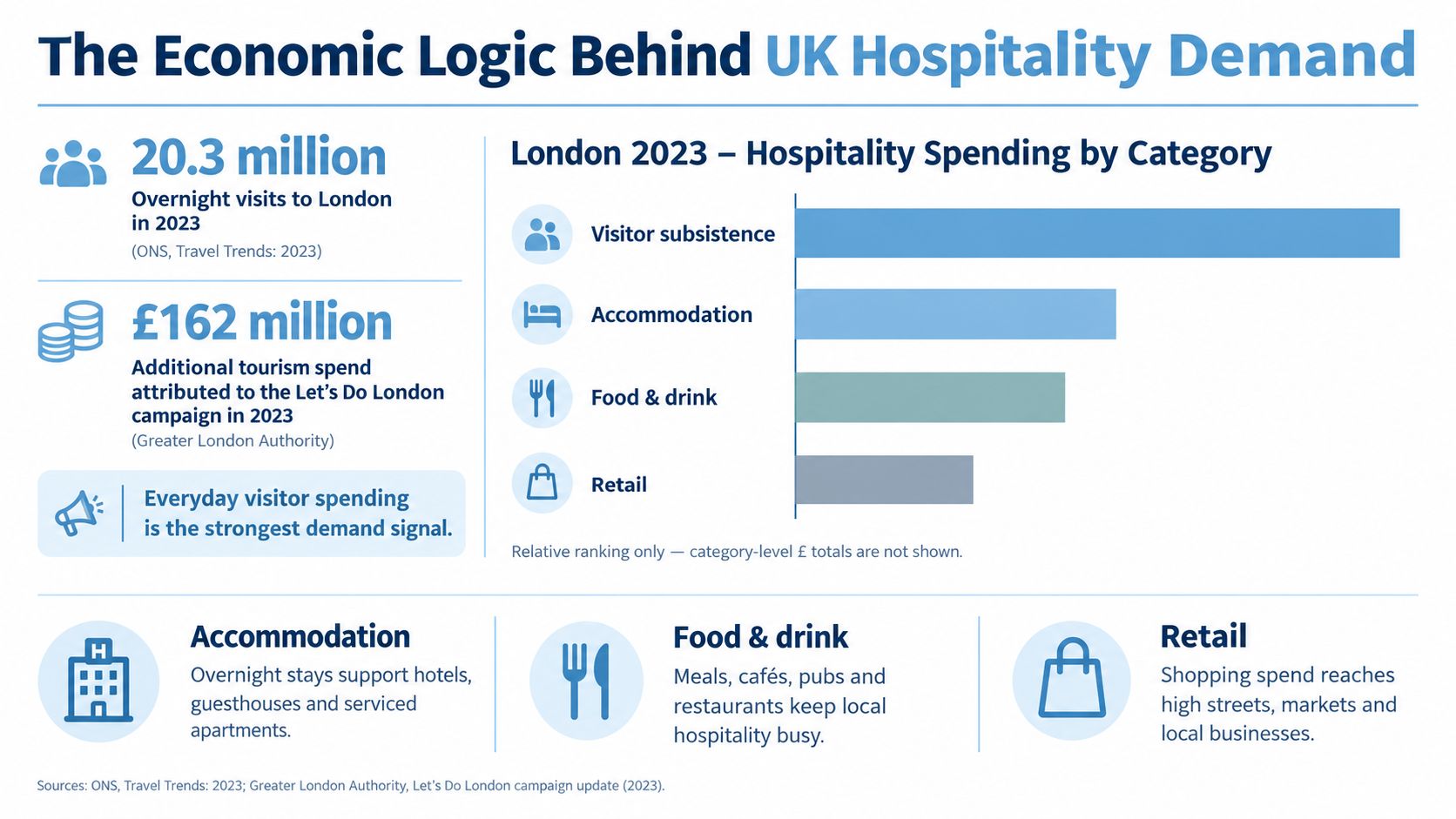
Headcount alone isn't the economic case for hospitality. Where guests stay, eat and spend time matters alongside how many enter the venue.
A UK Sport assessment published in 2007 examined six sporting events that generated £7.1 million in additional expenditure against £2.2 million in combined event funding. Accommodation plus food and drink was the largest spending category across spectators, delegations, officials and media; the events also generated more than 29,000 commercial bed nights, while spectators spent an average of £38 per day.
The spectator figure needs context. The assessment associated their lower daily spending with fewer spectators staying in commercial accommodation. It's a historical benchmark, not a current catering allowance or a figure to insert into a contemporary guest budget.
Separate visitor value from company value
The London-focused assessment accompanying the Value of Events reporting recorded 358,973 spectators at six major sports events in 2023, representation from all 32 London boroughs, and £160 million in total direct economic impact. Those city-wide totals don't establish a London spending breakdown by category; the subsistence finding belongs to the earlier UK Sport assessment.
For package design, distinguish the audience groups rather than treating everyone as a ticket holder. Spectators may need a convenient day visit. Delegations can require coordinated accommodation and hosting, while officials and media need arrangements compatible with their working responsibilities.
| Visitor group | Planning question |
|---|---|
| Spectators | Does an overnight option make attendance easier? |
| Delegations | Can accommodation, dining and transfers work as a coordinated itinerary? |
| Officials | Are hospitality timings compatible with operational duties? |
| Media | Can guests access food and accommodation without disrupting work? |
The practical recommendation is to make useful surrounding services bookable, not to add compulsory extras. Offer a suitable hotel option, a clear dining plan and travel guidance where they improve participation.
A finance director needs a sharper distinction: visitor spending benefits the host economy, whereas your organisation's return depends on what its hospitality achieves. Longer stays are worthwhile when they support guest comfort or useful interaction, not merely because they increase expenditure.
Planning Capacity, Flow and Safety on Match-Day
A hospitality space can look generous on a floor plan and become uncomfortable once furniture, service stations and attraction queues are installed. Gross floor area isn't usable guest capacity.
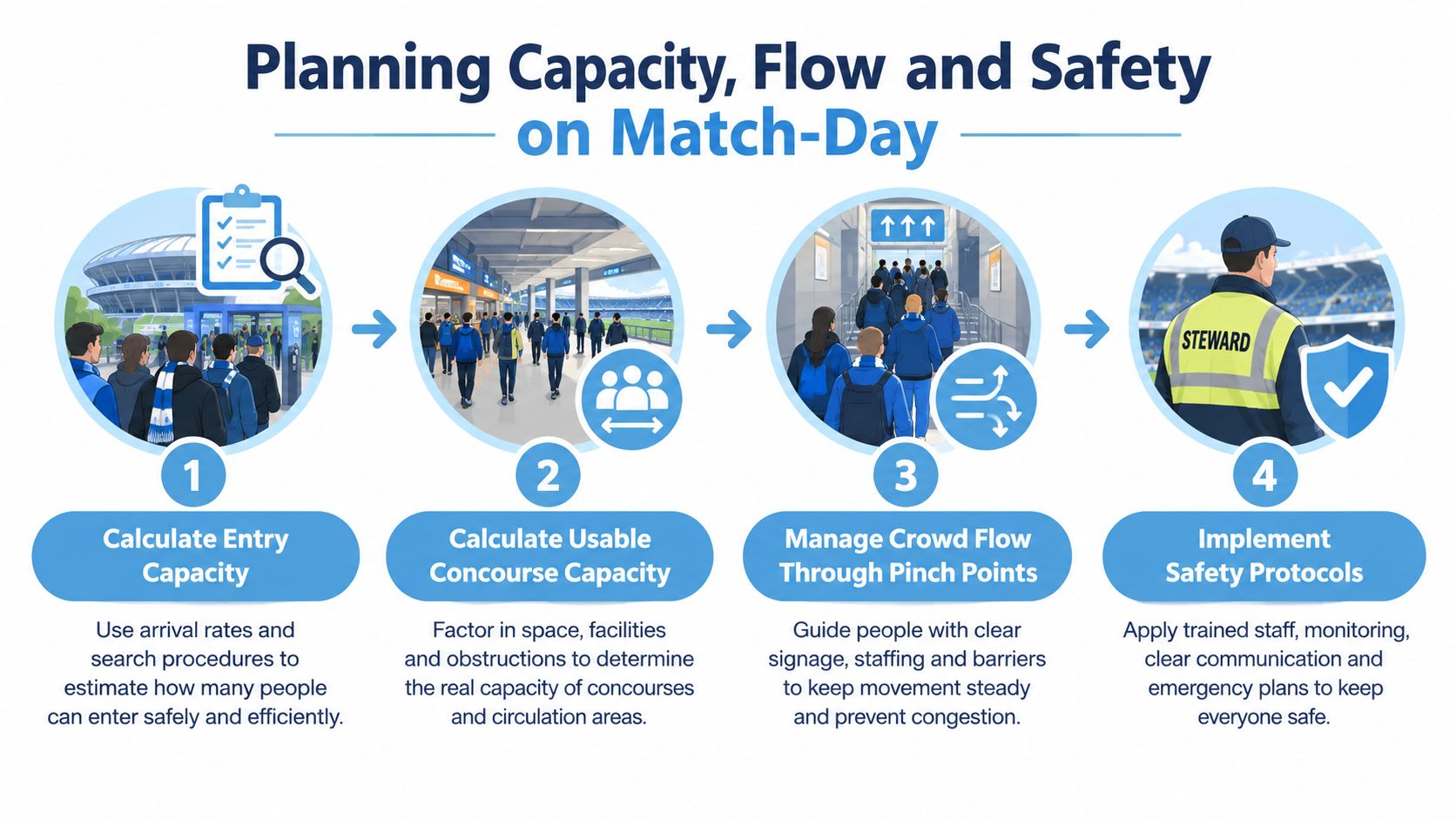
Agree the capacity calculation with the venue's competent safety team before selling places or committing to a layout. The controlling figure is the lowest relevant capacity, not the venue's headline attendance.
Establish the controlling capacity
- Calculate entry capacity. Assess arrival patterns, ticket checks, searches and available queue space. Include guests who arrive together after transport delays.
- Calculate usable hospitality capacity. Deduct structures, furniture, equipment, excluded zones and protected routes. A simulator's footprint includes its operating and waiting space, not just the machine.
- Adjust for the audience. Consider mobility requirements, guest behaviour and the density people can reasonably tolerate. A seated meal and a standing activation need different assessments.
- Calculate emergency evacuation capacity. Check exit provision and evacuation arrangements against the proposed occupancy. Don't assume an entrance can automatically perform the same role during an emergency.
Bradford Council's event-planning guidance includes indicative benchmarks of 2 people/m² for general planning, 3 people/m² in some fire-risk assessments, and up to 7 people/m² for open spaces under the Guide to Safety at Sports Grounds. These are not substitutes for a site-specific risk assessment, nor permission to pack a premium hospitality area to a published maximum.
Rehearse the movement, not just the layout
Map arrival, circulation and dispersal routes. Measure exits and pinch points, then position catering, check-in and attractions so their queues don't compete for the same pedestrian space.
Set queue triggers before doors open. A trigger might prompt staff to open another service point, pause participation or redirect arrivals when a queue reaches an agreed physical marker.
A queue that blocks an exit is an operational failure, even if the room remains below its agreed occupancy.
Brief stewards on escalation, radio language and who can stop an activity. Anticipate sudden movement during exciting sporting moments, and keep normal-operation staff connected with the emergency team.
For technical coordination, Amax Fire & Security Ltd's arena security solutions for venues can inform conversations about venue systems. For public-facing layouts, football fan-zone planning also needs clear separation between participation areas, spectators and through-routes.
Choosing a Hospitality Package That Works
Choose the format against the interaction you need. Senior client entertainment usually needs conversation and attentive hosting. An exhibition activation needs an approachable participation mechanic and a clear route from interest to follow-up.
Neither benefits from buying the most expensive format because it looks impressive.
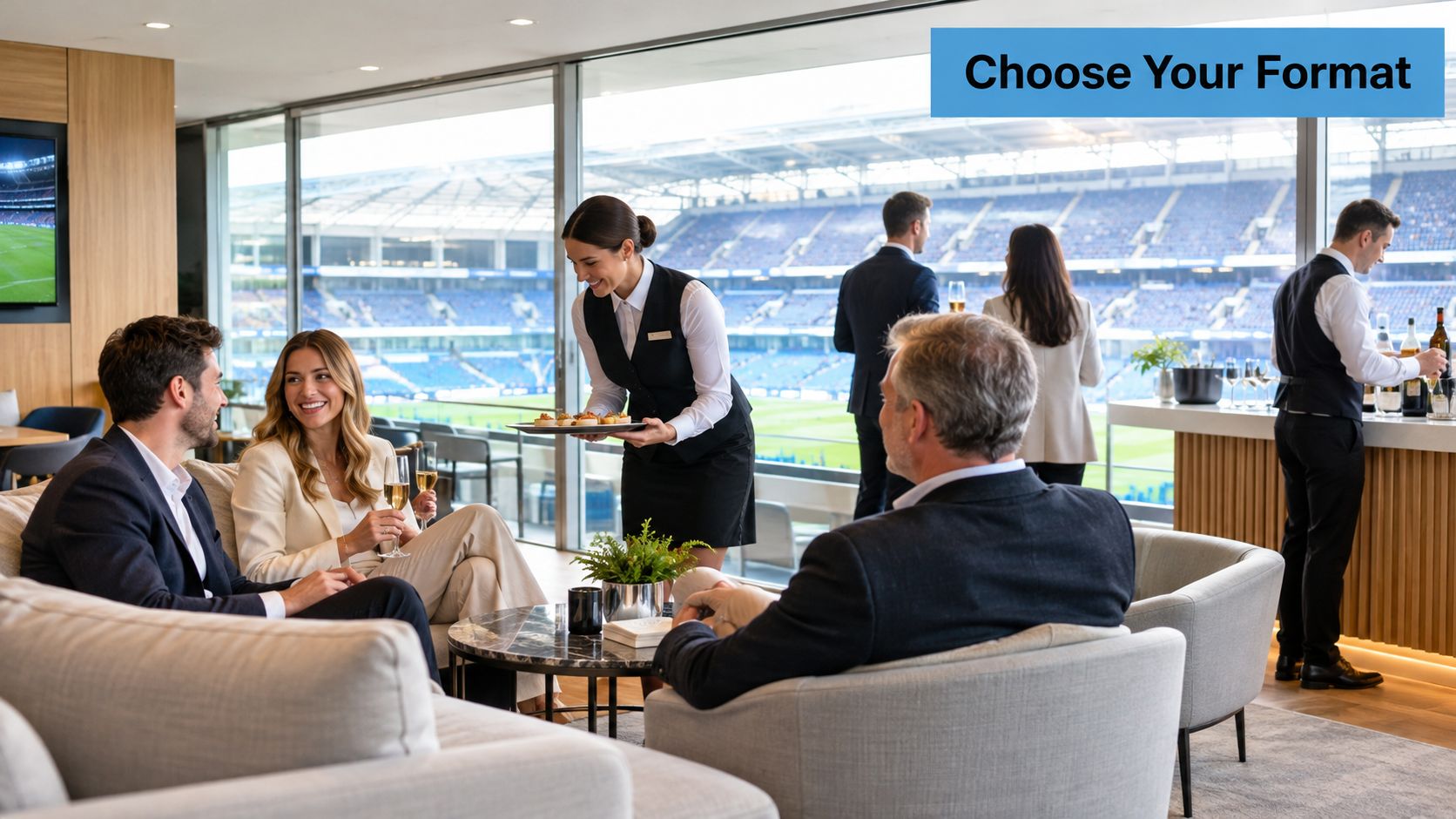
Match the setting to the conversation
| Format | Useful for | Trade-off to resolve |
|---|---|---|
| Shared corporate box | Hosted entertainment without exclusive space | Less control over neighbouring guests and atmosphere |
| Private suite | Confidential conversations and tailored hosting | Greater commitment to filling and staffing the space |
| Restaurant-style hospitality | A structured meal with a clear service rhythm | Table plans and service can restrict movement |
| Club-level seating | A premium sporting experience with a lighter programme | Fewer controlled opportunities for hosted interaction |
| Fan-zone or activation-led programme | Broad participation and brand engagement | Requires queue management and deliberate outcome capture |
A private suite can work well for an account-development programme, provided hosts know their guests and have a reason to bring them together. Restaurant hospitality suits groups that value a proper meal, but don't schedule the main conversation while staff are clearing plates or the sporting action demands attention.
Club-level seating is often the more restrained choice when guests principally want to watch the event. Adding an elaborate activation can undermine that purpose.
Give attractions an operational job
American football, rugby, golf and boxing simulators can provide a participation hook. F1 and multi-racing rigs, Batak Pro, giant Scalextric, VR experiences and electronic leaderboards offer different ways to structure friendly competition and create shareable moments.
Use them selectively:
- For an arrival period, choose a short activity guests can join without missing their host.
- For brand engagement, connect the challenge and branding to a recognisable campaign idea.
- For outcome capture, record participation and agreed follow-up rather than assuming every player is a qualified lead.
Keep noisy attractions away from conversations and allow people to watch without joining the queue. Participation should feel optional, not like a condition of receiving hospitality.
Published hospitality reporting from Engage Hospitality includes Royal Ascot's NPS of +40, alongside another major UK sports programme's NPS of 61 and match-day experience score of 8.2/10. These are contextual outcome benchmarks, not universal targets or proof that one package format outperforms another.
Handling Peak-Date Price Volatility
The most prestigious date can be the least efficient hospitality choice. A sought-after fixture loses practical value if guests can't find suitable accommodation, suppliers can't access the site or travel difficulties undermine attendance.
The UK Attendance Review 2025 edition reports 79.4 million ticketed professional sports attendances in 2025; the associated peak-date figures put London hotel occupancy at 88.6% in July 2025, with average room rates of £234.58, reflecting major-event clustering. Those figures are context for pressure-testing a booking, not a quote for your chosen hotel.
Price the complete experience
Request itemised proposals and compare them on the same assumptions. Include guest travel, accommodation, staffing, installation access and contingency rather than comparing ticket prices alone.
There's no universally correct room-booking lead time. Ask hotels about availability, release dates, cancellation terms and minimum commitments as soon as the event shortlist is credible. A flexible hold can be more useful than a cheaper rate attached to an unmanageable commitment.
Compare an adjacent event day where the sporting programme permits it. Check whether the guests you need can attend, then assess the complete cost difference.
Budget test: If the date changes, reprice the whole programme, not just the hospitality package.
When official inventory is constrained, an off-site activation can preserve a sense of occasion through themed entertainment and hosted interaction. It isn't equivalent to venue hospitality, so describe access accurately and verify any screening or branding permissions before promoting it.
Total experience cost categories to pressure-test
| Cost category | What to model | Risk if ignored |
|---|---|---|
| Venue and tickets | Package inclusions, access and change terms | Unexpected extras or unsuitable inventory |
| Travel | Routes, transfers and disruption alternatives | Late arrivals and avoidable no-shows |
| Accommodation | Room availability, release dates and cancellation | Unused commitments or guest booking difficulties |
| Staffing | Call times, travel and extended duties | Gaps in hosting or additional charges |
| Installation windows | Loading access, storage and removal | Equipment unable to enter or leave as planned |
| Contingency capacity | Alternative transport and adjustable catering | Last-minute fixes at uncontrolled cost |
Build a no-show response around real guest information. Reconfirm travel plans, assign a contact for disrupted arrivals and agree which catering or staffing commitments can still change.
Avoid applying an invented no-show allowance. Use your own comparable event history where available, and document assumptions where it isn't.
Building Sustainability Into the Premium Experience
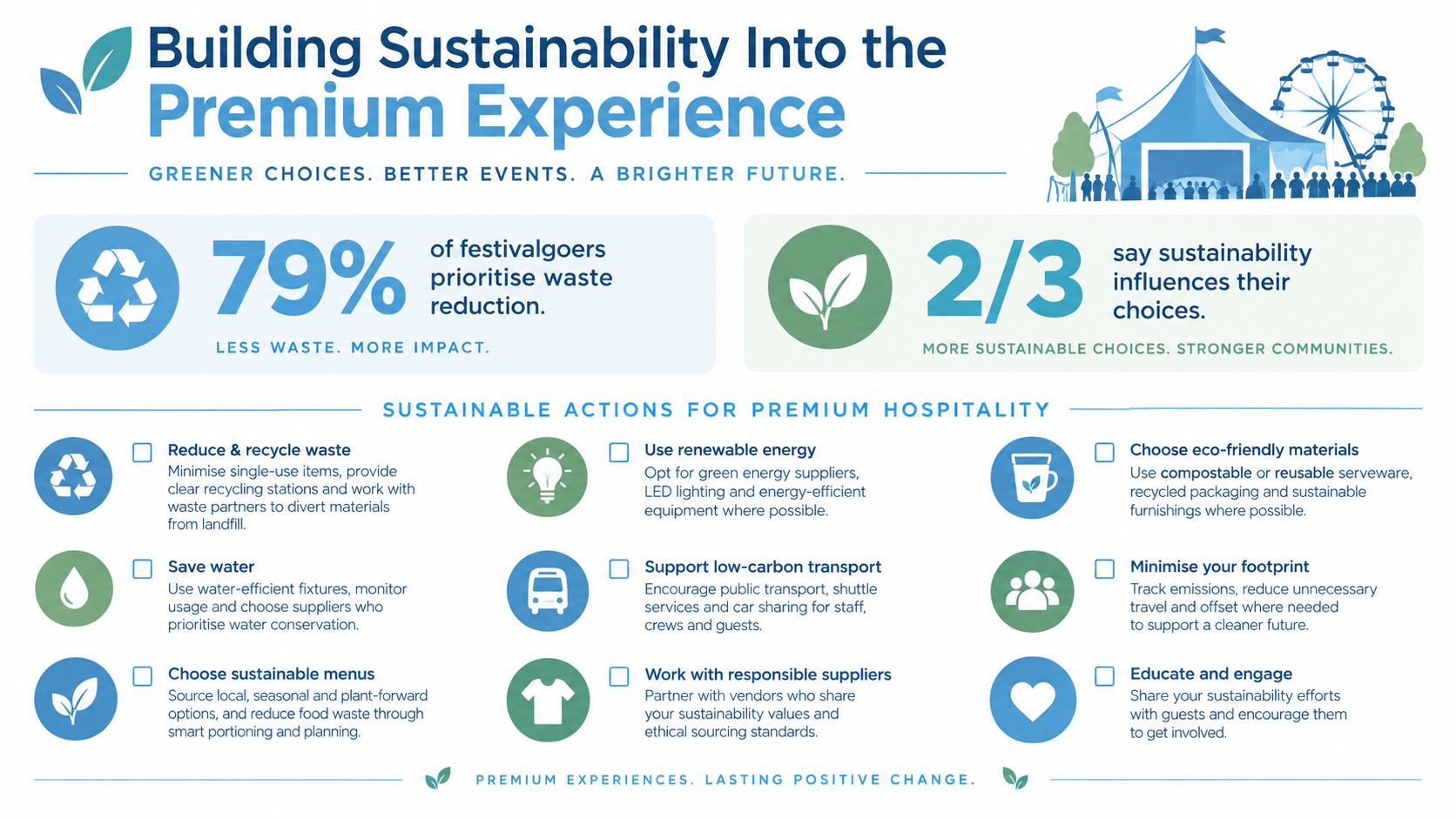
Sustainability doesn't have to mean a visibly reduced experience. Locally sourced menus, durable branded assets and useful travel support can be premium features when they're well executed.
Ticketmaster's UK festival research reports that almost 80% of festivalgoers prioritise waste reduction, two-thirds say sustainability influences ticket choices, and roughly three-quarters expect low-carbon travel options; it also cites EY findings that 61% of UK consumers would pay more for locally sourced food and 60% for contributions to local communities. Festival audiences aren't identical to corporate hospitality guests, but these findings provide a useful design signal.
Make the responsible option convenient
Send practical rail and public-transport information with the invitation, including the route from the station to the correct entrance. Don't merely advise guests to travel sustainably and leave them to solve the final journey.
Ask caterers for appealing food choices, provenance information and a service plan that responds to confirmed attendance. Reusable graphics and modular branding need storage and a credible reuse plan, otherwise they're more expensive single-event materials.
Visible community contribution should be specific. Explain who benefits and what the programme supports, rather than relying on broad claims about positive impact.
Measure delivery rather than intention
A useful event carbon footprint discussion begins with information the production team can collect.
- Attendee travel should record reported transport modes and the assumptions used where information is missing.
- Food choices should connect ordered portions, served meals and measured leftovers.
- Materials should distinguish hired, reused, newly purchased and discarded assets.
- Energy should use venue or supplier records where available, with estimates identified.
- Waste should record quantities and disposal routes, not just whether bins were provided.
- Local spend should identify relevant suppliers and community contributions against a stated definition of local.
Publish a concise post-event account of what was measured, what remains uncertain and what you'll change. Guests don't need inflated environmental promises; they need a credible explanation of the choices behind the experience.
Premium service and responsible delivery are compatible. The constraint is usually the quality of the planning, not the ambition of the menu or entertainment.
Measuring Hospitality ROI Properly
Hospitality reporting often stops at attendance and favourable feedback. The earlier hospitality reporting also describes 91% of surveyed companies engaging in corporate hospitality as not measuring ROI, a survey finding that shouldn't be treated as a universal description of UK businesses.
Define success before allocating tickets. Choose qualified meetings, opportunities created, retention or brand advocacy according to the programme's purpose. Agree what counts as a meaningful outcome with the sales or account team, not after the event when everyone wants a positive result.
Build a traceable measurement framework
Create a guest-level record connecting invitation, attendance, hosted interaction, follow-up and commercial outcome. Assign responsibility for completing it, and collect only information you can legitimately use.
For teams designing consistent survey questions and numerical measures, Gegan's practical quantitative research examples provide a methodological starting point. The essential discipline is to define each measure before collecting responses.
Track the following:
- Participation through attendance rate, no-show rate and cost per attended guest.
- Interaction through meetings per 100 guests, using the hospitality measurement framework described in the earlier reporting.
- Commercial progress through qualified-lead rate, opportunity-conversion rate and revenue influenced.
- Guest response through promoter score, with the survey population and response rate clearly stated.
Calculate ROI = (commercial value generated minus total programme cost) ÷ total programme cost. Separate booked revenue from pipeline value and disclose the attribution rule; an opportunity touched by hospitality isn't automatically an opportunity created by it.
Issue the guest survey within 24–48 hours, then review commercial outcomes after 30, 90 and 180 days, following the cadence in the hospitality measurement reporting. Survey the whole eligible guest group, not just enthusiastic respondents, and use a baseline or comparison group where feasible.
Don't count spending as success, stop at attendance or omit post-event sales activity. A polished dashboard can't repair missing follow-up records.
Resolve permissions before service begins
The Sporting Events (Control of Alcohol etc.) Act 1985 creates restrictions associated with designated sporting events, including alcohol and certain potentially harmful articles at designated grounds, alcohol on relevant passenger vehicles carrying fans, drunkenness and bar regulation. Check the applicable provisions with the venue and competent advisers; ordinary hospitality bar arrangements shouldn't be assumed to apply.
Legal requirements differ between Scotland, Northern Ireland, and England and Wales. Confirm alcohol, entertainment and late-night refreshment permissions with the relevant local authority and police where appropriate.
Treat 500 people or more as an escalation point for licensing review, not as a valid Temporary Event Notice threshold. A TEN in England and Wales is for fewer than 500 people, including staff; a larger event needs a different permissions assessment. Don't use a hospitality supplier or an unrelated commercial announcement as legal authority.
Take this checklist into the planning meeting:
- Event status and applicable sporting-event restrictions confirmed.
- Alcohol service and transport arrangements approved.
- Jurisdiction and licensing route checked with the relevant authority.
- Capacity, entertainment and refreshment permissions documented.
- Responsible operational contacts named before guests arrive.
PSW Events supplies interactive sports and racing attractions for corporate hospitality, fan zones and branded activations, with planning, branding, logistics, installation, on-site staffing and health-and-safety support. Visit PSW Events with your venue, event date, audience and commercial objective to discuss an activation that fits the guest journey and the total delivery budget.