
You're probably planning an event that can't afford to feel flat.
The venue is shortlisted. The date is held. Catering is moving. Stakeholders want something “memorable” but also commercially sensible. That's the point where event entertainment hire stops being a nice extra and becomes part of the event strategy. If attendees drift in, collect a coffee, glance at a stand and leave, the problem usually isn't the venue. It's that nothing on site gave them a reason to stay, take part, compete, talk or remember.
The strongest entertainment choices do more than fill a gap in the agenda. They create a job for the audience. They turn passive footfall into participation, and participation into conversation, dwell time, lead capture and brand recall. That matters even more in a market where planners are booking more and spending more. In the UK events economy, 66% of event professionals anticipate scheduling more events in 2025, and 74% expect budgets to increase, according to Eventgroove's event industry statistics. That combination tells you something important. Buyers are under more pressure to justify spend, but they're also treating experience design as a core decision.
Why Your Next Event Needs More Than Just Canapés
A drinks reception with polite background music can look polished and still achieve very little. Guests mingle with the same people they arrived with. Exhibition visitors pass by without stopping. Internal teams turn up, smile for a photo, and leave with no shared moment to talk about on Monday.
That's why good event entertainment hire has to be judged by business effect, not by novelty alone. A simulator, competitive game, branded challenge or immersive activation gives attendees a reason to engage physically and socially. It creates visible energy in the room. It also gives your team a practical tool. Staff can start conversations around the activity, capture details through a leaderboard or competition mechanic, and hold attention for longer than a static display ever will.

What a forgettable event usually gets wrong
Most underperforming events make one of three mistakes:
- They rely on atmosphere alone: Décor and food matter, but they don't create structured engagement.
- They choose entertainment too late: By the time entertainment is discussed, the format, power plan and floor layout are already working against it.
- They book for appearance, not function: Something can look impressive in a proposal and still fail on crowd flow, staffing, safety or relevance.
Practical rule: If the entertainment doesn't support a specific outcome, it's decoration.
Interactive attractions work because they ask something of the audience. Compete. React. Try. Compare. Share. That shift matters at conferences, exhibitions, product launches and staff events alike. The audience stops watching the event and starts taking part in it.
Entertainment is now a strategic line item
When budgets rise and event volumes rise, planners become more selective about what earns space on the show floor or in the running order. Entertainment that drives traffic, supports branding and fits cleanly into production plans usually survives scrutiny. Entertainment that only sounds “fun” often doesn't.
That is the essential case for event entertainment hire. It isn't about adding noise. It's about adding purpose.
Aligning Entertainment with Your Audience and Objectives
The wrong way to buy entertainment is to start with the catalogue.
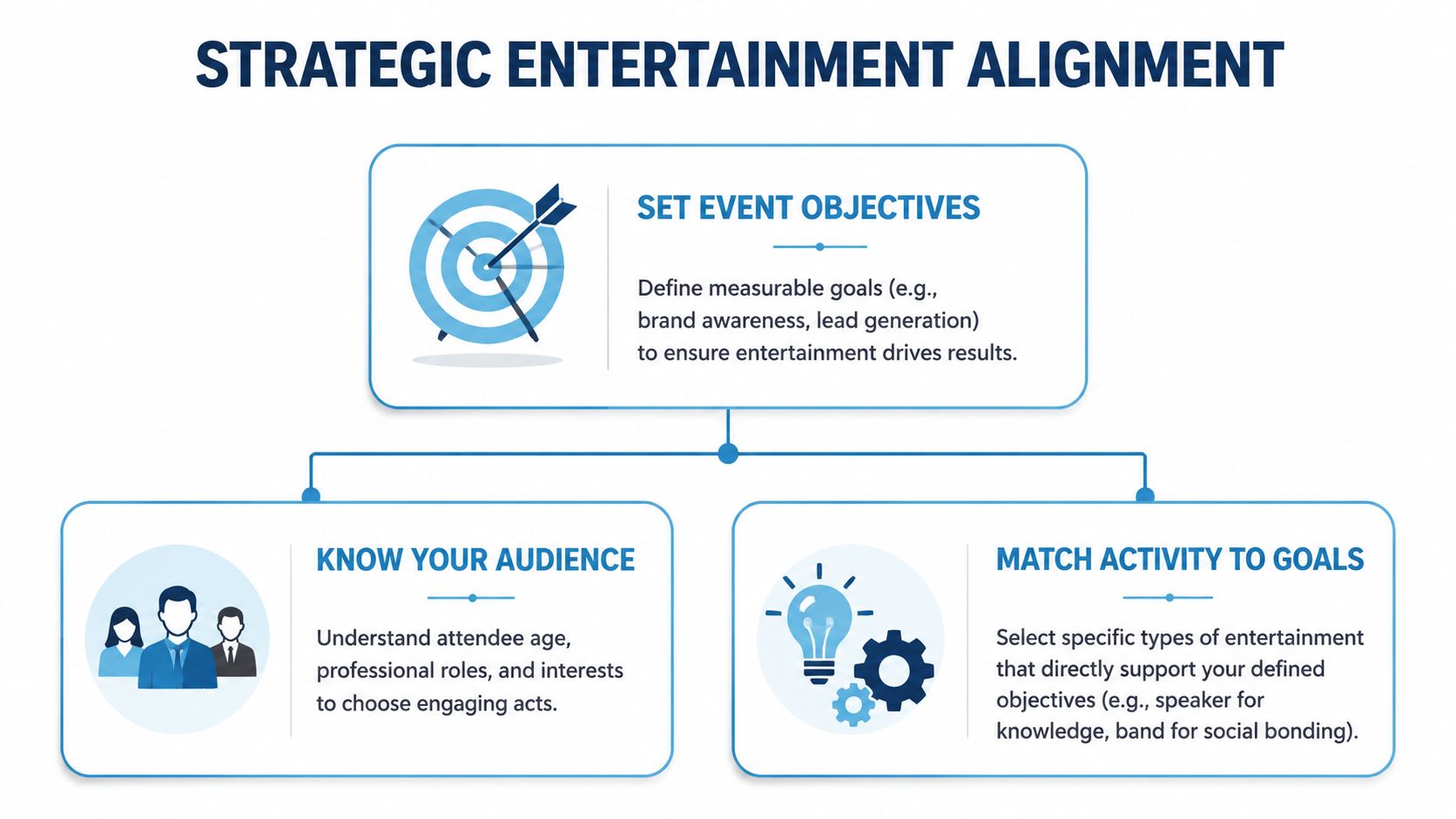
The right way is to start with the event brief and force a few clear decisions. Who needs to engage? What do you want them to do? What should happen immediately after the interaction? A strong entertainment concept is usually obvious once those answers are clear.
Physical events still dominate revenue, but planners are no longer working in a purely physical world. 60% of event revenue comes from in-person gatherings, while the virtual event market is projected to reach $236.69 billion in 2025, according to Remo's event industry statistics. In practice, that means your entertainment often needs to do two jobs. It must engage the people in the room and still produce content, visibility or campaign value beyond the room.
Start with the result you need
Entertainment choices become easier when you map them to a primary objective.
- Lead generation: Competitive formats work well here. Think reaction games, simulators with lap times, or branded scoreboards that justify a data capture step.
- Brand awareness: High-visibility installs tend to perform better than subtle acts. You want something people can see from distance and recognise instantly as part of your campaign.
- Team building: Cooperative or shared-play experiences are often stronger than individual high-score mechanics.
- VIP hospitality: The brief usually shifts from throughput to quality. Fewer participants, more attention, smoother facilitation.
- Product education: The entertainment needs a narrative link to the product. If that link feels forced, the activity becomes a distraction.
Ask better planning questions
Before you request a quote, answer these questions internally:
- Who is the audience really? Senior buyers, mixed delegates, staff, families, public visitors, or invited guests all behave differently.
- What behaviour are you trying to trigger? Stop, watch, queue, compete, network, post, scan, enquire.
- How long can each interaction last? High-throughput exhibition activity differs from a hospitality feature where guests can spend more time.
- Does the attraction need to carry branding? Some formats take vinyls, screen overlays and custom scoreboards well. Others don't.
- Will the moment need to work on camera? If content capture matters, choose something visually legible from multiple angles.
- Is there a hybrid audience to consider? If so, think about what can be streamed, clipped, shared or mirrored online.
The audience doesn't separate “entertainment” from the event itself. They experience one integrated environment. If the attraction feels bolted on, they notice.
Match format to behaviour
A leaderboard game creates repeat attempts and friendly competition. That suits exhibition stands and sponsor zones. A VR setup can be immersive and memorable, but it may slow throughput if headset turnover and briefing time aren't planned properly. Casino tables work well where the brief is light social interaction rather than overt sales activity. A racing simulator gives you spectacle, queue theatre and clear score-based competition.
That's why objective-first planning matters. Good entertainment isn't just enjoyable. It's operationally aligned.
Exploring the Spectrum of Modern Event Entertainment
Corporate planners often group entertainment into one bucket. In practice, the operational differences are significant. A Batak Pro unit, a two-seat F1 simulator, a VR pod and a casino table all create very different crowd patterns, staffing needs and brand opportunities.
The fastest way to narrow the field is to compare formats by what they are good at, not by how exciting they sound in isolation.
Entertainment type decision matrix
| Entertainment Type | Best For | Typical Footprint | Interactivity Level |
|---|---|---|---|
| Racing simulators | Exhibitions, motorsport themes, product launches, footfall attraction | Medium to large footprint with queue space and clear viewing area | High |
| Golf and sports simulators | Hospitality, staff events, sponsor activations, mixed-skill audiences | Medium footprint with safe swing or play zone where relevant | High |
| Flight simulators and VR | Immersive brand experiences, premium guests, tech showcases | Medium footprint with controlled access and supervision | High |
| Reaction games and leaderboards | Lead capture, stand engagement, competitions, fast turnover | Small to medium footprint | Very high |
| Giant Scalextric and social games | Networking, family days, shared participation, spectator appeal | Medium footprint with surrounding circulation | Medium to high |
| Casino tables | Evening events, hospitality, themed functions | Medium footprint, low technical burden | Medium |
| Inflatables and physical challenges | Family fun days, festivals, open public events | Large footprint with active safety perimeter | High |
Simulators and immersive tech
Simulators earn their keep when you need a focal point. They're visible. They generate queues. They give your team a clear opening line. F1 simulators, golf simulators and flight sims also allow for branded overlays and score-based competition, which is useful when the event needs measurable interactions rather than casual amusement.
The trade-off is that they aren't plug-and-play in the simplistic sense buyers sometimes imagine. They need clear access routes, setup time, power planning and enough surrounding space for viewing, queueing and safe circulation. For planners comparing options, unique event entertainment ideas from PSW Events gives a useful sense of how varied these formats can be across exhibitions, hospitality and team events.
Fast-play games and social competition
If your event needs volume, quick-play formats often outperform deeper immersive setups. Batak Pro, electronic leaderboards and compact reaction games turn over participants quickly and keep energy visible. That matters on busy stands where queues can become an asset if they look organised and purposeful.
These formats also suit sponsors because branding can sit close to the play mechanic. The activity becomes a branded challenge rather than a separate attraction living awkwardly beside the message.
A queue isn't a problem when it's managed. A dead zone around the activation is the real problem.
Casino tables, classic formats and lower-tech choices
Not every event needs a screen, headset or simulator rig. Casino tables still work because they lower the barrier to participation. Guests can join mid-conversation, stay social and move on without a briefing. That's useful for evening functions where networking matters more than hard competition.
Classic formats are also easier on infrastructure. They usually ask less from venue power and setup logistics. That doesn't make them automatically easier to execute well, but it does reduce the technical exposure.
Space and audience circulation matter more than brochures suggest
For immersive attractions, UK Health and Safety Executive guidance recommends allocating at least 0.5 m² per standing audience member, as noted in this UK stage-hire guide. That number matters less as a compliance talking point and more as a planning discipline. A simulator might fit physically into a floorplan, but if you ignore the crowd that forms around it, you've underplanned the actual footprint.
Use these quick checks when shortlisting:
- Viewing zone: Can people watch without blocking aisles?
- Queue shape: Will the line run into neighbouring stands or fire routes?
- Access width: Can the equipment get in without dismantling half the venue?
- Branding surfaces: Is there somewhere for the sponsor identity to live naturally?
- Noise profile: Will the attraction compete with speeches, panels or adjacent exhibitors?
The right entertainment type is rarely the one with the biggest headline impact. It's the one whose footprint, pace and interaction style fit the event you're running.
Planning Your Budget and Booking Timeline
Entertainment budgets go wrong for two reasons. Either the organiser compares headline hire fees without checking what's included, or the booking starts too late and the event ends up paying for preventable complications.
There isn't one universal price card for event entertainment hire, and sensible suppliers won't pretend there is. A compact game unit for an evening reception is a different job from a branded simulator package for a multi-day exhibition with transport, install crew, rehearsals and on-site staffing. The useful question isn't “what does entertainment cost?” It's “what exactly are we buying, and what conditions does that quote assume?”
What should be in the quote
Ask for the proposal to separate the moving parts. If a supplier sends a single figure with no breakdown, you can't assess value properly.
A working quote should clarify:
- Hire item or package: What equipment or activity is included.
- Crew provision: Whether staffing is included for delivery, operation and derig.
- Transport and access assumptions: Standard ground floor access is not the same as a city-centre venue with tight loading slots.
- Setup and derig time: Especially important if your venue has narrow tenancy windows.
- Branding scope: Screen graphics, wraps, backdrops, leaderboard customisation and approvals.
- Technical requirements: Power, network, ceiling height, floor loading, and any barriers or queue control.
- Contingencies: What happens if the venue changes, timings slip or access is delayed.
Budget by event purpose, not just by item
A mistake I see often is treating entertainment as an isolated line. It works better to budget by role.
For example, a lead-generation attraction on an exhibition stand may justify more production budget than an evening after-dinner feature because it's carrying part of the stand engagement strategy. A hospitality activity may need fewer participants per hour but more polish, more staffing and a cleaner visual finish. A team-building brief may need facilitation and flow, not just equipment on site.
That also affects the booking timeline. Custom-branded activations take longer because artwork, approvals, transport planning and venue sign-off all need room to breathe. For launches and branded roadshows, this is one reason planners often benefit from reviewing the wider product launch event planning process before confirming the entertainment element.
A practical reverse timeline
Use the event date as the anchor and work backwards.
- Early planning stage: Lock the objective, audience profile and likely footprint before you contact suppliers.
- Supplier shortlist stage: Compare format options against venue realities, not mood boards.
- Quote and revision stage: Finalise inclusions, branding scope, staffing and technical assumptions.
- Venue coordination stage: Confirm access, loading, power, internet, positioning and show schedule.
- Final production stage: Approve artwork, RAMS, crew timings and on-site contacts.
If any part of the event includes streaming or remote participation, the planning needs to account for more than the in-room attraction. Teams working on hybrid formats can learn a lot from workflows used for sharing live sermons with remote congregations, because the same discipline applies. You need clean signal paths, clear run-of-show planning and realistic expectations about what remote viewers can meaningfully experience.
Cheap entertainment can become expensive very quickly once access restrictions, branding changes or unsupported technical needs hit the schedule.
The best budget conversations are specific. They don't ask for “something fun for around X”. They define purpose, duration, audience, location and operational constraints, then test the quote against that brief.
The Ultimate Supplier Vetting and Contracting Checklist
A polished website doesn't tell you whether a supplier can load into a live venue, brief a venue technician, manage a queue, or recover calmly when the running order changes. Those are the things that decide whether event entertainment hire feels effortless or stressful on the day.
Supplier vetting should be practical. Ask questions that expose process, not marketing language.
Questions to ask your entertainment hire company
Start with experience that matches your event type.
- Have they delivered this format at similar events? A wedding DJ moving into corporate activations isn't the same as a supplier used to exhibitions, conferences or fan zones.
- Can they describe the setup sequence clearly? If the answer is vague, expect problems during load-in.
- Who is on site on the day? Sales handover gaps are common. You need named operational contacts, not just a generic office number.
- What does the crew do during live hours? Some suppliers drop equipment and leave. Others actively host, troubleshoot and manage throughput.
Technical vetting that planners often skip
Many issues begin at this point. A strong concept can still fail because the technical questions weren't asked early enough.
A critical one is power. High-draw attractions such as simulators often require dedicated circuits, and planners should confirm that the supplier has assessed the venue's power map to reduce the risk of tripped breakers and show interruptions, as outlined in this venue technology planning guide.
Use that as the basis for a blunt checklist:
- What is the total power draw of the attraction?
- Does any element require a dedicated circuit?
- Has the supplier reviewed the venue's socket locations and distribution plan?
- Are extension runs, cable management and backup assumptions included?
- If the activation includes streaming, scoring sync or remote elements, what network support is required?
Contract points worth checking carefully
The contract should answer operational questions before they become disputes.
Look closely at:
- Access assumptions: Loading bays, stairs, goods lifts, restricted tenancy times.
- Payment schedule: Deposit timing, balance due date and any trigger points for custom work.
- Cancellation terms: Especially important for venue changes or postponed shows.
- Damage and loss: Clarify where responsibility sits during public use.
- Substitution rights: Can the supplier swap equipment or crew without approval?
- Overtime and extended hours: Make sure the live operating window is defined properly.
Signs of a reliable supplier
Reliable operators usually sound boring in the best possible way. They ask for venue plans, loading details, power information and show timings early. They want to know about branding deadlines and emergency contacts. They query assumptions instead of flattering them.
If you mention a multi-level venue, restricted load-in or late artwork and they don't react, that's not confidence. It's usually inexperience.
Good suppliers don't just promise a great experience. They identify where it could fail and deal with it before the truck leaves the depot.
A proper vetting process protects your audience experience, your schedule and your internal credibility.
Managing Risk Insurance and On-Site Safety
This is the part many hiring guides gloss over, and it's where experienced planners usually get sharper.
Interactive entertainment introduces moving parts, participant behaviour, electrical equipment, queue management and often a degree of competition. Those factors aren't a reason to avoid immersive activations. They are a reason to treat risk management as part of the buying decision. Industry data shows 67% of UK event planners cite safety and liability concerns as a major barrier to booking immersive experiences, according to this hiring guide reference. That concern is justified. What isn't justified is booking anyway without checking the documents.
The documents you should ask for
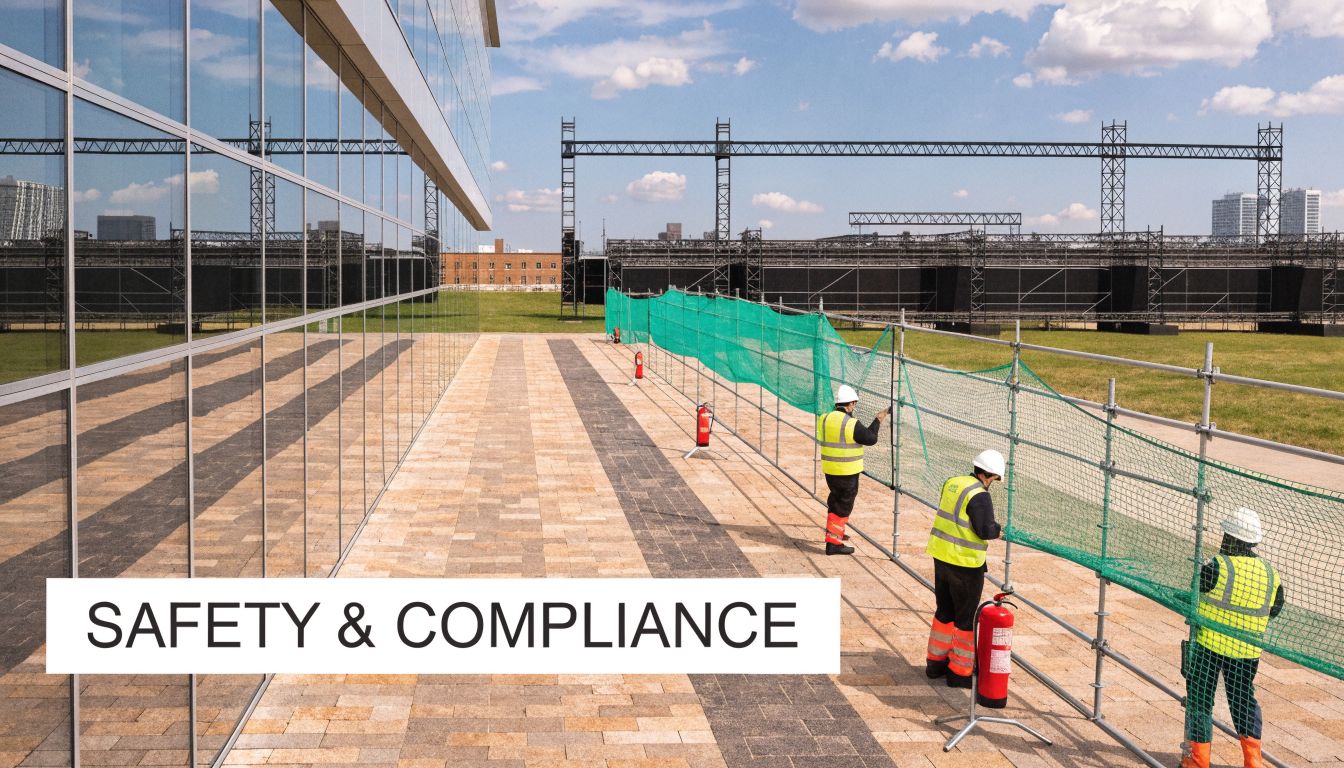
Start with the basics and ask to see them, not just hear that they exist.
- Public liability insurance: For many corporate and venue environments, planners expect a serious level of cover. PSW Events, for example, operates with £10 million products, employee and public liability insurance.
- Risk Assessments and Method Statements: Usually called RAMS. These set out hazards, controls, install method and live operational procedures.
- PAT testing records: Evidence that portable electrical equipment has been tested.
- Operator competence details: Who is supervising the activity and what they're authorised to do.
- Participant restrictions: Age, height, health or mobility limitations where relevant.
If you need a benchmark for internal planning, this event risk assessment template is the sort of resource that helps teams structure the conversation before the supplier paperwork lands.
What these terms mean in practice
Public liability insurance is there to respond if a third party suffers injury or property damage linked to the activity. It is not a box-ticking exercise. It is part of your protection if something goes wrong in a public-facing environment.
RAMS matter because “we've done this loads of times” is not a control measure. A proper document should show how equipment is installed, how cables are managed, where barriers are needed, who controls participation, and what happens if the unit develops a fault during live hours.
This short video is useful if your team needs a practical reminder that on-site safety is created by setup discipline, not by paperwork alone.
Where planners should push harder
Ask how the supplier separates spectators from participants. Ask who has stop authority if a unit becomes unsafe. Ask how incidents are recorded. Ask what happens when an attendee ignores instructions.
If you're building your own supplier scorecard, a useful companion read is how to compare event service providers, because it reinforces a point many buyers miss. Commercial fit and safety fit are not separate decisions.
The cheapest proposal can expose your brand more than the most ambitious attraction ever will. Safety compliance is part of the product.
Measuring Entertainment ROI and Setting KPIs
If entertainment only gets described as “a hit”, you'll struggle to defend the spend later.
The better approach is to decide before the event what success looks like, then measure the activity against that specific purpose. The KPI for a conference networking feature won't match the KPI for an exhibition lead-generation game. Entertainment ROI becomes easier to prove when you stop trying to measure everything and focus on the outcomes the activity was hired to support.
Match KPIs to the job of the activation
For exhibition and brand environments, useful KPIs often include:
- Lead capture volume: How many qualified contacts were recorded through the activity.
- Dwell time: Whether attendees stayed materially longer at the stand or activation zone.
- Participation count: How many people actively took part, not just walked past.
- Repeat plays: A good sign that the format created competition or social pull.
- Content output: Photos, clips, branded screenshots or other assets generated on site.
For internal events, the emphasis changes. You may care more about participation spread across departments, anecdotal feedback from managers, or whether the entertainment supported networking rather than creating a bottleneck.
Use a simple reporting model
A straightforward post-event review usually works best:
| KPI area | What to track | Why it matters |
|---|---|---|
| Engagement | Plays, queue activity, observed crowd build | Shows whether the attraction stopped people and held attention |
| Commercial value | Leads, follow-up conversations, sponsor visibility | Connects entertainment to business outcomes |
| Experience quality | Feedback from guests, staff and stakeholders | Tests whether the format matched the audience |
| Delivery quality | Setup performance, downtime, safety issues, crew response | Shows whether the supplier was operationally reliable |
If the entertainment had a job, it can be measured. If it can't be measured, the brief probably wasn't clear enough.
Report what stakeholders actually care about
Senior stakeholders usually want to know four things. Did it attract people? Did it support the brand? Did it run cleanly? Would you book it again?
That's why the strongest entertainment reports combine numbers with context. A leaderboard may show participation, but the actual value may have been the sales conversations happening around it. A simulator may have generated fewer total interactions than a fast-play game, but delivered higher-quality conversations with target buyers.
Good event entertainment hire should be enjoyable. It should also leave behind evidence that it worked.