
How do you stop a delegate who's already late for a keynote, phone in hand, forty metres from the coffee stand? That's the question behind most briefs for conference interactive activities, and it's not answered by a list of fun ideas. It's answered by throughput, sightlines and a reason to stay for ninety seconds longer than planned.
The scale of the opportunity is considerable. VisitBritain's business events research reports an estimated 1.08 million conferences and meetings across the UK in 2024, attracting 95.4 million delegates and generating approximately £19.3 billion in direct expenditure. Every one of those delegates walks past dozens of zones, stands and break areas. Most of them keep walking.
So this list judges every activity on three things a floor manager controls. Quick sessions, because a three-minute turn clears a queue and a ten-minute one kills it. Visible action, because people join things they can understand from six feet away. Built-in lead capture, because a sponsor who can't see names, dwell time and repeat visits next week won't fund the zone again.
Each of the eight options below comes with the formats that work, the formats that collapse under queue pressure, and what to plan before the rigs arrive. Judge them against your own floor, your delegate mix and how long you need people to stay.
1. F1 and Multi-Racing Simulator Tournaments
A racing rig earns its space in the first ten seconds. Someone sees a cockpit, a wheel and a car sliding into a corner on a big screen, and stops. That stop is the whole point.
Motion-enabled rigs let delegates race head-to-head or in timed heats, and a live leaderboard turns players into a crowd. A short race takes a few minutes, so a well-run queue clears quickly, and the format rewards both the competitive delegate and the one who wants a go. The social side carries more weight than the lap times. In a University of Dundee study of interactive conference technology, 55% of delegates reported a strong or weak positive effect on their conference experience, 36% were neutral and only 9% reported a negative effect, with delegates valuing the technology most as an icebreaker in social spaces (University of Dundee).
Where racing rigs pay for themselves
Motor show and automotive trade stands in the UK run head-to-head races for branded prizes. Brand activations at the major exhibition halls build daily knockout tournaments with live commentary. Both work because the barrier to entry is a steering wheel, not a skill test.
Four rules keep the queue friendly:
- Publish the winner rule before the first heat: fastest lap, first past the post, or best of three. Ambiguity is where disputes start.
- Put the tournament bracket on a screen near the queue: waiting delegates watch the next competitor and stay put.
- Keep the prize modest: a branded item for the top three each day beats one big prize nobody wins.
- Brief staff on rig operation and H&S before doors open: seat adjustment, cable routing and step-off points cause most incidents.
Sponsor tie-ins are straightforward. The sponsor's name sits on the leaderboard, a short product message runs on the queue screen, and entry to the draw happens at registration, which is also where the consent for follow-up gets captured.
2. Golf Simulator Challenges
A software company books a hospitality suite and wants sixty clients talking by seven o'clock. A golf simulator gets there faster than a drinks reception: closest to the pin gives strangers a shared target, a reason to watch each other's turn, and a score worth debating at the bar.
The setting carries part of the load. A 2024 survey commissioned by Conference Leeds found an engaging conference environment was the most frequently selected factor encouraging attendees to become more active, cited by 37% of respondents (Event Industry News). Golf fits that brief because it is sociable without needing golf knowledge, and the better players do not get an automatic head start if you choose the format carefully.
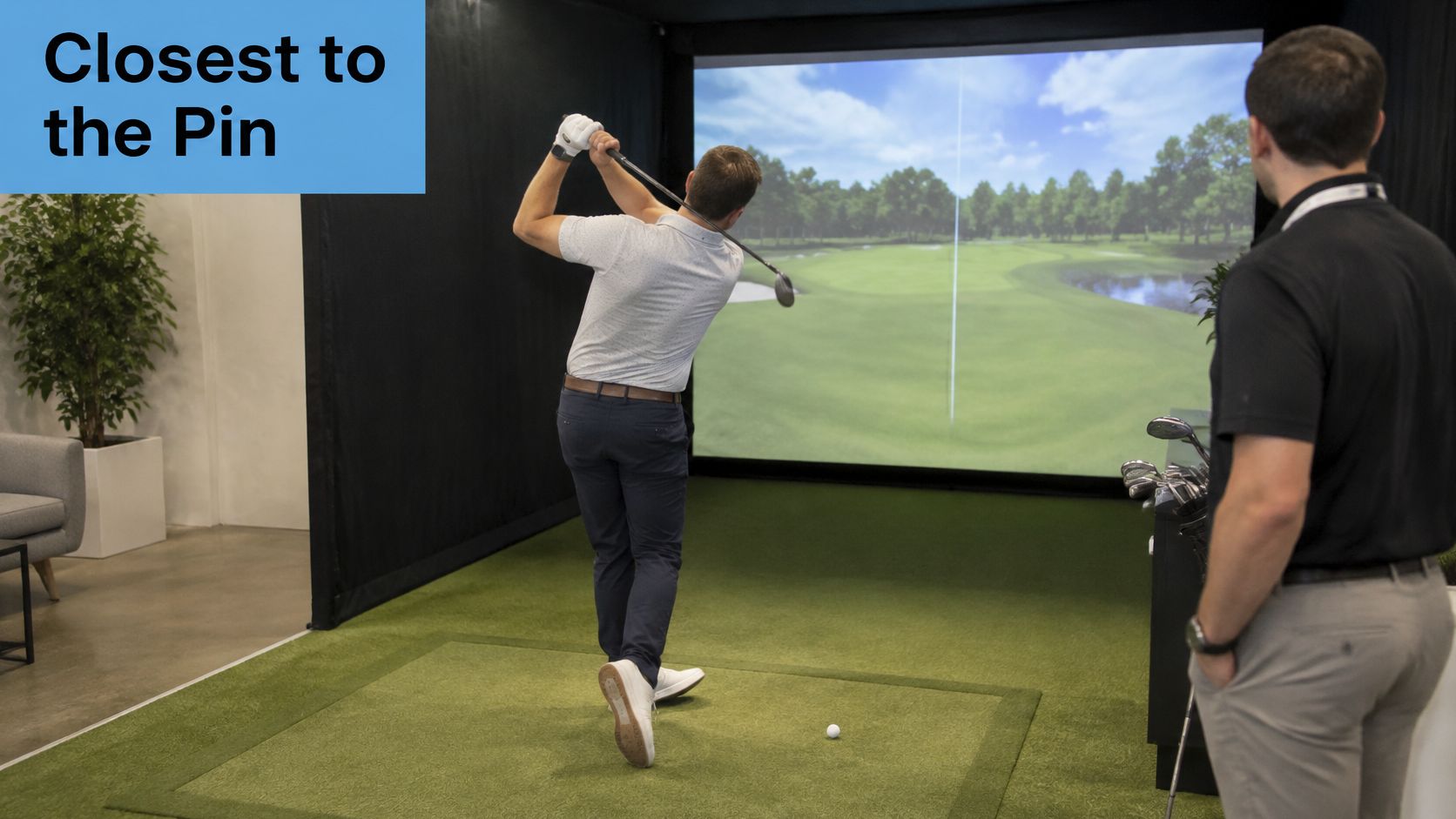
Launch monitors show ball speed, launch angle and distance as soon as the shot lands, so even a first-timer leaves with a number to beat. Keep turns short: a putting or nearest-pin contest moves a queue faster than a long-drive final, and a visible score gives waiting delegates a reason to stay within sight of the stand.
Formats that keep novices in the game
- Closest to the pin: the safest opener. One shot per delegate, one winner, no golf knowledge required.
- Longest drive: suits confident golfers and produces the number people screenshot, but it rewards power and can make casual players wait for a turn they will lose.
- Short putting contest: the highest throughput of the individual formats and the easiest to run on a crowded stand.
- Team scramble: four delegates share one score, which forces conversation between people who have just met and spreads the pressure across the group.
If you're hiring rather than buying, golf simulator hire is worth discussing with PSW Events, which provides on-site staffing for its attractions, so you can confirm the exact package for your event. I would treat staffing as part of the booking, not an extra: an unattended bay collects damage, loose swings and arguments about whose turn is next.
Practical rule: fence the hitting zone, staff it at all times, and schedule slots in advance. Unbooked golf bays attract a queue at exactly the moment your keynote ends.
Capture names and companies on the leaderboard screen itself, and say plainly what the data will be used for. A leaderboard that doubles as a follow-up list earns its floor space twice over.
3. Boxing Simulator Reaction Challenge
The boxing simulator is the quickest activity here to explain. A delegate throws three punches at projected targets, sees a score for speed, power and reaction time, and either walks on or joins the queue. Motion sensors handle the measuring, and nobody needs a briefing longer than fifteen seconds.
That speed has commercial value. Research gathered by Booking.com's business events statistics round-up reports that 77% of attendees say interactive elements improve their event experience, while 60% of planners identify advanced audiovisual support as a top priority. A high-energy challenge with a visible score serves both: the delegate gets a moment worth repeating, and the screen does the AV work.
Designing for throughput, not for the photo
Build the space around queue speed rather than the attraction.
- Set a short turn length: three to five punches per person keeps a queue of twenty moving.
- Show a live top ten: a visible ranking drives second attempts and gives bystanders a reason to stay.
- Mark the floor: tape a throwing line and a spectator line so nobody drifts into the swing zone.
- Staff the handover: one person managing wrist straps and prompts prevents most equipment damage.
Measure before you scale: count participant capacity per hour, average time per turn, how many people leave the queue, and how many return for a second attempt. A zone that looks busy while losing a third of its queue isn't working.
Sports and fitness exhibitions use punch-power challenges for top-score competitions. Festival fan zones use them to make social media moments. The instant score makes both viable, especially when a delegate can add a first name to the board and find their result later.
4. American Football and Rugby Kicking or Passing Simulators
A UK survey of 57 Gen Z professionals found that 53% preferred hands-on demonstrations and live simulations at events, compared with 25% for interactive workshops and breakout sessions and 12% for keynote speeches (Conference News). That ordering should change how a sponsor zone gets budgeted.
Kicking and passing simulators put delegates in front of a projected field and score them on accuracy, distance or speed. A throw, a kick or a pass, a target, a number. There's no learning curve and no advantage for the club player, which is what makes it work across a mixed room of rugby fans, American football followers and people who just want a go.
Running it as a team format
Team scoring changes the behaviour on the floor. Individuals play once, teams stay for a round.
- Create team leaderboards: department against department pulls in colleagues who'd otherwise walk past.
- Brand the screens with sponsor logos: a projected field is the largest logo in the hall.
- Brief the scoring before each round: thirty seconds of explanation removes the "how does this count?" friction that stalls a queue.
- Plan the space to avoid collisions: swinging legs and thrown balls need a marked zone and a clear approach lane.
The Gen Z survey also found 58% preferred a session of 30 to 45 minutes with interactivity, which suits a round-robin format far better than an open, all-day challenge. Run timed rounds, publish the schedule, and let people book a slot instead of hovering.
Corporate team-building days at UK venues use team passing and kicking challenges as the opening session, then repeat them after lunch once competitive instincts have had time to settle. Sports-themed exhibitions use the same rigs to pull in rugby and American football fans from three aisles away.
5. Giant Scalextric Race Challenge
Nostalgia is an underrated throughput tool. A scaled-up slot car track pulls two audiences at once: adults who had a set as a kid and younger delegates who've never seen one. Familiarity removes the hesitation that competitive simulators sometimes create.
That instinct fits how the market has moved. The UK Events Report 2020 identified a structural shift in delegate expectations, with audiences wanting an "experience" rather than a purely informational event, one that engaged, entertained, connected emotionally and felt sociable, interactive and personal (UK Events Report 2020). A slot car race is a low-risk way to deliver that: shared, sociable, and over in three minutes.
Layout and race formats
The visible action does the recruiting, so place the track where passing traffic can see cars running, not where it faces a wall. Build it in a square or a loop rather than a long straight, so spectators can stand on two sides.
- Run knockout heats, not open practice: published heat times tell delegates exactly when to return.
- Brand the car bodies and track signage: sponsor message on every lap, no extra space required.
- Keep a spare controller set: a failed trigger stops the whole zone while staff hunt for a replacement.
- Barrier the track and clear the walking route: small cars on the floor create trip hazards faster than any other attraction here.
Expert advice: a giant track's value is its repeat rate. Give every racer a card with their heat time and the day's final, and a good proportion will come back in the afternoon.
Corporate family days and festival activations in the UK use giant slot car tracks because the format scales from children's hour to a corporate knockout. Exhibition stands use head-to-head racing to build a queue at the edge of an aisle, where a static display would be ignored.
6. VR Experiences for Conference Attendees
VR fails at conferences for ordinary reasons: a headset that needs adjusting every four minutes, an onboarding demo that takes as long as the experience, and a queue that looks longer because nobody can see what is happening. The technology is rarely the problem. The operating model is.
A UK doctoral study at the University of Surrey drew on interviews with 13 event organisers and 25 conference attendees, observations at three conferences and a survey of 428 attendees, and found that the quality of the app experience mediated the relationship between perceived engagement benefits and overall event satisfaction, with attendee apathy and technical problems cited as significant barriers to adoption (University of Surrey open research). Swap "app" for "headset" and the finding reads the same.
Making VR work on a busy floor
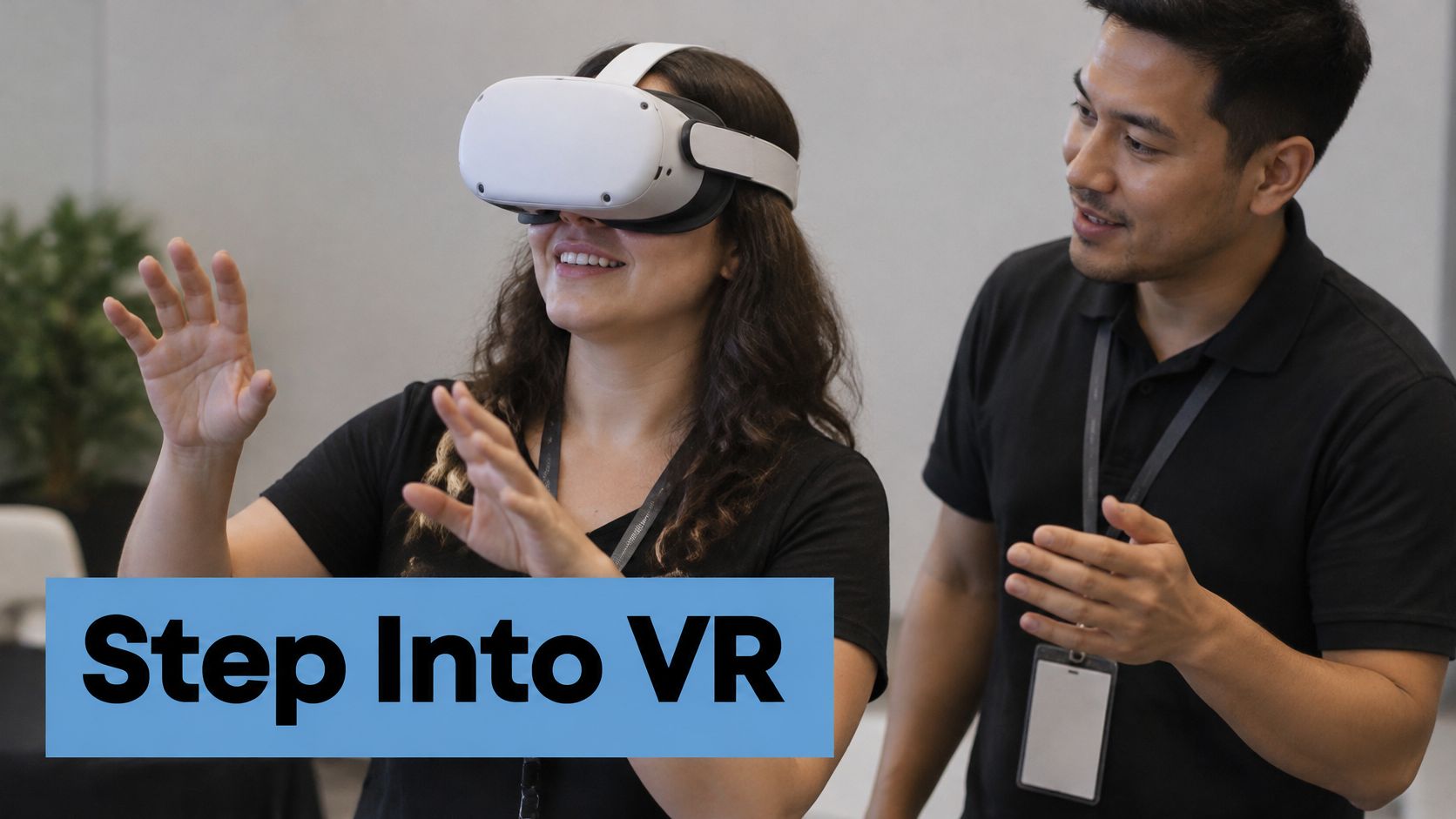
Short sessions protect throughput, and a few minutes per delegate is enough for a product walkthrough or a training scenario. Brief attendees on comfort and always offer a seated option, because a delegate who feels unsteady mid-demo will tell twenty colleagues.
Hygiene is part of the schedule, not an afterthought. Clean headsets between users with approved wipes and build that minute into the turn time rather than pretending it does not exist. Keep a sign-in form or QR code next to the headset station so the follow-up contact is captured while interest is warm, not after the delegate has drifted to the next stand.
Whatever virtual reality hire setup you bring in, ask for the headset feed to run to a screen beside the station. Mirroring the delegate's view is standard good practice on a trade-show floor: it answers the biggest complaint about VR by showing passers-by exactly what is happening, and it gives that passing traffic something to stop and watch. The same screen can carry sponsor branding, so the space earns its keep even between sessions.
Link the experience to a short feedback form or follow-up contact, and guard against the queue that forms when each session overruns by two minutes. Six sessions an hour beats four, every time.
7. Climbing Wall Challenge
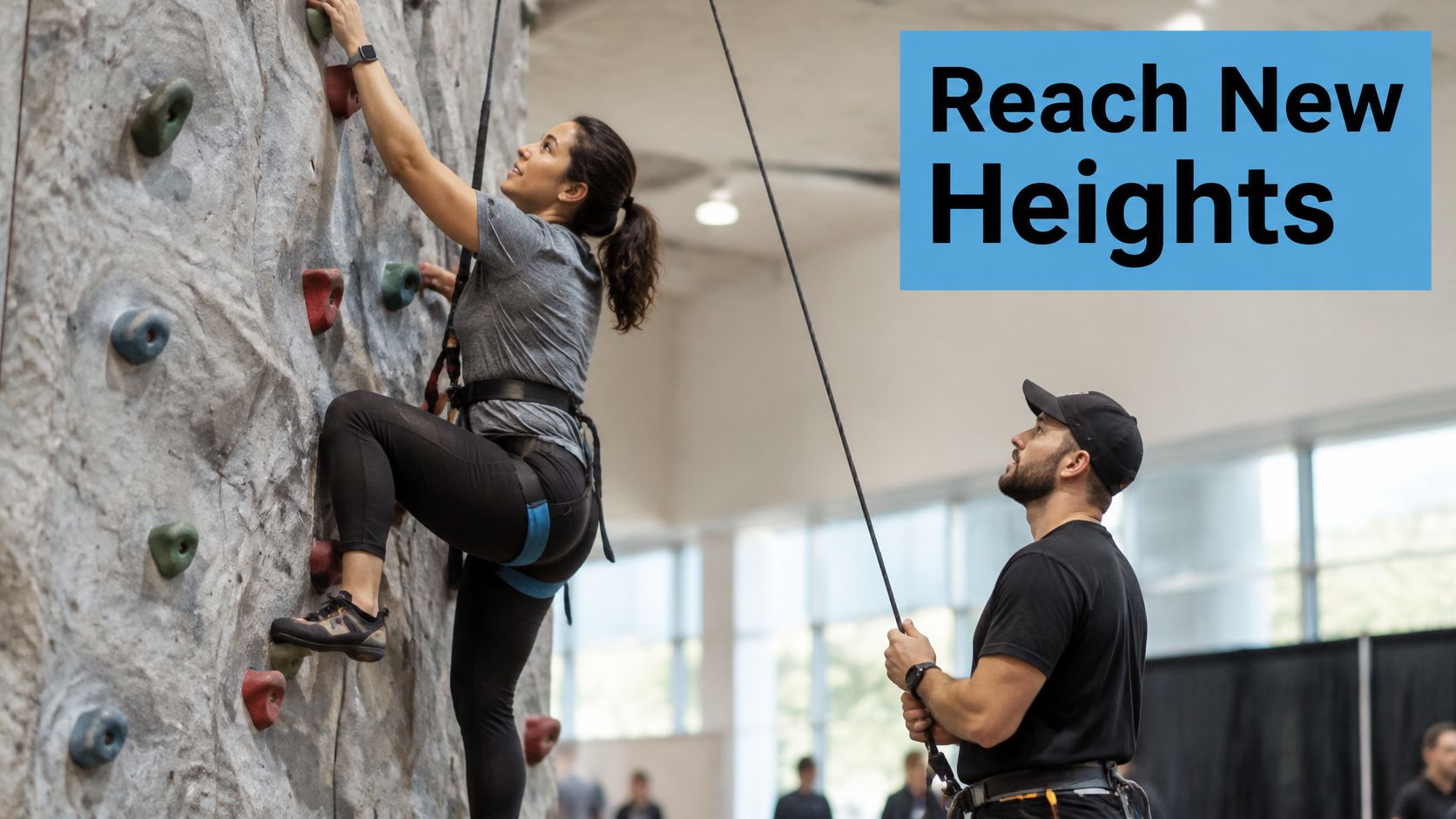
A climbing wall is the most visible thing on a conference floor, and the least forgiving to run badly. It draws a crowd fast, which is precisely why the safety and inclusion planning has to be settled weeks before the build.
Accessibility is the part most UK organisers under-plan. Industry reporting cited by Durham University's 2025 conference write-up notes that 52% of disabled people struggle to attend live events because of accessibility issues, while 68% of event professionals identify insufficient diverse representation as a barrier. Durham's own event combined in-person and online participation with quiet spaces, an immersive sensory room and visual communication systems, letting neurodivergent attendees engage on their own terms.
Safety, wall formats and non-climbing alternatives
- Waivers and briefings before the harness: no signature, no climb, and no exceptions at 4pm when the queue is longest.
- Minimum age and fitness guidance on the signage: it filters unsuitable participants before they reach the harness point.
- Team relay formats: four climbers, one combined time, which gets colleagues cheering and keeps turns short.
- Mats, spacing and staff ratios: a wall needs its own exclusion zone, so don't squeeze it beside a coffee queue.
Offer a traverse or low-height route alongside the timed climb, and a seated alternative nearby for delegates who want to take part without leaving a chair. Choice is what makes a physical activity inclusive.
More stimulation raises engagement for one delegate and excludes the next. Opt-in intensity beats one universally high-energy format.
Outdoor festival zones in the UK use climbing challenges to pull visitors off the walkway. Corporate team-building days run timed relay climbs for staff teams. Both need the same discipline: a marked zone, a briefed crew and a clear answer for the delegate who can't or won't climb.
8. Electronic Leaderboard Tournament Series
An electronic leaderboard turns four separate attractions into one competition. Scores from racing rigs, boxing challenges, golf bays and sports simulators feed live screens, so a delegate can see where they sit across the whole floor rather than within one zone. One tournament means one scoring language to explain, one queueing habit for delegates to learn and one set of results to report.
That connected view matters commercially. The autumn 2025 UK Events Report notes that clients increasingly expect measurable outcomes from their event spend: networking, lead generation, brand perception, satisfaction and longer-term community value. A shared tournament produces the numbers a post-event report can stand on, which keeps the activity line item alive when the budget comes up for review.
Proving an activity earned its budget
A leaderboard gives you a defensible measurement story: entries, repeat visits, average dwell time, consented scans, meetings booked at the zone and post-event recall. Set a baseline first, then track by audience segment and by participation route, so the figures survive a finance review.
- Publish how points are earned: clarity drives repeat play more than the prize does.
- Capture only consented data: state clearly what's collected and how it will be used, on the entry screen and at the stand.
- Put the leaderboard where everyone walks: a screen in a side room measures nothing.
- Keep each attempt short: the faster a delegate cycles through, the more entries the board records and the shorter the queue looks to people deciding whether to join it.
- Set a daily prize schedule: a final at 3pm each day gives delegates a reason to return to the floor.
Hybrid delivery complicates the picture. Organisers are adopting interactive networking platforms, on-demand content and integration between physical and virtual audiences, and still struggle to justify the cost of running both. A shared leaderboard helps, because a remote delegate can compete in the same tournament as someone standing in the hall.
Electronic leaderboard hire works best when it's planned as one system with the games rather than bolted on afterwards. I'd fix the scoring rules, the data consent wording and the prize schedule before choosing the rigs, and roster a dedicated staff member on the score desk at peak hours so nobody is splitting attention between two attractions.
Comparing the 8 Conference Interactive Activities
Judge each activity by what it does to the floor: how long a turn takes, how fast the queue clears, how much staff time it absorbs and what usable contact details it produces.
| Activity | Session Length | Space Needed | Best For | Lead Capture Potential |
|---|---|---|---|---|
| F1 and Multi-Racing Simulator Tournaments | 2–5 minutes per race | Room for rigs, power and queues | Competitive play and attracting spectators | High; prize draws and branded competitions |
| Golf Simulator Challenges | About 3–5 minutes per turn | Fixed bay with protected screen or netting | Networking and client hospitality | High; leaderboard can collect names and company details |
| Boxing Simulator Reaction Challenge | Under 1 minute | Clear floor space with safe spacing | High-energy, quick-turnaround competition | Moderate; scores and prizes can support sign-ups |
| American Football and Rugby Kicking or Passing Simulators | Quick rounds | Significant space for throwing or kicking | Sports-themed team challenges | Moderate; branded scoring and team competitions |
| Giant Scalextric Race Challenge | About 2–3 minutes per heat | Flat area for track and spectator barriers | Icebreakers and nostalgic racing | Moderate; branded races and prizes can encourage sign-ups |
| VR Experiences for Conference Attendees | A few minutes per session | Space for headset use and staff support | Immersive demos, training, and entertainment | High; registration or feedback forms can capture leads |
| Climbing Wall Challenge | About 3–5 minutes per timed climb or relay | Significant installation and safety area | Team-building and visible physical challenges | Moderate; participation or prize registration can capture details |
| Electronic Leaderboard Tournament Series | Event-wide, with repeat visits | Display space plus areas for linked activities | Sustained engagement across multiple activities | High; consent-based data capture supports follow-up |
Read session length against staffing before you book. The fastest queue, boxing, captures the least data, while the strongest capture options, VR and the leaderboard, cost you staff time or repeat-visit planning.
Turning These Ideas Into a Working Conference Plan
Three criteria run through all eight activities: short sessions, visible action, built-in lead capture. A format that fails any of them costs you floor space and returns nothing, however impressive the build looks on the render.
Start with dwell time, not the wish list. If your average delegate spends forty minutes on the exhibition floor, a fifteen-minute activity absorbs most of it while a five-minute one leaves room for a second stop. Match session length to the time delegates have. The market has grown competitive again: the UK Conference and Meeting Survey estimates 1.02 million conferences and meetings took place in 2022, up from 0.2 million in 2020 and 0.44 million in 2021, so delegates have more choice and less patience.
Then match the mix to the room:
- Small venue or tight floorplate: golf bays, boxing challenges and a single leaderboard screen. Low footprint, high turn rate.
- Large hall with aisles to fill: racing rigs and sports simulators at the perimeter, leaderboard at the centre to pull traffic through.
- Mixed audience with novices in the room: Scalextric and golf first, competitive simulators second.
- Sponsor-led activation: one high-visibility rig plus a connected leaderboard, so the sponsor sees names and repeat visits, not just photos.
The honest trade-off: the most visually impressive attraction often isn't the best investment. A simpler activity with reliable data capture and trained staff produces stronger evidence of return.
Plan the detail early. Power, ceiling clearance, rig footprint, queue lanes and network capacity decide most of these formats before you choose a supplier, and a site visit beats a floorplan every time. PSW Events, a Cambridge-based corporate entertainment and event management company, supplies and manages attractions from sports and racing simulators to leaderboards and VR across UK venues and international exhibitions, covering planning, delivery, staffing and H&S compliance so organisers can focus on delegates rather than cables. It never hands your event to a third party and tells you if a partner operator works alongside its own team.
Promotion decides whether the zone fills.
Filling a sponsor zone takes the same discipline as filling a room: the guide to promoting nights for DJs shows how pre-event build-up gets people through the door expecting something worth their time. Apply the same approach to your activation: tease the competition, name the prize, publish the schedule, then run it properly on the day.
PSW Events delivers racing, flight and sports simulators, giant Scalextric, electronic leaderboards, climbing walls and VR for conferences and exhibitions across the UK, with planning, branding, installation and on-site staffing handled end to end. If you're weighing up which attractions will hold a queue and capture leads on your floor, the team can talk through formats, space and power requirements for your venue. Visit PSW Events to see the full range and start a plan.