
£10 billion in tourism revenue came from UK music tourism in 2024, according to UK Music's evidence to Parliament. That's the scale of the surrounding live-experience economy, not a promised return from a branded stand. It reframes the buying question: instead of asking what will look impressive, ask what people will do, who can participate and what you'll be able to prove afterwards.
What Brand Activation Services Do
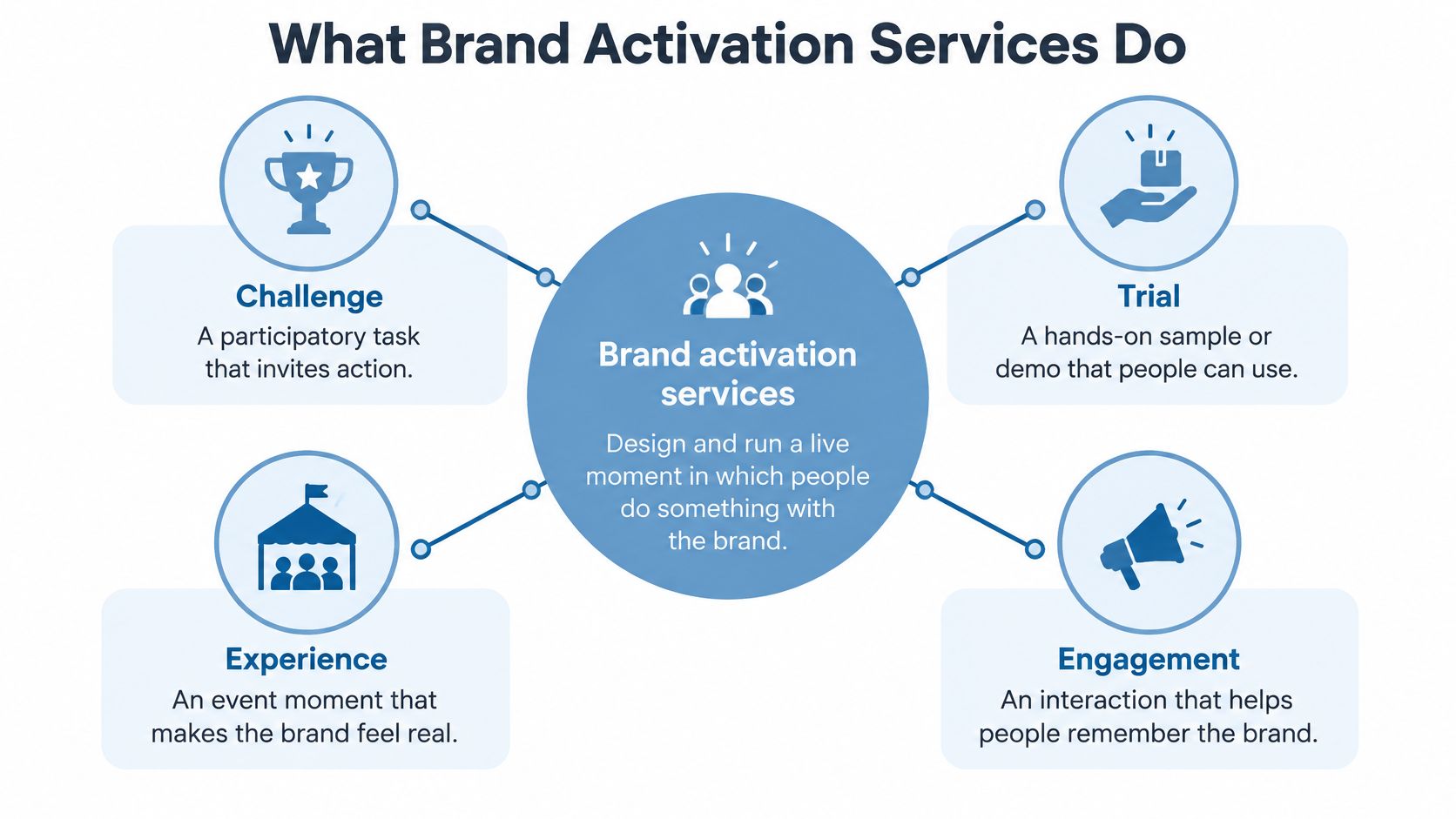
Brand activation services design and run a live moment in which people do something with the brand, such as a challenge, trial or demonstration, instead of only seeing its logo. For corporate planners, agency producers, exhibition organisers and in-house brand teams, the service connects an audience-facing idea with the equipment, crew and follow-up needed to deliver it.
Say a manufacturer is launching a product at an exhibition. Its planner needs more than a branded backdrop: visitors need a reason to approach, a useful interaction and a clear next step.
A static back wall is a shop window. An activation is the counter where someone tries the offer and leaves a name.
The commercial setting
Parliamentary evidence citing the UK Events Report 2024 puts the annual UK business-events contribution at £33.6 billion, including £16.3 billion from conferences and meetings and £10.9 billion from exhibitions and trade fairs. The same evidence reports that 38% of business events take place outside London, and compares average business-traveller spending of £209 with £101 for a leisure tourist.
Those figures describe the surrounding market, rather than activation revenue. They explain why exhibitors and sponsors care about attracting the right visitors and giving them a worthwhile reason to stay.
The venue base is substantial too: according to the Events Industry Alliance, reported by Event Industry News, approximately 1,145 exhibitions and conferences took place at the UK's main exhibition venues in 2024, attracting an estimated 7.2 million visitors.
The work behind the moment
The service has distinct jobs on the floor:
- Create a stop. Give someone a clear reason to turn towards the launch, stand or fan zone.
- Host a branded action. Make the experience understandable without a long explanation.
- Leave a usable record. Agree what marketing needs before choosing the capture method.
For a technology-led concept, Studio Liddell's resource on planning immersive experiences for brands is useful context for connecting strategy, technology and production. The practical distinction is between creating the idea and operating it reliably in a real venue.
When comparing experiential marketing agencies, separate creative ownership, equipment provision, staffing and reporting in the scope. A strong concept still needs an appropriate format and an agreed way to demonstrate its value.
UK Formats and Where Demand Sits
Choose the format by the audience's job, not by the largest piece of equipment available. Someone testing a drink, a buyer assessing a product and a supporter waiting for a match need different invitations.
The booking patterns below come from Fieldmarketing's analysis of 2025 experiential activity. They describe that dataset, rather than a complete census of every UK activation.
UK brand activation formats and demand signals
| Format | Best used for | Record on the day | UK demand signal |
|---|---|---|---|
| Product sampling | Trial and stated preference | Samples out and category choice | Nearly 49% of 2025 bookings, up 6% year on year |
| London hero activation | Highest-demand showcase | Verified visitors and completed actions | 39% of UK experiential activity |
| Regional roadshow | Comparable coverage outside the capital | Same mechanic and same lead fields in every city | Manchester, then Birmingham, Leeds, Newcastle, Glasgow and Edinburgh |
| Second-half immersive activation | Christmas and peak-season attention | Queue time, completion and repeat plays | Bookings more than doubled from the first half to the second |
| Exhibition or conference challenge | B2B meetings and product proof | Company, role and meeting status | Sits inside conferences, exhibitions and launches |
| Festival or fan-zone game | Participation and word of mouth | Unique players and shares, not passers-by | Stronger when the audience already expects a live experience |
Sampling is the volume mechanic in this comparison. Treat a sample as a counted trial with an optional preference question, not just something handed across a counter. Don't promise that distribution alone proves purchase.
A London showcase may justify a distinctive installation, but a prominent location doesn't guarantee the intended audience. Record completed actions separately from visitors so the team can distinguish attraction from participation.
Keep the experience comparable
For a regional roadshow, retain the same central mechanic and qualification fields. Localise directions, crew arrangements and venue logistics without altering what counts as a completed interaction.
Seasonal installations need a fresh operating plan. A quiet spring layout shouldn't automatically become the Christmas layout: review power, replenishment, crew breaks, weather protection where relevant and the space needed for queues.
Planning rule: A busier date needs a capacity decision, not just more branding.
An exhibition challenge should leave the sales team with a reason to arrange a meeting. Capture the business question behind the visit, rather than promising that every player becomes a qualified opportunity.
A fan-zone game serves a different purpose. Give supporters an enjoyable action and a result worth discussing, but don't equate a shareable image with verified social reach.
Pick one primary format first. Then check whether another city or a second-half date changes staffing, transport, installation access or queue management enough to require a revised quote.
A Measurement Pipeline Beyond Footfall
Activation metrics from exposure to commercial outcome
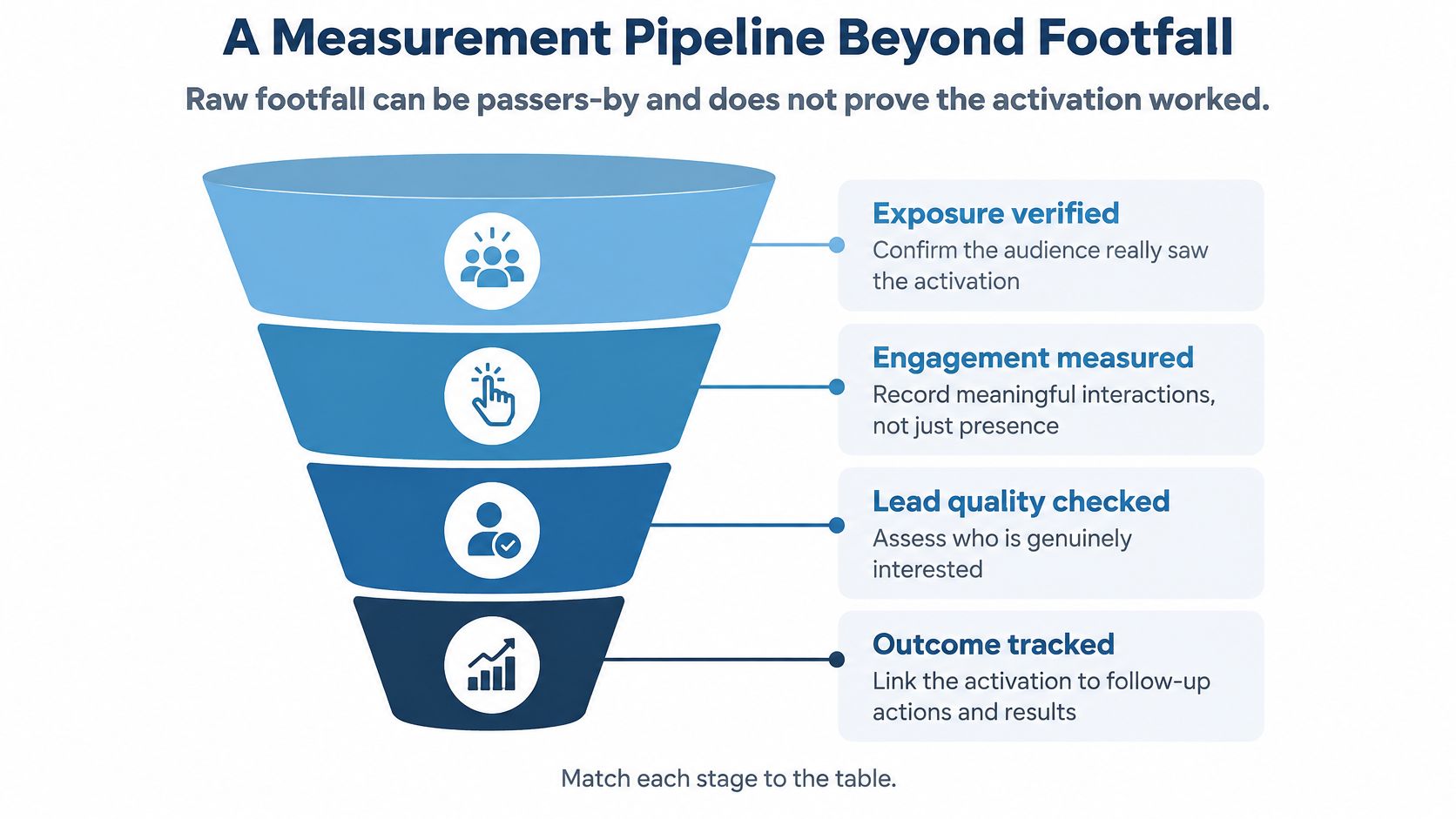
| Stage | What to count | What it can prove | When to read it |
|---|---|---|---|
| Exposure | Verified visitors, not everyone who walked past | Whether the activation was seen by the intended audience | Event day |
| Engagement | Dwell time, attempts, completion, score, repeat plays | Whether people actually took part | Event day |
| Conversion | Consented QR, CRM form or qualified badge scan | Intent and a usable first-party record | Event week |
| Commercial outcome | Meetings, opportunities, revenue or retention | Whether participation moved the business | 30, 60 and 90 days |
| Brand effect | Pre- and post-event awareness or consideration, with a baseline | Memory beyond the venue | After the event, against the baseline |
Raw footfall can be passers-by and does not prove the activation worked. The CORE initiative described by SpaceandPeople identifies footfall, sample distribution, sign-up rates and category preferences as live-campaign measurement points. They're useful inputs, but they need separate definitions rather than one headline total.
The commercial reporting cadence in the table follows Fresh Heather's guidance on measuring activation ROI, which recommends 30-, 60- and 90-day tracking beyond event week. Use those checkpoints to review what happened to the records, not to reissue the attendance report.
Build the record before opening
Start with a pre-event baseline and a written definition of each field. A London queue and a Glasgow queue aren't comparable if one team counts everyone nearby and the other counts only registered participants.
An electronic leaderboard or simulator system can log attempts, completion, score, ranking, repeat participation and average session duration where its configuration supports those fields. Staff can then capture consent and qualification information without treating a game entry as blanket permission for marketing.
Participation and dwell time are delivery metrics; qualified leads, meeting conversion, sales and repeat engagement are business metrics. Assign a campaign identifier to the usable records and agree who owns follow-up, deduplication and CRM updates.
The brand-effect row is a parallel check, not another funnel stage. Compare awareness or consideration after the event with the baseline, using consistent questions and a comparable audience.
Read the result without overstating it
A QR scan isn't revenue. A sales increase may also reflect paid media, seasonality or distribution changes, so use comparison groups where practical and describe attribution limits plainly.
For the reporting layout, ELECTE's resource on dashboard design for faster decisions offers useful context. Give operators a view of queues and completion, while marketing sees qualified records and subsequent outcomes.
Use the dataset to decide:
- Crew allocation. Whether the simulator-to-staff ratio supports both safe operation and useful conversations.
- Queue capacity. Whether visitors abandon the experience before participating.
- Future bookings. Whether to retain, simplify or replace the mechanic at the next UK date.
A defensible experiential marketing ROI review connects those decisions to evidence. It doesn't disguise missing commercial outcomes with a bigger footfall chart.
Benefits for Events and Marketing Teams
A marketing lead may want product consideration. An event lead may want a stand that attracts visitors without pulling every host away from conversations. A well-planned activation can serve both, provided the benefit is named before the creative is approved.
For the floor team, the practical gain is a hosted activity with a clear beginning and end. Operators run the equipment while brand representatives speak with guests, identify relevant needs and arrange the next conversation.
Participation creates a follow-up reason
A UK study of more than 50 experiential campaigns, reported by Marketing Week, found a 90% average increase in spontaneous brand awareness, a 91% increase in purchase likelihood, and recommendations to approximately four additional people per participant. These are findings from the campaigns studied, not guaranteed results for a new booking.
A ZEAL Group and Censuswide survey of 2,000 UK adults, reported by The Media Online, found that 26% recalled a live brand experience during the preceding year; 96% of those who remembered one took action afterwards, most commonly talking about it in person or by phone. That supports planning for conversation and follow-up, rather than assuming all value appears in a social dashboard.
The participant's action gives the follow-up something concrete to refer to. A result, a product preference or a question raised during a demonstration is more useful than an email that merely says thanks for visiting.
A spectacular queue with no consented records and no baseline is still a cost. A simpler experience with usable evidence can make a stronger case for the next booking.
Match the benefit to the audience
For a B2B stand, work backwards from the desired meeting. The host needs account context, the participant's role and the product issue worth discussing, not just a photograph of a busy aisle.
For a B2C fan zone or family day, the benefit may be repeat participation, conversation and a worthwhile reason to remain on site. Content teams can use a scorecard, photograph or leaderboard image as a participant-led story, with suitable permissions.
Keep the promised value specific:
- Launch communication. Let participants experience the claim rather than read another panel.
- Sales follow-up. Give the account owner relevant context for the next contact.
- Content reuse. Capture an output that makes sense after the event closes.
If the benefit can't be named before the creative is chosen, the activation is decoration.
Designing Activations People Can Actually Use
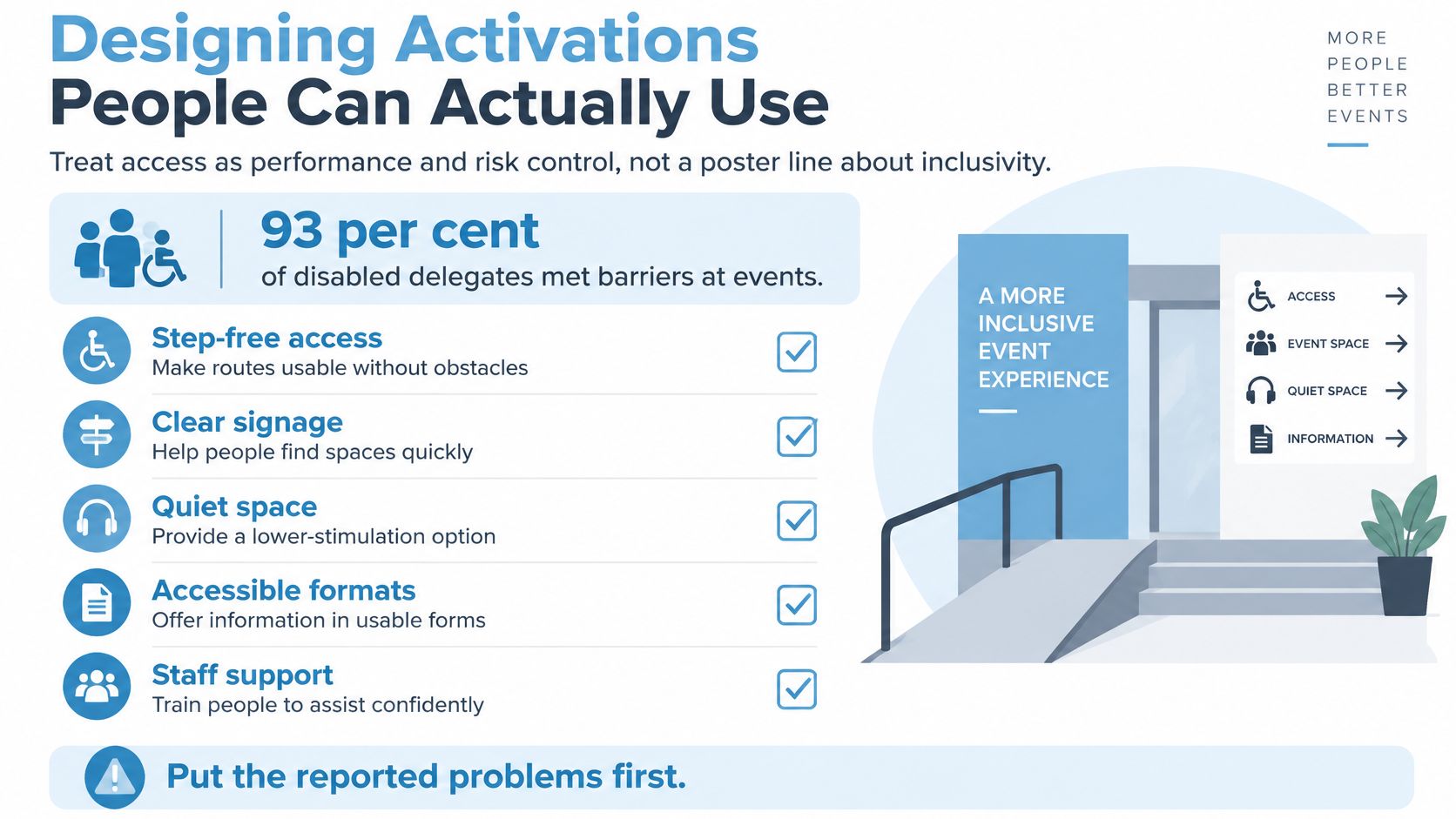
93% of disabled delegates experienced barriers at events, according to UK research reported by micebook. The reported barriers and communication findings below turn that headline into practical production decisions.
Treat access as performance and risk control, not a poster line about inclusivity. If someone can reach the stand but can't use the controls, the experience still excludes them.
Access barriers and what to change before arrival
| Barrier | Share reporting it | Change before the event |
|---|---|---|
| Inaccessible layouts | 28% | Step-free route, turning space and a reachable control height |
| Overstimulating environments | 27% | Sensory warning, quieter period and a lower-stimulus way to play |
| Untrained staff | 25% | Crew brief on offering help and not taking over the interaction |
| Inaccessible toilets | 24% | Confirm facilities with the venue and signpost them from the activation |
| Unclear or missing access information | 52% only sometimes clear; 17% missing | Send access notes with the invite, not only on site |
Start with the complete journey: arrival, queue, briefing, interaction, prize collection and exit. Keep cable protection, screens and spectators out of the usable route, and check turning space with the equipment in its installed position.
Publish sensory information before arrival. Describe flashing visuals, sound, motion and headset use plainly, then provide a quieter period or a lower-stimulus alternative where the chosen format allows it.
Adapt the interaction, not just the entrance
Specify seated and standing participation, reachable controls and a non-competitive alternative before equipment is confirmed. Don't describe a particular rig as accessible until the actual layout and interaction have been checked against participants' requirements.
Crew should explain the activity, ask whether help would be useful and let the participant direct that help. They also need to know how alternative participation and queue arrangements work.
Prizes shouldn't require a sprint to a distant collection desk. For useful takeaways, Dirt Cheap Product, Inc.’s guide to choosing promotional items attendees will keep provides selection context; make the collection process usable too.
Exclusion creates a measurement problem. People who can't play may never enter the completion or lead dataset, leaving a flattering dashboard that hides the failed invitation.
Send this pre-arrival check to the venue and hire team:
- Route and facilities. Confirm step-free access, turning space, toilets and signage.
- Interaction options. Confirm control reach, seated play and an alternative activity.
- Sensory information. Agree what will be published and what quieter option is available.
- Crew readiness. Name the briefing owner and explain how guests can request support.
Interactive Activations That Show the Idea
Each example below starts with an audience need and gives the planner three things: a stop, an action and a record. Read them the way a crew lead reads a rig plan. The stop gets people in, the action gives them something worth doing, and the record shows what the interaction produced.
An exhibition stand built around a meeting
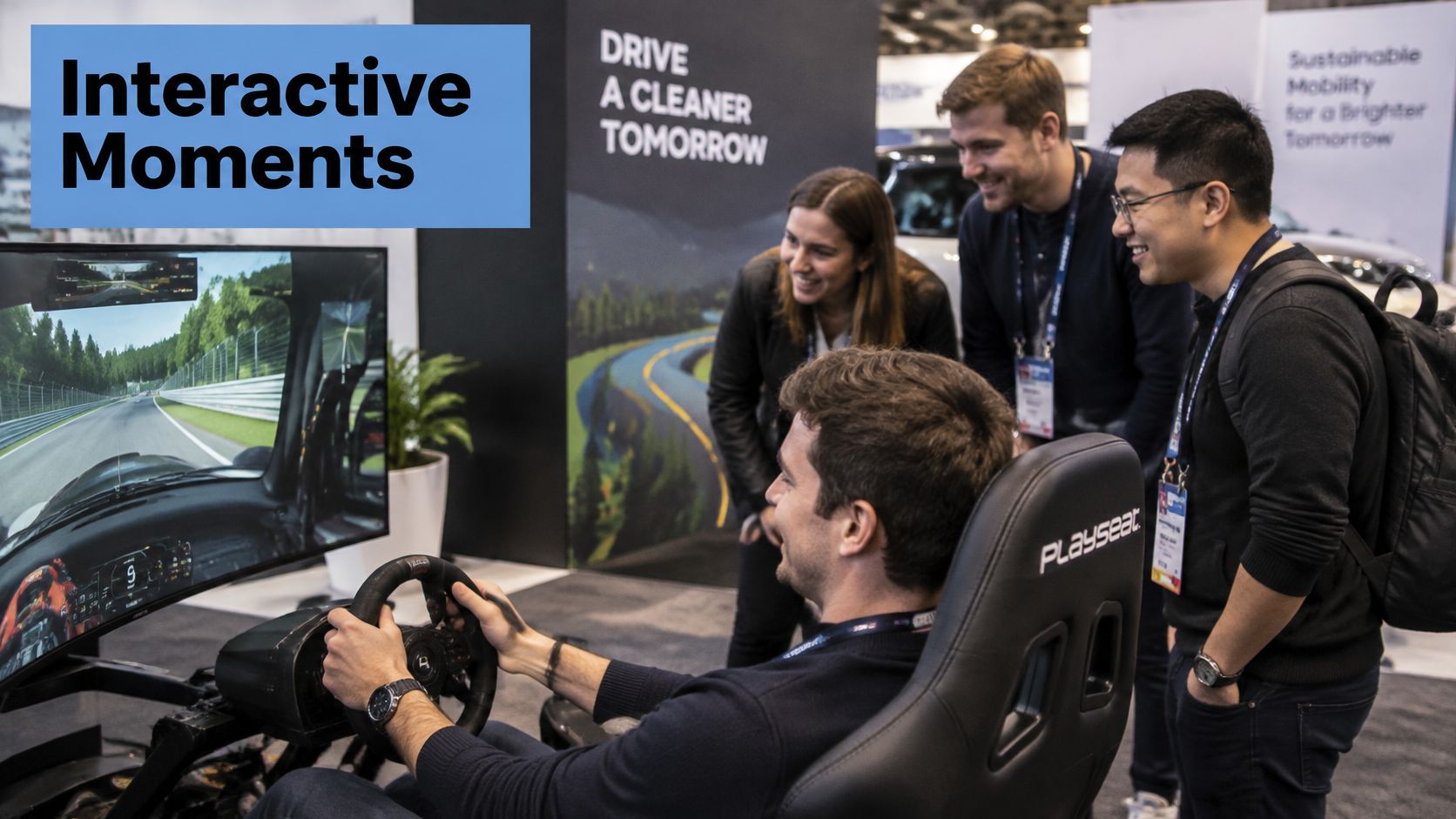
A visitor approaches a racing or flight simulator at a trade show. The attraction opens the conversation, while the host's purpose is to establish whether a relevant business discussion exists.
The stop is the visible stand entrance. The action is a timed session, followed by a brief conversation about the visitor's business needs.
The record is an electronic leaderboard result, with company and role captured by staff only after consent. The host can then offer an appropriate meeting rather than interrupting every participant with the same sales pitch.
A fan zone between matches
Supporters enter a branded zone where a football, rugby or motorsport challenge gives them something to do during a break. The operator explains the task while the host keeps the entrance clear and welcomes the next participant.
Here, the stop is the zone entrance, the action is the timed challenge and the record is a shareable leaderboard image plus a separately consented contact where appropriate. The audience job is entertainment and friendly competition, so the sales conversation stays optional.
Keep the challenge understandable from the queue. A supporter should know what they'll do and what result they'll receive before reaching the operator.
A promotional day for guests and families
At a brand-awareness day, reaction play, VR or a giant Scalextric track can provide a common activity for B2B guests and B2C families. Choose the interaction according to the guests' interests and the available space; the most elaborate visual is rarely the right default.
The stop is the activity area, the action is the chosen play session and the record is a leaderboard output participants can keep or share. Give hosts a natural moment to explain the brand connection so the activity never becomes an extended sales presentation.
PSW Events offers often inclusive, interactive activations for B2B and B2C audiences. We operate football, motorsport and flight simulators for conferences, exhibitions, brand awareness, party entertainment, sports fan zones and public events, alongside electronic leaderboards, game consoles, giant Scalextric and VR hire.
One recorded customer comment shows how a single activation can land with its intended audience:
“the day was brilliant and the children loved the coaching session on the Rugby Simulator”
Rachel B., Clydesdale Bank
Use interactive exhibition ideas to explore suitable equipment, then choose the pattern from the audience's job and apply the branding. If you want to quote a client's results, use figures the client has confirmed and approved for publication.
Brief PSW Events for Your Next Activation
A useful brief reads like a rig plan: what arrives, who it serves, how people take part and what counts as proof. Send those decisions and the quote can be compared like for like.
- Audience and city. Name who should participate, the town or city and the venue, including access limits.
- Primary format. Choose one main interaction, such as a simulator, leaderboard game or VR station, rather than mixing unrelated attractions.
- Success measure. State the commercial result and the evidence due at 30, 60 and 90 days: leads, bookings, repeat visits or recorded scores.
- Access requirements. List the route in, seated or standing participation, sensory information, queue space and staff support.
Match the service to the site
PSW Events is based in Cambridge and hires interactive entertainment across the UK, with service levels from dry hire, where no operator is required, up to full event management. Full management covers online planning meetings, site visits for site plans, power and utility requirements, on-the-day management and staffing, so your team can stay with guests. After equipment or a package is chosen, final details such as location, event times and site contacts are collected online or by phone. Cover includes £10 million products, employee and public liability insurance and more than 50 years of industry experience.
Make discovery part of delivery
Give Google an indexable event page with clear location and registration terms, and make the booking journey easy to complete on a phone. Pricing depends on format, site and whether operators are included. Ask each supplier for a written quote against the same decisions, then send your format, access requirements and success measure to sales@pswevents.com.
PSW Events offers interactive simulators, games and event support for brand activations across the UK. Visit PSW Events to match your audience and venue to available equipment.