
At 9am on opening day, the stand looks excellent. The lighting is right, the graphics are clean, and the attraction has arrived on schedule. Yet the badge scanners are idle, ambassadors are waiting for permission to start conversations, and nobody can explain what a visitor should do next. By the afternoon, the brand has generated footfall but little usable data.
That's the difference between a decorated event space and brand activation design. A successful activation engineers attention, participation, data capture and follow-up as one connected experience. The creative idea matters, but so do the queue, the power plan, the staff script, the interaction mechanic and the report that reaches the marketing team after de-rig.
What Brand Activation Design Really Means
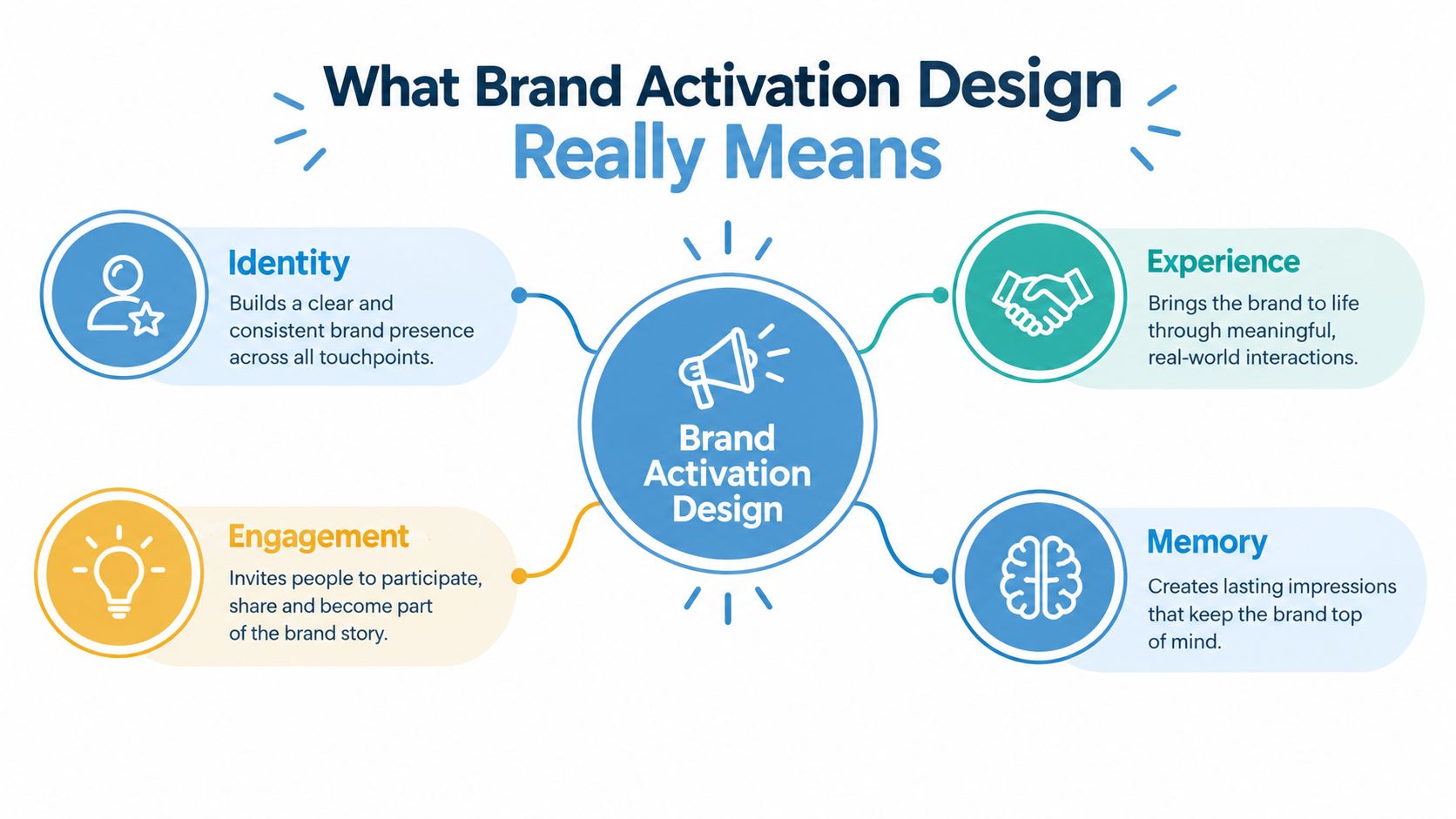
Brand activation design is the deliberate planning of a live experience that turns a brand message into measurable action. That action may be a product trial, a qualified conversation, an opt-in, a change in perception or a remembered message. The visitor should understand the offer, take part in something relevant and leave with a clear next step.
Stand design usually concentrates on visual presence. Event branding applies identity across graphics, furniture, screens and signage. Brand activation design connects those aesthetic decisions to behaviour. It defines what the audience notices first, what they do next, which information the team captures and how the brand continues the conversation afterwards.
Start with the commercial outcome
Set the outcome before choosing the attraction. A product launch may need hands-on trial. A B2B exhibition stand may need sales-ready leads. A fan zone may prioritise participation and positive sentiment. Each objective changes the space, staffing model, data flow and creative treatment.
Use this planning sequence:
- Define the action: Decide what a valuable visitor interaction looks like.
- Map the journey: Set the entry cue, participation step, brand message and exit action.
- Choose the mechanic: Select a demo, game, simulator, performance or conversation that makes the message tangible.
- Instrument the experience: Decide where scans, consent, feedback and interaction data are captured.
- Plan the handoff: Specify what happens to the data and who owns follow-up.
Practical rule: If the team can't describe the visitor journey in a few clear steps, the audience won't move through it smoothly on the floor.
The UK market exposes weak planning quickly. The live events sector generated £11.5bn of economic value in 2024, while the broader events industry supported £11.7bn of total economic output in 2025 and more than 127,000 jobs across the country, according to UK Events industry research. Brands activating at ExCeL, the NEC, Silverstone or a major festival operate within established infrastructure and substantial audience throughput.
Build measurement into the experience from the start. A simulator, demonstration or game can create dwell time, but its value depends on the interaction data, consented lead and follow-up route attached to it. Visual impact earns attention. Instrumentation turns that attention into a usable commercial result.
The Strategy and Creative Process Behind UK Activations
Creative teams often begin with the most visible part of the job, the idea. Producers know that the dependable route runs in a different order: insight, concept, build, run, measure. Treating those stages as separate workstreams gives each one an owner, a decision point and a deliverable.
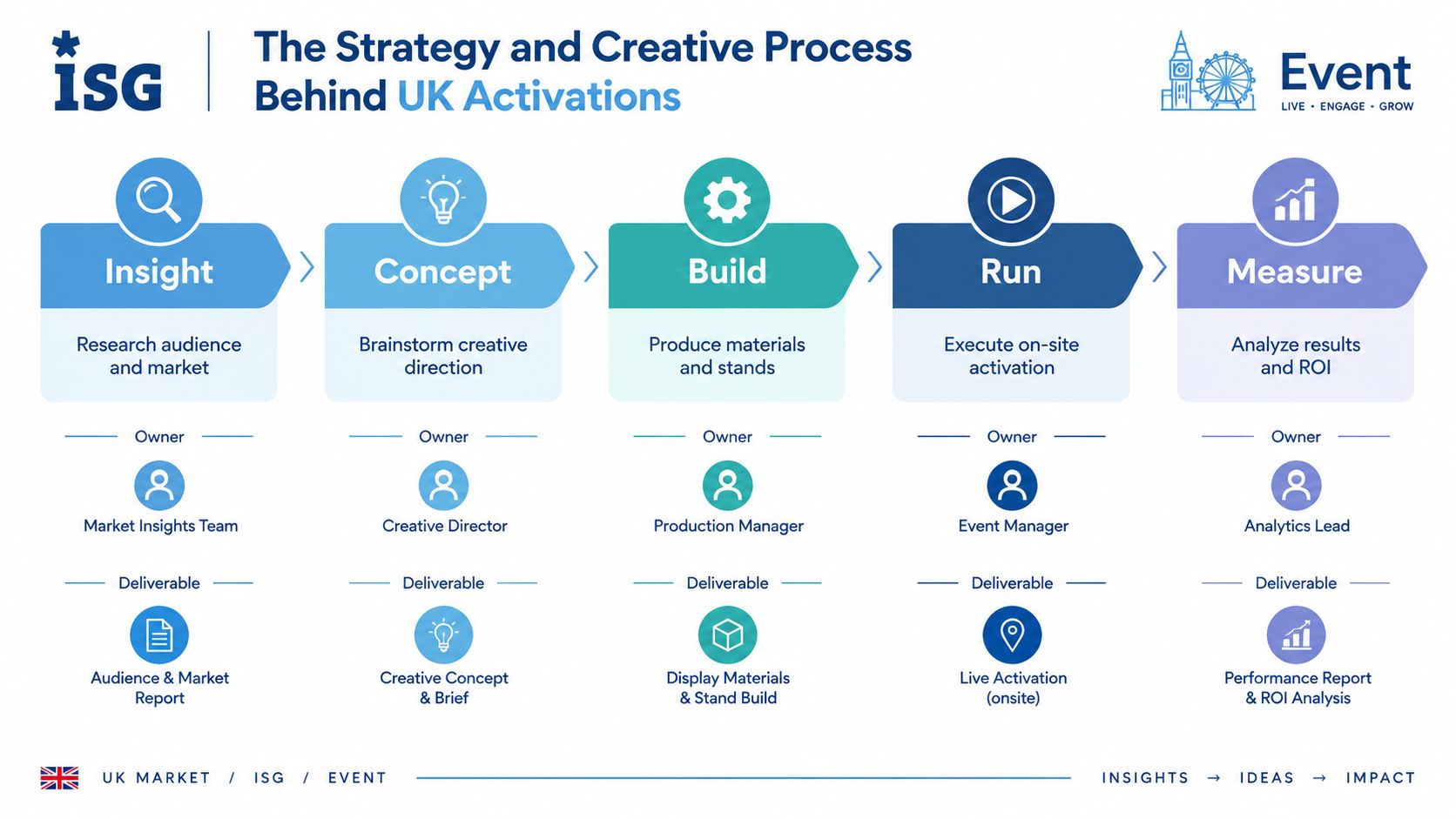
Insight
Start with the audience, venue and commercial problem. A trade show audience may arrive with limited time and a clear product question. A hospitality guest expects a more relaxed experience. A festival audience may respond to a simple, visual mechanic rather than a detailed demonstration.
The insight workstream should deliver a defined audience need, a message hierarchy, qualifying criteria and an initial measurement plan. UK experiential activity remains a significant channel, with 93% of UK event marketers running in-person or hybrid events on home soil in 2023, as reported by UK experiential marketing statistics. That makes audience relevance more important, not less. A crowded event gives brands plenty of potential contacts, but only a well-defined interaction turns attention into useful engagement.
Concept
The concept translates the insight into a participation mechanic. It might be a racing challenge, an interactive product selector, a live demonstration or a short diagnostic conversation. The strongest concepts make the brand's value visible through the activity itself.
Avoid adding technology because the brief says “immersive”. A simulator that has no connection to the message becomes an arcade machine. A beautifully staged product reveal that leaves visitors with no action becomes a photo opportunity. The concept should explain why the audience participates and why the brand has earned that moment.
Build, run and measure
The build workstream turns the concept into a safe, repeatable environment. Lock the footprint, power, access, graphics, queue treatment, data points and staffing requirements before the run sheet is finalised. If the build changes late, the operation inherits the risk through rushed testing, confused staff and missing equipment.
The run workstream covers briefing, opening checks, queue management, resets, fault escalation and close-down. The measure workstream should already have defined the fields, consent language, reporting owner and post-event timeline. UK experiential budgets rose 17.2% in Q2 2024 and 23.1% in Q1 2024, with experiential showing the fastest growth in the cited Bellwether dataset, according to brand activation success-rate reporting. Rising budgets bring sharper questions about efficiency, so measurement can't be bolted on after de-rig.
For teams developing the experience architecture, immersive experience design guidance is useful when mapping entry cues, the main interaction, outcome moment and follow-up path. The point isn't to make every activation elaborate. It's to make each design decision answerable.
Planning and Logistics for UK Activation Builds
The operational plan starts with the venue, not the render. ExCeL, Olympia, the SEC and other UK venues each have their own access rules, loading arrangements, submission processes, curfews and approved-contractor requirements. Confirm the event timetable, build access, storage position, vehicle booking process and emergency contacts before production begins.
Build the compliance route early
For a public-facing activation, the production file should cover CDM 2015 responsibilities, risk assessments and method statements, commonly known as RAMS. Submit the documents early enough to accommodate a venue query or rejection. A late RAMS rejection can stop an otherwise complete build from entering the hall.
Check the practical constraints alongside the paperwork:
- Floor loading: Confirm that the venue can accept the attraction, scenic elements and people in the intended footprint.
- Power: Specify the supply, distribution and equipment load. Under-specified generators and improvised cabling create avoidable operational and safety problems.
- Rigging: Secure approval for hanging signs, lighting or overhead branding before the design is released.
- Insurance: Provide public liability cover at the level required by the venue and client, with the relevant documentation available to the organiser.
- Audience safety: Review access, trip hazards, queue barriers, supervision and safeguarding. DBS requirements may apply where the audience includes under-18s.
Protect the visitor journey
Branding wrap should be printed against approved artwork, then pre-flighted for colour, resolution, bleed and installation orientation. A courier delay can leave a premium attraction operating beside unfinished graphics, so carry a contingency plan for critical print and use venue-approved storage where possible.
Furniture affects movement as much as comfort. Seating that blocks the queue or places a conversation outside the lead-capture point weakens the whole system. For practical guidance on matching seating, tables and display pieces to the floor plan, consult Ability Furniture Hire's selection guide.
Install windows should respect venue curfews, crew availability and testing time. Peak season creates double-booked crews, tight transport schedules and limited access slots. Confirm who is responsible for each handover, then allow time for a full systems test, including the attraction, screens, scanners, network connection, lighting and staff route.
De-rig is part of reporting. Label equipment, protect captured data, photograph the final condition and schedule the removal of graphics and hardware so the team can meet post-event reporting deadlines. Logistics isn't admin sitting behind the strategy. It determines whether the audience experiences a smooth journey or sees the production problems underneath it.
Measurable Objectives and KPIs That Prove Value
Measurement works best when the stand is designed around the data it needs to produce. A scanner placed behind the attraction captures fewer usable interactions than one positioned at the natural exit. A survey that appears before the visitor understands the brand creates friction. A QR code without a clear reason to scan becomes decoration.
Use five KPI families, then connect each one to a physical or operational decision.
| KPI | What It Measures | Typical UK Benchmark | Build-Stage Fix |
|---|---|---|---|
| Interaction rate | The proportion of visitors who actively participate | Set a target from the event objective rather than relying on footfall | Place the mechanic at the front of the journey and make the first action obvious |
| Dwell time | The quality and duration of attention | Define a useful interaction window for the audience and format | Design queue, reset and content timing around that window |
| Scan-to-lead conversion | The proportion of participants who become usable contacts | Agree qualification and consent rules before launch | Put QR, NFC or badge capture at the natural outcome point |
| Sentiment capture | Immediate reaction, understanding and preference | Compare responses against the campaign objective | Add a short prompt or mobile survey after participation |
| Downstream brand lift | Change in awareness, consideration or intent | Establish a pre-event baseline and post-event comparison | Build survey triggers and CRM matching into the data plan |
The supplied plan references benchmark ranges for B2B dwell time, lead capture conversion and brand-lift movement, but those figures aren't included in the verified data available for this article. Use them only if your own client, venue or research source supports them. A credible target is more useful than an impressive number with no comparable methodology.
UK experience-quality research shows how seriously measurement is now treated. KPMG's 2024/25 customer-experience benchmark draws on 124,505 consumer evaluations across 399 UK organisations, as described in the UK state of customer experience report. For an activation, that reinforces the value of a coherent journey. The physical environment, staff script, participation step and data capture should tell the same story.
Engineer the data path
Scope sensors, RFID, mobile capture, survey triggers and post-event sales attribution during concept development. Cabling, power, device charging, network access and data permissions all affect the build. If the measurement system appears on the day, the team will improvise around it.
Calculate return using cost per qualified interaction, not cost per impression alone. Impressions describe exposure. Qualified interactions show whether the investment created a conversation, trial, opt-in or sales opportunity. Experiential marketing ROI guidance can support the wider planning conversation, but the final model should reflect your objective, qualification rules and follow-up capability.
Activation Formats and Where Simulators Fit In
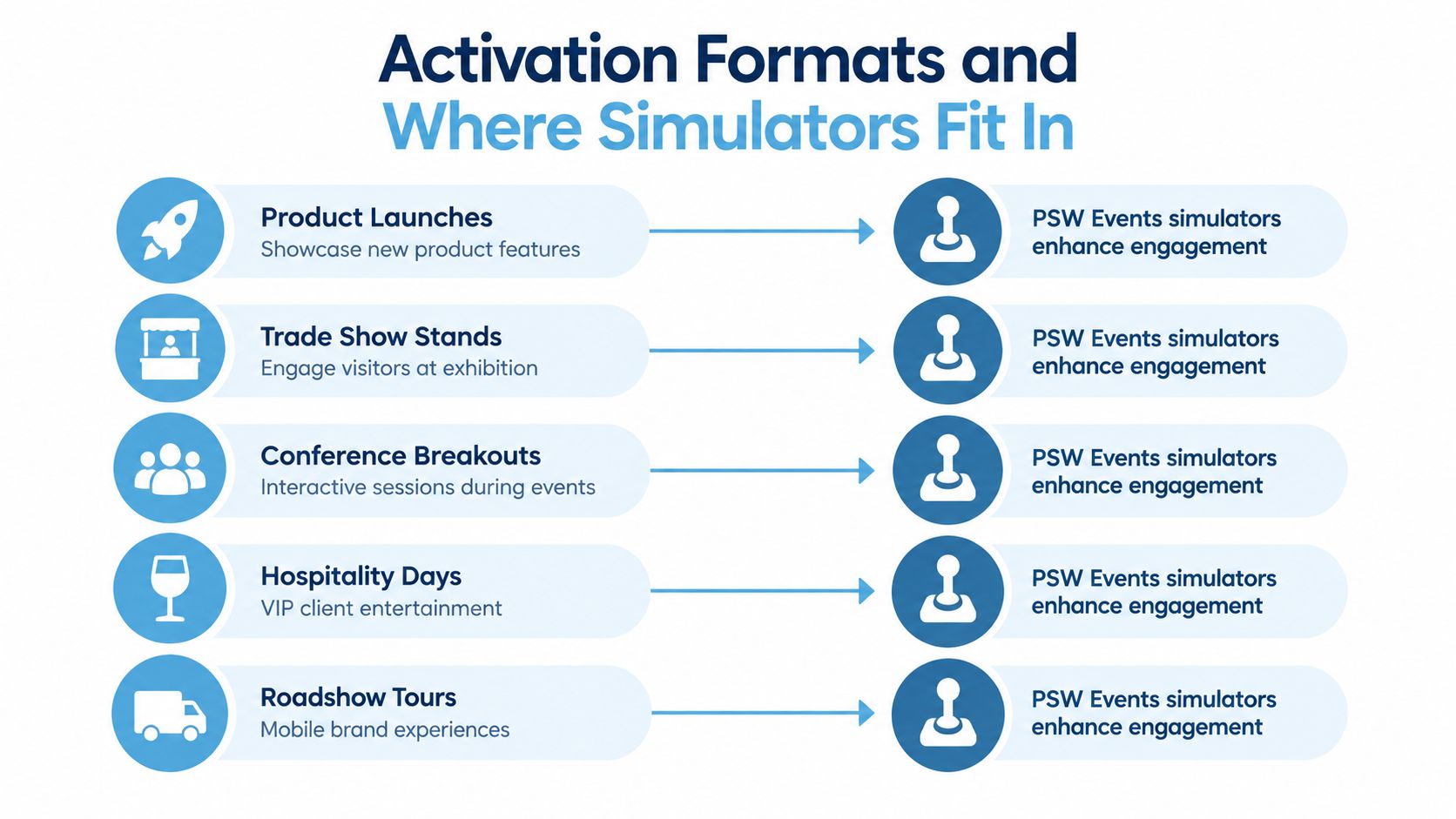
The right attraction depends on the audience behaviour you need. A product launch needs a reveal and a demonstration. A trade show stand needs repeated, intelligible interactions. A hospitality day needs a premium experience that doesn't make guests feel processed.
Match the format to the floor
At a Silverstone hospitality day, racing simulators can create a natural competitive anchor. Guests understand the challenge quickly, while branded leaderboards provide an outcome that can support conversation and content. The producer still needs to confirm the footprint, power draw, staffing ratio and throughput with the supplier, because those specifications vary by rig, venue and operating mode.
On an ExCeL exhibition stand, sports simulators can attract visitors from an aisle and create a reason to stay. The brand team can place the qualifying question, badge scan or QR handoff at the end of the interaction rather than interrupting the first moment of interest.
For a conference lobby, Batak Pro reaction walls offer a short, visible mechanic that can energise arrivals without requiring a long briefing. VR headsets can support product storytelling where a three-dimensional demonstration communicates more clearly than a screen, but the producer must plan headset hygiene, reset time, accessibility and supervision.
A festival or family-facing event may suit a climbing wall as a crowd magnet, provided the safety plan, supervision, queue and age suitability are clear. A premium evening can use casino tables to create a more social, hosted atmosphere. A roadshow requires transport, modular packaging, rapid setup and a format that works consistently across changing sites.
Specify the operating model
Before approving a simulator, request the details that affect the rest of the activation:
- Footprint: Confirm the required area in square metres, including queue, operator position and safe clearance.
- Power draw: Establish the supply, distribution and backup plan for the exact equipment package.
- Staffing ratio: Define the number of operators, hosts and brand ambassadors needed for safe, consistent delivery.
- Throughput: Model participants per hour after briefing, reset, sanitation and data capture, not just the headline play time.
- Brand integration: Agree which elements belong to the supplier and which remain with the agency, including wrap, signage, content and CRM flow.
Simulators work because they give visitors a participatory mechanic that competing stands can't copy in the same moment. They don't replace the campaign idea. The surrounding message, visual identity, lead-capture route and follow-up remain the agency's responsibility.
For attraction options and operational planning, simulator hire for UK events provides a relevant starting point. Treat the hire as one component in the system, not the system itself.
Best Practices for Corporate and Experiential Marketing
Large builds can look impressive while producing weak conversations. On busy UK trade-show floors, a compact, well-run stand with a clear mechanic often gives the team more control than a sprawling custom environment. The commercial question is whether each square metre earns attention, participation or a useful handoff.
Make the build repeatable
A modular structure should travel between London, Manchester and Birmingham without needing a full rebuild. Reusable frames, fabric graphics and replaceable panels reduce waste and make the next brief easier to cost. Printed fabric wraps can also create a cleaner finish than disposable foam board when the design team has planned the tensioning, storage and re-use route.
Staff need a single qualifying question, not an open-ended instruction to “have conversations”. The question should reveal fit quickly, then give the ambassador permission to guide the visitor towards the demo, attraction or sales colleague.
The rest of the operating model should support that simplicity:
- Connect physical and digital: Make the interaction lead naturally to a QR, NFC or badge capture point, then send the agreed follow-up within 48 hours, a timing expectation reported in UK events industry research.
- Seed the sales team: Share account context and agreed conversation goals before doors open, so sales staff recognise priority visitors rather than starting cold.
- Capture usable content: Record the interaction, leaderboard or product moment on the floor, then repurpose the footage during the same week.
- Debrief with discipline: Record what attracted people, where queues formed, which questions confused visitors and which leads progressed into the next-quarter brief.
- Budget each touchpoint: Protect spend on the mechanic, operator quality, data flow and follow-up before adding scenic extras.
Even small branded details need a job. If headwear or merchandise forms part of the visitor journey, creative hat display styling tips can help the team present it as an organised visual feature rather than a pile of giveaways.
The activation doesn't finish when the trucks leave. Content, CRM handoff, sentiment analysis and the next brief are where the physical experience becomes a repeatable marketing asset.
Bringing It All Together on Your Next UK Activation
Start with the commercial outcome. Then choose three measurable KPIs that prove whether the activation achieved it, such as qualified interactions, consented leads and a post-visit perception measure.
Shortlist two or three formats against the venue before approving the creative. Ask suppliers for the full operating specification, including footprint, power, access, staffing, throughput, insurance, RAMS support, installation timing and de-rig responsibility. If a simulator is part of the concept, scope it alongside the brand wrap, queue, operator position, content and lead-capture point.
Instrument the experience before install. Test the scanner, QR or NFC route, survey prompt, network connection, data permissions and reporting handoff in the same environment where the audience will use them. If budget or lead times tighten, cut decorative complexity before removing the mechanic, trained staff or measurement path.
A disciplined £50,000 activation with clear KPI plumbing can be more useful to a board than a £250,000 spectacle with no measurement. Those figures are editorial examples, not performance benchmarks. The principle is practical: repeatable UK activations come from controlled decisions, not from spending more on visible scenery.
PSW Events supplies, installs and operates interactive attractions for brand activations, exhibitions, conferences and hospitality events, including racing and sports simulators, VR, Batak Pro, climbing walls and casino tables. Visit PSW Events to discuss an attraction-led activation with the planning, branding, logistics, staffing and H&S requirements built into the brief.