
You're on a site walk with a supplier, the carpet tape is already down, the stand shell is built, and someone has just asked where the boxing machine hire unit can live without blocking the fire route. That's the moment this purchase gets decided, not on a glossy listing page, but on a loading bay with a stopwatch running and a venue manager watching clearances.
The best hire choice isn't just about whether the machine works. It's about whether it fits the audience, the schedule, the power, the access, the insurance, and the reason you booked an interactive attraction in the first place. A boxing machine can be a sharp, fast-moving crowd magnet, but it can also become an awkward prop if you treat it like a commodity and ignore how it runs on the day.
What Boxing Machine Hire Includes
The first truck doors open, and the unit usually looks like a single arcade cabinet. The hire package carries more weight than that. Alongside the punch mechanism and scoring display, it often includes the sort of attention-grabbing presence that pulls people off the aisle and into the queue. Depending on the brief, it may also cover branded signage, transport, installation, derig, and an attendant who keeps the queue moving and the play fair.
That detail matters because clients are not renting “a game”. They are renting an outcome, usually a burst of attention, a run of competitive plays, and a reason for people to gather around a stand or bar area. A dry hire can work if the venue team already knows how to handle the logistics, but most corporate buyers are weighing delivered hire against fully managed activation.
The difference is practical. Once the hire includes delivery, positioning, test-play, queue control, and on-site support, the budget line starts to look like an event service rather than a product rental. That is the right lens for exhibitions and private functions, because what you are buying is the ability to switch on entertainment without adding another layer of operational stress.
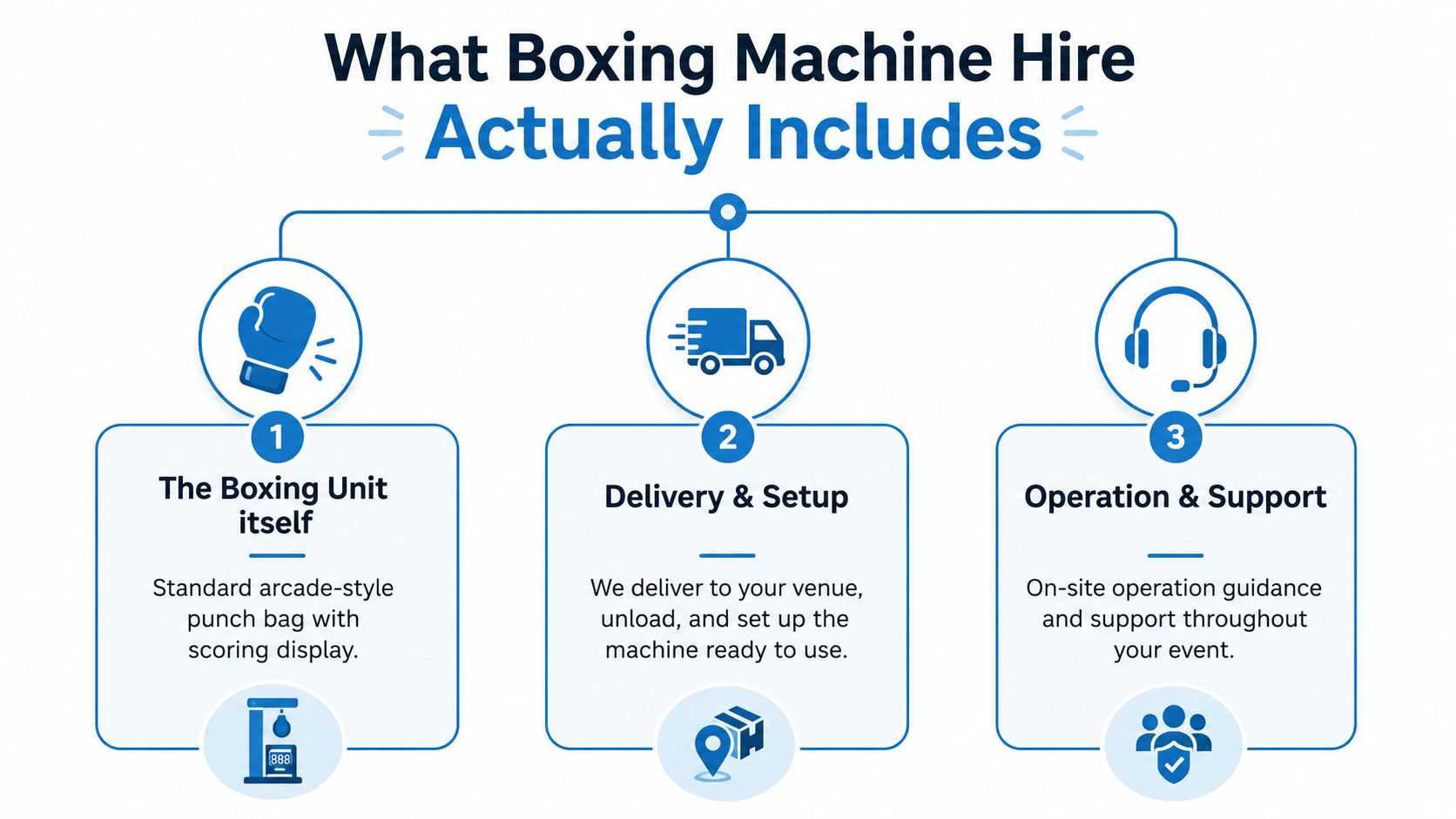
A boxing machine only feels simple once the power is in, the floor is level, and someone is there to manage the queue.
The hire tiers that matter
A dry hire is the simplest model, but it only works when the venue can handle access, placement, and oversight. Delivered hire shifts the heavy work to the supplier, which usually helps when the event team is already stretched across registration, catering, and exhibitor support. Fully managed activation is the format many planners end up choosing when the unit has to perform as part of a wider brand moment, not just sit in a corner and wait.
For planners comparing supplier models, the detailed breakdown on equipment rental rates for live event assets is a useful benchmark when you are deciding how much operational help you need. The key question is whether you want a machine, or whether you want a managed attraction that behaves like one more polished part of the event floor.
Power, Space and Setup Essentials
A boxing machine only works smoothly when the venue gives it the basics. Most units need a single 13A mains socket, around 2.5m high by 2.5m deep of clearance, and roughly 15 minutes for setup once access is confirmed as specified by a UK hire listing. That sounds modest until you're standing in a crowded hall where every spare metre has already been claimed by shell scheme, furniture, or sponsor build.
The operational checklist I'd hand to a venue
- Power: One standard socket is enough, but it needs to be close enough to avoid messy cable runs.
- Space: Leave room for the suspended bag to swing without clipping adjacent props or passing guests.
- Surface: Put the unit on flat, level ground. Uneven floors cause avoidable headaches.
- Access: Confirm the route before load-in, not after the van is parked.
- Timing: Treat setup as a short task only after the venue has cleared the way.
The weight side matters just as much as the footprint. UK hire listings show machines at 120 kg, 125 kg, 142 kg, 160 kg, and up to 200 kg, depending on model, which changes how you plan unloading, floor loading, and the vehicle you send according to UK supplier listings. One supplier also notes that the unit is on wheels but still can't be moved across grass, gravel, or stairs, so “we can get it close enough” is usually not a plan.
Practical rule: if the access route would be awkward for a catering fridge trolley, it'll be awkward for a boxing machine too.
That's why production teams should ask for the exact cabinet size, the access requirements, and the floor conditions before they commit. If the machine has to travel through service corridors, lifts, or stage wings, the route should be checked like any other heavy interactive prop. The right supplier will talk about access like a logistics partner, not a sales desk.
How Boxing Machines Compare to Other Interactive Attractions
A boxing machine competes in a crowded class of interactive attractions, and it doesn't win every time. A racing simulator usually gives longer individual sessions and a more immersive experience, while a Batak Pro style reaction wall is often better when you need rapid repeat turns and easier flow through a queue. VR pods can create strong novelty, but they tend to need more control, more briefing, and more patience from the crowd.
Where the boxing machine has the edge
A boxing machine is strongest when the audience wants something obvious, loud, and instantly understandable. Exhibition stands, fan zones, gym launches, and sport-adjacent events tend to reward that kind of format because people can size it up in seconds and decide whether to have a go. It also creates a simple social loop, someone punches, someone watches, someone tries to beat the score.
The weak spot is just as important. In premium hospitality, mixed-age family events, or settings where the tone needs to stay calm, a boxing machine can feel a bit aggressive unless it's carefully framed. Leaderboards, timed heats, and prize moments help, but they don't change the fact that not every audience wants to shout, compete, and queue for a punch challenge.
A good activation tool isn't the one with the most noise, it's the one that matches the room.
A useful way to choose
- Choose boxing machine hire when you want fast comprehension, visible competition, and a crowd that enjoys performance.
- Choose a simulator when your audience will stay longer and tolerate a deeper experience.
- Choose reaction-based games when throughput matters more than spectacle.
- Choose VR when novelty and immersion matter more than open-floor visibility.
That's why boxing machines often work best as a lead attraction rather than the only attraction. They're excellent at drawing people in, but they're not universally suited to every corporate audience, which is the mistake many brochure-style listings never admit. The best hire decision is the one that matches the crowd, not the one that looks most exciting on a supplier page.
UK Pricing, Packages and Throughput Economics
A boxing machine hire quote only makes sense once you separate hire cost from activation cost. A unit that looks cheap on paper can become expensive if it sits idle, needs extra supervision, or slows the stand down because the queue is messy. For planners, the key question is whether the machine will earn attention quickly enough to justify the spend.
Pricing in the UK is uneven, which is why it helps to work from live hire listings rather than guesswork. A London card-operated boxing punch machine is listed at £57 to £200 per day, with a 7-day rate of £400 quoted for the same item on a UK hire listing. That points to a straightforward commercial pattern, short-term hire is being sold as a day-rate product, not as a long contract.
Typical UK Boxing Machine Hire Packages
| Package Tier | Indicative Day Rate | What Is Included | Best Fit |
|---|---|---|---|
| Dry hire | Varies by supplier | Unit only, collection terms may vary | Sites with strong in-house event ops |
| Delivered hire | Varies by supplier | Transport, placement, and collection | Exhibitions and one-off brand activations |
| Fully staffed activation | Varies by supplier | Unit, install, attendant cover, queue management | High-footfall events and live campaigns |
Those package tiers change the economics in a real way. Dry hire keeps the invoice lower, but it also transfers the handling burden to your team, and that can be a bad trade if the venue is busy or the crew is already stretched. Delivered hire removes some friction, while fully staffed activation usually costs more but protects throughput because someone is there to keep the line moving and the rules clear.
There is also a performance benchmark worth keeping in view. One UK-based provider says its boxing machines have generated over £2,000 per month in profit for a well-placed unit in the British market. That is not a general market average, and it should not be treated as one, but it does show what happens when footfall is steady and the unit stays active instead of gathering dust between turns.
For planners, the useful move is to match the package to the event rhythm. A one-day exhibition stand needs the machine to justify itself through lead capture, dwell time, and visible crowd pull. A roadshow or pop-up can spread the cost over more touchpoints, so the daily rate is easier to defend. Venue-based use changes the equation again, because the conversation becomes closer to utilisation and return-on-footfall than a single rental decision.
For a clearer read on how suppliers build activation budgets, see our guide on experiential marketing activations. The commercial question is blunt, does the boxing machine create more attention than the same budget would buy in another format, and does that attention come with enough dwell time to matter?
Safety, Supervision and Legal Duties
Most hire pages sell the spectacle and skip the risk. That's a mistake, because the planner still carries the duty to make the attraction safe, and the supplier should be able to show how they help with that. In practice, you want a risk assessment, clear participant guidance, spacing around the swing zone, and a named person who understands when to slow things down.
What to ask before you sign
- Risk assessment: Ask for a written assessment that covers placement, power, access, and crowd flow.
- Supervision: Confirm whether the supplier provides a trained attendant or expects venue staff to run the game.
- Participant control: Decide who can play, how the queue is managed, and when a competitor is too tired or over-enthusiastic to continue.
- Insurance: Check public liability cover before the machine lands on site.
- Escalation rules: Competitive formats need rules for repeated attempts, disputes, and unsafe behaviour.
That's especially important at exhibitions and brand activations, where people get drawn in fast and queues can form at the worst possible angle. A good supplier should explain how they handle warm-up guidance, safe spacing, and public-facing oversight rather than assuming the machine can just be switched on and left alone.
There's also a legal side that gets overlooked. Under the amusement device maintenance framework, devices should be maintained and inspected by a competent person in line with the manufacturer's instructions or a competent maintenance manual, and a log book should travel with the device to record erection and storage details as set out in the general guide. That's the kind of operational discipline many casual listings never mention, but event teams should expect it.
For longer consumer hires, the regulatory line is even sharper. Hiring goods to a consumer for more than 3 months can fall into regulated consumer hire territory, with possible FCA implications and unenforceability risk if the activity is carried on without authorisation as outlined in consumer hire guidance. For planners, the practical takeaway is straightforward, short-term event hire is one thing, but long-term consumer rental needs proper legal checking.
If background screening is part of your staffing model, a volunteer criminal background check can be a sensible resource to review alongside the rest of your event compliance paperwork.
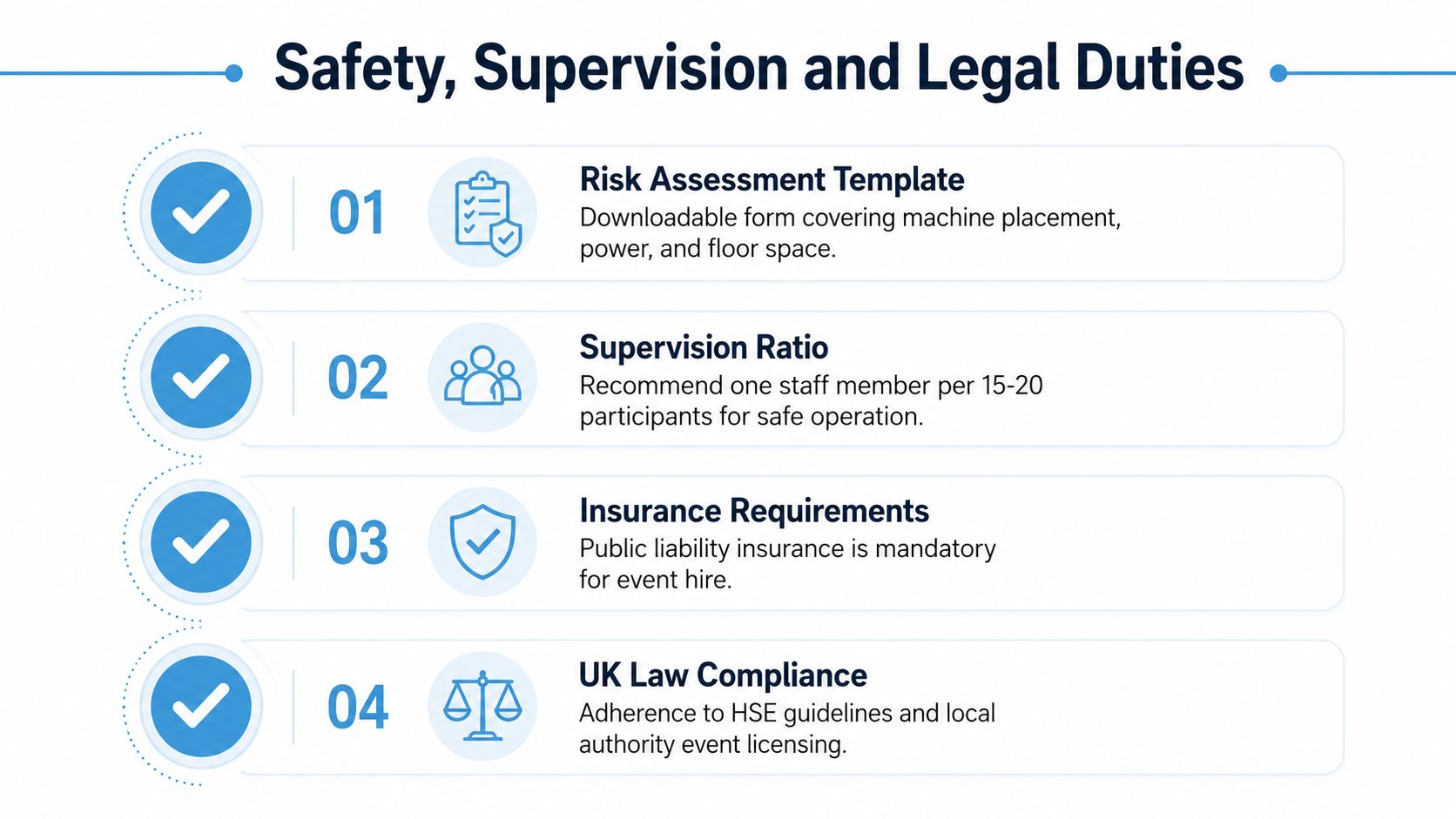
For planners who want a ready-made starting point, an event risk assessment template is the right place to begin before the machine reaches the loading bay.
Branding, Customisation and Activation Mechanics
A plain boxing machine is a novelty. A branded boxing machine is campaign space. That difference matters because the cabinet gives you a live surface in the middle of the crowd, and if you use it well, it becomes part of the message rather than just something people hit for fun.
The branding that earns attention
Full cabinet wraps work best when the event has a strong visual identity and the machine sits in a highly photographed position. Header signage helps people understand the challenge from a distance, and custom score screens turn the machine into a branded decision point rather than an anonymous arcade prop. If you want tighter physical branding, a shop for custom stickers at Custom Sticker Shop is a useful reference for how small-format decals can reinforce a larger visual theme.
The activation mechanics matter just as much. A top-score prize, a timed leaderboard, or a daily tournament gives people a reason to come back. That is the point where the machine moves from entertainment into measurable engagement, because you are no longer just counting hits, you are shaping repeat visits and giving the audience a reason to film the moment.
Practical rule: if the challenge does not create a second reason to return, you are leaving attention on the table.
Content capture without clutter
The cleanest content ideas are usually the simplest. A slow-motion replay on the punch moment, a scoreboard shot for social, a winner photo with the brand backdrop, or a hashtag call-out above the machine can all help the attraction travel beyond the floor. Do not overload the cabinet with messaging, though, because too much copy kills the speed of understanding.
For brands looking at how to position physical interactions inside wider campaigns, experiential marketing activations are the relevant frame, not generic entertainment hire. The machine should support the campaign goal, whether that is lead capture, social proof, or making the stand feel busy and alive.
The best version is often the one that feels competitive but light. Timed heats, a visible ranking, and a modest prize mechanism create momentum without turning the game into a complex contest. That is what makes the format useful for marketers, not just event guests.
Two Short Scenarios for UK Events
At a two-day technology exhibition at ExCeL London, the boxing machine sits beside a sport-themed stand and does one job well, it gives people a fast way to engage with the brand before a sales conversation begins. The unit is staffed through the day, the leaderboard stays live, and every high score creates a little knot of traffic around the stand. That kind of setup is familiar to teams working across major UK venues, including the sort of sites where PSW Events executes high-impact engagements at places like Silverstone, Wembley, ExCeL London, Manchester Central and SEC Glasgow.
A private 40th birthday at a Cambridge hotel is a different brief entirely. The machine is there for two hours of evening entertainment, the organiser wants a quick tournament, and the top three scores get a prize that makes people take one more swing. The hire package is lighter, the branding is minimal, and the outcome is social energy rather than lead capture.
What changes between the two
- Exhibition stand: Higher supervision, stronger branding, queue control, and a visible ranking system.
- Private party: Shorter run time, lower branding intensity, and a more relaxed pace.
- Shared principle: In both cases, the machine works because the format matches the audience.
The same unit can feel like a trade show asset or a party game depending on how it's framed. That's why experienced planners think in terms of audience behaviour, not just product type.
Booking Checklist and Common Questions
Before you book, the useful checklist is simple. Confirm the venue dimensions, power supply, access route, participant weight limits if the supplier specifies them, insurance cover, branding options, staffing plan, and whether your hire model triggers any longer-term consumer hire issues. If a supplier can't answer those clearly, the booking isn't ready.
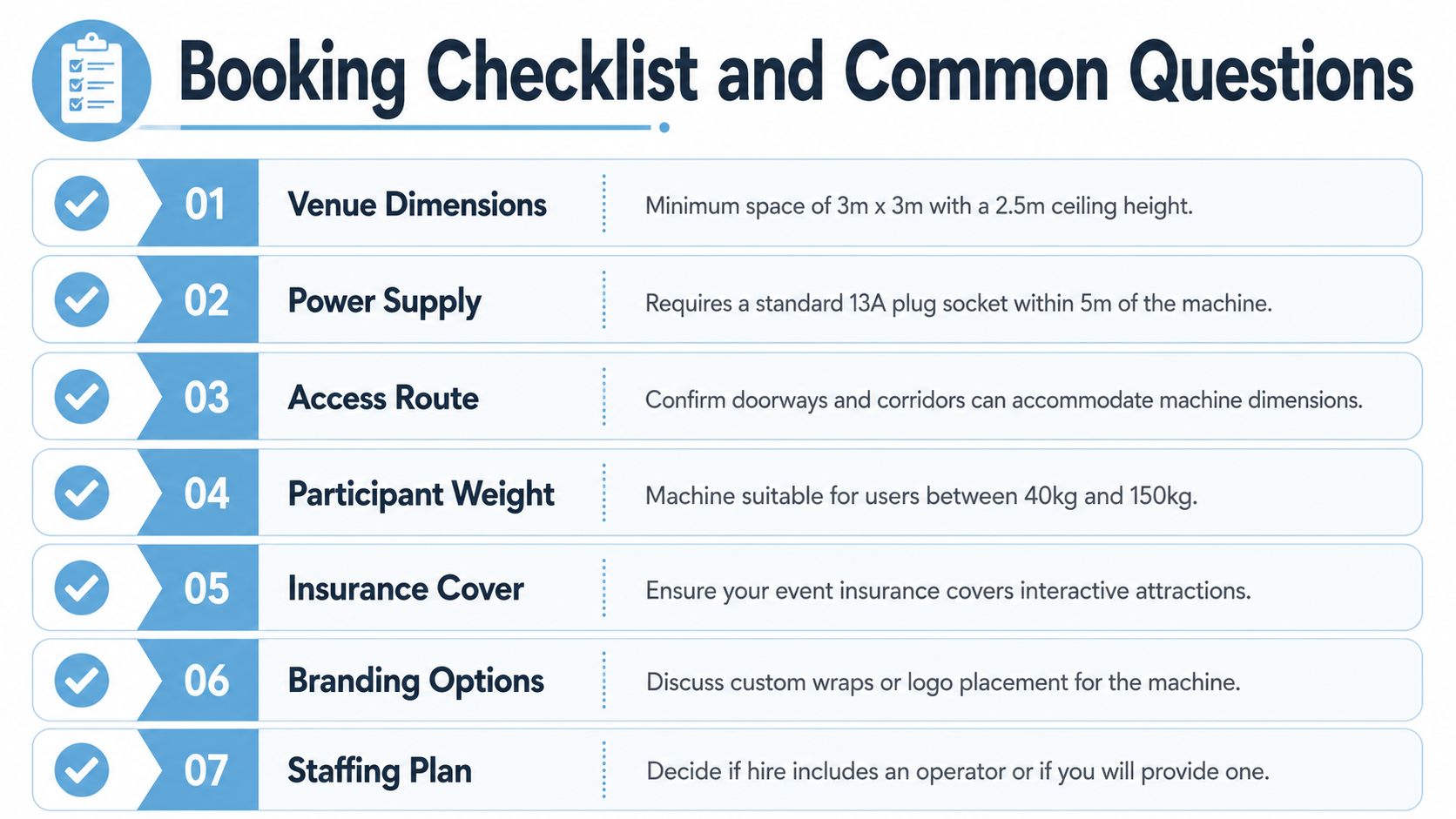
| Check | What to Confirm | Owner |
|---|---|---|
| Venue dimensions | Space, ceiling height, and swing clearance | Planner |
| Power supply | Socket location and cable route | Venue |
| Access route | Doors, lifts, and loading bay access | Production |
| Participant rules | Any local limits or event-specific screening | Supplier and planner |
| Insurance cover | Public liability and event cover | Planner |
| Branding options | Wraps, signage, and score screens | Brand team |
| Staffing plan | Attendant cover or self-managed operation | Supplier |
The questions that come up on almost every call
How far ahead should I book? Book as soon as the event date is fixed, because the primary constraint is usually availability of transport, staffing, and venue access, not the machine itself.
Can it go outdoors? Only if the ground is level, dry, and the supplier is happy with the access and weather plan. A machine that needs controlled footing is rarely a casual outdoor add-on.
What insurance should the supplier have? Ask for public liability evidence and make sure it matches the event risk profile. Don't assume the venue's cover extends to every hired attraction.
Can it be hired overseas? In principle, yes, but the logistics, compliance, and transport questions change quickly once the hire crosses a border. That's a different conversation from a standard UK event rental.
The strongest bookings are the ones that are easy to explain to the venue, the client, and the finance team. If you can answer the checklist above without caveats, you're probably ready to move.
If you're planning a corporate event, exhibition stand, brand activation, or private celebration and want the boxing machine handled properly, visit PSW Events. They can help with the hire, the branding, the logistics, and the on-site staffing so the machine does what it should, draw a crowd and keep it moving.