
A client wants an F1-style activation at a London exhibition centre. Marketing wants a convincing driving experience, the venue wants a clean risk assessment, and operations wants to know how many delegates can use the rig before the next appointment. Then the loading-bay manager asks for the packed dimensions, the electrician asks for the power requirement, and someone realises the impressive cockpit in the sales photograph may not fit through the access route.
That is the true test of the best racing simulator cockpit for an event. It isn't the rig with the most aggressive motion or the longest consumer specification sheet. It's the configuration that fits the venue, survives repeated use, accommodates the audience and produces a measurable result, whether that result is dwell time, lead capture, competitive engagement or a memorable brand interaction.
UK demand gives racing activations a strong starting point. Motorsport UK estimates that around 26.6 million people in the UK identify as motorsport fans, while approximately 15.4 million didn't realise they could participate themselves, according to Motorsport UK's participation research. A simulator can turn that passive interest into an accessible driving experience without requiring a competition licence, race car or circuit access.
What an Event Planner Needs From a Cockpit
Start with the event objective, then choose the hardware. Wheelbase, screen size and motion range come later.
A fixed-base cockpit is usually the strongest option for high throughput. It has fewer moving parts, supports simpler supervision and allows quicker resets between users. A seat-motion platform adds physical feedback while keeping most movement focused around the driver. A full-motion platform creates a more theatrical experience, but it requires closer attention to loading, safety and installation. A modular tub, often built from aluminium profile, gives event teams room to adapt. It can accommodate branded panels, alternative seats, displays and control layouts as requirements change.
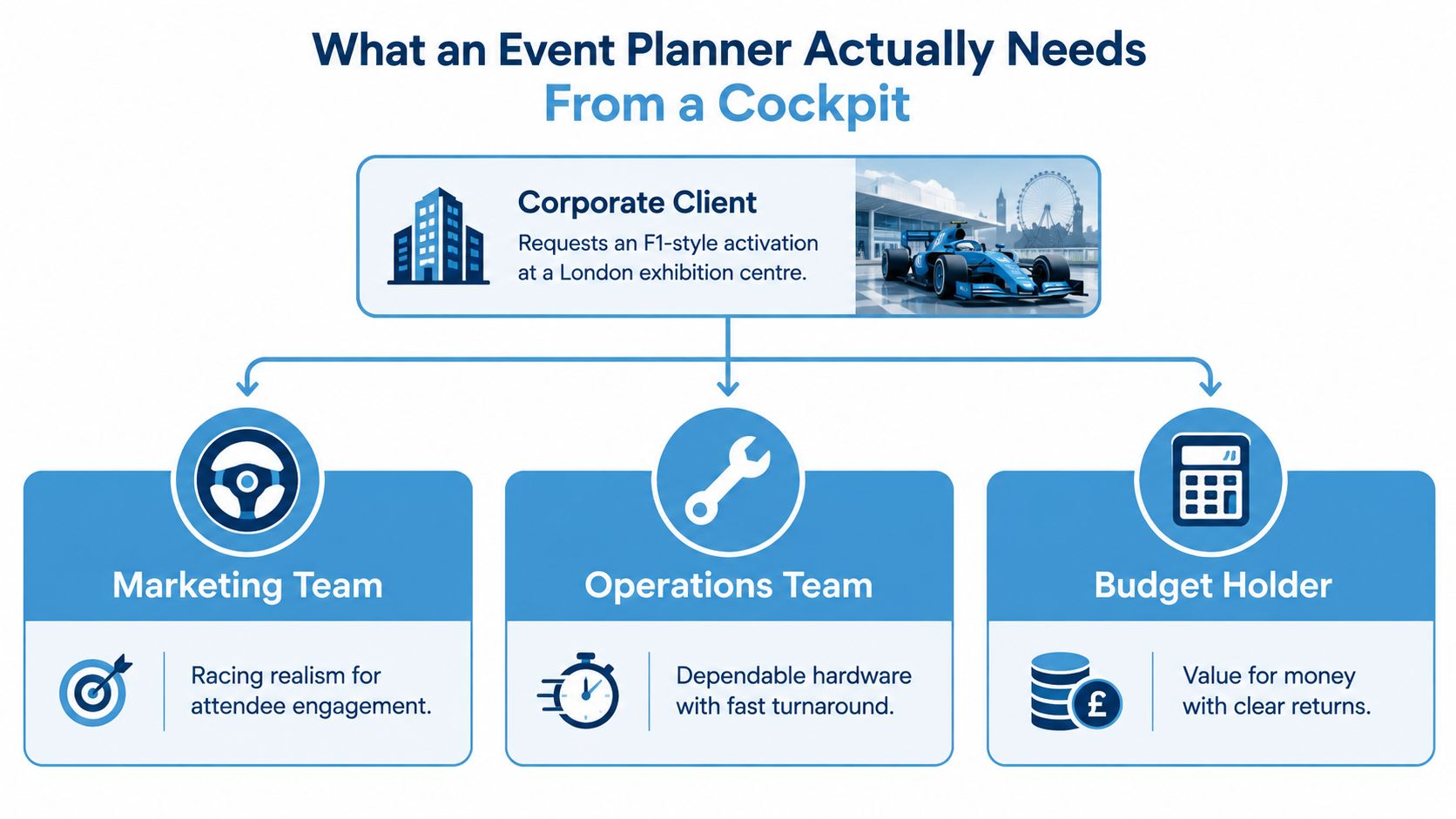
The audience shapes the specification. Delegates may arrive in work clothes, carry bags, follow tight appointment schedules and use a simulator for the first time. The operator needs rapid seat adjustment, clear instructions, predictable resets and an outcome users understand immediately.
Practical rule: Specify the audience journey before the hardware. A lap time, leaderboard position or branded photograph can contribute more to an activation than another layer of technical realism.
The delivery model matters too. Consumer comparisons often leave out venue surveys, transport cases, installation, branding, operator staffing, breakdown cover and post-event collection. A turnkey event supplier brings those decisions into one delivery plan. That can make a rig with a higher headline cost the more defensible choice for a corporate activation, because the specification covers the practical work required to operate it successfully.
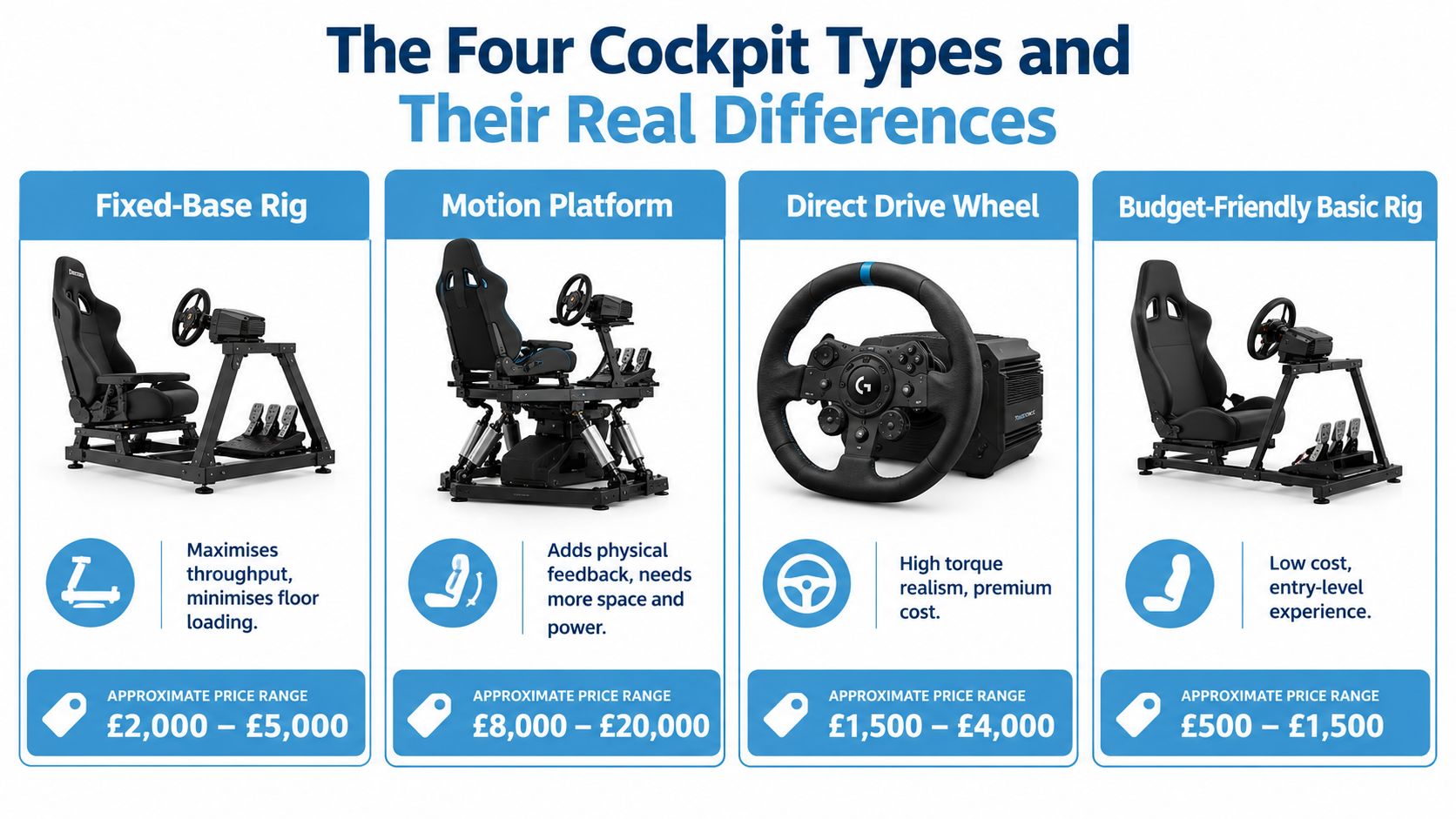
The Four Cockpit Types and Their Real Differences
The four common formats serve different audience outcomes. They shouldn't be treated as interchangeable versions of the same product.
Fixed-base rigs keep the frame and seat stationary while the software, wheel, pedals, screen and tactile feedback create the experience. They're the strongest choice for exhibitions, conferences and fan zones where the queue matters as much as the driver. They minimise floor loading and generally make it easier for an operator to observe the user, reset the system and keep the surrounding area orderly.
Seat-motion platforms move the seat or apply focused physical cues while leaving the wider frame in place. They add perceived realism without the full installation burden of moving an entire cockpit. For corporate hospitality and team-building, this is often the most sensible middle ground. It feels substantial, but it doesn't force every guest into an extreme experience.
Full-motion platforms can reproduce broader acceleration, braking and cornering cues. Coventry University describes motion platforms as tools for reproducing those forces, with applications including driver training, automotive research, autonomous vehicles and ADAS testing, as outlined in this UK motion-platform product reference. That makes motion valuable when the objective is to demonstrate vehicle dynamics or create a premium hero moment, not just to increase the number of people served.
Modular and tub rigs prioritise flexibility. Aluminium-profile frames can accept different seats, controls, display formats and branded skins, making them useful for agencies and production teams running varied briefs. They're also easier to adapt when the venue, sponsor or driving format changes.
For planners comparing technology outside simulation, the same principle applies when you compare gaming laptops and desktops. The right choice depends on the environment, workload and operating constraints, not a single headline specification.
The audience opportunity is broad. Motorsport UK's research identifies a large fan base that may not know participation is available, so the cockpit needs to lower the barrier rather than intimidate casual users. A fixed or seat-motion format usually does that better than a demanding full-motion installation.
Specs That Matter for Events Versus Specs That Do Not
Event specifications begin with the floor plan. A cockpit that fits on paper may still fail if its transport case can't pass through the loading route, if the assembled rig blocks an aisle or if there isn't room for a safe transfer into the seat.
The ImSim GARRA specification provides a useful high-end benchmark. It lists an 80 cm by 250 cm footprint, suitability for users from 1.2 m to 2.2 m tall, a 135 kg maximum user weight, a 25 to 160 kg brake-force range and four independent per-tyre tactile transducers. Those details answer practical questions about floor planning, mixed audiences and the difference between casual and experienced drivers.
| Metric | Fixed-Base | Seat-Motion | Full-Motion 6-DOF |
|---|---|---|---|
| Primary event strength | Throughput and dependable operation | Physical feedback with controlled complexity | Premium immersion and vehicle-dynamics demonstration |
| Floor-planning priority | Frame, seat, display and queue clearance | Rig plus seat-motion envelope | Full motion envelope, safety perimeter and access |
| User adjustment | Usually straightforward | Must include seat and motion checks | Requires seat, harness or restraint checks where applicable |
| Brake-force requirement | Adjustable settings preferred | Adjustable settings strongly preferred | Adjustable settings and controlled briefing essential |
| Operational risk | Lowest of the three | Moderate | Highest due to movement and installation complexity |
| Best KPI | Participation volume and leaderboard activity | Dwell time and perceived experience value | Premium engagement and product demonstration |
A direct-drive wheel can deliver convincing steering feedback, but torque alone doesn't tell you whether the rig is suitable for an event. Ask for the peak power draw, heat output, noise, setup duration, software reset process and recalibration time between users. Those are the specifications that determine whether a stand runs smoothly after several hours of public use.
The datasheet may not cover wheelchair transfer arrangements, transport-case dimensions, electrical requirements or the time required to restore calibration. Put those questions into the supplier brief. If the answers aren't available, treat that as a procurement gap rather than an operational detail.
For a ready-made configuration, PSW Events' racing seat hire illustrates the event-led approach. The relevant question isn't whether the product has an attractive component list. It's whether the complete setup can be delivered, operated and reset reliably in the venue you've booked.
Matching Cockpit Choice to Event Type
The best racing simulator cockpit changes with the event format. Start with the audience journey, then select the hardware.
For a high-volume exhibition or trade show, choose fixed-base rigs with a clear timed format, branded livery and an electronic leaderboard. The driver should understand the challenge quickly, complete it without a long briefing and leave with a result worth sharing. A hero unit can attract attention, but multiple dependable units usually serve the stand better than one complex platform that creates a queue.
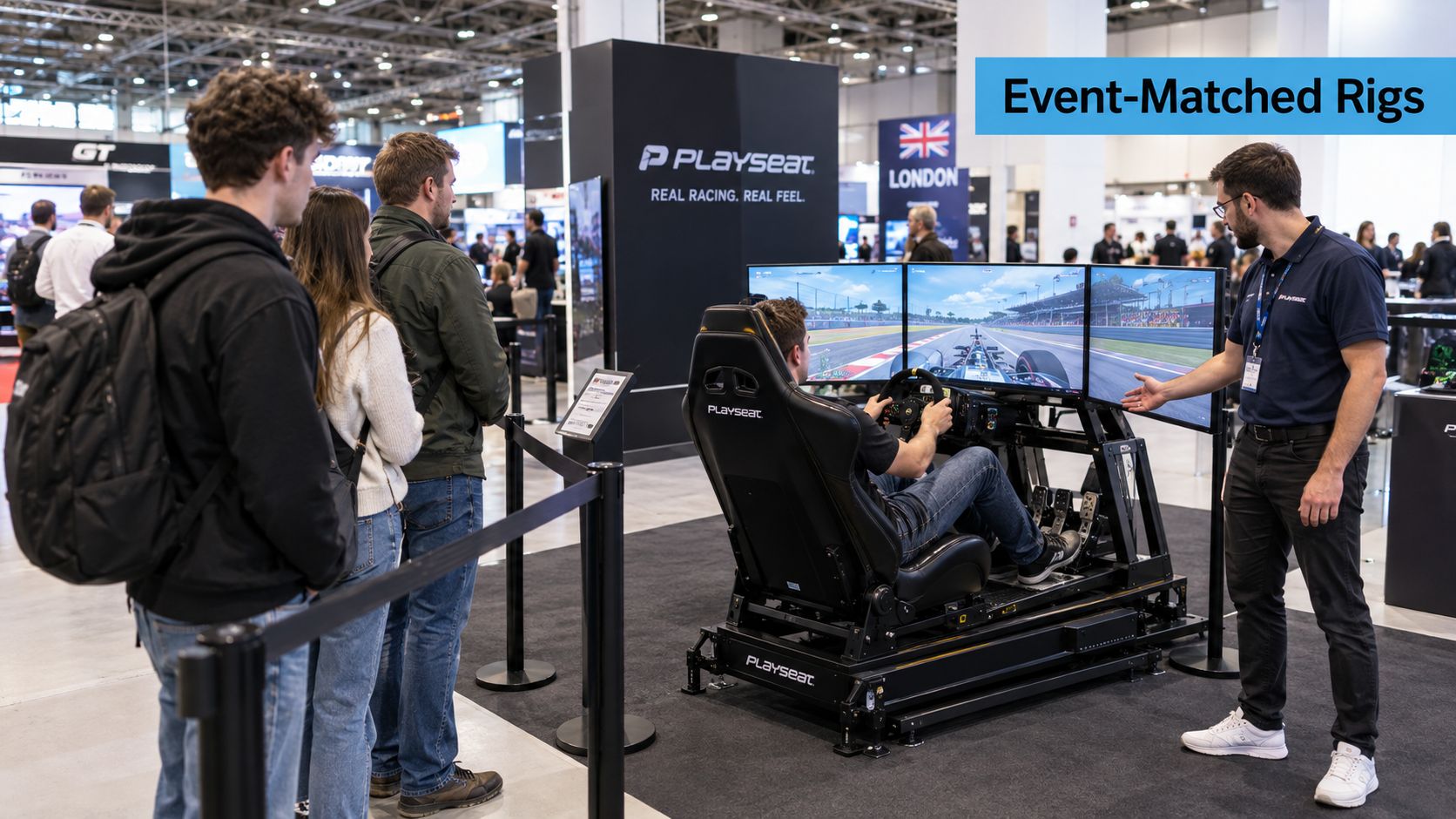
For team-building and corporate hospitality, use a seat-motion setup when the brief calls for a premium feel without overwhelming occasional drivers. Pair it with an operator who can adjust the intensity, explain the controls and keep the experience inclusive for guests who aren't motorsport enthusiasts.
A premium hospitality suite or product reveal can justify full motion when the audience is smaller and the dwell time per guest is deliberately longer. The platform becomes part of the presentation, not a queue-based attraction. Use it to demonstrate a vehicle concept, a circuit narrative or a high-value brand message, and build the briefing and reset process into the run of show.
For fan zones, think like a pit-lane garage. Multiple fixed or seat-motion rigs, visible scoring and consistent branding create a better public rhythm than a single elaborate machine. Silverstone reported 480,000 attendees across the 2023 and 2024 British Grand Prix weekends, with 164,000 spectators on the 2024 Sunday alone, the highest single-day British Grand Prix attendance at that time, according to Silverstone's attendance report. That scale demands obvious queue management and hardware that can operate repeatedly.
The right KPI might be participation, dwell time, lead capture or a shareable result. Choose the cockpit after choosing the KPI.
A strong activation often combines one hero rig with one or two supporting rigs. The hero unit creates the photograph and premium moment. The supporting units keep the queue moving and give more delegates a reason to stop.
Venue Logistics and UK Health and Safety Requirements
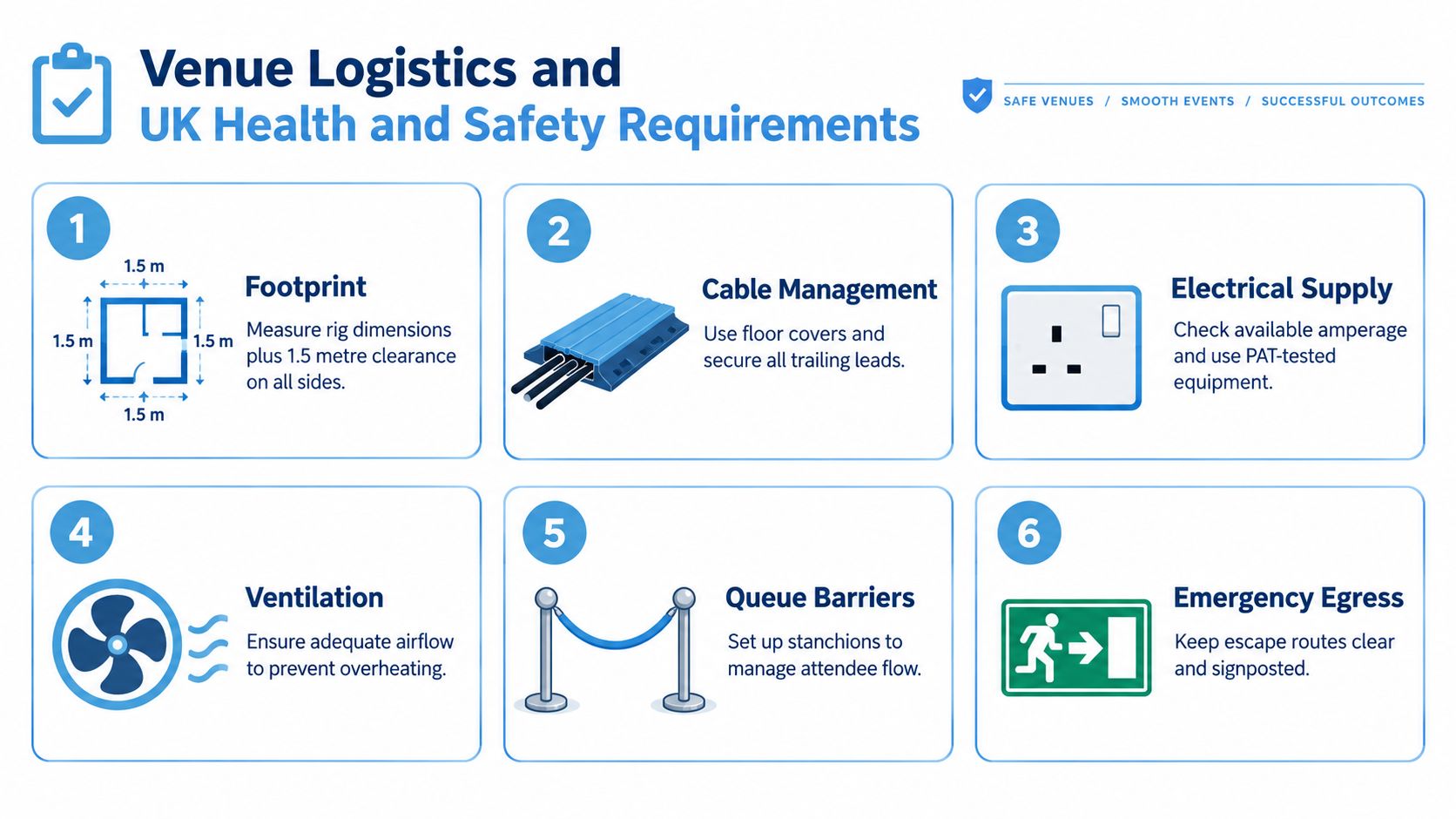
A simulator installation should enter the venue plan as production equipment, not as furniture. The floor plan needs the assembled footprint, transport route, operator position, queue space, cable paths, electrical points and emergency egress.
Motorsport UK's circuit-venue regulations provide useful context. They state that race circuits should normally be at least 9 metres wide, while sprint and hill-climb courses should normally be at least 3.5 metres wide, with substantial barriers and a 6.5 to 8-metre separation between pit-lane barriers and the pits, as set out in the Motorsport UK circuit and venue regulations. These aren't simulator dimensions, but they demonstrate how seriously racing environments treat clearance, separation and controlled movement.
For an exhibition stand, translate that principle into practical questions:
- Footprint: Record the assembled rig, display, operator position and queue, not just the seat frame.
- Cabling: Use suitable floor covers, protect crossings and keep leads away from transfer points.
- Power: Confirm supply, distribution and equipment testing requirements with the venue.
- Visibility: Give the operator a clear view of the driver, controls, moving parts and surrounding queue.
- Egress: Keep escape routes, fire equipment and venue access points unobstructed.
- Noise and heat: Check whether fans, speakers, motion systems or multiple displays affect neighbouring exhibitors.
The pre-opening inspection should resemble a disciplined scrutineering check. Motorsport UK explains that scrutineers inspect whether competitors' equipment and vehicles appear to comply before they reach the track or stage, with some events also carrying out post-event checks, as described in its competitor guidance. For a simulator, inspect frame stability, wheel and pedal fastening, seat adjustment, cable routing, electrical connections, pinch risks and the surrounding floor.
A racing simulator setup service should provide clear information for the venue pack, including dimensions, power, staffing, installation method and emergency procedures. Don't leave those details until the morning of the show.
Rental Versus Purchase and What to Ask the Supplier
For a one-off corporate activation, hire usually gives the cleaner operational model. Hire buys a managed experience for a defined period. Purchase adds storage, maintenance, transport, calibration and technical cover between events, along with responsibility for staffing and repairs.
Purchase suits an agency or venue with a regular event pipeline, secure storage and staff who can manage software and hardware. It becomes harder to justify when each activation needs a different footprint, brand treatment, display layout or access arrangement. Ownership also means carrying transport cases, replacement parts and contingency equipment when a wheel, pedal or screen fails.
Ask the supplier to split the quote into operational components:
- Delivery and collection: Confirm loading-bay access, timed delivery, collection windows and transport-case handling.
- Installation: Establish who assembles the rig, tests the software and signs off the system.
- Branding: Clarify whether liveries, panels, screens, leaderboards and artwork production are included.
- Staffing: Ask whether an operator remains present throughout, including breaks and shift changes.
- Insurance: Verify products, employee and public liability cover, then request the relevant documentation.
- Contingency: Confirm whether replacement controls, a backup system or a technical response plan is available.
PSW Events delivers simulator activations at Silverstone, Wembley, ExCeL London, Manchester Central and SEC Glasgow, with international showcases in Amsterdam, Frankfurt, Barcelona, Paris and Dubai, according to its UK racing simulator hire. That experience matters because venue logistics can create more risk than the driving software.
Put the packed dimensions, total equipment weight, power requirement, setup duration, reset process and access arrangements into the supplier agreement. Require named responsibilities for delivery, installation, operation and breakdown. A supplier who answers these points clearly is easier to brief, insure and sign off than one offering only a polished product photograph.
Compare hire with purchase by modelling the full delivery cost for each activation, including storage, staffing, transport and maintenance. For recurring events, calculate how often the cockpit will be used and whether the venue can support ownership without disrupting other event work. For occasional use, the managed hire route usually protects throughput and reduces procurement risk.
Accessibility as a Procurement Requirement
Accessibility must appear in the equipment brief before anyone chooses the cockpit. Retrofitting access after purchase or hire can restrict the seat, controls, motion settings and queue layout.
Ask whether a guest can transfer safely from a wheelchair, whether the seat adjusts for children and older delegates, and whether the wheel and pedals can support hand-control adaptations. A non-motion alternative should be available for guests who find movement uncomfortable, while audio briefings should work for people with hearing loss or sensory sensitivities.
The UK Events Report identifies wellness, mental health and accessibility as core event-design considerations, with frameworks such as the Live Events Access Charter shaping inclusive delivery in the UK. That makes accessibility part of event quality and duty of care, not a decorative add-on.
Questions to put into the supplier brief
- Can the seat be adjusted without dismantling the cockpit?
- Is independent or assisted transfer possible?
- Are hand controls available or compatible?
- Can motion, vibration and audio intensity be reduced?
- Does the operator know how to brief guests with different access needs?
- Does the queue provide a comfortable place to wait without penalising slower drivers?
- Can the team offer an equivalent non-motion experience?
Motorsport UK's accessible simulator initiative reflects a wider move towards adaptable controls. The procurement standard should be simple: specify the widest practical participation range first, then select the equipment that can support it safely.
The Procurement Checklist and Final Recommendation
Hand the supplier a brief that answers these questions before requesting a final quote:
- Objective: Is the activation designed for lead capture, dwell time, participation, competition or product demonstration?
- Audience: Will first-time drivers, children, older delegates and disabled guests use the cockpit?
- Architecture: Does the event need fixed-base, seat-motion, full motion or a modular tub?
- Venue: Have access routes, floor loading, power, noise, heat, queueing and egress been surveyed?
- Safety: Has someone checked frame stability, controls, cables, moving parts and operator sight lines?
- Experience: Is the session length, briefing, reset and leaderboard format defined?
- Branding: Are the livery, screens, signage and data-capture journey included?
- Staffing: Is a trained operator present for the full event?
- Contingency: What happens if the wheel, display, computer or motion system fails?
- Measurement: How will the team record participation, dwell time, repeat attempts and captured leads?
For a conference with around 200 delegates, I'd favour a fixed-base or seat-motion cockpit with a short timed challenge and a clear leaderboard. For a public exhibition expecting around 20,000 attendees, I'd specify multiple fixed-base units, visible scoring and effective queue management. For a 50-person hospitality experience, a full-motion hero rig can work if the venue, safety case and longer guest journey justify it.
The best racing simulator cockpit for an event is the one whose specification matches the KPI, the venue and the audience, not the one with the most impressive consumer spec sheet.
Start with the floor plan, the guest journey and the sign-off process. Then choose the hardware.
PSW Events provides racing and F1 simulator hire with planning, branding, logistics, installation, on-site staffing and H&S support for UK events. Visit PSW Events with your venue, audience and KPI, and ask for a cockpit recommendation built around the way your activation will run.