
The popular advice is simple: choose the most realistic racing simulator experience you can afford. That sounds sensible until the first delegate spends too long in the seat, the queue blocks your stand frontage, and less confident guests decide the attraction isn't for them. On a UK show floor, realism matters, but it must earn its space through throughput, accessibility, safety and useful engagement data.
The right question isn't “How advanced is the rig?” It's “What must this activation achieve, for whom, and at what pace?” A simulator can support a product launch, exhibition lead generation, hospitality programme, team activity or family audience, but each use case rewards a different balance of immersion and operational control.
The UK has credible foundations in this field. Lotus is widely credited with building one of the first purpose-built racing simulators in the mid-1960s, with reports suggesting that between 18 and 31 Lotus Racing Simulators were sold, an early commercial milestone in British motorsport entertainment and technical training. Hagerty's account of the Lotus simulator places today's event technology in a distinctly British engineering lineage.
Why the Most Realistic Simulator Is Not Always the Best Event Choice
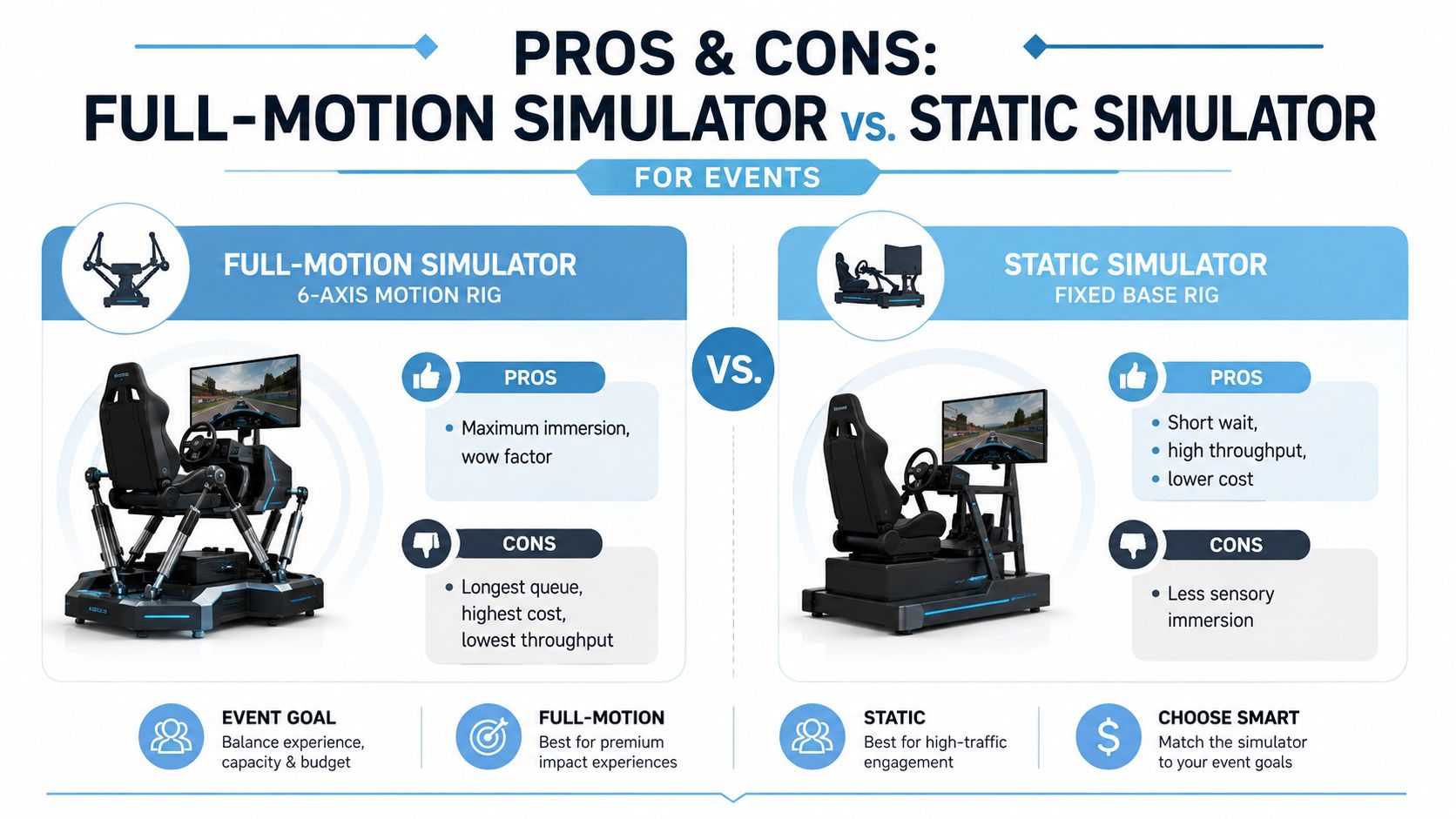
A full-motion platform can create an exceptional first impression, but the best event choice is rarely the machine with the greatest specification. Large movement, VR and complex calibration can lengthen the reset, increase briefing requirements and make some guests hesitant. If your objective is to speak to as many relevant visitors as possible, a simpler setup may outperform a technically superior one.
I assess three practical measures before I assess visual fidelity:
- Guest throughput: How many people can complete a meaningful session during the active event period?
- Audience access: Can children, first-time players, disabled guests, older delegates and competitive drivers all participate safely?
- Reset speed: How quickly can the marshal clean the seat, adjust controls, load the next profile and restart?
Event-grade realism becomes useful here. The experience should feel recognisably like driving a race car, with a responsive wheel, convincing screen presentation and clear feedback, without adding sensory complexity that slows the operation. A static F1-style rig can deliver strong theatre and photographs, while a motion platform may be better reserved for a smaller hospitality audience that values immersion over volume.
Practical rule: Specify the shortest satisfying session, not the longest possible session. A guest should leave feeling they've achieved something, while the next participant can start without a long technical pause.
Brand presentation also affects perceived quality. A well-finished chassis wrap, branded screen treatment and coherent signage can make a static simulator feel like a deliberate activation rather than rented equipment. For teams planning the wider visual treatment, a practical car stickers guide by Quote My Wall can help with early thinking around finishes, placement and brand consistency.
For a motion-led format, review the operational details of racing simulator motion hire before committing. The key issue isn't whether movement looks impressive. It's whether the platform suits your audience, floor, staffing plan and commercial target.
Comparing Racing Simulator Rig Types for Events
Rig selection should start with the audience and venue, not the supplier's product catalogue. A single executive guest at a hospitality event has different expectations from a queue of exhibition visitors who need a quick, repeatable interaction.
Static single-seat rigs
A static single-seat rig is usually the most forgiving option for mixed audiences. It can offer a fixed racing seat, force-feedback wheel, pedals and one or more screens, with relatively straightforward access for marshals and quick driver changes. It suits lead-generation stands, conferences and family-facing activations where reliability and approachable controls matter more than physical movement.
Its limitations are obvious. It has less sensory impact than a motion platform, and its presentation depends heavily on screen quality, branding and the quality of the game configuration.
F1-style half-car replicas
Half-car replicas deliver excellent brand theatre. They photograph well, give a sponsor or automotive brand a distinctive physical asset and can anchor a hospitality zone. The compromise is access. The seating position and enclosed styling can make driver changes slower, and the format is less flexible for guests with different body sizes or mobility requirements.
Use this type when brand visibility and premium presentation matter more than maximum participation.
Multi-rig banked setups
A banked arrangement supports head-to-head racing and gives spectators something to watch while waiting. It works well for competitive challenges, esports-style events and busy public areas. The supplier must plan cable management, marshal sightlines, queue separation and screen positioning carefully, otherwise the installation becomes visually noisy and difficult to supervise.
Full-motion platforms with optional VR
Motion platforms offer the strongest physical sensation, particularly for premium demonstrations and carefully managed hospitality. They also introduce more dependencies, including structural considerations, participant screening, more involved briefing and a greater need for trained supervision. VR can deepen immersion, but it can also create a barrier for guests who are uncomfortable wearing a headset or who need a clearer connection with the surrounding event.
For a broader overview of available formats, compare racing simulator hire options against the event's actual objectives rather than selecting the most elaborate package.
| Rig Type | Footprint (m²) | Power Requirement | Throughput (guests/hr) | Crew Needed | Best Event Use |
|---|---|---|---|---|---|
| Static single-seat rig | Confirm with supplier | Confirm with supplier | Confirm with supplier | One trained marshal | Lead generation and mixed audiences |
| F1-style half-car replica | Confirm with supplier | Confirm with supplier | Confirm with supplier | One marshal, with access support where needed | Brand activation and hospitality |
| Multi-rig banked setup | Confirm with supplier | Confirm with supplier | Confirm with supplier | Dedicated marshal team | Competition and public entertainment |
| Full-motion platform with optional VR | Confirm with supplier and venue | Confirm with supplier and venue | Confirm with supplier | Trained operator and marshal support | Premium demonstrations |
Don't accept generic footprint or power figures at quotation stage. Rig dimensions, electrical load, access clearances and staffing depend on the actual model, so the supplier should provide a venue-ready technical schedule.
Measuring ROI and Engagement From Simulator Activations
A racing simulator earns its floor space only when participation connects to a business action. A busy queue proves interest, not commercial value. It may also expose poor scheduling, slow resets or an attraction that occupies visitors without creating qualified conversations.
UK exhibition demand makes disciplined measurement worthwhile. The AEV's SASiE 2025 report records around 6.8 million exhibition visits at the main UK venues in 2025, with exhibition numbers reaching their highest level since 2015. The same verified data set estimates 1.08 million conferences and meetings in 2024, while the wider UK events sector is associated with approximately 85 million annual attendances.
These figures show market scale, not the expected result from one activation. Build the measurement plan around three layers.
1. Participation and flow
Record arrivals, completed sessions, abandoned queues, average wait, repeat attempts and downtime. The marshal or host should log why an interruption occurred, whether it was a technical fault, a briefing delay or a participant needing an adjustment. These measures separate genuine demand from avoidable operational drag.
2. Qualified engagement
Collect only information the client can use. A leaderboard can connect to a tablet form, badge scan or agreed consent flow, but the prize mechanic should not pressure guests to share unnecessary data. Match each completed run with a lead status, conversation outcome or meeting request.
3. Follow-up value
Export results to the client's CRM with clear consent records and event identifiers. Track whether a participant became a marketing-qualified lead, accepted a follow-up meeting or engaged with the brand after the event. A completed drive is an interaction, not automatically a lead.
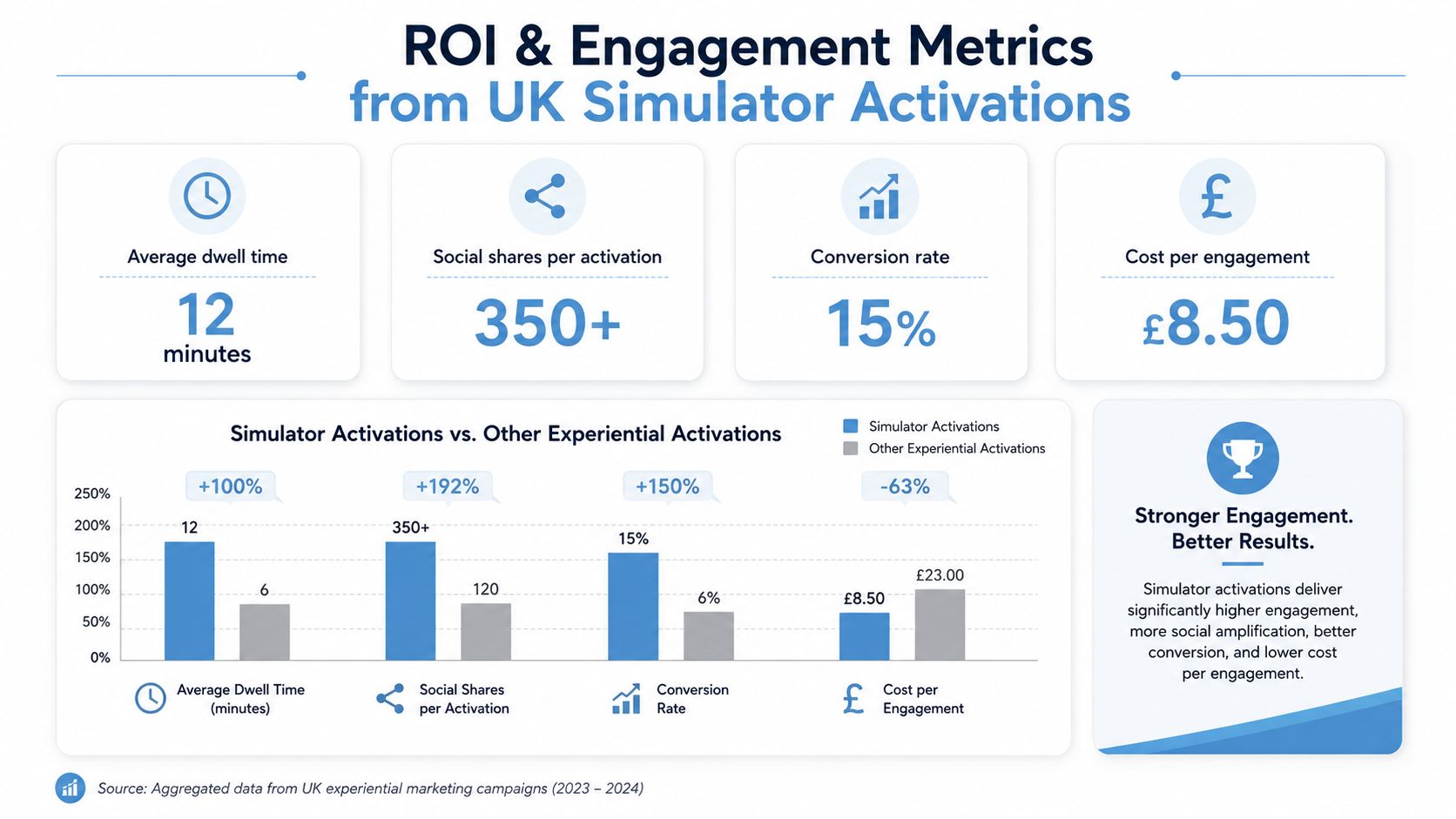
The useful ROI calculation is specific to the campaign. For a wider framework, see this guide to measuring experiential marketing ROI.
Cost per qualified lead = total activation cost divided by qualified leads generated.
Include equipment hire, crew, transport, installation, branding, floor space and registration technology in the numerator. Compare the result with a traditional exhibition tactic using the same definition of “qualified lead”. Social content, leaderboard participation and brand recall can support the report, but they should not replace commercial evidence.
Logistics and Planning Essentials for UK Venues
Most simulator failures are planning failures rather than driving failures. A supplier may deliver an excellent rig, yet the activation still struggles if the queue blocks a fire route, the power supply is wrong or the venue lift can't accept the packed equipment.
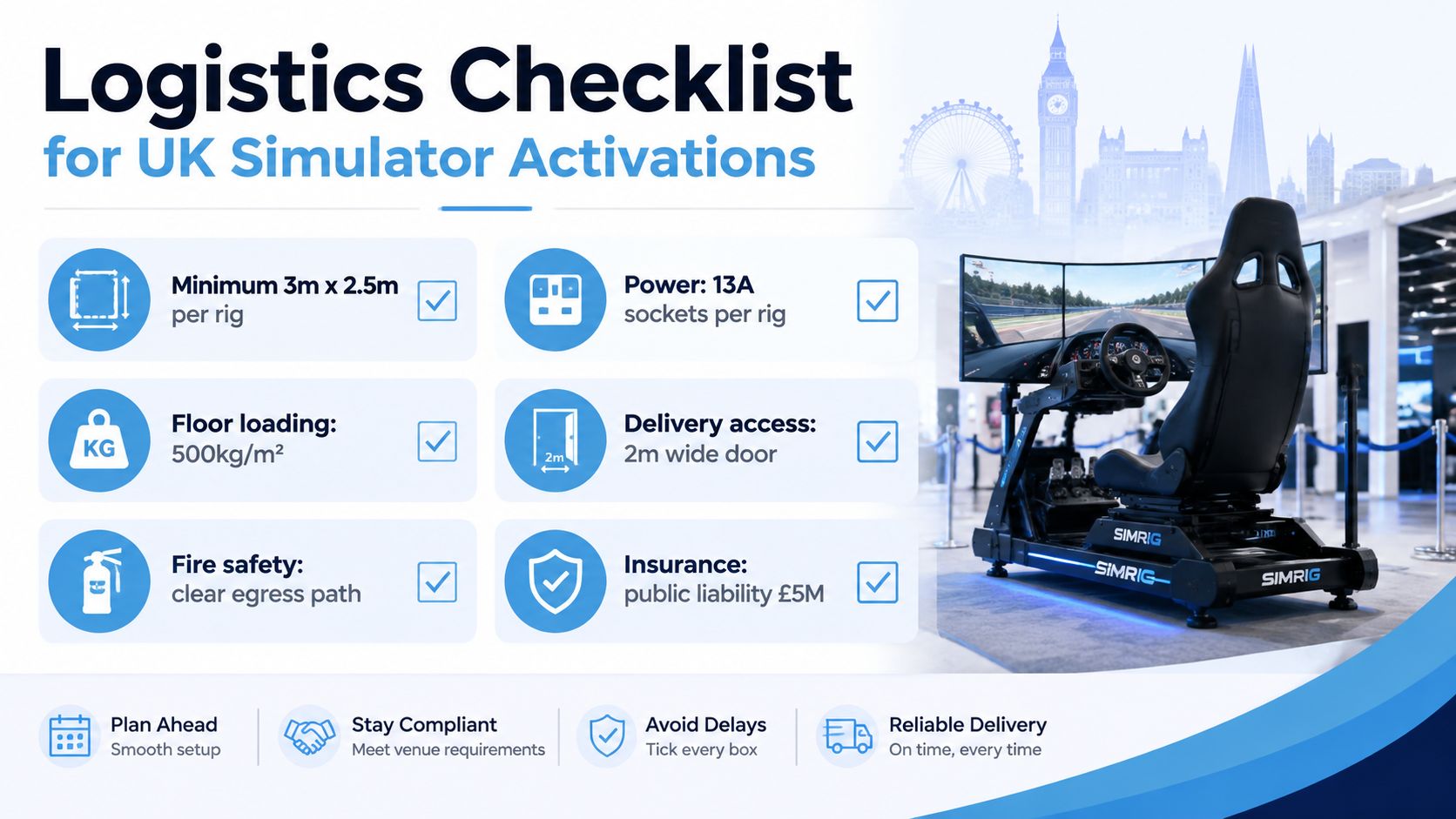
Start with a scaled floor plan. A single-seat motion platform may need a minimum footprint of 3m by 2.5m, plus 1.5m for queue and marshal space, according to the supplied planning assumptions. Static equipment may occupy less operational space, but the audience still needs a safe approach, accessible transfer area and clear exit route.
Space and access
Ask the venue for the confirmed floor-loading limit, delivery route, lift dimensions, door widths, loading-bay rules and build timetable. ExCeL London and NEC Birmingham have their own technical procedures, so never transfer assumptions from one venue to the other. Include the packed dimensions of the rig, flight cases and branding hardware, not just the assembled footprint.
Electricity and equipment
Static rigs may use standard UK 13A sockets, while full-motion hydraulic platforms can require 16A or 32A CEE-form connections, depending on the equipment. The supplier must confirm the actual requirement in writing and coordinate with the venue electrician. Don't rely on a generic extension lead plan for moving machinery.
People and safety
Use at least one trained marshal per rig, with two operators or support staff for a high-throughput activation where the queue, registration and driving positions need simultaneous attention. The operator should control the emergency stop, give a concise participant briefing and know the recovery process after a software, power or motion fault.
The risk assessment should cover participant suitability, moving parts, trips, electrical equipment, manual handling, emergency access, cleaning and supervision. Race Mode's terms, for example, specify a suggested minimum height of 153cm, and prohibit participation while pregnant or under the influence of alcohol or drugs. Another UK risk assessment states that users under 1.2 metres may not be permitted, that anyone over 90kg or 14 stone isn't permitted on the attachment, and that a fully trained operator must remain with the simulator. Race Mode's participant terms and the supplied UK racing simulator risk assessment illustrate why supplier terms must be checked before promotion.
Branding can range from a chassis wrap to a branded leaderboard, HUD overlay or result screen. Chassis artwork adds production and installation work. A result screen can connect the brand to the participant at the point of completion, often with less physical material. For guidance on protective transit materials and event packing, organisers may also find specialist packaging companies useful during the logistics planning stage.
Designing Inclusive Simulator Experiences for Mixed Audiences
Accessibility should be specified before the supplier prices the equipment. If the brief says “make it accessible” after the rig has been selected, the team may have limited options for controls, transfer, seating, briefing and supervision.
Motorsport UK has launched an Accessible Simulator designed to offer as many adaptations as possible in one device, allowing drivers to use different combinations of hands and limbs. The organisation has also published Accessible Circuit Guidelines for organisers and venues. That approach treats adaptation as part of the core design rather than a special accessory.
Design the participation route
Ask the supplier to demonstrate hand controls, adjustable seating, pedal extensions, transfer support and control sensitivity. A guest shouldn't have to explain their needs in front of a queue while the operator searches for equipment. Build private briefing space or a calm alternative into the floor plan where possible.
Software settings matter as much as hardware. A novice may need an assisted braking profile, a simplified track and a short guided run, while an experienced driver may want a competitive configuration. Both should feel respected, not placed into a one-size-fits-all challenge.
Include sensory choice
Offer a non-motion option, reduced audio and a clear explanation of what the platform will do before the participant sits down. Neurodivergent guests and people with motion sensitivity may prefer a stable rig, predictable lighting and a quiet briefing. These choices also help first-timers who are interested but nervous.
The business case is broad. The UK events sector supports around 775,000 jobs and approximately 85 million attendances a year, according to the verified data supplied with this brief. A format that excludes part of a mixed corporate audience wastes the investment in the stand and creates avoidable reputational risk. Motorsport UK's work provides a practical benchmark for discussing adjustments with venues, suppliers and clients.
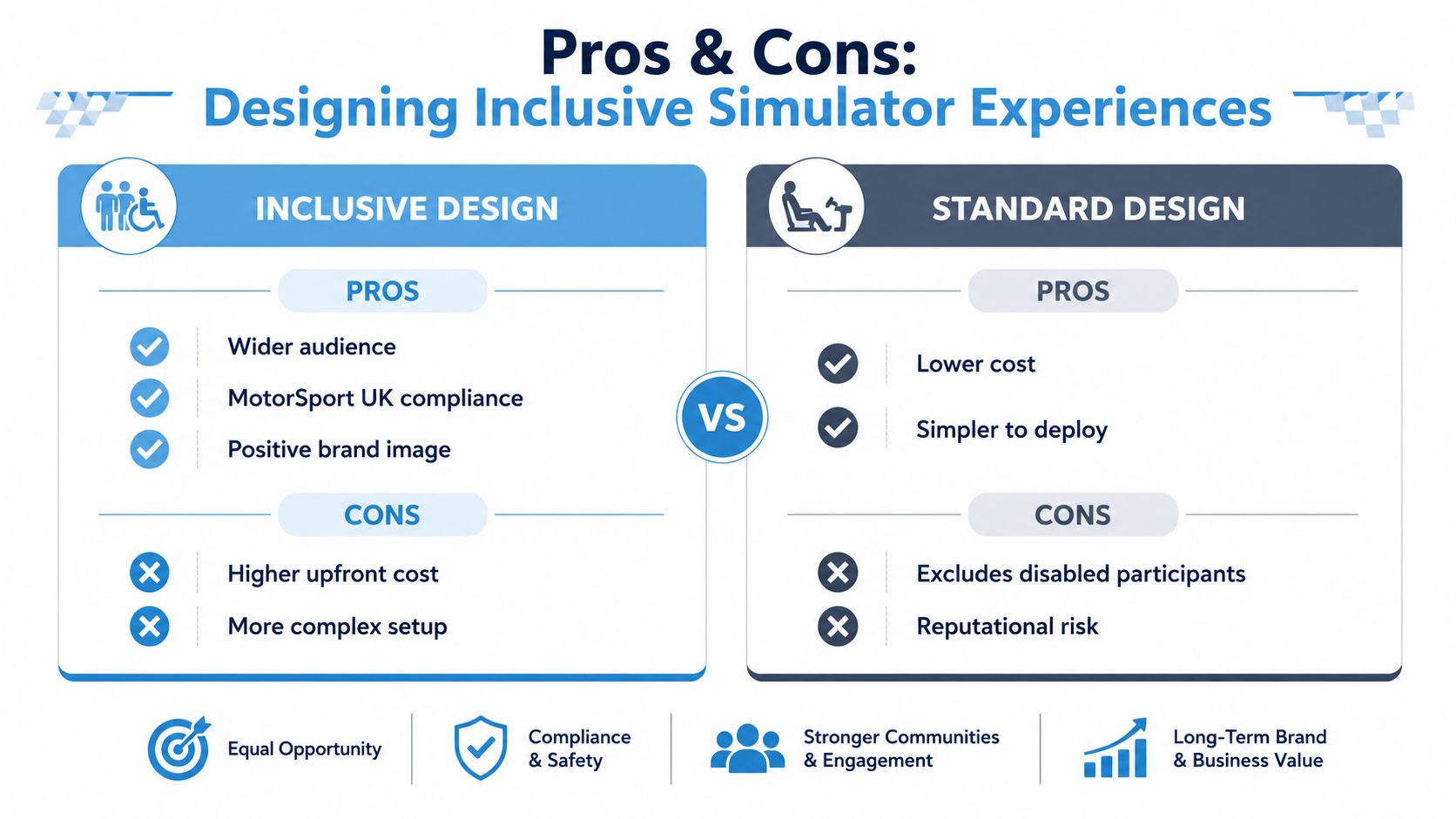
Train marshals to ask, “What would make this comfortable for you?” rather than assuming what a disabled guest can or can't do. Record adjustments in the operating plan, brief the whole crew and make the accessible route visible without making it stigmatising.
Sample Run Sheets and Venue Case Studies
A good run sheet treats the simulator as a small production, not a piece of furniture. The following operating model suits a full-day corporate conference in a venue such as the Business Design Centre, subject to the venue's approval and the supplier's technical plan.
Full-day conference format
At 06:00, the crew loads in, checks the route, positions the rig and completes calibration. At 08:30, the lead operator briefs marshals, tests the emergency stop, checks the registration tablet and confirms the participant script. Doors open at 09:00, with timed session slots managed on the booking tablet so delegates can attend talks without abandoning a queue.
At midday, reset the leaderboard and change the visible challenge. This gives afternoon delegates a fresh reason to participate and prevents the morning's top scores from making the activity feel closed. At 18:00, the crew begins teardown, exports consented participation data and confirms the CRM handover with the client contact.
Three-day exhibition format
A trade exhibition stand at an event such as the London Motor Show needs a different rhythm. A dual-rig setup can support staggered five-minute sessions, but claims about participant totals should come from the actual registration export, not an assumed capacity. Place the lead-capture prompt on the post-race result screen, then let the host qualify the conversation while the next driver starts.
The most common weak points are predictable:
- Connectivity: A cloud leaderboard should have an offline fallback. Wi-Fi can fail, so the local system must continue recording results.
- Ventilation: Motion equipment and operator PCs need sensible air circulation. A hot, enclosed cockpit will reduce comfort and increase supervision problems.
- Noise: An adjacent loud activation can make instructions hard to hear and reduce the sense of immersion. Position speakers and briefing areas accordingly.
- Merchandise flow: Keep giveaways away from the driving position and queue pinch points. These Dirt Cheap Product event planning tips are useful when coordinating branded items with the wider visitor journey.
The strongest run sheet includes named owners for calibration, registration, queue management, safety checks, data export and client reporting. If one person owns everything, the activation becomes vulnerable during breaks, faults and peak arrival periods.
Your Racing Simulator Booking Checklist
Use the following framework before requesting a final quotation. It forces the commercial brief, technical schedule and inclusion plan into the same conversation.
Start with the audience
Decide whether the priority is premium hospitality, product demonstration, family participation, competitive entertainment or qualified lead generation. A static single-seat rig may suit a broad audience, while a motion platform may work better for controlled demonstrations. If the audience includes disabled guests, children or first-time players, request adaptations and alternative modes at procurement stage.
Confirm the venue constraints
Obtain the approved footprint, queue space, access route, floor-loading information, electrical supply and egress plan. Treat 500kg/m² as a go/no-go threshold for a motion concept unless the venue and structural adviser confirm a suitable alternative. The supplied planning brief identifies 3m by 2.5m as a minimum reference footprint for a single-seat motion platform, plus queue and marshal space.
Test capacity against the target
A single static rig shouldn't be expected to sustain a requirement above 12 guests per hour without a clear session design and supplier confirmation. If the queue matters more than premium immersion, add rigs or shorten the experience rather than increasing technical complexity.
Put people and inclusion in the quote
Specify marshal coverage, breaks, operator training, accessible controls, sensory options, briefing arrangements, cleaning and emergency procedures. Ask how the supplier handles transfer support and what happens if a participant can't use standard pedals or a moving platform.
Ask these ten questions before signing
- What are the assembled and packed dimensions?
- What floor-loading and electrical requirements apply to this exact rig?
- What insurance certificates cover the activation?
- Has the equipment been PAT tested where applicable?
- Who controls the emergency stop and manages incidents?
- How many trained crew members are included?
- What accessibility adaptations are available?
- What happens if the internet connection fails?
- How are consent, registration and CRM exports handled?
- Is contingency hardware or a replacement plan available?
For a Silverstone Museum benchmark, the supplied venue information states that the racing simulator experience lasts 30 minutes, with slots running every 30 minutes from 10:30am, and that the last slot is 30 minutes before closing, including registration and briefing time. The supplied Silverstone Museum risk assessment shows why booking information needs to account for the whole guest journey rather than driving time alone.
F1 Arcade's London launch also demonstrates the scale possible in a dedicated venue. The Independent reported 60 simulators in a 16,000-square-foot venue, built at a cost of £6 million, with a launch standard price of £13.75 per person. The supplied report on F1 Arcade's launch is a useful reminder that permanent entertainment venues and temporary exhibition activations have very different operating economics.
PSW Events provides F1, driving, racing-seat, multi-rig and motion simulator formats, alongside planning, branding, installation, staffing and health and safety delivery. If your brief needs a racing simulator experience that works within a UK venue's practical limits, visit PSW Events to discuss the audience, space, access and measurement requirements before booking.