Your stand is built. The graphics look sharp. The brochures are stacked. Staff are ready.
Then the doors open, and the pattern starts. People slow down, glance across the stand, offer a polite smile, then keep walking. Your team gets snippets of conversation when what you need is stopping power, dwell time, and a reason for someone to give you more than ten seconds.
That’s where an interactive football game earns its place. Not as a novelty, and not as filler entertainment, but as a practical event tool. It gives people a reason to step in, take part, compete, watch colleagues, and stay long enough for your team to do its job.
In the UK, that matters because football already gives you a shared language with the audience. The sport’s pull isn’t abstract. The Premier League generated £6.1 billion in revenue in the 2022-23 season and total attendance exceeded 15 million, which underlines how ingrained football is in UK culture and why it works so well for event activations through 11v11’s football statistics coverage.
A well-chosen football experience can turn a flat space into a focal point. It can create a queue that acts like social proof. It can give sales teams a natural opening line that doesn’t feel forced. It can also give marketing managers something they’re often missing after the event, which is evidence that the attraction did more than “go down well”.
Transforming Your Event From Passive to Participatory
A corporate event usually fails subtly. Not with a disaster. Not with a technical collapse. It fails when attendees stay passive.
They browse instead of engaging. They accept a flyer instead of starting a conversation. They watch from the edge rather than stepping into the brand experience. An interactive football game changes that behaviour because it asks for action, not observation.

Why football works faster than most themes
Football has one major advantage in live events. People understand the challenge instantly.
They don’t need a tutorial to know what a penalty shootout is. They don’t need a long briefing to understand target zones, power, placement, or a timed leaderboard. That low barrier to entry matters at exhibitions, conferences, staff reward days, and fan-facing brand activations where attention is scarce.
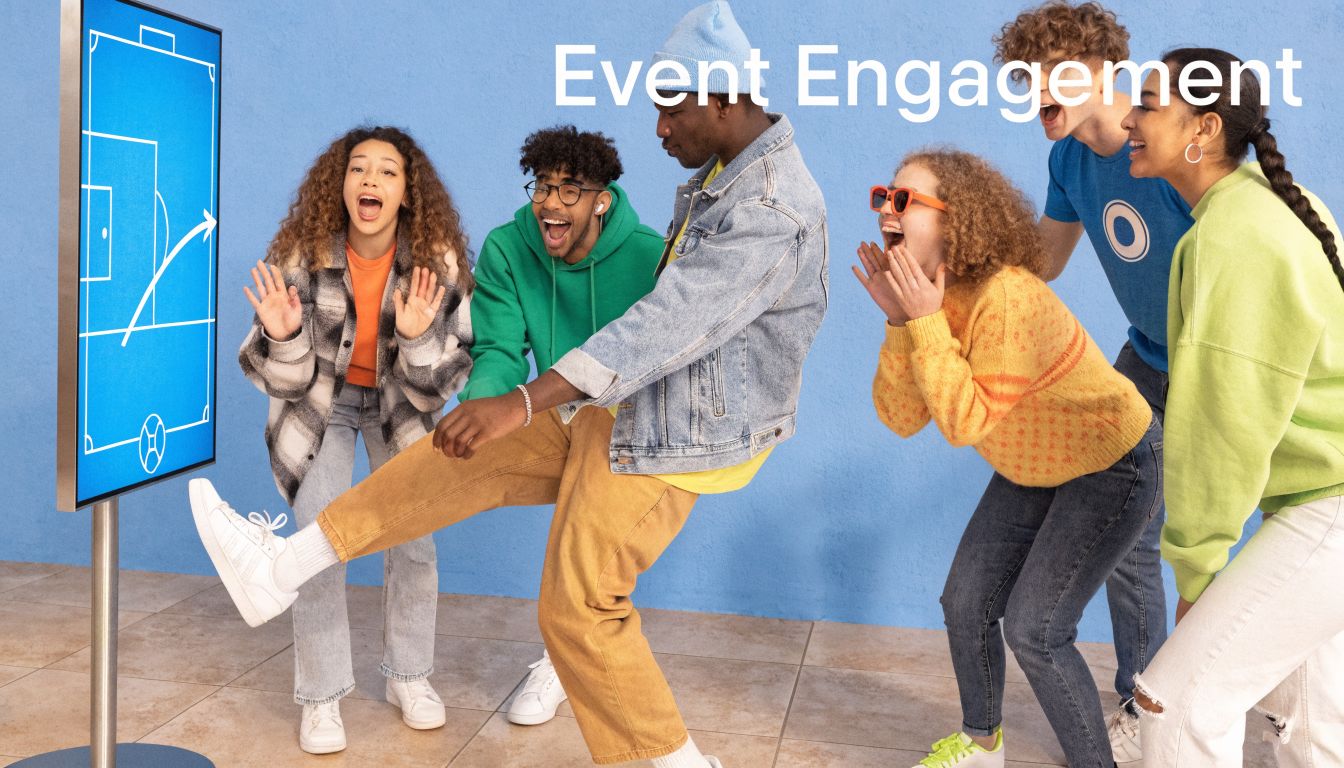
A football challenge also works for more than the player. It creates theatre for the people nearby. One person steps up to take the shot, and suddenly colleagues are filming, laughing, coaching, and competing. The activation stops being a one-to-one interaction and becomes a mini crowd event.
A good attraction gives one person a reason to play. A strong attraction gives five other people a reason to stop and watch.
From attraction to event tool
The strongest football activations don’t rely only on the sport itself. They use the familiarity of football to support a business objective.
That might mean:
- Driving stand traffic: creating visible activity that pulls visitors away from surrounding exhibitors
- Supporting lead capture: using sign-in, scoring, or leaderboard mechanics to open a data exchange
- Improving team participation: giving mixed groups a shared challenge that feels competitive without being exclusive
- Building brand memory: linking the experience to your messaging, campaign visuals, or product story
Football also carries a rich statistics culture, which helps when you want the activity to feel more credible and less like an inflatable side game. Whether you lean into historic records, current form, or simulated match conditions, the sport already comes with built-in narratives that audiences recognise.
That’s why an interactive football game works so well in UK event settings. It doesn’t need to persuade people to care about the format first. It starts from something they already care about, then channels that attention into measurable engagement.
The Three Core Types of Interactive Football Games
Not every football activation delivers the same result. Some are built for realism. Some are built for throughput. Some are built for spectacle.
The easiest way to choose is to think like an event planner, not a football fan. Ask what the game needs to do in the room. Does it need to attract serious competitors, process lots of people quickly, or create an immersive brand moment?
The three categories at a glance
| Game Type | Typical Footprint | Player Throughput | Best For |
|---|---|---|---|
| High-tech simulators | Medium to large footprint, depending on screen and run-up area | Moderate, because each attempt is more measured | Exhibitions, premium hospitality, B2B stands, data-led activations |
| Immersive VR experiences | Compact to medium footprint with supervised play zone | Lower than open skill games because kit changes and briefing take time | Product launches, experiential campaigns, press moments, fan engagement |
| Physical skill challenges | Flexible footprint, from compact target games to larger interactive goals | High, because rules are simple and rounds are short | Family days, conferences, festivals, high-volume public events |
High-tech simulators
This is the analyst’s choice. A high-tech simulator is the right fit when you want football to feel measured, modern, and credible.
These setups often track shot power, placement, speed, and scoring outcome. They suit audiences that enjoy competing on performance rather than just taking a quick kick for fun. In a corporate environment, that matters because the game can become a conversation piece. People compare scores. They ask how the system works. They come back for another go.
They also blend well with event branding because the screen environment can carry campaign assets, messages, and leaderboard visuals.
If your audience includes sports fans, engineers, tech buyers, or senior guests who don’t want something that feels childish, this format usually lands well. It has the same appeal as seeing how performance soccer ball advancements changed the modern game. The technology becomes part of the story.
Immersive VR experiences
VR is the headline act. It can be memorable and visually striking, especially if you’re trying to create a “have you tried that yet?” moment.
The trade-off is practical. VR tends to be slower to cycle through participants because headsets need guiding, fitting, cleaning, and supervision. Some guests love it. Some hesitate. A few won’t want to wear a headset at all, especially at business events where they’re dressed for networking rather than gameplay.
That doesn’t make VR a bad option. It just makes it a selective one. If your goal is premium immersion, press interest, or a highly branded content moment, it can work very well. If your goal is moving a large volume of attendees through a stand, it often isn’t the first choice.
Practical rule: If speed matters more than spectacle, choose a format that people can join within seconds.
Physical skill challenges
This is the arcade hero’s choice. Fast to understand, quick to play, easy to repeat.
Think interactive goal walls, passing drills, reaction targets, and timed shot challenges. These formats usually produce the broadest participation because they don’t ask people to “be good at football”. They only ask them to have a go.
That’s useful when your audience is mixed. At a family day, sales conference, or large internal event, you need something that works for teenagers, senior managers, casual players, and people in smart shoes. A physical skill challenge does that better than a highly technical simulation.
The weakness is depth. These games can be brilliant at pulling people in, but they don’t always deliver the same premium, data-rich feel as a more advanced simulator. They’re excellent for energy and volume. They’re less suited to a campaign that needs a polished technology story.
Beyond Fun The Strategic Benefits for Your Event
The moment an interactive football game starts drawing a crowd, it stops being “entertainment” and starts acting like event infrastructure.
That matters because marketing teams rarely get judged on whether people enjoyed the attraction. They get judged on whether it helped the event perform.

Footfall is the first win
At exhibitions and fan zones, the first battle is getting noticed. Advanced football systems using computer vision hardware and interactive screens have been associated with a 40% uplift in footfall at fan zones and conferences, while competitive leaderboards can extend session lengths by up to 50%, according to Hawk-Eye and Sports Interactive technology reporting.
That’s the operational value of live competition. Movement attracts attention. Noise attracts curiosity. A visible score challenge gives bystanders context straight away. They know what’s happening before anyone speaks to them.
For a brand team, this is often the most important shift. Your stand stops relying on outbound effort alone. The game starts doing some of the invitation work for you.
Dwell time creates sales opportunities
A busy stand with no dwell time still underperforms. People need enough time on the space for staff to talk, qualify, and guide them.
An interactive football game helps because people don’t just play. They wait for a turn, watch teammates, compare scores, and often stay to try again. That creates a more natural window for conversation than a direct sales opener.
A lot of event planners focus only on attraction. The stronger strategy is attraction plus structured follow-up:
- One staff member hosts the game
- One staff member manages sign-up or leaderboard details
- One staff member handles the commercial conversation
That split keeps the experience moving without wasting the attention it generates.
Lead capture works best when it feels earned
The best activations don’t ask for details too early. They let the guest engage first, then connect data capture to score tracking, rankings, prize draws, or content delivery.
That’s where football is useful. The competitive frame makes registration feel relevant rather than intrusive. “Enter your score” feels cleaner than “fill in this form so we can contact you later”.
If you’re shaping the wider campaign, it’s worth aligning the game with broader awareness planning rather than treating it as a one-off attraction. Teams refining event messaging often borrow from wider experiential thinking and brand recall principles, much like the guidance in Carlos Alba Media's brand strategies.
A football activation also fits neatly within a broader experiential marketing activation approach when the game is tied to content capture, social distribution, and a post-event lead journey instead of being left as a standalone novelty.
A quick example of the kind of atmosphere that makes this work:

Internal events benefit differently
For staff conferences and team-building days, the value isn’t lead capture. It’s participation.
Football works because it lowers the social friction. People who’d never volunteer for a workshop challenge will step forward for a target shot. Once a few people join in, the room loosens. Departments mix. Leaders become more approachable. The event gains energy without needing a stage-managed icebreaker.
That’s why the same interactive football game can serve very different goals. In public events, it drives attention and data capture. In internal events, it builds shared moments that people remember.
Planning Your Football Activation Logistics and Branding
A football activation can look effortless to the guest while being highly structured behind the scenes. That’s how it should be.
The planning questions are rarely glamorous, but they decide whether the experience feels polished or awkward on the day. Space, access, staffing, branding, power, and safety all need sorting early, especially in venues with strict build schedules.

Start with the footprint, not the wish list
A common planning mistake is choosing the game first and checking the space second.
That backfires when the venue plan leaves no run-up room, poor sight lines, or awkward queue positions. A large arena-style football installation can require a 14m x 7m footprint, and systems in this category can include twin interactive LED-lit goals, sub-50ms response times, and an 85-inch internal TV, as shown in the SCORZE interactive arena specification. That same setup has been shown to increase participant dwell time by 35-45% at corporate events in the referenced deployment data.
Those details matter because footprint isn’t just about fitting the hardware in. It’s about making the experience playable, visible, and safe.
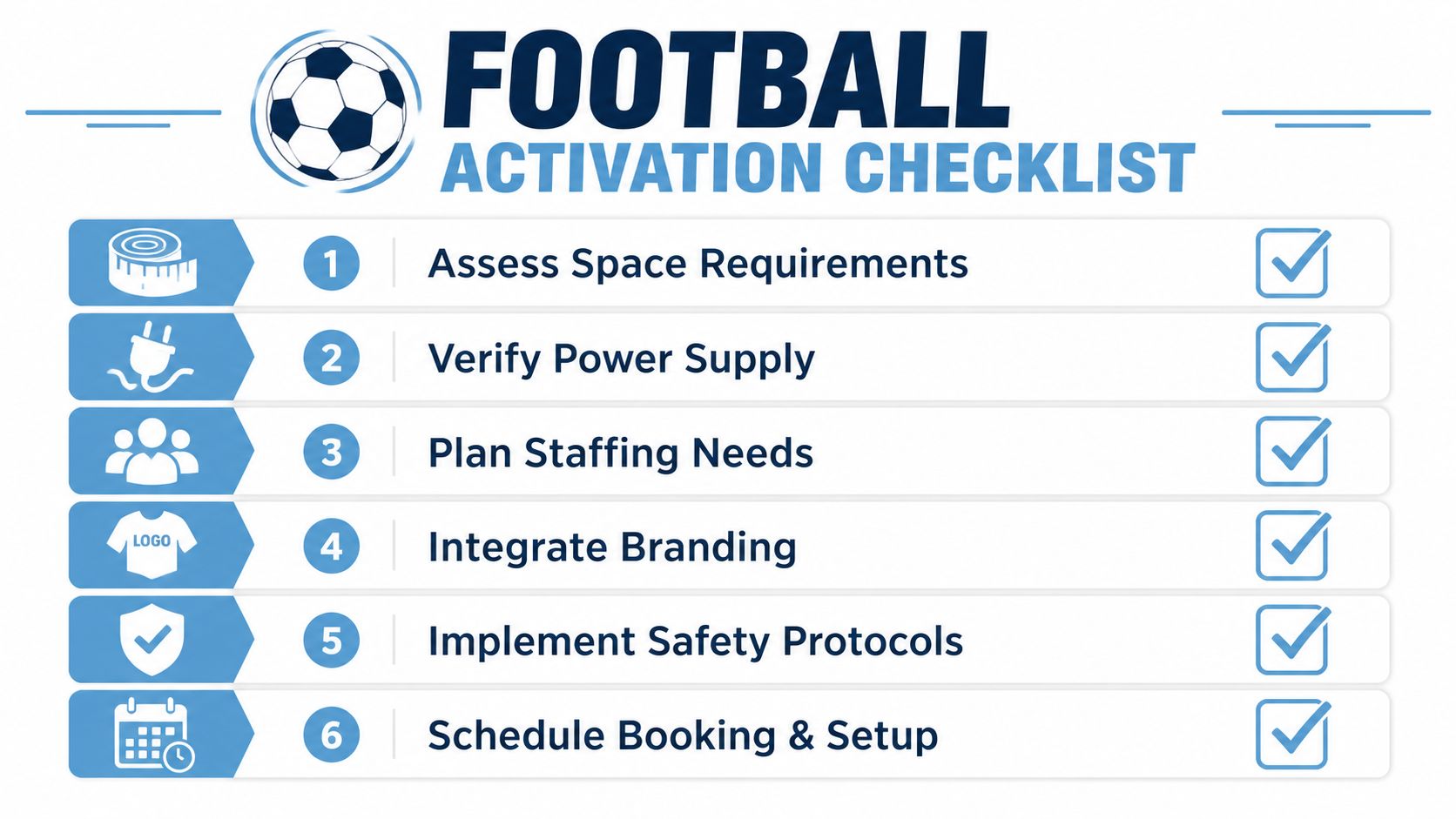
The practical checklist event teams should run
- Check access routes: confirm loading bay rules, delivery windows, door widths, lift access, and whether the equipment has to cross carpeted public areas
- Confirm power early: don’t assume the nearest floor box is sufficient or in the right place for clean cable management
- Allow for audience space: a football activation needs room for players, queueing guests, staff, and spectators with phones in hand
- Plan staffing around flow: self-managed games often stall, create confusion, or lose the lead capture opportunity
- Review venue rules: some sites are stricter on build height, sound, screen brightness, or rigging than clients expect
The attraction is only half the job. Queue shape, sight lines, and staff positioning usually decide whether it feels busy in a good way or crowded in a bad way.
Branding should be built into the game, not taped onto it
The strongest branded activations don’t stop at a logo board beside the kit.
You’ll get more value when the branding lives inside the experience itself. That can mean custom skinned housings, branded target zones, on-screen score graphics, digital backdrops, leaderboard pages, and post-play photo or video outputs that carry campaign identity. Done well, the game becomes part of your brand environment rather than a rented object placed inside it.
This is also where event planners should think about message hierarchy. The guest must still understand the challenge instantly. If branding makes the game harder to read, it weakens performance.
Safety and compliance aren’t paperwork extras
For a corporate event manager, the supplier’s operational discipline matters as much as the attraction.
You need confidence that RAMS, insurance, installation procedures, cable management, and operator supervision are all handled properly. That’s especially true at large venues and public-facing activations where the game sits inside a dense event environment. If you’re reviewing the risk side in detail, a practical reference point is football event risk assessment planning.
A smooth activation usually looks simple because somebody solved all the boring problems in advance. That’s what good planning buys you.
Measuring Success and Calculating Event ROI
The hardest conversation after an event usually starts with a fair question. “Did the attraction do anything useful?”
Too many interactive experiences still get judged on anecdote. The team says the stand felt busy. Guests seemed to enjoy it. Someone senior mentioned it looked popular. None of that is worthless, but none of it is strong reporting.

The measurement gap most planners run into
There’s a recognised gap in UK-specific data on corporate engagement metrics for interactive simulators, especially around realistic dwell time and lead capture benchmarks. That need for better reporting is highlighted in discussion around event planners wanting measurable moments and data-backed performance metrics in the technology and football engagement gap reference.
That gap creates two problems. First, it makes budget approval harder. Second, it makes post-event justification weaker than it should be.
What useful reporting looks like
The right reporting framework is simple. It should connect game activity to the event objective.
For most corporate activations, that means tracking:
- Participation volume: how many people played
- Repeat engagement: how many returned for another attempt
- Leaderboard behaviour: whether competition encouraged longer stays
- Lead capture points: which interactions collected usable data
- Content actions: whether guests requested or shared photo or video outputs
- Conversation quality: whether the attraction opened meaningful discussions for the team
That’s a more credible view of ROI than saying the game “created a buzz”.
Use football metrics the way sport uses performance data
One reason football works well as an event mechanic is that audiences already accept the logic of measurement in the sport itself.
Platforms covering English football data have popularised metrics such as expected goals, and one cited example notes that Manchester City led the Premier League with 89.4 xG in 2022-23 in football-statistics analysis linked from Sports Data Campus. For an event planner, the relevance isn’t the club stat alone. It’s the mindset behind it. Football fans are comfortable with scorelines, rankings, probabilities, shot quality, and performance comparison.
That makes leaderboard-driven activations easier to justify internally. The game doesn’t just entertain. It produces a familiar type of performance data that attendees instinctively understand.
Measure the attraction like a campaign asset, not like a side activity. If it drove traffic, captured details, or extended conversations, report that in the same language you’d use for any other channel.
A supplier that can turn gameplay into a post-event summary gives marketing managers something concrete to take back to stakeholders. That’s where an activation starts proving its value instead of merely hoping people noticed it.
Real-World Scenarios for Interactive Football Hire
An interactive football game changes shape depending on the brief. The same core idea can serve lead generation, family participation, or public buzz, but only if the format matches the setting.
Exhibition stand at ExCeL London
A B2B exhibitor at ExCeL usually needs a stand that attracts attention without derailing commercial conversation.
In that environment, a high-accuracy penalty or target-shooting simulator works well because it draws people in while still feeling polished enough for a business audience. The best version isn’t a free-for-all. It has a host, a clear scoring mechanic, and a branded leaderboard that gives staff a reason to ask for a name and company detail.
The key trade-off is sound and pace. Too quiet and nobody notices it. Too chaotic and the stand turns into a crowd with no control. A measured, tech-forward football challenge often threads that needle better than a novelty game.
Corporate family fun day in Cambridge
A family event needs broader appeal. The challenge can’t rely on technical knowledge or confidence in front of a crowd.
That’s where an interactive goal wall or fast physical skill game usually wins. Parents can join in without needing sportswear. Children understand the objective quickly. Colleagues who’d avoid a highly realistic simulator will still have a go because the format feels playful rather than intimidating.
The operational priority here is throughput. You need a game that resets quickly, keeps queue times sensible, and gives everyone a fair chance without long explanations. Fast rounds matter more than simulation depth.
Fan zone outside Wembley
A public-facing fan zone can support a more theatrical format, especially when the activation is tied to a product launch or campaign.
Here, a VR goalkeeper challenge or premium football simulator can create stronger visual content. People are already in a football mindset, so the appetite for spectacle is higher. This is also the type of setting where on-screen stats and realism can add value rather than complexity.
One useful layer is integrating real football-style data into the experience. Simulators can mirror the sport more convincingly by referencing live-style metrics such as expected goals, including the cited example that Manchester City led with 89.4 xG in 2022-23, which helps make an activation feel closer to the analytical language fans already recognise in UK football coverage.
Conference or roadshow in SEC Glasgow
A conference audience often sits between the exhibition visitor and the fan zone crowd. They’ll engage if the game is accessible, but they still expect the setup to look considered.
Often, planners make a smart compromise. They choose a physical challenge with a strong digital front end. That gives the event quick participation while preserving a modern, screen-led feel. A leaderboard can run all day, departments or teams can compete, and the activation becomes an energy point between formal agenda sessions.
Across all of these scenarios, the winning decision is rarely “Which football game looks coolest?” It’s “Which football game helps this audience behave the way we need them to behave?”
How to Hire Your Interactive Football Game with PSW Events
Most event managers don’t need more options. They need a cleaner decision process.
If you’re hiring an interactive football game, start with the event objective and work backwards. That one step will usually narrow the field faster than browsing product lists.
Step one is the brief
A useful supplier conversation starts with five things:
- Your event type: exhibition, conference, fan zone, family day, or internal team event
- Your audience: football fans, general public, mixed ages, B2B delegates, or staff
- Your venue conditions: footprint, access, timing, and operating restrictions
- Your goal: footfall, lead capture, social content, or morale
- Your brand needs: custom visuals, messaging, registration, or leaderboard integration
Without that context, the recommendation is guesswork.
Step two is matching format to outcome
Once the brief is clear, the decision usually becomes straightforward. If you need volume, choose a format with fast reset times. If you need premium feel, choose a simulator with stronger visual presentation and data output. If you need broad family participation, keep the challenge simple and inclusive.
One route for comparing options is to review broader games rental choices for UK events and then shortlist the football format that best fits the audience behaviour you want to encourage.
PSW Events is one supplier in this space and provides football simulator hire alongside delivery, installation, branding support, on-site staffing, and health and safety compliance for corporate events.
Step three is execution without friction
The day-of-event standard matters. The attraction should arrive on time, install cleanly, open on schedule, and run with staff who know when to entertain, when to speed up throughput, and when to support lead capture.
From a client perspective, that’s the value of a turnkey hire. You’re not just getting a game. You’re getting a managed experience with fewer moving parts left for your team to solve onsite.
When a football activation works properly, it feels spontaneous to the audience and controlled to the organiser. That’s the balance worth paying for.
Frequently Asked Questions
How much space does an interactive football game need
It depends on the format. A compact challenge can work in a modest stand space, while larger arena-style builds need much more room and safe run-up distance. Always plan for player space, queue space, operator position, and spectator sight lines, not just the hardware footprint.
Is it suitable for people who aren’t football fans
Yes, if the format is chosen properly. Fast target games and reaction-based challenges usually work well for mixed audiences because guests don’t need technical football ability to enjoy them. Highly realistic simulators are better for audiences that already like sport or competition.
Can the game be branded for a product launch or campaign
Yes. Branding can sit on the physical housing, screen environment, leaderboard, backdrops, and content outputs. The practical rule is to keep the challenge readable. If guests can’t understand the game in seconds, the branding has gone too far.
Does it work better for exhibitions or internal events
It can work for both, but the objective changes. At exhibitions, the game should support stopping power, dwell time, and commercial conversations. At internal events, it’s more about participation, shared competition, and creating energy in the room.
Do I need event staff to run it
In most corporate settings, yes. Staff keep the queue moving, explain the rules, reset play, and help turn attention into useful engagement. Unsupervised activations often lose momentum and create avoidable bottlenecks.
What should I ask a supplier before booking
Ask about:
- Footprint requirements: including safe operating area
- Access and setup: delivery timing, build duration, and venue constraints
- Power needs: and cable management
- Branding options: what can be customised on screen and on hardware
- Staffing model: who operates it and how many people are needed
- Compliance documents: RAMS, insurance, and method statements
- Reporting options: what participation or lead data can be captured
Can an interactive football game support lead generation
Yes, if the registration process is built into the experience. Leaderboards, score entry, prize mechanics, and content delivery are common ways to make data capture feel relevant. The key is to avoid interrupting the flow too early.
How far in advance should I book
Earlier is better, especially for branded builds, major venues, or busy seasonal periods. A straightforward hire may still be possible on a shorter lead time, but custom graphics, logistics planning, and venue approvals all benefit from more notice.
If you’re planning an event where attention is hard to win and harder to keep, an interactive football game can do more than entertain. It can attract a crowd, hold people in place, and give your team a practical way to turn activity into outcomes.