
Only 10% of UK workers felt engaged in 2025, while 17% felt lonely or isolated, according to Sodexo's 2025 workplace analysis. Those figures change the question from “Should we organise a team day?” to “Which workplace behaviours are we trying to improve, and how will we know?”
That's why team building matters when it's designed as a measurable collaboration intervention. A well-planned activity can give colleagues a controlled setting to practise communication, shared decision-making, trust and constructive challenge. It can't repair poor management, excessive workloads or an unsuitable working model on its own, but it can expose and strengthen the behaviours that make everyday work function.
For UK employers, the strongest business case connects an activity to a defined objective, such as cross-functional communication, onboarding, psychological safety, employee voice or relationship-building across hybrid teams. The event is only the rehearsal. The true test comes afterwards, when teams either carry those behaviours into meetings, handovers and projects, or return to old habits.
The UK Business Case in Numbers
UK engagement evidence places team building within operational planning, not only the social budget. The Engage for Success survey evidence reported average employee engagement of 65% in 2022, a three-percentage-point increase after two years of stagnation. Organisations that consistently embedded people issues into decision-making reported engagement of 77%, while only two in five employees worked for organisations taking that consistent approach.
That finding does not show that one event causes higher engagement or a defined productivity gain. It does show the value of connecting employee input with visible management action. In practice, that might mean a quarterly forum that publishes decisions and owners, or a voice survey followed by a reported action plan. A team activity can support those routines by giving colleagues a structured setting to practise communication and participation.
Treat the event as a business intervention
Start with the workplace problem, not the attraction. A mixed-department simulator competition could support cross-functional relationships. A facilitated problem-solving session could rehearse escalation and decision-making. An informal shared experience may help repair relationships, provided it creates meaningful interaction rather than just placing colleagues in one room.
Corporate planners preparing an internal proposal can use why team building matters to examine the wider business rationale. The same discipline applies to experiential marketing: define the intended response, design the experience around it, and assess the result using experiential marketing ROI principles rather than relying on enjoyment scores alone. For a provider such as PSW Events, simulator-led activities offer a practical format for observing collaboration during a defined challenge.
A defensible business case answers three questions:
- What needs to change? Teams may need stronger handovers or more contact between departments.
- What behaviour will the activity rehearse? Participants might practise asking for help, rotating leadership or challenging an assumption.
- What will happen afterwards? Managers need a follow-up action, pulse check or workplace experiment to test whether the behaviour transferred.
This framing gives HR, operations and leadership a shared basis for judging the intervention. It also keeps “team building” from becoming shorthand for an unmeasured perk.
How Team Building Actually Changes Team Performance
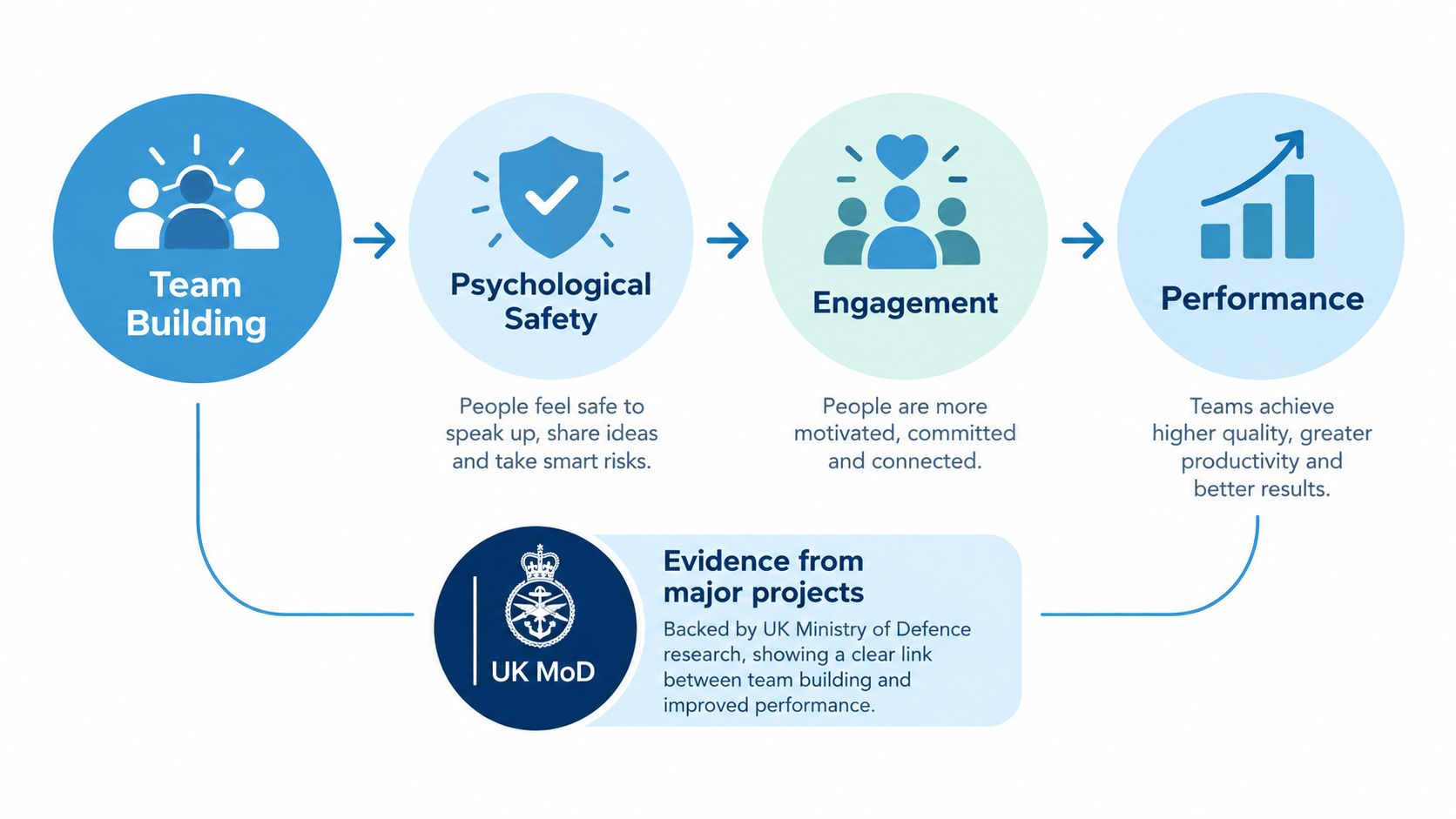
The mechanism is psychological safety, the shared belief that colleagues can ask questions, admit mistakes, challenge assumptions and contribute ideas without embarrassment or punishment. Activities matter when they give people repeated, observable chances to practise those behaviours under manageable pressure.
Evidence from UK Ministry of Defence major-project teams found that psychological safety explained 37.5% of the variance in perceived team-performance scores and 29.4% of the variance in wellbeing scores. Projects in the highest psychological-safety quartile recorded median wellbeing scores 47% higher than projects in the lowest quartile, as reported in the UK Ministry of Defence research.
Rehearsal creates evidence of behaviour
A simulator challenge can reveal who shares information, who takes over, who stays silent and how a group responds when a plan fails. A skilled facilitator can then debrief those observations without turning them into personal criticism. The useful question isn't “Who won?” but “What helped the group recover, and what stopped someone from speaking sooner?”
These moments align with the engagement enablers identified in the UK evidence base: strategic narrative, engaging managers, employee voice and organisational integrity. Team building is most valuable when managers model vulnerability, invite dissent and reward constructive challenge after the event. Without those conditions, the activity may produce a temporary mood lift without changing the team climate.
| Engagement Enabler | Workplace Behaviour Rehearsed | Measurable Signal |
|---|---|---|
| Strategic narrative | Connecting individual decisions to a shared goal | Participants can explain how their role supports the outcome |
| Engaging managers | Asking for input and responding constructively | More balanced participation during the activity and follow-up |
| Employee voice | Raising concerns, questions and alternative views | Issues are surfaced earlier in the debrief or subsequent work |
| Organisational integrity | Applying agreed rules consistently | Teams follow shared processes when pressure increases |
Design for transfer, not spectacle
The activity should require interdependent problem-solving, not parallel participation. Rotate roles, introduce short feedback points and give quieter participants meaningful responsibilities. Then hold a brief workplace-focused debrief that connects what happened to handovers, project escalation, cross-functional decisions or customer work.
The evidence supports psychological safety as a performance mechanism, not as a guarantee. A one-off social event won't create lasting change if managers punish challenge, objectives remain unclear or workloads leave no room for collaboration. The event should be treated as a safe, visible rehearsal for the behaviours leaders expect during ordinary work.
Productivity, Retention and Wellbeing Outcomes Worth Measuring
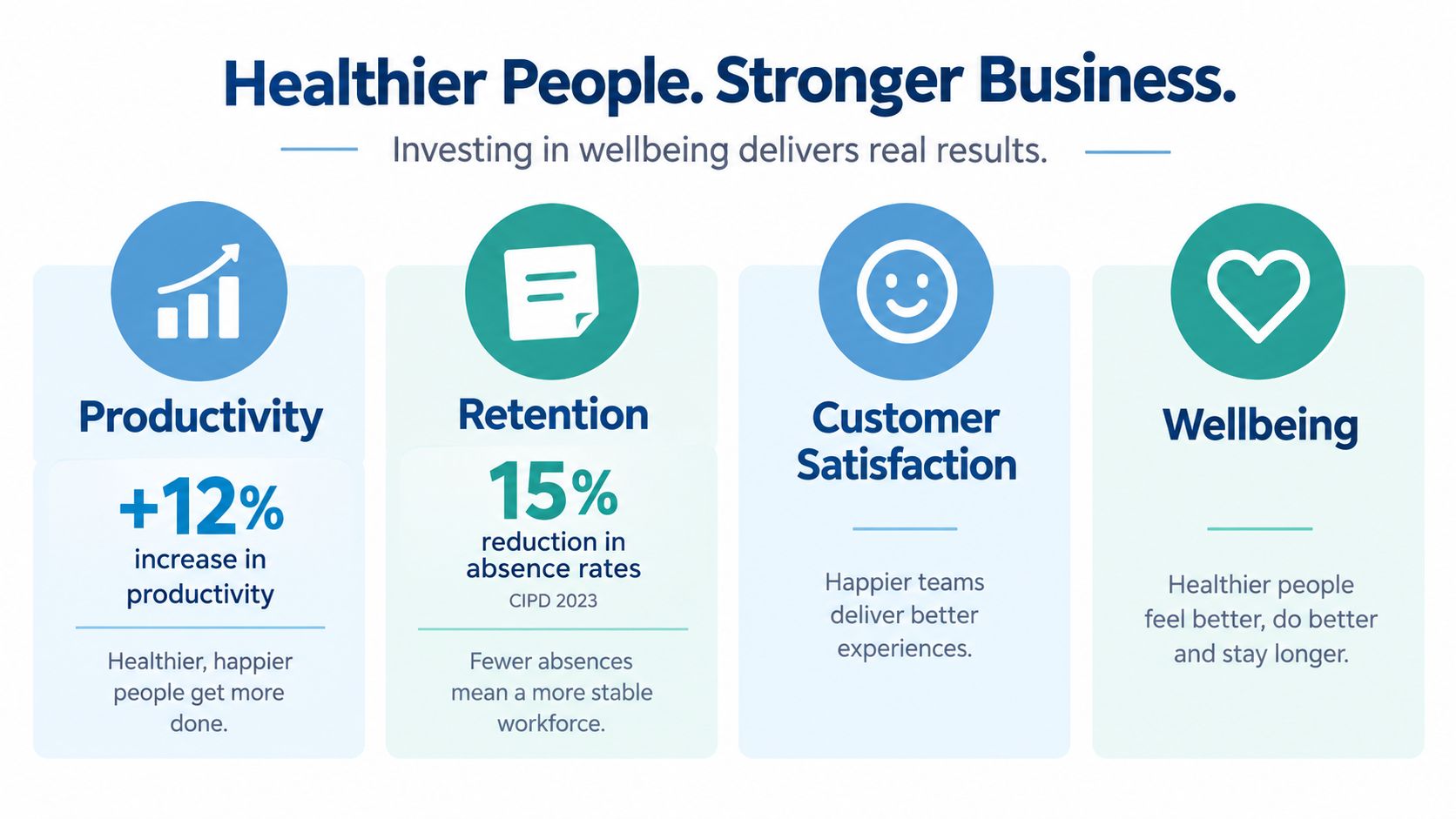
The operational case for team building depends on what changes after the event, not how many people attend. The CIPD links employee engagement with productivity, innovation, retention, customer satisfaction and health-and-safety performance in its employee engagement factsheet. These associations do not prove that a single activity will improve any metric. They do identify sensible outcomes for evaluation.
Wellbeing provides a second measurement route. The CIPD 2023 Health and Wellbeing at Work report recorded average UK absence of 7.8 days per employee, equal to 3.4% of working time lost. It also found stress-related absence in 76% of organisations, rising to 92% among organisations with more than 250 employees.
Team building cannot substitute for occupational-health provision, workload redesign or professional mental-health support. Its narrower contribution is relational: stronger working connections can make it easier to raise concerns, request help and coordinate when pressure increases. Those effects should be tested through workplace behaviour, rather than assumed from enjoyment scores.
Build a measurement chain
Measure the starting conditions, the immediate response and the behaviour that follows. A practical reporting set can include:
- Connection: Ask whether participants know whom to contact in another team and feel comfortable seeking help.
- Communication: Review whether cross-team handovers, referrals or information-sharing become clearer or more frequent.
- Psychological safety: Use a short pulse before and after the activity, covering speaking up, admitting uncertainty and challenging assumptions.
- Operational follow-through: Check whether the agreed post-event action was completed and whether managers reinforced it.
- Wellbeing context: Monitor relevant absence trends alongside wider wellbeing work, without attributing any change to the event alone.
Pair pulse results with one management commitment per team. Publish what changed within four weeks, so participants can see that employee voice has consequences. The engagement baseline covered earlier in this article supports this focus on follow-through, rather than treating the event as a standalone intervention.
A satisfaction score remains useful for checking accessibility and relevance, but it should not be the headline KPI. Finance partners are more likely to support a programme when reporting shows what participants practised, which behaviours changed in the following weeks and the organisational metric the intervention was intended to influence.
When Team Building Fails and What Must Come With It
Team building fails when leaders use an event to mask a workplace problem. An enjoyable activity cannot correct unclear objectives, weak management, excessive workload, exclusion or inadequate collaboration technology. It should not serve as a substitute for office attendance either.
Sodexo's 2025 workplace analysis found that 65% of UK workers said team interaction drives engagement, while only 42% indicated they would comply with compulsory office returns. It also reported that 53% felt pressure to spend more time in the workplace, although 80% said flexible working improved their quality of life. The full findings appear in Sodexo's UK workplace analysis. The implication is practical: connection matters, but enforced presence is not equivalent to effective collaboration.
Design against predictable failure modes
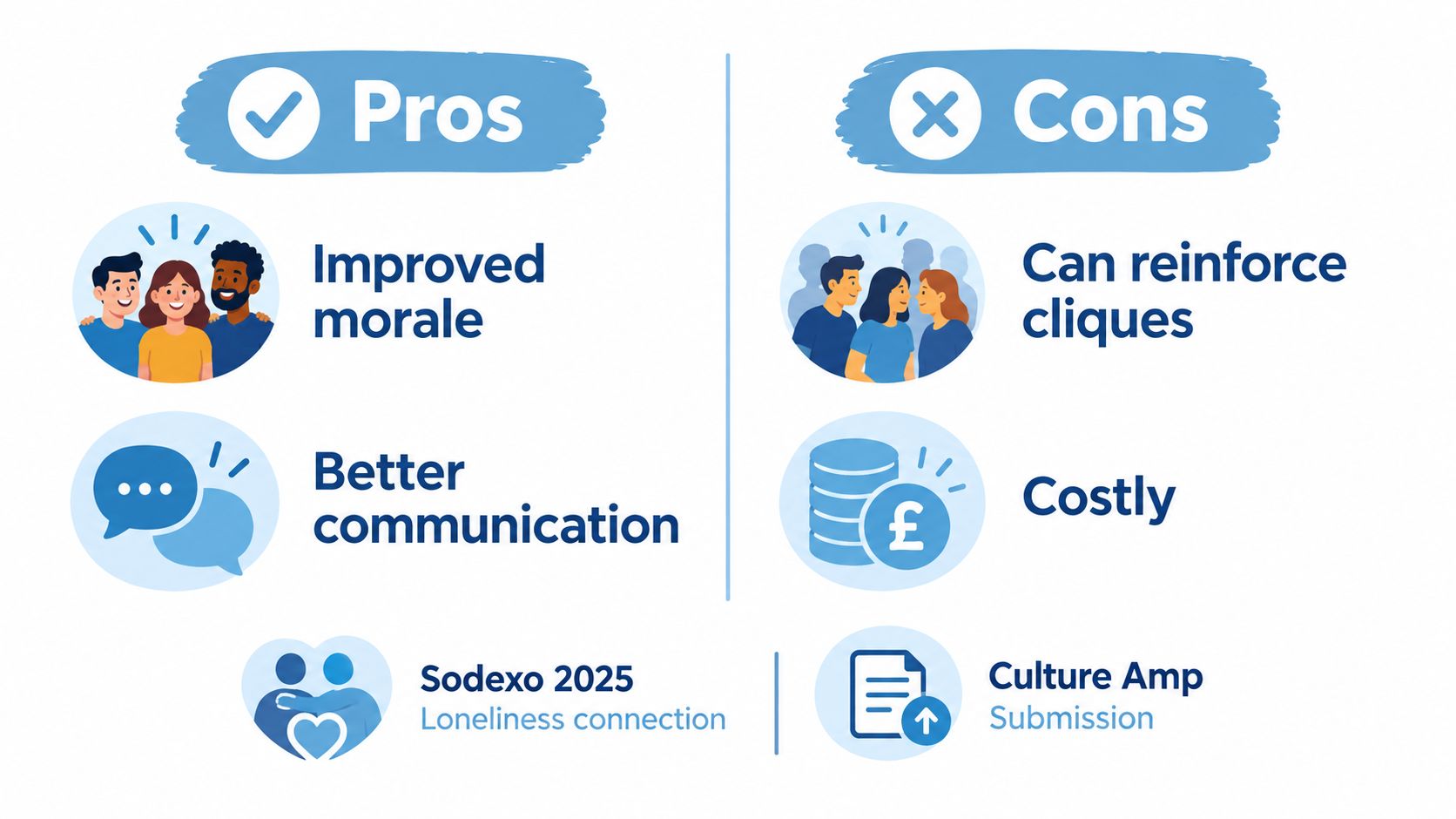
Hybrid teams need purposeful connection, not a compulsory gathering that treats flexibility as a defect. The ONS evidence indicates that 28% of working adults in Great Britain hybrid-worked between January and March 2025, while Culture Amp data submitted to Parliament placed UK engagement at 65% in January 2025, five percentage points below the global average. These figures are reported in the UK evidence on access to hybrid work.
| Failure Mode | UK Evidence Signal | Required Companion Action |
|---|---|---|
| Office attendance disguised as team building | Flexible working improves quality of life for many employees | Set a connection objective and provide equivalent value for remote and office-based staff |
| Entertainment without transfer | Enjoyment does not guarantee changed workplace habits | Schedule a facilitated debrief and document manager follow-up |
| Exclusive formats | Mobility, confidence and personal circumstances can affect participation | Provide accessible roles, alternatives and clear choices |
| Weak management | Employees may still hesitate to challenge assumptions | Train managers to invite dissent and respond constructively |
| Poor job design | Workload and role ambiguity can erase a temporary sense of connection | Address responsibilities, workload and collaboration systems alongside the event |
Use the loneliness signal carefully
The CIPD Good Work Index 2025 evidence found that more than one-third of working adults sometimes, often or always feel lonely at work. Written evidence to Parliament also found that employees working from home for more than 75% of their working time were more likely to report often feeling lonely at work, as shown in the parliamentary evidence.
These findings support purposeful relationship-building, not a blanket return-to-office policy. A team activity should help people form useful working relationships and practise collaboration in a setting that reflects their actual work. Leaders must also improve management quality, technology, job design and follow-through, because an event alone cannot resolve those conditions.
Choosing Activities That Match Your Objective
The right activity depends on the behaviour you need to rehearse. A planner seeking rapid feedback shouldn't choose a format designed only for informal conversation, just as a team with strained relationships may not benefit from a high-pressure competition before trust has been rebuilt.
The 2024 OPP workplace-psychology survey of more than 1,000 UK workers found that over 30% believed team-building activities would be useful in their jobs. However, 14.5% said team building was good in theory but often poorly run, and 18% said activities were often inadequately followed up. Only 11% would prefer taking a day off work to participating, according to coverage of the OPP survey.
Competitive simulators
Racing and sports simulators work well when the objective is rapid decision-making, visible feedback and shared performance pressure. F1 and multi-racing rigs can support departmental or mixed-team competitions, while American football, rugby, golf and boxing simulators offer different combinations of individual skill and group encouragement. Electronic leaderboards make progress visible, but organisers should avoid rewarding only the strongest individual performer.
A better design gives each participant a role. Teams can rotate drivers, strategists, coaches and analysts, then discuss how information moved between those roles. PSW Events offers options including F1 and multi-racing rigs, American football and boxing simulators, VR, Batak Pro and giant Scalextric within its team-building activities in the UK. The value comes from the structure around the attraction, not from novelty alone.
Collaborative problem-solving
Choose collaborative challenges when you need cross-functional coordination, listening and escalation. Participants should depend on one another for information or resources, with the facilitator introducing a clear constraint that requires a decision. The debrief can examine whether people asked questions early, shared partial information and made space for dissent.
Creative and shared experiences
Creative formats can lower the entry barrier for colleagues who dislike competitive environments. A shared task gives people a reason to talk without demanding athletic ability or specialist knowledge. These formats suit onboarding, relationship repair and inclusion objectives, particularly when the facilitator rotates participation and prevents confident voices from dominating.
Guidance on corporate retreat team-building activities can help planners compare broader retreat formats, but the same test applies: what workplace behaviour will participants practise, and how will managers reinforce it?
Physical and outdoor events
Physical or outdoor activities can create energy and shared memories, but they need careful accessibility planning. They shouldn't be the default choice for a group with mixed mobility, health or confidence levels. Use parallel roles, alternative participation routes and clear expectations so that the event strengthens belonging rather than exposing differences in ability.
Briefing a UK Provider for Measurable Results
A provider brief should begin with the business objective, not the product catalogue. State the behaviour you want to influence, the teams involved and the workplace situation that prompted the event. “Improve collaboration” is too broad. “Help sales and delivery teams share information earlier during client handovers” gives a provider something they can design around.
Use five headings in the brief:
- Objective and audience: Identify the teams, seniority mix, relationship challenge and desired behaviour.
- Format and access: Explain venue constraints, mobility requirements, sensory considerations, dietary needs and equivalent participation for remote or hybrid colleagues.
- Operational delivery: Confirm timings, floor space, power, branding, queue management, installation and breakdown.
- Measurement: Specify the pre-event pulse, immediate feedback, agreed behavioural signal and follow-up point.
- Risk and accountability: Request method statements, operator arrangements, insurance evidence and a named delivery lead.

Ask providers questions that expose delivery quality
Find out who manages the event on site, how facilitators adapt the format for different confidence levels and what happens when queues, delays or technical issues arise. Ask how the activity can be branded without turning the experience into a sales pitch, and how the team will protect participant data if scores or feedback are recorded.
For a UK corporate or brand-activation buyer, insurance and operating standards matter. PSW Events describes a delivery model covering planning, branding, logistics, installation, on-site staffing and H&S compliance, with £10 million products, employee and public liability insurance and more than 50 years' combined experience. Its corporate team-building offer can be reviewed through corporate team-building companies.
The final requirement is the handover ritual. Before participants leave, the facilitator should ask each group to identify one behaviour to continue, one obstacle to remove and one manager action required. Send those commitments to team leads, then repeat the pulse or review the operational signal at the agreed follow-up point.
Short Case Examples and the KPIs That Prove It Worked
Three UK scenarios show how team-building results should be assessed. At a sales conference, a mixed-team racing challenge brings sales and delivery colleagues together. Useful measures include whether participants identify contacts in the other function, whether cross-team queries increase appropriately and whether handover quality improves afterwards. Completion and enjoyment provide context, not proof of workplace impact.
A hybrid onboarding cohort requires a different design. Colleagues working from home for most of their time may have fewer informal opportunities to build relationships. Parliamentary evidence links home working above 75% of working time with a greater likelihood of often feeling lonely at work. The CIPD loneliness evidence cited in the failure-modes section supports measuring connection rather than office presence.
Use a short psychological-safety pulse before and after the activity, alongside contact frequency across teams, completion of agreed introductions and collaboration follow-through. The facilitator should record whether remote participants had equivalent influence, rather than counting attendance alone.
A brand activation at an exhibition has another success definition. The event team can measure dwell time, lead capture and the quality of follow-up conversations. The internal team-building element can assess role clarity, handovers between hosts and response speed when staff address visitor needs. These measures connect the experience with commercial and operational outcomes without attributing every result to the attraction.
Record the evaluation in four stages:
- Before: Capture a baseline for connection, psychological safety or the relevant operational behaviour.
- During: Record participation quality, role rotation, completion and observable collaboration behaviours.
- After: Gather immediate feedback, then review the agreed workplace signal during follow-up.
- Decision: Keep, adapt or stop the format according to evidence of transfer.
A successful activity produces observable practice, receives manager reinforcement and leads to the intended behaviour in ordinary work. Enjoyment may support participation, but it is not the outcome.
PSW Events provides managed interactive experiences including racing, sports, flight, VR and collaborative attractions for UK corporate events, exhibitions and team-building programmes. To align an activity with a workplace objective and measurable follow-through, visit PSW Events and discuss your brief with the team.