
You're sorting a stand, a staff day, or a private party, and the entertainment brief is already doing your head in. You need something people understand instantly, something that doesn't eat half the floor, and something a venue won't push back on. Table football hire solves that if you treat it like an activation asset, not a novelty game.
The reason it keeps getting booked in the UK is simple. It gives you short, repeatable rounds, it works across mixed-ability groups, and it fits the way corporate events run, with people drifting in and out rather than sitting down for one long session. The scoring format is part of the appeal, because mainstream games are often played to 5, 10, or 11 goals, while Bonzini competition rules use 7 goals and a two-goal winning margin Table football rules and hire context. That structure makes the format easy to rotate through crowds in minutes, which is exactly why planners keep using it at exhibitions, staff events, and private functions.

Why Table Football Hire Works for Live Events
You're trying to hold attention in a room where people are already being pulled in three directions. Table football hire works because it gives guests something they understand straight away, it keeps the floor plan under control, and it resets fast enough to keep traffic moving.
Why it holds a crowd
The format does the job event planners need. Two people step up, play a short round, and clear the space for the next pair without dragging the whole stand into a long briefing or a slow handover. That matters at trade shows and brand events, where the goal is repeated bursts of interest, not one long session that ties up the attraction.
Human table football pushes the same logic into a bigger footprint. UK supplier copy describes it as an 11-a-side setup with the aim of being first to 10 goals The Fun Experts table football hire, so the rules are obvious from the aisle and the game is easy to watch from a distance. Goal-based play gives you a clear finish, and a clear finish keeps the queue under control.
Practical rule: if an attraction needs a five-minute explanation, it is already losing against table football.
That is the commercial case in plain terms. You want something that pulls people in, gives them a reason to stay, and resets quickly. Table football does that without a long briefing, without a complex operating model, and without turning the event into a logistics problem.
Why planners choose it over more complex attractions
Complex activations slow the room down. If the activity needs coaching, costume changes, or a long safety talk, it may look strong on a proposal but it will not always turn into throughput on the day. Table football hire avoids that problem because most guests already know how to play, and anyone else can pick it up in seconds.
That is why it works across mixed audiences. HR teams use it for staff days because nobody gets excluded. Brand teams use it because spectators understand the action instantly. Private hosts use it because it gets people involved without turning the party into an admin exercise.
For live audience mechanics, that lines up with the wider idea of experiential marketing, where the goal is participation rather than just filling a room. Table football is one of the cleanest ways to do that, because it creates activity without demanding extra explanation or extra space.
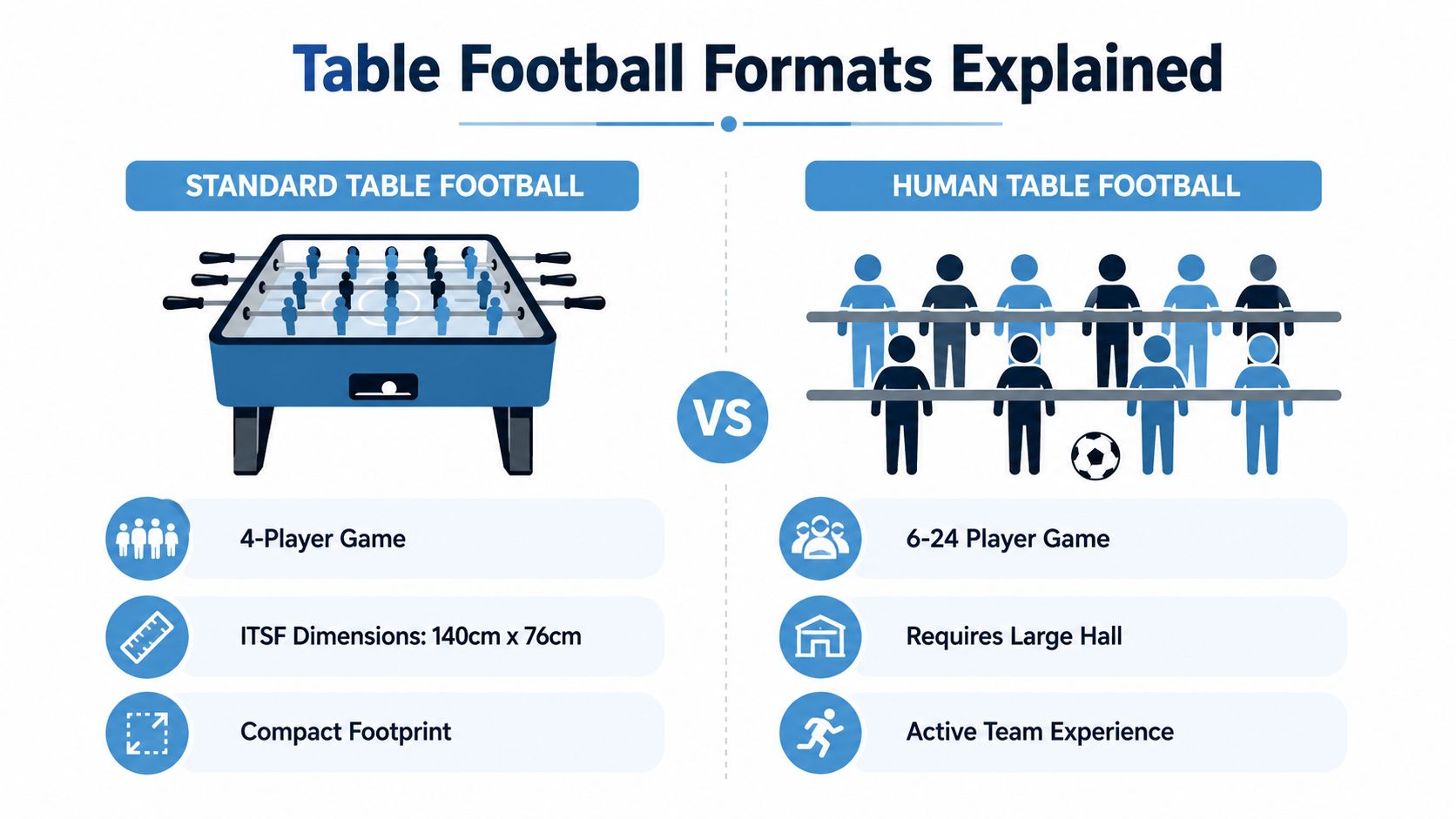
Standard and Human Table Football Formats Explained
Choose the format first. It sets the quote, the floor plan, and the level of crowd pull you get on the day. Standard table football suits tighter spaces and quicker turnover. Human table football is the louder, more visible option, and it needs a proper footprint to work. Get the format wrong and you either waste floor space or end up with a feature that does not look big enough for the room.
Standard table football
Standard table football is the practical hire choice for most corporate stands and smaller hospitality areas. The format is built around a compact table footprint, with hire-focused descriptions putting it at about 1.4 m wide x 1.0 m deep x 0.9 m high, and an operational area of about 2.4 m x 2.0 m The Fun Experts table football. Official-style guidance also points to table geometry of about 140 cm x 76 cm x 90 cm, with a playing field of 110 to 120 cm x 64 to 70 cm and 15.9 mm rods Liberty Games buyers guide. That geometry is what gives premium tables their clean action and responsive feel.
Use it when the room is tight and the queue needs to move. Rounds are fast, players reset quickly, and you do not need a host standing over the game explaining every rule. It also works well for pair rotation, which keeps throughput steady and stops the activation from backing up.
Human table football
Human table football is the spectacle format. Supplier descriptions say it uses 11 players on each team and is played to 10 goals The Fun Experts human table football. That is the whole point of it. The players become the figures, so the crowd can read the action immediately and see momentum shifts without any explanation.
Commercial takeaway: use standard tables when space is tight, use human table football when you need a visible crowd pull.
Scoring by goals rather than elapsed minutes keeps both formats easy to run in an event setting. You can manage turn-taking properly, keep the audience watching, and build a repeat-play rhythm without guessing how long each match will run. That predictability matters on busy stands and in corporate schedules where every slot already has a job to do.
The human version needs more room and more planning, but it gives you a stronger visual draw. If the brief is to pull people across the hall and hold them there, this is the format to specify. It also fits the same experiential logic used in brand activation planning, because the point is participation, not just decoration. If staff are wearing coordinated kit, keep the look consistent and use the same branded apparel planning tips across the activation so the stand reads as one unit rather than a mix of random pieces.
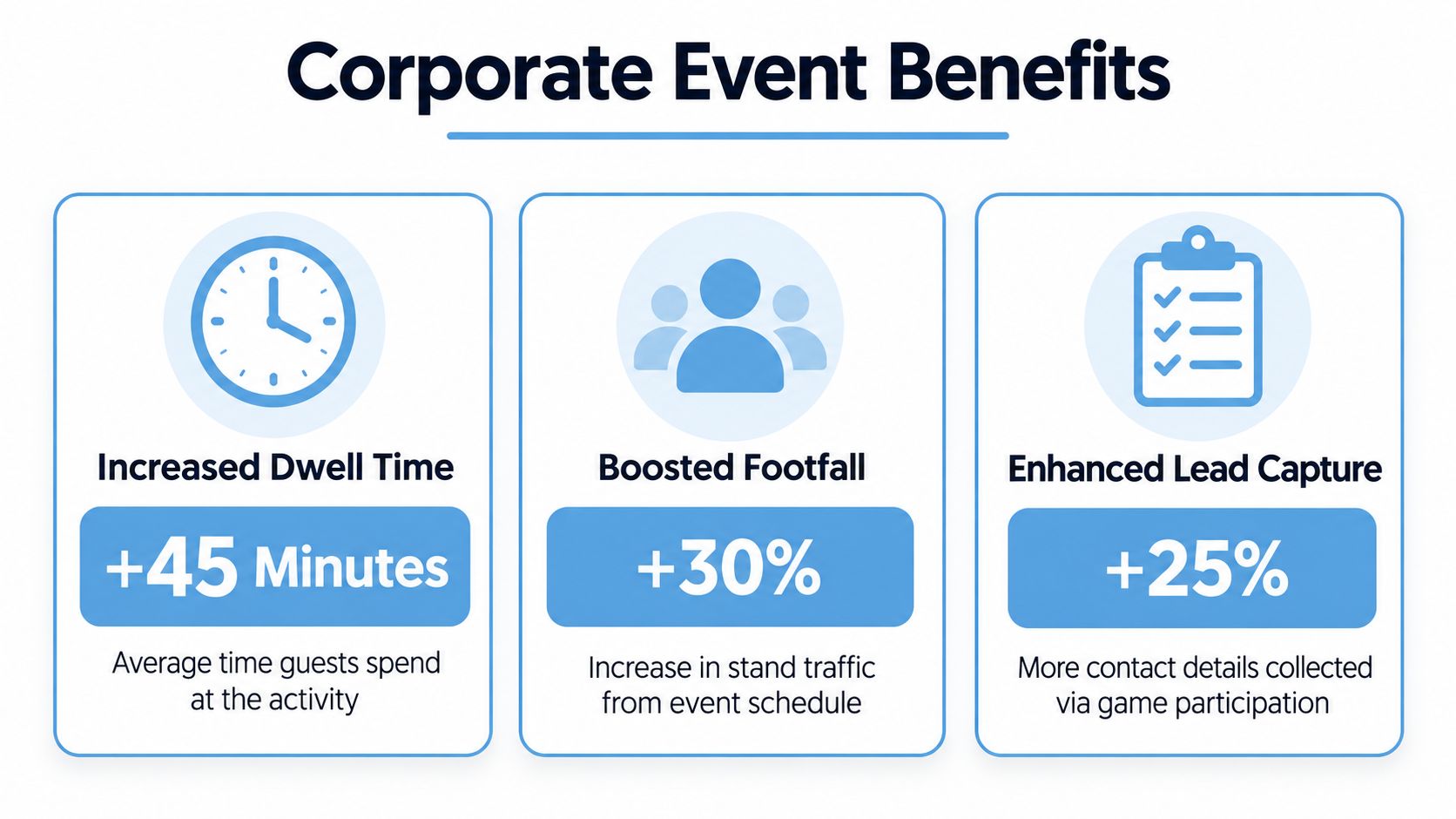
Business Benefits for Corporate and Brand Events
You do not book table football hire for the sake of filling space. You book it because it changes how people behave around the stand. Staff get a reason to invite passers-by in, spectators have something obvious to watch, and visitors have a clear reason to stay longer.
Dwell time you can manage
The strongest benefit is dwell time you can manage. A round ends quickly, fresh players step in, and the activity keeps moving without a reset crew or a long briefing. That matters because the format explains itself, and people do not need to learn the rules before joining.
For trade shows, that gives staff a longer window to start a proper conversation. For product launches, it creates a live focal point while the team works the room. For private parties, it keeps the entertainment from losing momentum after the first burst of interest.
Footfall and stand traffic
Table football works as a pull point because people know what they are looking at straight away. They do not need context, and they do not need a pitch. The game itself does the inviting, which is exactly why it works so well at exhibition edges where staff need to stop people walking past.
Place it where the aisle can see the play. That gives you a natural traffic cue. Put it too deep inside the stand and you waste the effect. Put it where the ball movement is visible and the contest is already doing half the work for you.
Lead capture with a reason to pause
Lead capture improves when the activity creates a short social exchange first. Staff can offer a quick game, then move into contact exchange while people are still engaged. That is cleaner than forcing a cold pitch at the edge of the carpet.
If you are building a broader campaign, pair the game with branded apparel and other event collateral. Useful planning ideas are set out in branded apparel planning tips, especially if your team needs a consistent visual presence around the table.
A game gets attention. A tidy stand, consistent staff clothing, and a clear reason to stop turn that attention into actual contacts.
For planners who want the wider strategy view, it also helps to use experiential marketing mechanics, because the point is not just entertainment. The point is to shape behaviour at the stand.
Where it fits best
- Trade shows: Use it where foot traffic is uneven and you need a reliable pull factor.
- Product launches: Use it when you want movement, noise, and a photo-friendly focal point.
- Team-building days: Use it when mixed ability is an issue and you need something anyone can join.
- Private parties: Use it when you want instant entertainment without a long run-up.
Logistics Planners Need to Lock Down Early
This is the part that gets skipped, then turns into a delivery-day problem. Footprint, access, flooring, power, and venue sign-off need sorting early. Leave them until the week before and you create avoidable delay, extra site checks, and more pressure on the crew.
Floor space and access
Start with the footprint, not the headline table size. One supplier lists a table at 1.4 m x 1.0 m x 0.9 m with an operational area of about 2.4 m x 2.0 m The Fun Experts table football. Another gives 0.9 m x 1.5 m for the table and 2.1 m x 2.1 m for the operating area Big Fun Hire table football hire. Use those figures as the planning base, then allow around 4.2 to 4.8 m² per unit before you add spectator or branding space.
That extra room is what keeps the activation working. Players need circulation space, guests need somewhere to stand, and the operator needs room to manage play without blocking a route. If the table is going into a shell scheme corner, measure the aisle access first and only then decide whether it fits.
Doorways matter too. One UK supplier says access through doorways and corridors needs a minimum width of 0.82 m The Fun Experts table football. If the route includes lifts, service corridors, or tight back-of-house access, check those dimensions before you confirm the booking.
Power, flooring, and staffing
Standard tables do not usually need much beyond safe siting, but branded or electronic versions may need power for scoring, lighting, or display elements. Ask the supplier exactly what needs plugging in and where the cable runs will sit. Keep leads out of public walkways, full stop.
Flooring protection is required on polished stone, timber, or temporary event flooring. Use mats or protection where the venue asks for it, and get written agreement if the table has to move through sensitive areas. Staffing is the other piece, because someone has to control queueing, explain the format, and keep play moving.
For teams planning the rest of the event build, this event planning timeline is a useful order of operations for approvals, access checks, and supplier sign-off. If your hire sits inside a broader procurement process, that is the point to line up supplier paperwork, including anything tied to haulage software pricing, so transport, delivery windows, and site handling are clear before load-in.
Documentation venues want
Most venues will ask for basic risk documentation, method information, and insurance evidence. If the supplier is fully managed, that request should be straightforward. A turnkey provider should also be able to confirm delivery, setup, strike, and on-site support without making you assemble the detail from separate emails.
If the venue cannot get a clear answer on access and load-in, the booking is not ready. That is the standard planners should hold.
Typical UK Pricing and Package Options
A workable UK quote should be easy to read and easy to challenge. One directory entry lists London Table Football Ltd at £250 for one table and £200 per table for two or more Table football pricing reference. Use that as a practical benchmark. It shows the market already prices on volume, so a single-table booking should cost more per unit than a multi-table hire.
Typical UK Table Football Hire Pricing Components
| Cost Element | Typical Range | What It Covers |
|---|---|---|
| Single table hire | £250 | One table for a standard booking |
| Multiple tables | £200 per table | Lower per-unit rate for two or more tables |
| Delivery and collection | Varies by venue and distance | Transport, load-in, and strike |
| Setup and install | Usually bundled in managed hire | Assembly, positioning, and basic handover |
| Staffing | Usually separate unless staffed package is quoted | On-site supervision and player flow |
| Branding | Add-on cost | Wraps, decals, signage, and visual theming |
| Electronic scoring | Add-on cost | Display and tracking where offered |
| Extended hire | Varies by duration | Multi-day or overnight retention |
A proper quote should show the full job, not just the table. Delivery, setup, and collection need to be listed clearly. If a supplier is also including staffed operation, electronic leaderboards, or branded wraps, those are fair extras, but they must sit as separate line items. Hidden bundling makes it harder to compare suppliers and harder to control the brief.
For procurement checks across different event assets, equipment rental rates gives a useful reference point when you are sanity-checking where table football sits inside the wider budget.
What moves the price
Volume is the first driver. A single table will usually cost more per unit than a multi-table booking, because hire companies can spread transport and handling across more kit. Staffing also adds cost, but it changes the day for the better, because someone is running queue flow, explaining rules, and keeping matches moving.
Branding only earns its keep if the visual build matters. If the stand already carries strong graphics, keep the table clean and the signage direct. If the event is light on dressing, wraps and themed decals do more work and help the game feel like part of the activation rather than a loose extra.
Distance, access, and turnaround also matter. A venue with awkward load-in, limited parking, or a tight changeover will push the price up because the supplier has to spend more time on handling and more care on site. If you are comparing transport-heavy hire categories, even haulage software pricing can help your team think more clearly about distance, delivery windows, and handling assumptions before you sign off a quote.
Add-Ons and How It Fits a Wider Activation Mix
Table football is strong, but it isn't always the only answer. At larger events, it works best as one station in a mixed entertainment layout, not as the entire proposition. That way you can match different audience types to different levels of energy.
Best pairings
If your audience is sports-led, table football sits naturally alongside American football or rugby simulators. If the brief is speed and competition, pair it with F1 or multi-racing rigs. If you need reaction time and noise, Batak Pro fits well. For longer dwell zones, giant Scalextric and VR experiences can carry the audience that wants something more immersive.
The reason this works is simple. Not everyone wants the same kind of interaction. Some guests want a quick match, some want a solo challenge, and some want a headset or a simulator seat. A mixed layout lets you serve all three without cannibalising footfall between zones.
When add-ons earn their keep
Leaderboards make sense when competition is part of the brief and you want repeat visits. Branded balls can work if people will see them in photos or if the game is being used as a giveaway hook. Photo backdrops are useful when social sharing matters and the event already has a strong visual theme.
Prize incentives are more selective. They help when there's a clear contest, but they can be wasted spend if the activity already has strong queue pressure. In that case, the game itself is enough. Don't buy add-ons just because they look good in a deck.
Where to keep it simple
If the stand is small, reduce the kit. A clean table, a good host, and clear signage often beat a cluttered setup with too many extras. The same applies to private events, where guests want to play rather than look at a pile of branded props.
A fully managed supplier reduces the workload further. If they're handling planning, delivery, install, staffing, and H&S paperwork, you're dealing with fewer moving parts and less client-side coordination. PSW Events fits that model as one of the UK operators that supplies interactive event entertainment, including football-based activations, alongside a broader range of simulators and games.
The right add-ons support the table, they don't compete with it.
Booking Checklist and Common Questions
Book it like a procurement item, not like a last-minute fun extra. That means you need a clear venue, a confirmed footprint, and a supplier brief that answers operational questions. If you send one tidy enquiry, you get a better quote and fewer surprises.
Procurement checklist
- Confirm the venue layout: Check where the table will sit, how guests will move around it, and whether it blocks any fire exits or service routes.
- Measure the access route: Compare door widths, corridors, lifts, and loading access against the supplier's dimensions before you commit.
- Check power and floor protection: Confirm whether the chosen format needs power, and whether the venue wants mats, tape, or other protection.
- Request H&S paperwork early: Ask for risk assessment details, method information, and insurance evidence in the first supplier exchange.
- Approve branding artwork: If you want wraps, signage, or leaderboards, sign off the artwork before the build window closes.
- Lock staffing and timing: Decide who runs the game, when it opens, and how it fits into the wider run-of-show.
- Plan reporting: If the table is part of a campaign, decide what you want back after the event, whether that's attendance notes, lead data, or simple operational feedback.
Common questions buyers ask
Does human table football work indoors at scale? Yes, provided you've got the room, the access, and the right venue permissions. The game is built for crowd visibility, so it works especially well in large halls and open event spaces.
How do you handle mixed-ability groups? Keep the rules simple, rotate players in short pairs, and avoid overcoaching. The format already does most of the work because people understand football without needing a tutorial.
What's usually in a fully managed package? Delivery, setup, collection, and on-site support are the basics. Depending on the supplier, branding, staffing, and electronic scoring can be added on top, so make sure the quote spells out each layer.
If you want a supplier who can handle football-themed interactive hire as part of a broader event plan, PSW Events is worth speaking to. They work across live activations, corporate entertainment, and turnkey delivery, so you can brief one team and keep the logistics tight.