
You've got a venue pencilled in, a crowd on the invite list, and a fundraising target that needs to feel realistic, not optimistic. That's usually the point where race night hire starts looking attractive, because it offers a familiar night out, simple guest participation, and a format that works in pubs, clubs, schools, and charity spaces across the UK.
The catch is that the easiest part is the concept. The part that makes the night succeed is the setup, from AV brightness and screen visibility to the regulatory details that decide whether your event can run as planned. Get those right, and the format is straightforward. Miss them, and even a good crowd can feel flat.
What Race Night Hire Actually Involves
A typical race night hire conversation starts when an organiser wants a fundraiser that doesn't feel like a lecture, raffle, or sit-down dinner nobody can be bothered to dress up for. A club secretary, school PTA, or charity coordinator often wants something social first, then profitable second. Race night hire fits that brief because it combines a pub-night atmosphere with a simple betting mechanic that most guests understand within minutes.

The format is a fundraising event built around pre-recorded horse races and a simple tote-style betting system. The Gambling Commission's guidance explicitly places race nights alongside bingo, casino, and poker fundraising activities, which matters because the regulatory framing is part of why the format has stayed popular in British clubs, schools, pubs, and charity venues (Gambling Commission guidance). In practice, most UK race nights use 6 to 8 simulated races shown on a screen, with guests making small-stakes bets and watching the races unfold as a shared room activity.
Practical rule: if guests can understand the betting in one explanation, the format is probably right for your audience.
That simplicity is the point. The event feels structured enough to run smoothly, but loose enough for people who've never backed a horse in their life. If you're comparing options, the race-night kit from PSW Events race night kit is the kind of hire solution that typically sits between a DIY setup and a fully managed entertainment package.
The appeal lies in the mix of entertainment and compliance-friendly fundraising structure. When prizes are not money and the event is run for charitable or good-cause fundraising, it can often be positioned as low-risk social fundraising rather than commercial gambling, which is exactly why so many organisers keep returning to it.
How Race Night Events Work in Practice
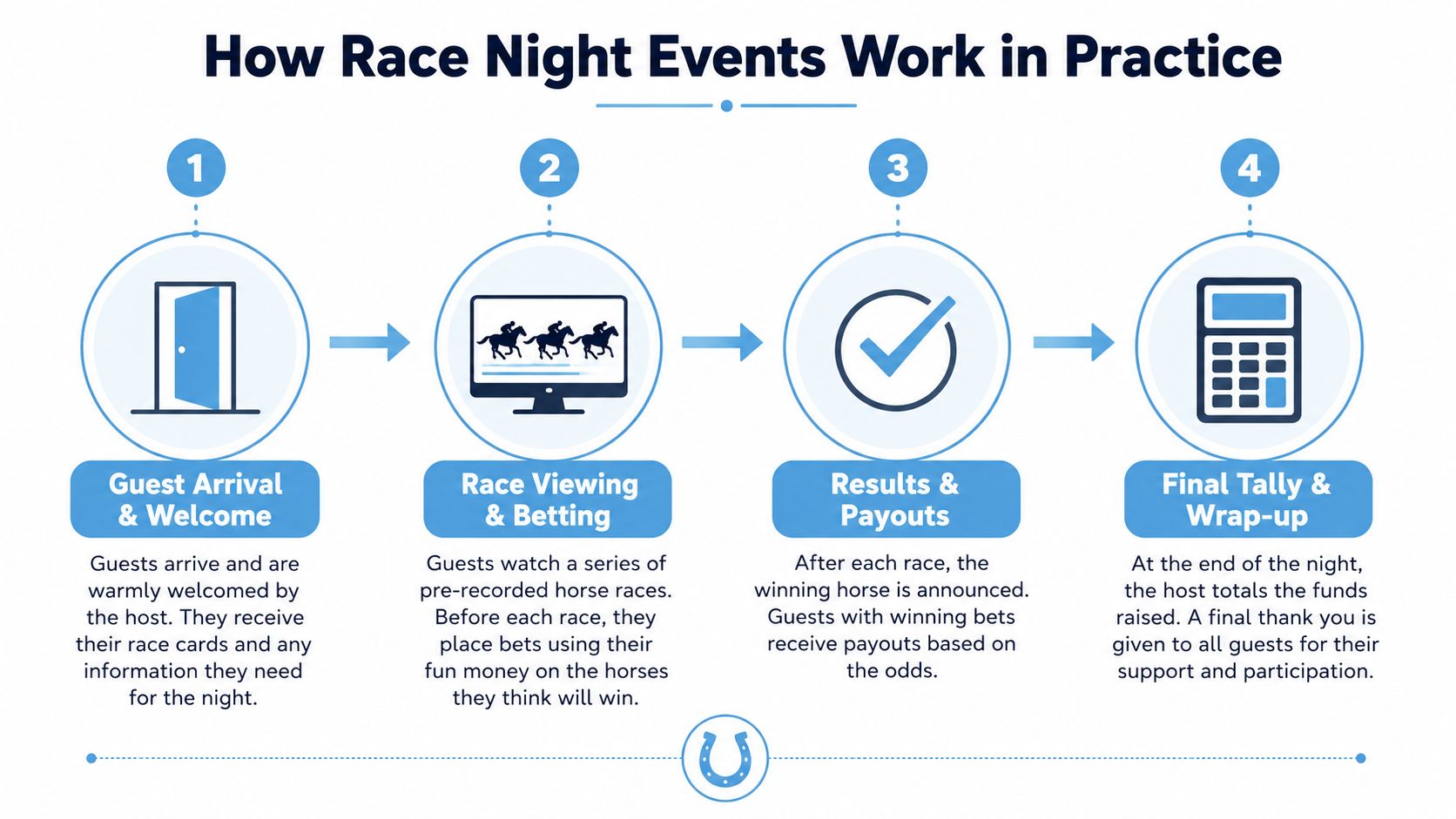
A race night works best when the room has a clear tempo from the moment guests walk in. They are greeted, handed a race card, and shown how the betting will run before the first race starts. That early control matters because the event depends on people joining in with the room, not sitting back and observing.
The betting flow
The operator opens betting on a race, the tote closes once the slips are in, and then the organiser draws the race film number to be played. That order keeps the night inside the usual fundraising format used for race nights, because guests are taking part in a chance-led social game rather than picking on form or odds.
The room has to move in a steady sequence. Announce the race, collect the bets, close the tote, show the race, pay out, then move on. If the handover between races is slow, or the gaps start to stretch, the crowd goes flat quickly. The practical side of the job is timing, clear calls from the host, and a payout process that does not stall the room.
What the room needs to keep pace
A race night only feels smooth when the basics are in place. The screen must be visible from the back of the venue, the sound needs to carry without distortion, and the organiser needs enough power and cable planning to avoid last-minute improvisation. In some rooms, that means checking where the projector will sit, where the speakers will reach, and whether the venue can take the load without tripping a circuit. Those details decide whether the night feels controlled or messy.
A good event also needs clear supervision at the betting table. Volunteers need to know who is taking cash, who is calling the race, and who is handling the payout after each result. That matters just as much as the content on screen, because even a well-produced race sequence falls apart if the front-of-house process is clumsy.
Why the format works for mixed audiences
A race night does not rely on racing fans. It works because the structure is easy to follow, even for guests who have no interest in horse racing. The host keeps the room moving, the betting stays simple, and each race feels like part of one evening rather than a string of separate clips.
For organisers who want to see how this kind of live format is used in a branded workplace setting, Corporate Challenge Events team building is a useful reference point. The practical lesson is the same. Guests stay involved when the instructions are clear, the screen and sound are reliable, and the event team keeps the pace under control.
The strongest package is the one your team can run cleanly, not the one with the longest brochure.
Comparing Race Night Formats and Packages
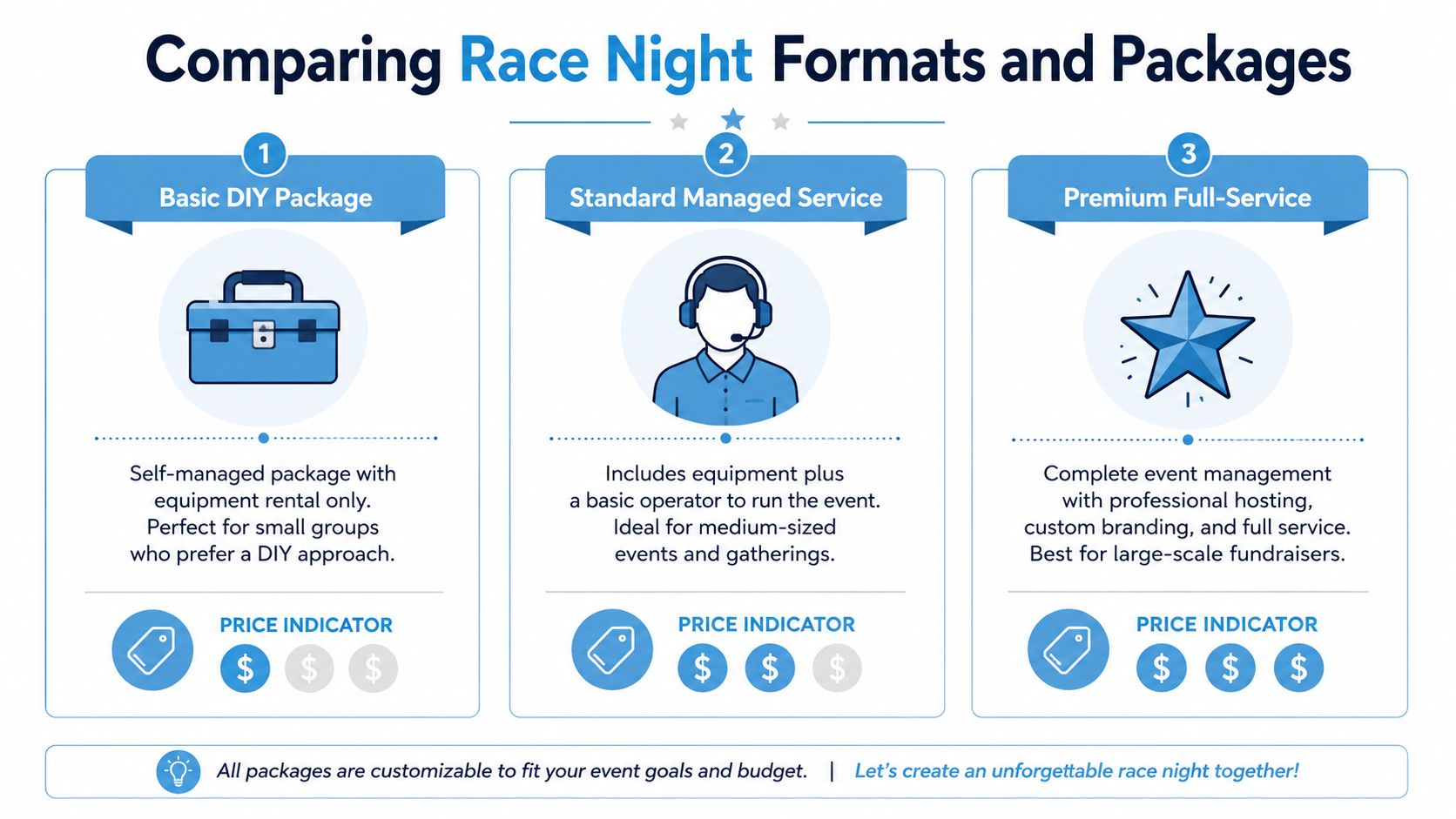
Not every race night hire package suits the same organiser. A small community group with a few volunteers has very different needs from a venue manager running a sponsored charity evening with guests who expect polish. The right choice usually comes down to how much control you want to keep, and how much time your team can realistically spare on the night.
Basic DIY versus managed delivery
A basic DIY package makes sense when you already have capable volunteers, a decent venue, and someone who can keep the evening on schedule. You save on staffing, but you inherit the risk of slow setup, poor pacing, and weak crowd control. It suits small groups where the fundraiser itself matters more than a polished production.
A standard managed service usually gives you the useful middle ground. You get equipment, a basic operator, and enough support to stop the event from depending entirely on one stressed organiser. That is often the safest option for medium-size venues, especially if the committee is running race night hire for the first time.
A premium full-service package is the least fiddly route. You hand over hosting, technical setup, and event flow to people who do it regularly, which is valuable if your team is already stretched with catering, ticketing, or sponsor management. The trade-off is obvious. You pay more, but you reduce the number of moving parts you have to manage on the night.
Add-ons that can change the room
The best events rarely rely on betting alone. Sponsorship boards, themed materials, auction items, and branded table extras can all lift engagement because they give guests more than one reason to spend. The challenge is restraint. Too many extras can crowd the core mechanic and make the room feel busy in the wrong way.
If you want a race night to behave like a proper fundraiser rather than a one-note entertainment slot, choose add-ons that reinforce the format instead of distracting from it. A clear host, visible betting, and one or two well-chosen extras will usually beat a room full of gimmicks.
The strongest package is the one your team can actually run cleanly, not the one with the longest brochure.
Technical Requirements and Venue Specifications
The most common race night problem I see is the screen, not the betting system. If guests can't read the race clearly, follow the numbers, or see the action without strain, the room loses pace and people stop leaning in. AV planning is not a nice-to-have, it is the core of the hire decision.
Brightness and resolution
Guidance for race-night equipment recommends 2,000 to 2,500 lumens for dark or dim venues, 3,000 to 4,000 lumens for normally lit community halls, and 4,000+ lumens for bright or large spaces (race-night equipment guidance). It also recommends 1080p Full HD as the preferred resolution. That combination matters because race footage and odds-style visuals need to stay sharp enough for quick viewing, especially once the room fills and the lights are up.
Screen sizing should match viewing distance. A practical rule of thumb is roughly 1/6 of the farthest viewer distance for screen diagonal, again from the same equipment guidance. If the screen is too small, guests at the back stop engaging with the race. If the projector is underpowered, the picture washes out as soon as venue lighting comes into play.
A venue that looks fine during a daytime visit can still fail at show time. Reflections from windows, low ceilings, and awkward sightlines all reduce visibility, so the screen position matters as much as the equipment itself.
Power and footprint
Technical planning also needs to cover the physical layout. One UK supplier lists a race-night unit at 2.4m x 3.7m x 2.0m with an operational area of 3.7m x 5.5m x 2.1m, powered by 2 x 13-amp sockets (Funtasia Entertainment product details). That's a reminder that these events usually run on standard mains circuits rather than specialist power, but older village halls and community centres can still trip you up if outlets are poorly distributed.
Cable runs matter too. If the projector, sound, and betting display all draw from different parts of the room, you need to know where the circuits are before setup starts. A room with enough sockets on paper can still be awkward if the accessible outlets are all on one side of the venue.
Race Night Technical Specifications
| Venue Type | Projector Lumens | Screen Resolution | Power Requirements | Operational Space |
|---|---|---|---|---|
| Dark or dim venue | 2,000 to 2,500 | 1080p Full HD | Standard mains, check venue load | Match viewing distance |
| Normally lit community hall | 3,000 to 4,000 | 1080p Full HD | 2 x 13-amp sockets | About 3.7m x 5.5m x 2.1m operational area |
| Bright or large space | 4,000+ | 1080p Full HD | Standard mains with circuit planning | Scale screen to the room |
Venue rule: verify the sockets, the light levels, and the sightlines before you sign anything. A good race night can survive a plain room. It can't survive a poor picture.
If the event uses a electronic display for results or betting flow, PSW Events electronic leaderboard shows the same practical point. Visibility and fast reading keep the room involved, and that depends on how the display is placed as much as on the software itself.
Understanding UK Gambling Regulations for Race Nights
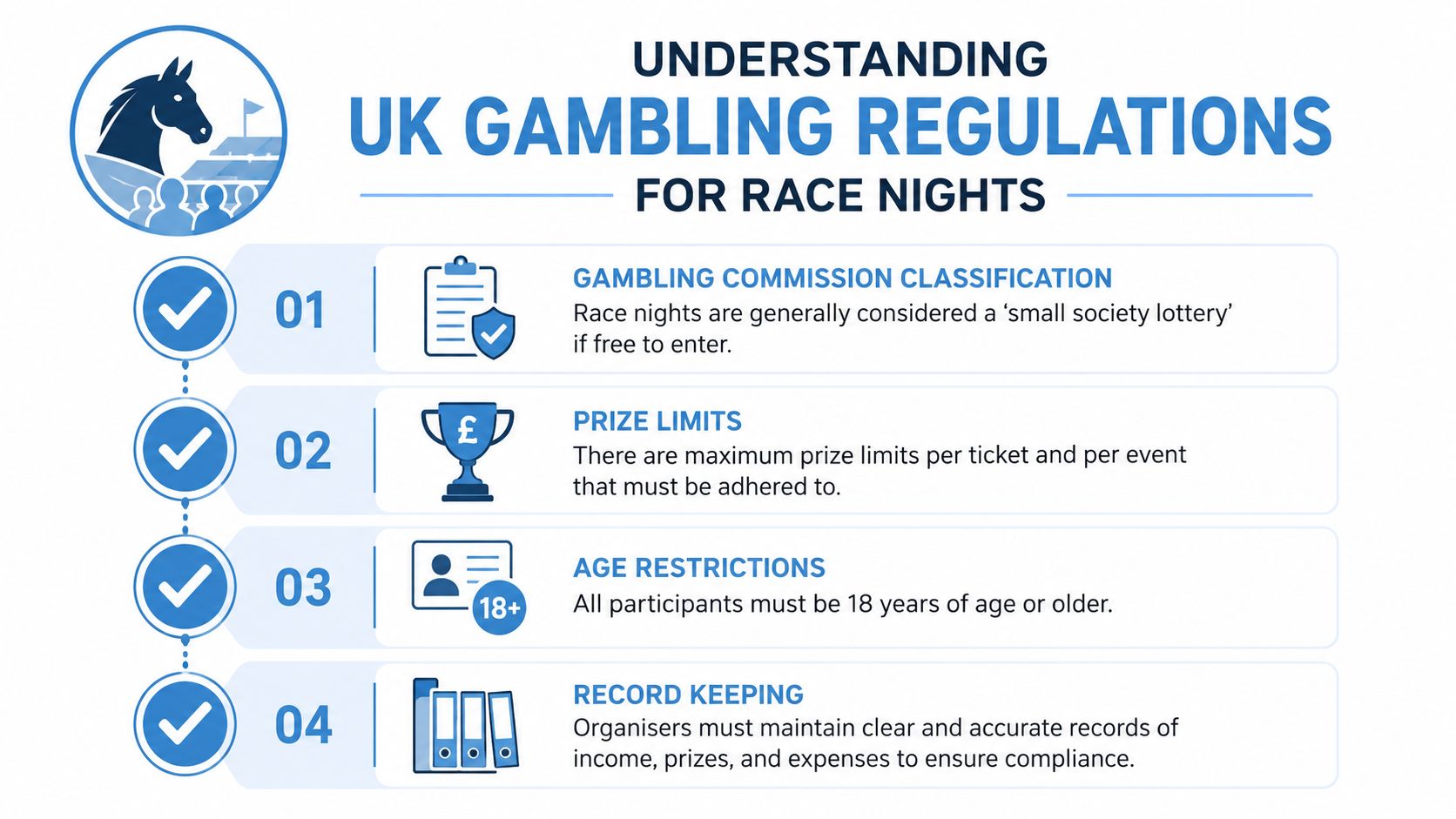
A race night can look informal from the room, but compliance is decided by the structure behind it. The Gambling Commission treats different non-commercial gaming arrangements differently, so organisers need to check the rules before tickets go on sale or money changes hands on the night (Gambling Commission race night guidance).
What has to be true
For private gaming, the Commission's guidance says no participation charge may be made, no amounts may be deducted from stakes or prizes, and no profits can be made, even for charity. That point catches out a lot of organisers who assume a good cause automatically changes the rules. It doesn't.
A local authority fact sheet describes race nights as events where participants stake money on recorded or virtual races, with selections entirely dependent on chance and no odds or form available to influence the choice (Spelthorne Council fact sheet). It also says participants must be told what good cause benefits from the profits. In practice, that means the beneficiary needs to be stated plainly on the flyer, the ticket, and the night's script.
The practical checklist
The compliance checks are straightforward, but they have to be done in the right order.
- State the beneficiary clearly: tell guests which good cause benefits from the event's profits.
- Keep the format chance-led: don't give odds, form, or any selection method that changes the nature of the game.
- Separate charity gaming from private gain: if the event is structured as private gaming, no profits can be made.
- Check the licensing route early: if the event shifts into a betting-event model, the Commission says a licensed bookmaker is required to administer the betting.
For organisers who want a broader entertainment package in a compliance-conscious setting, PSW Events fun casino hire sits in the same fundraising space, but the legal position still depends on the exact event structure.
A vague flyer is a warning sign. If guests cannot tell who benefits or what sort of game they are entering, the event has already been set up badly.
Realistic Fundraising Expectations and ROI
Race night hire is popular for a practical reason. It can produce a useful return without the overhead that comes with a dinner, auction, or full-day programme. UK race nights are widely reported to generate around £1,000 to £3,000 in a single evening (race night fundraising guide). One UK-focused source says a 100-person event can raise £2,000 to £3,500, depending on how well it is organised and how large the audience is. Another says a race night with 70 attendees can “easily raise £1,000”, which works out as a rough benchmark of about £14 per guest before local variation.
Those figures matter because they explain why the format keeps getting booked. The event's strength lies in the combination of modest entry friction, repeated betting opportunities, and a room full of people who are already there to socialise.
What drives the return
The strongest nights usually share the same features. The organiser has promoted the beneficiary clearly, the host keeps the races moving, and guests understand there is a visible reason to keep buying bets or extras. Sponsorships, table purchases, and optional add-ons help too, but they work best when the room already feels active and the spending feels part of the night rather than tacked on.
Weak nights are easy to spot. The betting is unclear, the pacing is slow, or the event looks under-produced for the audience in front of it. In those cases, even a decent attendance figure can underperform because the room never really catches.
The practical trade-off is simple. Higher return usually depends on tighter hosting, clearer sales prompts, and a venue setup that lets people hear, see, and follow the races without effort. If the AV is poor or the script drags, guests stop engaging and the spend drops quickly.
Where the format fits
Race nights work best as community fundraising, club socials, and corporate charity nights. They can also sit inside a premium activation if the guest list expects something more polished. The right positioning depends on who is in the room and how much spend per head you can realistically support without making the event feel pushy.
For organisers, the useful question is not whether the format can raise money, but whether the audience, venue, and pace support it. A race night that feels busy, clear, and well run will usually outperform a larger crowd that is confused, under-lit, or waiting too long between races.
Your Race Night Planning Checklist and Timeline
Start with the venue, not the advertising. Before you book anything, confirm that the room can handle projection, screen placement, and power without awkward compromises. Check whether the venue has enough sockets, whether circuits are shared with bar or kitchen loads, and whether the ambient light can be controlled during the races.
Before booking
- Confirm the beneficiary wording: every promotional asset should clearly say which charity, club, or good cause benefits.
- Verify AV suitability: ask about light levels, screen position, and whether the space can support a bright enough projector.
- Ask about power circuits: older halls often have limited outlet separation, so overload risk should be checked early.
- Choose the package level: decide whether you need DIY support, a managed operator, or a full-service delivery.
In the run-up
Once the venue is secured, move supplier conversations forward quickly. Review the contract, the included equipment, the setup window, and who handles breakdown. Then line up your volunteers or staff so nobody arrives on the night without a role.
Promotional planning should happen alongside ticket sales, not after them. If guests are paying to attend, they need to know what kind of night they're buying into, who benefits, and whether there's a dress code, raffle, or extra fundraising element attached. The clearer the message, the less work the host has to do later.
On the day
Build in time for screen testing, sound checks, and a short run-through of the betting flow. Have one person responsible for the room, one person managing payouts or prizes, and one person handling any cash or guest queries. If the venue is older, keep an eye on cable routes and trip hazards, because busy rooms become unsafe quickly when setup is rushed.
After the event, total the funds, thank attendees, and record what worked while it's still fresh. The best race nights aren't just profitable once, they're repeatable because the organiser remembers the small fixes that made the room feel easy.
If you're planning a race night and want the technical side handled properly, PSW Events supplies interactive event equipment and can support race-themed experiences with setup, staffing, and logistics. Visit PSW Events to discuss a hire package that fits your venue, audience, and fundraising target.