
You arrive at the exhibition venue before the doors open. The stand is assembled, the lighting is working, and the team is ready. Then you notice the banner is difficult to read from the aisle, the leaflets have been placed in a corner, and the giveaway materials look unrelated to the campaign visitors saw online.
That outcome usually starts weeks earlier, when promotional material printing is treated as a final purchasing task rather than part of the event experience. The right format, finish, message, distribution plan and measurement method should be decided alongside the stand design and audience journey. At a UK event, print isn't competing with digital in the abstract. It has to earn attention in a busy physical environment.
Why Printed Promotional Materials Still Win at UK Events
Printed collateral earns its place when it gives visitors a reason to stop, remember, act or continue the conversation after leaving the venue. A well-positioned poster can establish the message before a member of staff speaks to a prospect. A concise handout can give a buyer something useful to carry into a meeting. A personalised postcard can make a pre-event invitation feel deliberate rather than automated.
That physical presence matters because event audiences move quickly between stands, sessions and conversations. Digital screens are useful, but they compete with every other screen in the room. Print occupies the visitor's hands, table, bag or working area, creating opportunities for repeated exposure after the initial interaction.
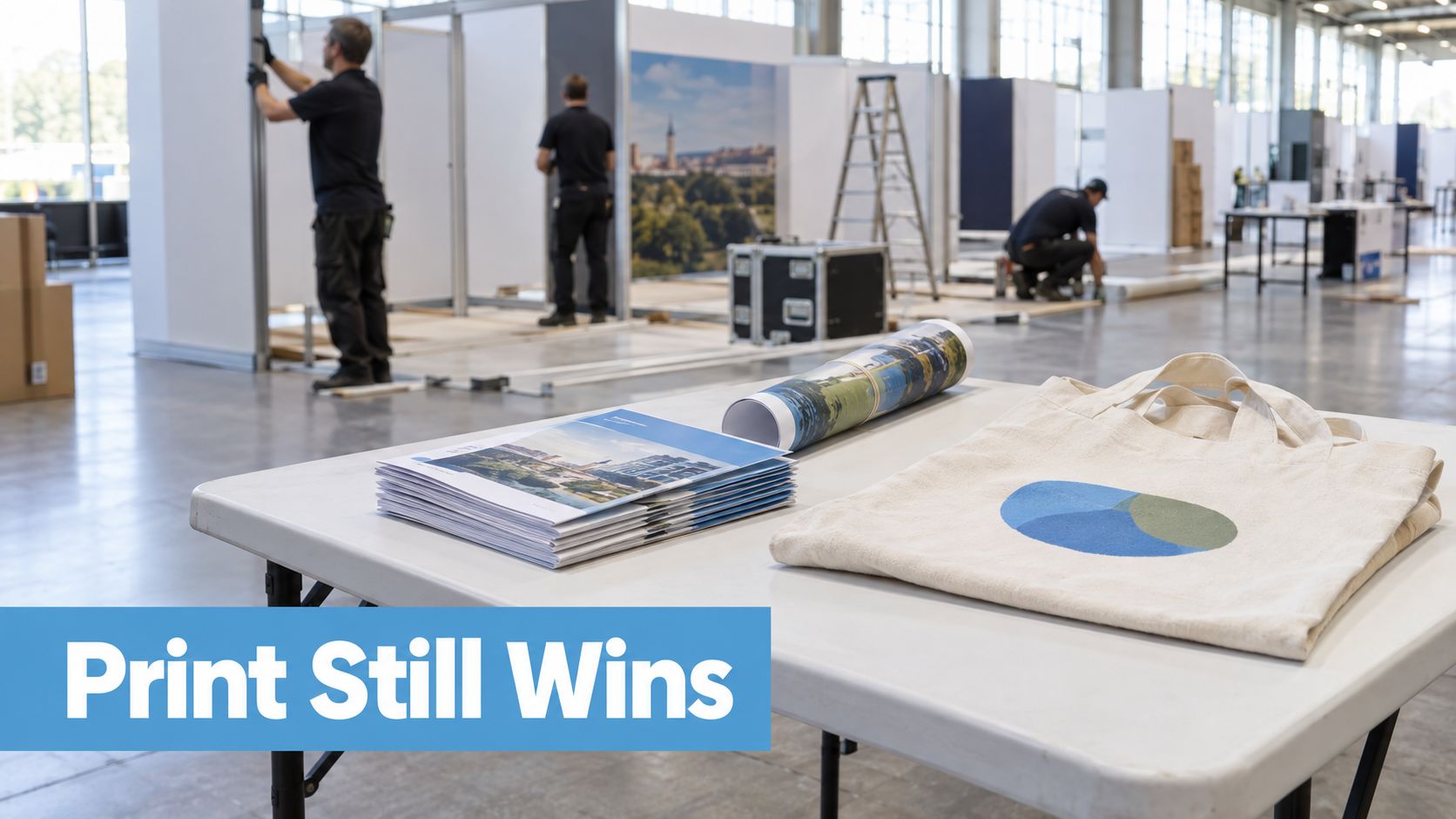
A mature UK supply base
Promotional brochures, leaflets, posters, catalogues and trade advertising materials sit within a substantial UK printing economy. The sector generates about £13.7 billion in annual turnover, employs around 93,000 people and includes roughly 6,800 companies, with about 75% employing fewer than 10 people, according to the UK print industry statistics.
That mix gives event planners access to local specialist suppliers as well as larger production houses. It also explains why the format remains practical rather than nostalgic. English commercial printing has deep roots, with British Print Industry Federation history materials recording William Caxton's first printing press in England at Westminster Abbey in 1476.
Operational rule: Print only works when the audience can understand it at the distance, speed and lighting conditions of the venue.
Before ordering, define the job each item must perform. A leaflet may support a sales conversation, while a large graphic may direct footfall or make the stand recognisable from an aisle. For ideas on combining printed collateral with branded giveaways, the guide to promotional products for events is a useful planning reference. You can also review practical event branding ideas before finalising the visitor journey.
Understanding the Core Printing Methods for Event Collateral
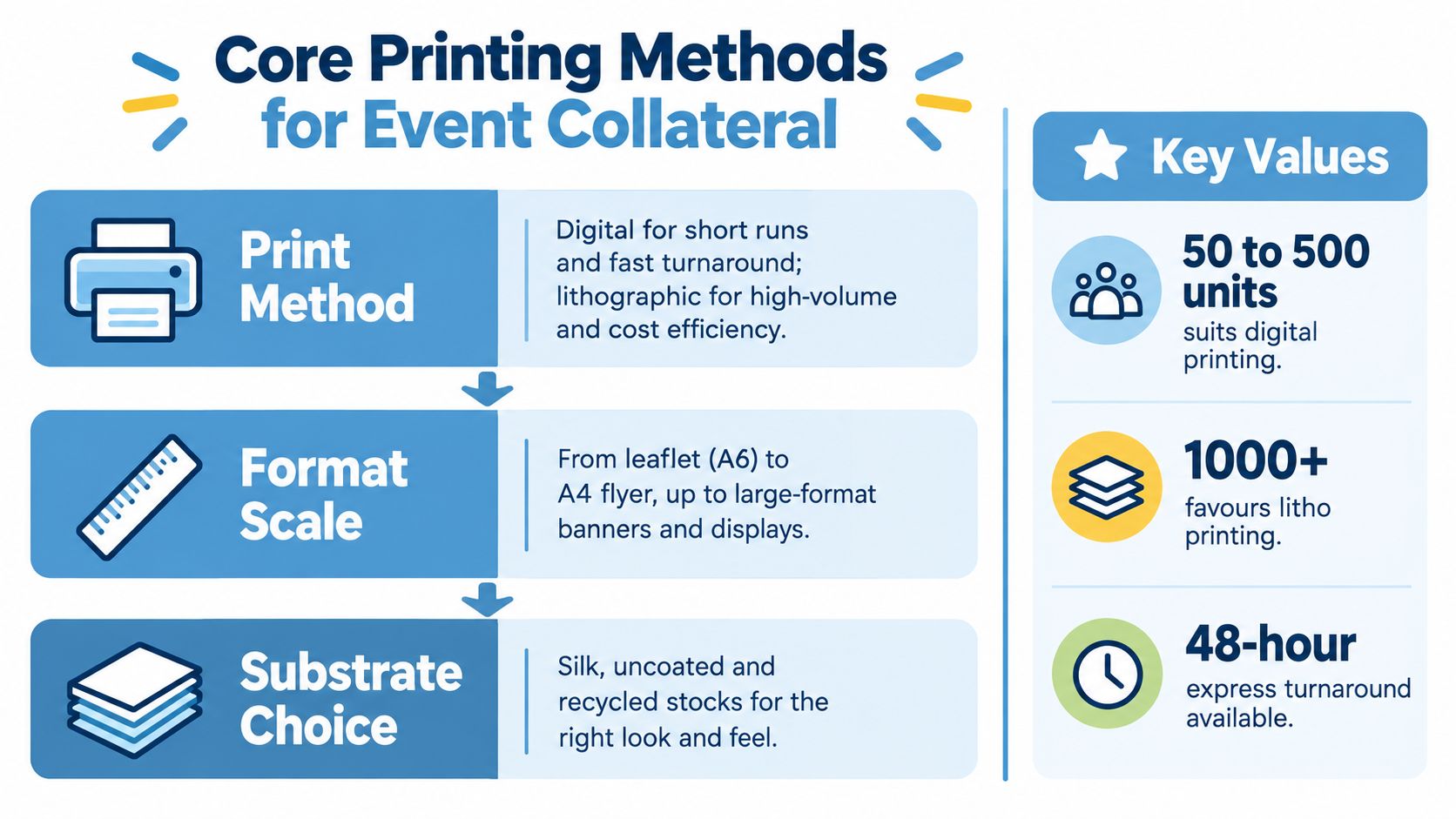
Planners often ask for “printed materials” as though method, size and substrate were one decision. They aren't. A reliable brief separates them into three layers: how the artwork is printed, how large it needs to be, and what it must withstand.
Digital printing is usually the sensible choice for short runs, quick turnarounds and several versions of one asset. It suits changing speaker details, segmented invitations and late-approved handouts. Offset printing becomes more attractive when a larger volume justifies plate setup and the campaign needs consistent reproduction across a substantial run. The choice isn't about which method is universally better. It's about whether the priority is flexibility or repeatable volume production.
Large-format output solves a different problem. A1 is an industry standard for event posters and flipcharts, while A0 is suited to maximum-impact displays in high-traffic areas and exhibitions, as outlined by UK large-format printing guidance. Providers also report custom widths up to 1500mm, which introduces practical questions about rigidity, viewing distance, transport and installation.
Match the method to the constraint
A two-day conference with a late speaker change favours digital production and a controlled versioning process. A national roadshow requiring the same brochure at multiple venues favours a method and stock combination that protects colour consistency. A graphic installed in a humid hall needs more attention to substrate behaviour and finishing than a programme booklet handed out indoors.
UV processes can help where fast curing, surface durability or repeated handling matters. Eco-ink options can support a lower-impact specification, but the printer still needs to confirm suitability for the substrate, drying conditions and installation environment. Ask for a production recommendation tied to the venue, not a generic list of available technologies.
For a clear explanation of digital production considerations, the Packaging Panda digital print guide provides useful background. Your final brief should state the quantity, artwork versions, finished dimensions, installation method, delivery address and deadline in one place.
Choosing Materials, Finishes, and Brand Colour Workflows
A proof can look excellent on a monitor and still disappoint under exhibition lighting. The usual cause isn't a dramatic design failure. It is a specification mismatch involving colour mode, stock, resolution, bleed or finish.
For full-colour brochures, programme booklets and posters, CMYK production is the normal route. When a brand colour must remain tightly consistent across a high-volume run, a Pantone or spot-colour workflow gives the printer a more controlled reference. These approaches aren't interchangeable, so identify the colours that are merely attractive and the colours that are brand-critical.
Write the file specification clearly
Artwork should be supplied at 300 DPI at final size with 3mm bleed, following the file-preparation guidance for printed paper from UK print and packaging advice. Larger posters generally benefit from higher GSM stock, which can reduce edge artefacts and humidity-related cockling during venue use.
Finish should support the visitor task:
- Matte lamination reduces glare where people need to read longer copy under strong stand lighting.
- Gloss finishing can make photography and short-read colour blocks appear more vivid, but reflections can hinder legibility.
- Spot UV can direct attention towards a call to action, logo or QR code without covering the whole piece in a high-gloss coating.
- Uncoated stock can feel approachable and may be easier to write on, while coated stock often gives sharper image reproduction.
A proof should show the finished trim, not just the artwork canvas. Check small type, QR-code contrast, safe areas, colour references and the position of folds or stitched sections. If the item will be installed repeatedly, ask how the finish behaves after transport and handling.
For projects where branded physical assets sit alongside a wider visitor experience, the event branding services page offers a useful reference point for coordinating visual elements. The printer's job is to reproduce the approved specification. The planner's job is to make that specification unambiguous.
When Print Outperforms Digital for UK Event Audiences
The useful question isn't whether print is better than digital. It is which printed format suits the audience, the moment and the action you want to measure.
UK direct-mail data shows a clear difference between audience conditions. JICMAIL reporting cited in the UK direct mail marketing guide records cold direct mail at a 0.9% response rate and £3.20 return per £1 spent. Warm mail reaches 7.2% response and £9.00 return per £1, while untargeted door drops record 0.5% response and £2.90 return per £1. The same reporting says cold response improved 24% year on year.
| Audience type | Response rate | Return per £1 spent |
|---|---|---|
| Cold direct mail | 0.9% | £3.20 |
| Warm direct mail | 7.2% | £9.00 |
| Untargeted door drops | 0.5% | £2.90 |
Those figures don't mean every event should receive a direct-mail campaign. They show why audience warmth and data quality should influence procurement. A known prospect invited to a relevant demonstration is a different proposition from an untargeted recipient receiving a generic leaflet.
Use each format at the right point
Before the event, targeted mail can create recognition and give the recipient a specific reason to visit. Use a personalised invitation, appointment prompt or compact information piece rather than sending a general brochure with no next action.
On the show floor, signage and handouts support footfall, orientation and lead capture. A handout should answer the question a visitor is likely to ask after the conversation, not repeat every sentence from the website.
After the event, a printed follow-up can reinforce a high-value interaction, especially when it contains a clear personal reference or a tracked route to further information. Link each version to a measurable action, such as a landing page, booking form or named meeting request.
Royal Mail MarketReach reporting cited in UK direct mail performance coverage says mail stays in the average home for around 8 days, captures roughly 134 seconds of attention over 28 days, and delivers average ROI of more than £7.20 for every £1 spent. Treat those measures as context for planning, not a promise for an untargeted event drop.
Planning Production Timelines and Managing Costs
The cheapest unit price is rarely the cheapest event decision. A low-cost print run that arrives after the freight deadline, uses the wrong substrate or fails colour approval creates replacement costs and operational disruption.
Production time depends on the item. Flyers are comparatively simple because they usually involve a standard sheet, straightforward trimming and no structural assembly. Roll-ups, banners and large graphics often need earlier sign-off because the supplier must source the substrate, apply finishing, check hardware or assembly and pack the item for transport.
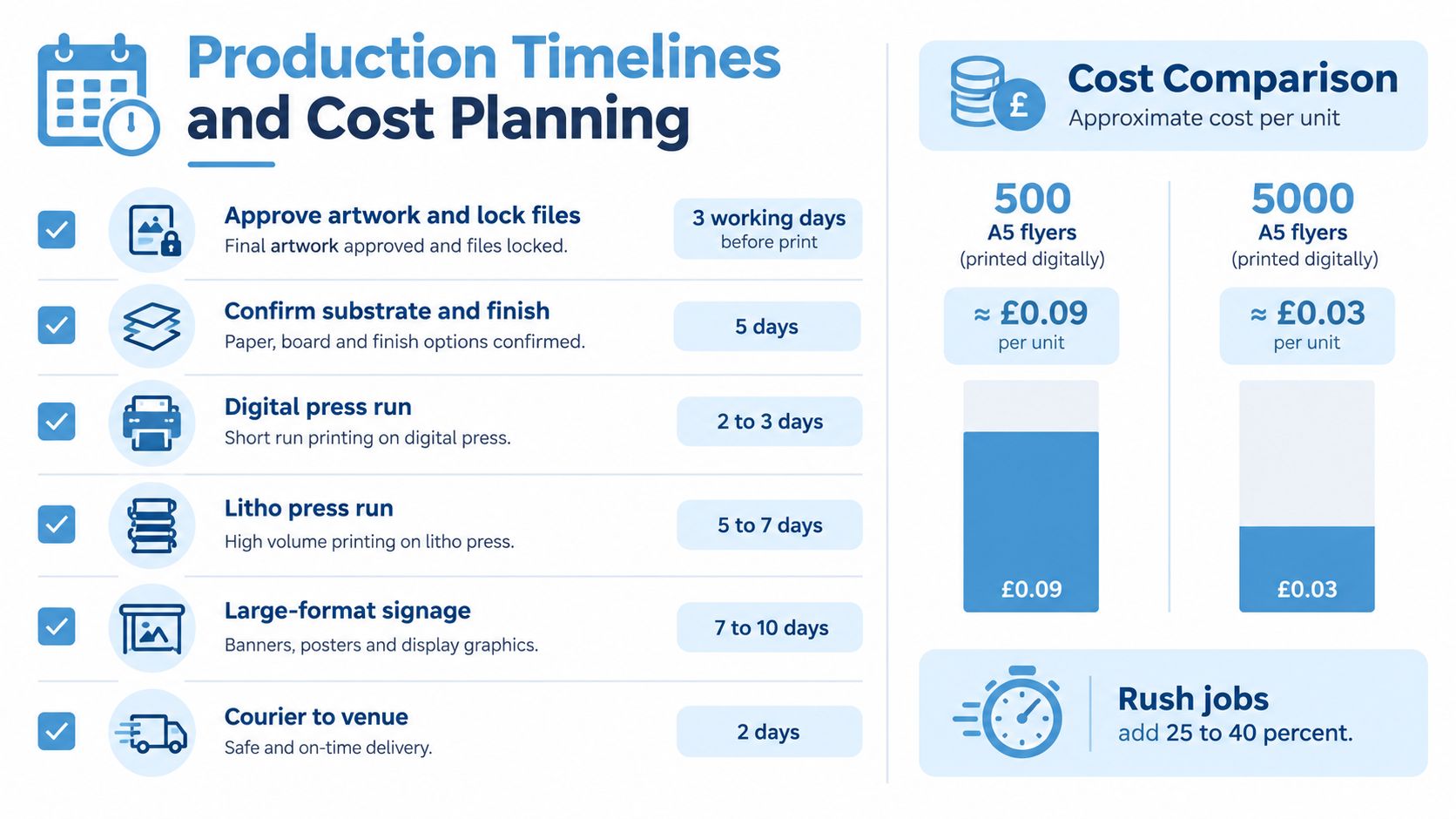
Cost drivers planners can control
Paper weight, quantity, finishing, packaging, delivery and rush handling all influence the quote. A heavier stock may be justified for a brochure used repeatedly, but it can add weight to transport and storage. Lamination can protect a frequently handled item, while a decorative finish may add cost without improving comprehension or lead capture.
Get comparable quotes by sending every supplier the same information:
- Quantity and versions: State total units and whether artwork changes across locations or audience segments.
- Finished size and stock: Specify dimensions, GSM preference, coating and intended use.
- Finishing: List folding, creasing, binding, lamination, eyelets, hemming or mounting requirements.
- Delivery plan: Include the venue, loading restrictions, delivery window and named recipient.
- Approval process: Confirm when a proof is supplied and when revisions stop.
Build quality assurance into the schedule
Ask for a physical proof when colour, texture or folding matters. Before dispatch, inspect seam alignment on large graphics, check vinyl adhesion on temporary signage and compare stand branding with the approved Pantone reference. Confirm the printer can meet the venue's packaging, labelling and delivery rules.
A UK direct-mail example shows why schedule and targeting deserve equal attention. The Royal Mail MarketReach figures cited earlier show sustained physical exposure, but exposure only helps when the piece arrives before the relevant decision or event. Keep a contingency for artwork corrections, courier delays and venue access. Rush work should be an exception, not the production plan.
Navigating UK Regulations for Event Print Distribution
Printed promotional material can create compliance issues at three separate points: distribution, content and sector approval. Treat each as a sign-off item before artwork goes to press.
Check distribution permissions
In England and Wales, councils can require permission to distribute free printed material in areas they control. This can include leaflets, cards, free newspapers, takeaway menus and other promotional items. The GOV.UK leaflet distribution licence guidance states that breaches can lead to a fixed penalty of up to £150 or a fine up to £2,500, as well as a criminal record.
The practical step is simple. Identify the council and precise public area where the team will distribute material, then check the local permission requirements before booking staff or printing volume. A permission requirement may apply to street activity even when the event organiser has approved the campaign.
Put the right information on regulated material
Election-related leaflets and posters have specific imprint requirements. The material must include the name and address of the printer, the promoter and, where different, the person on whose behalf it is published. The Electoral Commission imprint guidance also requires an address where the relevant person can be contacted, and publishing material without an imprint is an offence.
The CAP Code covers printed advertising in newspapers, magazines, brochures, leaflets, circulars, mailings, catalogues and other printed formats. The CAP Code also supports ASA guidance that literature accompanying promotional items must include necessary warnings and safety advice.
Pharmaceutical campaigns need an additional approval trail. Under the England and Wales pharmaceutical advertising rules, printed promotional material must be certified, checked and signed in final printed form by a company signatory before use, recertified at intervals of no more than two years, and retained with supporting material for at least three years after final use.
Making Promotional Print Sustainable and Traceable
Sustainability isn't solved by choosing a thinner sheet and ordering the same disposable campaign every year. The better question is whether each printed asset can work harder, travel further, be updated responsibly and connect the physical interaction to a measurable digital follow-up.
Current UK print-trend coverage for 2026 highlights variable data printing, personalised QR codes, print-on-demand and modular reusable assets, alongside renewed interest in premium finishes. The UK printing industry trends for 2026 also reports that the UK promotional-products market reached £1.334 billion in 2025, up 8.2%, indicating continued demand while production costs remain a planning concern.
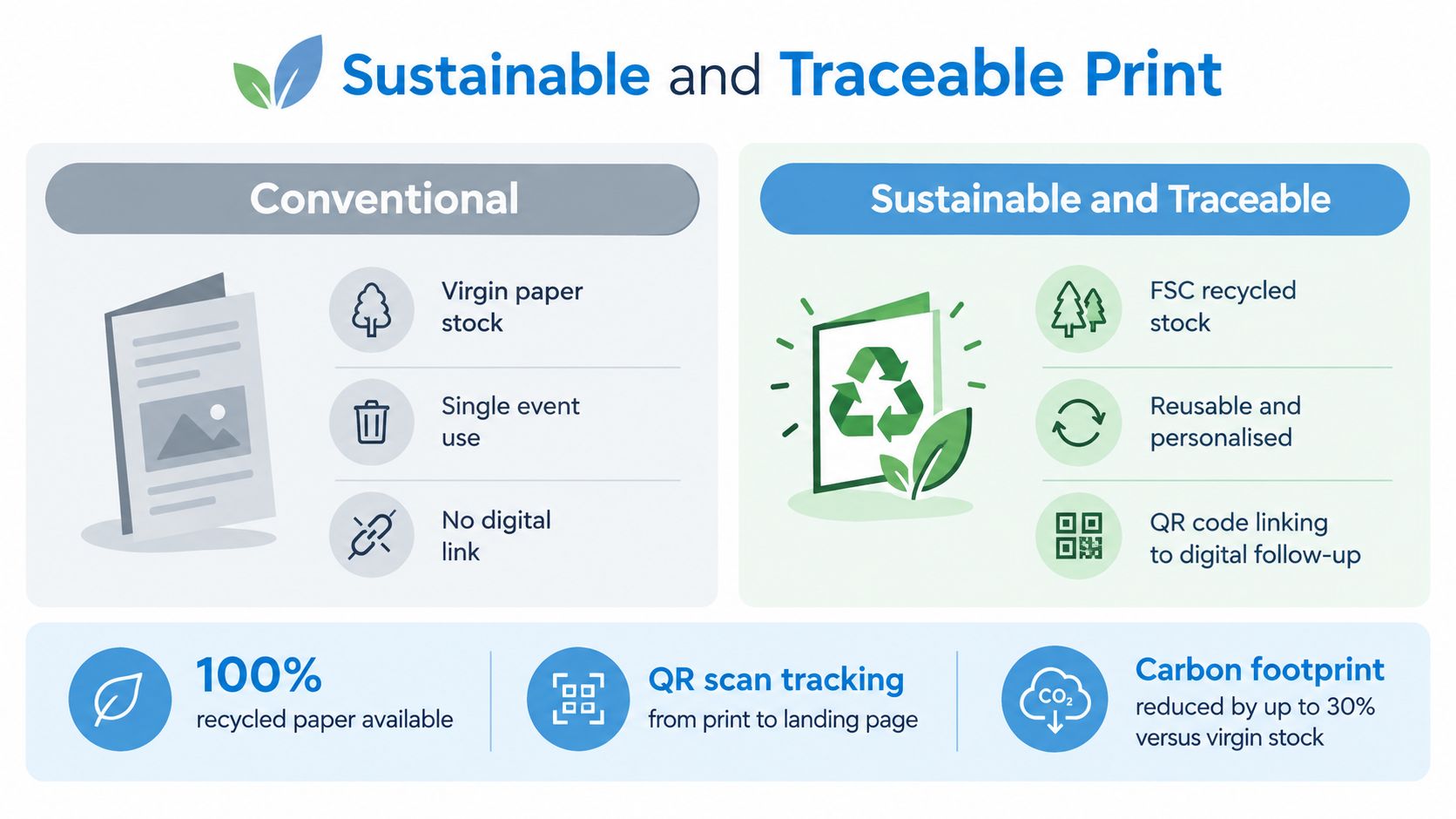
Design for reuse and measurement
Variable data can make an invitation or handout more relevant by changing the name, message, offer or QR destination. That relevance is useful only when the underlying data is accurate and the team has a follow-up process. A personalised print run without a CRM owner turns a targeted asset into an expensive formatting exercise.
Print-on-demand can reduce surplus stock, but it demands disciplined volume planning and a realistic production window. Reusable modular graphics may reduce repeat production, but they require durable construction, labelled storage and an asset register. A premium finish may increase longevity, yet it can also complicate recycling or raise the cost of replacement sections.
Sustainability is an operational decision. Specify what will be reused, who will store it, how versions will be tracked and what action the QR code should produce.
For event teams assessing the wider footprint of an activation, the event carbon footprint guidance is a useful companion. Measure more than paper weight. Track unused stock, transport, reprints, reuse across venues and the quality of post-event engagement.
Building a Practical Event Print Strategy That Works
A dependable event print strategy starts with the visitor action, not the supplier catalogue. Decide whether you need to attract attention, explain an offer, direct movement, support a conversation, collect a lead or continue a relationship after the event.
Use this decision flow
- Set the objective. Choose one primary outcome, such as qualified conversations, booked demonstrations, session attendance or post-event enquiries.
- Define the audience. Separate known prospects, warm contacts, general visitors and untargeted footfall. Their likelihood of acting should influence the format and volume.
- Select the format. Use large-format graphics for distance visibility, concise handouts for conversations and targeted mail for invitations or follow-up.
- Choose the method and material. Match digital or offset production, CMYK or Pantone control, stock, finish and construction to the job.
- Lock the schedule. Include proofing, revisions, production, packing, courier delivery and venue access. Large graphics deserve earlier attention than simple flyers.
- Complete compliance checks. Confirm distribution permissions, advertising warnings, imprints and sector certification where applicable.
- Measure the result. Use QR destinations, response codes, meeting records, footfall observations, dwell time and lead quality. Unit cost alone can't tell you whether the print worked.
A trade show competitor review, such as this Canton Fair competitor analysis, can help clarify how your stand should differentiate itself before you commit to graphics and handouts. The strongest specification is rarely the flashiest or cheapest. It is the one that fits audience behaviour, venue constraints, brand controls, compliance obligations and the next measurable action.
PSW Events can help you turn that strategy into a complete event delivery plan, combining branded interactive attractions with logistics, installation, staffing and on-site compliance. Visit PSW Events to discuss an activation where print supports footfall, dwell time and lead capture instead of sitting unused on a table.