
You're three aisles into a trade show and you've already walked past four stands where the staff outnumber the visitors. Nothing is obviously wrong with them. There's a banner, a bowl of sweets, a QR code and someone in a lanyard asking whether you're having a good show. Then you turn a corner and find a genuine crowd, three deep, watching two strangers race each other on a simulator while the leaderboard above them updates in real time.
The gap between those two stands is rarely budget. It's the choice of attraction. One gives a passing visitor a reason to stop within ten seconds, something to do for ten minutes and something to watch while they wait. The other asks them to care about a product before they've been given a reason to.
This list covers eight interactive entertainment ideas that hold up at UK corporate events, exhibitions, brand activations and private celebrations. Each is assessed the way a producer assesses it, on floor space, throughput, queue behaviour, branding potential and compliance, rather than on how good it looks in a supplier's showreel. The instinct that makes sports games for birthday parties work in a back garden applies on a stand in Birmingham: give people a simple contest with a visible score and they will queue for it.
The industry behind these attractions isn't small either. The UK video-games industry contributes between £6 billion and £12 billion in gross value added and supports around 73,000 jobs, according to the House of Lords Library's industry overview.
By the end you'll know which format fits a 3m x 3m shell scheme, which needs a clear run of floor and a barrier, and which one belongs in a hospitality suite rather than a hall.
1. Formula 1-Style Grand Prix Simulator Racing
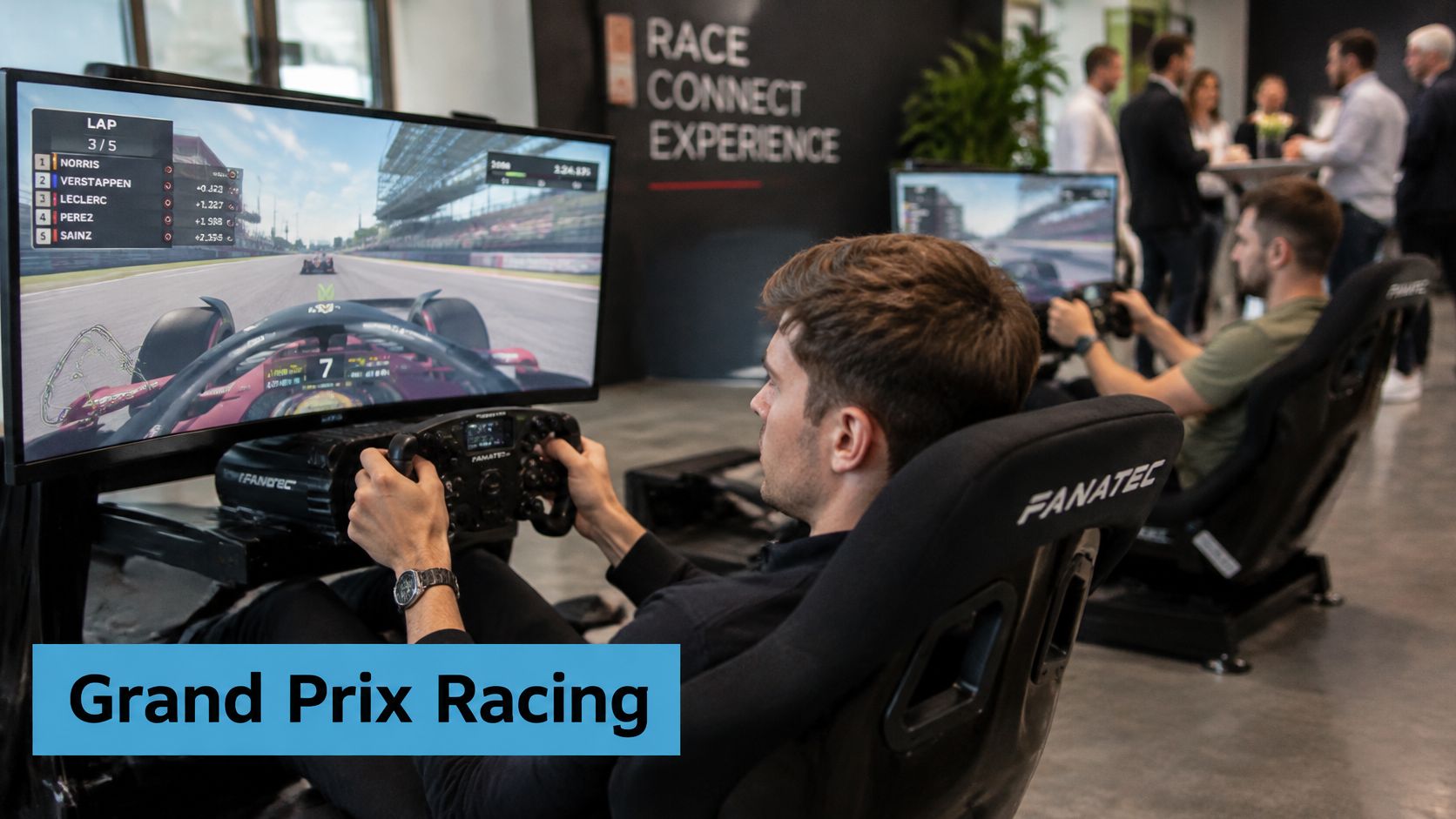
A grand prix rig earns its floor space in the first ninety seconds. One guest sits down, the lights count down, and by the end of the first lap there are four people behind the seat watching the lap time. That spectator effect is why the format keeps working. UK consumers spent £8.76 billion on video games in 2025, a 7.4% increase on 2024, according to Ukie's market figures, so most of your guest list already speaks the language.
The brief is simple. Guests pick a team livery, run timed qualifying, then race head to head while an electronic leaderboard publishes results to everyone standing nearby. A racing simulator experience suits corporate launches, conference breakouts, fan zones and private celebrations because the motorsport setting explains itself before a host has said a word.
The rig footprint is modest. The crowd around it isn't, and that's the thing to plan for. Sightlines matter more than the machine.
Getting the format right on the day
- Screen position: Put the leaderboard where the queue can read it. A scoreboard hidden behind the rig turns a shared competition into a private game.
- Heat length: Ten to 15 minutes per qualifying and race block keeps turnover honest at a busy show without making guests feel rushed.
- Team identities: Branded teams, a printed grid and a two-minute podium give the activity a beginning and an end.
- Site checks: Confirm sightlines, step-free approach, ventilation and emergency egress before the build, not on the morning.
Practical rule: If the queue can't see the score, you've installed a chair rather than an attraction.
Venues such as the F1 Arcade in London have already trained a paying audience to expect this format, and it carries into private celebrations too, as these London hen activities on Hen Hideaways show. Add a branded pit-stop challenge or a quick racing quiz between heats and you stretch dwell time without buying another machine.
2. VR Esports and Immersive Team Challenge
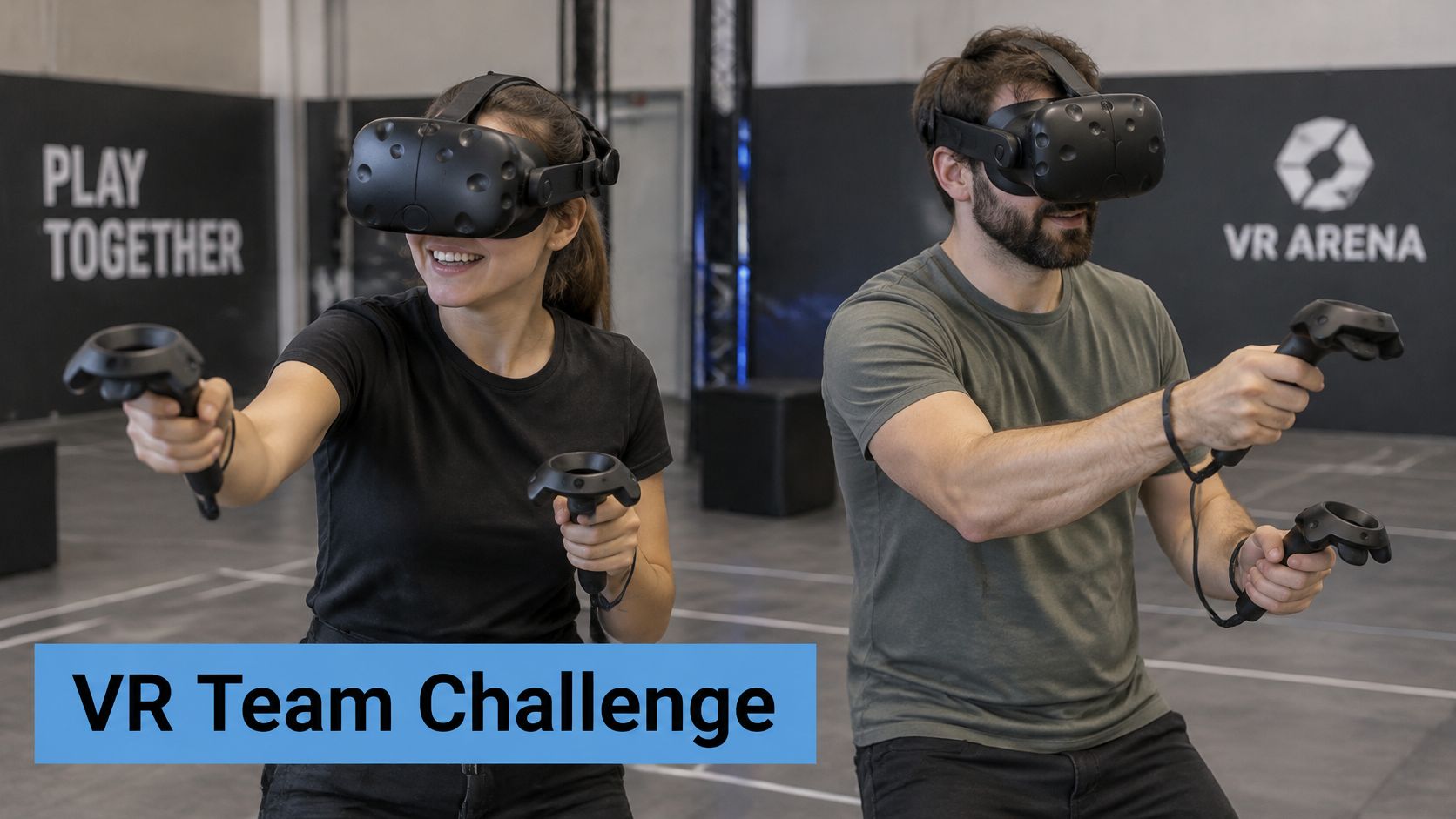
A VR attraction can draw a crowd, then lose it if guests cannot understand the game or the queue stalls. Choose short, clearly scored challenges, and assign a host to explain the objective, call results and keep each session moving. The headset matters less than the format around it.
For a corporate event, exhibition or brand activation, set a shared challenge that rewards communication as well as individual performance. Teams can take turns, so guests who are waiting still have a reason to watch and follow the score. Allow space for the play area, a visible queue and safe entry and exit. Check the venue's access, power and layout requirements before confirming the setup.
The Creative Industries Sector Deal committed more than £33 million to immersive technologies, including virtual-reality games and augmented-reality tourism experiences, according to the government's sector deal announcement. That investment signals interest in the category, but it does not make a VR corner work on its own. The event format, staffing and queue plan still need to suit the audience and venue.
The operational checklist
- Hygiene: Use disposable face interfaces or washable covers, and assign an attendant to fit and clean the equipment between guests.
- A fallback: Offer a screen-based or controller alternative for guests who cannot or prefer not to wear a headset, or who experience motion sickness.
- Session shape: Keep sessions short enough for exhibition footfall, and have a host call scores so the activity stays engaging for people in the queue.
- Briefing: Explain the objective and controls before guests put on the headset. A concise introduction helps them start confidently.
Run the queue like a ride: load, play, unload, reset.
Virtual reality for events works best when the shared task is the attraction, not wearing a headset. For team-building formats, the challenge and the group's cooperation should shape the experience, as they do in corporate team building at the Grand Canyon.
3. Interactive Batak Pro Reaction Wall
Batak Pro is the most efficient crowd builder per square metre on this list. It's a large electronic reaction wall where players strike illuminated targets and the machine returns a reaction time, a score and a ranking on a shared screen. There's no briefing beyond "hit the lights", no learning curve and no reason for anyone to feel foolish. Sports hospitality, conference breakouts, exhibitions and private celebrations all take it without adaptation.
The number does the converting. A visible score gives the next person in the queue a target and a stranger walking past a reason to stop. Gamification is already routine at UK events: 41% of UK event organisers reportedly used techniques such as leaderboards, scavenger hunts or rewards, and gamified events showed an average 19% increase in session attendance compared with non-gamified events, according to engagement research compiled for event planners. Sports audiences are there to be found too, with 30% of people aged 16 and over in England attending a live sporting event at least once during the 12 months covered by the 2025/26 Community and Engagement Survey.
How to run a reaction wall properly
- Seed a tournament: Publish a draw, run heats, hold a final at a set time. A public final gives the whole day a spine.
- Sponsor the score screen: Branding around the results is seen by everyone watching, not just the player. Keep it clear of the numbers.
- Staff the station: One host explains the rules and keeps pace. Without a host the queue stalls and the crowd drifts away.
- Check the approach: Screen at accessible height, level flooring, clear wheelchair route and room for a spectator line that doesn't block an aisle.
Queue design: A reaction wall with a visible score holds a spectator line far longer than the same game facing a blank wall.
Say a rugby club books it for matchday hospitality. The final runs shortly before kick-off, the winner collects a shirt, and the sponsor's logo has been on screen in front of every spectator for three hours. That's a sponsorship asset, not a party game.
4. Giant Scalextric Circuit Exhibition
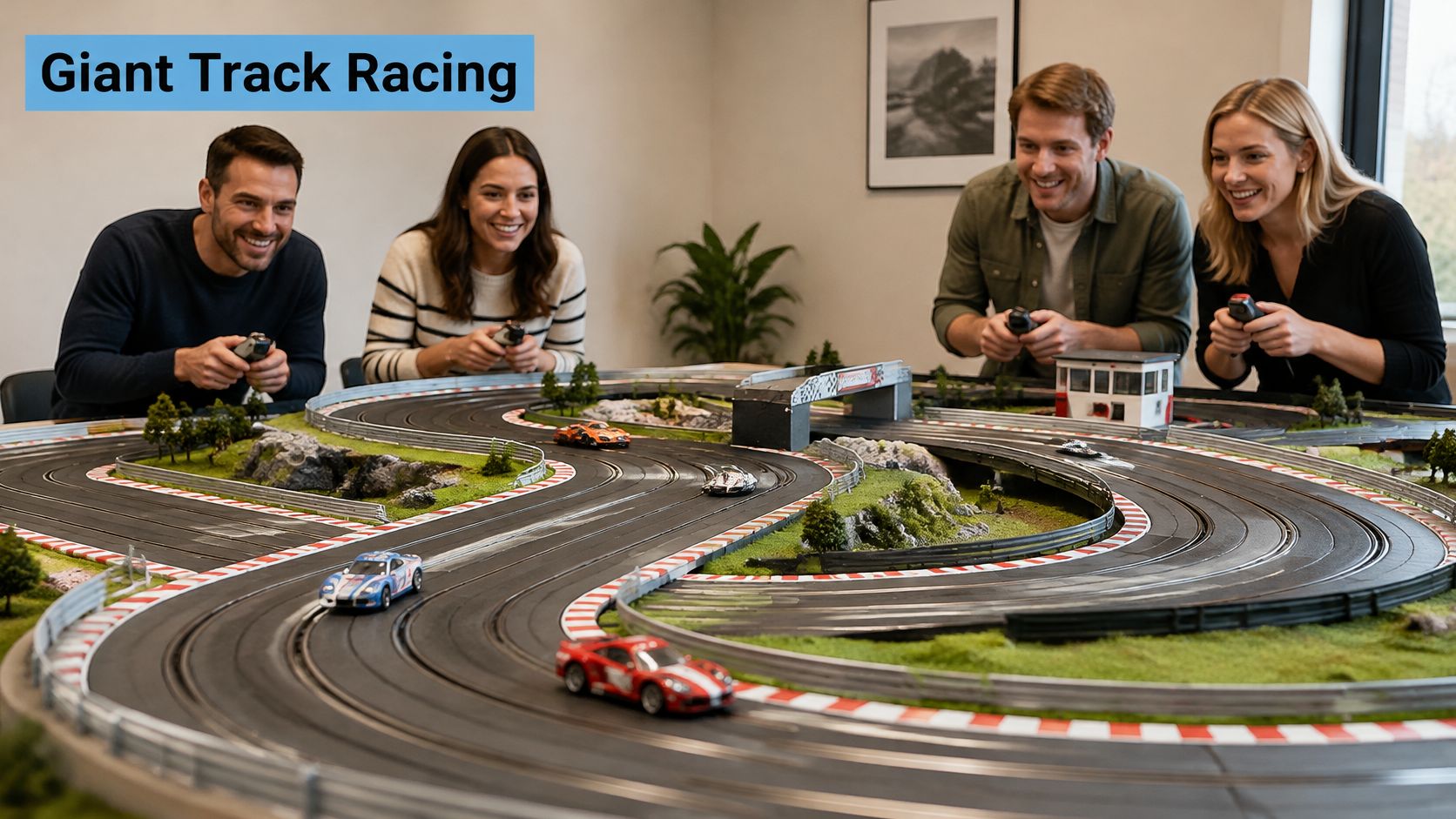
Scalextric has an advantage no simulator can buy. A parent recognises it before the child does. A giant circuit installation turns that recognition into a physical centrepiece, with guests driving cars, changing lanes, controlling carousels and racing against a clock. Product launches, family entertainment, fan zones and high-end private parties all suit it.
What makes it valuable is the footprint signal. A large track is visible from across a hall, so it pulls passing traffic without anyone handing out flyers. That's also the risk. A circuit that looks spectacular but lets four people play at once builds a crowd that watches for two minutes and walks on.
Configure the layout before you fall in love with the theme.
Planning the circuit
- Perimeter control: Barriers or a raised section keep hands and bags off moving cars. Budget for it rather than improvising with tape on the day.
- Layout to the room: Match the track shape to the footprint and leave a clear viewing edge. Long straights read better from a distance than tight technical sections nobody can see.
- Timed heats: Fixed race lengths stop the track becoming the gathering point for three guests and a queue of twenty.
- Build time: Large layouts need installation and testing time, especially across multi-day events with overnight security and a rebuild each morning.
Say a heritage car brand books the circuit for a launch. The track becomes the photography backdrop, the timed heats become the competition and a product sampling station at the exit catches guests as they leave the pit lane. The attraction, the content and the data capture come out of the same square of floor.
5. Motion Flight Simulator and Helicopter Adventure
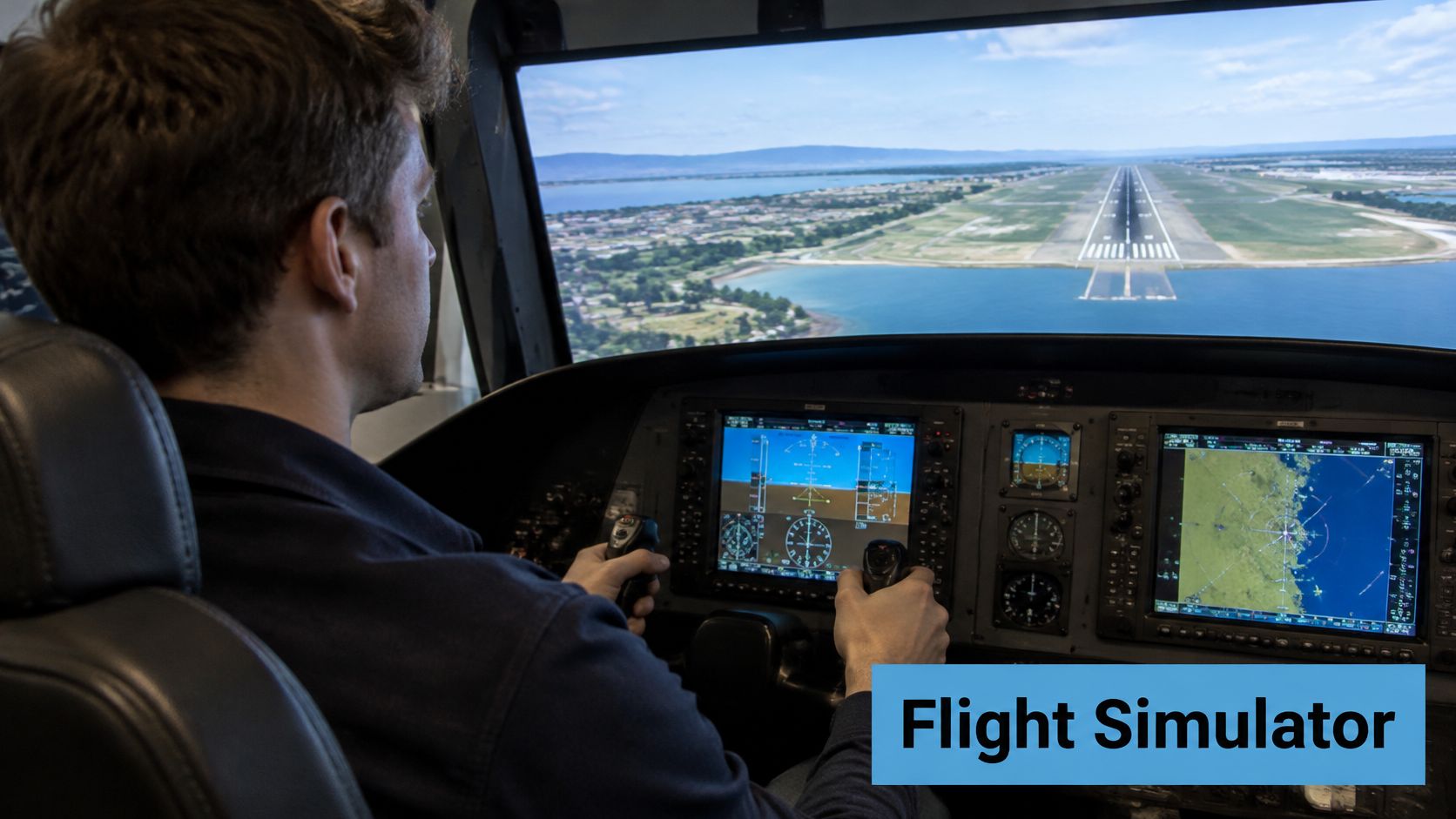
Aviation simulators do something most attractions can't. They make a technical story physical. A motion platform with a replica cockpit, instrument panel and projected environment lets a guest take off, land, chart a course or fly a rescue scenario, and it looks credible enough to carry a message about engineering, training or safety.
That credibility is why the format turns up at aviation-sector launches, recruitment fairs, aerospace exhibitions and family events. It's also why it fails when it's oversold. Hand a guest a full instrument panel with no clear first task and they'll freeze, apologise and walk away, taking the watching crowd with them.
The scenario does the work, not the hydraulics.
Making a flight sim work for a mixed queue
- One task per guest: A single circuit, a landing or a hover. Not a full checklist under time pressure.
- Seated alternative: Keep a non-motion seat available for guests who can't use a moving platform or feel unwell on one.
- Spectator screen: A flight-deck or mission-control display lets the queue follow progress and gives the host something to narrate.
- Brand alignment: Choose the scenario to match the story, whether that's emergency response, tourism or future mobility.
- Venue checks: Structural loading, power supply, fire safety and access routes need agreeing with the venue in advance, in writing.
Briefing rule: Give every guest one sentence they can act on, then let them fly.
At a recruitment fair the sim turns into a conversation about training pathways, apprenticeships and what the job involves. The queue is the qualified audience, and the host is the person who starts the conversation while the guest is still grinning.
6. Sports Simulator Multi-Activity Arena
At a university recruitment fair, five simulator stations can turn a passing crowd into a route through the event. Guests collect scores at each stop, while the admissions team has a natural opening for conversation. The format works best when stations are close enough to feel connected but spaced to keep queues from blocking each other.
A multi-activity arena can combine familiar sports such as football, rugby and golf with options including boxing or racing. PSW Events offers simulator hire across sports including American football, boxing, cricket, football, golf, rugby and other activities. Choose a mix that suits the audience and available footprint, then give guests a clear order to follow. A passport or scorecard makes progress visible and gives teams a practical way to track participation.
Measurement can be difficult for experiential campaigns. 39% of UK experiential marketers reportedly struggle to demonstrate ROI, while 59% cite insufficient internal resources as a major obstacle, according to research on experiential marketing effectiveness. A multi-station format can support follow-up by recording scores or completed stations, rather than relying only on a count of people who passed by. Agree in advance what information is collected and how it will be used.
Designing the rotation
- Passport mechanic: A printed or digital card stamped at each station encourages guests to complete the route. Keep any personal-data request separate and clear.
- Short rounds: Set five to 10 minutes per station and use timed rotations when the crowd needs structure. The right pace depends on the activity and queue.
- Route and queues: Place the most popular station where guests can see it, but leave room for waiting guests without blocking entrances or other activities.
- Prize categories: Recognise skill, accuracy and team results so more guests have a reason to take part.
Mix rule: Two familiar sports can draw guests in; less familiar choices give them a reason to try another station. Balance the set before adding more equipment.
For a recruitment fair, students can complete five stations and submit a card with their details. The admissions team can see which activities attracted interest and use the scores to start relevant conversations. The activity earns attention; the follow-up makes that attention useful.
7. Interactive Climbing and Adventure Wall
Accessibility is the part of interactive entertainment that most supplier lists skip. UK event research based on feedback from more than 50 planners found that accessibility is widely recognised as a priority, yet organisers still feel ill-equipped to deliver it consistently across in-person, hybrid and digital formats, according to Event Technology's summary of the findings. A climbing wall forces the issue, because the physical challenge is the product rather than a feature of it.
A supervised wall with graded routes, auto-belay systems and digital scoring works at outdoor-adventure launches, wellbeing conferences, sports festivals and family events. It also produces the content most activations want: a guest at the top of the wall, branded overlay included, shared before they've taken the harness off.
Making a wall inclusive, not just impressive
- Graded routes: Publish height and difficulty at the base of the wall so guests self-select without an audience deciding for them.
- Non-climbing roles: Timing, judging, coaching and scorekeeping let people take part without leaving the ground.
- Access notes: Put the wall in pre-event access guides, with harness sizes, footwear rules and a stated alternative activity.
- Risk paperwork: Venue-specific risk assessment, insurance, floor loading and a rescue procedure agreed before build.
- Quiet periods: Schedule a low-noise slot with no music and no commentary for guests who find crowds difficult.
The most successful attraction at an inclusive event is rarely the most advanced one. Configurable pacing, alternative controls, clear instructions and trained hosts widen participation faster than another headline device.
Say a wellbeing conference books a wall for the afternoon break. Half the delegates climb, a quarter judge or time, the rest watch with a coffee. Nobody stands at the edge of the room deciding the event wasn't for them, and the photo station by the mat captures the whole thing.
8. Interactive Casino Table and Social Gaming Lounge
Casino tables sell atmosphere rather than adrenaline. A dressed blackjack or roulette table with trained dealers gives a hospitality suite or exhibition stand an instant social centre and keeps guests in one place long enough to have a proper conversation. That's useful at conferences, private celebrations and brand activations where the objective is dwell time rather than competition.
The compliance point comes first, not last. Unless you intend to run a licensed gambling operation, tables should use demonstrative chips and prize points, with no cash handling and no cash prizes. Check UK Gambling Commission requirements and the venue's own policy before any game is advertised, and put the format in writing for the venue's events team so nobody is guessing on the night.
Running a table that includes everyone
- Masterclasses: Short teaching rounds at the start get guests playing within minutes rather than watching from the edge.
- Low-noise options: Blackjack and baccarat suit conversation. Keep louder formats away from quieter tables.
- Experienced hosts: A dealer who explains as they deal keeps the table welcoming and the play responsible.
- Prize structure: Points redeemed for branded prizes, with a running leaderboard if the room is large enough to need one.
The casino table hire format pairs well with live music or an awards dinner, and the spending appetite is there: 39% of UK consumers planned to spend on live music in 2024, according to a Mastercard survey of 1,000 UK respondents. Guests are still buying nights out. A gaming lounge is one of the few attractions that keeps them in the room after dinner.
Comparing the eight interactive entertainment ideas
| Idea | Best suited to | Footprint required | Guest throughput | Branding potential |
|---|---|---|---|---|
| Formula 1-Style Grand Prix Simulator Racing | Corporate events, launches, fan zones and celebrations | Larger footprint for simulator rigs | Moderate; queues reduced with multiple rigs | High; custom liveries, teams and event graphics |
| VR Esports and Immersive Team Challenge | Corporate team challenges, trade shows and brand activations | Compact arena space | High with short sessions | High; branded screens, teams and game content |
| Interactive Batak Pro Reaction Wall | Conferences, exhibitions and sports hospitality | Compact footprint | Moderate; rotations or multiple units help manage queues | Moderate; branding around the display and score screen |
| Giant Scalextric Circuit Exhibition | Product launches, family events and motorsport displays | Large footprint, especially for custom layouts | Moderate; timed races help keep play moving | High; themed tracks, scenery and branded challenges |
| Motion Flight Simulator and Helicopter Adventure | Aviation events, recruitment fairs and corporate conferences | Substantial space for cockpit and motion platform | Moderate; briefing and coaching affect session pace | High; scenarios can reflect the brand story |
| Sports Simulator Multi-Activity Arena | Conferences, sports launches, recruitment fairs and fan zones | Flexible, but requires space for multiple stations | High across multiple activities; rotations support flow | High; branded games, teams and challenges |
| Interactive Climbing and Adventure Wall | Wellbeing events, sports festivals and outdoor-brand launches | Significant space with safety clearances | Moderate; supervised climbing can create waits | High; branded wall, holds, mats and digital displays |
| Interactive Casino Table and Social Gaming Lounge | Corporate hospitality, private celebrations and evening events | Space for tables and social areas | Moderate; guests can join and leave between activities | High; themed décor, tables and sponsor branding |
Matching the Right Idea to Your Event
Choose the attraction by matching its format to the audience, available space and event objective. Racing, football and golf are familiar activities that need little explanation. VR, flight simulators and climbing benefit from a host who can explain the first task clearly and keep participants moving.
Check the venue plan before confirming a format. A reaction wall may suit a compact stand, while a giant circuit or climbing wall needs more floor space, suitable height and room for barriers and spectators. Keep queues within your allocated footprint, not in a neighbouring exhibitor's area.
Throughput depends on both the event schedule and the activity. A conference break with many attendees arriving in a short window calls for brief heats or several stations. In a hospitality suite, longer sessions can give guests more time to talk. Set the format to fit the flow, rather than relying on the equipment alone.
Be clear about the objective. Footfall, dwell time, lead capture and staff rewards can each call for a different attraction and hosting approach. Decide what success looks like first, then choose the activity.
Allow for delivery costs and requirements beyond the equipment: staffing, queue layout, power distribution, barriers and branded score screens all affect how the attraction runs. A hosted session may accommodate fewer players, but can leave more time for conversation than rapid, unattended play.
PSW Events is a Cambridge-based event management and corporate entertainment hire company, specialising in entertainment throughout the UK and supplying simulators and ride equipment worldwide. Its offerings include F1 and other racing simulators, sports simulators, Batak Pro, giant Scalextric, VR, climbing walls and casino hire. For organisers using its services, PSW can manage the show so the client can focus on engaging with guests and potential clients.
Shortlist a few suitable formats, then request a venue-specific floor plan rather than relying on a generic brochure. Check access, power, clearances, queue space and the position of the audience before confirming. If competition suits the brief, build the session around heats, a final and a result guests can share.