
Hybrid event solutions have moved well beyond pandemic contingency planning. UK search interest rose from 7,510 searches during lockdown to a forecast 63,000 searches over the following 12 months, an increase of 890%, according to Event Tech Live's UK-focused analysis. That demand tells only half the story, though. The hard question for organisers in 2026 is whether the digital layer creates measurable commercial value, or adds cameras, crew and platform fees to an event that would have worked better in one room.
A well-designed hybrid event gives physical and remote audiences distinct reasons to participate. A poorly designed one streams a room, loses online attention and reports inflated attendance by adding every registration together. This guide focuses on the practical decisions that determine the difference, including format, production cost, accessibility, interactive attractions, conversion and reporting.
Why Hybrid Event Solutions Are Now a Mainstream UK Format
UK interest in hybrid events rose from 7,510 searches during lockdown to a forecast 63,000 searches for the following 12 months, a reported 890% increase, according to the Event Tech Live study. London represented 13,760 of those forecast searches, followed by Birmingham at 3,124, Leeds at 1,556, Edinburgh at 1,324, and Manchester at 1,322.
The figures point to more than London demand. London remains a major commercial hub, while Manchester, Birmingham, Leeds and Edinburgh represent active markets for organisations with distributed offices, partner networks and customer communities. Hybrid delivery can widen access without asking every delegate to travel to the capital, provided the online experience has a clear commercial purpose.
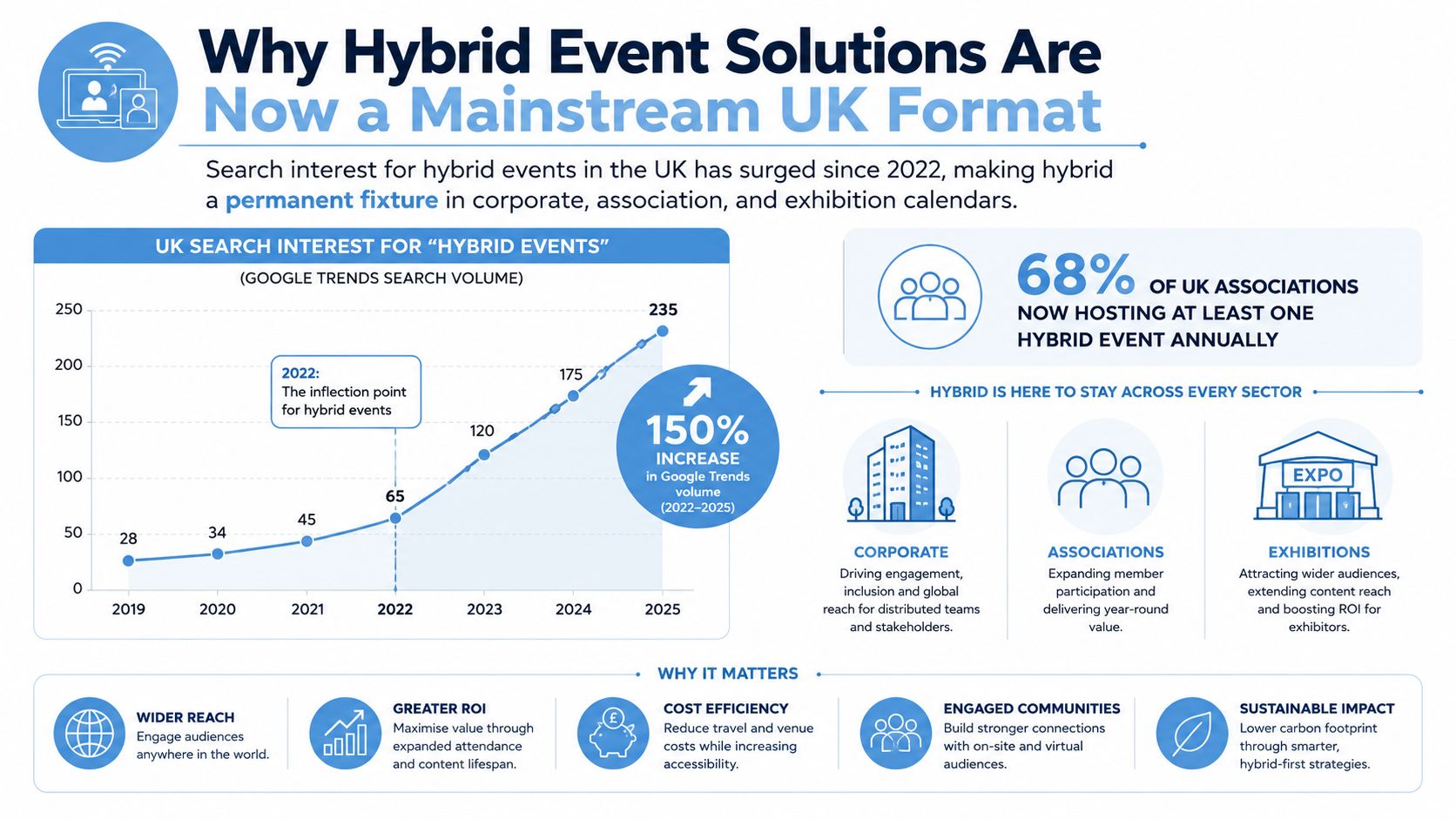
The format has outgrown its original purpose
The Events Industry Alliance research reports that the UK events industry added £11.7bn to the economy in its 2025 economic impact study, compared with £11.5bn in the 2024 study. Hybrid now operates within that significant market, supporting conferences, exhibitions and brand activations that need reach beyond a single venue.
Delegate expectations have shifted. People increasingly ask whether they can join remotely, watch sessions later or contribute without entering the main room. Sponsors want more than a logo on a stage screen, while boards are looking for qualified pipeline, stakeholder access and reusable content rather than a headline attendance total.
Producer's view: Hybrid is a commercial delivery model. Give it a defined job, such as regional access, accessibility, lead capture or content distribution, before approving the extra platform, crew and production costs.
The strongest UK programmes measure whether that digital layer pays back through better access, stronger lead capture or content that continues working after the doors close. Interactive attractions such as simulators and VR can also change the engagement calculation, but only when they create trackable participation rather than expensive spectacle. The weakest programmes add a stream because the technology is available, then report combined registrations as if they represented equivalent engagement. That distinction should shape format, budget and reporting from the start.
What Hybrid Event Solutions Mean
A hybrid event is a simultaneous physical and digital experience, designed as two connected audience journeys. The room and remote audience can share the core programme, while each receives appropriate content, support and opportunities to participate.
UK search interest in hybrid events rose from 7,510 searches during lockdown to a forecast 63,000 over the following year, an 890% increase. That demand has encouraged many organisers to add a digital channel, but audience scale alone does not justify the extra platform, crew and production cost.
A livestream add-on usually points one or more cameras at the stage and sends the feed to an online platform. That can support a speech or panel, while genuine hybrid solutions give remote viewers their own interaction design, presenter support, moderation and content rhythm.
Build two journeys around one show
Start with a shared editorial spine. The opening, keynote, product demonstration or closing message may serve both groups, but the surrounding experience requires separate decisions.
For the in-room audience, that could mean stage energy, networking, demonstrations and physical exhibits. Remote participants may need a digital MC, moderated chat, online networking lounges, polls, question routing and short links to supporting content. They should not spend long periods waiting through a room reset or an extended audience microphone exchange.
A practical example is a 600-delegate London conference streamed to 4,000 online attendees, with watch parties in Manchester and Edinburgh. The online audience needs its own welcome, platform navigation, moderation and local participation prompts. The regional watch parties need a reliable connection to the central show. Presenters in London must understand that remote questions form part of the programme and require planned timing.
Interactive attractions can strengthen either journey when participation is measurable. A simulator or VR activation may generate stronger engagement than passive viewing, but its value depends on booked sessions, completed interactions, qualified leads or reusable content. Without those measures, it remains an expensive production feature.
Give the digital layer its own production paperwork
The digital experience needs a separate run sheet alongside the main event schedule. It should identify:
- Online ownership: Assign a digital producer or MC to welcome viewers, explain interaction tools and keep remote participants informed.
- Question control: Give moderators a process for filtering, grouping and escalating questions to the stage.
- Sponsor inventory: Define digital placements, virtual booths, session branding, lead forms and clickable calls to action before selling packages.
- Content tracks: Create online-only briefings, networking windows or replay assets where the physical schedule leaves remote viewers waiting.
- Technical escalation: Set out the response if a speaker loses connection, a platform feature fails or a remote contributor needs a backup route.
A dual-audience broadcast model also changes speaker briefing. Presenters should acknowledge remote participants, use clear visual framing and avoid relying on room applause as the only response. The show caller must coordinate stage cues, online graphics, remote contributors and audience interaction in one sequence.
Core Formats and Technical Components
UK producers usually choose a format by balancing audience geography, content importance, venue capability and tolerance for technical complexity. The four approaches below aren't interchangeable.
Four practical production models
Broadcast-led events use one primary venue and a controlled stream. They suit keynote conferences, awards and product announcements where the physical room provides energy and the digital audience needs a polished feed. The build normally includes multiple cameras, vision mixing, professional audio, a streaming platform, captions where required and a backup encoder or connection.
Hub-and-spoke programmes connect a central host venue with regional locations. This approach can reduce travel pressure and give local teams a meaningful role, but it adds coordination across rooms, time delays, presenter handovers and network paths. Each spoke needs local technical support, clear contribution feeds and a defined fallback if the link drops.
Fully produced events treat the online audience as a primary audience rather than a secondary viewer. They may use a broadcast studio, presenter-led links, pre-recorded inserts, graphics packages, digital networking and online-first sessions. This model offers the most control, but it requires the strongest editorial planning and the clearest business case.
Simulive combines pre-recorded sessions with a scheduled live experience. Viewers watch edited content at a set time while joining live chat, polls or Q&A. It reduces speaker and presentation risk, although the production team must brief contributors and manage the boundary between recorded and live material.
Match equipment to the audience promise
A professional build depends on more than camera count. Audio quality, lighting, vision switching, platform configuration and reliable connectivity usually shape perceived quality more than an extravagant stage design.
| Format | Typical Build | Best Fit |
|---|---|---|
| Broadcast-led | Multi-camera capture, vision mixing, professional audio, streaming platform, interaction tools and connection redundancy | Conferences, awards, launches and single-venue programmes |
| Hub-and-spoke | Central show caller, contribution feeds, regional AV teams, synchronised schedules and local fallbacks | Distributed organisations, regional engagement and multi-location meetings |
| Fully produced | Studio or broadcast venue, presenter links, graphics, pre-recorded inserts, digital moderation and online-first content | High-value campaigns, global audiences and content-led programmes |
| Simulive | Edited recordings, scheduled playback, live moderation, polls, Q&A and replay management | Training, product education and sessions where consistency matters |
Separate the capture chain from the streaming chain where budget permits. A camera or vision failure shouldn't automatically remove the recording needed for post-event content. Bonded 4G can provide a useful backup route when venue connectivity is uncertain, while separate show-caller communications stop online moderation from competing with stage comms.
The event management layer also matters. A platform or event coordination software can help teams manage schedules, speakers, registrations and operational information, but it won't compensate for an unclear show flow. Technology should support the production plan, not become the plan.
Benefits, Costs, and Honest Trade-Offs
The business case for hybrid event solutions starts with reach, but reach alone won't pay for production. Online registrations may create a larger top-of-funnel audience, yet attendance and participation can vary sharply between physical and digital channels.
The UK CREDS 2023 evaluation recorded online registration-to-attendance conversion of roughly 33% for one event and 49% for another, compared with approximately 67% and 81% for in-person registrations. It also recorded online drop-out rates of around 50%. The practical conclusion is clear: registration volume isn't the same as delivered audience value.
Where the premium can pay back
Hybrid becomes easier to justify when the digital audience connects to a defined commercial or organisational outcome:
- Qualified pipeline: Remote participation can extend access to prospects who wouldn't travel, provided the organiser captures consent, engagement and follow-up signals.
- Content licensing: A keynote, demonstration or training session can continue working through on-demand distribution, subject to rights and approval.
- Sponsor upgrades: Digital booths, clickable calls to action, remote demos and post-event content can support a higher sponsorship tier when the inventory is designed before the sales process.
- Accessibility and reach: A remote option can support people who can't attend physically and audiences outside the host region.
Production costs rise because the organiser is operating a show, a platform and an engagement layer at the same time. UK coverage cites production-only costs of roughly £15,000 to £40,000 for a one-day corporate hybrid event with 200 in-person attendees, as reported by Gass Productions. That range is a warning against treating streaming as a minor line item.
When one format is the better choice
A small, single-region audience may not generate enough digital value to support the additional crew and technology. A single-session sales meeting can also work better as an intimate in-person discussion or a focused webinar. An activation without a content-repackaging plan may pay for a stream that nobody uses after the event.
| Format | Cost per Attendee (£) | Reach Potential | Content Lifespan |
|---|---|---|---|
| In-person | Depends on venue, catering, travel and production scope | Primarily physical audience | Often tied to the live day unless recorded |
| Hybrid | Includes physical delivery plus digital production and platform costs | Physical audience plus remote and on-demand access | Can extend through edited and replay content |
| Virtual | Platform, production and digital engagement costs | Broad geographic access without venue capacity | Can support replay and downloadable content |
Don't approve hybrid because it sounds progressive. Approve it when the digital audience has a measurable role in the business case, and when the team knows how it will convert attention into pipeline, learning, access or content value.
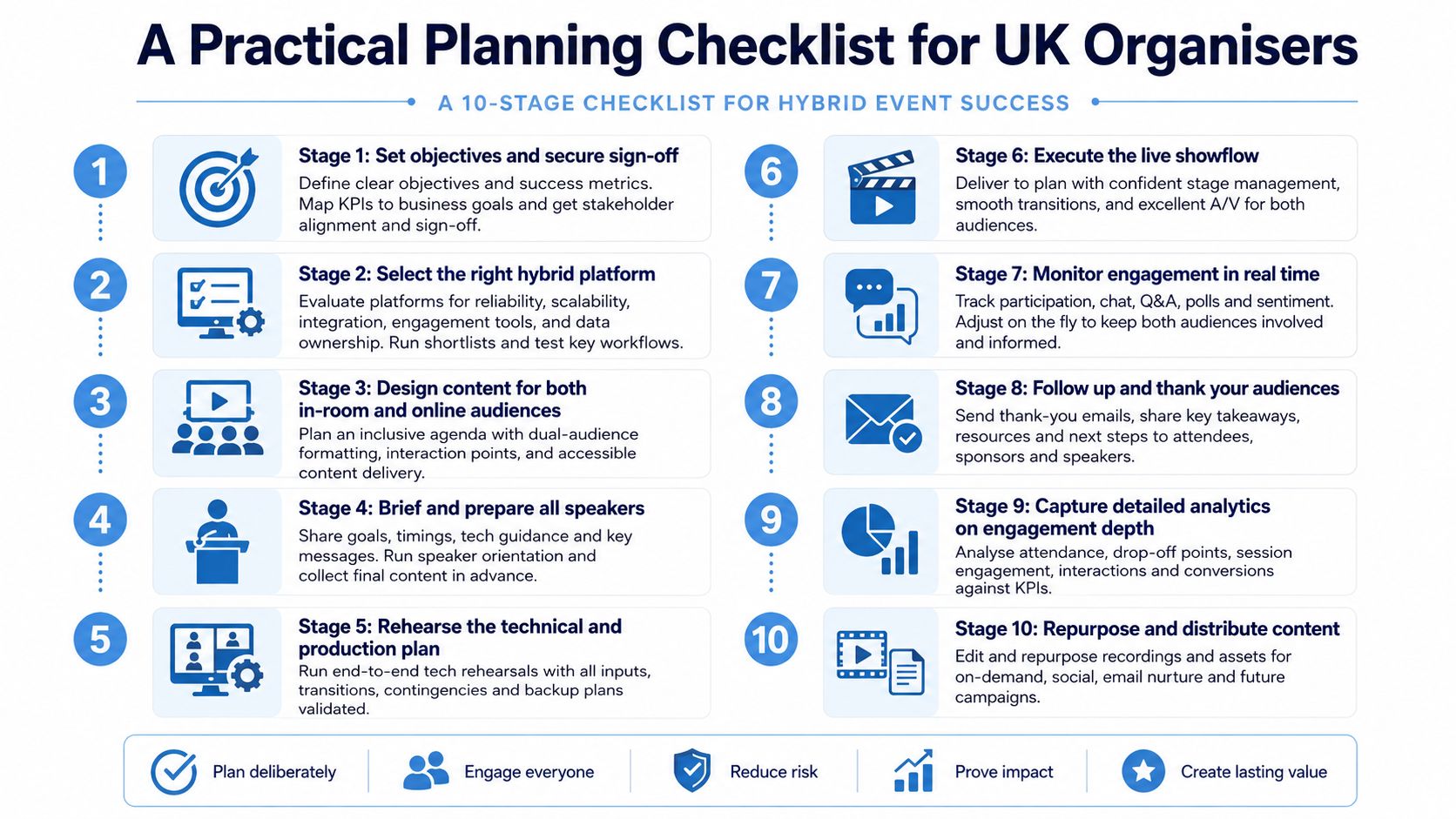
A Practical Planning Checklist for UK Organisers
The most reliable hybrid builds start with decisions, not equipment. Work through the sequence below before committing to a platform or production supplier.
- Sign off the objective. Separate commercial, stakeholder, learning and accessibility goals. Set different KPIs for the room and the online audience, rather than forcing one attendance target across both.
- Define audience journeys. Map registration, joining, participation, networking, follow-up and replay for each audience. Decide which moments need to be live and which can be recorded.
- Shortlist the venue and studio. Check rigging, power, loading access, room acoustics, camera positions and connectivity. Major London hotels can create bandwidth contention when several teams share a network.
- Procure the AV partner. Ask for a production design, crew plan, backup approach and clear assumptions. Don't accept a generic equipment list without a show-flow explanation.
- Choose the platform. An event app may suit networking and schedules, a webinar platform may suit a focused broadcast, and a custom microsite may suit a branded campaign with multiple content paths.
- Design for accessibility. Hybrid access should be planned from the outset. University of East Anglia guidance recommends asking participants about access needs before the event and continuing to respond to issues during delivery.
- Write the dual-audience run of show. Protect online viewers from dead air, long room-only segments and unclear transitions. Build in moderation, captions, speaker introductions and digital prompts.
- Brief and rehearse speakers. Test every remote contributor, confirm presentation formats and prepare a substitute route for last-minute dropouts. A recorded backup can protect a keynote from a failed connection.
- Assign live roles. Separate the show caller, stage manager, platform moderator, speaker technician, audience engagement lead and data lead. One person can't safely monitor every layer.
- Hand over analytics and content. Agree the dashboard, CRM fields, replay workflow and ownership before the event closes. The team should know how scans, questions, poll responses and viewing behaviour will be used.
Protect both audiences during delivery
The UK hybrid access tips from Come Together recommend separate information for in-person and online participants, advance sharing of event details and support for people who don't have suitable devices. Those details affect attendance as much as the headline stream.
Run a technical rehearsal that includes the platform, not just the stage. Test the registration path, joining instructions, captions, polls, chat moderation, remote speaker handovers and the escalation route. Streaming a popular keynote can overload an untested platform, while an attractive venue can still fail if the internet service can't support the agreed contribution and distribution paths.
Vendor Selection Criteria and Red Flags
Procurement teams should score suppliers against the delivery risk, not just the visual polish of a proposal. A low headline price can conceal platform fees, additional streaming capacity, overtime, captioning, travel, rehearsal charges or post-event editing.
The matrix below provides a starting structure. Adjust the weighting to reflect the event's risk profile, but make every supplier answer the same questions.
| Criterion | Weight (%) | What to Score | Red Flag |
|---|---|---|---|
| Technical capability | 25 | Broadcast-grade AV, redundant encoders, audio quality, CDN capacity and backup connectivity | Single-point-of-failure streaming setup |
| Production experience | 20 | Relevant UK conference, exhibition or activation references and named delivery personnel | Supplier won't share reference contacts |
| Platform reliability | 15 | Documented service commitments, latency expectations, moderation tools and support model | Vague service-level language |
| Accessibility | 10 | Captions, accessible navigation, multiple participation routes and support planning | Accessibility treated as a late add-on |
| Security and data handling | 10 | GDPR posture, access controls, recording permissions and data retention process | Unclear ownership of attendee data |
| Cost transparency | 15 | Separate production, platform, streaming, crew, rehearsal and post-event lines | Bundled costs that can't be compared |
| On-site support | 5 | Named engineers, escalation process and venue coordination | No on-site engineering team |
Ask for evidence, not adjectives
Terms such as "broadcast quality" and "enterprise-ready" don't tell a procurement lead how a supplier behaves under pressure. Ask to see a sample run sheet, risk register, comms plan and post-event report. Require the proposal to identify what happens if the primary encoder, venue connection, speaker laptop or platform feature fails.
A supplier should also distinguish between platform capability and production responsibility. The platform may provide registration, video delivery and chat, while the production company manages cameras, vision, audio, lighting and show calling. Event vendor selection criteria can help structure that comparison before commercial scoring begins.
A credible supplier makes the failure plan easy to find. A risky supplier makes the feature list look impressive and leaves the contingencies vague.
Where Interactive Attractions Fit in Hybrid Programmes
Interactive attractions can strengthen a hybrid programme when they create one shared action across physical and digital audiences. A simulator, VR module or electronic leaderboard gives remote participants something to follow, influence or compete against. That's more useful than adding a virtual booth that receives little traffic.
The attraction must connect to the programme architecture. It needs a booking or queue system, a clear scoring rule, a content capture plan and a lead trigger that respects consent. The digital audience may watch a live attempt, submit a prediction, join a bracket or compare scores with colleagues at another location.
Three workable UK scenarios
A London product launch could use a racing simulator as a live bracket. Guests compete at the venue while remote viewers follow the leaderboard, nominate a driver or join a digital challenge. The producer can schedule leaderboard reveals between product segments, giving the attraction editorial value rather than leaving it as an isolated stand activity.
A Manchester training day could pair VR safety modules with remote delegates. Physical participants complete the module on-site, while online attendees watch a guided version, answer scenario questions and discuss the correct response with a facilitator. The value comes from shared learning and comparable feedback, not from claiming that both groups received an identical experience.
A Birmingham sales conference could use a darts wall to aggregate scores from regional venues. Each location contributes to a common table, and the central host reveals progress during the show. The activity gives distributed teams a reason to stay connected and creates natural moments for branded content.
Make the attraction commercially defensible
Dwell time, social sharing and lead capture should be designed into the activation brief. Use a QR code or platform form at the point of participation, but explain why someone should submit details. A scorecard, personalised result, follow-up resource or invitation to a related session gives the exchange a useful purpose.
Don't promise a performance lift without a measurement baseline. Track attempts, completion, repeat participation, online interactions, scans, qualified conversations and the cost of each meaningful engagement. The attraction earns its place when it helps the event achieve a stated objective, not merely because it photographs well.
Measurement, Reporting, and Next Steps
Hybrid reporting starts with clean definitions. The ABC event attendance standard says organisers should report in-person and online attendance separately and remove duplicates from any combined figure. That prevents a registered delegate who attends in the room and later watches online from becoming two people in the headline total.
Your stakeholder dashboard should combine platform analytics, CRM stages and on-site scan data. Report attendance depth, engagement minutes, qualified leads sourced from interactive attractions, cost per attendee by tier and post-event replay views. For reporting structure and follow-up discipline, this guide to post-event reporting is a useful reference.
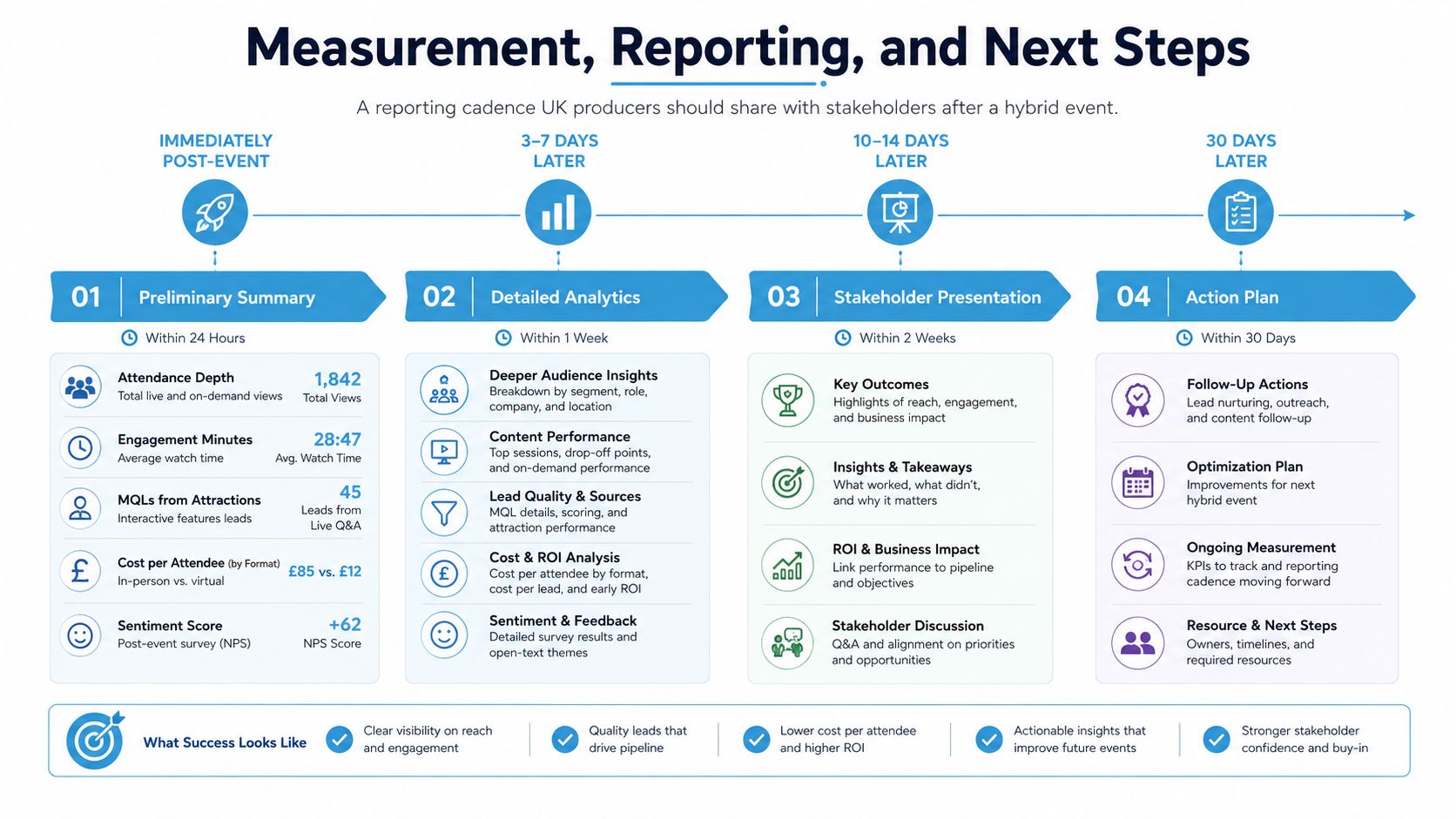
Use a 90-day decision sequence
In week one, confirm objectives and create the supplier shortlist. By week four, select the venue and platform. By week ten, lock content and complete the main rehearsal. Within fourteen days of close, issue the initial report, reconcile attendance and pass qualified engagement into the CRM.
Use a defined lead capture process for events when attractions, sponsor interactions and digital questions feed commercial follow-up. The final report should show not only how many people attended, but which audience participated, what they did and what action followed.
PSW Events delivers interactive hybrid-event attractions across the UK and worldwide, including racing and sports simulators, VR, flight experiences and electronic leaderboards, with planning, branding, logistics, staffing and installation handled as one service. Visit PSW Events to discuss an attraction-led programme that gives both in-room and remote audiences a measurable reason to engage.