
You’re probably dealing with one of two problems.
At an exhibition, people walk past the stand, glance at the screen, take the brochure, and keep moving. At an internal event, the room is well produced, the agenda is solid, but the energy never quite lifts. In both cases, the issue isn’t usually effort. It’s that passive formats struggle in busy environments.
A cycle simulator solves a different problem from a printed panel, a looping product video, or a standard hospitality area. It gives attendees a reason to stop, a reason to participate, and a reason to stay long enough for your team to start a proper conversation. That’s why cycle simulators now sit comfortably inside trade shows, conferences, fan zones, wellness days, and team-building programmes. Used well, they aren’t just entertainment. They’re an engagement mechanism.
For planners, that distinction matters. You’re not hiring a bike because it looks interesting. You’re choosing an interactive format that can support dwell time, lead capture, brand recall, and clean on-site delivery. The difference between a smart booking and a wasted one comes down to setup, throughput, staffing, branding, and how the experience is framed around your event objective.
Energise Your Event with Interactive Experiences
Static event assets still have a place. Branded walls, sample stations, presentation screens, and hospitality counters all do useful work. But they don’t always create momentum on their own, especially in halls where every exhibitor is trying to pull attention from the same aisle.
A cycle simulator works because it changes attendee behaviour. People don’t just look at it. They queue, compete, watch colleagues ride, check scores, take photos, and talk about the challenge afterwards. That shift from passive viewing to active participation is what makes it commercially useful.
The strongest activations use that participation with intent. A leaderboard gives sales teams a reason to collect names. A branded route or challenge ties the attraction back to a campaign. A team relay creates internal interaction between departments that would otherwise spend the day in separate conversations. In practical terms, it helps fix three common event frustrations:
- Low stand engagement: People need a clear reason to break stride and step onto your space.
- Short conversations: If attendees stay only briefly, your team has little chance to qualify interest.
- Forgettable experiences: If nothing happens on the stand, nothing gets remembered after the event.
Cycling also carries broad cultural familiarity, which helps. Plenty of attendees already understand the appeal of racing, hill climbs, and timed efforts. Others connect with it through leisure riding or holiday routes. If you’re building a themed activation around travel, wellness, sport, or outdoor lifestyle, inspiration can even come from route-led content such as RoutePrinter’s guide to best bike trails, which shows how strongly cycling experiences are tied to scenery, challenge, and story.
A good interactive attraction doesn’t interrupt the event. It gives the event a centre of gravity.
What Exactly Is an Event-Grade Cycle Simulator
A lot of planners start with the same assumption. They think a cycle simulator is basically an exercise bike with a screen attached.
It isn’t.
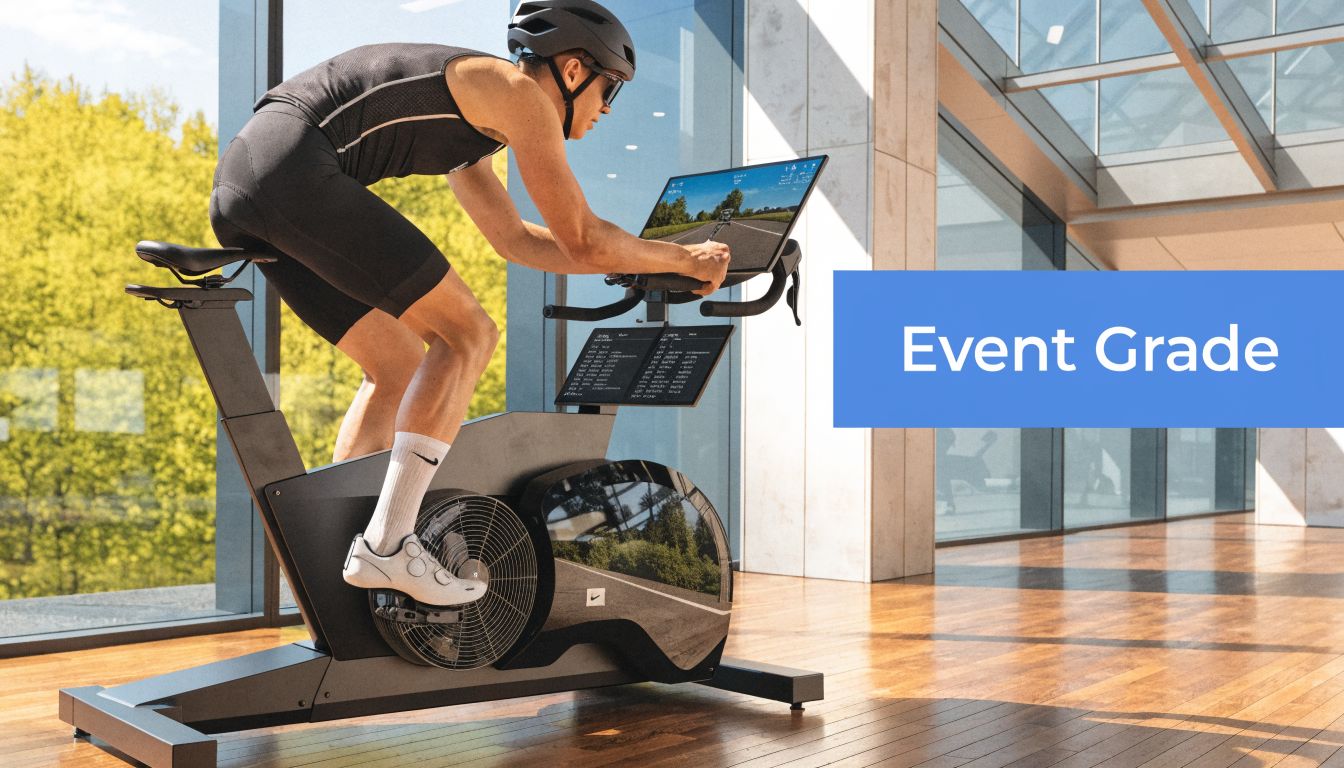
A professional event-grade cycle simulator is built to respond to rider input in a way that feels immediate and convincing. Pedalling effort, steering, braking, resistance, visuals, audio, and on-screen competition all need to work together. If one part feels off, the entire experience becomes flat very quickly.
It’s closer to simulation than fitness equipment
The easiest comparison is this. A basic gym bike lets someone pedal in place. An event-grade simulator interprets what the rider is doing and turns it into an interactive experience with consequence. Speed changes. Terrain matters. Competition feels live. The rider can see the result of every effort.
That difference is why some rigs draw a crowd and others don’t.
In traffic safety research, advanced bicycle simulators have gone much further than entertainment setups, using motion platforms, steering input, braking input, and rider-bicycle dynamic models to reproduce realistic lean behaviour. Evaluations cited in the HFES Europe paper show these systems can correlate simulated lean angles with real-world stability thresholds such as 15 to 20° lean for cornering at 20 km/h, and they outperform static trainers by 40% in behavioural realism according to the referenced findings in the HFES Europe simulator research paper. Event units don’t need laboratory complexity, but the principle is the same. Realism drives engagement.
The components that matter on an event floor
From a planner’s point of view, three parts matter most.
- Responsive resistance: If the rider sprints and nothing meaningful changes, interest drops. Pedal feedback has to match what’s happening on screen closely enough that effort feels rewarded.
- Clear visual feedback: Big screens, bold race graphics, obvious lap progress, and visible results are more important than obscure technical data. The audience needs to understand the contest instantly.
- Stable interaction: Steering, braking, and transitions need to feel reliable. In an event setting, people of mixed confidence levels will use the rig. If control feels awkward, throughput slows down.
Why immersion matters commercially
Immersion isn’t only about realism for realism’s sake. It affects how long people stay, how seriously they take the challenge, and whether bystanders decide to join in.
That’s the commercial reason to avoid underpowered setups. If the attraction feels like a novelty bike with a monitor, attendees try it once and move on. If it feels competitive and reactive, they compare scores, challenge colleagues, and ask for another go.
Practical rule: The more obvious the cause and effect between rider input and on-screen response, the stronger the queue, the better the crowd, and the easier it is for your event staff to keep the experience moving.
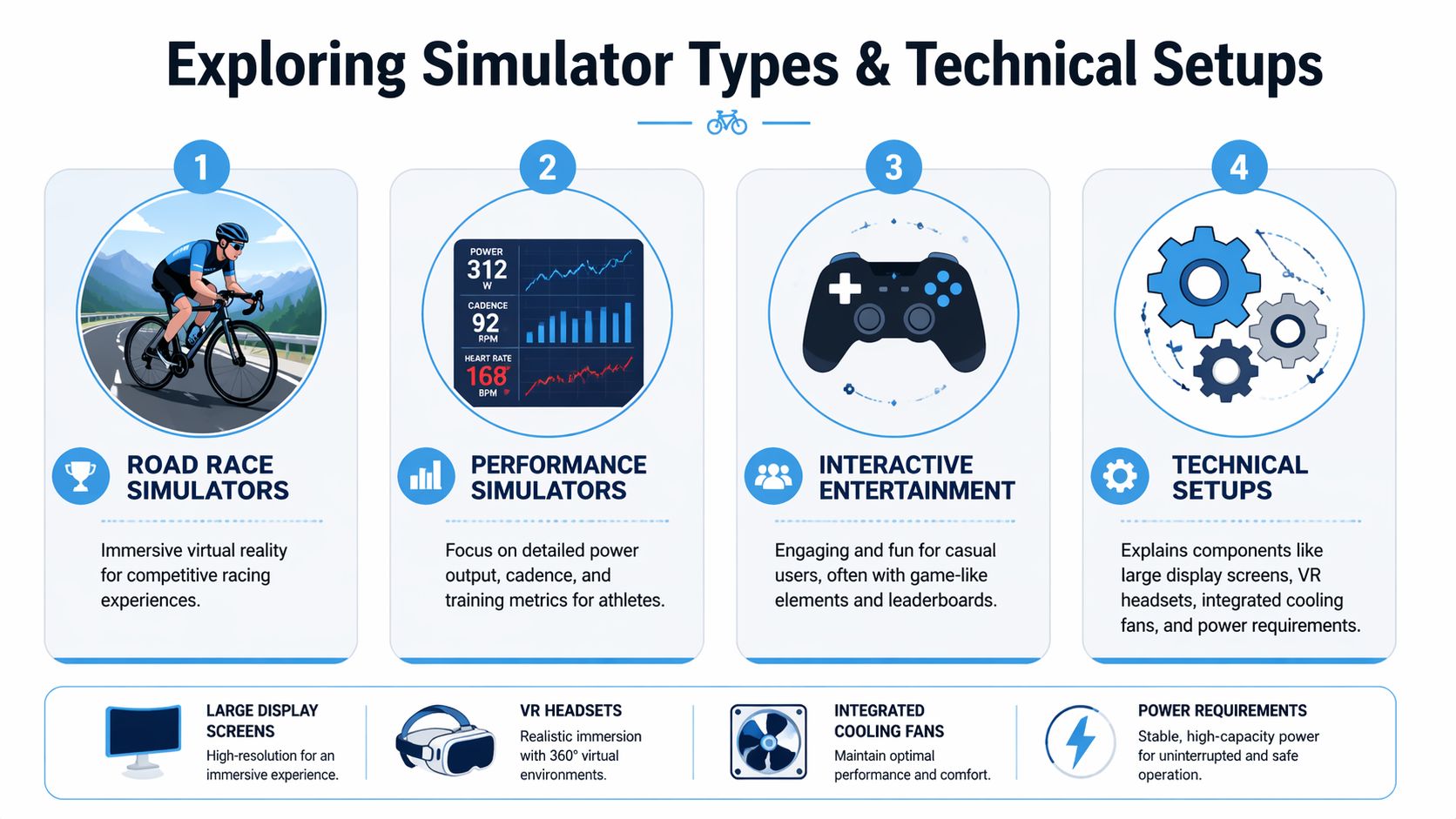
Exploring Simulator Types and Technical Setups
There isn’t one universal cycle simulator format. The right build depends on what you need the attraction to do. Some events need high throughput and easy queue management. Others need impact, immersion, or a deeper branded story.
Static high-throughput rigs
These are usually the most practical option for trade shows and conferences. The rider gets a stable bike platform, a clear on-screen race or route, and simple controls that don’t require much explanation.
They work well when your priorities are queue flow, repeat participation, and easy staffing.
Pros
- Fast turnover: Riders can get on and off quickly.
- Simple briefing: Good for mixed audiences with no training needed.
- Compact footprint: Easier to fit into stand plans and shared event spaces.
Cons
- Lower spectacle factor: They don’t create the same visual drama as motion or VR builds.
- Less suited to premium launches: If the brief is all about visual impact, a static rig can feel conservative unless branding is strong.
Motion-enabled simulators
These setups add physical movement or enhanced dynamic response to make the ride feel more reactive. They suit launches, fan zones, and larger activations where audience draw matters as much as rider experience.
In UK exhibition use, motion-enabled cycle rigs introduced at SEC Glasgow were associated with a 30% cost-efficiency gain in logistics, reducing setup time from 8 to 5.5 hours in the referenced event data. That matters when build windows are tight and venue access is expensive.
Best fit
A motion setup earns its place when the attraction itself is part of the showpiece, not just a support mechanic for data capture.
Trade-off
You get more wow factor, but you also need more careful space planning, better queue control, and a stronger operator presence.
VR-led immersive setups
VR can be excellent when the brief is inclusivity, novelty, or a more immersive team-building format rather than pure throughput. It changes the emotional feel of the experience. Riders often focus more on the route, environment, and personal challenge than on simple speed alone.
That can be a real advantage for wellness days, staff engagement programmes, and audiences that may not respond to hard-edged competitive messaging.
What planners need to watch is throughput. Headset cleaning, rider orientation, and pace of changeover all need proper management. VR can be strong. It just can’t be treated like a plug-and-play aisle attraction.
Multi-rider race formats
If you want crowd energy, multi-rider setups are hard to beat. Side-by-side competition creates a natural audience because everyone understands the contest immediately. One rider surges, the other reacts, the screen updates, and spectators start choosing sides.
That’s often the right answer for:
- Exhibition stands where footfall matters
- Team-building sessions where departments compete
- Fan zones where fast rounds and visible winners keep energy high
For planners comparing providers and formats, it helps to review dedicated simulator hire options with an eye on throughput, footprint, branding, and staffing rather than only the headline visual.
A planner’s decision filter
The wrong way to choose is to ask, “Which setup looks the most exciting?”
The better questions are:
| Simulator type | Best use case | Main planning concern |
|---|---|---|
| Static rig | Exhibitions and conferences | Stand traffic flow |
| Motion simulator | Product launches and fan zones | Space and build logistics |
| VR setup | Team-building and accessibility-led activations | Throughput and supervision |
| Multi-rider race | Competitive engagement and crowd draw | Queue handling and operator control |
If your event needs volume, keep it simple. If your event needs theatre, invest in immersion. If your event needs conversation quality, use a format that creates enough dwell time for the commercial team to do their job.
Boosting Event ROI with Cycling Simulators
Most planners don’t need another attraction. They need something that earns its floor space.
That’s the standard a cycle simulator should be judged against. Does it attract people, keep them engaged, support lead capture, and give the brand team usable output afterwards? If the answer is no, it’s just expensive scenery.
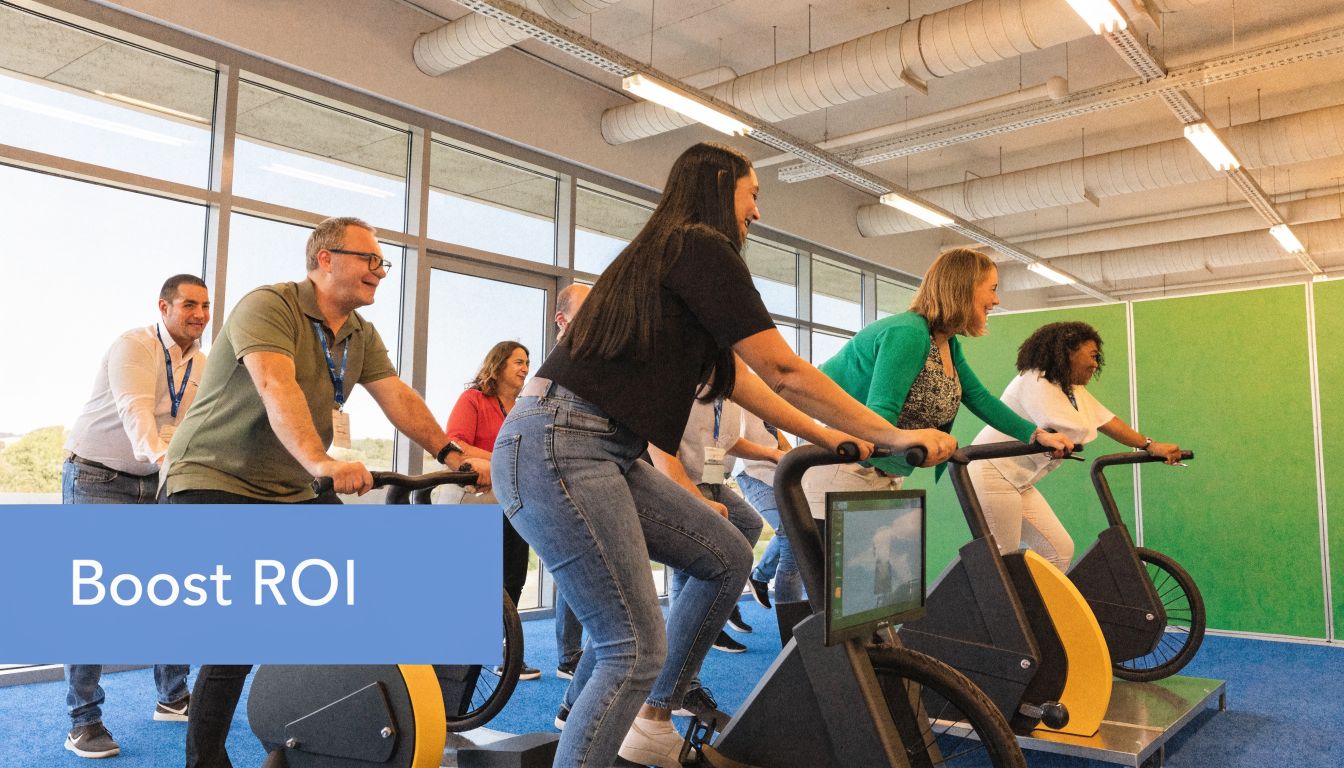
In the UK, cycling simulators have become a regular part of corporate entertainment. PSW Events reports over 500 deployments across venues including Silverstone and Wembley since 2015, with a 35% increase in event dwell time from client feedback surveys between 2020 and 2025, while UK Sport data shows cycling participation rising 22% post-2012 London Olympics, and a 2024 British Cycling report notes simulators used in 40% of trade shows and exhibitions, enhancing lead capture by 28% for brands. Those figures appear in the verified business context supplied for this brief.
Dwell time is where value starts
Short interactions rarely convert into useful event outcomes. A quick glance doesn’t give your team enough time to explain the offer, qualify the attendee, or connect the attraction to the campaign.
A cycle simulator changes that by design. The attendee has to register, get briefed, ride, see the result, and often compare it to someone else’s score. That sequence naturally creates more time on the stand. More time means better conversations, and better conversations improve the quality of the leads you collect.
This is why I’d always advise planners to think beyond the ride itself. The ride is the hook. The core value sits in what happens before and after it.
Lead capture works best when it feels earned
The easiest data-capture mistake is making the form the main event. If attendees feel they’re filling out a lead sheet just to play a game, conversion drops and staff end up forcing the interaction.
A better model is performance-led capture. People enter because they want a score on the board, a timed result, a place in a heat, or a branded takeaway linked to their ride. The data request feels like part of the challenge, not an interruption.
That’s one reason cycle simulators work well inside wider experiential marketing activations. They give the audience a visible action to complete, which makes the transition into brand messaging more natural.
The strongest event data capture feels like part of the game, not paperwork at the side of it.
Footfall comes from visible competition
Busy halls reward anything people can understand from a distance. A multi-rider race, a live leaderboard, or a sprint challenge does that well because nobody needs a long explanation.
At venues such as ExCeL London, simulator zones averaged 15,000 interactions per show in 2023 and boosted footfall by 18% in the supplied verified data. The practical lesson is straightforward. If the challenge is visible and the result is easy to read, people stop.
That visibility depends on execution:
- Screens must face the aisle: Don’t turn the action inward where only the rider can see it.
- The format must be legible: “Fastest sprint” is easier to grasp than a dense technical training simulation.
- The staff prompt matters: A confident host can turn bystanders into participants quickly.
A short look at a live cycling challenge helps show why the format works on a stand:
Social visibility and post-event recall
Not every value point has to be measured in lead forms. Some of the return comes from visibility in the room and memory afterwards. People photograph scoreboards, film colleagues racing, and mention the activation in recaps because something happened there.
That’s where branding needs discipline. Keep the challenge simple, make the route or interface look like your campaign rather than a generic game screen, and ensure the result board carries your visual identity clearly. The simulator creates the moment. Branding makes sure the moment belongs to you.
Cycle Simulators in Action Across UK Events
The value of a cycle simulator becomes easier to see when you look at how it behaves in different rooms. The same core technology can feel very different depending on audience, venue, and objective.
The exhibition stand that needed a crowd
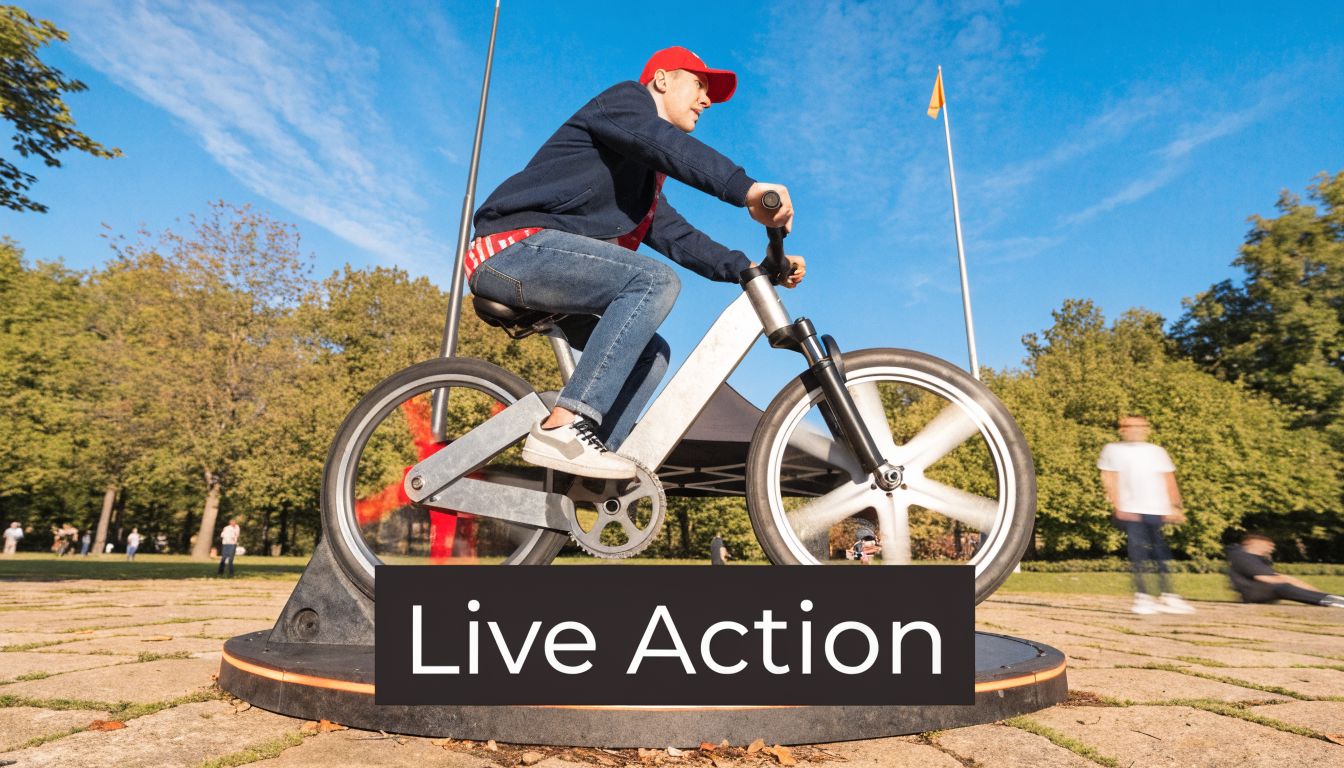
At a busy trade show, the stand often has only a few seconds to win attention. A head-to-head sprint challenge fixes that because the contest is visible from the aisle. One rider starts to pull ahead. The screen updates. Colleagues stop to watch. Someone from the sales team invites the next person onto the bike.
That format works especially well when the brand wants pace and energy rather than long-form demonstration. The simulator becomes the magnet. The surrounding team handles the conversion.
The team-building brief that needed participation
Internal events often suffer from polite disengagement. People attend because they’re meant to, not because the format gives them a reason to join in. A virtual climb or relay challenge changes the dynamic because it creates shared effort without needing specialist athletic ability.
Departments can ride in teams, compare times, and support each other without the activity feeling childish or forced. The best versions keep the mechanics simple and the social energy high.
If a team-building activity makes people self-conscious, participation falls away. If it gives them a clear task and a bit of friendly competition, the room usually carries itself.
The fan zone that needed branded energy
In a sports venue or public activation space, a cycle simulator works well when the brand wants people to do something physical, visible, and short enough to keep the queue moving. Timed rides, branded jerseys on screen, and fast leaderboards all help.
The key is pace. Fan zones don’t reward over-explanation. The experience has to start quickly and end with a result people can understand at a glance.
The inclusive VR activation planners keep asking for
There’s a less discussed use case that’s becoming more important. Inclusive team-building and accessibility-led participation. In a 2025 UK survey by the Event Industry Council UK chapter, 68% of corporate planners said they seek accessible interactive attractions, yet only 12% reported availability of adaptive simulators, according to the verified data supplied with the reference to the Berkeley VR cycling research link. The same verified data also states that cycle simulators in VR can reduce perceived injury risk by 40%, and that 73% of Gen Z prioritise accessibility.
That gap matters. Plenty of planners want active experiences that feel inclusive, but many interactive bookings still lean towards high-pressure formats or equipment that excludes less confident participants. A well-managed VR cycle experience can soften that barrier. It makes the activity feel safer, more exploratory, and easier to join.
The wrong approach is to treat accessibility as a bolt-on message after the fact. The better approach is to design the activation from the start so different confidence levels can participate comfortably.
Your Essential Pre-Event Planning Checklist
A cycle simulator can be easy on event day, but only if the planning is done properly. Most on-site problems are created long before the van arrives. Space assumptions are wrong. Build times are too optimistic. Nobody has agreed where the queue sits. The branding file arrives late. Venue access is tighter than expected.
That’s why the planning process matters more than the spec sheet.
Cycle simulators entered the UK event market prominently after the 2008 Beijing Olympics, with adoption surging 45% in corporate hires by 2012. The verified data also states that PSW Events delivered cycle sims to 200 UK conferences from 2016 to 2025, achieving 99.9% uptime and zero incidents under £10m liability insurance. That kind of operational record matters because venues such as Manchester Central and SEC Glasgow reward suppliers who can install quickly, work safely, and keep to schedule.
Start with venue reality
Before you discuss graphics or competition format, confirm the operational basics.
| Phase | Task | Key Consideration |
|---|---|---|
| Initial enquiry | Define the event objective | Decide whether the simulator is there for footfall, team-building, lead capture, or brand storytelling |
| Venue review | Check footprint and access | Confirm floor space, loading routes, lift access, and whether doors, corridors, or build windows create restrictions |
| Technical planning | Confirm power and screen positions | Make sure the simulator, displays, and any leaderboard equipment can be placed where attendees will actually see the action |
| Branding prep | Gather creative assets early | Late artwork causes rushed setup and weak visual integration |
| Data capture setup | Agree the registration flow | Keep forms short and align them with the challenge mechanic |
| Staffing plan | Assign operator and host roles | Someone must run the experience while someone else handles the audience and leads |
| H&S sign-off | Review risk assessment and insurance | This is non-negotiable for corporate venues |
| Post-event wrap-up | Plan reporting output | Decide in advance what success looks like and how results will be shared |
Build the activation around one commercial goal
A common mistake is trying to make one simulator do everything. If you ask it to be a product demo, a wellness feature, a lead engine, a social photo moment, and a technical showcase all at once, the experience gets muddled.
Pick the primary job.
- For exhibitions: Prioritise queue flow, score visibility, and simple data capture.
- For internal events: Focus on participation, team formats, and broad accessibility.
- For launches: Put more attention on scenic content, bespoke branding, and presentation quality.
If the event sits inside a wider launch programme, practical planning guides for product launch event delivery help align the simulator with the rest of the audience journey rather than treating it as an isolated booking.
Branding is more than logos on a screen
Good simulator branding doesn’t just paste a logo into the corner. It shapes what the rider sees and what the audience remembers. That could mean route naming, branded scoreboards, event-specific challenge titles, or a visual style that matches the stand and campaign.
Keep it legible. Event branding has to work at a glance. Dense visual clutter weakens the experience.
Staffing and safety decide whether the day feels professional
I’ve seen technically decent attractions underperform because nobody owned the live experience. The ride was there, but the queue drifted, people didn’t know how to join, and the sales team stayed behind the counter.
A professional simulator activation usually needs:
- An operator to manage the equipment and rider handover
- A host or brand rep to invite participation and explain the challenge
- A clear H&S framework covering rider use, supervision, and public interaction
Smooth execution is rarely about the machine alone. It’s about who briefs riders, manages the queue, and keeps the experience safe without making it feel restricted.
Frequently Asked Questions About Cycle Simulator Hire
Is a cycle simulator a better choice than an F1 simulator for an exhibition?
Sometimes, yes. If the brief is pure motorsport theatre, an F1 rig may fit better. But many exhibition planners need a broader audience draw, simpler operation, and tighter logistics. The verified data for this brief states that F1 rigs can cost £15k+ to hire, while cycle simulators sit at £5k to £8k, making the cycling option more cost-effective for many B2B activations. The same verified data also notes that cycling participation was up 18% in UK Sport England 2025 data, which supports the category’s mainstream appeal.
Cycle simulators also tend to feel less intimidating. More people are willing to have a go, which is useful when your stand needs volume rather than niche enthusiasm.
Do cycle simulators actually help lead capture?
They can, if the experience is designed for it. The strongest model is a clear challenge tied to a visible result. People enter details to join the competition, claim a place on the board, or receive a branded follow-up linked to their score. The verified data states that custom branding and leaderboards on cycle sims have been shown to yield a 28% lead capture uplift.
The weak model is collecting data before the attendee understands why they should care.
Are they only suitable for sporty audiences?
No. That’s one of the biggest misconceptions. A cycle simulator can be tuned for hard competition, but it can also support casual participation, scenic rides, light team challenges, and inclusive wellness formats. The audience framing matters more than the equipment itself.
If your event audience includes mixed confidence levels, avoid making the activation look like elite training. Position it as a challenge, an experience, or a team activity.
What affects the hire cost most?
Usually the main factors are format, number of bikes, screen package, branding complexity, staffing, venue access, and event duration. A simple static setup for a conference is very different from a branded multi-rider build with leaderboard integration for a large exhibition.
The useful question isn’t only “What does it cost?” It’s “What outcome is the activation there to produce?” That keeps the budget tied to a commercial reason.
Conclusion The Finish Line
A cycle simulator is most valuable when it’s treated as an event tool, not a novelty. It can draw a crowd, keep people on a stand longer, create a natural path into lead capture, and give teams a shared experience that people remember afterwards.
The difference between average and effective usually comes down to planning. Choose the right simulator format for the objective. Make the challenge easy to understand. Give the audience a visible reason to join in. Build the staffing, branding, and H&S around the live environment rather than around a brochure description.
For corporate planners, that’s the key opportunity. You’re not hiring a bike. You’re building a measurable interaction.
If you’re weighing up a cycle simulator for an exhibition, conference, launch, or team event, it helps to map the format against your actual event KPI before you book. The right setup can be straightforward, commercially useful, and easy to run. The wrong one will just occupy floor space.