
Your office of 40 people has just finished a difficult quarter. Someone suggests another pizza lunch, but the manager organising it wants something colleagues will look forward to. You need an activity that feels like a reward, not another meeting with a competitive icebreaker attached.
The right company fun day ideas can lift morale, encourage cross-team conversations and give people a shared story afterwards. But enthusiasm isn't universal: an Acas-commissioned YouGov survey of 1,052 employees in Great Britain found that 31% disliked team-building activities. Give people a choice of how to join in, including watching, helping or taking a quieter break.
The activities below range from simulator tournaments to volunteering days, matched to practical group formats, venues and budget bands. Those bands describe the relative resources involved, not quoted prices: travel, staffing, venue hire and catering can change the overall cost considerably.
For a small-group starting point, the Litter Caterpillars team building guide also offers ideas you can adapt to your workplace. For a UK booking, though, shortlist around the space and attendance you have. A 15-person office outing and a 300-person conference need very different arrangements, even when they use the same attraction.
1. Racing Simulator Grand Prix

A racing simulator gives spectators something to follow as well as giving drivers something to do. Run an F1-style qualifying session on a circuit such as Silverstone, then bring the finalists back for a closing race or podium presentation.
Best fit: A 15-person office tournament, or a drop-in attraction within a 300-person conference.
Venue: A conference room, exhibition hall or indoor hospitality space with suitable power and delivery access.
Budget band: Medium to higher, depending on the rigs, staffing and event duration.
For a conference scenario, open registration during the morning break and publish driving slots rather than letting a queue build beside the equipment. Display the leaderboard where colleagues can watch without blocking the driver's access.
Make the competition welcoming
- Practise first: Give newcomers an untimed practice lap before recording their result.
- Keep settings consistent: Use the same circuit, assistance settings and scoring rules throughout each competition.
- Broaden the prizes: Recognise improvement and team performance, not just the fastest experienced gamer.
Compare the seating formats and event applications in our racing simulator guide before settling on a layout. We offer F1, driving and racing-seat simulator hire, so the equipment choice can follow the event format.
The trade-off is throughput. An impressive rig still serves drivers in turn, so don't make racing the only attraction at a large staff day.
2. Flight Simulator Challenge
Landing a virtual aircraft gives colleagues a challenge they're unlikely to encounter during an ordinary working day. A helicopter simulator or motion flight simulator works particularly well as a reward-day attraction, with a host explaining the controls before each attempt.
Planning match: Small departmental groups taking scheduled turns, or a bookable attraction for conference delegates. Choose an indoor venue with clear equipment access and treat this as a higher-budget option.
Say an adventurous sales team wants something more memorable than drinks after a meeting. Set a consistent landing challenge, let participants practise the controls, and score the attempt using the simulator's available measures rather than inventing complicated judging criteria.
A spectacular attraction isn't automatically a high-capacity attraction. Plan the queue and the alternative activity with equal care.
Give guests a comfortable choice
Motion won't suit everybody. Include a non-motion alternative in the programme and explain what the experience involves before someone commits to taking part.
We offer helicopter and motion flight simulator hire. Our flight simulator cost guide is a useful starting point for considering the equipment and event arrangements, but build your budget around the complete delivery rather than the attraction alone.
For an exhibition, the same challenge can encourage visitors to pause and talk with your stand team. Keep any contact-data collection separate and clearly explained, and don't make surrendering personal details the price of joining a staff activity.
3. Sports Simulator Tournament
Not everyone wants to drive or fly. A sports simulator tournament lets colleagues contribute through different activities, such as golf, American football, rugby and boxing, without organising a full outdoor sports ground.
Best fit: A large departmental day or a 300-person conference with staggered participation.
Venue: An exhibition hall, sports hall or spacious conference venue.
Budget band: Medium to higher, rising with the number of staffed stations.
Consider a company sports day in Manchester or London. Teams rotate through different simulators while colleagues waiting nearby can watch the scores, talk and decide which challenge to try next.
Design the rotation before the scoring
Draw the activity zones onto the floor plan before announcing a tournament. Golf swings, thrown balls and boxing movements need suitable clearances, while spectators need somewhere to stand outside the operating space.
- Use comparable results: Convert each sport's result into a simple tournament score rather than adding unrelated raw measurements.
- Reward involvement: Include a participation element so confident athletes don't determine every result.
- Brief the hosts: Explain how to welcome beginners and demonstrate the activity without embarrassing anyone.
We offer sports simulator hire across golf, American football, rugby, boxing and other disciplines. Choose a varied mix rather than assuming every colleague follows the same sport.
The benefit is variety; the compromise is space and staffing. If the venue is cramped, a well-hosted single-sport challenge works better than a crowded collection of stations.
4. Giant Scalextric Race Night
The appeal of Giant Scalextric is immediate: people can see the cars, understand who's ahead and cheer without learning a complicated game. It suits a mixed-age workforce and gives a family fun day an attraction adults and children can enjoy together.
Planning match: A small office social, a departmental celebration or a drop-in zone at a larger event. A hotel function room or indoor venue foyer can work, provided the track doesn't obstruct circulation. Budget band: Medium.
For a staff summer celebration, use relay teams so colleagues hand over the controller rather than disappearing after an early knockout. At an exhibition, trackside branding can connect the activity to the stand without requiring a lengthy sales explanation.
Layout rule: Put the track where people can notice it, not where they must squeeze past it.
Keep the racing easy to follow
A commentator can explain position changes and invite the next drivers forward. Use a random draw or separate novice and confident racers if a few enthusiasts dominate.
Leave room around the controls, protect cables and nominate a host to recover stranded cars. Don't let guests lean across the layout while others are racing.
We offer Giant Scalextric and Digital Scalextric hire. The main trade-off is the footprint: the track becomes a fixed feature of the room, so plan catering queues, accessible routes and spectator positions around it before installation.
5. Escape Room Team Challenge
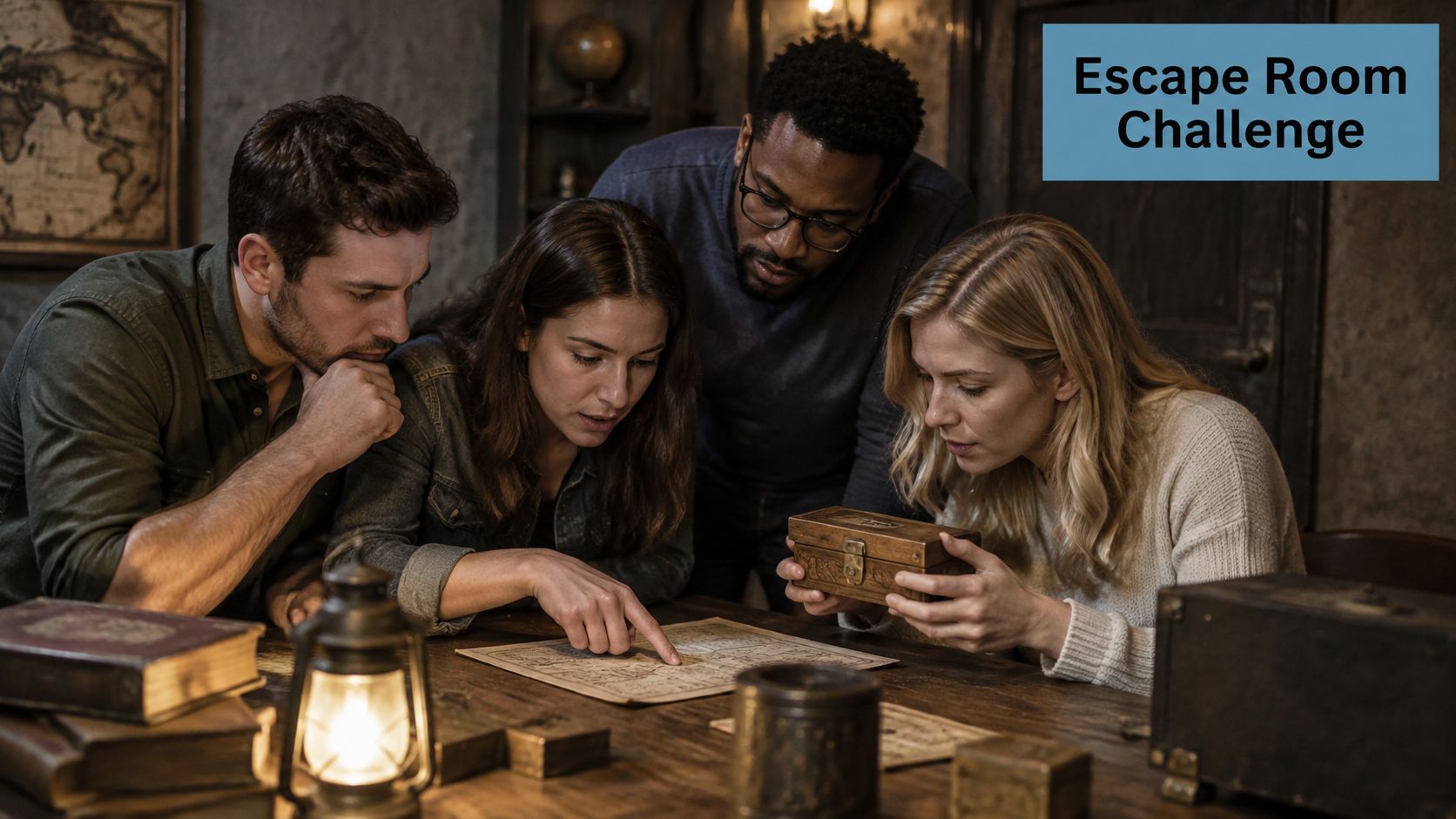
Choose an escape room when you want sustained collaboration rather than a quick turn on an attraction. Colleagues have to share clues, test ideas and notice what someone else has missed.
Best fit: A 15-person office outing split into smaller teams.
Venue: A dedicated city-centre escape venue, or a meeting space using a hosted portable puzzle format.
Budget band: Low to medium for an existing experience; higher for bespoke production.
For cross-departmental team building, mix colleagues who don't normally work together. Keep individual puzzle teams to five or six people so participants have room to contribute instead of watching a confident colleague handle every lock.
Check the experience, not just the theme
- Access and comfort: Confirm physical access, lighting, sound effects and how participants can leave the room.
- Puzzle variety: Choose a mix of observation, logic, language and practical tasks.
- Useful debrief: Discuss how the group shared information, rather than labelling colleagues by personality.
A product-launch version can use clues that reveal brand messages, but bespoke writing and testing add work. For a straightforward staff reward, an established game is usually the simpler choice.
The limitation is flexibility. Fixed starting times make late arrivals awkward, and enclosed or theatrical environments won't appeal to everyone. Offer a parallel café meetup or tabletop challenge rather than treating opting out as a lack of team spirit.
6. Urban Treasure Hunt
A treasure hunt is one of the most adaptable company fun day ideas when the budget is tight. You can build it around local landmarks, a park or the grounds of your venue, using printed clues or a phone-based route.
Planning match: A 15-person team divided into small groups, or a larger workforce using staggered departures. Venue: A walkable city centre, accessible park or self-contained estate. Budget band: Low for an internally organised route, medium for a hosted experience.
An Edinburgh away day, for example, could combine landmark clues with creative photo tasks before everyone meets for lunch. Our Edinburgh scavenger hunt guide offers a location-specific starting point.
Walk the route before your guests do
Check crossings, gradients, public toilets, building works and mobile reception. A route that looks compact on a map can be awkward for someone using a wheelchair or managing fatigue.
- Give clear boundaries: Supply a map, finish point and contact details for the organiser.
- Vary the tasks: Mix observation, knowledge and creativity rather than rewarding speed alone.
- Plan for weather: Prepare an indoor alternative or a shortened route before the forecast becomes a problem.
Remote colleagues can contribute through a parallel research or photo challenge, but don't leave them on a video call while everyone else walks away. The low equipment cost is attractive; the organiser's route-testing and moderation time is the hidden commitment.
7. Dragon Boat Racing
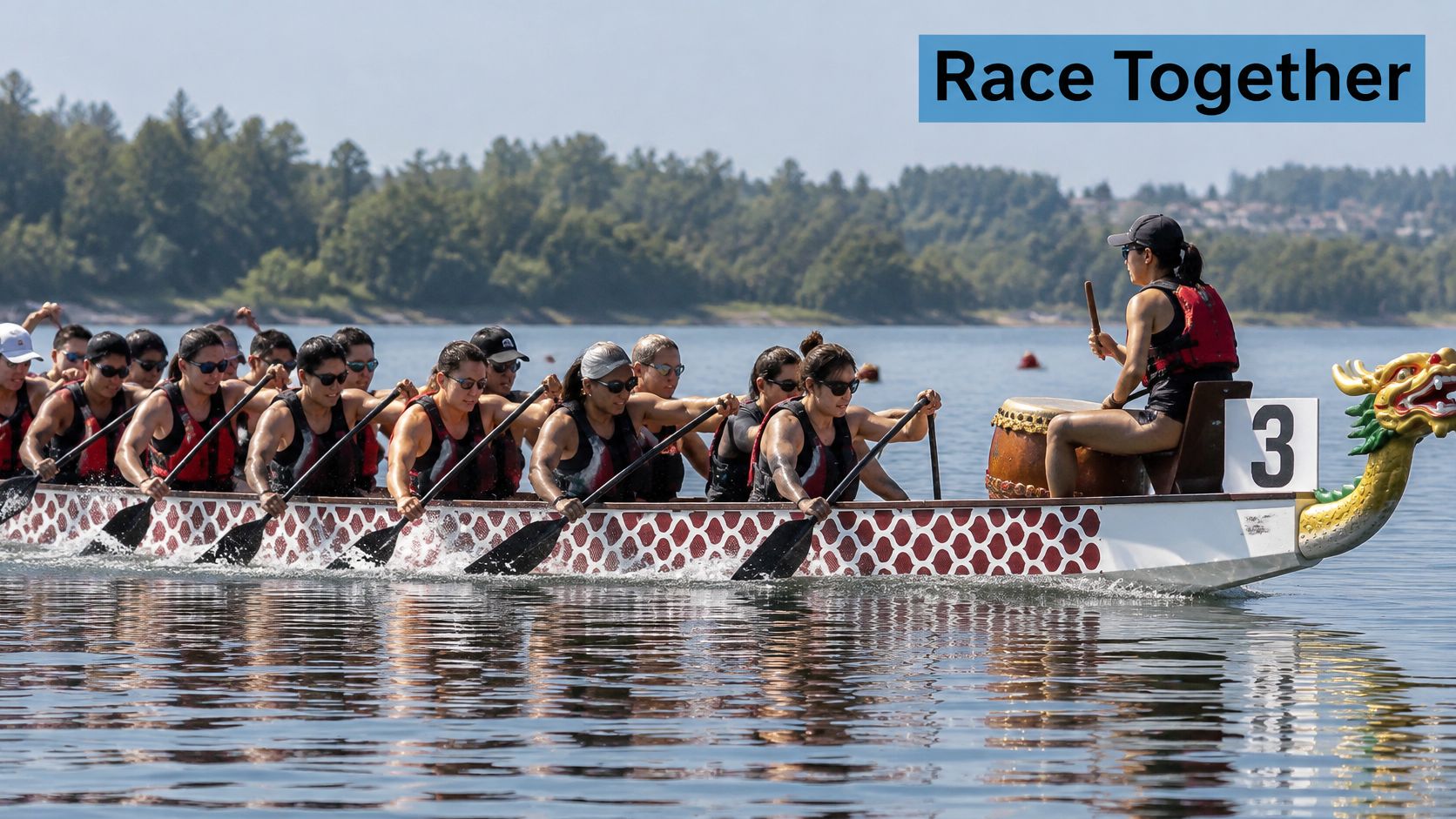
Dragon boat racing makes coordination visible. A crew that listens to the drummer and paddles together has a better chance of moving effectively than colleagues trying to overpower one another.
Best fit: Larger departments able to form crews of around 20 paddlers, with shore-based roles for others.
Venue: A managed lake, reservoir or suitable river event site.
Budget band: Higher, because specialist operation, safety cover and waterside facilities are central to the day.
A corporate charity race can combine a shared physical challenge with fundraising for a local cause. Build in coaching before the heats, and let the specialist operator determine boat capacity, participant suitability and operating conditions.
Make the shore experience worthwhile
Not everyone will want to paddle. Give supporters a comfortable viewing area, refreshments and a meaningful role in the event, without pressuring them to explain why they're staying ashore.
Don't sell a water-based day as universally accessible. Describe the activity honestly and give colleagues a worthwhile alternative.
The Health and Safety Executive's event-planning guidance identifies risk assessment as the key tool for matching safety arrangements to the event's scale, audience, location and activities. For this format, weather decisions, changing facilities, first aid and access to the water need attention before invitations go out.
The reward is a collective challenge. The compromise is greater weather exposure, specialist logistics and less freedom to improvise on the day.
8. Cookery Challenge

Food gives people an obvious reason to gather, but the format matters. A guided cookery session suits nervous beginners; a timed challenge suits a team that actively enjoys competition.
Planning match: A 15-person staff reward or a departmental group using separate workstations. Choose a culinary school, teaching kitchen or properly equipped catering venue. Budget band: Medium to higher, depending on ingredients, instruction and facilities.
For a lunchtime reward, teams could prepare complementary dishes and share the meal afterwards. A bake-off-style challenge also works, but avoid recipes that leave participants waiting around while everything is in the oven.
Put dietary planning ahead of judging
Collect dietary and allergen information privately, then agree suitable ingredients, workspaces and handling arrangements with the catering team. Don't promise an allergen-free experience unless the venue can support that claim.
- Support beginners: Provide clear recipes, demonstrations and labelled ingredients.
- Share the work: Include preparation, timing, presentation and washing-up roles.
- Judge fairly: Recognise collaboration and thoughtful use of ingredients alongside taste.
Keep the host's commentary friendly rather than turning mistakes into entertainment. A colleague who rarely cooks shouldn't feel they're auditioning for television.
Cookery combines the activity and meal, which can simplify the programme. Its limits are kitchen capacity, dietary complexity and clean-up time, so it's less flexible than a drop-in attraction at a large conference.
9. Corporate Volunteering Day
A volunteering day offers a meaningful alternative when colleagues would rather contribute than compete. Community gardening, park clean-ups and charity packing sessions can all work, provided the receiving organisation needs the help.
Best fit: A small office team working together, or a larger workforce divided across agreed tasks or sites.
Venue: A charity facility, community garden, public space or suitable workplace packing area.
Budget band: Low to medium, allowing for materials, transport, supervision and a contribution to the host organisation.
Start with the community partner's priorities, not a photogenic task chosen by the company. Business in the Community's workplace volunteering programmes, local charities and council-coordinated projects are sensible routes to explore.
Agree a useful, achievable job
A team might prepare community growing beds or pack requested supplies, then share lunch with the project organisers. Confirm the task, equipment, waste arrangements and supervision before staff arrive.
- Offer different roles: Include seated, administrative or sorting tasks where the project supports them.
- Fund the practical needs: Don't assume a charity can absorb the cost of hosting your workforce.
- Report truthfully: Share completed work and the partner's feedback without inflating the impact.
Volunteering isn't free entertainment. Staff release time, transport and coordination still need a budget, and some organisations can't use a large visiting group productively.
Keep photographs optional and get permission before featuring beneficiaries. The strongest outcome is useful work completed respectfully, with time afterwards for colleagues to talk about what they contributed.
How the company fun day ideas compare by group size, setting and budget
| Item | Best group size | Typical setting | Budget level | Best for |
|---|---|---|---|---|
| Racing Simulator Grand Prix | Small teams to hundreds | Conferences, exhibitions, corporate race days | Setup-dependent | Inclusive competition and team spirit |
| Flight Simulator Challenge | Individuals or pairs rotating | Corporate reward days, exhibitions, away days | Higher cost per participant | Memorable challenges and teamwork |
| Sports Simulator Tournament | Teams rotating between stations | Indoor sports days, staff rewards, fan zones | Equipment-intensive | Mixed interests and abilities |
| Giant Scalextric Race Night | Teams in head-to-head races | Exhibitions, family fun days, summer events | Setup-dependent | Easy-to-follow, nostalgic competition |
| Escape Room Team Challenge | Small teams, with parallel rooms for larger groups | Team-building days, product launches | Not specified | Collaboration and shared problem-solving |
| Urban Treasure Hunt | Teams | City centres, parks, venues, festivals | Low-cost | Exploration, fresh air and flexible team activities |
| Dragon Boat Racing | Teams of around 20 paddlers | Lakes, rivers, reservoirs | Logistics-intensive | Team cohesion and charity events |
| Cookery Challenge | Teams | Kitchens, culinary schools, staff reward events | Flexible | Social, inclusive team competition |
| Corporate Volunteering Day | Teams | Parks, community spaces, charity sites | Not specified | Purpose-driven teamwork and social impact |
Choosing the Right Fun Day for Your Team
Start with three questions: how many people are attending, what space and budget you have, and what outcome matters most, whether that's competition, collaboration or contribution. Shortlist two or three activities that fit those answers, then confirm logistics early, including power, floor space and dietary needs.
For a small office, an escape room, treasure hunt or cookery session can give everyone a shared experience without a complicated production schedule. For a large conference, simulators and Giant Scalextric work better as hosted attractions within a wider programme than as activities every delegate must complete together.
Budget for the whole event
Compare like with like when reviewing proposals. Equipment hire alone doesn't tell you the cost of venue access, transport, installation, staffing, catering or any additional power arrangements.
A low-cost activity can become expensive if it needs substantial internal planning. Equally, a staffed attraction may reduce the work your own team has to do during the event.
PSW Events is a Cambridge-based provider of sports, racing and flight simulators and full event management across the UK. We can help create site plans, arrange equipment delivery and installation, and manage staffing and the day's operation.
Confirm responsibilities before arrival
Write down who controls supplier access, opening checks, first aid, queues and weather decisions. The HSE's guidance on managing an event says organisers must coordinate work activities, provide relevant risk information, ensure staff are competent and monitor safety arrangements.
For larger corporate fun days, we arrange site visits and discuss site plans and event details during planning. Share the venue's loading arrangements, restrictions and programme early so the activity layout fits the building rather than competing with it.
Participation principle: Invite people into the day without making enthusiasm a test of loyalty.
Include comfortable seating, non-alcoholic refreshments and a quieter place to talk. Explain activity access and physical demands in advance, and make it clear that watching or choosing an alternative is acceptable.
Afterwards, ask whether people enjoyed themselves, met colleagues they don't usually speak to and would choose a similar event again. Review queues, unused activities and operational problems as well as the photographs. The best choice isn't necessarily the most elaborate attraction; it's the one your team can enjoy comfortably and your organisers can run properly.
PSW Events offers simulator hire, interactive entertainment and full event management for company fun days across the UK, including planning, installation and on-site staffing. Visit PSW Events to discuss your attendance, venue and preferred activities, and build a programme that fits your team.