
You're eight weeks out from a 250-guest product launch, the venue is in the Midlands, and the floor plan is already fighting for space. The client wants something more memorable than a photo booth, more active than a beer wall, and less intrusive than a DJ. An arcade racing machine looks promising, but only if it earns its footprint, keeps queues moving, and doesn't create a compliance problem.
The questions are practical. Which cabinet fits through the venue access route? How many guests can play in an hour? What does a single-day hire really involve beyond the machine rate? Does the activation need an attendant? Will the venue accept the power, noise, vibration and insurance requirements? And does a prize mechanic bring the Gambling Act 2005 into play?
A racing cabinet can work brilliantly for exhibitions, launches, awards evenings and fan zones. It can also become an expensive obstacle that attracts a queue, blocks sightlines and produces little useful engagement. The difference comes from planning the cabinet as an activation tool, not treating it as a novelty.
Planning an Arcade Racing Machine for a UK Activation
The Midlands planner starts with the wrong question if the conversation begins with, “Can we fit a racing game in?” The useful question is, “What job must this attraction do on the floor?” If the launch needs fast participation between product demonstrations, an upright cabinet may outperform a premium simulator. If the brief depends on guests lingering, competing and sharing footage, a sit-down rig or motion platform may justify the slower turnover.
Start by writing the intended guest behaviour into the brief. Is the machine there to pull people towards a stand, create a branded photo opportunity, support a competition, or give invitees a reason to stay after the presentation? Each objective changes the suitable format, staffing model and layout.
Make the floor plan answer first
Request the venue drawing before requesting a supplier quote. Mark the cabinet position, queue line, operator position, power route, spectator area and access path. A machine that technically fits may still fail if guests need to stand behind it, turn around it or wait beside a busy catering route.
Ask the supplier for the assembled footprint, not the boxed transport dimensions. Confirm doorway clearance, lift dimensions, ceiling height, floor loading and the route from vehicle to event space. For a marquee or older building, ask whether the access route includes thresholds, ramps, narrow doors or fragile flooring.
Practical rule: If the supplier can't provide an installation drawing and a clear access plan, you don't yet have a usable quote.
Decide what success looks like
A racing activation needs a simple measurement plan. Track participation, repeat plays, competition entries, qualified conversations or captured leads, depending on the client's objective. Don't claim that a simulator will automatically generate better engagement than a photo booth. Give it a defined role and judge it against the role.
The UK arcade story helps explain why these machines remain recognisable. British amusement venues were built around mechanical, electro-mechanical and pinball machines before video games changed the market. Pong appeared in 1973, and UK arcade-history coverage records that Space Invaders had sold 85,000 arcade cabinets in the United Kingdom by 1979. Racing games were already present in British venues by the late 1970s, and the category became more immersive as sit-down cabinets and sprite scaling developed. Sega's Out Run, released in 1986, became a landmark arcade racer, as described by Square1's UK arcade machine history.
That history matters commercially because guests understand the invitation immediately. They don't need a long explanation before taking the wheel. Your planning responsibility is to make sure the machine's operating model supports the event rather than competing with it.
What Counts as an Arcade Racing Machine
An arcade racing machine is a public-facing racing attraction built for quick, approachable play. The label covers several very different products, so read the hire quote carefully rather than relying on the headline description.
Identify the format on the quote
The first format is the upright or cockpit-style arcade cabinet. It normally combines a screen, steering wheel, pedals, controls and game hardware in one branded enclosure. These machines are recognisable, visually strong and comparatively straightforward to position at a trade show or reception.
The second is a sit-down driving rig. It uses a dedicated seat, steering wheel, pedals and screen, often with a more convincing driving position than an upright cabinet. The rig may run a console-style racing title or a simulation platform. It's a better fit where the experience needs to feel like an activity rather than a quick button press.
The third is a motion-enabled racing simulator. This may combine a hydraulic or electromechanical platform with a cockpit, multiple screens or a VR headset. It creates a stronger sense of immersion, but it also brings greater requirements for floor space, operator control, safety documentation, setup time and queue management.
Don't confuse any of these with a generic racing video game on a television, a quiz terminal, or a prize-redeeming amusement machine. The visible theme may be similar, but the hardware, staffing, venue treatment and compliance position can differ.
Use the right terminology when briefing suppliers
Ask whether the quote covers the cabinet, game licence, branding, delivery, installation, operator, competition software, scorekeeping and removal. Ask whether the machine is free-play or coin-operated. Ask whether the supplier controls the game settings and whether internet access is required.
A client looking for broad participation may not need a full simulator. A smaller event with a strong motorsport identity may value cockpit realism more than raw throughput. If the brief includes several non-racing attractions, a carnival game rental bundle can help you compare the racing unit with other interactive formats rather than evaluating it in isolation.
The cleanest brief describes the intended guest experience first, then the format. “Branded sit-down racing experience for an awards reception” is useful. “One arcade racing machine” isn't enough.
Cabinet and Rig Types Compared
The cabinet format determines the basic trade-off between throughput, immersion and production complexity. Upright machines are usually the efficient choice when guests have limited time. Sit-down rigs suit longer participation. Motion platforms make sense when the experience itself is the headline attraction.
Match the machine to the event pattern
An upright cabinet works well on a busy exhibition stand where the play needs to be understood quickly and reset without much intervention. It's visible from a distance and can sit beside a host, lead scanner or product demonstration. Keep the competition simple. A best-lap leaderboard is easier to explain than a multi-stage tournament.
A sit-down rig works better at an evening awards event, client reception or team-building session. Guests can watch the driver, comment on the race and take turns without feeling rushed. The seat also creates a natural boundary, which helps an attendant manage the experience.
A motion platform or triple-screen rig belongs in a premium launch, motorsport tie-in or sponsor experience where dwell time and visual impact matter more than rapid cycling. It can generate compelling footage, but you'll need to control access, explain the experience and plan for guests who may not want intense movement or VR.
The PSW Events racing simulator hire service illustrates the kind of supplier detail planners should look for, including whether the provider handles the simulator experience as an event service rather than dropping off equipment.
Shortlist with the commercial pattern in mind
The table uses planning bands, not guaranteed market prices. Suppliers price by specification, branding, transport distance, staffing, date, venue and production complexity, so obtain a written quote before putting a figure in a client budget.
| Format | Footprint (W x D) | Throughput (plays/hr) | Indicative UK Hire (per day) | Best-fit event |
|---|---|---|---|---|
| Upright cabinet | Confirm assembled dimensions | High for short plays | Supplier quote required | Trade show, launch, public activation |
| Sit-down rig | Confirm cockpit and queue footprint | Medium for timed races | Supplier quote required | Awards evening, reception, team building |
| Motion platform | Confirm platform, screens and safety zone | Lower for longer experiences | Supplier quote required | Premium launch, sponsor experience, motorsport tie-in |
Don't use the table to promise capacity. Use it to identify what needs validating. Require the supplier to state the assumed play duration, reset time, staffing level and competition format. Throughput is a production variable, not a permanent property of the cabinet.
Specs That Actually Matter for Event Planners
Supplier brochures often lead with graphics and game titles. Planners need to translate those features into venue decisions.
Start with dimensions and access
Ask for the assembled width, depth, height and weight, followed by the packed dimensions. An upright cabinet may pass through a standard route while a motion platform arrives as separate sections and needs assembly in the event space. A triple-screen rig can also create a wide visual footprint beyond the cockpit itself.
Ceiling height matters in exhibition halls, marquees and historic venues. Ask the supplier a direct question: Will the fully assembled rig clear the lowest point on the route, including door closers, lighting bars and venue signage?
| Spec | Upright Cabinet | Sit-Down Rig | Motion Platform |
|---|---|---|---|
| Space decision | Cabinet plus queue | Cockpit, seat movement and spectator zone | Platform, screens, safety clearance and queue |
| Height question | Will it clear the access route? | Does the seat and display suit the room? | Will the full assembly clear doors and ceiling features? |
| Power question | Is the venue supply suitable? | Are wheel, display and computer loads covered? | Does the supplier need dedicated provision? |
| Guest experience | Fast, accessible entry | More immersive seated play | Highest immersion, with more supervision |
| Planning risk | Congestion around the cabinet | Queue and transfer space | Vibration, motion, VR and operating controls |
Treat performance specifications as experience controls
A racing wheel with weak force feedback can feel like a toy, while a stronger wheel can make the driving interaction feel credible. Ask the supplier to describe the wheel system in plain terms and explain how it behaves for casual players, not just experienced sim racers.
Display latency matters when the event is competitive. For a serious timed format, ask whether the display chain is under 20ms, then confirm the supplier's measurement method and configuration. A fast-looking screen won't solve poor input settings or an unstable computer.
Audio spill can become a problem in hotel ballrooms and conference halls. Request volume limits, headphone options and a plan for announcements. HDMI pass-through can support sponsor branding, lap-time overlays or a secondary display, but confirm exactly what signal the supplier can provide and who supplies the content.
Power planning must be based on the supplier's actual equipment list. Don't assume a standard socket is adequate for every motion or multi-screen setup. Ask for the total load, plug arrangement, cable lengths and whether the venue's production team must provide dedicated circuits.
UK Compliance and Venue Rules
The first compliance question is whether the machine is being used for free play, paid play, prizes or gambling. A racing cabinet used as a free attraction at a private corporate event may have a different position from a machine that accepts stakes or awards a prize through a regulated mechanism.
Under the Gambling Act 2005, a gaming machine is equipment designed or adapted for individuals to gamble, and the Secretary of State can regulate the circumstances in which it's made available. The Gambling Commission's technical standards cover operation, notices, metering and other controls for relevant licensed machines. They aren't a product-quality score.
Separate venue classification from cabinet style
UK arcade-style premises include Adult Gaming Centres, which are for over-18s, Unlicensed Family Entertainment Centres, which need a permit from the local licensing authority, and Family Entertainment Centres, which can offer an unlimited number of certain gaming machines to all ages, as outlined by the Gambling Commission's arcade guidance.
That classification is about the premises and machine use, not solely whether a cabinet looks like an arcade game. A free-play racing simulator at a corporate event isn't automatically equivalent to a prize machine in an arcade. However, adding staking, prize pools or gambling functionality can change the assessment, so put the mechanic in writing before the quote is approved.
Category D examples show how tightly the law can define machine mechanics. A UK regulation guide describes crane grab machines with a maximum £1 stake and up to a £50 non-monetary prize, while coin pusher or penny fall machines can take up to 20p with a maximum £20 prize. Those rules concern the relevant machine categories, not every racing cabinet, but they demonstrate why “it's only a game” isn't a sufficient compliance analysis. See the UK amusement machine regulation guide when comparing prize mechanics.
Your event file should include the supplier's compliance statement, risk assessment, electrical records, insurance evidence and game configuration. Venue teams may add requirements for listed floors, vibration, fixings, load distribution and public access. The Gambling Commission's testing and technical standards approach also means material hardware or software changes need proper change control before deployment.
Hire Versus Buy and Long-Term Rental
For most corporate planners, short-term hire is the sensible default. It keeps the machine, servicing, storage and software responsibility with the supplier. You pay for the activation you're running, not for an asset that may spend most of its life in a warehouse.
Long-term rental becomes more compelling when a venue has a repeatable programme, such as weekly racing nights, seasonal attractions or a permanent entertainment offer. The contract should define servicing, breakdown response, replacement equipment, game updates, branding changes, insurance responsibility and end-of-term removal.
Outright purchase suits an operator with secure storage, technical capability and predictable utilisation. An upright cabinet may begin in the four-figure range, while motion rigs can reach five figures, but those are only broad capital bands. Treat them as a starting point for supplier discussions, not as a quote. The purchase case must also include transport, PAT testing, insurance, maintenance, software licensing and the cost of staff time.
Compare the commercial routes
| Factor | Short-Term Hire | Long-Term Rental | Outright Purchase |
|---|---|---|---|
| Capital commitment | Low | Spread across the contract | Highest at acquisition |
| Storage | Supplier manages it | Usually agreed in the contract | Buyer must provide secure storage |
| Maintenance | Supplier responsibility | Contract-dependent | Buyer responsibility |
| Flexibility | High for one-off briefs | Moderate | Lower once equipment is owned |
| Best use | Launch, exhibition, reception | Recurring venue programming | Permanent arcade or frequent roadshow |
| Main risk | Day rate, transport and staffing exclusions | Contract terms and utilisation | Underuse, repairs and asset logistics |
For storage, event suppliers may need a dedicated facility rather than a domestic garage. A service such as Admiral's Yard market trader storage is relevant because the storage brief includes access, security and handling, not just empty floor area.
Use arcade game rental services as a comparison point when building a hire shortlist. Ask every provider for a total delivered cost.
Use a simple break-even test
Choose short-term hire for a one-off corporate event, product launch or exhibition. Choose long-term rental when the venue has scheduled programming and wants predictable servicing. Consider purchase only when the equipment will support a permanent floor, repeated roadshow dates or a reliable internal booking pipeline.
A roadshow may still favour hire because transport, handling and regional support can outweigh the apparent value of ownership. The cheapest machine is not the cheapest activation if your team must arrange every delivery, repair and compliance document.
Staffing, Safety and On-Site Delivery
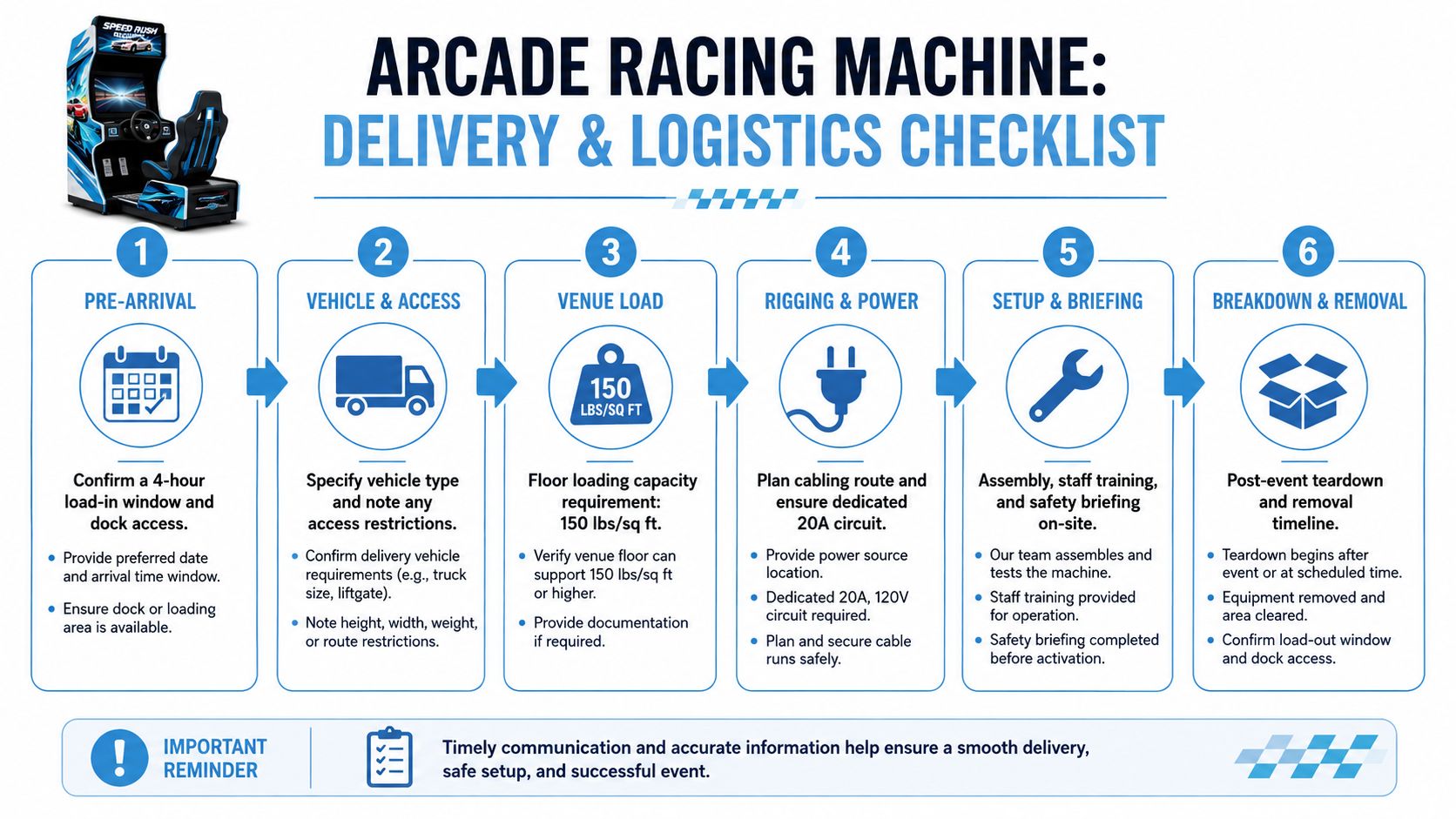
A racing machine needs a delivery plan, not just a booking time. Start with the venue's load-in window, loading bay rules, vehicle restrictions, lift access and route to the floor. Confirm whether the cabinet arrives assembled or in sections, who protects the venue flooring, and where cases will stay during the event.
A dedicated attendant is usually worthwhile for a competition, premium activation or motion rig. The attendant resets the game, explains controls, manages the queue, records scores, watches for unsafe use and keeps the attraction presentable. A roaming host can work for a quiet reception, but they're a poor substitute when the machine is central to lead capture or has moving hardware.
Build the queue around the play format
The supplier should state the assumed play duration, reset process and maximum safe operating pattern. Use visible signage to explain eligibility, race length, scoring and prizes before guests reach the seat. For a head-to-head experience, allow space for spectators without blocking the operator or emergency routes.
The venue will normally want evidence of electrical inspection, suitable equipment marking, public liability cover, a pre-show risk assessment and a method statement where motion, VR or complex assembly is involved. Confirm the supplier's insurance level against the venue contract. The client brief mentions £5m to £10m public liability as a working benchmark, but the required level is set by the venue, organiser and risk profile, so don't present that range as universal.
Installation requirements for event attractions should be checked against the venue's technical pack. Floor loading, cable covers, vibration, noise and fixings need written approval where the building or event rules demand it.
Make access and safeguarding operational
A sit-down machine can offer seated play, but the seat height, transfer route, steering position and pedal arrangement still need checking. Provide step-free viewing where possible, keep cables covered, and consider whether instructions, signage or an induction loop arrangement need adapting for the audience.
For school or family audiences, confirm operator training and safeguarding arrangements, including DBS checks where the client or venue requires them. At close, the attendant should save competition data, power down in the supplier's sequence, secure removable equipment, remove branding and record any damage before the venue handover.
A Practical Checklist for Your Next Brief
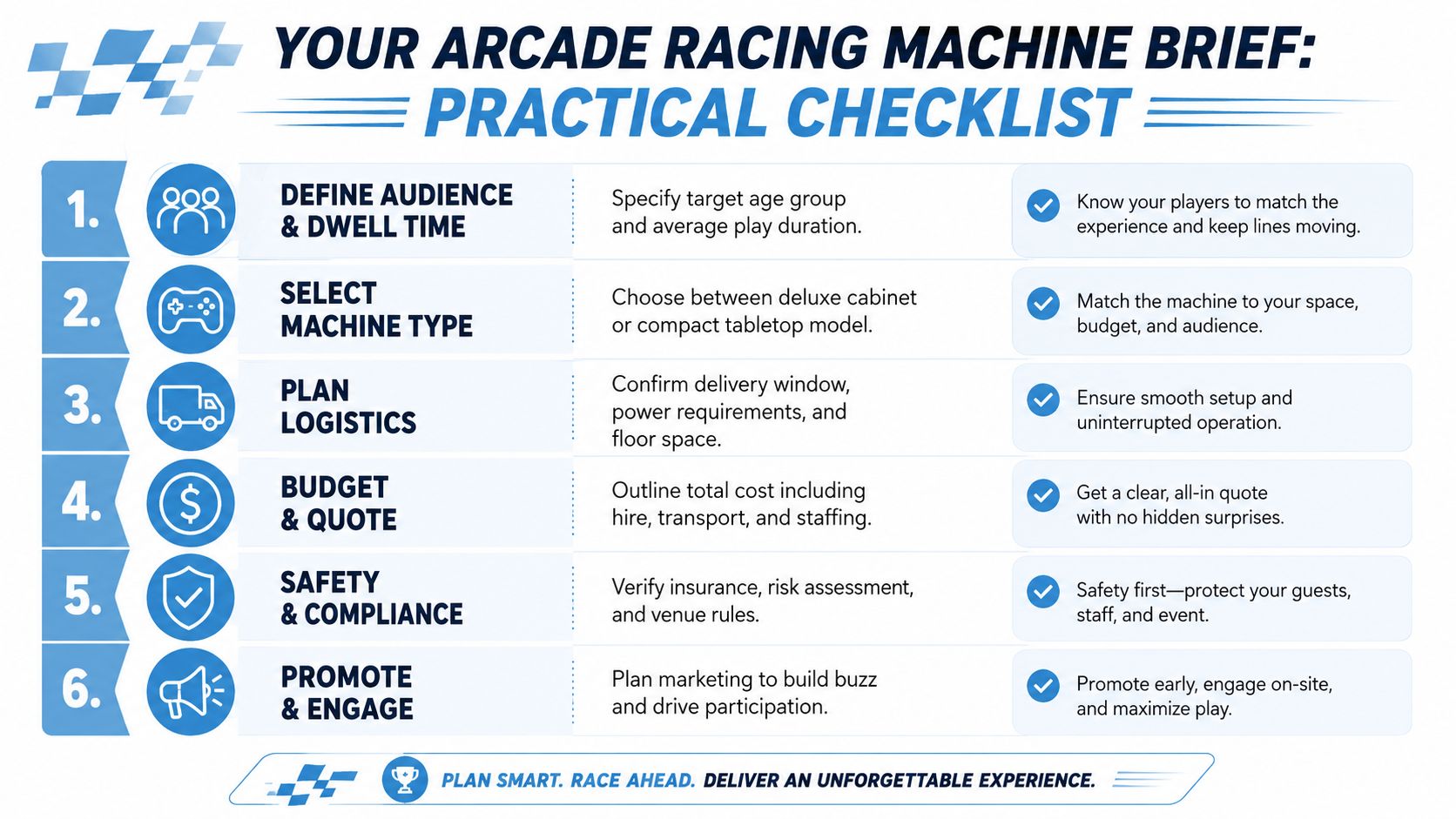
Run the brief in this order. Each decision should produce a clear pass or fail, not another vague action point.
Define the audience: Write down the target age group, accessibility needs and expected dwell time. Pass only when the machine format matches the audience's willingness and ability to participate.
Set the activation job: Choose one primary outcome, such as footfall, lead capture, competition entries or guest entertainment. Pass when the supplier can explain how the machine supports that outcome.
Select the format: Choose an upright cabinet, sit-down rig or motion platform. Pass when the choice reflects the required throughput and experience depth, rather than the most impressive brochure image.
Confirm the venue: Obtain the assembled footprint, height, weight, access route, floor-loading requirement, power details, noise limits and cable plan. Pass only when the venue's technical contact approves the installation information.
Lock the compliance position: Confirm free play, paid play, prize mechanics, age controls and any Gambling Act implications. Pass when the supplier and venue agree how the machine will operate.
Choose the commercial model: Compare delivered hire, long-term rental and ownership against the event pattern. Pass when the quote includes delivery, setup, staffing, removal, insurance responsibilities and any branding costs.
Approve the operating plan: Name the attendant, queue manager, lead-capture owner and venue contact. Pass when someone is responsible for every live part of the activation.
File the safety documents: Collect insurance evidence, electrical records, risk assessment, method statement and venue-specific approvals. Pass only when the production file is complete before load-in.
For a single-cabinet evening reception, the checklist will usually resolve to a sit-down or upright machine, a simple free-play format, one trained attendant, controlled audio and a delivered hire quote. The priority is reliable participation without turning the room into a gaming floor.
For a multi-rig brand activation, the answer may be several matched racing stations, branded scoring, a dedicated queue host, stronger power planning, lead capture and a documented competition format. The cost band rises with the number of units, staffing, branding, transport and technical production, so the budget should be built from the complete delivered package rather than a cabinet day rate.
PSW Events provides racing simulator hire, F1 simulator experiences, Giant Scalextric, delivery, branding, installation, staffing and health and safety support for UK corporate activations. Visit PSW Events with your venue, guest profile and event date to discuss a practical arcade racing machine specification.