
You’re probably in one of two situations right now.
Either you’ve got an exhibition stand, conference breakout area, or client activation to fill, and the brief says the same thing it always says: make it interactive, make it memorable, and make sure it drives conversations rather than just attracting people who want freebies.
Or you’re planning an internal event and you need an activity that feels more current than a quiz, more social than a VR headset, and more commercially useful than a novelty game that people try once and forget.
That’s where the American football simulator becomes interesting for UK planners. Not because it’s trendy for its own sake, but because it sits in a useful middle ground. It’s physical, visible, competitive, easy to understand from the outside, and distinctive enough to cut through a crowded event hall.
Why American Football Simulators Are Your Next Big Event Hit
A lot of planners still default to the obvious sports themes. Football, racing, golf. They work, but they also blend in. If you’re trying to create stand-out at a trade show or give a brand activation a sharper identity, “safe” can become forgettable very quickly.
American football is different in the UK because it still feels fresh. That matters. According to research on the UK event opportunity for American football simulators, 'NFL UK' searches increased by 45% in 2025, London Games attendance reached 85,000, yet only 12% of experiential activations featured American football sims compared with 38% for soccer. The same source also notes that interactive sports simulators can increase dwell time by 27% and lead capture by 19%.
That combination is what gets marketers interested. Growing audience demand, but low activation saturation.
A crowded hall rewards difference
On a busy exhibition floor, people don’t stop because a stand says “book a demo”. They stop because something is happening. An American football simulator creates exactly that kind of visible activity. Someone’s throwing, other attendees are watching the screen, colleagues are comparing scores, and your stand suddenly has energy around it.
That energy is useful because it does three jobs at once:
- It attracts footfall: motion and competition draw attention from a distance.
- It holds people longer: a score challenge gives people a reason to stay.
- It creates a reason to talk: your staff have a natural opening line that isn’t forced.
It also solves the “we’ve done this before” problem
Many clients ask for “something interactive” but then shortlist the same formats everyone else is using. If you’ve already explored selfie stations and want a more participatory option, this guide to an Alternative to photobooths is useful because it frames the broader question properly. The core issue isn’t replacing one novelty with another. It’s choosing an attraction that gives people a reason to engage with your brand.
Practical rule: If an activity only produces a photo, it’s decorative. If it creates a queue, a score, and a conversation, it becomes commercially useful.
For UK corporate planners, the missed opportunity is straightforward. NFL interest is rising, but most brands still treat American football as too niche, too American, or too specialist for local audiences. In practice, that hesitation works in your favour. It means the format still feels unexpected.
What Is an American Football Simulator
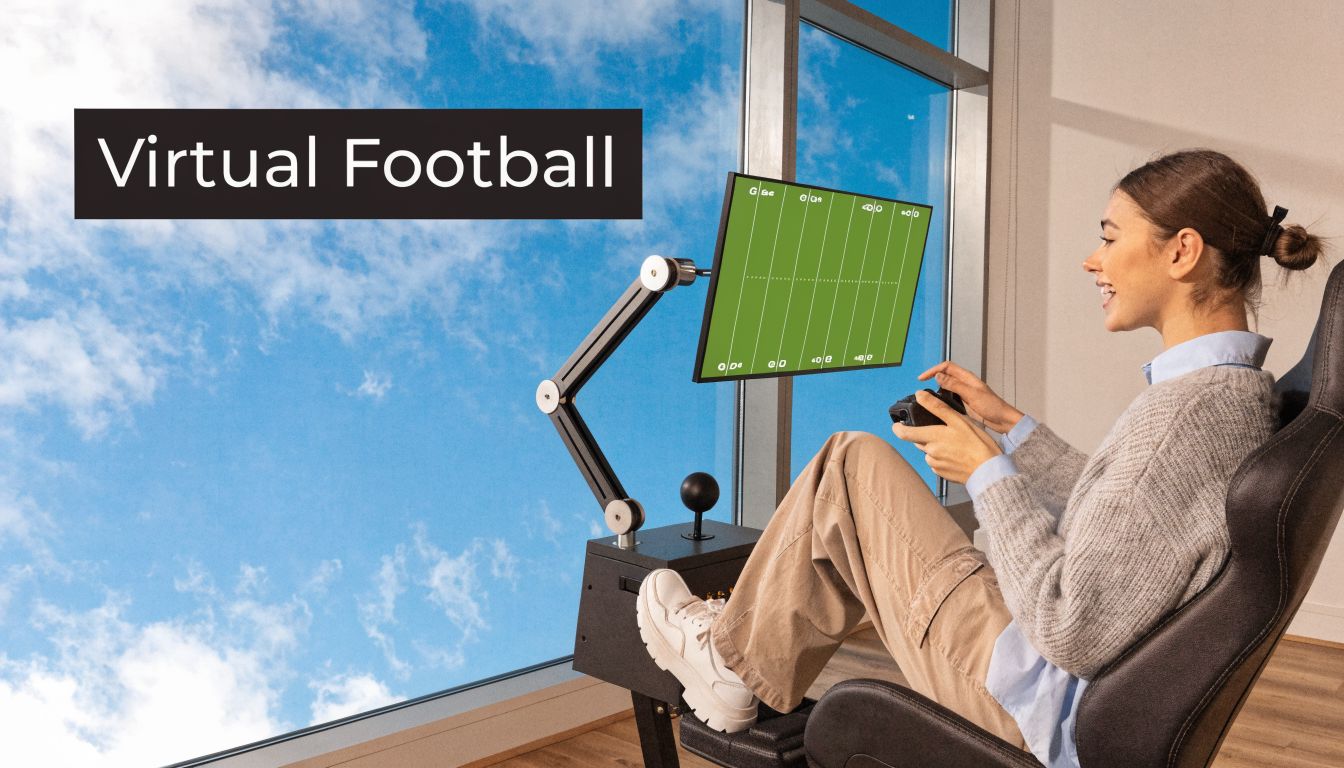
At its simplest, an American football simulator is a live, physical game that turns real player movement into an on-screen football challenge.
Think of it as a high-tech version of a fairground throwing game, but with much better feedback, stronger visuals, and a lot more competitive depth. Instead of tossing a ball at a static target and walking away, players make throws, dodge, react, and watch those movements translated into a virtual football environment on a large display.
What the player actually does
Some event planners get the wrong idea. They assume the experience is basically a console game in a nicer cabinet. It isn’t.
The participant usually performs a real action. They might throw a football, aim at a target area, or react physically to movement prompts. The system captures that input and turns it into a digital result. On screen, the player sees the pass attempt, the route, the defender response, and the outcome.
That physicality is what makes it work at events. Spectators understand it instantly.
What makes it different from a normal game station
A standard gaming setup is private. One person plays while everyone else struggles to see what’s going on. An event simulator is public by design. The screen is large, the challenge is easy to follow, and the competitive result is visible.
A few practical points help define it:
- It’s built for shared spaces: trade shows, conferences, family days, fan zones.
- It’s easy to approach: guests don’t need prior NFL knowledge to enjoy a throwing challenge.
- It feels active: that matters when you want the stand to look busy and inviting.
The experience can also be adapted for different event goals. Some activations lean into branded accuracy challenges. Others focus on timed scoreboards or head-to-head play. If you’re reviewing options for American football simulator hire, that’s usually where the specification discussion starts. Not with jargon, but with the question, “What do you want attendees to do, and what do you want your team to measure?”
Most confusion disappears once planners stop thinking “video game” and start thinking “interactive sports attraction”.
Why the format travels well in the UK
It doesn’t require attendees to understand every NFL rule. They don’t need to know what a nickel defence is or when to go for it on fourth down. They just need a clear challenge and a visible score.
That’s why the format works for mixed audiences. Serious sports fans enjoy the theme. Everyone else enjoys the action.
How Modern Football Simulators Work
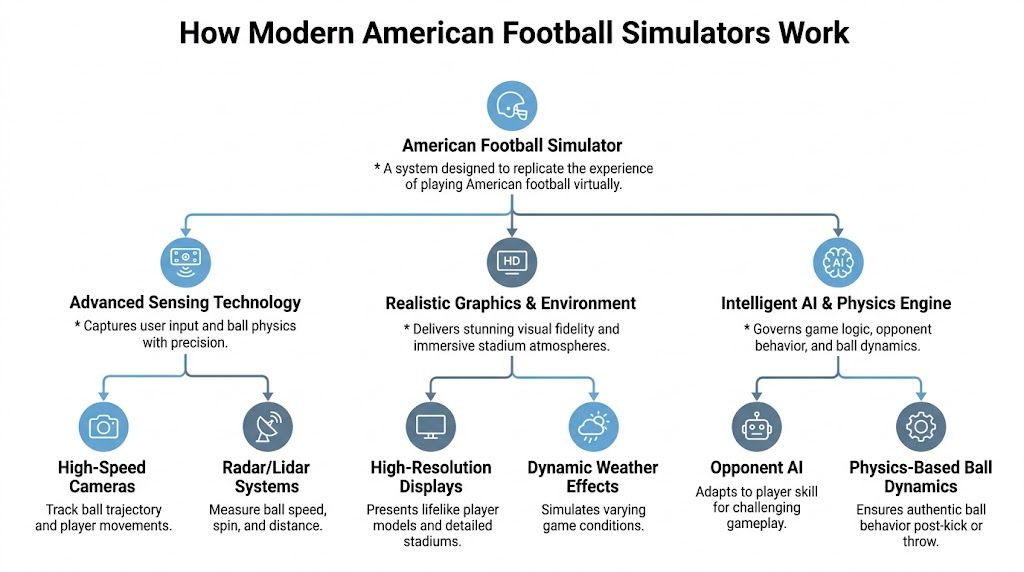
The reason a good simulator feels convincing isn’t one single piece of kit. It’s the way several systems work together. Sensors capture what the player does. Software interprets it. Graphics and physics turn that input into a believable football outcome.
Here’s the technology in a simple visual form.
Sensing the player’s movement
A modern American football simulator uses motion-capture technology to understand what the participant is doing. Verified deployment data describes systems using infrared cameras and depth sensors, similar in concept to Kinect or Intel RealSense, tracking movement at 120 to 240 FPS. That level of tracking supports actions such as dodging and throwing with responsive feedback in event environments, as outlined in the technical benchmark summary for football simulator systems.
For a planner, the useful takeaway is simple. The simulator isn’t guessing. It’s reading motion quickly enough that the player feels a connection between what they did and what appeared on screen.
That matters because delayed or vague feedback kills credibility. If someone throws and the on-screen result feels disconnected, the attraction stops feeling premium.
Translating motion into game logic
The next layer is the software. The simulator takes movement data and applies rules, ball behaviour, and game outcomes to it. That includes things like throw direction, velocity, timing, and whether the player completed the objective.
Some systems also use physics engines to make outcomes feel natural rather than scripted. If the throw is off, it should look off. If the player reacts too slowly, the result should reflect that.
This is one of the big differences between a polished simulator and a gimmick. Better software creates believable cause and effect.
Why the realism isn’t random
There’s another piece that often gets overlooked. Strong football simulators don’t just look realistic. Their underlying logic can be informed by real football data.
A verified machine learning study on American football simulation found that a point spread model achieved 82.79% accuracy in explaining variation in point spreads based on six key in-game statistics, and when tested on 2014 NFL games using actual in-game statistics, it predicted the winner approximately 86% of the time. Those models were trained on three years of historical NFL data and validated against an additional year, according to the American football simulation research paper.
That doesn’t mean your exhibition game is running a betting model. It means the wider simulation field has demonstrated that football outcomes can be modelled with meaningful accuracy, which supports the credibility of data-driven gameplay.
The best event simulators feel authentic because the sport itself is structured enough to simulate well.
Rules still matter, even at events
Another reason these experiences are engaging is that they inherit the logic of the sport. The official structure of American football is rule-based and strategic. A game lasts 60 minutes, split into two 30-minute halves and four 15-minute quarters. Teams need to advance 10 yards within four downs, or possession changes. That rule framework underpins how football simulation tools are designed, as described in the Football Simulator manual.
For event use, you’re not asking attendees to play a full match. You’re borrowing the sport’s logic so the challenge feels purposeful rather than arbitrary.
The practical stack behind the scenes
For a corporate event planner, it helps to think in three layers:
- Capture layer: cameras and sensors read movement.
- Processing layer: software interprets the action and applies physics or game logic.
- Display layer: the screen shows a result that the player and the crowd can follow.
If those three layers are balanced, the simulator feels smooth, competitive, and premium. If one fails, attendees notice immediately.
Unlocking Engagement Benefits for Your Event
A good event attraction does more than entertain. It gives people a reason to stop, a reason to stay, and a reason to speak to your team.
That matters even more in the UK right now. Interest in the NFL has grown well beyond a niche audience, but many corporate activations still treat American football as if it only belongs at US-themed events. For a UK planner, that creates an opening. You can use a familiar but still distinctive format to stand out on a crowded exhibition floor or add energy to a conference agenda without asking guests to learn a complicated activity.
It attracts attention in a way static stands cannot
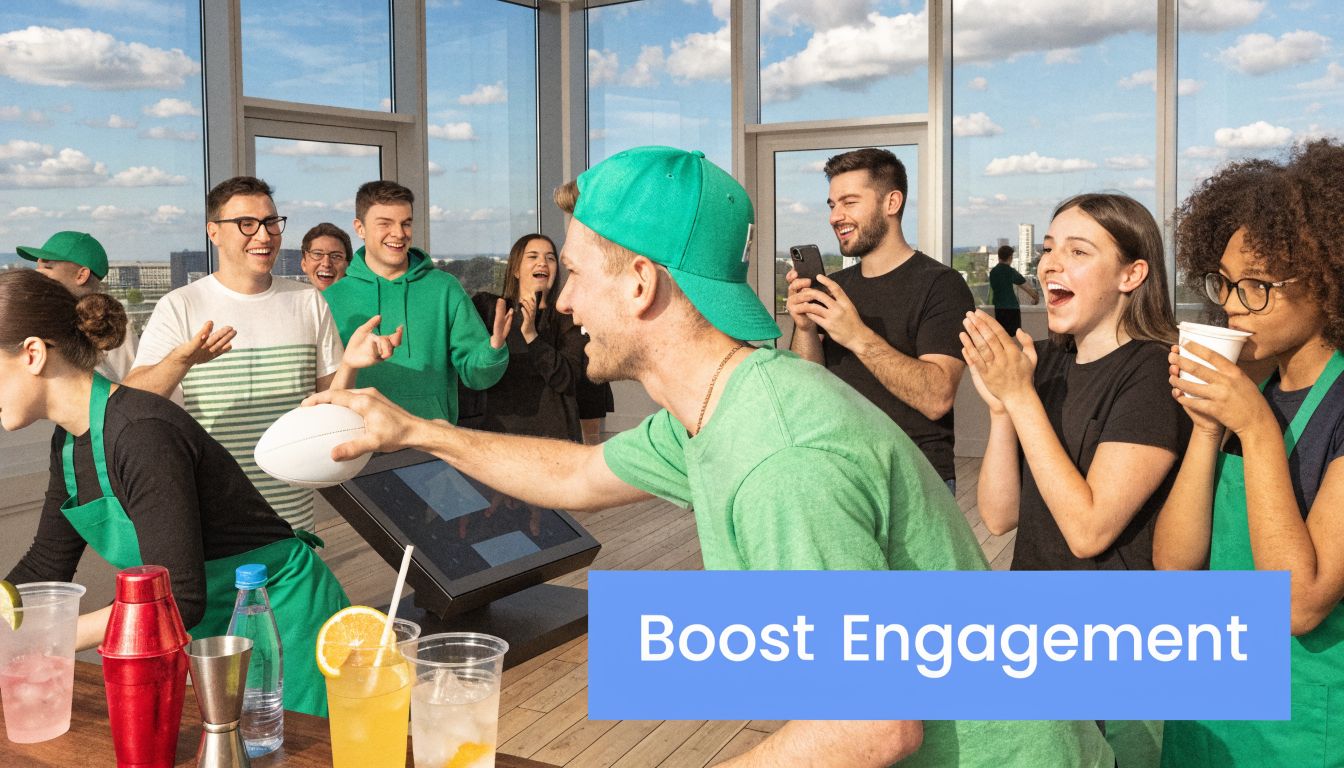
At exhibitions, attention starts with movement. A person steps up, throws, and waits for the score. People nearby can follow what happened immediately, even if they know very little about the sport. That is why this format often works better than passive screens or product plinths. It creates a live moment people can understand from a distance.
The business value is simple. More people pause. More people watch. Your team gets more natural openings to start conversations.
For UK brand teams trying to connect with clients, prospects, or staff, that matters more than novelty alone. A simulator gives your stand a visible focal point without making the brand experience feel childish.
It increases dwell time because people want another go
The challenge is easy to grasp. Throw accurately. Beat the score. Try again.
That simplicity is useful at busy events because it reduces hesitation. Guests do not need a long briefing, and they do not feel embarrassed if they have never held an American football before. They can join in quickly, then decide whether to turn one attempt into a friendly competition.
The practical application of good staffing makes a measurable difference. An experienced operator keeps the queue moving, explains the challenge in a few seconds, and turns a single throw into a branded interaction. For larger activations, specialist event staffing support helps protect that flow and keeps the experience polished during peak periods.
It gives groups a shared objective
Some activities work well for one person but create dead time for everyone else. A football simulator usually does the opposite. Even while one guest is playing, colleagues are watching, reacting, comparing scores, and deciding who is up next.
That group dynamic is useful for corporate events because it supports more than one objective at once. It can break the ice between clients and sales teams, give conference delegates a mental reset between sessions, or add structure to team-building without forcing anyone into a high-pressure format.
In practical terms, it works like a short skills challenge rather than a full sports lesson. That is why it suits mixed audiences. Competitive guests can chase the leaderboard. Less confident guests can still take part without feeling out of place.
It fits different event formats without losing purpose
The same simulator can support different goals depending on how you frame it.
At a trade show, it gives your stand team a conversation starter and a clear route into lead capture. At an internal event, it adds energy and encourages departments to mix. At a client hospitality event, it gives people something more substantial than a novelty side game, especially during arrival periods or networking breaks.
For UK planners, the framing matters. Position it as a quick, competitive challenge with broad appeal, not as an experience only NFL superfans will understand. That keeps participation high and removes the fear that guests need specialist knowledge to enjoy it.
On site advice: Use simple language on signage and in the staff script. “Step up, throw, and get on the leaderboard” works better than heavy NFL jargon.
Spectator appeal adds value around the activation
One of the biggest advantages is that the crowd gets involved too. People can read the result instantly, celebrate a strong score, and anticipate their own attempt. That creates energy around the footprint rather than trapping the experience on a single screen.
For a marketing manager, that spectator value is not a nice extra. It is what helps the attraction earn floor space and budget. A busy stand signals relevance. A visible queue signals interest. A shared moment gives your team more chances to start the right conversation at the right time.
The strongest results come when the simulator is planned as part of the event strategy, with a clear role in engagement, lead capture, and brand memory.
Event Logistics From Space to Staffing
Planners usually like the idea of an American football simulator long before they’re comfortable with the logistics. That’s normal. The practical questions are the ones that decide whether an attraction feels easy to approve or unnecessarily risky.
The good news is that simulator logistics are usually straightforward when the supplier is used to venue work.
What you need to check first
The first question is space. Verified guidance for UK simulator setups recommends positioning in 3 x 4 metre spaces for trade-show style deployment, according to the American football simulator hire guidance. In real planning terms, that means you need enough room not just for the equipment, but for the player zone, operator space, and a small spectator cluster.
Then check power and access. Most corporate venues can accommodate simulator equipment without drama, but the supplier should confirm socket requirements, loading access, set-up windows, and whether the display needs a clear sightline from a main aisle.
Staffing matters as much as floor space. A trained operator doesn’t just manage safety. They keep the queue moving, explain the challenge properly, and make sure the activation doesn’t lose momentum during busy periods.
Simulator hire at a glance
| Requirement | Specification | Notes |
|---|---|---|
| Space | 3 x 4 metres | Allows for equipment, player movement, and basic spectator flow |
| Player format | 1 to 2 players | Useful for head-to-head play and paired participation |
| Session style | Short turns | Better for throughput and repeat attempts |
| Staffing | On-site operator recommended | Helps with safety, briefings, queue management, and energy |
| Venue type | Usually indoor-first | Check access, sightlines, and flooring in advance |
| Connectivity | Sometimes useful for leaderboards or updates | Confirm if internet access is required for your chosen setup |
| Compliance | Professional supplier should handle risk paperwork | Ask for RAMS, PAT status where relevant, and insurance documents |
Safety and operator support
One of the easiest mistakes is assuming a simulator is self-running. It isn’t. Even a simple, polished setup performs better with human support.
A staffed attraction typically delivers better event outcomes because the operator can:
- Keep instructions short: guests join faster when the challenge is explained clearly.
- Adjust the pace: busy floor, slow floor, or VIP moment all need slightly different handling.
- Manage safe use: especially important with physical movement and repeated play.
- Protect the brand experience: the stand always looks organised.
For organisers that need support beyond the equipment itself, dedicated event staffing solutions are often what turns a good activation into a reliable one.
Ask the supplier who is responsible for installation, live operation, and end-of-day shutdown. If the answer is vague, the logistics probably are too.
Insurance and venue confidence
For corporate clients, insurance paperwork often matters as much as the attraction. Venues and procurement teams want reassurance that the activation has been assessed properly and can be operated safely.
That’s why experienced suppliers provide documentation early, not after someone asks twice. If your event includes multiple stakeholders, getting those details agreed in advance saves a lot of last-minute friction.
Measuring ROI and Capturing Leads
If a simulator only creates fun, it’s hard to defend in a budget meeting. If it creates measurable engagement and qualified conversations, it becomes much easier to justify.
Marketing managers usually need a clean answer to one question: what did this attraction produce that a standard stand wouldn’t?
Start with the right KPIs
The strongest simulator activations are planned around a small set of useful metrics. Not vanity numbers. Operational ones.
Common KPIs include:
- Unique participants: how many people took part
- Total plays: how many attempts were generated across the event
- Average dwell pattern: whether people engaged briefly or stayed around the stand
- Staff conversations started: how often gameplay led into a sales or brand discussion
- Leaderboard opt-ins: how many people were willing to share details for a score entry
Those metrics matter because they connect event theatre to commercial performance.
Make the game part of the lead capture journey
The best lead capture mechanic is one that feels like part of the experience, not an interruption.
A few formats work particularly well:
Leaderboard entry
Players submit their name and company, or scan a badge, to appear on the live scoreboard.
Prize challenge
The highest score of the day wins a branded prize, hospitality upgrade, or follow-up experience.
Team competition
Departments, clients, or invited guests compete under a branded team name.
Post-play follow-up
Staff use the end of the game as the natural moment to ask qualifying questions.
The point isn’t to force data capture onto every participant. It’s to create a reason for attendees to volunteer it.
Build reporting into the stand plan
A simulator gives you visible activity, but that activity only becomes reportable if someone has planned the process around it.
Think about these questions before the event opens:
- Who records participant data?
- What counts as a qualified lead?
- Will the scoreboard feed into a CRM workflow or stay manual?
- What does the stand team say after each play?
If you don’t answer those questions in advance, the simulator may still be popular, but the post-event report will feel thin.
Don’t ignore the brand layer
There’s also a softer ROI that matters in crowded categories. A branded simulator challenge gives attendees a memory anchor. They may not remember every stand they visited, but they often remember the one where they threw a football, hit the board, and got cheered by colleagues.
That’s especially useful when combined with broader stand concepts such as interactive exhibition ideas that tie physical participation to messaging, product positioning, or campaign themes.
A game earns its budget when the sales team can point to names, conversations, and follow-up actions, not just applause.
In practice, that means designing the attraction backwards from the report you want to write afterwards.
Simulator Success Stories in the UK
The easiest way to judge whether an American football simulator fits your event is to picture it in a real setting. Not as a spec sheet, but as a live environment with people, noise, deadlines, and brand pressure.
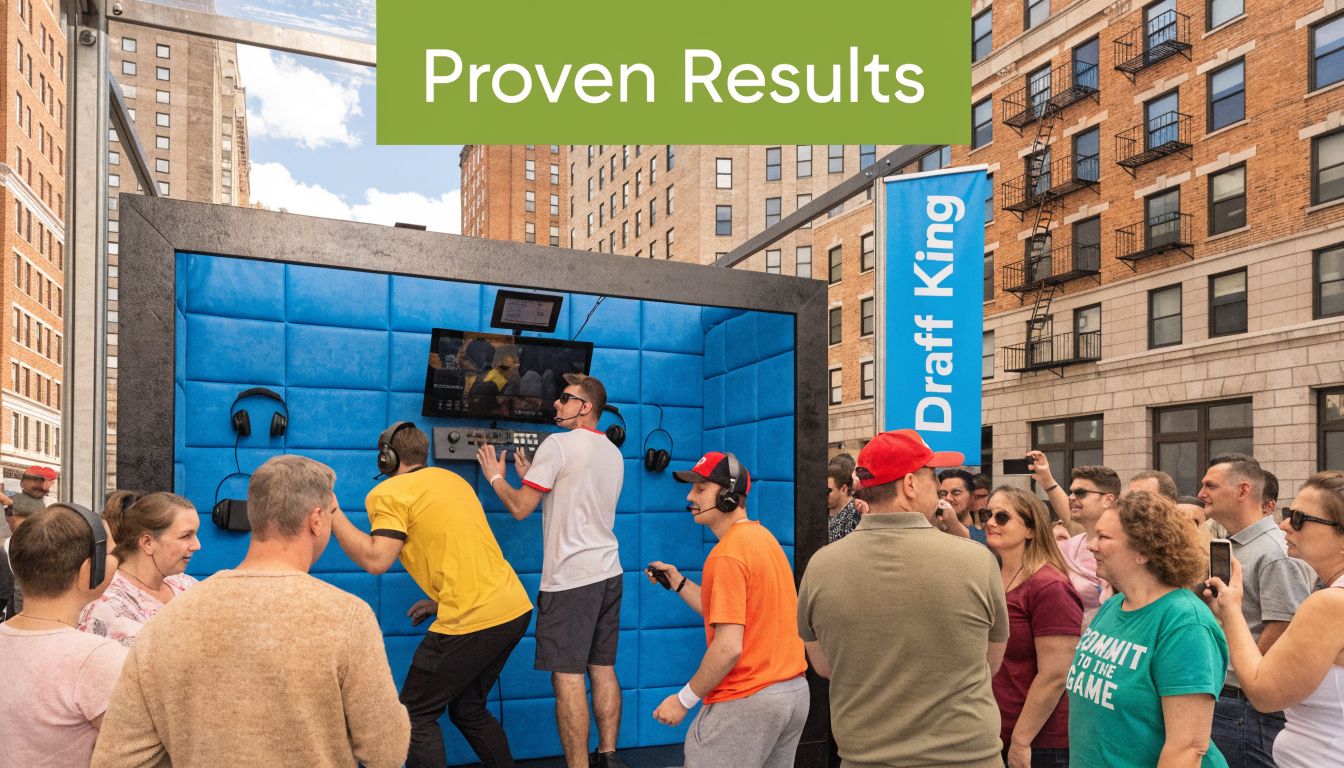
Trade show stand at ExCeL London
A B2B brand in a competitive hall needed something that could stop traffic without feeling gimmicky. The simulator became the front-of-stand hook. Attendees could join a quick throwing challenge, see their result instantly, and compare scores with colleagues.
What made it effective wasn’t just the gameplay. The stand team used the score moment as the handover into a product conversation. Instead of asking, “Can we help you?”, they were talking to people who had already engaged.
Corporate family fun day
At an internal company event, the usual challenge is age range. Some attractions appeal to children, others to adults, and many split the audience rather than bringing them together.
The football simulator handled that well because the format was easy to grasp. Parents understood it immediately, children enjoyed the visible action, and colleagues who wouldn’t normally join a highly technical game still felt comfortable having a go. The activity gave the event a more energetic centre without becoming over-complicated.
Fan zone atmosphere near Wembley
A sports-themed environment changes the tone again. In a fan zone, guests already arrive with enthusiasm, so the job of the simulator is to channel that energy into participation.
The strongest moments tend to come from quick challenge rounds, visible scoring, and crowd reaction. Fans don’t need long explanations. They need a turn, a target, and a result. In that setting, the simulator becomes part competition, part spectator theatre.
When the attraction suits the mood of the venue, the queue forms on its own.
Across all three scenarios, the underlying reason the format works is consistent. It’s physical enough to attract attention, simple enough to explain fast, and competitive enough to make people care about the outcome.
Your American Football Simulator Questions Answered
By this stage, UK event planners usually stop asking whether the idea is interesting and start asking the questions that affect delivery. Will it suit a mixed audience? Can it carry the brand properly? Is it easier to run than VR? Those are the right questions, because a simulator only earns its place if it works on a busy event floor and supports a commercial objective.
Can we brand the simulator properly
Yes, and the best results come from treating branding as part of the guest journey rather than decoration around it.
A football simulator works a bit like a branded stage set. Guests see the identity before they play, during the challenge, and again when the result appears on screen. That gives you more than logo visibility. It gives you repeated brand exposure tied to an active moment that people remember.
A strong branded setup usually includes:
- On-screen identity: logos, colours, and campaign messaging built into the game screens
- Leaderboard branding: so every score and replay keeps the host or sponsor visible
- Physical presentation: printed surrounds, plinths, or stand graphics that frame the attraction
- Call to action: a clear next step after the throw, such as scanning a QR code, speaking to staff, or entering a prize draw
For a UK corporate audience, that matters. Many guests may be curious about the NFL without being committed fans, so the branding and the prompt after play often do more commercial work than the football theme alone.
Is it suitable for mixed audiences
Usually, yes.
That point matters more in the UK than in the US. At many British corporate events, a large share of attendees will recognise the sport from Wembley, Tottenham Hotspur Stadium, social clips, or fantasy leagues, but they may not know the rules in any depth. The simulator format solves that problem because the task is simple. Throw at the target. Watch the score. Have another go if you want to improve it.
Difficulty can be adjusted, so beginners are not put off and competitive guests still have something worth chasing. That is why the format works well at conferences, exhibitions, staff events, and hospitality functions, not only at sports fan activations.
Why choose this over VR
The practical question is not which option looks newer. It is which one keeps people participating, watching, and moving through the space without delay.
VR can create a strong one-person experience, but event managers in the UK often run into the same operational issues. Headsets take time to fit and clean, some guests are hesitant to wear them, and the activity can become visually closed off from everyone nearby. A football simulator is easier to understand from a distance. People can see the challenge instantly, watch a colleague take part, and decide to join the queue without needing a separate explanation.
For live corporate events, that usually leads to three advantages:
- Wider accessibility: more attendees are comfortable taking part
- Faster throughput: fewer pauses between users
- Better audience value: the activity works for players and spectators at the same time
In practical terms, a simulator behaves more like a visible feature on the stand than a private booth. That difference matters if your objective is footfall, dwell time, and branded interaction.
What hire model makes sense
The right hire model depends on how often you need the attraction to work and what the event is trying to achieve.
A single-day hire usually suits conferences, client hospitality, and brand launches where the simulator acts as a live draw and conversation starter. Multi-day hire tends to fit exhibitions and public activations, where consistent staffing, reliable reset times, and repeatable branding matter more. Longer placements can make sense for venues, touring campaigns, or seasonal programmes where the simulator becomes part of a wider engagement plan rather than a one-off feature.
The useful way to decide is to start with the business goal. If the priority is attracting traffic to one event, the setup can stay focused and compact. If the priority is lead capture across several dates, you will want a format that supports repeat branding, reporting, and a process your event team can run consistently.
If you’re planning a UK event and want an attraction that is distinctive, social, and commercially useful, an American football simulator is worth serious consideration. For practical advice on hire formats, branding, delivery, and on-site operation, you can speak to PSW Events, a Cambridge-based team delivering simulator experiences across the UK and internationally.