
You've got a date pencilled in, a guest list that mixes keen golfers with complete beginners, and a familiar problem: how do you keep everyone involved? The classic corporate golf day, a shotgun start, drizzle on the back nine and half the office waiting in the clubhouse, doesn't suit every audience.
The best corporate golf day ideas break that mould. Indoor simulators, short team challenges and live scoring let you build an event around your guests rather than expecting everyone to enjoy a full round.
That doesn't mean abandoning proper golf. It means choosing where competition adds something and where it gets in the way of conversation. A client hospitality day needs different pacing from an exhibition stand, while a staff reward shouldn't leave non-golfers watching their colleagues have all the fun.
Planning principle: Choose the format your venue and guest list can support, then add the competitive extras. Don't book an impressive attraction and work out the queue afterwards.
These eight options range from traditional course hospitality to quick, indoor activations. Each has a clear use case, along with the venue, weather, skill and footfall constraints that determine whether it's right for your event.
1. Indoor Golf Simulator Team Tournament
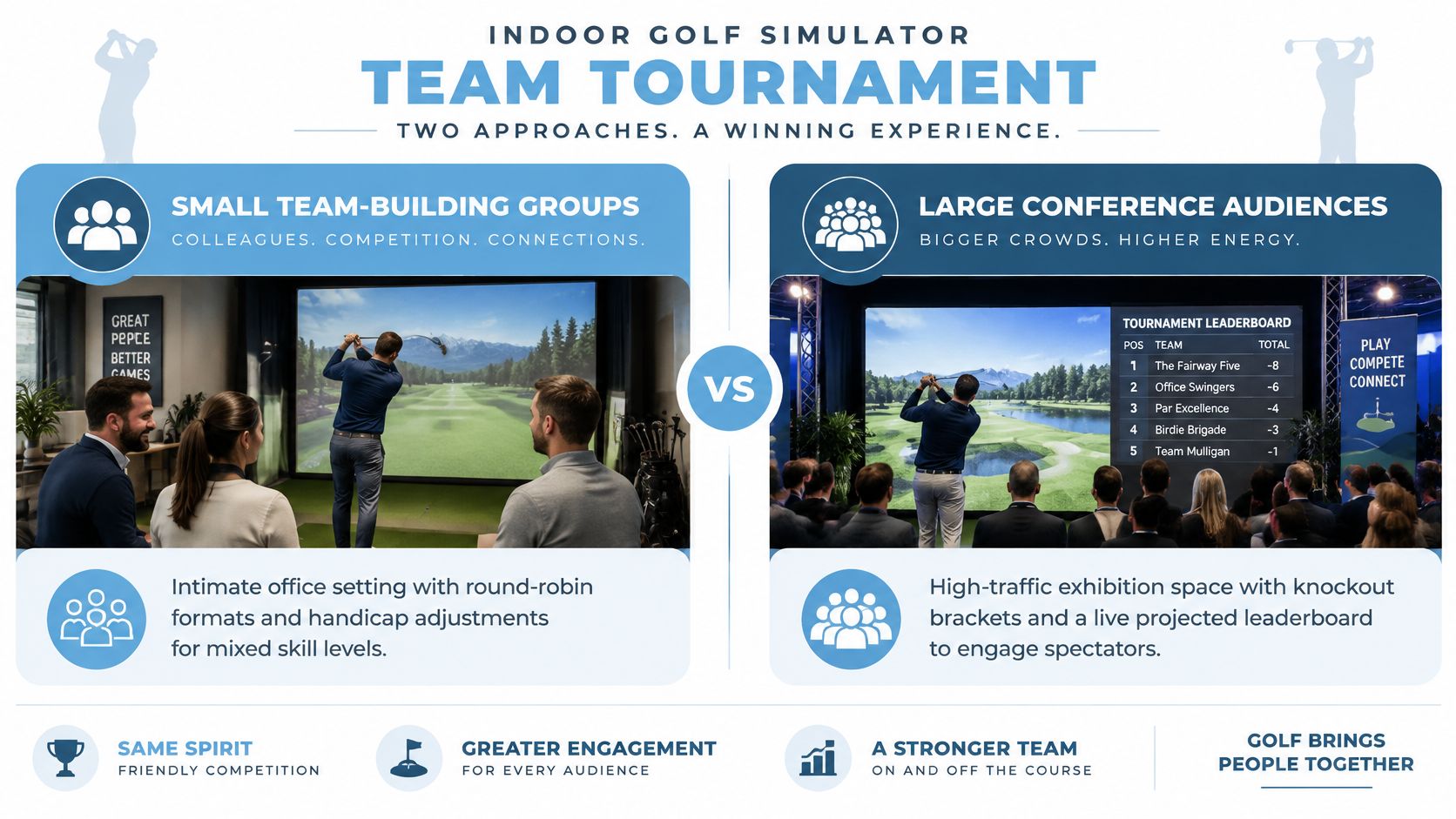
An indoor simulator tournament gives colleagues a shared competition without making the weather part of your production plan. Teams play a virtual course, such as St Andrews or Pebble Beach where the software supports it, with individual results contributing to a team total.
For a London financial services team, that could mean a staff league spread across a quarter, ending with a hosted final. At an exhibition at the NEC or ExCeL London, a shorter bracket works better because visitors won't commit to a lengthy round.
Build the schedule around actual play
Allow 15 to 20 minutes per player for a nine-hole format as an initial planning allowance, then test the chosen settings before confirming capacity. Beginners, practice swings and player changeovers can all stretch the schedule, so a busy stand usually needs a short shot challenge instead.
- Venue fit: Check ceiling height, swing clearance, delivery access, power and the space behind spectators. Floor area alone isn't enough.
- Fair scoring: Explain handicaps or beginner adjustments before play starts, and don't change the rules halfway through.
- Footfall: Face the leaderboard towards passing delegates, but keep the queue outside the swing enclosure.
- Hosting: Give an operator responsibility for introductions, scoring and moving players along.
Use the technical requirements for golf simulator hire when developing the floor plan. The format is largely weather-independent once installed indoors, but it isn't space-independent: squeezing spectators around an active club swing is a poor compromise.
2. Corporate Pro-Am on a Real Course
Choose a pro-am when unhurried client hospitality matters more than maximum participation. A professional golfer or PGA professional joins corporate teams, offering advice and conversation throughout the round, followed by a shared meal.
A sponsor-backed charity day at Wentworth or a client event at The Belfry provides a useful model. Treat those as venue concepts to investigate, not evidence that a particular professional, package or course configuration is available.
Protect the hospitality time
For peak-season dates, start checking course and professional availability at least six months ahead. Confirm whether the venue can accommodate a shotgun start, how guests reach their starting holes and what happens if play finishes later than planned.
A short clinic before departure helps guests settle in. Give the professional a clear role, including introductions and coaching, rather than assuming their presence alone will create good networking.
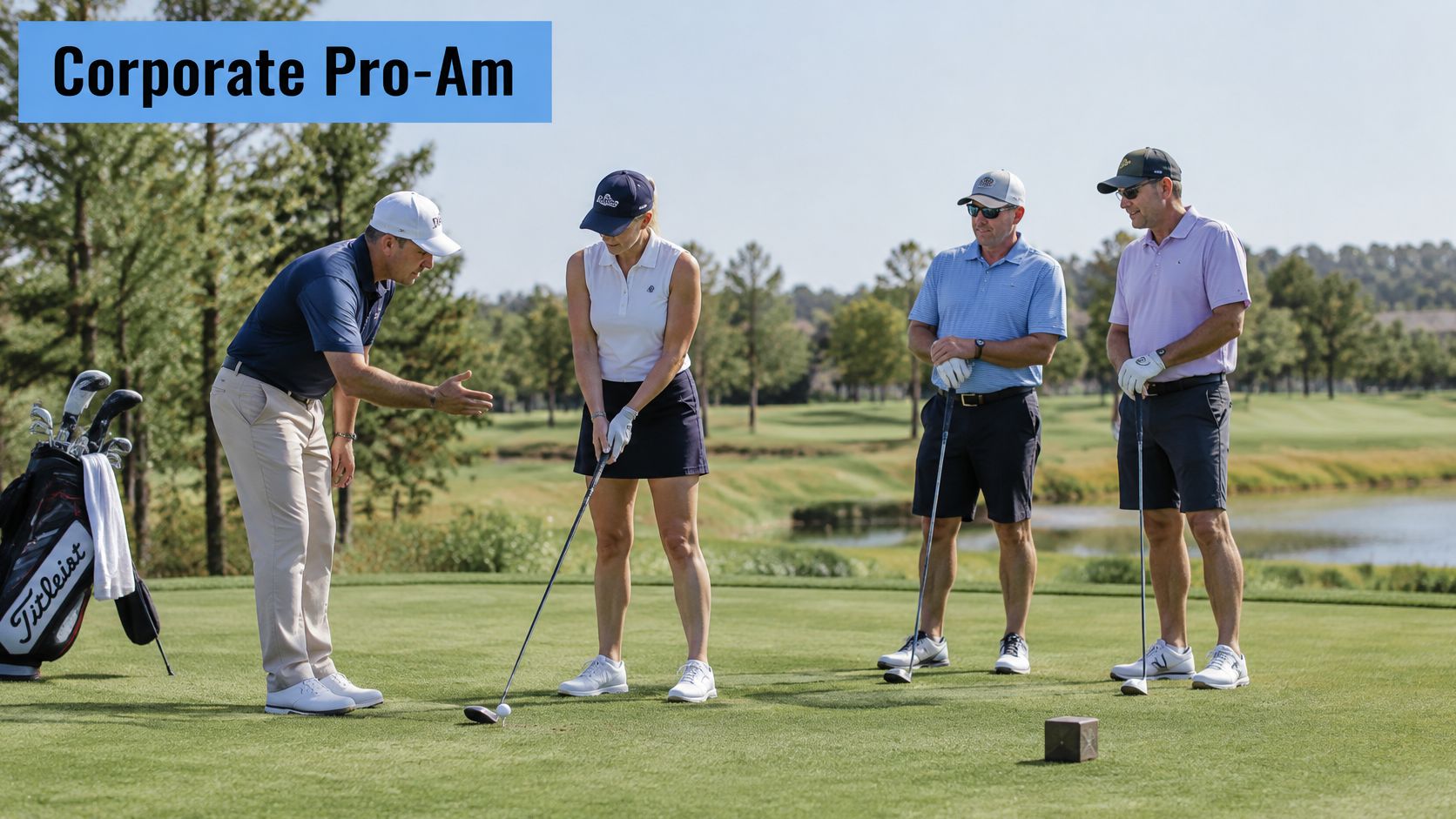
The trade-off is straightforward: a real course offers sustained conversation, but guests are committed to their group and exposed to weather. Recent demand also deserves attention, with Golfshake reporting that rounds played in Great Britain increased 7% year-on-year in Q3 2025.
Build the run sheet backwards from dinner, including changing time, transfers and delayed finishes. Offer a hosted non-golf alternative, such as a driving experience or clay shooting where appropriate, with its own safety arrangements and a clear reunion point. Sending non-golfers to wait in the bar isn't an alternative programme.
3. Putting Challenge and Mini Golf Activation
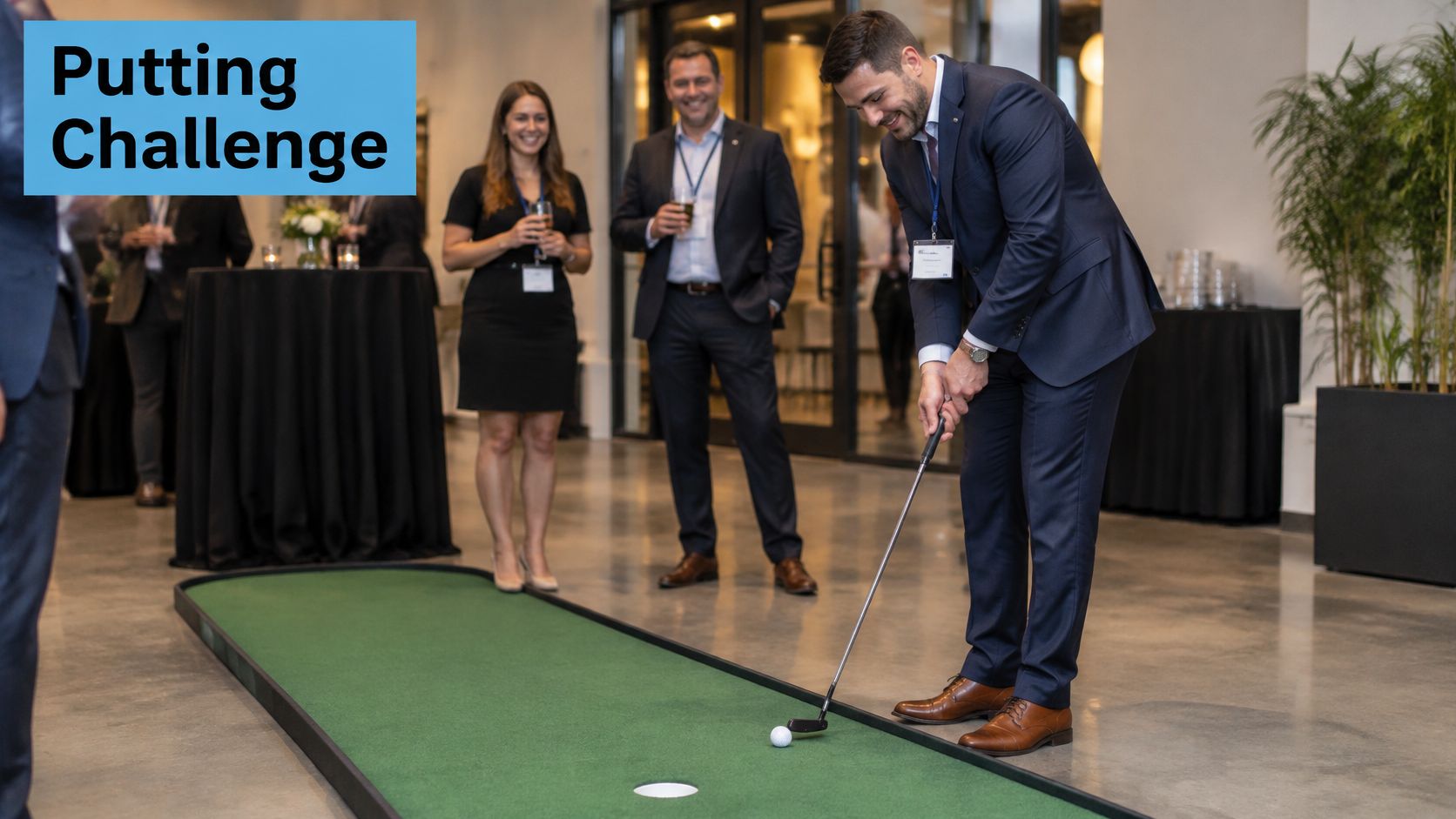
For an exhibition stand, putting is often more practical than a full-swing attraction. Visitors understand the task quickly, spectators can follow the result, and a portable green can fit a lobby, courtyard or stand frontage without the same swing-clearance requirement.
The audience is broader than committed golfers. Golf Business News reported that 9.4 million adults in England played crazy or mini golf during the previous twelve months, supporting its use as a familiar, low-barrier activity.
Make the queue part of the layout
Consider a product launch where delegates attempt a branded putting challenge before speaking to a demonstrator. Position the activity beside the visitor route, not across it, and put refreshments where waiting guests won't block play.
- Participation: Set a fixed attempt allowance and explain the tie-break before anyone starts.
- Lead capture: Keep the entry form short, explain how details will be used and separate competition entry from marketing preferences.
- Repeat play: Display prize tiers, but pause repeat attempts when new visitors are waiting.
- Surface: Check level changes, mat edges and outdoor drainage before installation.
Options for crazy golf hire help establish whether you need a single focal challenge or a walk-through course. A courtyard staff day in Cambridge or Milton Keynes can use the latter, provided there's an indoor fallback.
Borrow ideas from games to play during a round, but simplify them for passing visitors. Complicated scoring undermines the main advantage: fast participation.
4. Charity Golf Scramble
A scramble gives less-confident golfers a way to contribute without playing every hole alone. Everyone hits, the team chooses its preferred ball, and players continue from that position until the hole is completed.
For formal competition, publish the handicap method with the invitation. The Learn Golf scramble guide describes the R&A's recommended four-player allowance as 25%, 20%, 15% and 10% of course handicaps, ordered from lowest to highest, with the adjusted figures added together.
Separate fundraising from tournament administration
A local chamber of commerce could use this format to support a children's hospice, inviting businesses to enter teams and sponsor holes. The organiser should appoint separate owners for scoring and fundraising so neither job gets neglected when guests arrive.
- Fundraising target: State what you're raising money for and how donations will reach the charity.
- Sponsorship: Define signage, recognition and any hosted activity included in each package.
- Guest balance: Pair beginners with patient players rather than leaving an inexperienced team to struggle.
- Communications: Agree photography permissions and the charity's approval process before publishing impact stories.
A scramble lowers the skill barrier, but it doesn't remove the walking, weather exposure or time commitment of a course-based day.
Keep sponsor activations away from landing areas and avoid lengthy challenges that hold up the field. During prize-giving, let the charity explain what the money will support, then share the confirmed fundraising result afterwards.
This format works when participation and fundraising reinforce each other. It works less well when every hole becomes another sales pitch or donation request.
5. Golf Clinic and Networking Lunch
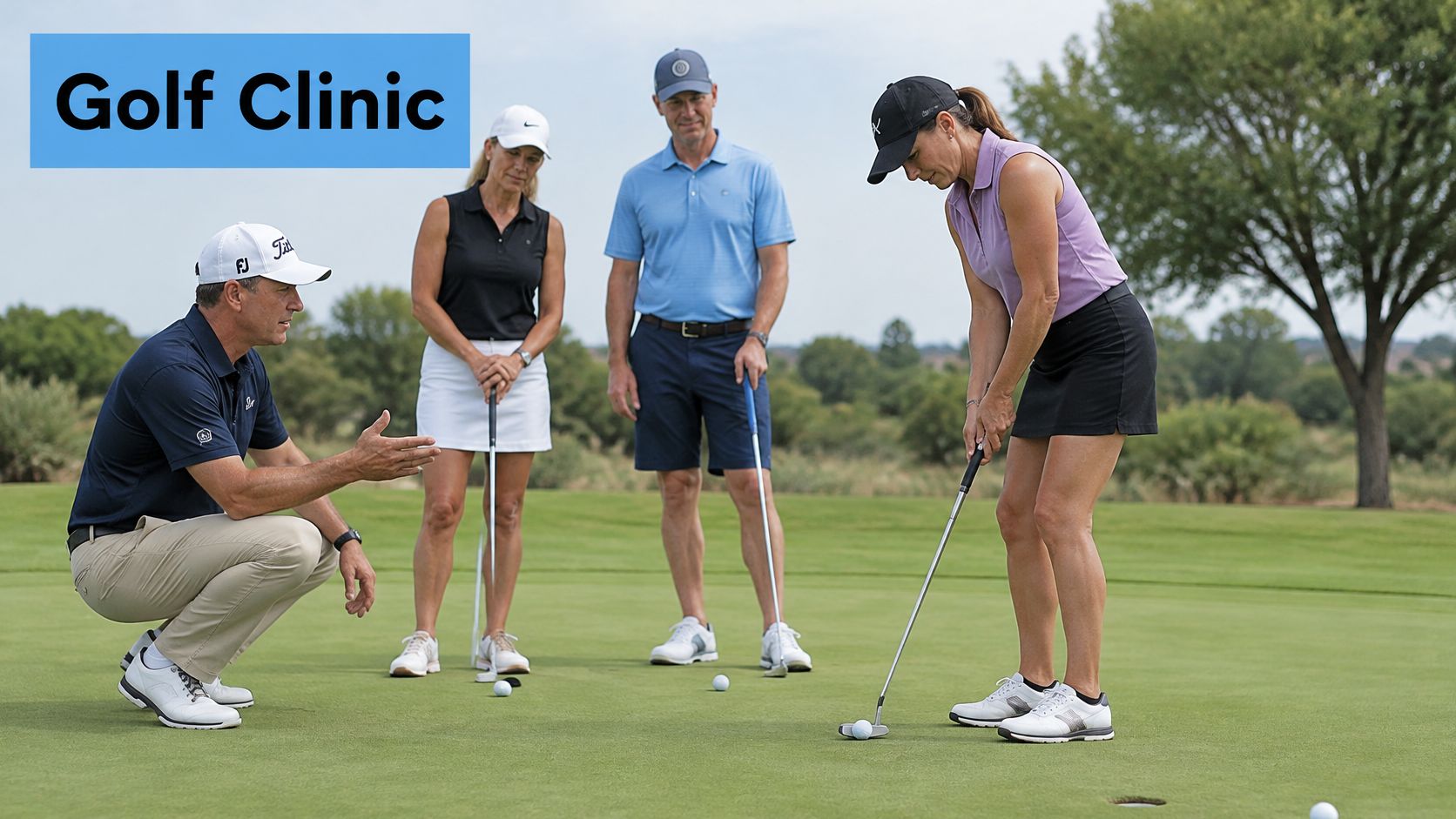
A clinic followed by lunch suits guests who want an introduction to golf without committing to a full round. The coaching provides an easy conversation starter, while the meal gives hosts time to develop relationships.
A practical use case is a client breakfast at a UK driving range, followed by putting and short-game coaching. For leadership development, simulator coaching can sit alongside facilitated discussions, provided the sporting activity supports the meeting rather than consuming it.
Teach something guests can use immediately
Keep clinic sessions to around 30 to 45 minutes as a planning recommendation. Focus on a manageable skill, such as putting alignment or making consistent contact, rather than trying to rebuild everyone's swing.
Group guests by confidence and coaching needs, but avoid publicly labelling people as weak players. Offer an observation-and-networking route for anyone who doesn't want to swing a club.
Accessibility should shape the plan from the beginning. Sporting Insights' account of EDGA-commissioned research estimates that around 1.3 million people with disabilities, health conditions or learning differences already engage with golf in some way.
Provide a private way to request adjustments, step-free routes, seating and clear information about the session. Ask what would help someone participate, not for their medical history.
At lunch, use table themes or introductions tied to the purpose of the event. Send take-home coaching notes or agreed video clips afterwards, but keep the follow-up useful rather than turning it into an unsolicited sales sequence.
6. Multi-Sport Simulator Day with Golf
Golf doesn't have to carry the whole event. Combine it with racing rigs, rugby or boxing simulators when the audience has varied interests and guests will arrive in waves.
For an exhibition zone at Manchester Central or ExCeL London, the attraction mix can give visitors a reason to stop and colleagues something to discuss. A staff festival or product launch at Silverstone or Wembley could use the same approach, subject to the booked space and production arrangements.
Balance capacity, not just variety
The main delivery risk is uneven throughput. If one activity takes much longer than another, guests collect in the slowest queue while nearby stations sit empty.
- Layout: Separate waiting areas from active play, cables and operator access.
- Scoring: Award comparable participation or placement points rather than adding unrelated raw scores.
- Staffing: Assign operators to activities and a separate person to oversee guest movement.
- Peak demand: Use timed rotations for organised groups and controlled entry when walk-up demand rises.
The Health and Safety Executive says organisers must control event risks across setup, the live event and breakdown, including coordinating work and ensuring staff competence. A pre-opening briefing should cover stop procedures, participant instructions and who handles incidents.
Capacity check: Calculate throughput using the full guest cycle, including briefing, adjustment, play and changeover. The game timer alone won't tell you how many people you can accommodate.
Indoor delivery reduces weather dependency, but more attractions mean more power, access and production coordination. Choose complementary activities you can operate well, not a crowded collection of equipment.
7. Live Streamed Golf Leaderboard Challenge
A visible leaderboard can turn a private attempt into a shared event. Add a controlled live stream and remote colleagues or social audiences can follow the competition too.
For example, a UK exhibition product launch could run a nearest-the-pin challenge, show results on the stand screen and broadcast an announced final. That creates a clearer viewing moment than streaming an entire day of arrivals, practice swings and empty playing space.
Design for spectators and participants separately
Use an electronic leaderboard to show standings clearly, with readable names or participant aliases. Keep operator controls separate from the public display and agree who approves results before they appear.
Test broadband, camera angles, audio and the streaming platform during production rehearsals. A local screen feed should remain usable if the internet connection fails, and the host needs a simple way to pause the broadcast.
- Permissions: Obtain written participant consent before filming or streaming, and provide a route to play without appearing.
- Content: Create a recognisable hashtag and frame shots around the participant, result and brand.
- Measurement: Track entries, qualified conversations, meeting requests and relevant social reach separately.
- Follow-up: Connect competition records to the CRM only through the agreed data process.
Measurement shouldn't stop at applause. A historical Total Research survey reported by Marketing Week found that only 34% of 260 blue-chip companies attempted to measure return on corporate hospitality expenditure.
Treat that as a warning about evaluation, not a current benchmark. Define what counts as a useful outcome before opening registration, then distinguish spectators from entrants and genuine prospects from people who wanted a turn.
8. Golf Day with Rewards and Staff Recognition
A staff recognition event should celebrate work, not just identify the strongest golfer in the company. Build it around a course visit, simulator tournament or mixed programme, then give workplace achievements their own place in the awards.
For an annual sales and service celebration, guests might take part in optional golf challenges before dinner. The company awards recognise specific contributions, while sporting prizes remain a lighter part of the evening.
Keep recognition separate from sporting ability
Publish the award criteria in advance and explain who makes the decisions. Include achievements from less-visible teams, and don't make attendance or physical participation a condition of receiving recognition.
- Inclusive activities: Offer putting, seated networking or another hosted option alongside the main competition.
- Meaningful speeches: Name the achievement and its effect on colleagues or customers, rather than reading generic praise.
- Suitable prizes: Consider experiences, shared team rewards and non-golf options as well as equipment.
- Feedback: Ask whether people felt included and recognised, not merely whether they enjoyed the food.
For sporting awards, use ideas that help you find prizes golfers actually want, then check that the overall prize selection suits your wider workforce. A specialist club accessory won't mean much to someone who has never played.
The logistical advantage is flexibility: you can move the competition indoors or shorten it without losing the purpose of the day. The main risk is allowing a delayed tournament to push dinner and recognition late into the evening.
Protect the awards time in the run sheet. Golf is the activity; appreciation is the reason everyone's there.
Corporate Golf Day Ideas at a Glance
| Idea | Format | Best For | Weather Dependent | Skill Level Needed |
|---|---|---|---|---|
| Indoor Golf Simulator Team Tournament | Team tournament on virtual courses | Team building and conference audiences | No | Beginner to advanced; handicaps can balance teams |
| Corporate Pro-Am on a Real Course | Full-day team golf with a professional | Client entertainment and networking | Yes | Mixed; golf experience helps |
| Putting Challenge and Mini Golf Activation | Quick putting games on portable greens or mini golf holes | High-footfall events and brand activations | No, if indoors; partly, if outdoors | Beginner |
| Charity Golf Scramble | Team round selecting the best shot on each hole | Fundraising and corporate social responsibility | Yes | Beginner to advanced |
| Golf Clinic and Networking Lunch | Group coaching followed by a meal | Beginners, non-golfers and business networking | Partly; depends on practice venue | Beginner |
| Multi-Sport Simulator Day with Golf | Rotating activities across golf and other simulators | Large, mixed-audience events | No | Beginner to varied |
| Live Streamed Golf Leaderboard Challenge | Simulator competition streamed to screens or social channels | Brand reach and measurable engagement | No | Beginner to advanced |
| Golf Day with Rewards and Staff Recognition | Golf-themed event with awards and celebration | Staff recognition and team morale | Partly; depends on indoor or outdoor venue | Varied; include non-golf options |
Choosing the Right Format and Getting It Delivered
The best corporate golf day ideas match the audience, venue and weather reality rather than forcing everyone onto a course. Shortlist a few formats, decide whether your priority is client entertainment, staff rewards or brand reach, then brief a specialist against that objective.
For senior-client hospitality, a pro-am or coaching lunch gives hosts sustained conversation time. For exhibition footfall, putting and short simulator challenges are easier to join without abandoning the rest of the show. For a mixed workforce, optional activities and shared recognition usually make a stronger programme than a compulsory competitive round.
Turn the shortlist into a workable brief
Send the delivery team the venue plan, access arrangements, event timings, expected arrival pattern and audience profile. Include the deadline for installation and testing, not just the time guests arrive.
State how you'll judge success. A staff reward might prioritise participation and inclusion, while a brand activation needs a clear record of relevant conversations and follow-up opportunities.
The HSE's event-planning guidance recommends proportionate planning based on the event's scale and risks, with clear responsibility for safety. Agree who controls the activity area, who can stop play and how venue, organiser and contractor responsibilities fit together.
Don't accept a weather fallback that exists only as a sentence in the proposal. Reserve the space, allow for the equipment and explain how guests will move there.
PSW Events is based in Cambridge and supplies golf simulators, electronic leaderboards and multi-sport attractions across the UK. Our full delivery service includes planning, site visits, installation, staffing and H&S compliance, backed by £10 million Products, Employee and Public liability insurance and over 50 years' combined experience.
We can develop site plans, establish power and utility requirements and manage delivery on the day, leaving your team free to engage with guests. For larger events, we arrange site visits and maintain closer contact as the layout and programme develop.
Email sales@pswevents.com to request the events guide brochure, including your proposed venue, date and event purpose. A clear brief makes it easier to choose a format that's enjoyable for guests and realistic to deliver.
PSW Events offers golf simulators, electronic leaderboards and interactive sports attractions for corporate hospitality, exhibitions and staff events. Visit PSW Events to request the events guide brochure and discuss a golf-day format suited to your audience, venue and delivery schedule.