
The venue looks perfect in the proposal. The creative is bold, the audience journey seems obvious, and the agency promises a smooth experience from first sketch to final report. Then the load-in starts, the venue raises a licensing question, the brand ambassadors need retraining, and nobody can explain how a busy activation will produce usable leads.
That's the test of experiential marketing agencies. The winning partner isn't the one with the most spectacular showreel. It's the one that can turn a commercial objective into a well-run UK activation, protect the budget, comply with venue rules, capture meaningful data, and tell you what happened afterwards.
Why the Agency Choice Changes Everything
A brand team can leave an activation with strong photographs, a busy queue and little commercial value. Leads may be weak, invoices incomplete and the final report limited to footfall and social reach. The problem usually began before the event, with an agency appointment that treated creative impact as the whole brief.
Your chosen partner shapes the production plan, supplier quality, crew performance, venue compliance, health and safety process and the data captured at each interaction. Those decisions determine whether the activation can convert attention into a useful next step for the business.
Practical rule: If an agency cannot explain how the activation will work operationally and commercially, the creative idea is premature.
The same brief can produce two very different outcomes. One agency may put a senior account director in the pitch, then hand delivery to a junior coordinator. Another may provide stronger production leadership, established venue relationships, trained talent and reporting that links audience actions to the campaign objective. The difference appears under pressure, during load-in, live delivery and breakdown.
Agency selection should also follow UK search and buyer behaviour. Brand teams often search for turnkey delivery, regional coverage, conversion planning, and an ROI framework, rather than a concept alone. Build the shortlist around the work your team needs to buy and deliver. An agency that ranks for a broad creative term may still lack the operational capability, regional reach or measurement discipline your activation requires.
Start with the commercial route to market. Define the audience, the action you want after the interaction and the evidence that will prove progress. Then ask agencies to show how their creative, staffing, data capture and follow-up support that route. This prevents a visually impressive idea from absorbing budget without giving sales, marketing or CRM teams anything usable.
The scale behind the decision
Experiential marketing operates within a commercially significant UK events economy. UK-focused reporting puts the wider events industry at over £84 billion contributed to the economy in 2023 and identifies events as the leading category for increased marketing investment in 2026, with net balances of +14.7% in Q1 and +11.0% in Q2. The same reporting says nearly 73% of UK consumers felt live brand experiences made them more connected to companies in 2024, compared with 68% in 2022 (UK experiential marketing effectiveness reporting).
Those figures support investment, but they do not prove that any individual activation worked. Measure live activity inside the wider campaign, alongside reach, response, qualified leads, sales influence, content value and customer follow-up. Choose an agency that can connect those measures, not one that presents attendance as the final answer.
What Experiential Marketing Agencies Actually Do
An experiential marketing agency turns a commercial objective into a live, physical, or hybrid interaction that moves people towards a defined action. The visible output might be a concept, set, technology or trained team. The core work sits behind it: audience planning, permissions, safety, logistics, staffing, data capture, follow-up and reporting.
The UK discipline grew from brand stunts and promotional activations. Bovril handing out hot drinks at winter train stations, Cadbury's drumming gorilla, and Pepsi Max's Black Mirror crash demonstrate how public moments can prompt conversation and participation instead of leaving audiences with a passive advert.
The commercial model became more formal in the late 1990s and early 2000s. The 1999 book The Experience Economy helped position experiences as a distinct value proposition. LIME, a UK experiential marketing subsidiary, launched in 2001 and reportedly reached £2.5 million in billings during its first 11 months. UK event and experiential spend was also tracked as a repeat-investment category, including a 2.6% rise in the IPA Bellwether Q4 2018 report (UK experiential marketing market history).
The agency's role in the wider marketing mix
An experiential partner designs and delivers the audience interaction. That work can combine strategy, creative, production, logistics, staffing, compliance, technology and reporting.
PR may generate editorial attention and shape the story. Advertising buys reach through media. An in-house event team may manage stakeholder relationships and brand governance. The experiential agency must make the interaction work on the ground, then connect it to the campaign's next step.
Briefing language should reflect that distinction. A PR-led brief may prioritise talkability. An advertising brief may prioritise reach and frequency. An experiential brief must define what people will do, what the brand will learn, how data will be captured and what happens after the interaction.
Choose the partner's scope according to the job. A trade show booth builder may suit a clear, repeatable exhibition presence. A full experiential partner earns its fee when the brief includes a product launch, roadshow, pop-up, festival zone, fan experience or hybrid campaign with several moving parts.
For context on the commercial ecosystem around specialist agencies, Bidwell's marketing sector outlines how marketing services businesses are structured and evaluated. Use that context to understand the supplier market, then judge each agency against your audience, route to conversion and operational requirements.
The operating model to look for
A credible agency should show how its plan becomes:
- A defined audience journey, from arrival and first contact through participation and follow-up.
- A physical or digital environment, designed around behaviour and the intended action rather than decoration.
- A production plan, covering suppliers, build, AV, staffing, transport and venue coordination.
- A compliant operation, with risk assessments, method statements, insurance, licensing and accessibility addressed early.
- A measurement system, agreed before the first visitor arrives and connected to the wider campaign.
That operating chain separates experiential marketing from an event that just carries a logo.
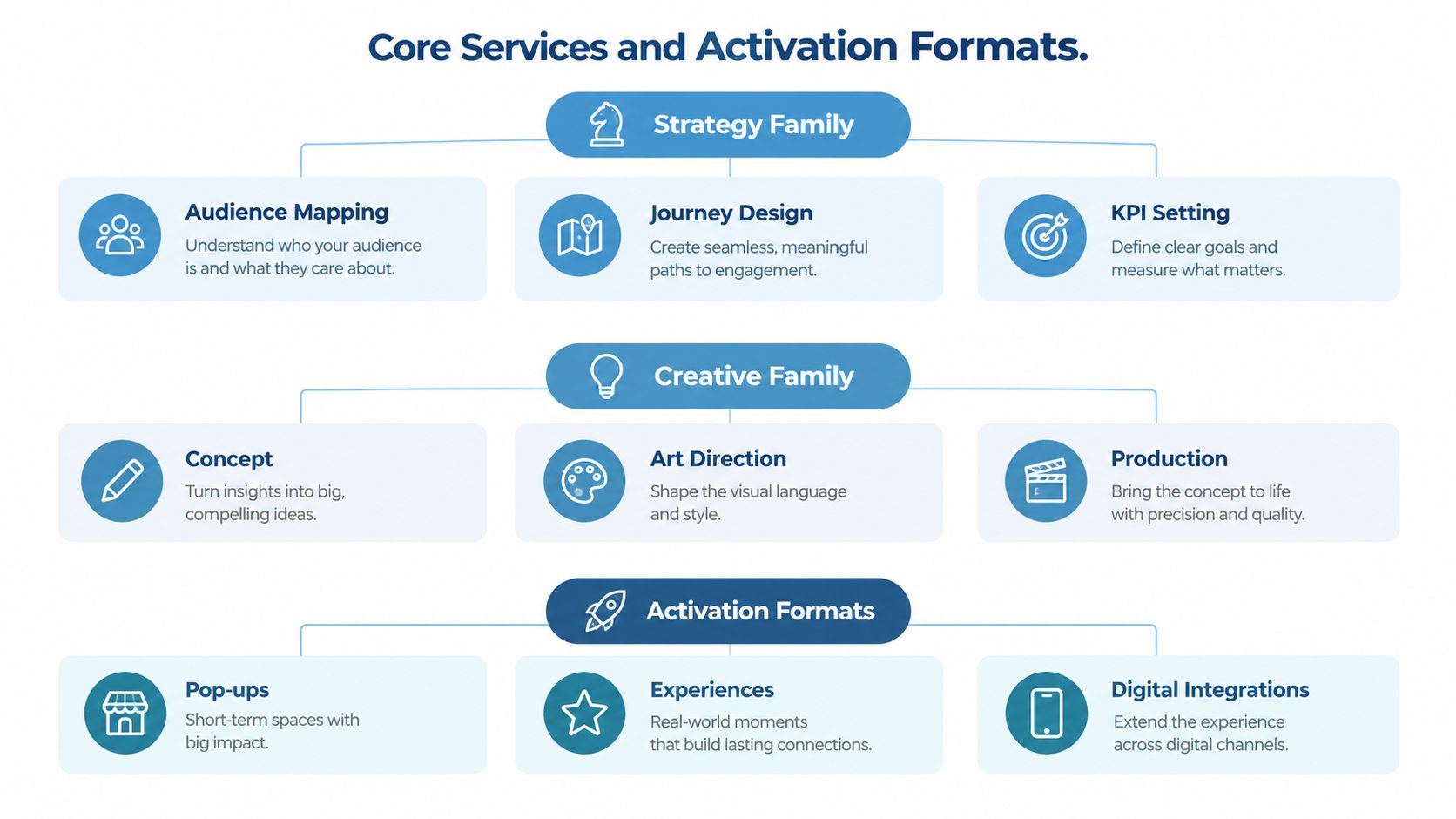
Core Services and Activation Formats
Treat an agency's service list as a menu, not a badge of prestige. You need to know which capabilities are directly owned, which are delivered through established partners, and which are listed merely because they sound useful in a pitch.
Start with strategy
The strategy family should cover:
- Audience mapping, identifying priority segments, barriers, motivations, and venue behaviour.
- Journey design, defining what happens before, during, and after the interaction.
- KPI setting, separating the primary commercial outcome from supporting experience measures.
A sampling tour may need a high-throughput journey and a retail coupon. A B2B exhibition may need qualified meeting requests and a clear post-show nurture route. The agency should adapt the structure to the format rather than force every campaign into the same template.
Build the creative and production layer
Creative services normally include the concept, naming, art direction, copy, spatial design, content capture, and visual system. Production then turns that idea into a physical reality through set build, AV, staging, props, lighting, branded vehicles, digital interfaces, and reusable assets.
Ask to see the transition between stages. A moodboard is not a build plan. You need evidence of detailed layouts, CAD capability, technical drawings, production schedules, and a clear process for approving changes.
Cover the operational work
Logistics can include venue hire, permissions, travel, routing, storage, crew scheduling, freight, power, cleaning, and replenishment. Compliance may involve RAMS, insurance, licensing, accessibility, food safety, electrical checks, safeguarding, and venue-specific rules.
Talent services cover hosts, performers, demonstrators, brand ambassadors, technicians, and specialist operators. The agency must train those people on the brand, the audience journey, the capture mechanic, escalation procedures, and the limits of what they can promise.
Digital services may include registration, apps, QR codes, NFC, AR, livestreaming, interactive screens, lead forms, and CRM handover. Post-event work should include data cleansing, reporting, attribution analysis, content delivery, and a debrief that answers the original business question.
Match services to formats
Common UK activation formats include:
- Sampling tours, where routing, replenishment, permission, speed of interaction, and consent capture matter.
- Pop-ups and retail takeovers, where conversion, dwell time, accessibility, and store integration need equal attention.
- Roadshows, which demand modular builds, reliable transport, regional crew coverage, and contingency planning.
- Conferences and B2B trade show booths, where product education, meetings, lead quality, and follow-up are central.
- Festival experiential zones and fan zones, where throughput, queue design, staffing, and safety must work in a crowded environment.
- Product launches, where the live moment must connect to press, content, retail, sales, and digital activity.
- Hybrid streams, where the remote audience receives a designed experience rather than a passive camera feed.
A turnkey model, such as PSW Events' combination of interactive attractions, branding, logistics, installation, staffing, and health and safety delivery, shows how one supplier can integrate several workstreams. The important point isn't the supplier name. It's whether the proposed operating model gives you clear ownership, dependable handovers, and one accountable person when something changes.
How UK Brands Evaluate and Shortlist Agencies
A useful shortlist starts with search behaviour, then moves quickly into operational proof. Google Search accounts for more than 90% of general search queries in the UK, and the Competition and Markets Authority says that share has remained above 90% for at least fifteen years (CMA analysis of UK search market outcomes). StatCounter's September 2026 UK data records Google at 91.39%, Bing at 6.08%, Yahoo at 1.32%, DuckDuckGo at 0.65%, Ecosia at 0.30%, and Yandex at 0.22% (StatCounter UK search-engine market share).
Your agency discovery strategy should therefore prioritise Google visibility, but don't confuse search visibility with delivery capability. Build a longlist from category searches, trusted industry events such as M&IT and Event Marketing Summit, venue recommendations, agency directories, and references from comparable brands.
Use a four-stage funnel
- Longlist: Find agencies with the relevant format, geography, sector, and production depth.
- Capability filter: Remove firms that can't provide the required staffing, compliance, regional coverage, technology, or reporting.
- Chemistry test: Give the remaining agencies a realistic briefing conversation, not just a polished pitch.
- Commercial review: Compare scope, assumptions, exclusions, fees, change control, and payment terms.
A hard pass is appropriate when an agency can't provide relevant references, clear ownership of production, credible safety processes, or a measurement plan. Creative style, presentation format, and the exact balance of in-house and freelance resource are more negotiable if the agency is transparent and properly managed.
Copy this decision matrix
| Criterion | Weight | Agency A (Score 1-5) | Agency B (Score 1-5) | Agency C (Score 1-5) | Notes |
|---|---|---|---|---|---|
| Strategic fit | High | Audience, objective, format, sector | |||
| Execution depth | High | Production, crew, suppliers, venues | |||
| Measurement capability | High | Capture, attribution, reporting | |||
| Commercial transparency | High | Scope, exclusions, fees, change control | |||
| Regional delivery | Medium | UK coverage and local execution | |||
| Sustainability practice | Medium | Reuse, waste, transport, materials |
For a practical procurement reference, use these vendor selection criteria for event partners while adapting the scoring to your own risk profile.
The strongest signals appear outside the pitch deck. Call references who have worked with the proposed account team. Ask for a post-event debrief sample, not only a case study. Check whether the contract identifies creative ownership, data responsibilities, cancellation terms, and day-of escalation. A beautiful deck can't rescue unclear accountability during a load-in.
Budgeting and Measuring ROI on Live Activations
Live activation budgets become difficult to defend when every cost is mixed into one headline figure. Separate the budget into three layers so the team can see what creates the experience, what supports delivery, and what drives audience action.
Build the budget in three layers
Hard production costs cover the physical and technical foundation: build, staffing, venue, power, staging, AV, transport, and technology.
Soft costs include talent, licensing, contingency, agency fees, approvals, insurance, and specialist production support. These costs often look less visible in an early concept, but they protect the idea from operational failure.
Activation spend covers the elements that move people through the experience, such as sampling, hospitality, ticketing, gifting, digital amplification, and audience incentives.
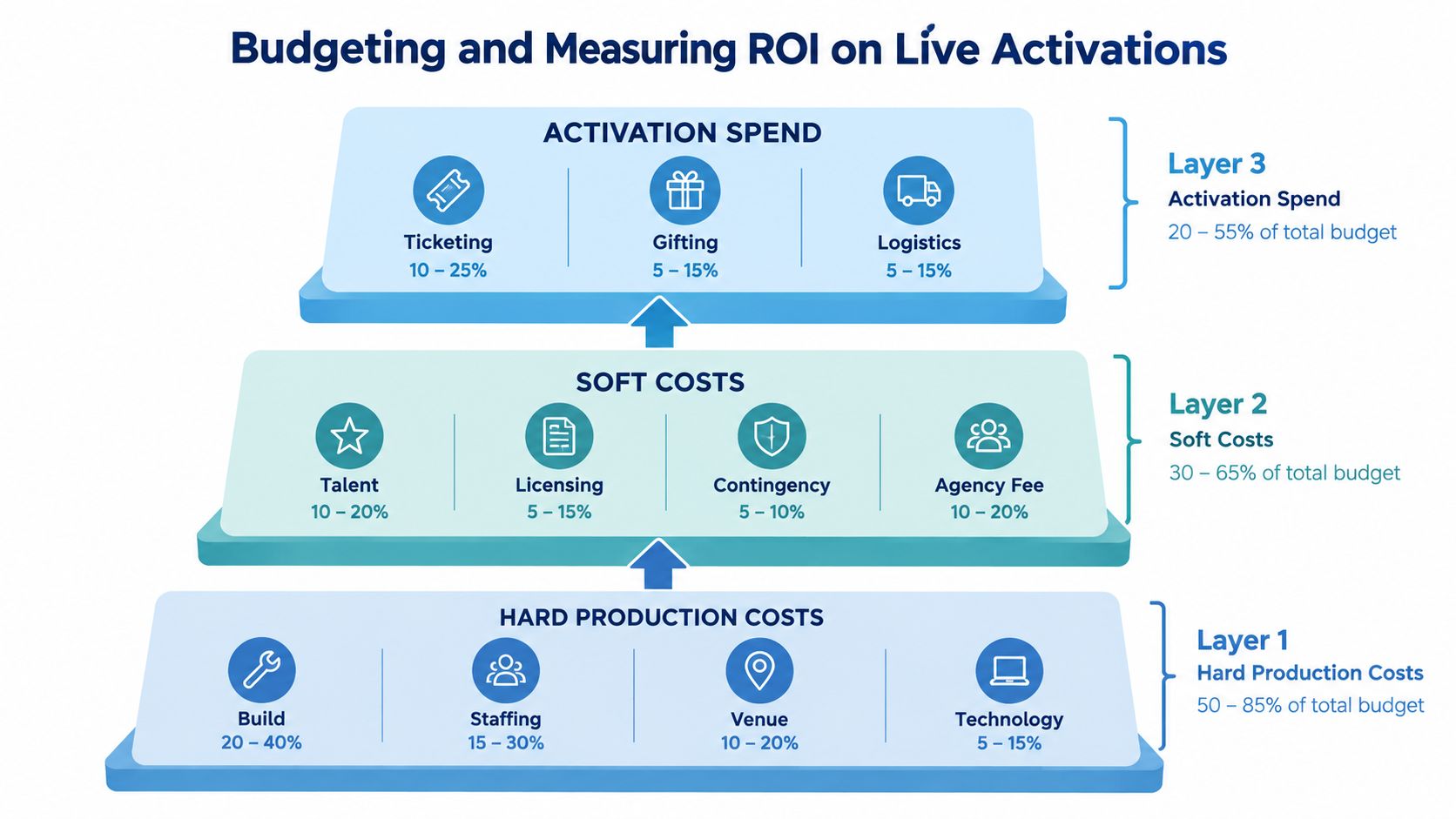
Ask the agency to show assumptions for each layer and give you a cost per attendee benchmark that fits the format. A conference booth, a retail pop-up, and a multi-site roadshow shouldn't be judged by the same unit economics. Be sceptical of cost-per-impression logic when the campaign hasn't produced meaningful interaction, consented data, retail movement, or sales intent.
Measure the work before it happens
A defensible framework pairs hard and soft outcomes.
- Hard ROI: Qualified leads, direct sales, redemptions, meetings booked, sign-ups, product trials, and cost per acquisition.
- Soft ROI: Brand lift, earned media, dwell time, sentiment, advocacy, recall, and NPS.
- Operational measures: Queue time, interaction completion, staffing efficiency, data quality, and incident reporting.
Set the measurement spine before production begins. Pre-event KPIs might include registrations, audience composition, intent, and baseline awareness. During the activation, track qualified interactions, completed journeys, capture consent, dwell time, trial, and conversion. Post-event measures should cover follow-up speed, sales progression, nurture engagement, content performance, and brand response.
Measurement principle: Report the activation as one component of the campaign, not as a self-contained miracle or failure.
That matters because live activity rarely runs in isolation. A launch may include paid search, PR, social content, retail support, email, partnerships, and sales follow-up. Industry reporting has noted that marketers planned to increase spend on brand experiences while practitioners warned that “it is impossible at present to give a true singular ROI figure” when events sit within broader campaigns (Campaign coverage of field marketing measurement).
Use a clear attribution statement in the report. Separate what the activation directly generated from what it influenced, then show how the evidence connects to the wider campaign. A useful experiential marketing ROI framework can support that conversation, but finance still needs your definitions, assumptions, source data, and follow-up methodology.
Designing Activations That Convert Instead of Just Entertain
Spectacle without a conversion mechanic is rented attention. The audience may enjoy it, photograph it, and move on without giving the brand a usable signal.
Write the brief backwards from the business outcome. Decide whether the priority is lead capture, retail traffic, product trial, sign-up, sale, meeting creation, or consented audience data. Then design the physical journey around the action, rather than adding a QR code at the end because someone remembered measurement during artwork approval.
Put conversion into the brief
A conversion-led brief should name:
- One primary KPI, with supporting measures kept separate.
- Defined audience segments, including who should be prioritised and who shouldn't.
- A capture mechanic, such as QR, NFC, an opt-in form, a retail coupon, a booking flow, or a product code.
- A follow-up route, including ownership, timing, CRM destination, and nurture content.
- A trained host or mechanic, able to guide participation and explain the next action without turning the experience into a hard sell.
UK trend commentary describes the category moving from “how impressive can we look?” towards “what problem can we solve?”, with stronger festival activations using a clear conversion mechanic (UK experiential marketing trends commentary). That shift is commercially sensible. A brand can still create surprise, humour, and visual appeal, but every element should earn its space by helping the audience understand, participate, choose, share, or convert.
The trade-off is real. A conversion-first experience may be less visually extravagant and more operationally disciplined. You may need more interaction stations, simpler instructions, shorter journeys, clearer signage, better queue management, and staff who can handle throughput consistently.
Hold the agency to that logic in the debrief. Don't accept “people loved it” as the conclusion. Ask how many priority visitors completed the intended action, how many records were valid, which points in the journey caused drop-off, how quickly follow-up happened, and what the agency would change before repeating the format. For support with the physical and interactive side of the journey, immersive experience design for live brand environments is the right level of conversation, provided the design remains tied to the conversion objective.
Procurement Checklist and Questions to Ask
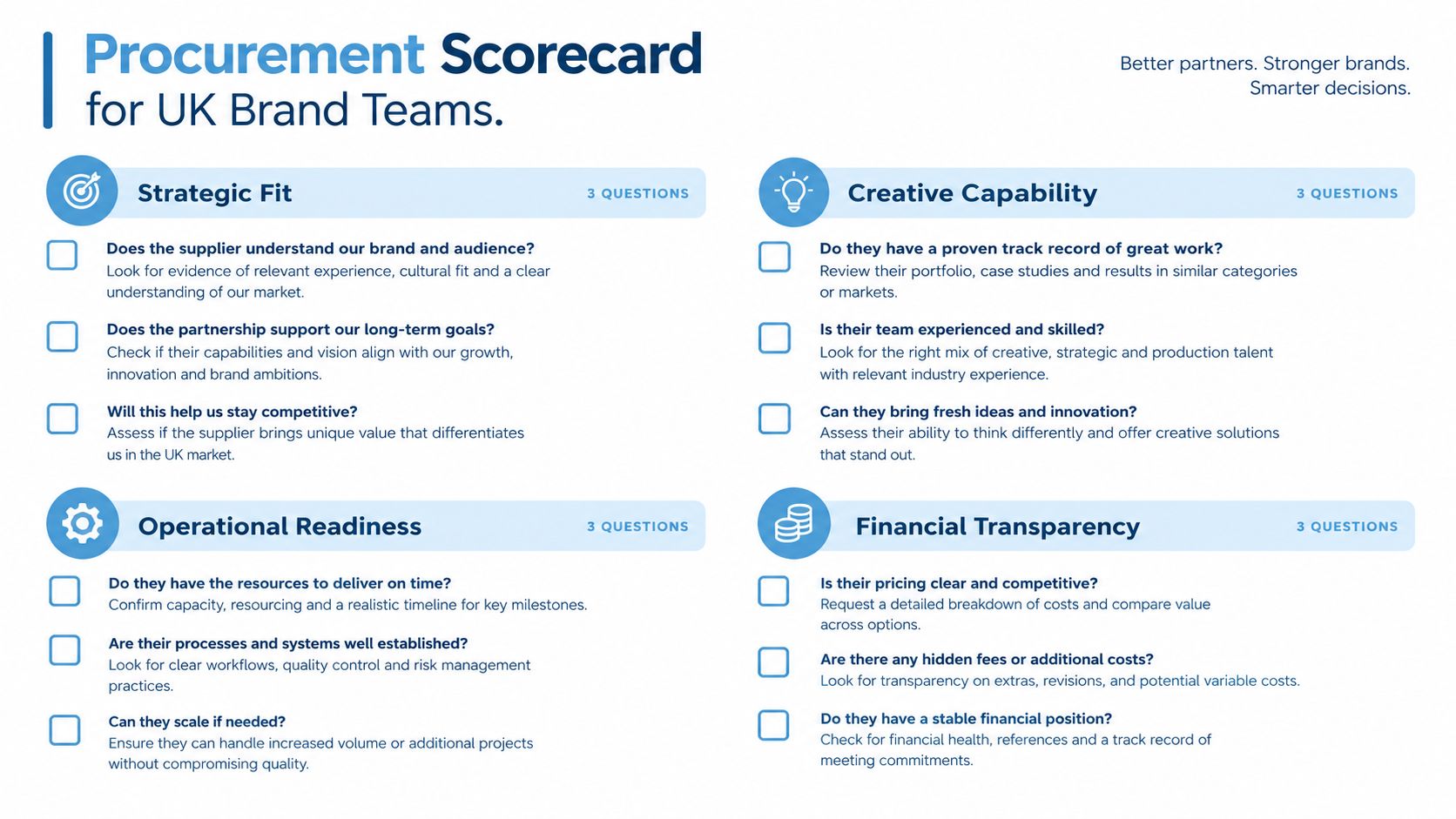
Take this scorecard into the first agency call. You're not looking for the longest supplier list. You're looking for evidence that the proposed team can own the brief from commercial objective to safe delivery and useful follow-up.
Agency credentials
- Industry membership: Confirm relevant professional memberships, including RBA membership where applicable.
- Insurance: Check cover levels, exclusions, and whether subcontractors carry appropriate protection.
- Venue access: Ask which venues and supplier networks the team regularly works with.
- Crew model: Understand the ratio of in-house staff, trusted freelancers, and one-off subcontractors.
Proof points
- Comparable work: Request live case studies with named metrics that match your objective.
- Reporting evidence: Ask to see a post-event debrief with data definitions and attribution notes.
- References: Speak to clients who used the proposed account and production team.
Commercial hygiene
- Rate card: Require transparent rates, assumptions, exclusions, and mark-ups.
- Payment milestones: Tie payments to agreed deliverables and approval points.
- Cancellation terms: Clarify exposure if the venue, date, audience, or scope changes.
- Creative ownership: Confirm who owns concepts, artwork, designs, content, and reusable assets.
Operational readiness
- Technical capability: Check CAD, build partners, technical production, and venue documentation.
- Sustainability: Ask how materials, transport, storage, reuse, and waste are handled.
- Contingency: Require a practical response plan for weather, supplier failure, technology faults, staffing gaps, and crowd changes.
Chemistry and governance
- Named account lead: Put the person who will run the work in the proposal.
- Response standards: Agree response SLAs, meeting cadence, approval routes, and escalation.
- Day-of staffing: Confirm who has authority on site and who can make a safe operational decision.
Ask these questions directly:
- How do you turn an open brief into a defined audience journey and costed scope?
- What do you cut first when the budget becomes too tight?
- Which elements do you deliver in-house, and which rely on partners?
- How do you train and brief the on-site team?
- What data do you collect at each interaction?
- How do you separate direct results from wider campaign influence?
- Who owns the creative IP and captured content?
- What happens if the venue changes its requirements during load-in?
- Who has final authority for health and safety on the day?
- What does your post-event debrief include beyond footfall and social reach?
Use the answers to choose the partner that makes fewer promises and provides stronger evidence. Then brief them with one primary outcome, a realistic budget structure, clear decision rights, and the operational constraints you already know. PSW Events provides interactive brand activation support across exhibitions, conferences, launches, fan zones, and experiential campaigns, including planning, branding, logistics, installation, staffing, and health and safety compliance. If that delivery model fits your next brief, visit PSW Events to discuss the activation and the audience action you need it to produce.