
Your exhibition stand is polished, your product team is ready, and the doors have opened. Yet delegates keep walking past passive screens and neatly arranged brochures because nothing gives them a reason to stop. By the afternoon, the stand may have plenty of impressions but very little meaningful participation, useful data, or follow-up momentum.
The strongest event activation ideas treat attention as the start of an interaction, not the finished result. A simulator, competition, photo experience, or challenge should make participation simple, keep queues moving, represent the brand naturally, and produce evidence that supports the next commercial decision. That matters in a UK events market estimated to be worth £61.653 billion annually, supporting more than 700,000 jobs, with exhibitions and trade fairs contributing £10.9 billion and meetings and conferences £16.3 billion, according to the UK Events Report summary.
The ten ideas below are assessed against the same practical questions: what business objective does the activation serve, who will use it, what scale can it support, what will delivery require, and which KPIs can prove its value? For B2B campaigns, that measurement discipline belongs alongside broader planning covered in this guide to events for B2B marketers.
1. Interactive Simulator Experiences
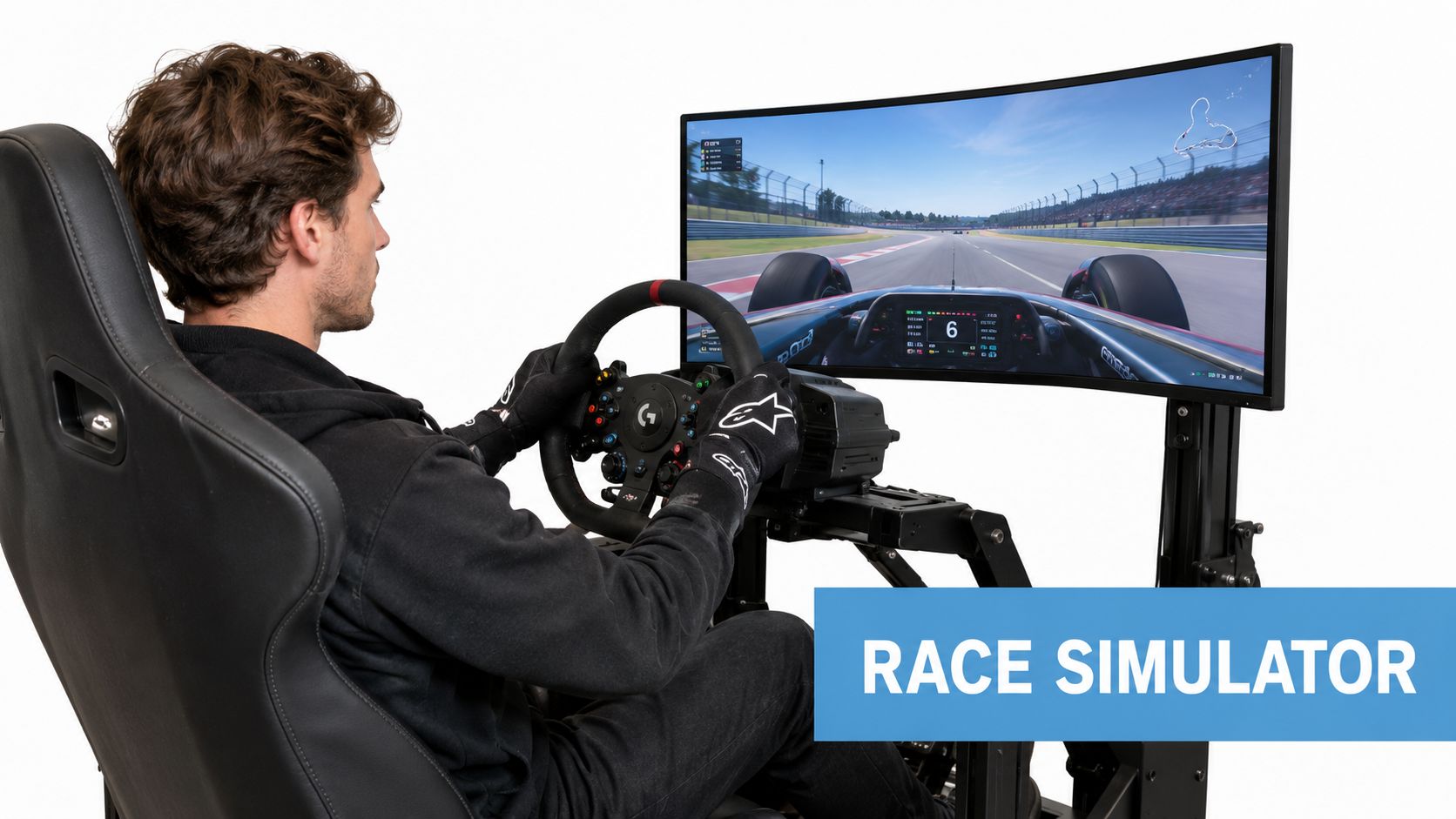
An interactive simulator earns attention because the participant does something immediately. A racing rig, flight simulator, golf simulator, or sports challenge turns a passing delegate into an active user, while the score creates a natural reason to stay, try again, or invite a colleague.
For a corporate hospitality event at Silverstone, F1 racing simulators can reinforce the setting without requiring guests to understand a complex product message. At an aerospace conference, a flight simulator can provide a more relevant demonstration than a generic game. American football simulators suit sports brands, while golf simulators can support conversation at hospitality and networking events.
Match the experience to the objective
Use the simulator differently depending on what you need:
- Footfall: Place it where passing traffic can see the action and the leaderboard.
- Dwell time: Add a timed experience, repeat attempts, or rotating formats.
- Lead capture: Require contact details when participants submit a score.
- Brand recall: Apply sponsor logos to the leaderboard, rig surrounds, and digital results.
- Social content: Make the score and participant name easy to save or share.
The trade-off is throughput. A high-end simulator can create a memorable experience, but a long reset process or unclear queue will frustrate visitors. Keep instructions visible, rotate experience types during the day, and offer recognition to more than just the best performer so newcomers don't feel excluded.
For a managed installation, simulator hire for events can cover the attraction alongside branding, logistics, staffing, and on-site operation. Track participation starts, completed runs, repeat attempts, dwell time, qualified contacts, and follow-up actions, rather than treating the queue alone as success.
2. Branded Photo and Video Booths
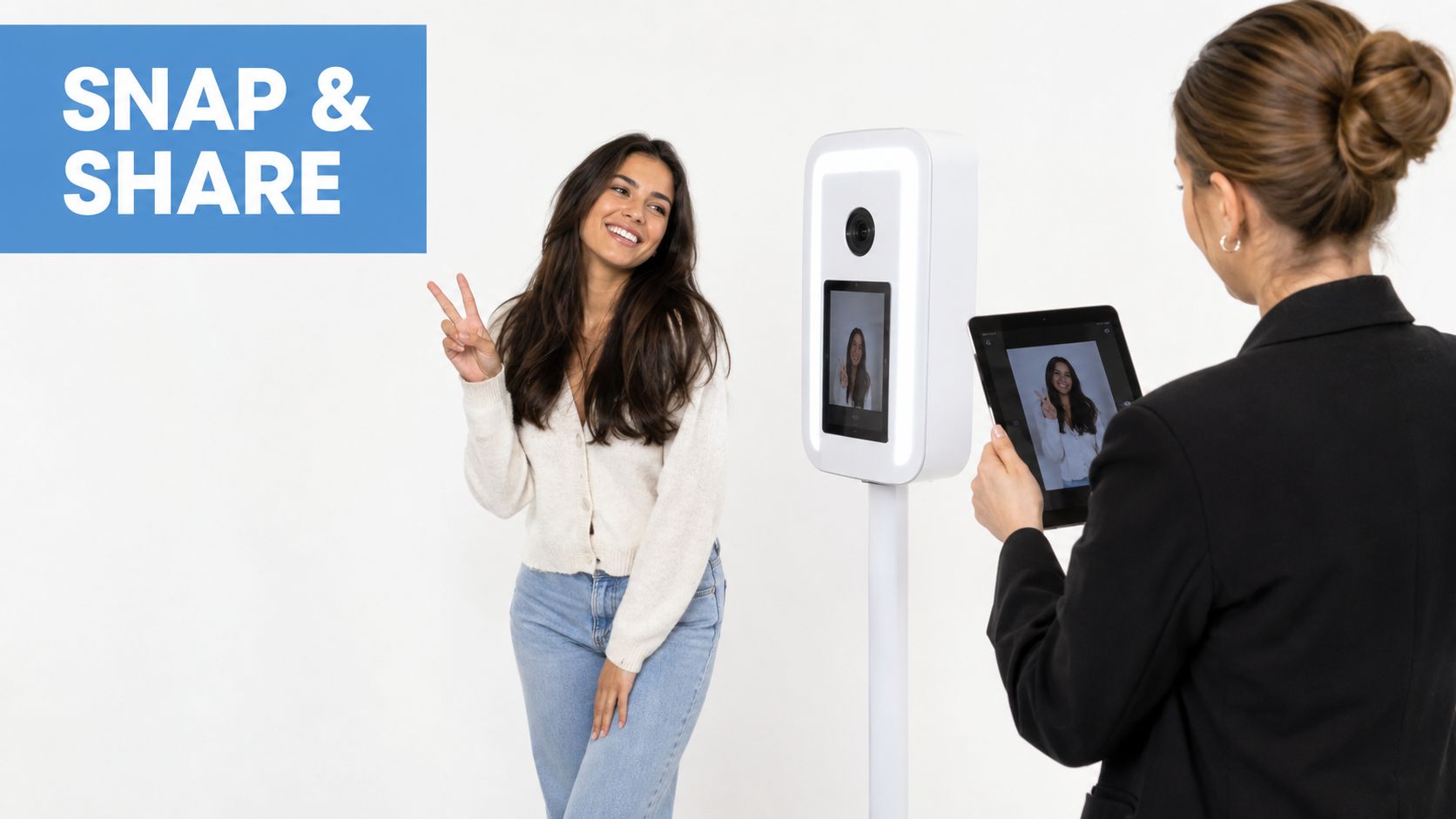
A photo or video booth works best when the output is useful enough to keep. A branded image, short video, or virtual scene gives attendees a takeaway they can share, while the delivery process can create a clear permission-based route into your database.
A fashion product launch might use a styled backdrop and campaign props. At a conference, the booth could connect the image to a delegate badge or event theme. A festival sponsor might build a selfie station around its visual identity, while a team-building event could turn group photos into a timed creative challenge.
Make sharing part of the experience
The booth should be readable from a distance, quick to understand, and simple to use without a staff member explaining every step. QR codes and one-click delivery reduce friction, but asking for an email before sending the file must be transparent. Use a clear consent statement and separate marketing permission from the basic delivery choice.
The creative trade-off is between visual impact and brand relevance. A spectacular background may generate shares without helping people remember the sponsor. A restrained design that includes a product, message, or useful call to action may produce fewer casual images but stronger commercial value.
Consider these operating details:
- Props: Choose objects that encourage group participation rather than a single static pose.
- Moderation: Review live content before displaying it publicly.
- Screen display: Show selected images to create social proof without exposing private data.
- Follow-up: Add a post-event message connected to the shared content, not an unrelated sales email.
A specialist photo booth hire service can manage the hardware and delivery flow. If the brief needs something less familiar, compare the format with these photo booth alternative ideas. Useful KPIs include completed captures, opted-in contacts, shares, branded hashtag use, qualified conversations, and post-event responses.
3. Gamified Leaderboard Competitions
A leaderboard turns a simulator into a repeatable event format. Visitors understand the objective, see how their result compares, and have a reason to return before the session ends. Golf simulators, boxing simulators, Scalextric racing and multi-game fan zones can all support this structure, but the scoring method should match the audience and business goal.
At a corporate event, a golf challenge can prompt conversation between meetings. An automotive exhibitor might connect a Scalextric championship with vehicle design or engineering. A sports brand could use a supervised boxing challenge to attract participants and spectators. For hospitality campaigns, the same mechanics can inform restaurant loyalty program ideas, particularly where repeat visits and tiered rewards matter.
Design for more than the winner
A single first-place prize can deter beginners and reduce participation. Create categories for skill level, improvement, team performance or consistency, giving more visitors a credible route to recognition. Refresh rankings throughout the day, announce results where suitable, and offer a clear way to save scores for approved sharing.
The main trade-off is competitive pressure. Strong rivalry can increase repeat attempts, while an intense format may put off a corporate audience. Friendly time trials, team rankings and “beat the host” challenges usually offer broader participation than an elite performance table.
Set the format around venue capacity and event timing:
- Short rounds: Make each attempt quick to explain, run and reset.
- Visible progress: Display scores immediately and state how rankings are calculated.
- Tiered rewards: Recognise improvement, consistency and team results, not only the highest score.
- Fair play: Separate age groups, experience levels or equipment types where they affect results.
An electronic leaderboard for events can link the attraction to branded screens and live ranking updates. Track attempts, repeat participation, average engagement time, scores submitted, contacts captured and conversations that progress to a meeting. Treat a participant as a lead only when they fit the target audience and provide usable consent. For larger events, assign a marshal, test score recovery and prepare a manual fallback if the network fails.
4. Virtual Reality Experience Zones
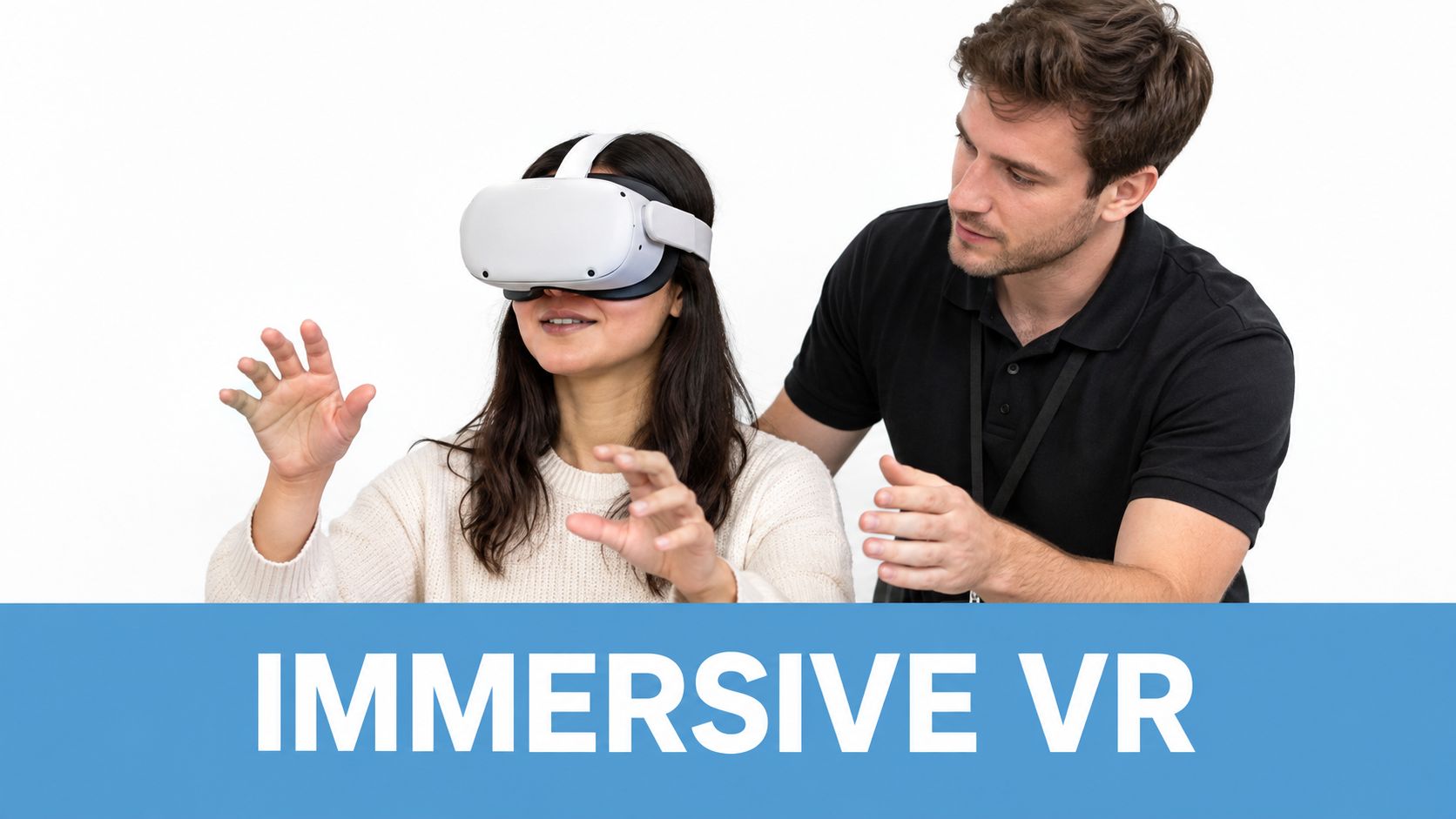
VR is valuable when the audience needs to experience something that can't be brought to the venue. A property developer can offer virtual walkthroughs of an unfinished development. An aerospace company can let delegates explore a flight scenario. A corporate conference can use VR for product simulation or training, while a festival can offer an adventure experience designed for entertainment.
UK event technology adoption supports this format, but the data also highlights the need to design it carefully. Twenty-two per cent of UK event organisers use VR or AR, and 60% of attendees find VR or AR engaging, according to UK event technology statistics. Those figures indicate interest, not automatic success. A headset doesn't solve a weak experience, slow queue, or confusing brand message.
Protect flow and comfort
Offer short and longer experience options so visitors can choose according to available time. Give every participant a clear safety briefing, explain how to remove the headset, and sanitise equipment between users. Staff should support people with different levels of technical confidence without making inexperienced participants feel awkward.
VR's main trade-off is throughput versus immersion. A detailed simulation may impress a small number of users, while a simpler experience can serve more people and create more conversations. A non-VR viewing screen can keep spectators involved and provide an alternative for anyone who doesn't want to wear a headset.
Track starts, completions, abandonment, queue time, repeat use, feedback, content choices, consented data, and post-event enquiries. The experience should also have a clear debrief. After a property walkthrough, for example, a host can discuss the development. Without that human hand-off, VR risks becoming an isolated attraction rather than a sales or brand asset.
5. Team-Based Challenge Circuits
A circuit combines several attractions into one shared journey. Teams might rotate between a simulator, climbing wall, casino table, Batak Pro station, golf simulator, and VR experience, collecting points as they go. The format works well for corporate team days because it supports different personalities. Competitive participants can chase scores, while others can contribute through collaboration or problem-solving.
The circuit also solves a venue-flow problem. Instead of placing one popular attraction at the centre of a crowd, organisers can distribute activity across several stations. Each station needs a clear purpose, visible scoring, and an operator who can keep the experience moving.
Build the route before the theme
Stations should be short enough to support predictable rotation, with transition time included in the schedule. Staff need to know how to explain the challenge, manage equipment, monitor safety, and record scores. A visual progress board helps teams understand their position without repeatedly asking an organiser.
A circuit is more operationally demanding than a single attraction. It needs more floor space, more staff, and stronger coordination between stations. It can also create a better shared memory because team members discuss tactics, encourage one another, and see a cumulative result.
Use practical safeguards:
- Flexible entry: Allow people to join a team or leave without disrupting the whole route.
- Balanced scoring: Don't let one specialist activity decide the entire result.
- Accessible options: Provide alternatives for different physical abilities and comfort levels.
- Physical theming: Use signs, props, and colour coding to make transitions intuitive.
For an exhibition, a shorter circuit may work better than a full team-day format. For a large internal event, a more varied route can support longer participation. Measure team completion, station-level participation, average time per station, repeat visits, satisfaction, and the number of useful conversations created by the activity.
6. Live Performance and Entertainment Integration
A live performer can turn an activation zone into a destination. A DJ announcing simulator winners creates rhythm and anticipation at a festival. A celebrity athlete can host a racing challenge at a sports event. A comedian can comment on a team circuit, while a live band can provide atmosphere around gaming stations at a corporate gathering.
The performer shouldn't operate as a separate show that happens to sit next to the brand. Their role is to make the activation easier to notice, easier to understand, and more enjoyable to join. Brief them on the audience, the brand message, the timing, and the boundaries of audience interaction.
Use energy with control
Schedule the biggest performance moments when footfall is likely to be strongest, then use quieter intervals for conversations and lead capture. Create clear sightlines so non-participants can watch without blocking the queue. A host can explain the rules, invite the next participant, celebrate a result, and direct people to a relevant product conversation.
Entertainment has a clear trade-off. It can increase noise and attention, but it can also drown out sales conversations or make a serious B2B message feel misplaced. Match the format to the event. A high-energy DJ may suit a fan zone, while a skilled presenter or athlete may be better for an aerospace conference.
Capture short, consented clips for post-event content, but don't let filming obstruct the live experience. Measure spectator numbers, participant starts during performance windows, queue movement, dwell time, content outputs, and qualified interactions. The strongest result isn't merely a larger crowd. It's a crowd that understands what to do next.
7. Brand Storytelling Through Interactive Installations
Brand storytelling becomes more persuasive when visitors reveal the message through their actions. A flight simulator can introduce an aviation company's heritage as the participant progresses. A racing simulator can connect driving performance with engineering decisions. A sport-specific challenge can use athlete achievements to frame the brand's expertise, while an interactive timeline can turn a corporate anniversary into a sequence of discoveries.
The installation needs a narrative spine. Start with a problem, decision, or challenge that the participant can recognise. Then make the experience reveal a product benefit, value, or piece of company history through play. If the brand appears only as a logo around the edge, the activation may entertain without building understanding.
Let the story do the selling
Avoid placing a long product explanation before the activity. Visitors usually engage more willingly when the challenge starts quickly and the message emerges at the right moment. A host can then connect the participant's result with a real-world application.
Useful design choices include:
- Progressive messages: Reveal one benefit at a time instead of presenting every claim upfront.
- Familiar references: Use recognised ambassadors, characters, or visual cues where they fit.
- Feedback capture: Ask what participants understood or remembered, rather than only whether they enjoyed it.
- Takeaway content: Provide a branded summary, result, or next step after completion.
The trade-off is subtlety. A message that's too hidden may fail to communicate, while aggressive product placement can make the experience feel like an advert. Test the journey with someone unfamiliar with the brand and ask them to describe what they learned afterwards.
Track message recall, product questions, completion rates, feedback themes, relevant lead quality, and post-event content downloads. For a B2B audience, the host's follow-up conversation may be more valuable than the game itself, so give staff a short set of questions that connect the narrative to business needs.
8. Prize and Incentive Integration Systems
A prize gives people a clear reason to participate, return, or complete a data-sharing step. F1 simulator winners might receive racing merchandise. A leaderboard could provide an upgraded experience. A retail challenge might issue a voucher, while a tournament could offer premium content or event access.
The reward needs to reinforce the desired behaviour. If you want high-quality conversations, don't make the prize available after a meaningless scan. If you want repeat visits, structure the competition so attendees can improve their score later. If you want post-event action, make the reward or voucher useful after the event rather than handing out a generic item with no connection to the brand.
Reward participation without distorting it
Offer several performance or participation tiers. This gives more people a realistic chance of receiving recognition and prevents the entire experience from becoming a specialist contest. Make redemption immediate where possible, explain availability clearly, and train staff to answer eligibility questions consistently.
Prizes can also create operational problems. Physical stock needs storage, tracking, and replenishment. High-value rewards may attract people who have no interest in the brand. A sponsor partnership can broaden the prize pool, but it can also introduce competing messages if the arrangement isn't planned carefully.
Practical rule: The reward should make the next brand action easier, not simply make the queue longer.
Measure participation by reward tier, repeat attempts, completed challenges, lead quality, voucher use, post-event visits, and follow-up conversion. Be clear about the rules, any age restrictions, and how personal data will be used. A well-designed incentive increases relevance and momentum. A badly designed one attracts volume without commercial value.
9. Data Capture and Analytics Integration
Data capture should sit inside the experience, not interrupt it. A participant can submit a simulator score, choose a scenario, answer a preference question, or complete a short feedback prompt. Those actions can reveal interest and intent, provided the organiser explains the exchange and collects information lawfully.
At a corporate conference, a simulator score could connect to a consented participant profile. An interactive product scenario could record which features a visitor explored. A leaderboard could register competitive participation, while a post-experience survey could assess brand perception or identify a follow-up topic.
Separate useful data from vanity data
The first question isn't how much data the activation can collect. It's which data the sales, marketing, or customer team can use. Capture fewer fields if that keeps participation easy. A job role, company, business need, and agreed follow-up may be more valuable than a long form completed by people who aren't relevant prospects.
Build the measurement plan before the event:
- Consent: Explain what will be collected, why it's needed, and how it will be used.
- Experience design: Ask for information at a natural point, such as score submission or digital delivery.
- Privacy controls: Restrict access, anonymise reporting where appropriate, and follow the organisation's privacy process.
- Live reporting: Use dashboards to identify queue issues, popular formats, or weak conversion during the event.
- Post-event analysis: Connect participation with meetings, replies, opportunities, or other agreed actions.
The trade-off is speed versus depth. A short interaction can produce broad participation, while a longer questionnaire may deliver richer segmentation but lose people before completion. Measure consented profiles, completion rate, field quality, preferences, follow-up acceptance, meeting bookings, and downstream action. Don't call a contact qualified merely because they entered a competition.
10. Customisable Modular Experience Packages
A regional sports activation may need one F1 simulator and a leaderboard, while a corporate team day could combine golf, boxing, and a photo booth. A conference with more floor space might add a climbing wall or Batak Pro. A festival could run several stations as a complete circuit. Modular packages let organisers match the attraction mix to the audience, venue, objective, and available budget.
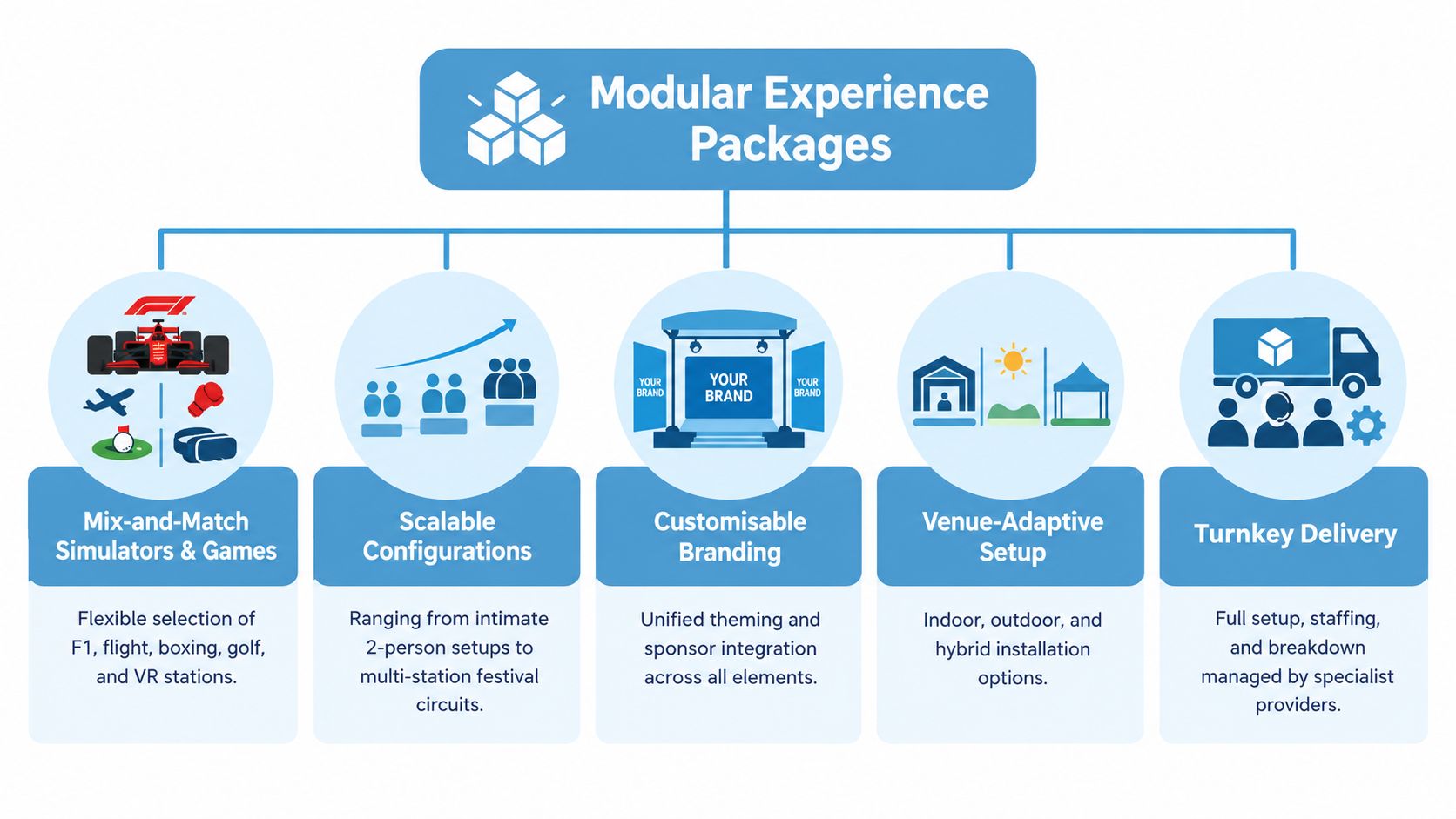
The format works well for brands operating across multiple locations. Keep the visual identity, scoring logic, data process, and host briefing consistent, then change the physical attraction to suit each room and audience. A simulator can support product demonstration or corporate hospitality, while the same scoring and leaderboard system can drive competition at an experiential event. With limited space or budget, one high-impact activity may perform better than several attractions competing for attention.
Integrate the package early
Modular equipment is not automatically plug-and-play. Several attractions may require separate power supplies, network access, screens, storage, queue space, and trained operators. Before approving the creative, confirm venue rules, access routes, floor loading, noise limits, fire procedures, installation windows, and dismantling requirements.
Choose elements that support the same audience behaviour. A racing rig, electronic leaderboard, and branded prize system can encourage repeat participation. A quiet networking lounge beside a loud simulator may reduce useful conversations. A photo booth can support a challenge circuit when its content serves the same campaign, but it may also draw visitors away from higher-value discussions.
Assess the package against:
- Audience fit: Match activities to interests, ability levels, and accessibility needs.
- Operational load: Plan staffing, maintenance, resets, storage, and contingencies.
- Technical integration: Confirm power, networking, screens, scoring, and data capture.
- Brand cohesion: Apply one visual system and consistent host language.
- Measurement: Set KPIs for each attraction and for the package overall.
A specialist supplier can reduce coordination risk by managing branding, logistics, installation, staffing, and health and safety together. Track participation per attraction, space efficiency, throughput, dwell time, lead quality, repeat use, cost against objective, and post-event action. This shows whether the package created useful business value, rather than merely filling the floor.
Comparison of 10 Event Activation Ideas
| Activation Type | 🔄 Implementation Complexity | ⚡ Resource Requirements | 📊 Expected Outcomes | Ideal Use Cases | ⭐ Key Advantages / 💡 Quick Tip |
|---|---|---|---|---|---|
| Interactive Simulator Experiences | High – setup, calibration, trained operators | Dedicated floor space, power, motion rigs, staff | Strong engagement, repeat sessions, measurable scores | Corporate hospitality, sports brand activations, networking events | ⭐ Memorable & measurable engagement, 💡 Place in high-traffic areas, use leaderboards |
| Branded Photo and Video Booths | Low–Medium – simple tech but peak queueing | Camera/booth, green screen, reliable internet, attendant | Wide social reach, lead capture, instant shareable content | Product launches, festivals, conferences | ⭐ Cost-effective social amplification, 💡 Make sharing one-click with QR links |
| Gamified Leaderboard Competitions | Medium–High – real-time monitoring & scoring | Robust networking, multiple stations, large displays, support staff | Repeat participation, spectator excitement, data capture | Tournaments, fan zones, hospitality events | ⭐ Drives competition & retention, 💡 Refresh leaderboards regularly; tiered prizes |
| Virtual Reality (VR) Experience Zones | High – hardware, hygiene, and training needs | VR headsets, tracking, sanitisation, networked PCs, operators | Very high memorability, emotional impact, behavioural analytics | Product demos, immersive storytelling, training scenarios | ⭐ Extremely immersive experiences, 💡 Offer short sessions (2–5 min) and strict sanitisation |
| Team-Based Challenge Circuits | High – complex logistics and scheduling | Large multi-station footprint, many staff, varied equipment | Sustained engagement, team bonding, even traffic flow | Team-building, large corporate days, festival circuits | ⭐ Versatile and social engagement, 💡 Design 5–10 min stations for smooth rotation |
| Live Performance & Entertainment Integration | Medium–High – scheduling and coordination risk | Performers, sound/staging, emcees, coordination staff | Increased dwell time, crowd draw, shareable moments | Festivals, premium corporate events, peak-traffic activations | ⭐ Amplifies atmosphere and footfall, 💡 Align performance peaks with expected traffic |
| Brand Storytelling Through Interactive Installations | High – narrative design and content development | Custom content, longer session flows, specialist designers, staff | Deep brand connection, better recall, behaviour change | Trade shows, product launches, corporate anniversaries | ⭐ Creates authentic emotional connection, 💡 Integrate messages subtly into gameplay |
| Prize & Incentive Integration Systems | Medium – logistics, legal and admin work | Prize inventory, redemption tech (QR), CRM integration, staffing | Higher repeat plays, stronger motivation, sponsor activation | Competitive activations, retail tie-ins, lead-generation events | ⭐ Boosts participation and sponsor value, 💡 Offer multi-tier prizes and instant redemption |
| Data Capture & Analytics Integration | High – privacy, integration, security demands | Registration systems, QR/RFID, analytics dashboard, security controls | Actionable insights, measurable ROI, remarketing lists | Enterprise events, data-driven campaigns, sponsor reporting | ⭐ Delivers measurable business intelligence, 💡 Obtain clear consent and anonymise data |
| Customisable Modular Experience Packages | Medium – coordination and cohesion planning | Mix-and-match equipment, adaptable logistics, turnkey provider support | Flexible scaling, cost-efficient deployment, consistent quality | Multi-venue rollouts, varied budgets, hybrid events | ⭐ Scalable and adaptable solutions, 💡 Prioritise high-impact elements when constrained |
Choose the Activation That Can Prove Its Value
Start with the audience and one primary business objective. A trade show team trying to generate qualified conversations needs a different activation from a consumer brand seeking social content, and both differ from an internal team day focused on collaboration. Write the desired action in plain language, such as “book a product conversation”, “complete a product trial”, or “create a shareable brand asset”. If the objective can't be explained clearly, the activation will probably collect activity without direction.
The UK opportunity is substantial. The sector is estimated to support more than 1.3 million business events each year, while main UK exhibition venues recorded 7.2 million exhibition visits in 2024, compared with 6.92 million in 2023, according to the SASIE 2024 report. A typical median exhibition attendance was 3,000, while the average was 6,800, so your activation must work both in concentrated stand environments and in larger, busier venues. Those audiences create opportunity, but they also create competition for attention.
Next, match the idea to space and throughput. A simulator may be ideal for a compact stand if the queue is visible and the experience resets quickly. A team circuit needs more room and coordination. VR may deliver a strong product demonstration but needs hygiene controls and alternatives for visitors who don't want to wear a headset. A photo booth needs a clear background, lighting, privacy, and a smooth digital delivery path. Entertainment requires sightlines, sound management, and a host who can connect the crowd to the brand.
Then confirm delivery requirements before booking. Ask who will install and operate the equipment, how participants will be briefed, what happens if the technology fails, and how the team will manage queues. Review accessibility, risk assessments, electrical requirements, venue restrictions, insurance, data protection, and emergency procedures. An attraction that looks impressive in a proposal can become a liability if the floor plan, staffing model, or safety process is vague.
Agree KPIs before the supplier arrives. Footfall is useful as a context measure, but it doesn't show whether the right people participated. Compare:
- Dwell time: How long did participants remain engaged?
- Participation: How many people started and completed the experience?
- Repeat visits: Did the format encourage another attempt or a colleague referral?
- Content: How much usable, consented photo or video content was created?
- Lead quality: Did contacts match the intended audience and provide actionable information?
- Post-event action: Did participants reply, book meetings, request information, or progress commercially?
Measurement also needs a search and follow-up plan. Google dominates UK search discovery. StatCounter-based reporting places its share at 91.75% in August 2026, with Bing at 5.67%, according to the UK SEO industry report. The CMA has separately found that Google accounts for more than 90% of general search queries in the UK, as reported in this UK search market overview. Build your event landing page, follow-up content, and activation terminology around the phrases your UK audience uses, while treating Bing and other engines as useful secondary channels.
Don't choose the most spectacular idea by default. Choose the experience that makes the intended behaviour easy, fits the venue, protects participants, and produces evidence your stakeholders can understand. For a simulator or interactive attraction package, PSW Events provides delivery for exhibitions, conferences, brand activations, team building, fan zones, and private events across the UK and internationally, with planning, branding, logistics, installation, staffing, and health-and-safety support.
Tell PSW Events what audience you need to engage, what space you have, and which KPI matters most. The team can help shape a turnkey combination of simulators, VR, electronic leaderboards, photo booths, sports attractions, or modular challenges for your event. Visit PSW Events to discuss the activation and delivery support that fit your brief.
PSW Events supplies interactive simulators, leaderboards, VR, photo booths, and modular attractions for UK and international corporate events, exhibitions, conferences, and brand activations. Share your audience, venue, and commercial objective with the team, then visit PSW Events to plan a measurable experience.