
Tuesday morning in a Manchester office. A corporate planner is nursing a flat white while reading a 12-page procurement brief that asks for “event support” without defining what that means. Her board has already cut last year's budget by 15%, and the next approval meeting will focus on three questions: how many people stopped, how long did they stay, and how many useful leads did the event create?
That's the decision behind event management services. You're not buying a venue, a stage or a team in branded shirts. You're buying a controlled route from business objective to audience action, with delivery capacity, safety and evidence built into the plan. The UK market is substantial, with the UK events industry estimated at £61.653 billion annually in the UK Events Report 2024, including business events, exhibitions and trade fairs, and leisure and outdoor events (UK Events Report 2024).
The practical issue is that demand doesn't remove delivery risk. Recruitment remains challenging for event businesses, skilled candidates are in short supply, and work-life balance is a major retention concern (ESSA industry survey). Martyn's Law, formally the Terrorism (Protection of Premises) Act 2025, also applies where it's reasonable to expect 200 or more people to be present at the same time, including staff and visitors (Martyn's Law guidance). This guide answers the questions that planner needs answered, in the order they arise, from scope and supplier models to ROI, compliance and live scenarios.
The Briefing Every Event Planner Wishes They Had
The planner closes the procurement document and rewrites the opening line. “Provide entertainment” becomes “increase qualified conversations at the stand, create a reason to remain in the space and return a usable contact record to sales.” That change takes less than a minute, but it alters every supplier conversation that follows.
A simulator, competition or interactive installation can attract attention. It can't, by itself, prove commercial value. The brief needs to specify the audience, the action you want from them, the experience they should have, the information you need to capture and the evidence the board will accept.
Start with the decision behind the event
For a trade show, the commercial action might be a qualified meeting booked by a prospect who fits a defined account profile. For an internal away-day, it could be participation, team feedback and a smooth experience that doesn't make employees queue through an avoidable bottleneck. For a public activation, it might be dwell time, opt-in data and a clear connection between the interaction and the brand.
The UK's business-events economy has long been recognised as a significant contributor, with government and industry sources citing around £32.6 billion a year entering the UK economy and 8.8 million business visits in 2017 (International Business Events government report). More recent industry reporting recorded 95.4 million delegates, approximately 144.8 million delegate days and around £19.3 billion in delegate spending in 2024 (UK Conference and Meetings Survey guidance). Those figures don't justify every activation. They do explain why planners are expected to defend spend with more than attendance totals.
Practical rule: If the supplier can only report how many people passed the stand, the brief isn't finished.
The sections ahead treat event management as an engagement channel. They also address the less glamorous questions that decide whether an ambitious concept survives contact with the venue, the crew rota and the compliance file.
What Event Management Services Actually Include
Event management services are the umbrella covering strategy, creative direction, production, logistics, audience handling and measurement for a live experience. Think of the event day as the visible tip of the project. Most of the work happens before guests arrive, when the team converts an objective into a buildable, staffed and measurable operation.
A useful way to understand the scope is to walk through a venue day. Before doors open, someone must confirm what success means, source the space, review the contract, appoint suppliers, design the floorplan, arrange power and AV, brief staff and test registration. During the event, the team manages arrivals, queues, programme cues, audience flow, incidents, lead capture and supplier performance. Afterwards, it reconciles costs, removes equipment, cleans the data and produces a report.
The core building blocks
The work normally includes:
- Objective setting and KPI design: Define whether the event is intended to generate leads, support sales conversations, improve employee connection or create public participation. Choose measures that match the decision.
- Concept and creative direction: Turn the objective into a format, visual identity and audience journey. A racing simulator may be the draw, but the surrounding challenge, messaging and follow-up determine whether it performs commercially.
- Venue sourcing and contract review: Check access, capacity, restrictions, loading, utilities, insurance requirements and cancellation terms before committing.
- Supplier procurement: Appoint production, furniture, AV, catering, staffing, security, transport and specialist attraction suppliers where required.
- Production and build: Deliver the physical environment, graphics, staging, lighting, technical equipment and event-day infrastructure.
- Registration and delegate management: Manage invitations, booking, check-in, badges, attendance records and communications.
- On-the-day operations: Coordinate the venue, crew, talent, speakers, suppliers, queues, changes and contingency decisions.
- Measurement and reporting: Connect attendance data with dwell time, interactions, lead quality, feedback and agreed commercial outcomes.
The visible activity may occupy one venue day, while the paid preparation often extends over roughly six weeks. Costs don't all move with guest numbers. Staffing, catering and consumables usually scale with attendance, but venue hire, rigging, design, project management and some technical infrastructure are largely fixed. Halving the guest list rarely halves the production budget.
Keep the scope honest
Event management services don't automatically mean standalone catering, hotel booking or travel administration. A caterer can feed guests without owning the audience journey. A travel agent can arrange transport without managing a live activation. Put boundaries around each supplier's responsibilities early, or scope creep will appear as a series of small “can you also” requests.

Service Models Compared End-to-End Modular and On-Site
The right delivery model depends less on the event label and more on who can carry the risk. A repeatable internal format with a proven playbook needs a different supplier arrangement from a public activation involving unfamiliar venues, multiple audience touchpoints and high brand scrutiny.
There are three common approaches.
End-to-end delivery
One agency owns the concept, supplier coordination, production and on-site operation. This suits a product launch, major brand activation or complex trade-show presence where one accountable lead protects continuity. It also works when the client team is small or occupied with sales, marketing and stakeholder management.
The failure mode is dependency. If the agency's project management is weak, every decision becomes concentrated in one place. Ask for named personnel, escalation routes, production schedules and reporting deliverables, not just a polished creative deck.
Modular hire
The client retains creative control and appoints specialists for separate elements, such as a golf simulator, racing rig, AV package, stage, furniture or temporary staffing. This can stretch the budget when an experienced in-house project manager already understands the venue and can coordinate the interfaces.
The risk is fragmentation. A simulator supplier may arrive on time, but that doesn't guarantee the power plan, floor protection, branding, queue system and data capture workflow will work together.
On-site delivery
The client plans the event and hires a production crew for the live period. It makes sense for recurring conferences, roadshows and internal formats where the playbook is stable and the team has already made the key decisions.
The main failure mode is late discovery. A crew can execute a strong plan, but they can't repair an unclear brief, missing supplier information or an unrealistic load-in schedule once the event is live.
The requested rate bands and headcount thresholds should be treated as supplier-specific commercial inputs, not universal market facts. A credible quote will depend on venue, complexity, access, equipment, crew roles, working hours and whether the supplier is accountable for the complete experience.
Event management service models at a glance
| Model | Best For | Typical UK Day Rate | Biggest Risk |
|---|---|---|---|
| End-to-end | Complex activations, launches and high-visibility exhibitions | Quote against scope | Over-reliance on one agency |
| Modular hire | Established in-house teams and repeatable formats | Quote per specialist package | Gaps between suppliers |
| On-site delivery | Proven events with an existing playbook | Quote against crew and hours | Planning problems surface too late |
How to Evaluate and Brief a UK Supplier
A supplier should make the event easier to control, not merely easier to decorate. Start with evidence. Ask for the documents that show whether the company understands public-facing delivery, venue procedures and the consequences of a poorly controlled build.
Request proof before creative
For public events, ask to see the supplier's public liability insurance certificate and confirm that the level matches the venue and activity. The supplied brief for PSW Events identifies £10 million in products, employee and public liability insurance, but every supplier should be checked on its own current documentation.
Request risk assessments and method statements, known as RAMS, for the actual equipment and environment. Generic paperwork copied from another job won't tell you how the team will manage a motion simulator beside a pedestrian route, protect cables, supervise participants or respond to a technical fault. Check PAT records where applicable, crew competence, DBS checks where the venue requires them, and evidence that the supplier understands Martyn's Law responsibilities.
The vendor selection criteria for event planners should also include practical questions:
- Audience profile: Who is attending, and what behaviour should the experience encourage?
- Flow: Where will people arrive, queue, participate and leave?
- Dwell target: How long should a meaningful interaction take?
- Brand controls: What language, imagery and data permissions are mandatory?
- Site constraints: What are the access, power, ceiling, noise and load-in conditions?
- Contingency: What happens if the attraction fails, the queue exceeds the safe plan or the weather changes?
Separate a logistics house from an experiential producer
A logistics supplier can move equipment efficiently. An experiential producer should also understand why the equipment is there. Look for a portfolio with comparable audiences, in-house fabrication or technical capability where relevant, trained on-site staff, a clear lead-capture process and post-event reporting.
Don't accept “attendance” as the only success measure. Put agreed reporting into the contract, including how interactions are counted, what makes a lead qualified, how consent is recorded and when the data will be transferred.

A short brief can fit on one page: event purpose, audience, venue, date, format, footprint, working hours, brand requirements, safety constraints, desired interaction, data process, reporting and budget ceiling. The cheapest quote often becomes expensive when it delivers low-quality engagement, requires extra crew or leaves the client to solve coordination gaps.
Budgeting, ROI and the Numbers Behind Events
A board rarely challenges event spend because it has a budget. It challenges spend that has no credible connection to an outcome. Separate the cost of producing the environment from the cost of prompting and measuring audience action.
The UK events market spans conferences, exhibitions, trade fairs, consumer roadshows and outdoor events. The £61.653 billion annually figure cited for the wider events industry, alongside £16.3 billion from business events, £10.9 billion from exhibitions and trade fairs, and £18.3 billion from leisure and outdoor events, shows why one pricing template cannot fit every format (UK Events Report 2024 market data). Fixed costs, audience behaviour and proof of value vary by event type.
Avoid treating unverified market price bands as tariffs. Catering, venue, production and attraction costs change with city, venue rules, footprint, access hours, staffing and technical specification. Ask suppliers to place their assumptions beside every line.
Build the budget around decisions
A CFO-friendly budget separates:
- Production: Venue, build, staging, AV, lighting, power, rigging, furniture and installation.
- Activation: Attraction hire, presenters, competition mechanics, brand ambassadors, content and audience incentives.
- Measurement: Registration, scanning, consent management, lead qualification, surveys, analytics and reporting.
The easily missed costs are often practical. Allow for power distribution, rigging approvals, waste removal, security, insurance excesses, travel, storage, overtime and VAT treatment. A change in any of these can alter the delivered cost without changing the creative concept.
CFO test: Show what the event cost, what the audience did and what the sales or marketing team can do with the resulting data.
Measure engagement, not just attendance
A useful report separates footfall from participation. Track entries to the activation zone, completed interactions, average dwell time where the system permits it, qualified leads, consent rate, meetings booked and follow-up status. For internal events, participation and feedback measures are more appropriate than a sales metric.
The format also needs a clear cause-and-effect case. A simulator can give people a reason to stop, while trained staff, a short conversation route and a low-friction data process turn that pause into a useful interaction. Use this experiential marketing ROI framework to connect the attraction with a measurable next step, rather than treating entertainment as the result.
Logistics Timeline and UK Health and Safety Checklist
A strong event plan starts before the creative is approved. At T-12 weeks, confirm the venue, audience, suppliers and safety responsibilities, then use the remaining time to resolve access, staffing and compliance issues before build pressure arrives.
T-12 to T-10 weeks
Confirm the venue, issue the supplier RFP and define the required RAMS. Request the floorplan, access schedule, power information, ceiling and rigging rules, occupancy conditions, preferred suppliers, and restrictions on noise or branding.
Give the venue realistic attendance expectations so safe capacities and concurrent tenancies can be assessed. If the venue does not provide crowd safety management, appoint a competent team and follow the Purple Guide and event safety guidance.
T-9 to T-7 weeks
Sign contracts, confirm insurance, review permits and assess the event against the Terrorism (Protection of Premises) Act 2025. The requirements apply where it is reasonable to expect 200 or more people at the same time, including staff and visitors. Treat this review as one part of wider crowd, fire, accessibility and emergency planning. The Martyn's Law requirements should be checked with the venue and relevant dutyholders.
T-6 to T-4 weeks
Lock production drawings, catering numbers, AV specifications, staffing roles and build schedules. For temporary structures, confirm CDM 2015 duties with the relevant dutyholders. Public-space activity needs a clear plan for pedestrian flow, barriers, emergency access and separation from unrelated footfall.
T-3 to T-1 weeks
Complete the crew briefing, final site walk, equipment checks, communications test and rehearsal. Everyone should know who can stop an activity, who contacts the venue and what triggers the contingency plan.
On event day, record the briefing, monitor the operation, manage incidents and capture the engagement data promised in the brief. Afterward, supervise removal, check the venue handover, close the incident log and complete any required RIDDOR reporting. Review electrical arrangements against the applicable requirements of BS 7671.
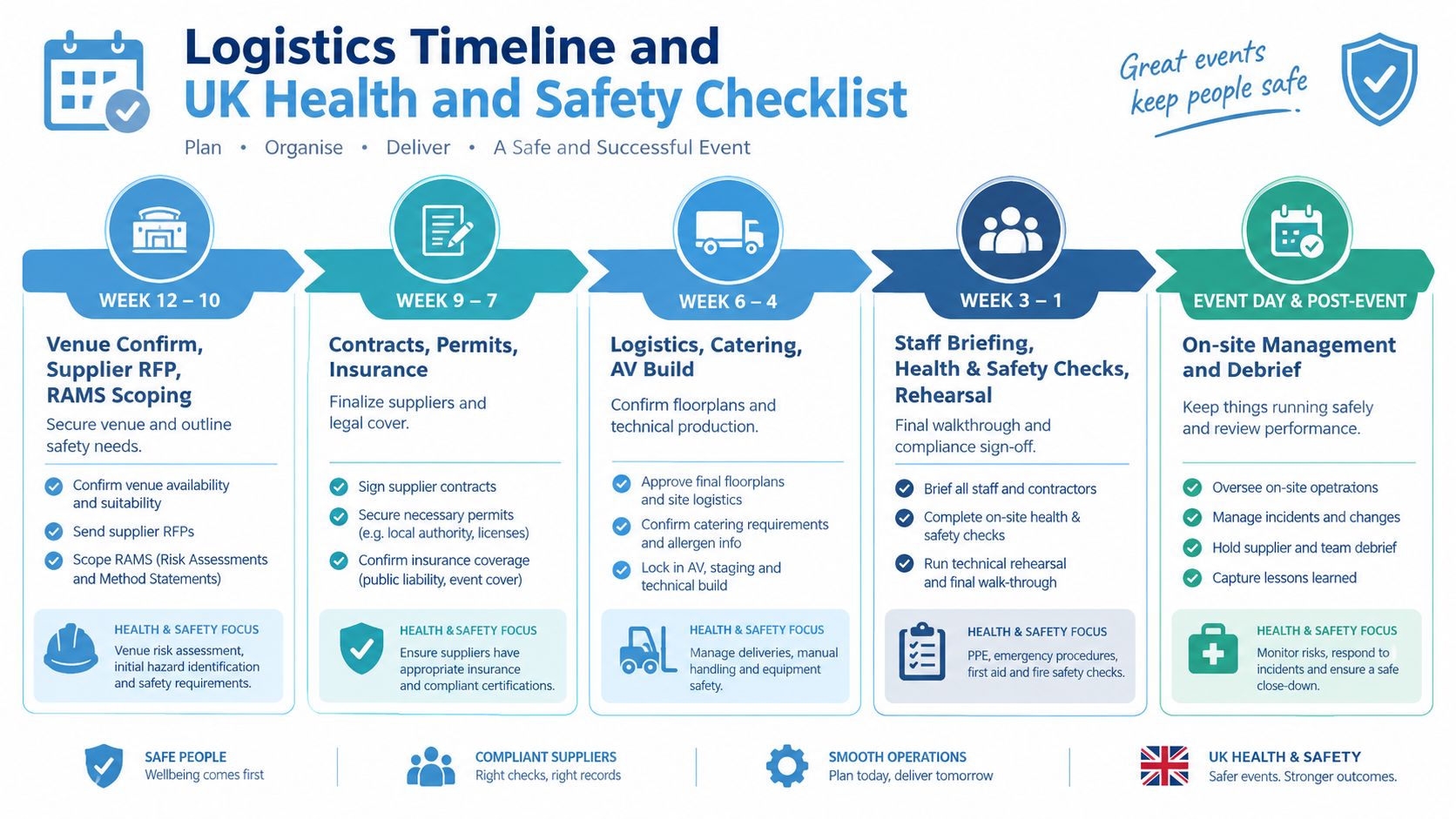
A practical checklist should cover:
- Venue: Capacity, access, utilities, egress and concurrent tenancy confirmed.
- People: Competent crew, role briefings, first aid and crowd safety arrangements agreed.
- Equipment: RAMS, inspection records, cable management, guarding and emergency stops checked.
- Legal: Martyn's Law preparedness, CDM duties, insurance and incident procedures reviewed.
- Close-down: Data captured lawfully, equipment removed, waste cleared and debrief completed.
Include health and safety compliance guidance for events in supplier discussions before accepting a quote. Safety requirements affect staffing, equipment and schedule, so adding them after creative approval can change the delivered cost.
Industry Snapshots Trade Shows Activations and Team Building
The same event management service can produce very different results depending on the audience journey. Three scenarios make the trade-offs clearer.
A first exhibition stand at ExCeL London
A B2B SaaS company is exhibiting at ExCeL London and must choose between a shell scheme and a custom build. The team considers hiring a golf simulator to create a reason for visitors to stop against a backdrop of 15,000 visitors, a figure supplied for this scenario rather than a verified event statistic.
The specialist attraction supplier provides the equipment, operator and competition format. The client accepts the cost of a simpler stand design in exchange for a stronger interaction point, and the commercial measure becomes qualified contacts rather than total plays. The risk is a queue full of casual participants, so the staff script needs a clear qualification question before or after the activity.
For supporting items, a planner can also review guidance on effective event giveaways and select something that extends the conversation rather than adding disposable clutter.
A two-weekend drinks roadshow
A consumer drinks brand is working across Westfield White City and Liverpool ONE. Instead of transporting a permanent build, it uses modular hire for a photo moment and a racing simulator unit, adapting the footprint to each venue's access and trading conditions.
The supplier type is a specialist experiential hire company with a local crew plan. The brand accepts less architectural control, but gains flexibility between sites and avoids rebuilding every element from scratch. The critical result is not the number of photographs. It's whether the interaction creates an identifiable brand memory and a permission-based follow-up route.
An away-day at a Buckinghamshire estate
An FTSE 250 HR team books an away-day and combines catering, AV and two team-building simulators. The event producer manages the site plan, power, staffing and timetable, while the HR team owns the content and employee objectives.
The client accepts that some activities will feel competitive and therefore balances them with inclusive participation options. Engagement is measured through structured feedback and participation records, not sales leads. The supplier needs to manage transitions carefully, because a delayed activity can compress catering, presentations and travel.
| Event Format | Typical Audience | Recommended Service Model | Key Metric | Common Pitfall |
|---|---|---|---|---|
| Trade show | B2B buyers, partners and exhibitors | End-to-end or modular with strong in-house management | Qualified leads and dwell time | Counting plays as prospects |
| Brand activation | Public consumers and target communities | Modular hire or end-to-end | Participation, dwell time and consented data | Prioritising spectacle over flow |
| Team building | Employees and leadership teams | End-to-end or managed modular delivery | Participation and feedback | Designing for competitive participants only |
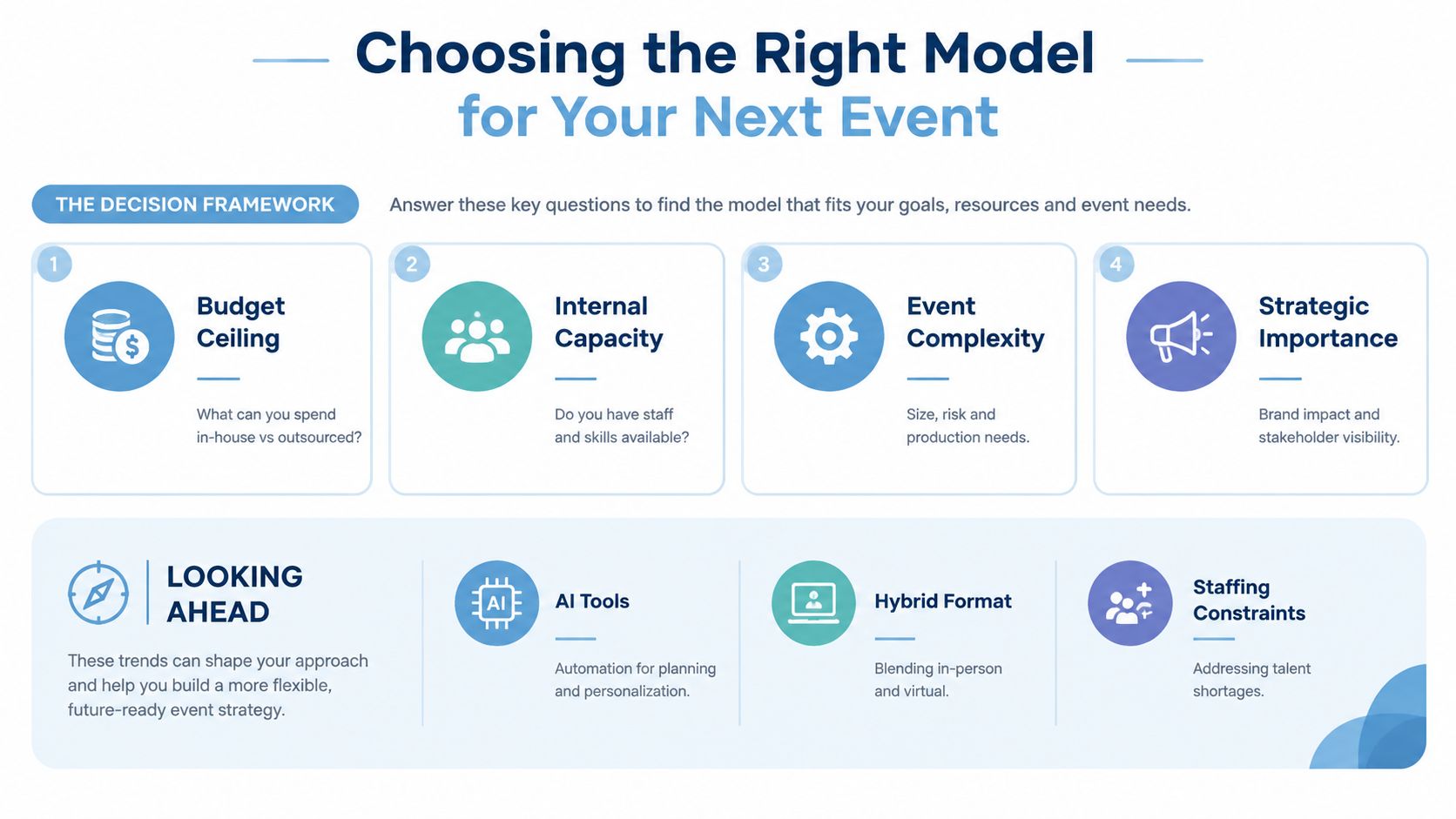
Choosing the Right Model for Your Next Event
Use four questions before you compare supplier quotes:
- What's the budget ceiling? Separate fixed production costs from scalable staffing, catering and audience activity.
- How much internal capacity exists? If nobody owns the plan, modular hire won't create one.
- How sensitive is the brand? A high-profile launch usually needs one accountable delivery lead.
- How much measurement is required? If the board expects leads and pipeline evidence, choose a supplier comfortable with data capture and reporting.
Choose end-to-end delivery when the event is complex, strategically important or operationally exposed. Choose modular hire when the in-house team has a strong project manager and wants specialist equipment without outsourcing the entire concept. Choose on-site delivery when the plan, suppliers and audience journey are already proven, but the internal team needs an experienced crew for the live period.
The UK search environment also matters before promotion begins. Google holds more than 90% of general search queries in the UK, and StatCounter's August 2026 figures put Google at 91.75%, Bing at 5.67%, Yahoo! at 1.25%, DuckDuckGo at 0.71%, Ecosia at 0.30% and Yandex at 0.28% (StatCounter UK search engine data). Build event landing pages and supplier content for the search behaviour your audience uses.
Plan for AI-assisted registration and matchmaking, hybrid attendance as a normal expectation and continued crew shortages that can push lead times earlier than older planning habits. One industry overview reports that 58% of event professionals increased AI and automation use, 66% outsource at least part of event management, and 80% host or plan hybrid events as a core format (corporate event planning trends for 2026). This week, place a venue hold and build a shortlist of suppliers who can show both safe delivery and measurable audience engagement.
PSW Events provides planning meetings, site visits, site plans, power and utility coordination, event attractions, installation, on-site staffing and event management for corporate events, exhibitions, activations and team-building days. Visit PSW Events to discuss an event management service that connects interactive experiences with practical delivery, safety and measurable audience engagement.