
You're organising a conference in London. The venue is confirmed, the speakers are briefed, and coffee and canapés are covered. Yet you know the networking reception could become a room full of people checking their phones unless there's a reason to stay, participate and start conversations.
That's where corporate entertainment earns its place. It isn't just a comedian after dinner or background music at a drinks reception. Used properly, it's a planned experience that helps an organisation promote a brand, attract leads, recognise staff, strengthen relationships or collect useful engagement data.
Introduction to Corporate Entertainment
Corporate entertainment is any organised entertainment or interactive experience provided for a business audience. It can appear at a conference, exhibition, trade show, product launch, staff celebration, awards evening, client dinner, fan zone or private corporate party. The format might be a live act, a casino table, a racing simulator, a VR installation, a team challenge or a branded attraction.
The important distinction is purpose. Hospitality gives guests food, drink and a comfortable setting. Corporate entertainment adds a reason to take part. That reason might be competing on an electronic leaderboard, testing a golf simulator, experiencing a branded flight simulation or sharing an activity with a potential client.
The UK market is large enough for planners to treat entertainment as part of commercial event design rather than an optional extra. The UK events industry contributes £61.6 billion annually, while corporate events account for £33.6 billion and generate £5 billion more than leisure events. Those corporate events include conferences, trade shows, exhibitions and product launches, so the category reaches far beyond parties and client hospitality. The UK events industry figures show why corporate entertainment sits inside a major business ecosystem.
A useful way to understand the difference is to compare entertainment with experiential marketing. Entertainment becomes experiential when the guest's participation helps create a memorable interaction with the organisation, product or message.
For planners, the process starts with four questions:
- Who needs to engage? Identify prospects, customers, employees, partners or the wider public.
- What should they do? Choose an activity that creates participation, not just observation.
- What business result matters? Define brand visibility, lead capture, relationship-building, staff recognition or another outcome.
- What evidence will you collect? Decide how you'll track participation, conversations, contacts, feedback or follow-up.
That approach turns entertainment into a measurable event component.
Core Concepts and Evolving Trends
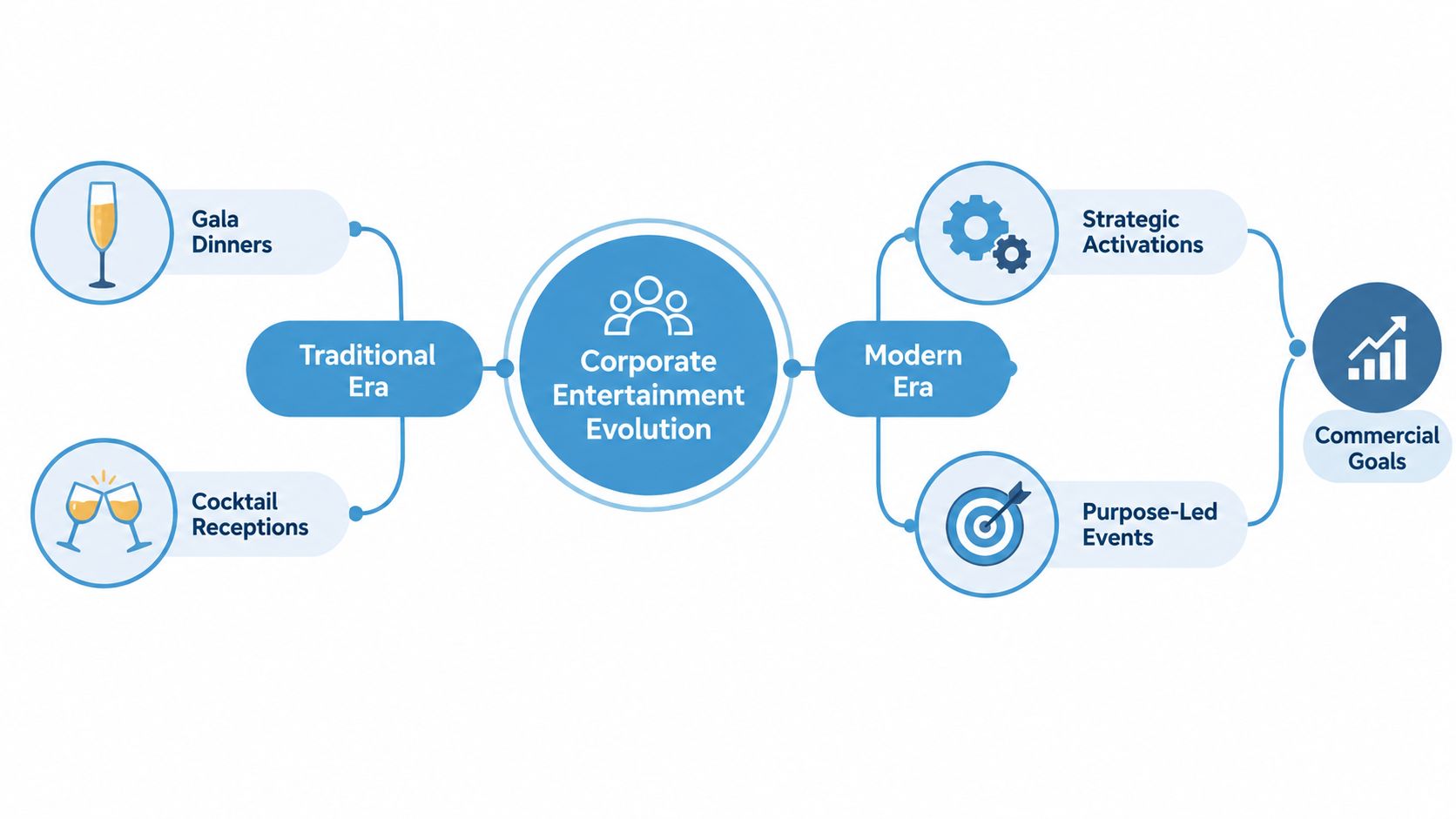
Corporate entertainment once suggested a familiar scene, a gala dinner, a cocktail reception and perhaps a live band. Those formats still have a place, but the modern UK definition is broader. A simulator at an exhibition stand, a VR experience at a product launch or a competitive team activity at a conference can all qualify when the experience supports a business purpose.
The change reflects the way the wider events ecosystem has developed. UK hospitality employed around 2.6 million people in September 2025, while the sector generated £69.5 billion of economic output in 2023. UK contract catering was worth about £4.9 billion in 2024, up 7% year on year. These hospitality and catering figures help explain why corporate entertainment is closely connected with venues, catering teams, staffing, transport and event operations.
From attendance to participation
The old question was often, “How many guests can we accommodate?” The more useful question now is, “What should each audience group do, and what should happen afterwards?”
A smaller private dining event can create deeper client conversations than a large reception. A branded simulator can give a prospect a reason to stop at a stand, speak with a team member and remember the company after the exhibition. A staff challenge can turn a routine internal gathering into a shared achievement.
Recent UK event coverage points towards this more focused model. Private dining enquiries rose 12% in 2026, while awards event value rose 39% year on year and guest numbers rose 86%, indicating a movement towards smaller, purpose-led formats as well as carefully designed larger occasions. The UK corporate event format trends show that scale alone doesn't define value.
The modern planning test
A useful activation should answer three tests:
- Relevance: Does the experience suit the audience and brand?
- Participation: Can guests understand it quickly and join without specialist knowledge?
- Evidence: Can the organiser observe or record useful activity?
That's why technology-led attractions have become more practical. They can be branded, repeated, staffed and adapted to different spaces, while their activity creates clear points for measurement. Corporate entertainment hasn't become less social. It has become more deliberate.
Common Corporate Entertainment Formats
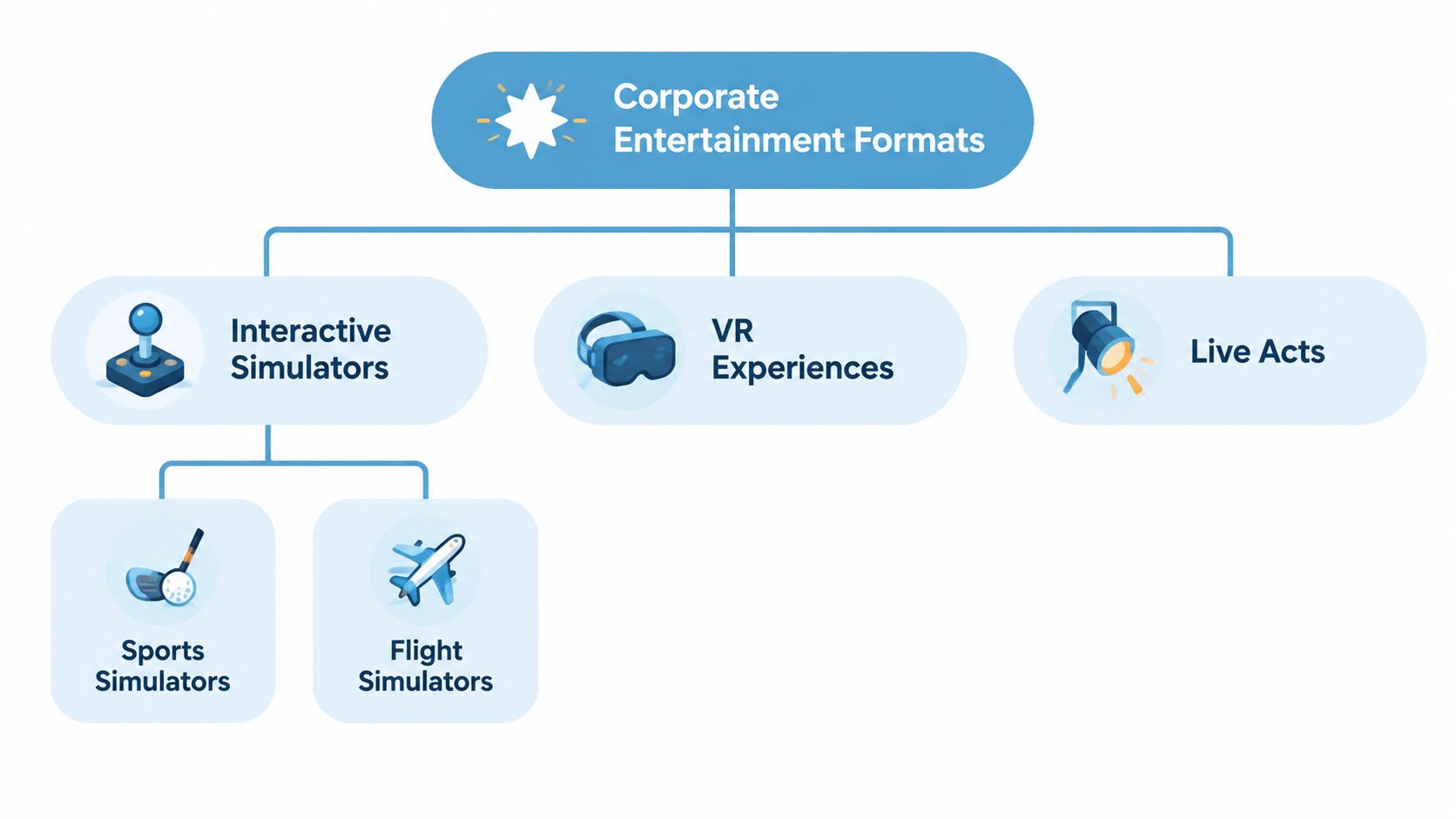
The right format depends on the audience, venue, time available and desired outcome. A racing rig may suit a technology launch, while a casino table could work better at a themed awards evening. The strongest choice isn't necessarily the most dramatic attraction. It's the one that makes participation easy and supports the event's purpose.
Interactive simulators
Sports simulators create a familiar competitive entry point. Golf, football, rugby and boxing experiences can attract people who already follow sport, but they can also work for casual participants because the basic objective is easy to understand. A golf simulator might support a client reception, while an American football challenge could give an exhibition stand a short, repeatable activity.
Racing simulators bring speed, competition and visual energy into a controlled footprint. An F1 or multi-racing rig can use timed laps, electronic leaderboards and branded screens to encourage repeat attempts. The leaderboard also gives staff a natural reason to speak with participants and invite them to return.
Flight simulators offer a different kind of immersion. Motion, helicopter and aviation-themed experiences can support aerospace, travel, engineering and technology events, but they don't need a technical brand connection. They're also useful when organisers want a spectacle that works indoors without relying on weather.
VR and interactive challenges
VR can transport a guest into a designed environment, making it suitable for demonstrations, training themes and imaginative brand activations. The organiser should plan for headset hygiene, clear operating instructions, queue management and enough space for safe movement.
Batak Pro and similar reaction challenges work well when the event needs quick turns and visible competition. Participants can understand the task immediately, while an electronic score encourages colleagues to compare results. Giant Scalextric adds a more social format, with several people able to watch and discuss the action.
Live acts and social formats
Live music, performers, comedians, caricaturists and roaming acts can establish atmosphere quickly. Their main strength is emotional energy, although organisers should still consider volume, timing, content suitability and how the act fits the brand.
Casino tables create a strong theme for private celebrations and awards evenings. Use non-cash play, trained staff and clear explanations so the activity remains inclusive and brand-safe. Team-building activities can combine problem-solving, physical challenges or creative tasks, depending on the audience's abilities and comfort levels.
For outdoor receptions, planners may also find practical ideas in this guide to enhancing outdoor dining events, particularly when entertainment needs to work alongside food service and changing weather conditions.
Regional audience behaviour supports portable formats. Government participation data found that in-person live sport attendance varies across areas from 25% to 36%, which illustrates why attractions that can be installed in different venues and repeated across locations are useful for UK-wide campaigns. The government participation survey provides the regional context.
| Format | Audience appeal | Planning consideration |
|---|---|---|
| Sports simulator | Familiar competition | Space, power, screen position and queue flow |
| Racing rig | Speed and repeat attempts | Timings, leaderboard operation and supervision |
| Flight simulator | Immersion and spectacle | Footprint, access route and technical setup |
| VR experience | Novelty and discovery | Hygiene, safe movement and operator support |
| Batak Pro | Fast, accessible challenges | Clear scoring and frequent resets |
| Casino tables | Themed social interaction | Trained croupiers and non-cash play |
| Live act | Atmosphere and shared attention | Schedule, sound and content suitability |
Business Objectives for Corporate Entertainment
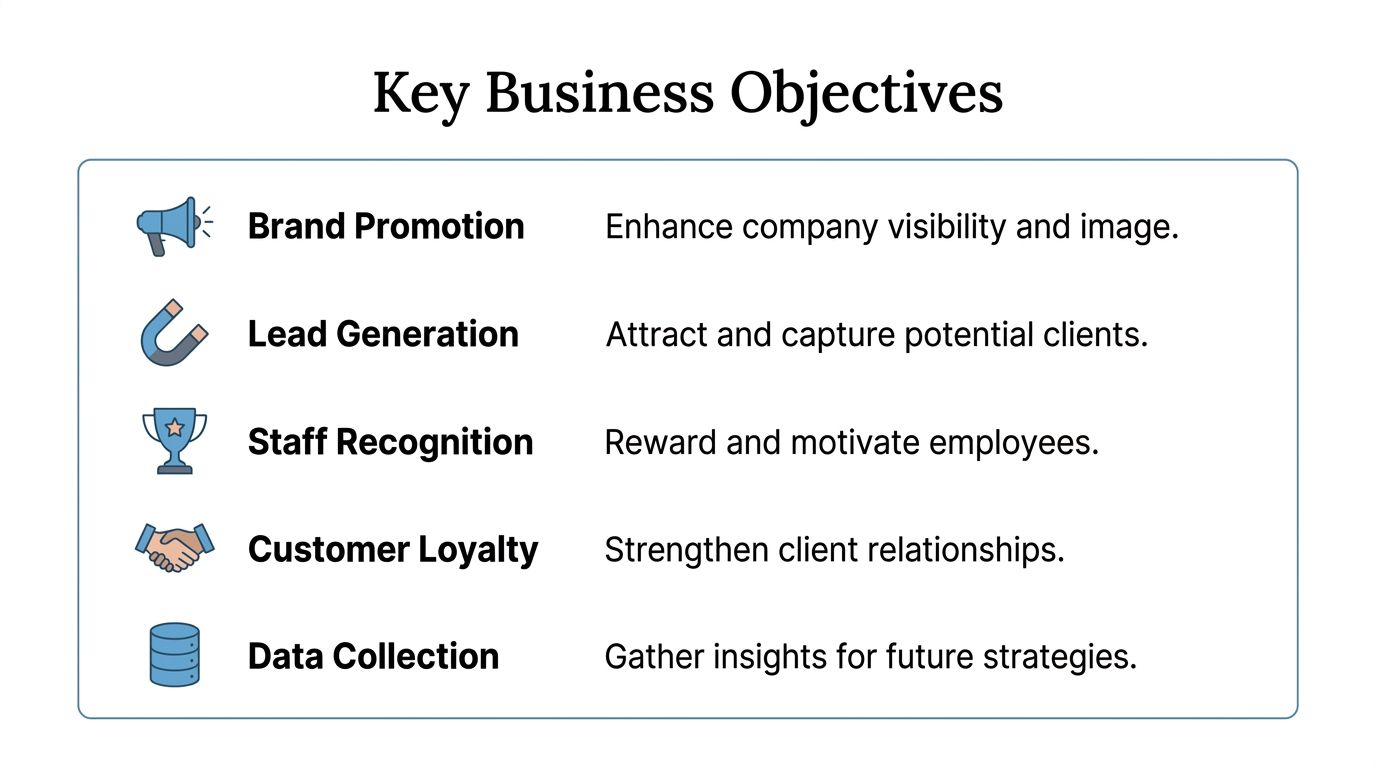
Entertainment becomes easier to choose when the planner defines the business objective first. Start with the result, then select the activity. Don't begin with a favourite attraction and try to invent a reason for using it.
Brand promotion
A branded racing simulator can make a company's presence visible from across an exhibition hall. Apply the organisation's colours, messaging and call to action to the rig, screen graphics, leaderboard and participant journey. The attraction shouldn't overwhelm the brand. It should create a memorable setting in which the brand team can have a useful conversation.
Lead generation
A trade-show attraction works as a lead-generation tool when participation connects naturally to contact capture. A visitor might complete a timed challenge, submit a score and then provide details to receive a result, enter a prize draw or access follow-up content.
The data process needs careful design. Tell guests what information you're collecting, why you need it and how you'll use it. A form that's too long can interrupt the experience, while a short, relevant form can help staff qualify the conversation.
Staff recognition
Internal events needn't rely on speeches alone. A flight simulator, golf challenge or team racing competition can reward achievement while giving colleagues a shared activity. For a recognition event, consider private scoring, team participation and accessibility rather than focusing only on the fastest individual.
The entertainment should reinforce the message behind the occasion. If the event celebrates collaboration, use a format that encourages colleagues to support one another. If it recognises performance, a leaderboard may create the right sense of occasion.
Customer loyalty
Client entertainment works best when the experience gives guests time to interact without forcing a sales presentation. A casino table, private simulator challenge or well-managed team activity can provide a shared reference point for future conversations.
Ask whether the format suits the relationship. A high-energy attraction may suit a launch audience, while a quieter hospitality setting with a guided activity may be more appropriate for senior clients. The right choice demonstrates that the organiser understands the guests' preferences.
Data collection
Data collection can support future event decisions, audience segmentation and sales follow-up. Capture only information that has a clear use. Combine participation data, such as attempts or scores, with consented contact details and qualitative feedback.
Practical rule: Choose one primary objective and a small number of supporting measures. If every activity tries to generate leads, entertain guests, reward staff and communicate every brand message, the experience will feel confused.
A simple objective-to-format match can help:
- Brand visibility: Use an attraction with strong visual presence and branded touchpoints.
- Lead generation: Use a repeatable activity connected to a short, transparent data journey.
- Staff recognition: Use competition, rewards or shared challenges that reflect the culture.
- Customer loyalty: Choose a social format that creates relaxed conversation.
- Data collection: Build consent and recording into the guest journey before installation.
The attraction is only one part of the outcome. Staff briefing, placement, messaging and follow-up determine whether the experience supports the business goal.
Measuring Benefits and Key KPIs
A racing simulator or VR zone can attract attention, but attention alone doesn't prove value. Measurement starts before the event, when the organiser records the objective, audience, activity and intended action.
UK live experiences demonstrate the potential scale of participation. Festivals and concerts recorded 37.1 million total attendances in 2022, including concert and festival attendance, while music tourism generated £6.6 billion in spending and sustained 56,000 jobs. UK Music's live-event report provides the wider context for why in-person experiences can command attention. A corporate activation still needs its own measurement plan, but live participation offers a powerful model.
The core KPI set
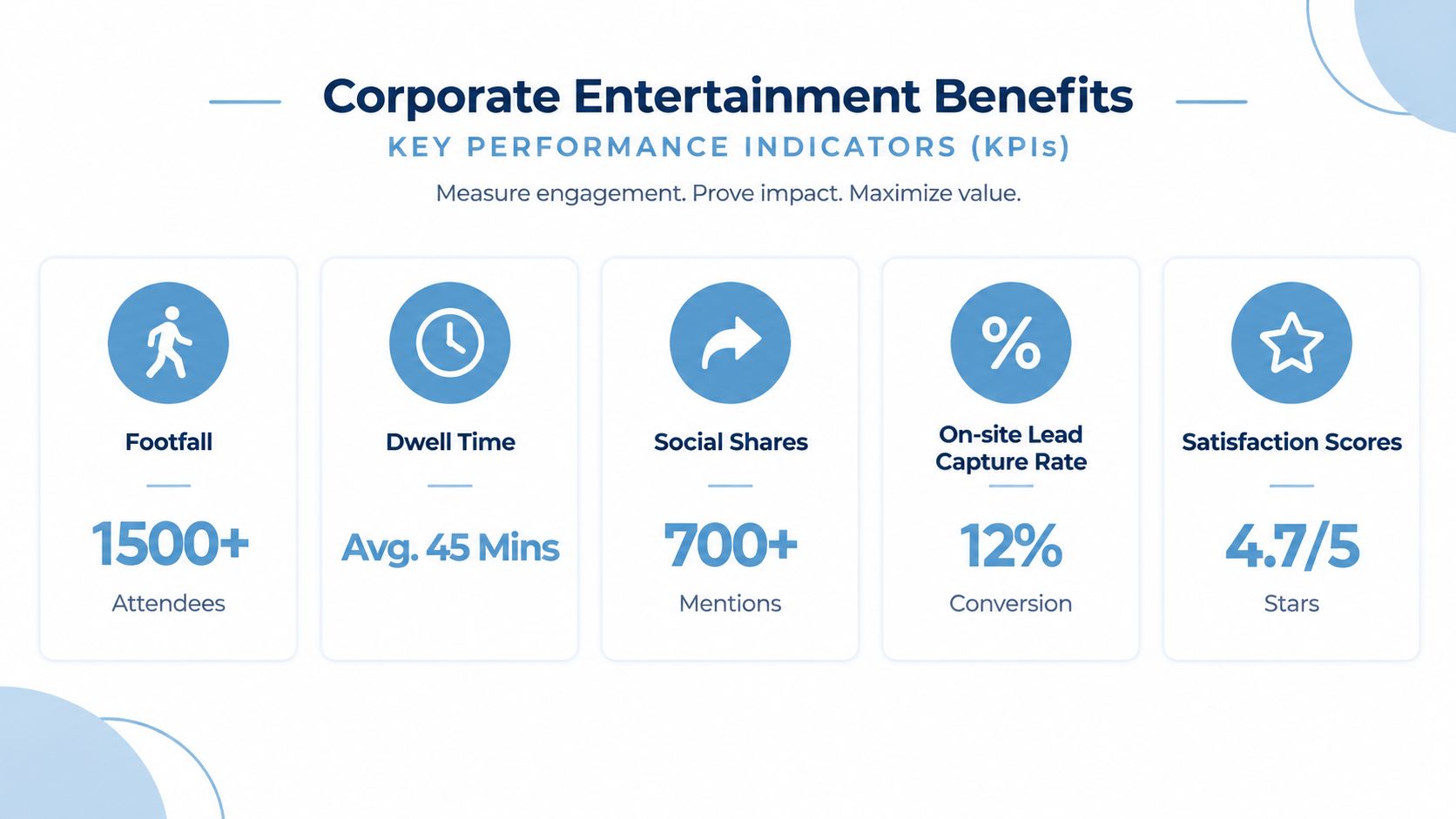
Footfall records how many people reach the activation area. Use manual counters, venue data or event-platform records, and define whether a repeat visitor counts once or multiple times.
Dwell time shows how long participants remain engaged. A racing rig can record session duration, while staff can use a simple observation method for activities without electronic tracking. Longer dwell time can create more opportunity for conversation, but it isn't automatically better. The activity must retain attention without creating queues that frustrate visitors.
Social shares indicate whether the experience gives people something worth posting. Use a clear event hashtag, branded visual moment or opt-in sharing prompt. Don't treat every mention as positive sentiment. Review the content and identify what guests shared.
On-site lead capture links participation to commercial follow-up. Track completed forms, consent, qualification fields and the source attraction. A leaderboard can invite contact capture, but the form should remain clear and proportionate.
Satisfaction scores reveal whether guests valued the experience. Ask a short post-activity question, then combine the score with an open comment so the team understands the reason behind the response.
Make the numbers useful
Create a baseline before the event. Record expected footfall, target audience, available staffing, planned operating hours and the action you want participants to take. Afterward, compare actual activity with the original objective rather than comparing unrelated events.
Electronic leaderboards can record attempts and scores. QR codes can connect a physical attraction to a landing page. Post-event surveys can test brand recall, enjoyment and willingness to speak with the organisation again. Sales and marketing teams should agree on ownership of the data before doors open.
Use guidance on experiential marketing ROI to connect participation data with wider commercial reporting. The final report should explain what happened, who engaged, what the audience did next and which changes should inform the next activation.
Planning Budgets Logistics Supplier and Compliance
A corporate entertainment budget doesn't stop at the hire fee. The total cost can include transport, installation, staffing, branding, venue access, power, insurance requirements, data collection, dismantling and contingency planning. Ask suppliers to separate those elements so you can compare proposals fairly.
The brief doesn't provide verified market prices for individual formats, so a responsible budget guide must avoid invented pound ranges. The table below uses qualitative planning bands, not fabricated price quotes. A supplier should confirm the actual cost after checking the venue, dates, operating hours, access conditions and branding requirements.
| Format | Typical Budget Range | Setup Time |
|---|---|---|
| Batak Pro or compact reaction challenge | Lower footprint, scope-dependent | Short setup, subject to access |
| Casino tables | Moderate, depending on tables, staff and theming | Venue-dependent setup |
| Sports simulator | Moderate to substantial, depending on equipment and branding | Requires planned installation |
| Racing simulator | Moderate to substantial, depending on rig specification and staffing | Requires technical setup |
| Flight simulator | Substantial, depending on motion system and access | Longer technical setup |
| VR experience | Scope-dependent, based on headsets, content and staffing | Requires testing and safe-space preparation |
| Multi-attraction activation | Substantial, based on attraction mix and production needs | Requires coordinated installation |
Build the budget around the guest journey
Start with the audience flow. How will guests see the attraction, understand it, join a queue, participate, receive a result and move towards the next action? A cheaper attraction placed behind a pillar may deliver less value than a more visible format with clear signage and efficient staffing.
Then separate fixed and variable requirements:
- Equipment: Confirm the exact attraction, backup arrangements and technical specification.
- Transport: Check loading access, delivery windows, parking and venue restrictions.
- Installation: Ask who builds, tests and removes the equipment.
- Staffing: Confirm operators, hosts, queue managers, croupiers or technical support.
- Branding: Define artwork deadlines, print production, screen content and approval stages.
- Venue services: Check power, internet, lighting, floor protection, rigging and storage.
- Insurance: Request current policy details and confirm the venue's requirements.
- Contingency: Plan for late access, restricted lifts, technical changes and weather where relevant.
A supplier's quote should state assumptions. If the price depends on a level loading bay, a specific power supply or access during a set window, those conditions need to appear in writing.
Plan the logistics before the attraction
Request the venue floor plan and mark the attraction footprint, queue, operator position, branding and emergency routes. Include the path from the loading area to the final position. Large equipment may fit in the event room but fail at a narrow doorway, lift or corridor.
Create a working timeline:
- Confirm the objective, audience and format.
- Check venue access, floor loading, power and operating restrictions.
- Approve the supplier scope and insurance documentation.
- Submit artwork, guest-flow plans and risk information.
- Test the equipment and confirm staffing.
- Brief the team on participation, data capture and escalation procedures.
- Inspect the installation before guests arrive.
- Record participation and feedback during the event.
- Dismantle safely and reconcile the post-event data.
For exhibitions, the timetable can be tighter because organisers control build periods and documentation deadlines. Early supplier involvement helps prevent an attractive idea from becoming an access problem.
Vet the supplier properly
Ask for evidence rather than relying on a polished brochure. Check previous venue experience, named operators, equipment condition, replacement plans, branding capability and the process for technical faults. Confirm whether the supplier manages the entire delivery or passes installation and staffing to another party.
You should also establish who makes decisions on site. One named production contact can coordinate with venue management, health and safety teams, security and your event lead.
For wellbeing-led internal events, entertainment planning can sit alongside broader workplace initiatives, including implementing workplace health screening programmes when that forms part of the organisation's employee experience strategy. Keep the entertainment and health services operationally separate, with clear consent and privacy arrangements.
Treat compliance as part of design
UK event-safety guidance requires formal health and safety controls and risk assessments under Regulation 3 of the Management of Health and Safety at Work Regulations 1999. Some exhibition guidance requires exhibitors and contractors to submit risk assessment forms up to 14 days before the exhibition build. The event health and safety guidance should be checked alongside the venue's own rules.
A practical risk assessment checklist includes:
- Access: Can equipment reach the space without unsafe manual handling?
- Stability: Is the attraction level, secured and protected from impact?
- Electrical safety: Are cables covered, routed safely and suitable for the venue?
- Movement: Does the activity require clear space for arms, feet, motion or headsets?
- Queues: Can guests wait without blocking exits, aisles or emergency equipment?
- Supervision: Does a trained operator control every session?
- Users: Have age, height, mobility, sensory and health considerations been addressed?
- Hygiene: Are shared headsets, controls and contact surfaces cleaned between users?
- Emergency response: Do staff know how to stop the equipment and escalate an incident?
- Weather: Does an outdoor installation have a clear wind, rain and heat plan?
- Documentation: Are risk assessments, method statements and insurance certificates available?
PSW Events can be considered as one turnkey supplier option for planners who need sports, racing or flight simulators, VR, Batak Pro, casino tables and related attractions, with planning, branding, logistics, installation, staffing and compliance support. Its stated cover includes £10 million products, employee and public liability insurance, but planners should still verify that the specific policy meets their venue and event requirements. The corporate entertainment event service provides a relevant starting point for discussing scope.
Case Studies of Successful Corporate Entertainment
A useful case study should explain more than the attraction. It should show the original problem, the operating plan and the evidence collected afterwards. Without verified project figures, the examples below focus on the delivery logic rather than invented attendance or conversion results.
At Silverstone, a motorsport-themed event naturally creates an audience expectation around speed and competition. An F1 or multi-racing simulator can extend that theme into an interactive zone, with timed sessions, operator guidance and an electronic leaderboard. The planner's challenge is usually flow. The team needs to keep the queue moving, make the experience understandable to occasional participants and give guests a reason to return without allowing one competitor to dominate the equipment.
The operational answer is a clear session format. Staff explain the controls, manage the queue and record scores consistently. The client can then review attempts, repeat participation and conversations generated around the activation. That evidence is more useful than reporting that the simulator was present.
At ExCeL London, a large exhibition environment creates a different challenge. The attraction must be visible among competing stands, fit the agreed footprint and operate reliably across build, open and breakdown periods. A branded sports simulator or Batak Pro challenge can provide a quick entry point for visitors who may not yet know the exhibiting company.
The team can connect the activity to a short lead-capture journey. A visitor completes a challenge, receives a score or ranking and then speaks with a member of the sales team. Staff should qualify the conversation rather than treat every participant as an equivalent lead. The resulting report can separate footfall, participation, dwell time, consented contacts and follow-up status.
International showcases in Amsterdam, Frankfurt, Barcelona, Paris and Dubai add travel, venue and language considerations. A portable format gives the organiser more control over delivery, but the team must verify local venue rules, power, access, staffing and documentation. Instructions may need to be adapted for a multinational audience, while the brand treatment should remain consistent.
Across all three settings, the transferable lesson is simple:
A successful activation is designed as an operating system, not ordered as a piece of equipment.
The attraction creates the invitation. The staff, layout, data process and follow-up turn that invitation into a business interaction. PSW Events' stated experience across venues such as Silverstone, Wembley, ExCeL London, Manchester Central and SEC Glasgow illustrates the type of venue familiarity planners may want to examine when comparing suppliers, but each proposed project still needs its own objectives and evidence plan.
Conclusion and Next Steps
Corporate entertainment is best understood as purpose-led participation for a business audience. The modern UK version may be a small private dining experience, a branded simulator at a trade show, a staff competition or a VR zone at a product launch. The format matters, but the objective, guest journey, staffing and measurement matter more.
Before booking, complete this checklist:
- Define the audience and primary business outcome.
- Choose an attraction that suits the venue and participation style.
- Map the guest journey from arrival to follow-up.
- Confirm access, power, staffing, branding and insurance.
- Submit risk assessments and method statements on time.
- Agree KPIs before the event starts.
- Give sales or HR teams ownership of post-event follow-up.
A supplier that handles planning, installation, staffing and compliance can reduce the operational load, particularly when the activation includes technical equipment or several venues. Review the attraction options, prepare your venue details and request a scope based on the outcome you need.
PSW Events provides interactive sports, racing, flight and VR entertainment for exhibitions, conferences, launches, team events and private corporate celebrations. Visit PSW Events to explore suitable formats, discuss delivery requirements and request a custom quotation for your next UK activation.