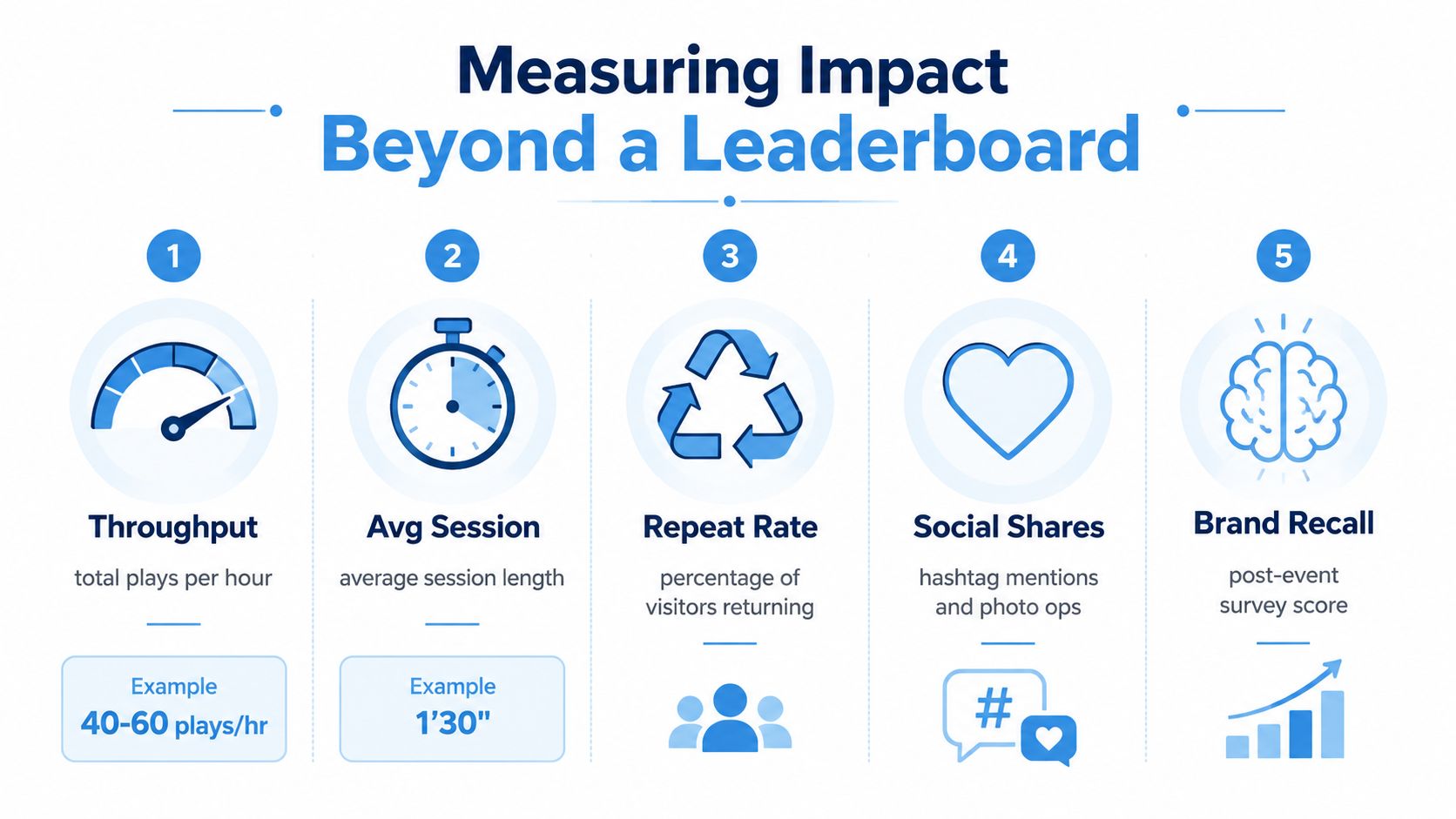
You're standing outside a London exhibition hall, watching delegates gather beside a stand while an LED wall flashes targets twenty metres away. Someone steps forward, hits the lights, and leaves with a score on the screen. Within moments, colleagues are discussing whether they can beat it. For the event team, the attraction is obvious, but the harder question is whether that attention turns into dwell time, repeat plays, social sharing or qualified leads.
A light reaction game can deliver those outcomes, but only when the hardware, venue layout, staffing and measurement plan work together. Batak is the practical reference point for the format because it has moved from sports training into UK event hire, while retaining a repeatable reflex-testing structure. This guide covers what planners are hiring, how to specify it, where it works, and how to defend its value in a post-event report.
What a Light Reaction Game Actually Is
A delegate sees a glowing target, reaches out and strikes it. The next target appears, the player reacts again, and the machine records the result. That simple loop is the foundation of a freestanding reaction wall, usually built around a Batak-style unit with illuminated targets arranged inside a rigid frame.
The cabinet contains the controller, score displays and audio cues. The player doesn't need a handset, headset or complicated briefing. They stand in front of the frame and hit the lit pods with their hands. That low-friction interaction is why a light reaction game can draw people from a busy concourse without a lengthy explanation.
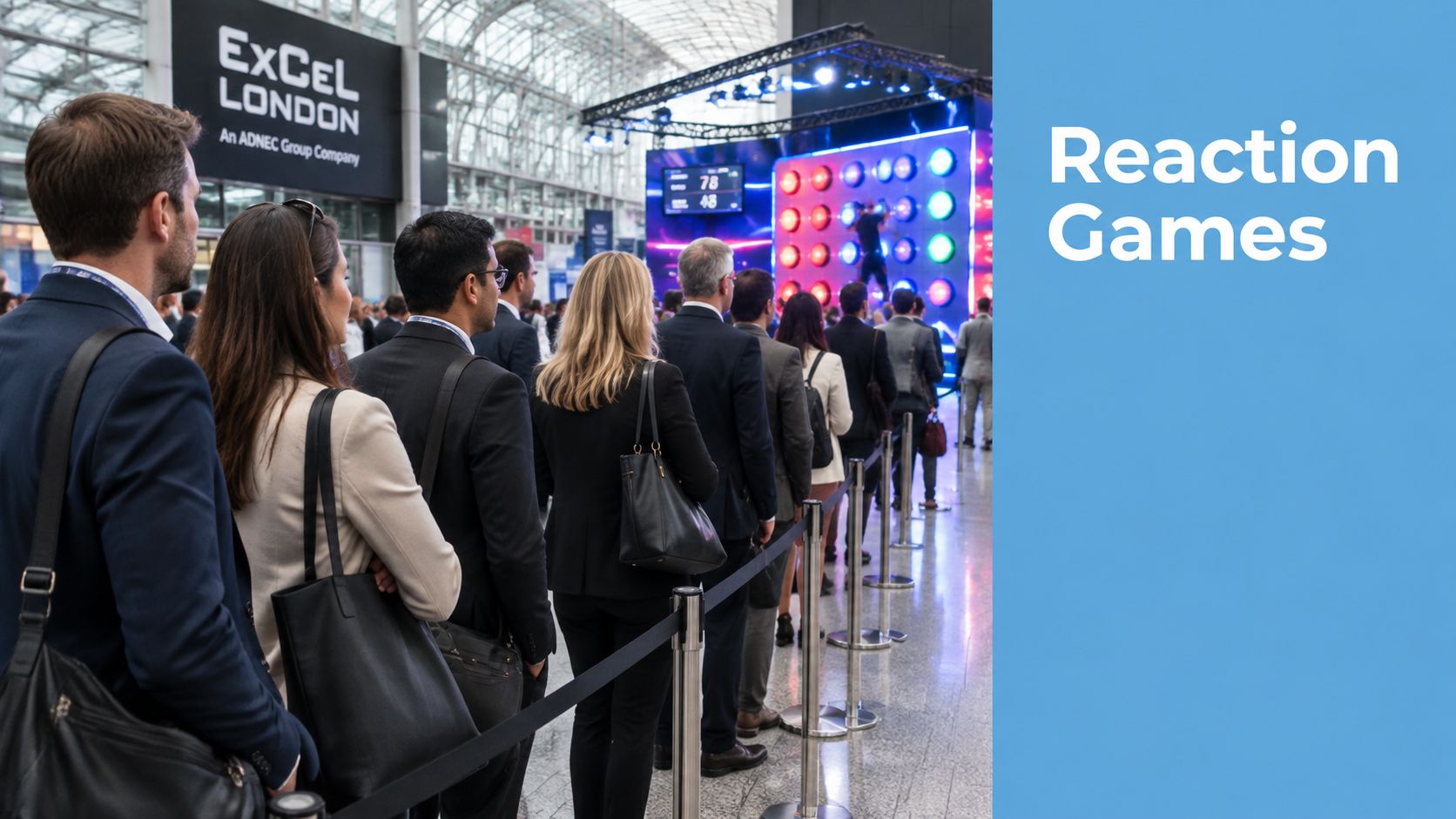
The event-grade format
Batak began as a sports training tool, developing from “Bat Attack” before spreading into professional sport and event hire. UK accounts describe its use by Premier League football teams, including a Batak Pro supplied at Manchester United's Carrington facility as a promotional device for MUTV. The same UK account records the point at which the format moved into conventions and team-building events across the country, leading to products such as Batak Lite and upgrades including brighter LEDs and stainless-steel finishes. The UK Batak background provides that useful history.
That distinction matters when you're choosing equipment. Commercial Batak Pro and Batak Lite units are designed for repeated public use, with frames that withstand heavy use, visible scoring and a presentation suitable for corporate environments. Smaller consumer wall-mounted products can be useful for home training, but they aren't automatically appropriate for a busy exhibition stand, public liability requirements or continuous play.
Practical rule: Specify the equipment for the audience flow, not just the game itself. A unit that works in a gym may be awkward, fragile or visually underpowered at an exhibition.
Batak Pro descriptions refer to eight illuminated LED targets in a maximum-stretch frame, while newer reaction-training variants describe twelve targets. Scoring combines speed and accuracy, turning a quick interaction into a repeatable test rather than an unstructured arcade attraction. For UK hire, confirm the exact model, target count, display arrangement and operating mode before you approve the quotation. PSW Events' Batak Challenge is one example of how the attraction is positioned for event use.
How the Targets, Timing and Scoring Work
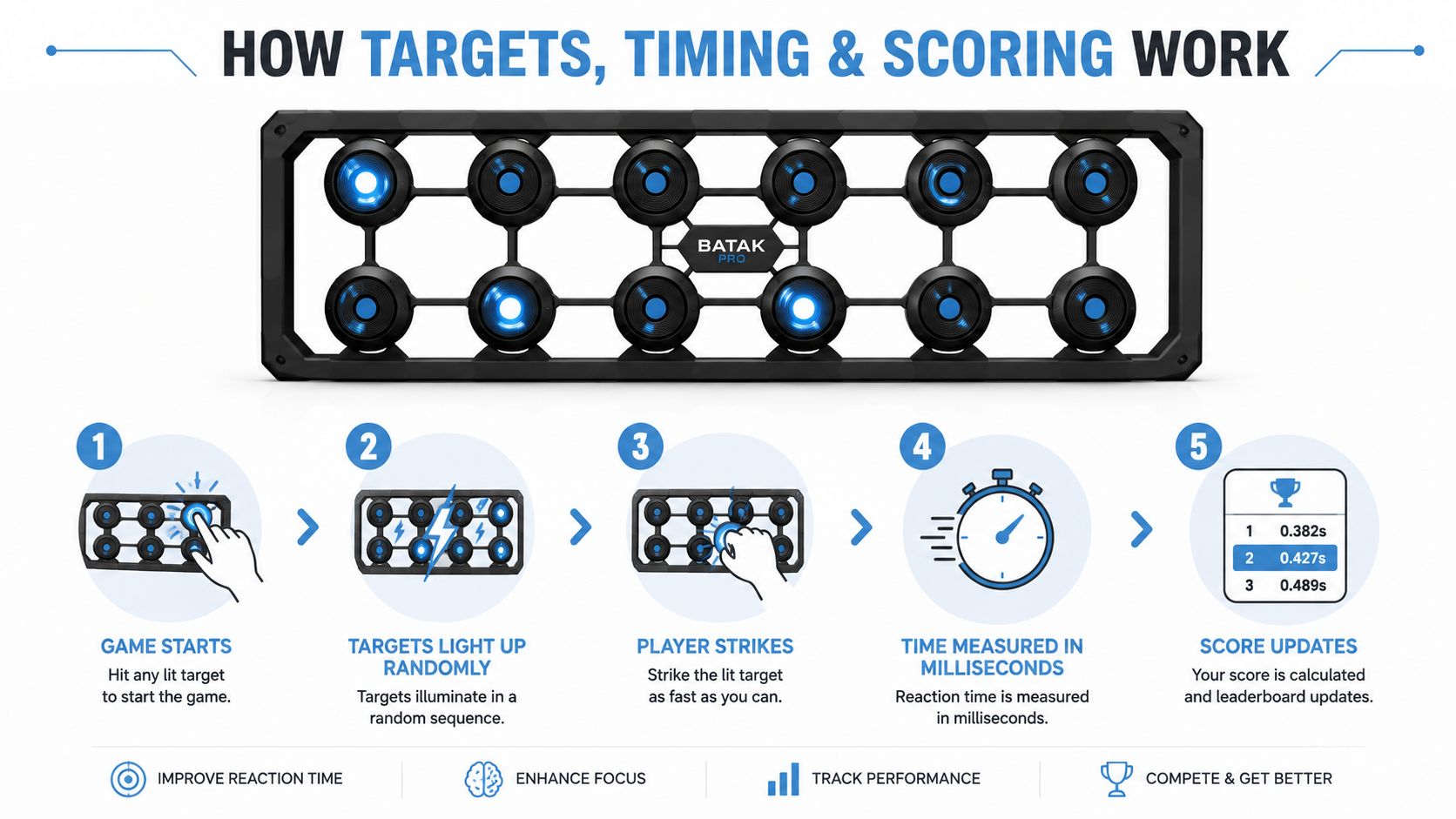
A Batak Pro setup is easiest to understand as a perception-action loop. The controller presents a visual cue, the player identifies the active target, the hand moves to it, and the system records the strike. The shorter that loop, and the fewer mistakes made along the way, the stronger the score.
The physical specification is built around a rectangular frame and illuminated target pods. The manufacturer's manual describes 12 polycarbonate, high-impact, high-intensity LED targets, a central LCD display and two three-digit LED score and time displays. It also lists 32 workout routines and an infra-red Strike Back Beam that detects the player's presence. The Batak Pro manual is the right reference when you need to verify the hardware rather than rely on a hire listing.
A typical play sequence
- The game starts. The controller activates the selected routine and the player takes position.
- A target lights up. In a common Batak-style test, one random target appears at a time.
- The player strikes. The next light appears only after the current target has been hit.
- The system measures performance. The controller records successful hits, timing and, depending on the mode, misses or elapsed time.
- The score updates. The final result can appear on the unit, a connected leaderboard or both.
Common event modes run for 30 or 60 seconds, with the score based on the number of successful hits. Other formats include a standard accumulator, a 50-target strike mode capped at 100 seconds, and a four-player relay. Those formats preserve the same visual-motor challenge but alter the pacing, pressure and queue behaviour. Top End Sports' Batak reaction test description explains the differences and notes that performance can improve quickly during the first attempts.
That practice effect has a direct production consequence. Don't mix familiarisation attempts with scored runs if you're comparing players or reporting a benchmark. Give each participant a clear practice opportunity, then start the official attempt under the same rules.
Reaction time is compelling because it turns a sub-second skill into a visible result. Typical human reaction times are commonly placed in the 200 to 250 millisecond range by a widely used benchmark source, while a large online dataset reports a 273 millisecond median and 284 millisecond average across more than 81 million recorded clicks. Those figures aren't event performance promises, but they explain why participants understand the challenge immediately. The score gives them something concrete to improve, compare and share.
Why Audiences Gravitate to Reaction Games
Most activation mechanics lose people during onboarding. A delegate has to understand the objective, find the controls, wait for an explanation and decide whether the effort is worthwhile. A light reaction game reduces that sequence to a visual instruction. The target lights up, the player hits it, and the score makes the result obvious.
That accessibility brings mixed audiences into the same competition. A senior buyer, a graduate delegate and a member of the event crew can all understand the challenge without needing specialist sporting ability. The game's evidence base also extends beyond entertainment. The UK Biobank reaction-style snap task records clicks and time to first click across 12 rounds, showing that reaction-style measurement has a formal place in UK biomedical research.
The event value comes from the loop after the first attempt. Players see a score, decide they can improve it, and ask for another go. Friends and colleagues then enter because the result is public and comparable. That behaviour can support repeat plays and queue energy, but it shouldn't be treated as guaranteed performance. The supplier, operator and surrounding campaign determine whether the game becomes a one-off novelty or a reason to stay.
What to measure before promising results
There's limited independent evidence linking reaction-game hire directly to lead capture, dwell time or social conversion. UK listings often focus on capacity, branding and venue suitability, while the neutral Batak dataset from University College Dublin found no significant differences in reaction times across four protocols and no significant correlations with physical characteristics among trained athletes. That supports a more accurate positioning: the game is an accessible competition, not proof that one body type or athletic background will win.
| Metric | Typical range | Why it matters |
|---|---|---|
| First-time dwell time | Qualitative planning measure | Shows whether the mechanic holds attention beyond a passing glance |
| Repeat plays | Qualitative planning measure | Indicates whether the score creates a reason to return |
| Leaderboard shares | Qualitative planning measure | Connects gameplay with social and brand visibility |
| Scan conversion | Qualitative planning measure | Tests whether the interaction supports lead generation |
| Queue depth | Qualitative planning measure | Reveals demand, friction and the need for additional staffing |
A leaderboard creates social currency only when the surrounding process makes sharing easy. Let players see their name or handle, photograph the result, and understand what to do next. If the wall sits beside a data form with no host or clear prompt, the score may entertain people without producing a defensible marketing outcome.
The machine creates the competition. The event team creates the reason to continue.
Event Applications for Reaction Game Hire
The same light reaction game behaves differently depending on the brief. A corporate away day needs a social format and a confident host. A fan zone needs crowd movement. An exhibition stand needs fast qualification without blocking the sales team. A brand activation needs a mechanic that connects visibly to the product.
Team-building and corporate away days
For a team-building day, use heats, relays or department-versus-department challenges rather than leaving the unit in free play. Mixed-ability groups respond better when the host explains that the result is about the selected mode and the shared experience, not a test of sporting status.
At a hotel or conference venue, position the wall where colleagues naturally gather between sessions. The unit should become a focal point that breaks departmental silos, supported by a host who can invite quieter participants and keep competitive personalities from dominating every round. Organisers exploring wider group formats may also find wellness retreats for corporate groups via Ticketsmith useful when building a programme around participation rather than a single attraction.
Fan zones
Motorsport, rugby and music fan zones use reaction walls to pull footfall away from a concourse and towards sponsor hospitality, sampling or merchandise. The wall works best adjacent to the commercial objective, not at the far end of the footprint. A host can run short challenges while a second team member handles sampling, sign-ups or prize fulfilment.
At a venue such as Silverstone, the unit can support a driver-versus-driver format. At a rugby event, a relay can make the activity feel collective rather than purely individual. The game provides the hook, but the placement controls whether the sponsor receives useful traffic.
Exhibitions and trade shows
Exhibitions are the most demanding environment. A passing delegate has limited patience, so the wall should sit on the stand edge with a clear sightline, not in the middle where it interrupts conversations and creates a physical bottleneck. The host needs a compact qualifying question ready before the final score is revealed.
Brand activations
A battery brand might frame the challenge around sustained power and a countdown. An automotive client might run driver-versus-driver finals on a small stage, with the leaderboard forming the visual centre of the presentation. The target sequence stays the same, but the choreography changes around it.
| Use case | Typical format | Primary KPI | Surrounding setup |
|---|---|---|---|
| Team-building | Heats, relays and group tournaments | Participation and repeat play | Host, team scoring and prize moment |
| Fan zone | Short public challenges | Footfall into sponsor space | Sampling, merchandise or hospitality |
| Exhibition | Fast individual attempt | Qualified scans and dwell time | Stand-edge placement and sales hand-off |
| Brand activation | Themed challenge and finals | Campaign engagement and sharing | Stage, content capture and branded leaderboard |
Hiring, Setup and Logistics for UK Venues
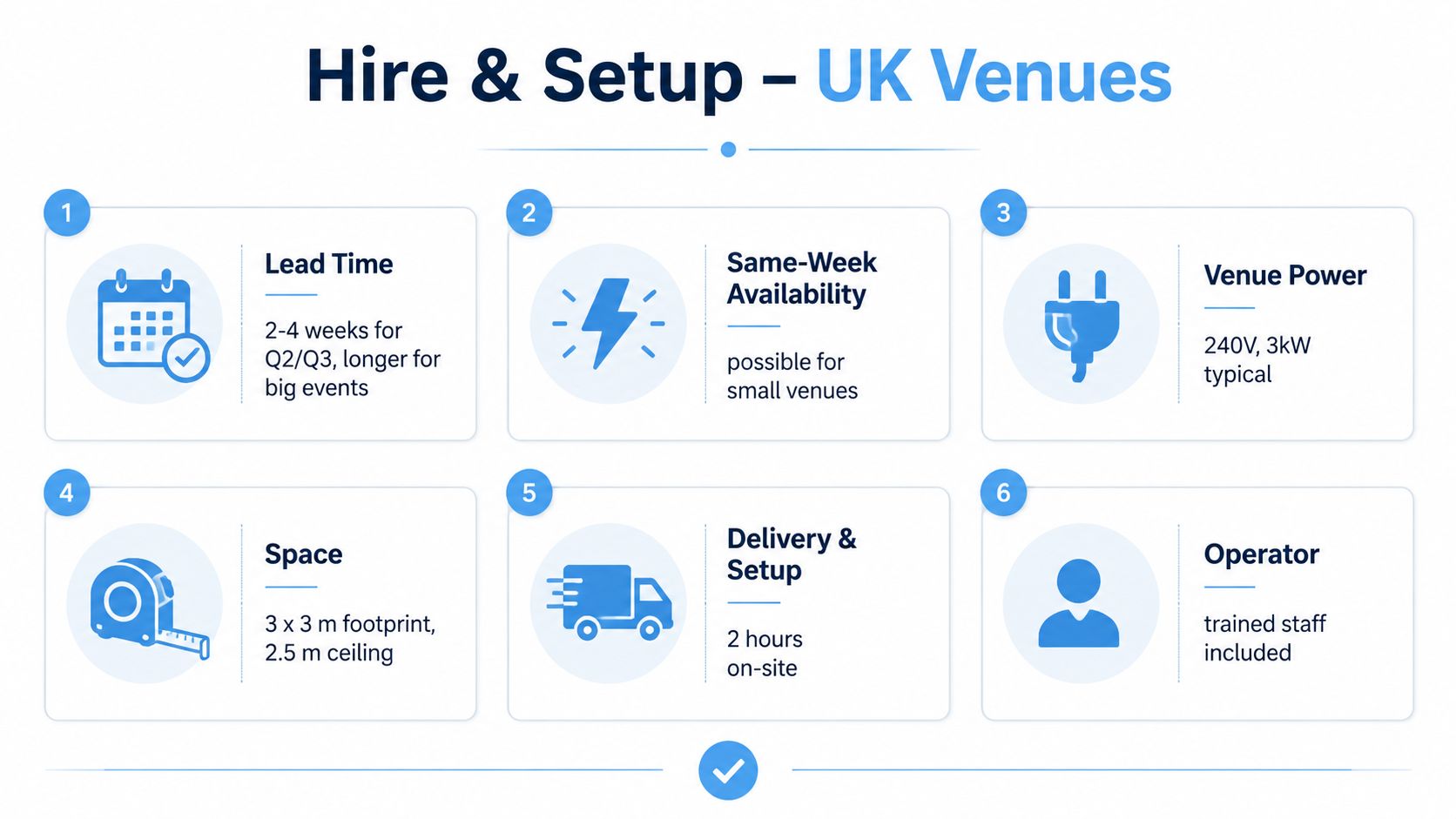
Start with the booking calendar. Serious operators often reserve Batak Pro units two to four weeks ahead for Q2 and Q3 events, with longer planning windows for large activations. Same-week availability can exist for smaller venues, but it reduces choice and can add pressure to transport, branding and crew planning.
Ask for the full technical pack before the purchase order. A credible supplier should be able to provide insurance details, PAT testing, risk assessments and method statements, but the RAMS still need to reflect the specific venue, access route and audience conditions.
Space and access
Allow roughly 2.5 metres by 2.5 metres of clear floor for the wall and player position, with additional stand-off from passing traffic. The exact venue drawing matters more than the nominal footprint. At ExCeL London, Manchester Central or Old Trafford, a small obstruction can become a queue problem quickly, especially when the unit faces a major aisle.
A crowd barrier or low stage edge helps separate players from footfall. Keep the floor level because a freestanding frame can rock on an uneven surface. Confirm load-in access, lift dimensions, dock restrictions and the route from the loading bay to the final position. Transport is commonly handled in a Transit-sized van, so step-in access and a realistic unloading slot should be part of the brief.
Power, crew and safety
Use one suitable 13A socket per unit and confirm the venue supply with the production team. Festival sites require extra care because generator power can be inconsistent, so the crew should use an appropriate surge-protected distribution setup where permitted.
One trained host can run continuous play. Two people are more effective during busy periods, with one managing the queue and another handling scoring, explanations and data capture. Agree who resets the unit, who records faults and who owns the leaderboard before doors open.
Load-in check: A technically compliant attraction can still fail if the van can't reach the dock, the frame can't pass through the lift or the queue has nowhere safe to form.
See the unit in operation before approving the final layout.