
Your budget can look healthy in March and still unravel by the final invoice. That's the situation for experiential campaigns, especially when simulator hire, venue rules, staffing, transport, and branding all shift between quote and delivery. The strongest cost control strategies don't just trim spend, they protect margin, keep delivery smooth, and help planners defend ROI when the pressure is on. For a useful benchmark on event budgeting language, see this budget wedding decor tips article, even though the context is different.
UK planners also have to work against a volatile cost backdrop. Factory input prices in the UK went from 19.2% annual growth in August 2022 to 0.1% in April 2024, then to -0.1% in January 2025, according to the Office for National Statistics data cited in the Zone and Co cost control report. At the same time, Bank Rate moved from 0.1% in December 2021 to 5.25% by August 2023 in the same report, which pushed financing and working-capital costs higher for event businesses. For experiential marketing, that means every simulator, operator, van journey, and supplier term needs to earn its keep.
1. Tiered Pricing and Package Bundling
Tiered packages work because they give clients a clean choice while giving you better control over inventory, staffing, and margin. In simulator hire, the client rarely wants to buy a line item list and negotiate every bolt. They want a clear outcome, a visible upgrade path, and confidence that the package fits the ambition of the event.
A practical structure is to build packages around real combinations, not artificial labels. A conference activation might start with a single simulator, move to a three-simulator package, and then progress to a full-day branded experience with add-ons for extra operator hours or premium wrap. Trade show buyers understand this quickly when you frame the offer as Starter, Impact, and Platinum, because the value progression is obvious and the operational plan behind it is easier to execute.
How to make tiers work in the real world
The mistake is stacking restrictions into the lower tiers so they feel cheap rather than useful. Clients spot that immediately, and it creates awkward negotiation later. A better approach is to make each tier different in scale, coverage, and audience draw, then spell out what's included, setup time, operator hours, branding, and equipment variety.
Practical rule: if a package doesn't change how the event feels on site, it's not a tier. It's just a price disguise.
Historical bookings are the best guide here. Look for common simulator pairings, repeated staffing patterns, and the kinds of branded extras clients consistently buy. Then review the tiers quarterly so they track demand and your actual delivery costs, not last year's assumptions.
2. Early Booking Discounts and Advance Commitment
Early commitment is one of the cleanest ways to stabilise event cost control because it improves scheduling and reduces last-minute logistics pressure. In a busy UK calendar, a planner who books spring in spring and autumn before summer gives the supplier room to place staff, lock transport, and avoid expensive rush decisions. That's especially valuable when you're moving high-impact attractions across multiple venues.
The win isn't just the discount itself. It's the better forecast. When clients commit months ahead, you can plan fleet usage, align equipment with the calendar, and reduce the chance that a strong booking collides with a transport bottleneck or staffing gap. That makes the discount a planning tool, not just a sales tactic.
Building the discount structure
A simple ladder keeps the offer understandable and prevents endless exceptions.
- 6+ months out: use the strongest incentive for clients who can commit early and help fill your calendar.
- 4 to 6 months out: keep the offer meaningful, but lower than the top tier so there's a reason to decide sooner.
- 2 to 4 months out: reserve a smaller saving for planners who still need a nudge.
- Under 2 months: hold firm on standard pricing, because the schedule risk is already higher.
The deposit matters as much as the discount. Non-refundable commitment signals seriousness and protects you if the client changes direction. A CRM can help here, especially for repeat corporate buyers who usually book large activations and already trust your delivery standards.
Early booking also supports margin planning during peak exhibition periods. For autumn events sold in spring, the offer can move demand into quieter months and smooth out the staffing curve. That gives your team a better shot at disciplined delivery instead of reactive firefighting.
3. Equipment Utilisation and Cross-Hiring Optimisation
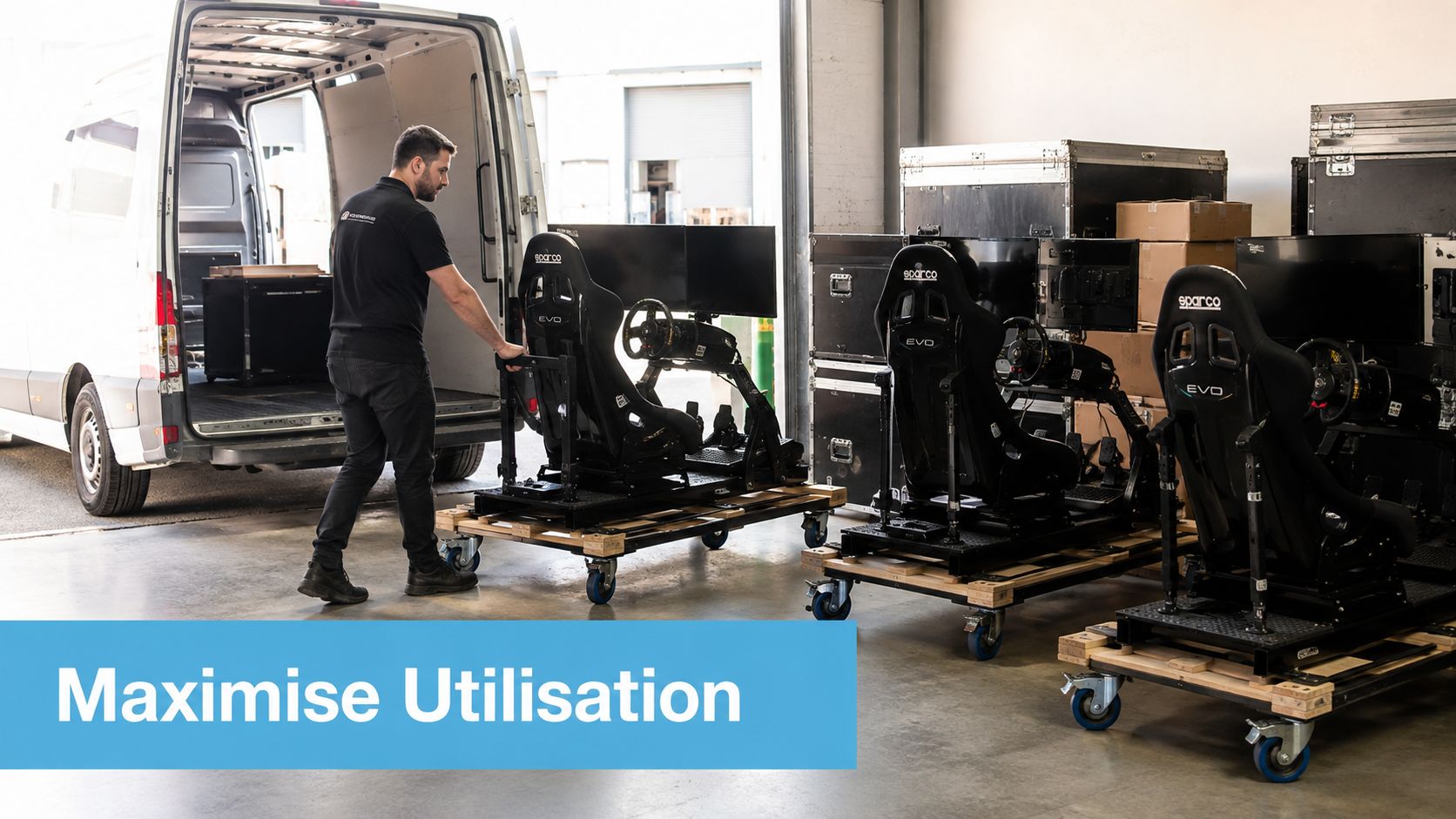
Simulator inventory only creates profit when it is moving. Idle stock ties up capital, increases storage pressure, and makes the hire model less efficient. Utilisation has to sit at the centre of cost control, because every unused rig is capacity you have already paid for.
The strongest operators plan around routing, timing, and deployment windows. A racing rig that serves one venue on Friday and Saturday, then reaches a second site for Monday and Tuesday, will usually outperform a machine left in storage between isolated jobs. The same logic applies to golf, boxing, flight, and multi-rig setups. The more often the asset is in front of a paying audience, the better the return on that equipment.
What specifically improves utilisation
Visibility comes first. Live asset tracking, condition checks, and booking data need to sit in one place so you can see which rigs are busy and which ones are underused. A centralised inventory approach, similar in principle to the control logic described by Gresham in its market data cost management guidance, is useful here even outside finance. The point is simple, know what you own, who is using it, and where duplication is creating avoidable cost.
A simulator that sits idle between bookings is not a fixed asset doing nothing. It is margin leaking subtly.
Rapid deployment protocols matter too. Standardised setup, calibration, and teardown procedures reduce delay on site and make cross-hiring more realistic across venues. If you buy or rent at scale, review the equipment rental rates page once, because utilisation only works when pricing and deployment speed are aligned.
4. Dynamic Staffing and Flexible Labour Models
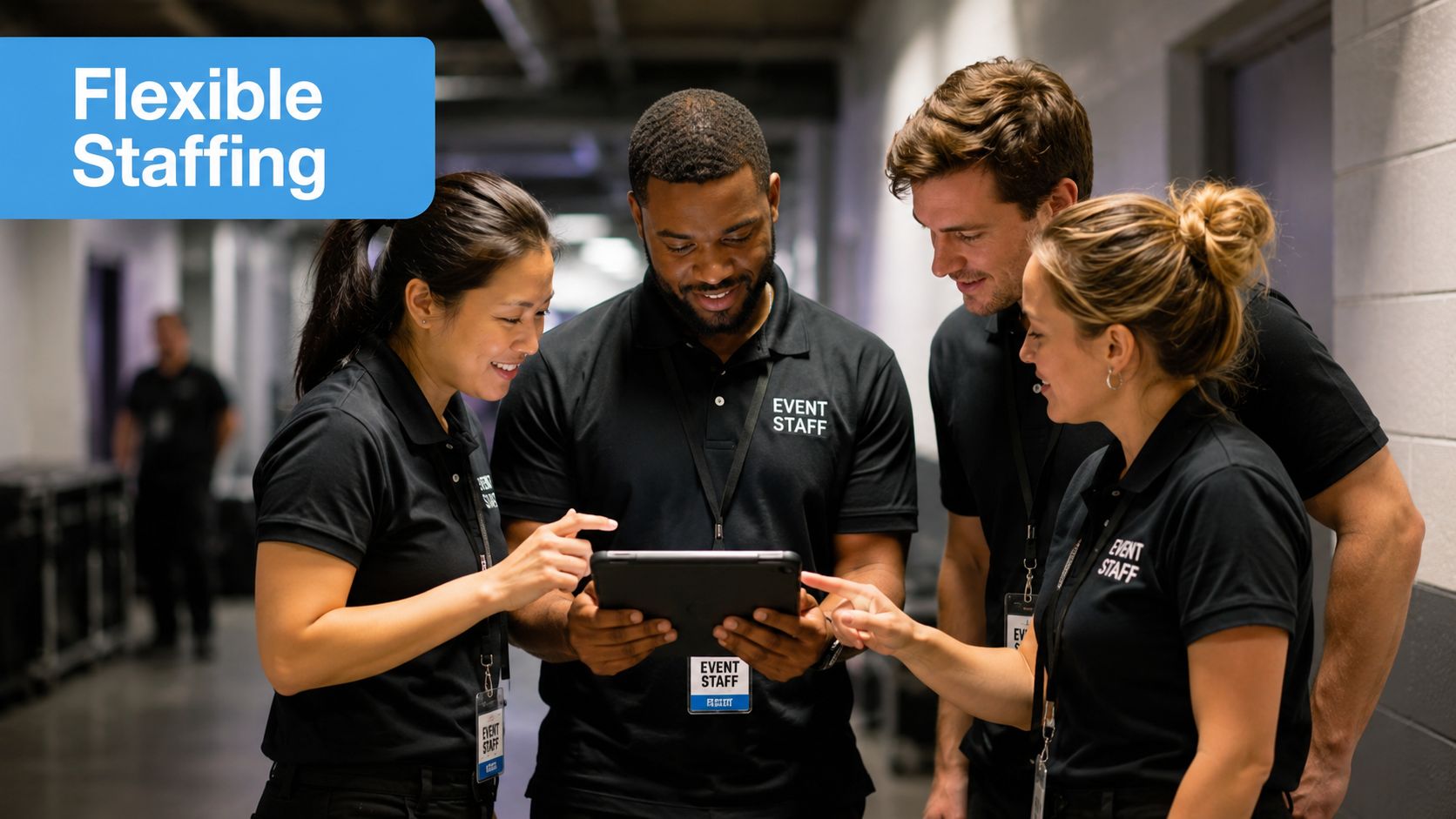
Labour is usually where event budgets become either disciplined or bloated. A permanent core team gives you quality control, brand consistency, and accountability. A flexible layer of trained freelancers gives you scale for exhibition season, launches, fan zones, and branded roadshows without carrying the overhead year-round.
That hybrid model is especially useful in experiential marketing because the workload isn't flat. One month might need a compact delivery team. The next might require operators, technicians, brand ambassadors, and supervisors across several venues. If you try to staff every peak as a permanent requirement, payroll becomes rigid very quickly.
Make flexibility reliable, not chaotic
The trick is to treat freelancers like a managed capability, not a last-minute scramble. Build a preferred network, train them on simulator operation, H&S, and client messaging, then review performance after each deployment. That keeps quality high and gives you a pool you can trust when the calendar tightens.
A useful control layer is a skills matrix. It tells you who can operate which rig, who can manage brand messaging, and who can step into a venue lead role if needed. That makes shift allocation faster and cuts avoidable admin.
Practical rule: if a freelancer can't be briefed, deployed, and debriefed consistently, they're not flexible labour. They're a risk premium.
For staffing businesses, the event staffing solutions page is a natural reference point for how a hybrid model can be packaged around demand. The goal is simple: scale labour with event volume, not with hope.
5. Preventive Maintenance and Equipment Reliability Programmes
The cheapest repair is the one you never need to make mid-event. In simulator hire, reliability is a cost control issue because breakdowns don't just create repair bills. They create replacement costs, reputational damage, and lost operating time.
A proper maintenance programme starts with the obvious but often skipped basics. Every rig needs a schedule, a checklist, and a record of what's been done. Daily pre-event diagnostics catch small issues before the venue doors open, and planned servicing keeps bigger systems from failing when they're under load. For motion-based equipment, that discipline matters even more because moving parts wear differently from static attractions.
Build maintenance around usage, not hope
The most effective maintenance plans are tied to actual use intensity. If a unit works hard through a peak season, it should not wait until a failure to receive attention. Keep a spare parts inventory for critical systems, document every service action, and give core staff enough technical knowledge to handle basic troubleshooting on site.
A clear go or no-go process is essential. If a rig fails the pre-deployment check, it should be replaced or held back before it reaches the venue. That's not overcautious, it's cheaper than explaining to a client why the headline attraction is out of service.
Maintenance is a cost control tool because it protects revenue, not just assets.
For more specialised categories, the same approach applies to motion systems, leaderboards, and calibration-heavy activations. The cost control in construction guide is about projects, not events, but its monthly update discipline is a useful analogue for keeping complex assets under control. In event work, the equivalent is routine inspection plus a formal failure log.
6. Venue Partnerships and Revenue Sharing Models
Venue partnerships change the cost equation because they can replace one-off hire friction with recurring commercial value. Instead of treating every activation as a separate negotiation, you build a relationship where the venue benefits from traffic, dwell time, and a stronger visitor offer. That can reduce upfront venue charges and make the venue more willing to support promotion.
The best partnerships happen where the attraction fits the venue's audience. Motorsport, boxing, football, and fan-led experiences work well in spaces with steady footfall and clear event identities. A venue that sees the simulator as part of its visitor offer will often help with marketing, ticketing, and visibility because it has a stake in the result.
Structure the relationship so both sides win
Revenue share only works when the rules are explicit. Define what counts as gross revenue, what costs are deducted, who pays for marketing placements, and how performance is reviewed. Without that clarity, a shared model can become messy very quickly.
Venue data is valuable here too. Peak times, visitor profiles, and on-site feedback can tell you whether a simulator is in the right location and whether the programming needs to change. If the venue promotes the attraction properly, both sides benefit from stronger traffic and better conversion.
The strongest venue deal isn't the cheapest one. It's the one that gives the attraction a reason to perform well every week.
For planners comparing venue economics, a useful parallel is the way the reduce Felixstowe port costs resource frames efficiency around route and stakeholder coordination. Different sector, same lesson, when a partner has skin in the game, your cost base usually behaves better.
7. Outsourced Logistics and Transport Consolidation
Transport can eat margin fast if every booking is treated as a one-off movement. The smarter model is to consolidate shipments, use specialist logistics providers, and keep your own fleet footprint lean unless there's a clear reason to own more of it. That reduces capital cost and gives you access to people who understand venue access, H&S, and event timing.
For UK event planners, this matters because site access windows are rarely generous. A late van, a wrong-sized vehicle, or an awkward unloading process can force overtime, create stress on the venue side, and increase the chance of damaged equipment. A specialist 3PL with event experience is often cheaper than in-house improvisation once you factor in missed slots and operational risk.
What to ask logistics partners
- Delivery windows: confirm exact arrival and unload requirements before the event week.
- Insurance and SLA terms: make sure the provider accepts the risk profile of high-value kit.
- Visibility tools: use freight management software so you know where assets are in transit.
- Buffer time: build in room for traffic, venue access issues, and setup contingencies.
Consolidation is where the saving often sits. Weekly transport runs, regional pickup patterns, and planned routes between multiple venues can reduce empty mileage and lower handling noise. Keep a small emergency transport option available, but don't let the exception become the default.
8. Technology Investment in Automation and Self-Service
Automation is one of the easiest ways to stop low-value admin from draining labour hours. Booking portals, automated invoicing, self-service scoring, and integrated payments all reduce manual touchpoints. In event operations, that matters because admin time is hidden cost, and hidden cost becomes margin loss surprisingly quickly.
A client portal is especially useful for simulator hire. Planners can check availability, choose packages, get instant quotes, and pay without waiting for a back-and-forth email chain. On the delivery side, live leaderboards and self-service scoring reduce the need for extra staff to manage a process that technology can handle more cleanly.
Start with the processes that repeat most
Do the boring stuff first. Booking, invoicing, and confirmation workflows are usually the highest-impact areas because they happen on every job. If those systems talk to CRM and accounting tools properly, you cut data entry, reduce errors, and make reporting far more useful.
Then test the customer-facing experience. A tool only saves money if the client uses it. Staff also need training before launch, because a broken handover creates frustration and can erase the labour saving you were trying to capture.
Good automation removes friction without making the service feel cold.
There's a direct cost control link to measurement here as well. If you can track which automation saves time and which one mainly creates complexity, your next investment becomes easier to justify. For experiential marketing teams, that's where the ROI story gets stronger.
9. Negotiated Supplier and Vendor Contracts
Supplier negotiation works best when you treat it as a structured commercial process, not a once-a-year haggle. The advantage comes from volume visibility, consolidated buying, and a clear understanding of where long-term value sits. For event businesses, that includes equipment manufacturers, insurers, travel suppliers, calibration partners, and specialist technicians.
The strongest contracts don't just push down headline prices. They improve working capital and reduce surprise cost creep. Longer payment terms, service inclusions, and fixed-rate agreements can matter as much as the discount itself, especially when cash flow is tight after a busy booking cycle.
Negotiate the whole relationship, not just the invoice
If a supplier knows you understand your volume, they're more likely to offer a serious commercial response. Multi-year agreements can deliver better pricing and bundled support, while clear service-level expectations reduce the chance of emergency callout pricing later.
This is also where vendor selection matters. The vendor selection criteria page is useful because supplier control starts long before the contract is signed. Pick partners who can support scale, respond on time, and hold quality when the calendar gets busy.
Practical rule: if a supplier only looks cheap before the contract is signed, they're probably expensive in the wrong places.
Payment terms, technical support, training, and data sharing are all negotiation levers. Use them. If supplier flexibility helps you preserve margin, that's a real cost control win, even when the discount line looks modest on paper.
10. Client Retention and Lifetime Value Optimisation
Retention is one of the most underrated cost control strategies in event work because repeat business is cheaper to service than new business is to win. Existing clients already understand your process, trust your delivery, and know what the attraction does on site. That cuts sales friction and usually improves planning efficiency too.
For experiential campaigns, retention also helps with asset planning. Repeat customers often book similar rigs, similar formats, and familiar venue windows. That predictability is useful because it lets you line up staffing, transport, and maintenance more intelligently than with a constant stream of one-off requests.
Make the relationship easier to repeat
Segment your clients by value and likelihood to return. High-value corporate accounts deserve stronger account management, regular contact, and early access to new attractions. Loyalty discounts can work, but they should sit inside a broader service model that includes preferred dates, pre-allocated equipment, and proactive recommendations for the next activation.
Case studies and ROI documentation are especially effective here. When a planner can show internal stakeholders what worked before, the rebook conversation gets easier. Referral programmes can help too, because a trusted introduction often shortens the sales cycle more than a price concession does.
Retention saves money twice. It reduces acquisition cost and makes delivery smoother.
If you want stronger margins, protect the clients who buy well, brief well, and return well. That's where lifetime value becomes a cost control tool, not just a sales metric.
10 Cost-Control Strategies Comparison
| Strategy | Implementation Complexity 🔄 | Resource Requirements & Speed ⚡ | Expected Outcomes 📊 | Ideal Use Cases 💡 | Key Advantages ⭐ |
|---|---|---|---|---|---|
| Tiered Pricing and Package Bundling | Medium, requires pricing analysis & package design | Low–Medium resources; speeds quoting and sales | Predictable revenue, higher ARPU, simplified sales | Conferences, trade shows, multi-segment clients | Predictable cashflow; drives upsell; inventory optimisation ⭐⭐⭐ |
| Early Booking Discounts and Advance Commitment | Low, policy + CRM automation | Low resources; improves planning lead time | Smoother demand, improved cash reserves, fewer rush costs | Seasonal conferences, annual exhibitions | Demand smoothing; better resource planning; early cash inflow ⭐⭐️⭐ |
| Equipment Utilisation & Cross‑Hiring Optimisation | High, complex logistics & scheduling | High resources (transport, tracking); maximises asset throughput | Much higher utilisation, faster capex recovery, lower per-event cost | Multi-venue tours, back-to-back bookings | Maximises ROI on kit; enables competitive pricing ⭐⭐⭐ |
| Dynamic Staffing & Flexible Labour Models | Medium–High, HR, onboarding & compliance | Variable labour cost model; scales quickly during peaks | Labour costs align to demand; rapid scaling capability | Seasonal peaks, large exhibitions | Cost scalability; access to flexible talent; reduced fixed payroll ⭐⭐️⭐ |
| Preventive Maintenance & Equipment Reliability Programmes | Medium, scheduled programmes & monitoring | Requires maintenance team/parts; occasional downtime for service | Fewer emergency failures, longer equipment life, reliable delivery | High-value rigs, flagship events, frequent deployments | Minimises downtime; reduces liability; protects revenue ⭐⭐⭐ |
| Venue Partnerships & Revenue Sharing Models | Medium, contract negotiation & relationship mgmt | Low capex for space; variable revenue split impacts margins | Reduced fixed venue costs, venue-led promotion, predictable traffic | Permanent activations, high-footfall venues | Shared risk; venue marketing lift; improved utilisation ⭐⭐️⭐ |
| Outsourced Logistics & Transport Consolidation | Low–Medium, 3PL contracts and SLA management | Reduces capex and fixed fleet costs; flexible capacity | Lower transport costs, professional handling, scalable delivery | Multi-city delivery runs, high-frequency shipments | Cuts fixed overhead; access to logistics expertise ⭐⭐ |
| Technology Investment in Automation & Self‑Service | High, development, integrations, compliance | High upfront cost; greatly increases operational speed & data | Reduced admin, better UX, data-driven optimisation | High-volume bookings, self-serve customer flows | Efficiency gains; automated billing; BI insights ⭐⭐⭐ |
| Negotiated Supplier & Vendor Contracts | Medium, procurement strategy & negotiations | Requires procurement effort; improves unit costs & payment terms | Lower input costs, improved working capital, supplier support | Large equipment portfolios, recurring parts & services | Price stability; priority support; better payment terms ⭐⭐⭐ |
| Client Retention & Lifetime Value Optimisation | Medium, CRM, account management & programmes | Investment in account teams and loyalty offers; long-term payoff | Higher LTV, lower acquisition cost, more referrals | Blue-chip repeat clients, annual contract customers | Predictable revenue; stronger client relationships; referral growth ⭐⭐⭐ |
Your Blueprint for Profitable Experiential Events
Effective cost control is not about cutting corners or sacrificing impact, it's about making smarter, more strategic decisions. The strongest cost control strategies in UK experiential marketing start with visibility, then move into planning, and finish with disciplined correction when spend starts to drift. That's the difference between reacting to an overrun and managing one before it damages the job.
The UK data make that discipline more important, not less. Producer input prices have swung sharply in recent years, Bank Rate has stayed high enough to affect working capital, and labour productivity remains below pre-pandemic levels according to the ONS and the other verified sources cited above. In that environment, planners who rely on instinct alone are taking a bigger risk than they need to.
For simulator hire and high-impact activations, the smartest play is to match the offer to the event, the venue, and the booking pattern. Tiered packages improve quoting, early commitment helps scheduling, utilisation keeps assets earning, and preventive maintenance protects delivery. Layer on flexible staffing, partner logistics, negotiated suppliers, and retention-focused account management, and you get a cost base that behaves far better under pressure.
That's the essence of cost control in events. It's not about saying no to ambition. It's about making ambition financially sustainable so your activations still look strong when the invoice lands.
PSW Events helps planners build that kind of control into the brief from day one, from simulator hire and staffing to branding, logistics, and on-site delivery. If you're planning an exhibition, brand activation, fan zone, or corporate experience, visit PSW Events to see how a smarter delivery model can protect both your audience impact and your margin.