
You're probably staring at a venue plan, a draft run sheet, and a fundraising target, trying to work out how to make guests stay longer, bid more freely, and leave talking about the night for the right reasons. That's the core job of charity event entertainment in the UK now. It's no longer just about filling the room between speeches, it's about helping the event perform financially in a sector where fundraising is measured against income, conversion, and efficiency, not atmosphere alone, as NP Capital's fundraising guidance frames event productivity and the AAW 2025 benchmarks show across a £1.8bn sample base from 53 charities, representing 7% of UK charity voluntary income (NPC guidance on fundraising event productivity, AAW Fundraising Benchmarks Report 2025).
The best entertainment choices do three things at once. They pull people into the action, create natural moments for giving, and give sponsors or partners a reason to be visible without hijacking the room. That's especially important in a market where physical fundraising still dominates, because the Massive Top 25 found physical events made up 88% of the collective £132 million raised in 2024, and only three virtual events made the rankings, the lowest number since 2019 (Massive Top 25).
1. Interactive Racing Simulators
Racing simulators work because they turn passive guests into competitors. At a charity gala, brand activation, or sponsor reception, that shift matters, since people don't just watch the attraction, they queue for a run, compare lap times, and come back to beat the leaderboard. For fundraising, that repeat behaviour creates more dwell time, more social chatter, and more chances to ask for a donation at the right moment.
The strongest placement is central, not tucked away in a corner. If the simulator sits near the bar, registration, or auction area, it becomes part of the event flow rather than a side show. That's why motorsport rigs often perform well at exhibition halls and large venues, including high-footfall spaces such as ExCeL London and Manchester Central, where foot traffic can be converted into attention and then into lead capture.
Practical rule: if guests can see the leaderboard from across the room, they'll keep checking it.
Use competition to support giving. A sponsored fastest-lap prize, a timed team challenge, or a donor-only qualifier all make the experience feel purposeful rather than random. For charities, that's a better fit than a loose “free play” setup, because the attraction can be tied directly to auction padding, raffle pushes, or sponsor messaging.
A simple operational point also matters, queue management. Without it, the stand becomes crowded and the event team loses control of timing. With it, the rig stays busy, guests understand the turn-taking, and the sponsor gets a premium-looking installation rather than a bottleneck.
For a practical setup reference, see PSW Events' racing simulators in the UK.
2. Flight Simulators and Helicopter Experiences
Flight simulators feel premium from the moment guests step in. The cockpit framing, instrument panels, and briefing process create a different tone from a standard party game, which makes them useful for VIP rooms, patron events, and donor experiences where perception of value matters as much as entertainment itself.
That premium feel should be reinforced, not diluted. A short professional briefing before the session and a quick debrief afterwards make the experience feel curated, which helps justify it as an add-on rather than just another attraction. This is especially useful at corporate hospitality nights, where hosts want something memorable without turning the event into a noisy fairground.

A good flight-sim format also supports content capture. Guests tend to react visibly, which gives the charity usable clips for social posts, post-event thank-yous, and sponsor recaps. If the organiser wants to keep the experience exclusive, a hospitality bundle with lounge access and catering often works better than open access to the wider room.
Premium experiences convert best when they feel earned, not mass-produced.
The main trade-off is throughput. Flight and helicopter simulators are less suitable for very large, fast-moving audiences than reaction games or leaderboard-based attractions. That doesn't make them weaker, it makes them better for the right section of the event, especially when the goal is donor appreciation, executive engagement, or a high-value brand moment. For venue planning and setup expectations, use PSW Events' flight simulator requirements as a practical reference.
3. American Football and Rugby Simulators
Sports simulators make sense when the audience already cares about the game. At rugby fan zones, Wembley activations, or corporate events linked to sports brands, they give guests a hands-on reason to stop, compete, and share. That relevance matters, because entertainment performs best when it feels native to the event rather than dropped in for novelty.
The best use case is a branded challenge. One person kicks, throws, or completes a play, then the next tries to beat the score. That structure encourages spectators to stay nearby, which is exactly what a fundraiser wants when it's trying to keep attention around a sponsor wall, a donation prompt, or a merch stand.
A strong setup usually includes a few simple features.
- Team brackets: build group rivalry and keep multiple participants engaged.
- Highlight clips: let fans share standout plays on social channels.
- Data capture: collect sign-ups and follow-up contacts with consent.
- Branded add-ons: use merchandise or sampling to reinforce the sponsor message.
The catch is fit. These simulators work brilliantly in sport-led settings, but they can feel out of place at a formal black-tie gala unless the audience is strongly aligned with the theme. That's why event planners should match the game to the room, not just the sponsor brief.
For practical venue integration, the American football simulator is a useful example of how to position a sports attraction without losing flow. It's strongest when the organiser wants active participation, not silent observation.
4. Golf Simulators and Virtual Course Experiences
Golf simulators bring a different kind of charity-event value. They suit hospitality rooms, client-facing receptions, and sponsor lounges because they feel polished, familiar, and easy to understand without a long explanation. Guests can play a full round or take a short challenge, which helps the organiser control pace across the evening.
That flexibility matters. Some guests want a quick nine-hole slot between drinks and speeches, while others will stay for a longer round if the room allows it. A short-format competition is usually the safer choice for fundraising events, because it keeps the line moving and avoids losing less-confident players who might never join a full round.
Where golf simulators earn their keep
They work best beside a bar, lounge, or networking area, not on the far edge of the venue. When the simulator sits near hospitality, it supports conversation, keeps the room active, and gives hosts a natural conversation starter with donors or sponsors. That makes it a better fit for events where relationship-building matters as much as ticket sales.
Professional instruction also helps. Golf can intimidate non-golfers, so a calm starter who explains the controls can widen participation and reduce hesitation. For repeat visitors, a visible handicap or score-tracking format keeps the experience from feeling one-and-done.
The main downside is that golf can become too “nice” if it isn't tied to a reason to play. A charity event needs stakes, even if they're playful. The organiser might offer a closest-to-the-pin prize, a sponsor-branded leaderboard, or a donor-only challenge to keep the money motive visible.
For those exploring course-style setups, the guide to backyard greens for Prescott homes is an adjacent example of how golf-style play spaces are framed elsewhere, even though the event use case is very different.
5. Boxing Simulators and Combat Sports Experiences
Boxing simulators are strong because they create instant energy. Guests understand the goal immediately, hit the target, and want to try again if the score looks beatable. That makes them ideal for wellness brands, sports activations, and team events where a bit of competitive aggression is part of the appeal.
The setup has to feel controlled. Safety briefing, warm-up guidance, and trained staff matter because this is a physical attraction, not just a touchscreen game. When the queue is busy, a good operator keeps things moving without letting the area become chaotic.
Make the competition visible
A scoreboard turns a decent attraction into a fundraising asset. If guests can see the highest punch force, speed, or accuracy, they'll start challenging each other naturally. That's useful at a charity event because the game creates its own social pressure, which can be linked to raffle entries, sponsored attempts, or a prize draw for top performers.
The best version of this attraction is branded but not overbranded. Keep the event identity clear, but let the sponsor own the prize, the score display, or the challenge title. That keeps the room from feeling like a commercial roadshow while still giving the sponsor something tangible.
Boxing simulators do have limits. They aren't the best fit for mixed-age gatherings where some guests may prefer lower-impact attractions, and they need enough floor space for safe movement. If the event audience includes donors, staff, and families, it's worth pairing the boxing unit with a calmer experience nearby so the whole room feels inclusive.
6. Batak Pro Reaction Testing Systems
Batak Pro is one of the best charity-event choices when throughput matters. The attraction is simple, fast, and easy to understand, which means a long queue can still feel productive rather than frustrating. Guests step up, tap the lights, and leave after a short burst, so the stand can handle a steady flow at trade shows, conferences, and public fundraisers.
That speed is the point. At events where organisers want as many people as possible to interact with a brand or cause, Batak Pro gives them a clean, measurable challenge without needing long briefing times. It also works well in mixed audiences because nearly anyone can try it, which is rare for more technical or physically demanding attractions.
A good operator uses the stand like a mini competition arena. Team challenges, time trials, and public rankings all keep people watching even when they're not playing. Add a small prize for the fastest score and the stand starts to function like a magnet for passers-by.
Operational insight: the game itself is quick, but the queue is where the fundraising value is won or lost.
Hygiene and cleaning matter here more than many organisers expect. The attraction is high-contact, so regular wipe-downs and clear handover discipline are part of the guest experience, not just a back-of-house task. If the event has a sponsor, the game can also carry branding cleanly because the hardware is compact and visually tidy.
For charities, this is the attraction to choose when you want interaction without heavy setup, and activity without a steep learning curve.
7. Giant Scalextric Slot Racing
Giant Scalextric works because it combines nostalgia and competition in a format most guests recognise instantly. People don't need a long explanation. They pick a lane, start the race, and immediately understand whether they're winning or losing, which is ideal for fundraising events that need quick participation.
The attraction does especially well with mixed-age audiences. Families, colleagues, and donor groups can all enjoy it without the physical demands of a sports simulator, so it bridges the gap between a playful fun day and a more structured corporate event. That also makes it useful for charity events where the room includes people with very different energy levels.
Build the room around the race
A visible lane layout and overhead leaderboard make the attraction feel important, not tucked away. That's the difference between a nice side feature and an event centrepiece. If the organiser wants the race to generate repeat visits, the prize should reward either the fastest lap or the tournament winner, not just the person who happens to arrive first.
Branding can be more playful here than on a golf or flight setup. Car colours, decals, and track-side signage are easy ways to fold sponsor identity into the experience without making it feel forced. For private celebrations or family fundraisers, those same custom touches can make the attraction feel more personal.
The main limitation is space for spectators. The track needs room for observers, because much of the appeal comes from watching someone narrowly miss a win and then come back for another attempt. If the viewing area is too tight, the atmosphere drops and the game loses some of its pull.
For charities that want accessible, repeatable competition, Giant Scalextric often punches above its weight.
8. Virtual Reality Experiences and Immersive Environments
VR can be one of the most effective interactive choices when the event wants novelty and immersion. It pulls guests into a fully different environment, which makes it valuable for product launches, brand worlds, escape-room formats, and training-style activations. The key is to treat it as an experience, not a gadget.
The guest journey has to be clean. Clear safety advice, motion-sickness warnings, headset sanitisation, and a calm handover process are all part of the attraction's credibility. If the room feels rushed or messy, the premium effect disappears fast.
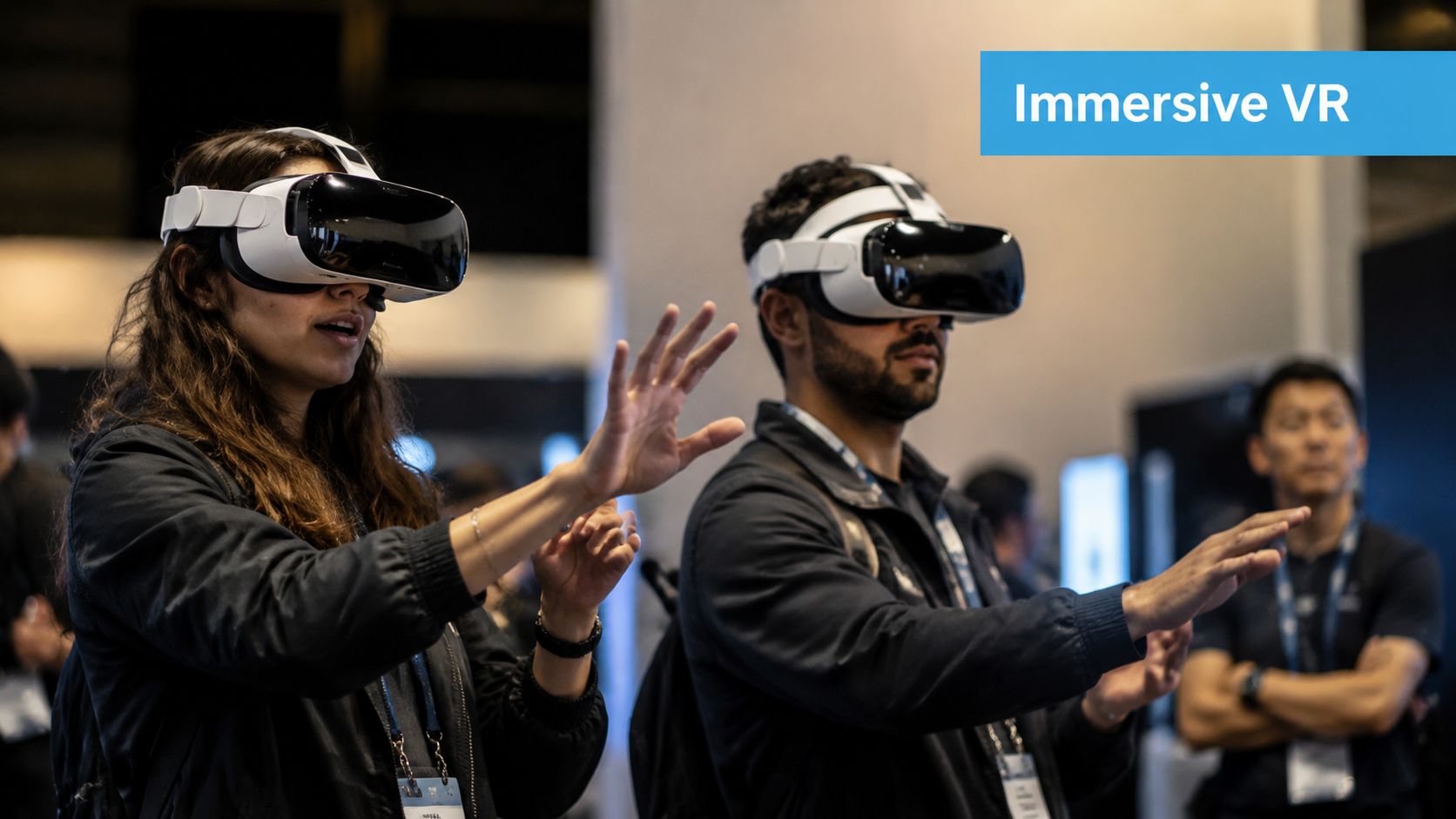
Use VR to create shareable moments
VR is one of the easiest formats for spectator screens, which is useful because bystanders enjoy watching the participant as much as the participant enjoys the game. That gives the charity a second layer of engagement around the headset itself. It also creates cleaner content for social media because the reactions are visible and immediate.
The biggest operational risk is overload. If there are too many experiences and too few staff, the queue becomes confusing. If there's only one VR title, repeat interest can drop. The best answer is usually a small menu of experiences so different guests can choose between adventure, challenge, and brand-led content.
For charity events, VR is strongest when it supports a message, not when it tries to do everything. A branded environment, a challenge linked to donor recognition, or a campaign visualised in 3D will usually outperform a random novelty game because it gives guests a reason to connect the experience to the cause.
That's also where VR fits into modern fundraising behaviour, since charity events increasingly need formats that support mobile bidding, QR-based donation prompts, and hybrid engagement. The 2025 CAF UK Giving Report found that 13% of UK donations are now made online, up from 10% in 2024, which shows how important digital-ready entertainment has become for charity event planning (CAF UK Giving Report 2025 coverage).
9. Casino Gaming Tables and Interactive Gambling Experiences
Casino nights work because they create social energy without asking guests to be serious gamblers. At gala events, auctions, or donor receptions, roulette, blackjack, and poker tables give people something to do while still keeping the room polished. The entertainment feels familiar, which lowers the barrier to participation.
The compliance side cannot be ignored. UK Gambling Commission rules, responsible messaging, and the use of play money or tokens need to be handled properly, especially when a charity wants the event to feel fun rather than financially risky. A responsible setup protects the charity's reputation and keeps the focus on fundraising, not gaming.
Casino tables work best when the event feels like hospitality first and game night second.
That means table placement matters. If the tables are hidden, they won't drive energy. If they're too dominant, they can overshadow speeches, auctions, or live fundraising moments. The sweet spot is a visible, well-managed area where guests can drift in and out while still hearing the programme.
Croupier briefing is another detail that separates a smooth night from a messy one. The team needs to understand the charity's tone, the rules of the event, and how prizes or donation-linked outcomes should be handled. Done well, the tables become a polished networking tool, not just a novelty.
For a practical breakdown of game structure, how Super Six Baccarat works is a useful reference point, though the charity setting should always stay non-financial and clearly framed.
10. Climbing Walls and Adventure Challenges
Climbing walls bring physical theatre into a charity event. They're visible from across the venue, they invite applause, and they create a natural sense of achievement when guests reach the top. That makes them especially effective for family fundraisers, wellness events, and outdoor corporate gatherings.
Safety is the first requirement, not an afterthought. Harness demonstrations, clear briefing, trained staff, and weather protection all need to be in place before the first climber steps up. If any of those pieces are missing, the attraction becomes stressful for organisers and less welcoming for guests.
Build confidence before competition
A wall with multiple difficulty levels works far better than a single tough face. Guests who are nervous can start simple, while more confident climbers can move to timed runs or team challenges. That progression keeps the attraction inclusive and stops it from becoming an all-or-nothing test.
Climbing also works well for social content. Photos at the top, video of the final reach, and team recognition shots all give the charity strong post-event material. That content is useful because it shows effort, not just attendance, and effort is easier to link to a cause.
The limitation is venue and environment. Indoor events need the right ceiling height and floor space, while outdoor settings need proper maintenance and weather planning. In return, the attraction gives you something that feels active, communal, and memorable, which is a strong combination when the event needs more than background entertainment.
Climbing walls are most effective when the charity wants a visible challenge with a clear finish line. Guests understand the goal immediately, and that makes it easy to fold the activity into sponsorship, team recognition, or donor engagement.
Charity Event Entertainment: 10-Item Comparison
| Experience | Complexity 🔄 | Resources ⚡ | Effectiveness ⭐ | Results/Impact 📊 | Ideal use cases & Tips 💡 |
|---|---|---|---|---|---|
| Interactive Racing Simulators | High, hydraulic motion rigs, technical setup, staff training | High, large footprint, power, maintenance, operators | ⭐⭐⭐⭐ | Strong dwell time, measurable lap metrics, repeat engagement | Corporate team-building, brand activations; place centrally, use leaderboards and app integration |
| Flight & Helicopter Simulators | Very high, full-motion platforms, safety briefings, certified instruction | Very high, specialist instructors, maintenance, lengthy sessions | ⭐⭐⭐⭐ | Premium emotional impact, VIP retention, strong social share | VIP hospitality, executive rewards; sell as premium add-on, provide certificates and video capture |
| American Football & Rugby Simulators | Medium-high, motion capture and sport-specific mechanics | Medium, cleared safe space, moderate staff, branded kit | ⭐⭐⭐ | High fan engagement, sponsor alignment, competitive replay content | Fan zones, sports activations; run team tournaments and offer instant replays for social sharing |
| Golf Simulators & Virtual Courses | High, swing-analysis tech, realistic physics, calibrated systems | High, space, clubs, trained staff, longer session times | ⭐⭐⭐⭐ | Extended engagement, appeals to corporate/affluent demographics | Client hospitality, executive entertainment; position near lounges, offer timed rounds and instruction |
| Boxing & Combat Simulators | Medium, motion-sensing systems, safety protocols | Medium, durable equipment, staff for safety, maintenance | ⭐⭐⭐ | Energetic, high-visual engagement; good photo/video moments | Fitness activations, team challenges; enforce warm-ups, staff supervision and capture punch metrics |
| Batak Pro Reaction Systems | Low, simple LED setup, minimal training | Low, compact footprint, low cost, minimal staff | ⭐⭐⭐ | Very high throughput, rapid rounds, broad demographic appeal | Exhibitions, high-traffic activations; place in busy areas, run tournaments and maintain hygiene protocols |
| Giant Scalextric Slot Racing | High, custom large-scale tracks, complex assembly | High, significant space, technical support, upkeep | ⭐⭐⭐ | Strong group participation, nostalgic crowd appeal, extended play | Family days, brand activations; host team brackets, allow car customisation and spectator viewing |
| Virtual Reality (VR) Experiences | High, immersive software, hardware, safety & motion mitigation | High, headsets/PCs, skilled tech staff, sanitisation protocols | ⭐⭐⭐⭐ | High emotional impact and brand prestige; measurable user analytics | Product launches, immersive storytelling; provide spectator screens, multiple experiences and strict sanitisation |
| Casino Gaming Tables | Medium, table setup, dealer staffing, compliance needs | Medium-high, trained croupiers, table equipment, licensing checks | ⭐⭐⭐⭐ | Upmarket atmosphere, long dwell time, good for fundraising | Gala events, VIP hospitality; use play money, ensure UK regulation compliance and trained dealers |
| Climbing Walls & Adventure Challenges | Medium-high, safety systems, harnesses, supervised belay | High, trained supervisors, insurance, space, weather considerations | ⭐⭐⭐ | Promotes team bonding, visible activity with photo ops | Team-building, wellness events; offer graded routes, mandatory safety briefings and capture achievement photos |
Matching Entertainment to Your Fundraising Goals
Choosing the right entertainment is a strategic decision that directly affects your fundraising result. A racing simulator leaderboard can drive repeat visits and sponsored challenges, while a premium flight rig can give VIP donors a sense of exclusivity. A casino table might suit an elegant gala, but a Batak Pro stand may do more for footfall, speed, and queue turnover.
The best charity event entertainment doesn't just look good in the room. It supports a clear outcome, whether that's keeping guests in the venue longer, creating a sponsor moment, encouraging team competition, or giving people an easy way to give after a strong emotional high. That's the standard to use in the UK now, especially when fundraising events are being judged as part of broader voluntary-income performance and not as standalone hospitality spend, as reflected in the AAW 2025 benchmark sample and NPC's productivity framework (AAW Fundraising Benchmarks Report 2025, NPC guidance on fundraising event productivity).
For UK charities, the practical test is simple. Does the attraction support the event objective, fit the audience, and make it easier to raise money on the night or after it? If the answer is yes, the entertainment has a fundraising role. If the answer is no, it's probably just decoration.
That's where suppliers like PSW Events can be useful, because the right partner should be able to handle planning, branding, logistics, installation, and on-site staffing without turning the entertainment into a management headache. For organisers working on black-tie dinners, fan zones, exhibitions, or donor receptions, the value sits in attractions that are easy to run, simple to explain, and strong enough to pull attention back to the cause.
PSW Events supplies interactive entertainment for fundraising, corporate, and private events across the UK, including simulators, VR, Batak Pro, climbing walls, and casino tables. If you're planning charity event entertainment that needs to drive engagement as well as donations, visit PSW Events to explore the options and discuss the best fit for your event.