
You've got the venue, the guest list, and a date that won't move. The casino tables look like the easy part, until the first supplier quote lands and you realise you're comparing apples, oranges, and a half-written risk assessment. That's where most UK planners lose money, time, or both.
Casino table hire is not a simple furniture drop. It's a live entertainment setup that depends on game choice, dealer quality, floor space, venue rules, and how tightly the supplier handles compliance. The supplier pages rarely spell out the messy bits, which is why a like-for-like buying framework matters more than the headline price.
Why Casino Table Hire Is More Complex Than It Looks
A corporate planner books two blackjack tables for a client reception, assumes the rest will be handled, and then discovers the venue wants a floor plan, insurance evidence, and a load-in window that clashes with catering. The supplier can provide the tables. The event still fails if no one has checked access routes, staffing, or whether the activation even fits the room.
That's the trap with casino table hire. The equipment is only one layer. The live event experience depends on dealer scheduling, venue compliance, guest flow, and the way the tables sit inside the wider production plan. If you're planning a branded evening, the casino element also has to work alongside lighting, AV, registration, and security.
One practical reference point is Overton Security event hire, because venue protection and crowd movement often sit in the same approval process as entertainment hire. If the security team, venue manager, and supplier aren't aligned early, the casino setup becomes the problem everyone else has to fix on the day.
Practical rule: Treat casino hire like a managed event service, not a prop delivery. If the quote doesn't cover who is doing what, it's incomplete.
The better approach is to ask a supplier to prove they've thought through the whole activation, not just the table count. That means game format, staffing, access, timings, insurance, and what happens when the event runs late. In the UK, where casino-style entertainment sits inside a broader gambling market that generated £15.6 billion in gross gambling yield for the year to March 2024, with £6.9 billion from online gambling and £4.6 billion from non-remote gambling, the format is familiar, but the event delivery still needs proper control. The modern licensing framework also dates back to the Gambling Act, which came into force on 1 September 2007 according to the Gambling Commission report cited in the brief.
Choosing the Right Casino Games for Your Event
Start with your audience, not the supplier's favourite table. A sales team, a conference crowd, and a wedding party all want different levels of noise, pace, and social friction. If you pick the wrong mix, the tables sit half-used while the bar or dance floor gets the attention.
Roulette, blackjack, poker, and baccarat each do a different job
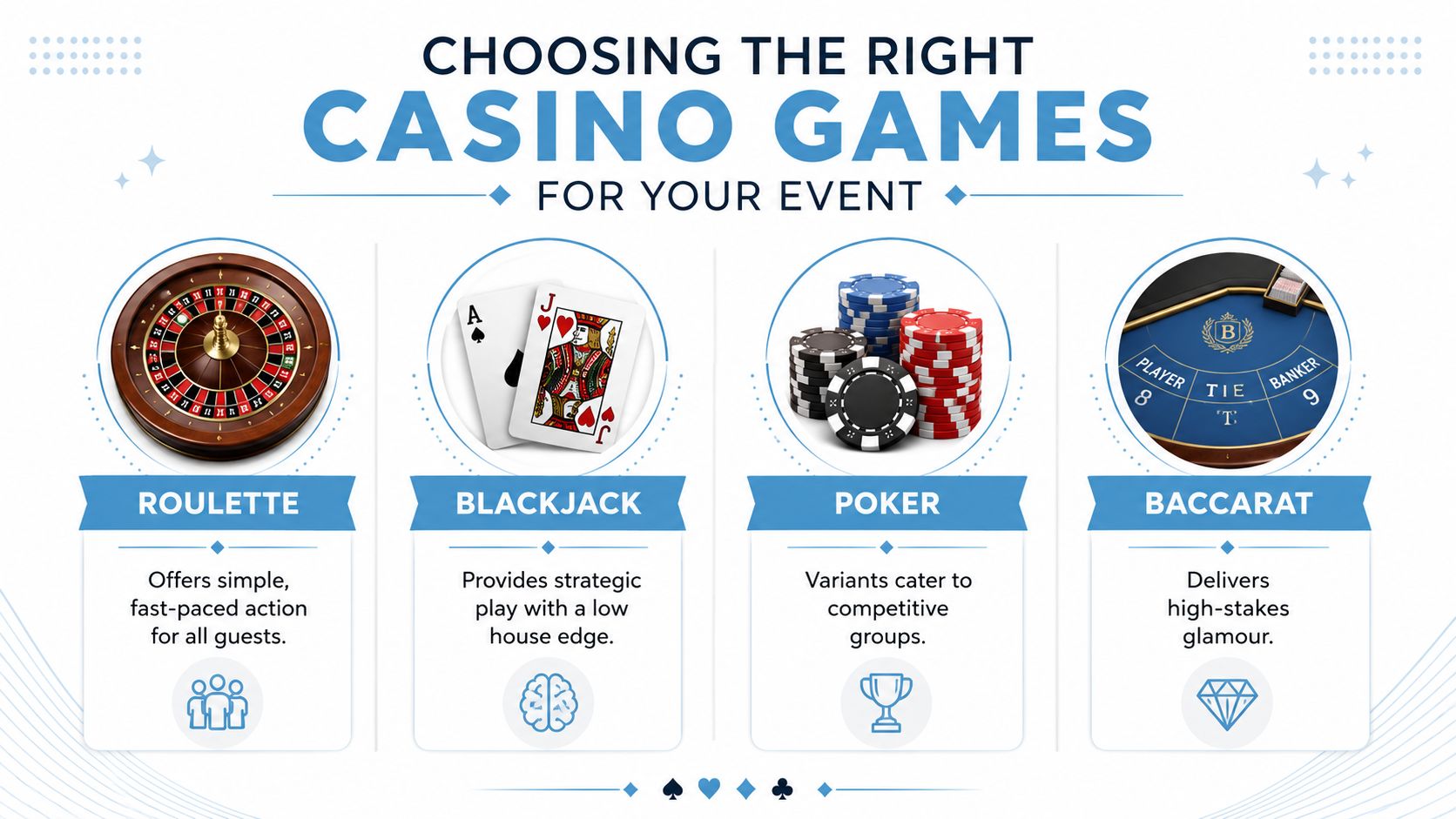
European roulette is the safest default for mixed UK audiences. The standard format uses a single-zero wheel with 37 pockets, numbered 0 to 36, and that gives the house edge of about 2.7% in the standard game format used for UK-facing hire (Simply Good Times). It's easy to explain, quick to join, and doesn't punish guests who arrive knowing nothing.
Blackjack is the most versatile table for hire because it keeps the pace moving without intimidating beginners. Standard live-game rules usually have the dealer stand on 17 or higher, while the player tries to reach as close to 21 as possible without busting, and many hire setups use a multi-deck shoe (Ace Events Casino FAQ). That makes it ideal for guest groups who want a bit more interaction without the slower rhythm of poker.
Poker variants suit competitive, self-selecting crowds. They work when guests already know the basics or are happy to watch first and join later. Baccarat brings a more polished, high-glamour feel, but it's best reserved for audiences that like a slower, more ceremonial table.
The image below gives a clean visual comparison for clients who need to sign off the game mix quickly.
Match the table mix to the room, not the other way round
If the event is a product launch or exhibition after-hours session, put roulette and blackjack first. They pull in curious guests and let first-timers join without awkward coaching. If the brief is a private celebration with a smaller, more involved guest list, one poker table can work, but only if the host expects people to sit longer and follow the action closely.
Useful rule of thumb: More unfamiliar guests means simpler game mechanics. If half the room needs a lesson, poker is the wrong opening table.
Table count matters as much as game choice. Too many tables create dead space and dilute energy. Too few tables create queues, and queues at a casino activation kill momentum fast. The right answer is a balanced mix, usually weighted toward the games that accept beginners immediately and keep turnover strong.
Understanding True Pricing and What Your Quote Includes
The headline rate is rarely the complete rate. Supplier pages often advertise a table price and stop there, which is exactly how budgets drift off course. If you want a true comparison, every supplier needs to quote on the same basis.
Read the quote line by line
A proper casino table hire quote should split the table itself from the service wrapped around it. Dealer staffing is the first cost most buyers underestimate, especially if the event runs late or overflows the planned finish. Delivery, collection, setup, breakdown, and venue access also carry cost because they use labour and time, not just transport.
A low headline fee can hide extras for overtime, evening access, floor carry, lift restrictions, parking, and late changes. If you compare one supplier's all-in price against another supplier's table-only rate, the numbers are meaningless.
UK event budgets are tight, so the only sensible approach is to compare the full service scope and keep the quote format identical across suppliers. For a practical benchmark on the broader hire side, use PSW Events equipment rental rates as a reference point, then ask each casino table supplier to break out the same cost headings.
| Casino Table Hire Cost Components | Typically Included | Often Charged Extra |
|---|---|---|
| Table hire | Table frame, cloth, game surface | Premium finishes or themed styling |
| Dealer staffing | Scheduled croupier cover | Overtime, late finish, extra dealers |
| Delivery and collection | Transport to venue | Difficult access, parking, long carry |
| Setup and breakdown | Assembly and removal | Extended setup windows |
| Venue admin | Basic supplier coordination | Extra site visits or off-hours access |
| VAT | Sometimes shown separately | Added at the final invoice stage |
| Booking terms | Standard hire period | Minimum hire extensions or short-notice changes |
Buying rule: Ask every supplier, “What's not included?” That question exposes most of the hidden cost.
For procurement, insist on a single total figure, then ask for the assumptions behind it. Event duration, guest numbers, and venue location all affect delivery and staffing, but those variables should be stated clearly, not buried in the small print. The supplier that explains pricing cleanly is usually easier to manage on site as well.
Space Planning and Technical Requirements
Most failed casino layouts don't fail because of the game. They fail because the room is too tight, the dealer has nowhere to stand, or the route from loading bay to event space wasn't checked. Casino tables are big physical objects, and they need more than the bare footprint shown in a sales email.
Measure the room as if the tables were permanent
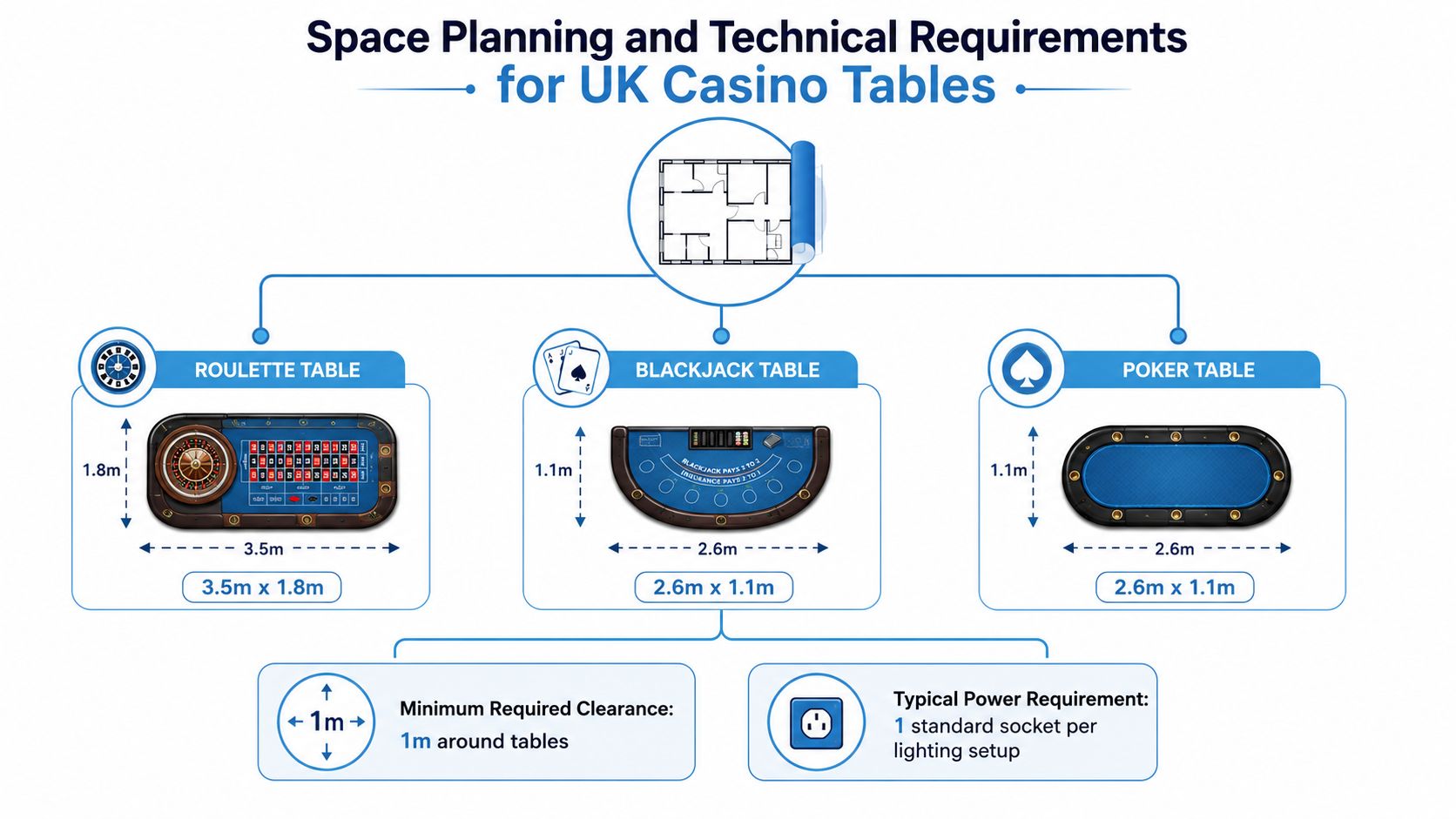
Standard baccarat tables are typically 2,400 to 2,800 mm long and 1,200 to 1,600 mm wide, while blackjack tables for seven-player layouts are usually 2,100 to 2,400 mm long. Overall table height is generally 760 to 800 mm from floor to playing surface, and the dealer-side cutout commonly extends 400 to 500 mm to hold chip trays, card shoes, and RFID arrays (Macau MR). Those figures matter because the back-of-house envelope is part of the table, not an optional extra.
The image below is the quickest way to brief venue teams, production crews, and clients who need a layout sign-off.
Build the layout around access and circulation
You need enough clear space for guests to move without pinching the aisles or blocking the dealer. That means checking lift size, doorway width, stair access, and whether the venue can accept the table components in the first place. If there's a mezzanine or upper floor, confirm floor loading with the venue rather than assuming it will be fine.
Power is another common miss. Electronic roulette wheels and digital display elements need to be placed where the supplier can reach suitable sockets without trailing cables across guest routes. If casino tables are sharing a room with bars, stages, or lounge seating, leave them enough separation to stop the floor feeling cramped.
A straightforward production rule helps here.
Leave enough room for the dealer to work, the guest to step in, and the table to breathe. If any one of those is compromised, the layout is too tight.
For mixed activations, casino tables usually work best along a perimeter or in a defined zone rather than right through the centre of the room. That keeps circulation predictable and lets other features, such as photo moments or networking areas, work without interference.
Licensing and Compliance for UK Events
A lot of organisers assume casino tables are automatically fine if they're not using real money. That assumption is too loose for the UK. The line between entertainment and regulated activity matters, and venues are asking tougher questions before they approve events.
Social gaming is not the same as gambling activity
The UK's modern framework comes from the Gambling Act, which came into force on 1 September 2007 and defines how casino-style gaming is treated in Britain. For private and corporate events, that context matters because planners need to understand when tables are being used as entertainment and when a legal issue starts to appear. If chips are for fun money and no real gambling is taking place, the setup is usually handled very differently from a licensed gambling environment.
Compliance is not just about the Gambling Act. Venue policy, age gating, insurance, and risk controls all sit in the approval chain. A reputable supplier should be able to provide public liability evidence and clear operational detail, because many venues now want that documentation before they sign off the booking.
What to ask for before the venue approves anything
Use the same checklist for every supplier, and ask for it early.
- Age control: Confirm how the operator handles mixed-age audiences and whether entry controls are needed.
- Staffing detail: Ask who is dealing, who is supervising, and what training they bring.
- Insurance evidence: Request documentation that proves the supplier can operate on your site.
- Risk assessment: Make sure the venue has a written document it can file internally.
- Event rules: Clarify whether the setup is pure entertainment, prize-based, or tied to any promotion.
For a working template, keep the venue paperwork aligned with PSW Events' event risk assessment template. It's much easier to get approval when the supplier documents the activation in a way the venue's safety team can review.
A difficult but honest point, the main risk is often not the quality of the tables. It's whether the activation can be delivered compliantly at scale across a busy venue. That is where many otherwise decent bookings fall apart.
Compliance rule: Don't wait for the event week to sort paperwork. If the venue doesn't have the documents, the tables won't get approved.
Branding and Activation Strategies for Corporate Events
Casino tables earn their keep when they do more than fill space. For corporate events, they can drive footfall, hold attention, and give a branded room a reason to stay busy. That only happens when the setup matches the commercial objective.
Corporate activations and private celebrations need different treatment
A product launch needs visible branding, fast guest rotation, and a clear reason for people to stop at the table. A trade show after-hours event needs something that encourages conversation without feeling too staged. A staff rewards night can be more relaxed, because the aim is atmosphere rather than lead capture.
Private events work differently. Weddings, milestone birthdays, and family celebrations usually need cleaner styling, lighter branding, and a table mix that doesn't feel too aggressive. The event succeeds when the casino element looks like part of the entertainment programme rather than the main story.
There are several ways to build that identity into the hire. Branded table cloths, custom chip designs, digital leaderboards, and dealer attire all change the mood of the room without changing the game rules. For corporate clients, those details can be tied to prize draws or social content moments. For private clients, the same tools are usually better used more subtly.
PSW Events offers casino tables as part of a wider event entertainment range, so it can sit alongside other interactive formats when a casino floor is only one part of the brief. That matters if you want the casino area to work as one zone inside a broader activation rather than as a standalone island.
The main decision is simple. If the casino element is a marketing tool, brand it. If it's pure guest entertainment, keep the styling elegant and let the tables do the work.
Your Booking Timeline and Planning Checklist
A casino floor falls apart fast when the booking starts late. The supplier may still have availability, but the strongest dealers, the tidiest layout plan, and the smoothest venue approvals usually go to the organiser who started early and confirmed the details properly.
Work backwards from the event date
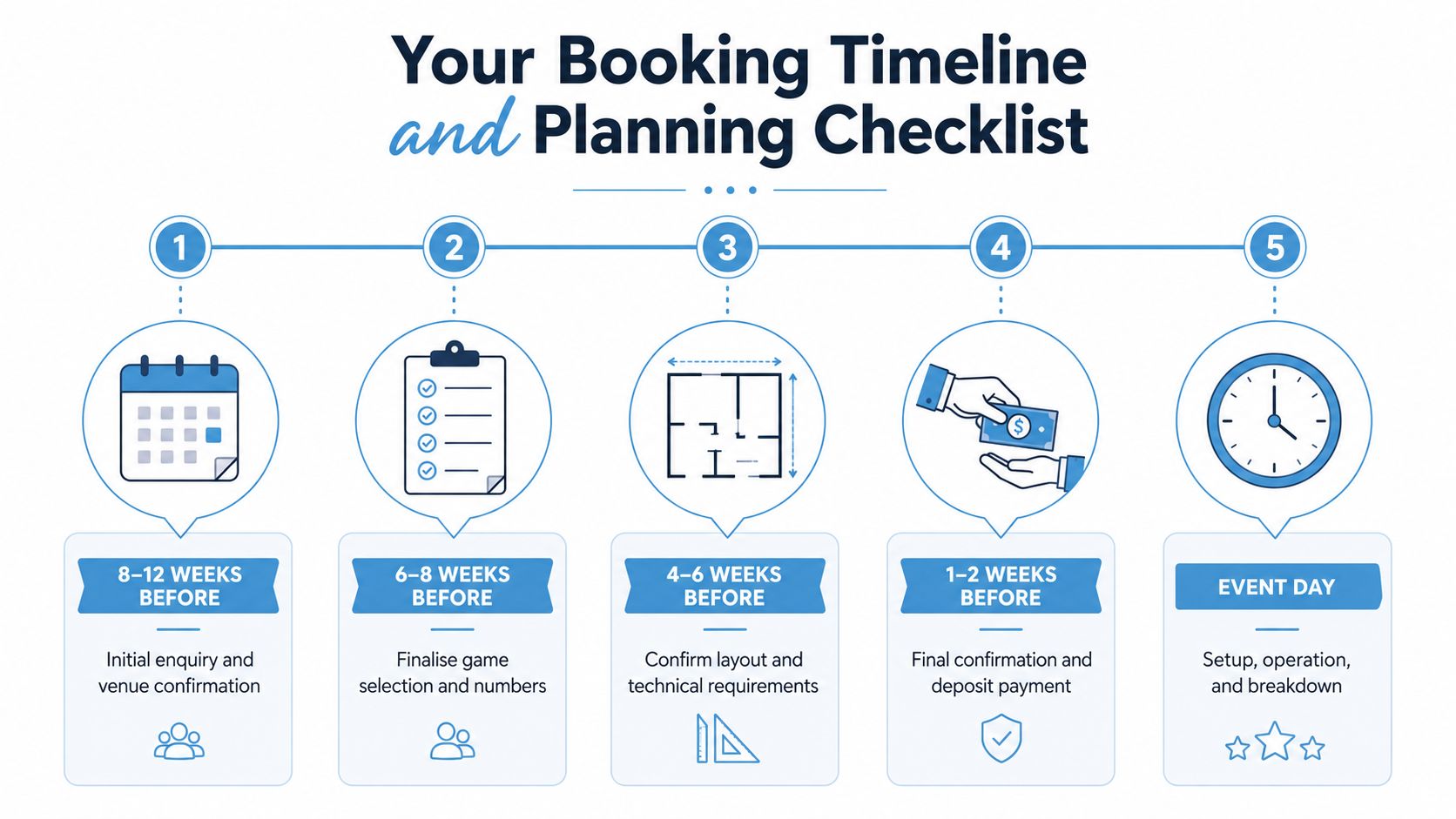
Use the planning timeline below as a live checklist, not a rough guide. Start by locking the venue and agreeing the game mix, because every later decision depends on those two calls. That gives the supplier time to allocate staff through proper business-hour channels, which is how most UK providers still handle planning and staffing enquiries.
A supplier's published office hours, such as Monday to Friday, 9:30am to 5pm on one UK casino-hire operation (Leisure King), tell you exactly how this category works. It is not a same-day, instant-dispatch service. Good outcomes come from organised planning, not late pressure.
If you want a cleaner planning sequence, use this event planning timeline alongside the supplier's own booking steps.
The flow is easier to manage in five stages.
The practical booking checklist
- Initial enquiry: Confirm the venue, guest count, and whether the event is corporate or private. At this stage, ask about access, loading, and any venue rules that could affect setup.
- Game selection: Decide on roulette, blackjack, poker, baccarat, or a mix that suits the room and the guest profile. A weak mix creates dead space and slows the room down.
- Layout sign-off: Fix the floor plan, access route, and any power or space constraints. If the venue has tight doors, low ceilings, or awkward corners, deal with that early.
- Compliance pack: Send insurance, risk, and venue documents before the approval deadline. Missing paperwork is where bookings get delayed, especially in venues with strict event management teams.
- Final confirmation: Lock staffing, timings, branding assets, and overtime cover. Confirm what happens if the event runs long, because that is where hidden charges usually appear.
By the time event week arrives, the supplier should know the room, the schedule, and the guest flow. On the day itself, dealers should arrive early enough to set up calmly, brief the host, and manage chip distribution without rushing the first guests through the door. If the operation feels improvised, it was booked too late.
Frequently Asked Questions About Casino Table Hire
Can guests win real money at hired tables? For standard corporate and private entertainment, they shouldn't be. Keep it as fun-money play unless the legal and licensing position has been checked properly.
How many dealers do you need? One dealer per table is the normal expectation, because the dealer runs the game, explains the rules, and keeps the pace moving. If the event has multiple tables, make sure the staffing quote reflects each one separately.
Can casino hire work outdoors? Only if the supplier and venue are confident about shelter, power, flooring, and weather protection. Outdoor use sounds simple until wind, damp, and access turn it into a problem.
What if guests don't know the rules? That's normal. Dealers should explain the basics at the table and keep the energy calm enough for first-timers to join without feeling exposed.
What about tips and gratuities? Agree the policy before the event, because guests will ask. Some hosts want gratuities discouraged, others leave it open, but the supplier should brief the team either way.
If you want casino tables that are properly planned, compliant, and ready to slot into a corporate activation or private event, talk to a team that handles the full setup, not just the equipment. Visit PSW Events to discuss casino table hire, branding, staffing, and event logistics with a supplier that understands the whole production chain.