
Planning an event in 2026 means dealing with a tougher brief than many realize. Getting people through the door isn't the hard part anymore. Keeping them engaged, getting them to participate willingly, and giving sponsors or stakeholders something measurable at the end is where events succeed or fail.
Static stands, looping screens, and polite product demos rarely hold attention for long. Interactive games for events work because they ask people to do something, not just watch. That matters in live settings where attention is short and participation has to feel immediate. In the UK, that approach has a strong institutional precedent. The Royal Statistical Society has formalised hands-on, game-like statistics activities for careers fairs, festivals, and schools, showing that short, practical interaction is already an established face-to-face engagement model in Britain through its hands-on statistics activities.
That same principle applies on an exhibition floor, at a conference break, or during a branded activation. If people can understand the game quickly, see progress instantly, and compare themselves with others, they'll stay longer and remember more. If you're also sorting out uniforms, promo kit, or giveaways, it's worth pairing games with practical branded items such as affordable branded hats for events.
The list below gets straight to the options that are practical in the field, with the logistics, staffing realities, branding opportunities, and trade-offs that matter when budgets and floorplans are real.
1. Racing Simulators (F1 and Multi-Car Rigs)
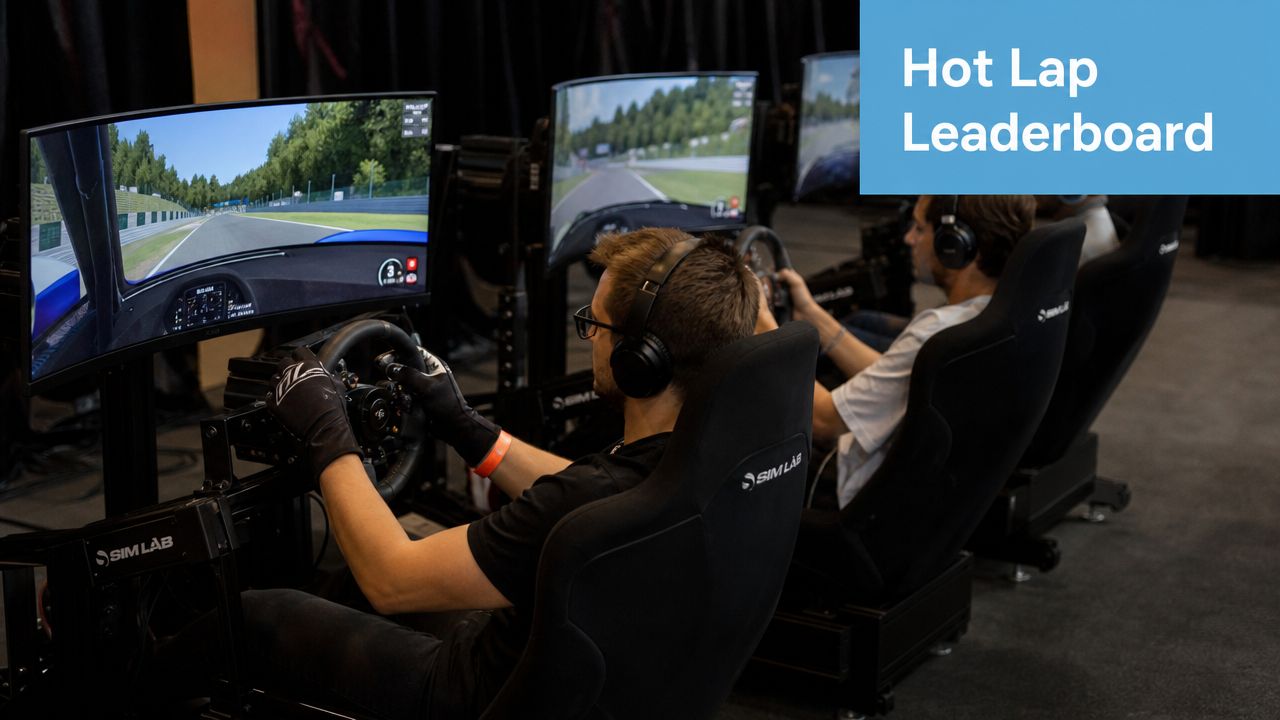
Racing simulators are one of the few attractions that can stop people in their tracks from across an aisle. The visual pull is strong. Cockpits, screens, steering wheels, audio, and visible competition do a lot of the selling before a member of staff says a word.
They work especially well for automotive, technology, finance, and premium hospitality events because they feel aspirational without needing a complex explanation. A quick lap time challenge is enough. That's why they suit busy venues like ExCeL London, Wembley, or Manchester Central, where visitors decide in seconds whether to approach.
What works in practice
The best deployment isn't open-ended free play. It's structured competition. Give people one practice lap, one scored lap, then push the best times onto a leaderboard. That creates repeat visits without creating chaos.
For premium activations, separate the queue from the spectator area. When everyone crowds the rig itself, you lose flow and your staff end up doing crowd control instead of lead capture.
- Best use case: Product launches, automotive stands, sponsor hospitality, and VIP breakout zones.
- Staffing reality: You need operators who can reset sessions quickly and keep the energy up. Technical knowledge alone isn't enough.
- Branding potential: Cockpit wraps, on-screen branding, leaderboard naming, and branded fastest-lap prizes all work cleanly.
If you're sourcing this category, PSW's racing simulators for UK events show the sort of setup event teams typically use for branded competitive formats.
Practical rule: Treat sim racing as a premium attraction, not background entertainment. If it's tucked into a corner with no queue plan, it underperforms.
The trade-off is throughput. A simulator creates strong dwell time and memorable interaction, but each individual session takes longer than a reflex game or a photo moment. That means it's better when quality of engagement matters more than sheer volume.
2. Sports Simulators (American Football, Rugby, Golf, Boxing)
Sports simulators are easier to sell to a mixed audience than many planners expect. People don't need to be sporty to enjoy them. They just need a simple challenge and a clear result. Throw speed, shot accuracy, points, or reaction score all work because the output is immediate.
This category is useful when you want a competitive feel without the intimidation factor of a full physical activity. At fan zones, hospitality spaces, and branded roadshows, sport-themed challenges create a shared language quickly. A rugby passing challenge or golf shot simulator gives strangers something easy to talk about.
Where they outperform other formats
Sports simulators often beat more complex attractions when your audience ranges from clients and staff to families and casual guests. People understand the objective straight away. That lowers the barrier to entry.
The strongest planning lesson here is simplicity. UK evidence on gamified participation reported that students using game-based activities became more interested in the subject, and the number of projects produced on the introduced topics was higher than in the comparison group. The same coverage described four arcade-style, score-based experiences built around simple play mechanics in the Royal Statistical Society video on gamified statistics activities. That matters for event games because it reinforces a point practitioners know well. Clear scoring and low-friction rules outperform over-explained concepts.
A few field-tested choices make the difference:
- Tiered difficulty: Start easy, then let confident players opt into harder modes.
- Visible coaching: Staff should give one useful prompt, not a long briefing.
- Prize discipline: Keep rewards tied to performance or product knowledge, not random participation alone.
The downside is thematic fit. Sports simulators are brilliant for fan engagement, team building, and energetic brands. They're weaker when the event tone is formal, highly technical, or luxury-led unless the sport itself fits the audience.
3. Flight Simulators (Helicopter, Fighter Jet, Commercial Aviation)
Flight simulators feel different from almost everything else on an event floor. They create a premium, almost theatrical experience. People don't just play. They sit down, take instruction, and commit to the moment.
That makes them excellent for aviation brands, high-end hospitality, STEM engagement, and VIP client entertainment. A helicopter simulator or fighter-jet-style setup can anchor a whole activation if the surrounding design supports it.
Here is the kind of visual experience clients often reference for this category:
Why this format feels premium
A flight simulator has built-in anticipation. The pre-brief matters. The controls matter. The idea of take-off and landing gives the session a natural beginning, middle, and end. That structure helps staff deliver a polished guest journey rather than a quick arcade hit.
Use this when you want fewer participants but stronger perceived value per participant. At a private client event or executive hospitality evening, that's often the right trade.
Queue comfort matters more here than with most games. People will wait longer for a flight simulator if they can see progress, hear commentary, and know their turn is coming.
The trade-off is operational. Flight sims need capable operators, clear power planning, and enough space around the unit for briefing, waiting, and exit. If your event is built around high throughput and rapid-fire lead collection, a reflex game or mobile challenge may do more work for less effort.
Still, for memorable branded interaction, very few formats hold attention like this one. If the audience values experience over speed, flight simulation earns its footprint.
4. Virtual Reality (VR) Experiences
VR is still effective, but only when it's managed tightly. Left alone, it becomes a queue generator with poor throughput. Run well, it gives you one of the most immersive branded experiences available.
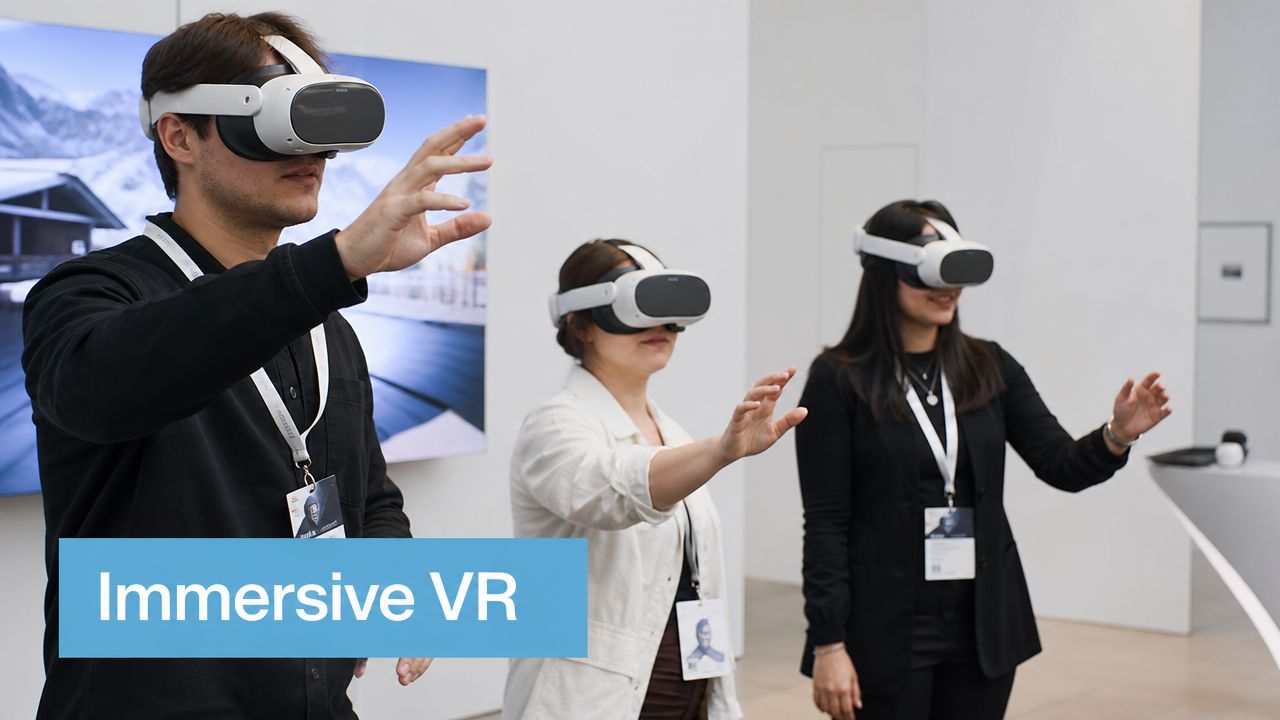
The strongest VR activations are short, seated or stable, and easy to understand before the headset goes on. Branded showroom tours, guided product experiences, puzzle games, or light competitive scenarios all work. What fails is overcomplication. If the user needs too much onboarding, your staff become trainers instead of hosts.
Accessibility and audience fit
Experienced planners need to be honest. The most tech-heavy option isn't always the best option. For mixed-accessibility corporate audiences, many articles name VR, scavenger hunts, and leaderboard games without addressing mobility, sensory needs, neurodiversity, language access, quiet space, or non-digital alternatives. That gap is highlighted in this accessibility-focused discussion of interactive games for corporate events.
If you're using VR, build alternatives into the plan from the start. Offer a mirrored screen for group viewing. Provide seated options. Keep audio manageable. Make sure people can opt into a parallel activity without feeling excluded.
A practical VR setup usually needs:
- Fast hygiene turnover: Cleaning between users must be visible and efficient.
- Short runtime: Keep the experience brief so the queue doesn't become the whole activation.
- Operator confidence: Staff need to calm nervous first-timers and troubleshoot quickly.
VR is strongest when immersion is the message. It's weaker when your audience needs a fast interaction tied to lead capture.
5. Giant Scalextric Racing (Slot Car Racing)
Giant Scalextric has one major advantage over many digital activations. Spectators enjoy it almost as much as participants. That makes it ideal for receptions, hospitality spaces, family days, and exhibition stands where you need visible energy rather than a headset-hidden experience.
It also has broad age appeal. Senior decision-makers get the nostalgia. Younger guests understand it immediately. That cross-generational pull is hard to beat.
Why it keeps people around
A good Giant Scalextric setup turns into a mini arena. People gather, shout advice, celebrate crashes, and stay for the next race. From a planner's perspective, that's useful because not every participant needs direct staff time at once. One race entertains the room.
For team-building formats, pair drivers and rotate roles. One person drives, the other tracks scores or acts as pit support. It sounds simple, but it creates social interaction naturally, which is exactly what many networking events are missing.
If this is the format you want, PSW's Giant Scalextric hire option is the type of supplier page planners often use to assess footprint and event fit.
Keep race windows fixed. Eight-minute chaos is fun. Open-ended play isn't.
The trade-off is data capture. Scalextric is brilliant for atmosphere and dwell time, but less naturally suited to detailed qualification unless you build registration into the queue or tournament structure. If lead quality is the main KPI, add pre-race sign-in, branded heats, or sponsor checkpoints.
6. Climbing Walls and Adventure Course Challenges
Climbing walls and adventure challenges create spectacle first and participation second. People see height, movement, and a challenge in progress, which pulls attention from a distance. That's useful at outdoor events, sports venues, festivals, and large-scale corporate fun days.
This category works best when the brief includes energy, confidence-building, or team support. It doesn't suit every audience. Some guests will jump at the chance. Others will never go near it. That's not a failure, but it does mean you shouldn't rely on it as the only interactive attraction.
The real-world trade-off
These installations require more planning discipline than lighter-touch games. Safety briefing, harnessing, weather, staffing, and supervision all matter. The emotional barrier matters too. Some guests need encouragement. Others want a clear beginner route so they don't feel exposed.
The most inclusive versions aren't always the most dramatic-looking ones. Lower-height challenge elements, assisted climbs, or side-by-side team formats often broaden participation far better than a wall that looks impressive in photos but deters half the room.
In practice, this format works when:
- The venue can support it: Access, rigging, ground conditions, and sightlines all need checking early.
- The event benefits from spectacle: Outdoor launches, family festivals, and wellbeing days suit it.
- The brief allows slower throughput: Harnessing and briefing take time.
This is one of the clearest examples of matching attraction to audience. For some brands, a climbing wall says energy and confidence. For others, it says risk and delay. The context decides.
7. Casino and Gaming Tables (Roulette, Blackjack, Poker)
Casino tables are often dismissed as generic evening entertainment, but they're still one of the most reliable social formats when the room needs loosening up. They don't demand athleticism, specialist knowledge, or loud extroversion. Guests can join for two minutes or settle in for a full round.
That flexibility is valuable at gala dinners, awards nights, hospitality suites, and private celebrations. Tables also spread people naturally around the room, which helps spaces that otherwise bottleneck around bars or stage sightlines.
What makes them work
The dealer matters more than the table. A technically correct but flat croupier gives you a dead zone. A dealer who teaches lightly, keeps the pace moving, and welcomes nervous first-timers turns the table into a social hub.
Use branded chips or play money, not anything that muddies the compliance line. Keep the rules simple and visible. If you're running a tournament layer, make sure guests understand whether they're playing casually or competing.
A practical approach looks like this:
- For networking events: Use roulette and blackjack for easy drop-in participation.
- For competitive formats: Use poker finals or chip leaderboards later in the evening.
- For sponsors: Brand the felt, the chips, or the prize redemption counter.
Casino tables won't deliver the same visual drama as simulators or climbing features. What they do provide is low-friction interaction over a long period. That's often exactly what an evening programme needs.
8. Interactive Batak Pro (Reflex and Coordination Challenge)
Batak Pro is one of the best high-throughput options available. It doesn't need much explanation, it's visible from a distance, and the score gives immediate bragging rights. For exhibition stands and fan zones, that's a powerful combination.
This is one of the formats I'd choose when the objective is to pull people in quickly, qualify interest fast, and keep the queue moving. It also works well in wellness-themed internal events because the challenge feels active without becoming intimidating.
Best setup for exhibitions
Put Batak where passers-by can see the action and the score screen. The attraction is partly the game itself and partly the public proof of performance. If someone sees a colleague post a strong score, they want to beat it.
For practical sourcing, PSW's Batak hire page reflects the kind of standalone challenge many organisers use at trade shows and brand activations.
The commercial logic for this sort of game is strong. CEIR attendee research found that 67% of attendees say games that help educate attendees about products in a fun way are effective, while only 7% of exhibitors offer them. That gap matters because Batak-style interactions can do more than entertain if you wrap the score challenge around product prompts, timed demos, or qualification questions.
A few ways to improve it:
- Hourly competitions: Fresh leaderboard cycles keep new arrivals engaged.
- Short branded script: Tie the challenge to your message before and after the attempt.
- Team relay mode: Useful for staff events and hospitality groups.
The limitation is depth. Batak creates quick excitement, not long-form storytelling. Use it when speed and visibility matter.
9. Interactive Photo Booths with AR and Green Screen
Photo booths remain one of the safest bets in event entertainment because the value is obvious. Guests get a keepsake. Brands get shareable content. Staff don't need to persuade people that the experience matters because the output is tangible.
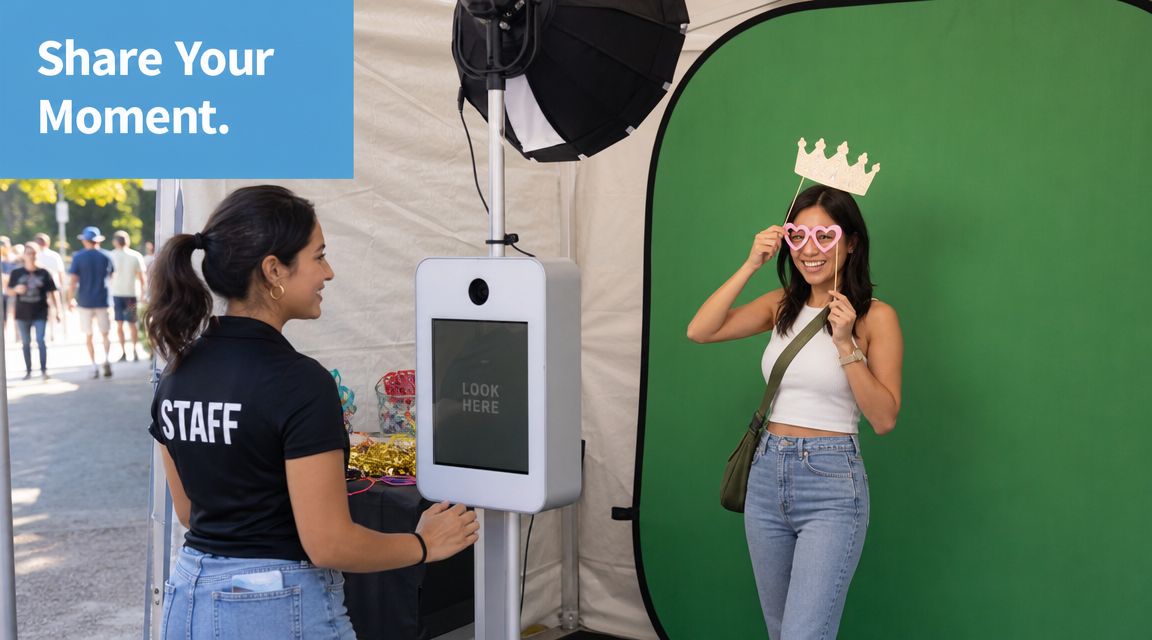
The stronger versions now combine printed photos, digital delivery, branded overlays, and AR or green screen scenes that make the photo feel event-specific rather than generic. That's the difference between a queue and a novelty.
Branding and lead capture
This format is stronger for awareness and social sharing than for hard qualification, but it can still support data capture cleanly. Email delivery of images, optional competitions, and branded galleries all create sensible follow-up opportunities if the consent journey is handled properly.
For teams exploring custom overlays, animated lenses, or mobile visual effects, broader AR solutions for developers can help shape the creative side.
What works best is restraint. Give people a few polished scene choices, not endless gimmicks. Overloaded interfaces slow everything down and make the booth feel harder than it should.
A photo booth earns its place when the output is worth keeping. If the image looks disposable, so does the brand memory.
The downside is that photo booths can become passive if no one hosts them well. Props strewn on a table and a printer in the corner isn't an activation. A staffed booth with clear branding, fast delivery, and visible examples usually performs much better.
10. Mobile App-Integrated Gaming Experiences (Location-Based Games, Treasure Hunts, Challenges)
Mobile-linked games are useful when you want to spread engagement across a whole venue instead of concentrating it in one footprint. They work for exhibitions, conferences, festivals, and multi-room corporate events because they can move people to sponsor zones, content theatres, or product stations.
The biggest practical decision is whether you need an app. In many cases, you don't. A browser-based experience reached via QR is often better for live events because there's less friction at the point of entry.
Why mobile-first matters
A useful benchmark comes from game ecosystems rather than the event sector directly. A study of top-grossing mobile games found 72% web-store adoption across top-grossing genres, 75% in action games, and all top 20 social casino games using web stores. For events, the takeaway is simple. People are increasingly used to browser-accessible, low-friction digital interaction. That's why QR entry, web apps, and lightweight mobile journeys tend to beat forced downloads.
That doesn't mean every event should launch a full digital treasure hunt. It means the entry barrier must stay low. If guests need to install something, verify an account, and learn a complex interface, many won't bother.
What tends to work:
- Simple missions: Visit stands, scan checkpoints, answer short questions, gain progress.
- Optional participation: The game should enhance the event, not gate it.
- Physical support: Signage, staff prompts, and visible QR points are essential.
The common mistake is building a mobile game that's clever in theory but invisible on site. If people can't discover it in seconds, it won't matter how good the mechanics are.
Top 10 Interactive Event Games Comparison
| Experience | Implementation Complexity 🔄 | Resource Requirements ⚡ | Expected Outcomes 📊 | Ideal Use Cases | Key Advantages ⭐ | Quick Tips 💡 |
|---|---|---|---|---|---|---|
| Racing Simulators (F1 & Multi-Car Rigs) | High, specialist motion platforms, networked rigs, technical setup | Very high, transport, power, dedicated space, operators, maintenance | Premium engagement, measurable performance, long dwell times | Motorsport activations, corporate team building, trade shows, fan zones | Extremely engaging; strong sponsorship and data-capture potential | Manage queues, run tournaments, capture leads via apps |
| Sports Simulators (Football, Rugby, Golf, Boxing) | Medium–High, sport-specific calibration and operator training | High, sport equipment, sensors, biometric tracking, space | Quick, repeatable sessions with coaching feedback and social sharing | Sports brand activations, fan zones, corporate sports days | Accessible to non-athletes; strong photo/video opportunities | Tiered challenges, use athlete benchmarks, show leaderboards |
| Flight Simulators (Helicopter, Fighter, Commercial) | Very high, realistic cockpits, motion systems, instructor-led scenarios | Very high, large footprint, specialised instructors, transport and maintenance | Memorable VIP experiences, long sessions, strong lead generation | VIP hospitality, aviation events, military recruitment, premium activations | High perceived value and emotional impact; training-safe environment | Offer tiered experiences, pre-flight briefings, video upsells |
| Virtual Reality (VR) Experiences | Medium, headset setup and content integration; iterative dev cycle | Medium, headsets, content development, sanitisation, support staff | High novelty and shareability; flexible outcomes depending on content | Brand activations, training, trade shows, museums, theme parks | Highly customisable, portable, scalable, strong storytelling | Keep experiences short, sanitise headsets, provide intuitive onboarding |
| Giant Scalextric Racing (Slot Car) | Medium, track construction and modular setup; labour for assembly | Medium, significant floor space, setup crew, vehicle maintenance | Social, spectator-friendly engagement with quick race throughput | Family events, retail activations, automotive shows, team building | Broad age appeal; durable and visually themed for brands | Run tournaments, provide practice laps, create spectator areas |
| Climbing Walls & Adventure Courses | High, certified safety systems and trained operators required | High, large space, safety harnesses, insurance, skilled crew | Dramatic spectacle, strong team-building and memorable experiences | Corporate team building, festivals, schools, charity challenges | Physical challenge with high satisfaction and visual impact | Clear safety briefings, progressive routes, medical screening |
| Casino & Gaming Tables (Roulette, Blackjack, Poker) | Medium, table logistics, professional dealers, legal compliance | Medium–High, staffing costs, table setups, potential licensing | Sophisticated atmosphere, extended evening engagement, networking | Galas, VIP hospitality, weddings, charity fundraisers, evening events | Premium social experience; professional delivery boosts credibility | Use play-chips, entertaining dealers, ensure local compliance |
| Interactive Batak Pro (Reflex Challenge) | Low–Medium, compact electronics; plug-and-play arcade setup | Low, small footprint, minimal operators, low maintenance | Very high throughput, short intense plays, leaderboard-driven engagement | Arcades, fan zones, malls, fitness activations, quick-activation areas | Portable, low-maintenance, appeals across ages | Prominent placement, hourly tournaments, visual/audio celebrations |
| Interactive Photo Booths (AR & Green Screen) | Medium, camera/lighting plus AR/green-screen integration | Medium, HD kit, internet, printing consumables, attendant | Highly shareable branded content, measurable social reach and leads | Product launches, festivals, trade shows, weddings, retail promos | Strong organic amplification and tangible takeaways | Use branded hashtags, email capture, rotate AR filters |
| Mobile App-Integrated Gaming (Location-Based) | High, custom app development, GPS/AR integration, testing | High, dev team, backend, connectivity, analytics and support | Extended venue engagement, behavioural data capture, footfall-driving | Trade shows, multi-venue campaigns, festivals, scavenger hunts | Scalable and data-rich; drives discovery and sponsor visits | Build simple UI, pre-event downloads, offline features and QR support |
Choosing the Right Game for Your Event Goals
The right game isn't the one that looks best on a pitch deck. It's the one that matches your event objective, your audience's comfort level, your venue constraints, and the kind of result you need to report afterwards.
If the brief is footfall and visibility, fast-play formats usually win. Batak Pro, sports simulators, and mobile challenges are strong because they lower the commitment barrier. People can join quickly, understand what they're doing, and move on without feeling trapped in a long queue. If the brief is dwell time and premium interaction, racing simulators and flight simulators are stronger because they create a fuller experience and a stronger memory.
Lead quality needs a more disciplined view. One of the biggest mistakes in interactive games for events is rewarding participation without qualifying intent. That attracts prize-seekers, not useful prospects. Better mechanics ask one or two smart questions during registration, tie the challenge to product understanding, or route top scorers into a conversation with the right team member. The game should earn the sales conversation, not replace it.
Accessibility also needs to be part of the first conversation, not the last. A visually dramatic attraction can still be the wrong choice if it excludes a large part of the audience or creates avoidable discomfort. In mixed corporate groups, low-tech social play often performs better than complex tech because more people join in without hesitation. That's not less ingenious. It's better matched to the audience.
From a planning perspective, I tend to group these formats into three practical buckets:
- High throughput and quick engagement: Batak Pro, sports simulators, photo booths, mobile web-based games.
- Premium and high-dwell experiences: Racing simulators, flight simulators, selected VR experiences.
- Social and atmosphere-led formats: Giant Scalextric, casino tables, climbing or challenge features where the crowd effect matters.
Measurement should be built into the design. Count sign-ups, track repeat attempts, log qualified conversations, note queue behaviour, and compare which activation pulled the right people in. Fun matters, but fun on its own rarely justifies budget for long.
If you need one supplier to coordinate multiple formats, branding, logistics, installation, staffing, and health and safety, PSW Events is one relevant UK option in this category. The practical advantage of that model is consistency. Fewer handovers usually mean fewer surprises on site.
Good event games don't just fill space. They create reasons to stop, participate, talk, and remember. That's what makes them commercially useful, not just entertaining.