
Gallup's benchmark is the sharpest wake-up call I know for this topic: only 21% of employees were engaged globally in 2024, with Europe the lowest region at 14%. If you're planning employee engagement activities in the UK, that matters. It tells you the bar is low, attention is fragmented, and generic perks won't rescue a tired team.
Too many companies still treat engagement like an annual survey followed by a pizza lunch. That isn't a strategy. It's a holding pattern. The better approach is to build experiences people remember, then connect those experiences to recognition, autonomy, manager habits, and cross-team relationships.
The UK data points in the same direction. The Office for National Statistics uses questions around interest, skill use, and autonomy as engagement-related proxies, and in 2023 77.4% of workers said their job was interesting, 67.1% said they could use their skills, and 74.2% said they could decide how to do their work. Good employee engagement activities should strengthen those exact conditions, not distract from them.
If you need practical ideas, not fluff, start here. These 10 formats move beyond the break room and into memorable, measurable experiences that people talk about afterwards. For a broader strategy view, this guide on how to improve employee engagement is a useful companion.
1. Immersive Simulator Team Challenges
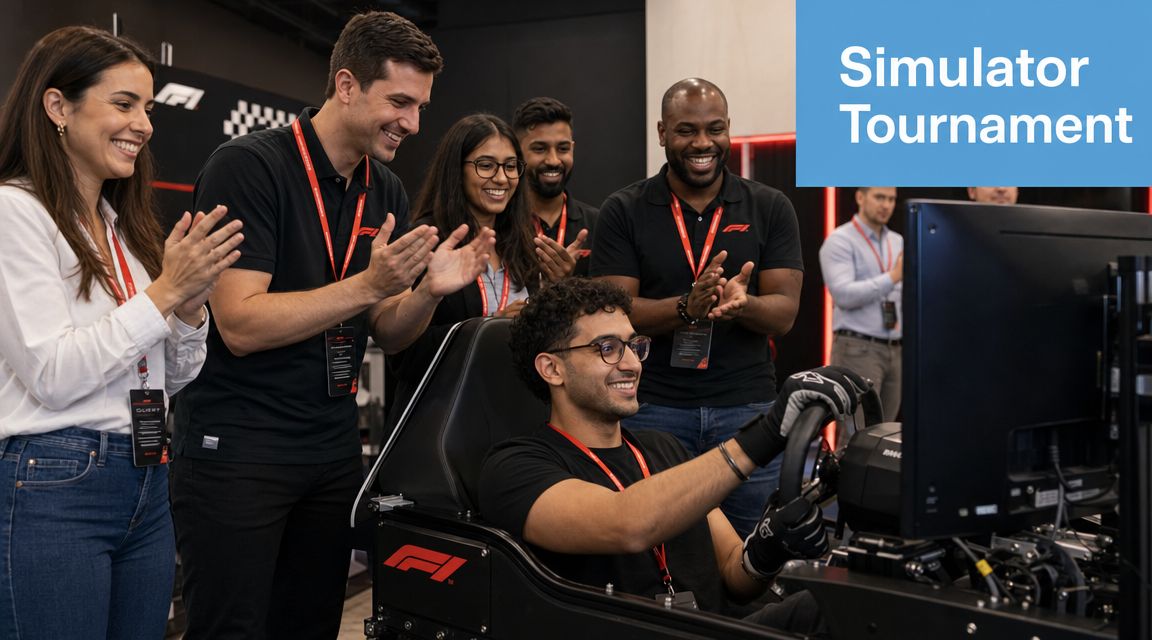
If you want instant energy in a room, simulator competition is hard to beat. Racing rigs, helicopter flight simulators, and sports simulators give people a shared focus fast. Nobody has to fake enthusiasm when there's a live leaderboard and a colleague trying to shave seconds off a lap time.
This works especially well for sales kick-offs, annual conferences, reward days, and office roadshows. A tech team can run an F1 tournament between product and sales. A finance department can rotate through flight and golf challenges during a quarterly away day. The format feels premium without forcing awkward networking.
How to run it properly
The biggest mistake is letting a small group dominate the equipment while everyone else watches. Book enough stations, stagger timed heats, and build the schedule around participation rather than pure competition. If you're sourcing specialist kit, use a provider that handles simulator hire for corporate events including install, staffing, and on-site troubleshooting.
Use a simple format:
- Multiple skill paths: Offer racing, flight, and sports options so non-gamers don't feel boxed out.
- Short briefing first: Give everyone a practice run. Confidence matters more than raw ability.
- Visible scoring: Show fastest lap, most improved, best teamwork, and wild card awards.
- Natural downtime: Place seating and refreshments nearby so people talk between rounds.
Practical rule: The best simulator event isn't the one with the best winner. It's the one where nobody feels left out.
Budget-wise, this sits in the moderate to premium bracket because kit, transport, staffing, and floor space all matter. But the upside is clear. You get a focal attraction, strong internal content for comms teams, and a format people will remember next quarter.
2. VR Wellness and Mindfulness Experiences
Not every engagement activity should be noisy. Some teams need the opposite. VR wellness experiences can give employees a short, structured reset during demanding periods, especially when offices are busy and quiet space is limited.
Done properly, this isn't entertainment dressed up as wellbeing. It's a dedicated station with guided breathing, immersive nature scenes, low-motion meditation content, and clear time limits. I've seen this work best in high-pressure environments where staff won't attend a traditional wellbeing session but will try a short VR experience because it feels new and contained.
Where it fits best
A financial services team can set up a temporary wellness pod during reporting season. A healthcare organisation can offer it as part of a staff support day. A manufacturing site can use it after shifts in a designated breakout area, provided hygiene and supervision are managed properly.
Keep the operational side tight:
- Lead with wellbeing language: Position it as recovery and focus support, not as a gimmick.
- Choose gentle content: Start with seated, low-motion experiences for first-time users.
- Handle hygiene properly: Disposable face covers and cleaning between users aren't optional.
- Use time slots: Short sessions keep queues moving and stop the station becoming a bottleneck.
A good outcome measure here is simple and qualitative. Track participation, repeat use, and short anonymous feedback about how people felt before and after. You don't need complicated dashboards to see whether the station is helping or just attracting curiosity.
Quiet engagement still counts. Sometimes the most effective employee engagement activities lower the temperature in the room instead of raising it.
3. Cross-Functional Department Olympics
Cross-functional events succeed or fail on one point. Do people leave having actually worked with someone outside their usual circle?
Department Olympics can answer that better than a standard social because the format creates repeated, low-stakes interaction across teams. Used well, it breaks routine and gives people a reason to talk, solve, and compete together without forcing awkward networking.
The strongest version is a staged, multi-activity event built around mixed challenges. Racing simulators, Batak-style reaction walls, timed construction tasks, quiz rounds, precision games, and short relays all work well because they reward different strengths. That matters. If every station favours speed or fitness, you lose half the room.
For larger rollouts, it helps to work with a supplier that can build corporate team building events with several attractions under one operating plan.
How to structure it so silos actually soften
Start with one short department-based round if you want some tribal energy. Then move quickly into mixed-team formats. That shift is what makes the event useful, rather than just noisy.
A practical event flow looks like this:
- Opening round by department: Good for energy and familiar faces.
- Main rounds in mixed teams: Combine people from operations, sales, finance, HR, and leadership.
- Stations with different skill types: Include reaction, logic, communication, and coordination tasks.
- Clear scoring rules: Post live leaderboards so the room stays engaged.
- Awards with range: Recognise collaboration, problem-solving, and team spirit, not only first place.
This kind of atmosphere is easier to picture in motion:
What makes the format work in practice
I would not run this as Marketing versus Finance all afternoon. That usually reinforces existing camps and gives louder teams too much control over the tone. A better model is controlled mixing, short station times, and an MC who can keep the pace up without turning the event into a shouting match.
Operational discipline matters here more than people expect. Rotations need to be timed properly. Queue-heavy stations need a backup activity. Rules need to be simple enough to explain in under a minute. If one station is clearly more fun than the others, fix that before the event goes live or your flow breaks down fast.
Useful design choices include:
- Team sheets with planned rotations: Prevent bottlenecks and dead time.
- A strong host: Keeps scoring credible and energy balanced.
- Visible facilitators at each station: Reduces confusion and resets equipment quickly.
- Low-barrier activities: People should be able to join in without specialist knowledge or physical confidence.
Where it fits best
This format works well at internal conferences, annual meetings, merger integration programmes, and culture-reset events after restructuring. It is especially effective where departments work in parallel but rarely collaborate in person.
If the objective is behaviour change, add follow-through. A short post-event reflection, manager discussion, or team survey helps turn a fun day into something more durable. Some firms also log individual takeaways through a coaching platform so managers can revisit communication and collaboration themes after the event.
The measure of success is simple. Count how many cross-functional conversations happened, how many mixed teams completed every station, and whether people would volunteer for a similar format again. If those signals are weak, the event was entertainment. If they are strong, the event did its job.
4. Executive Flight Simulator Experiences for Leadership Development
Leadership groups don't need another hotel meeting room with a flip chart and stale pastries. If you want senior people engaged, challenge them with something that creates pressure, decision-making, and reflection. Flight simulators do that well.
A motion-enabled helicopter or flight simulator creates a clear scenario. Information comes fast. Roles matter. Communication matters more. That makes it useful for executive off-sites, high-potential cohorts, and leadership development programmes where you want more than passive discussion.
Why this format lands with senior teams
It feels exclusive without being frivolous. Senior leaders are more likely to give the session proper attention if it's framed as a decision-making exercise with a structured debrief, not just a novelty reward. Pair the simulator with facilitated reflection on communication, delegation, and situational judgement.
Good use cases include partnership-track cohorts in professional services, executive committee off-sites, and leadership retreats after a strategy day. The simulator becomes the practical segment that reveals who takes over, who listens, and who stays calm when things get messy.
Senior teams don't need more theory. They need situations that expose habits quickly.
Follow-up matters. If the experience raises useful leadership insights, capture them in coaching discussions or peer reflection sessions afterwards. For teams formalising that development, a coaching platform can help extend the learning beyond the event itself.
This is not the right format for every manager in the business. It's premium, it needs skilled facilitation, and it works best with a tightly defined group. But for leadership development, it's far more memorable than another slide deck on resilience.
5. Interactive Booth Activations at Internal Conferences and Expos
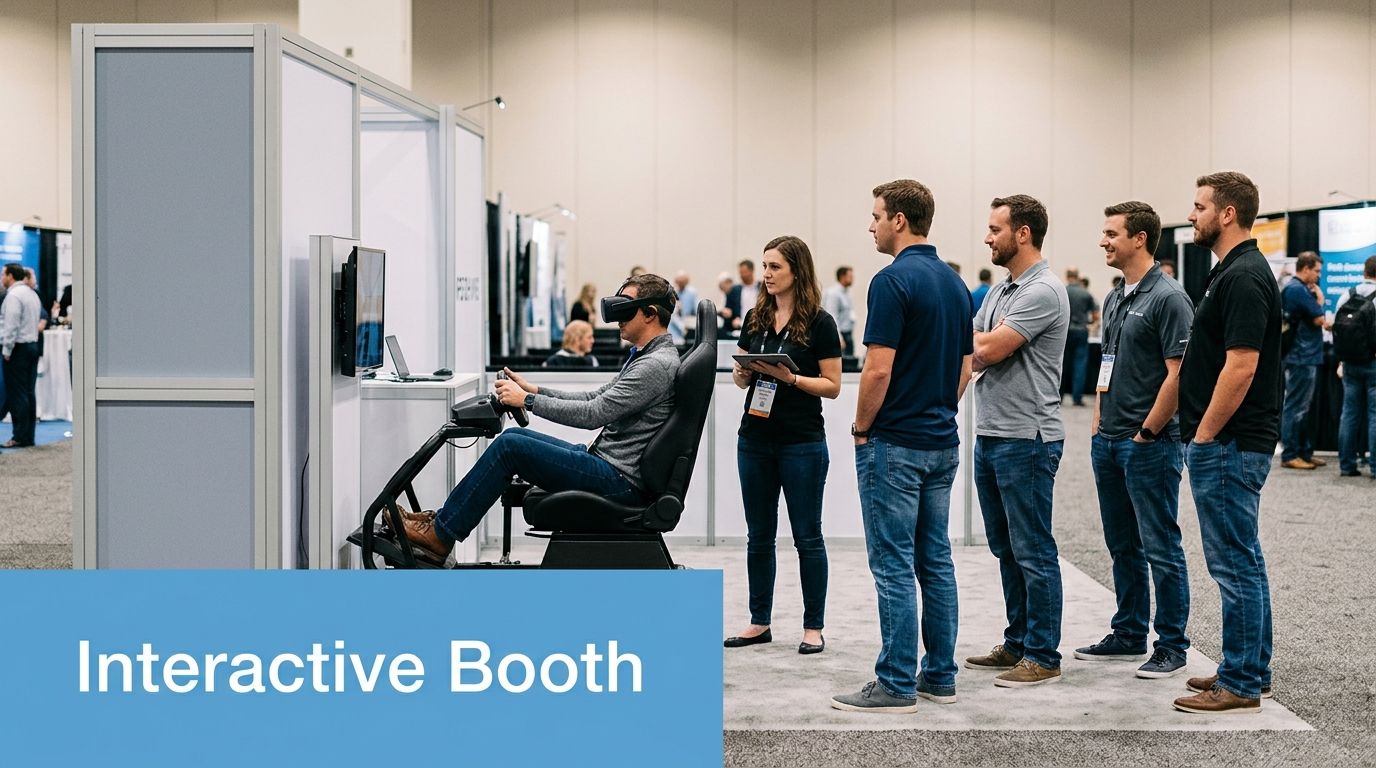
Internal conferences often have a dead zone between keynote sessions and breakout rooms. People drift to coffee, check emails, and wait for the next agenda item. Interactive booth activations solve that if they're placed properly and tied to the event theme.
A simulator booth in the centre of an internal expo creates dwell time and conversation. People queue, watch, compare scores, and start talking to colleagues they wouldn't usually approach. That's useful at town halls, strategy roadshows, internal trade fairs, and multi-site gatherings.
What makes the booth work
Position matters. If the activation is hidden in a corner, it becomes a side attraction. Put it where traffic already flows and staff it with people who can manage queues, keep sessions short, and connect the experience to the event message.
For branded stand builds and event-floor experiences, look at experiential marketing activations that combine attraction, branding, and staffing under one plan.
Build it around practical event realities:
- Fast sessions: Keep each turn short so busy attendees still join.
- Clear queue management: Long, messy lines kill goodwill.
- Photo moments: Give internal comms teams usable content.
- Theme linkage: Tie the leaderboard to regions, functions, or conference messages.
This format is also a good answer to the shift from passive engagement tools to action-oriented platforms. The wider employee engagement software market is projected to grow strongly, with one study forecasting growth from USD 1.1 billion in 2026 to USD 4.9 billion by 2036, with cloud deployment taking a 48.0% share. In practice, live activations now work best when they connect to digital follow-up, recognition, and manager action rather than sitting as isolated moments.
6. Competitive Fantasy League Seasons with Simulator Tournaments
One-off events create a spike. Seasonal leagues create a rhythm. If you've got a workforce that responds well to friendly competition, a fantasy-style simulator league can keep engagement alive across a quarter or even a full year.
The structure is simple. Employees join a season, earn points across scheduled rounds, and follow standings over time. Racing rigs are the obvious anchor, but flight and sports simulators can work too. The key is continuity. The story keeps moving, which gives comms teams and managers more than a single event to talk about.
How to stop it becoming cliquey
Longer programmes fail when the same confident people dominate every round. Build categories that reward consistency, improvement, and participation. Let late joiners enter through catch-up rounds. Publish the rules upfront so nobody argues about scoring halfway through the season.
This works well in large offices, campus environments, and organisations trying to create social glue across hybrid schedules. Quarterly finals can sit inside a wider company event, while monthly updates can run through internal channels with short highlights and standings.
Useful features include:
- Tiered competition: Separate novice and experienced players if skill gaps are wide.
- Narrative themes: Give the season a name and visual identity.
- Manager support: Ask line managers to encourage participation without forcing it.
- Inclusive awards: Most improved often matters more than champion.
This format suits teams that already have some appetite for repeat participation. If engagement is very low, start smaller. Don't launch a year-long league into a culture where nobody currently turns up for anything.
7. Departmental Wellness Days with Holistic Activity Stations
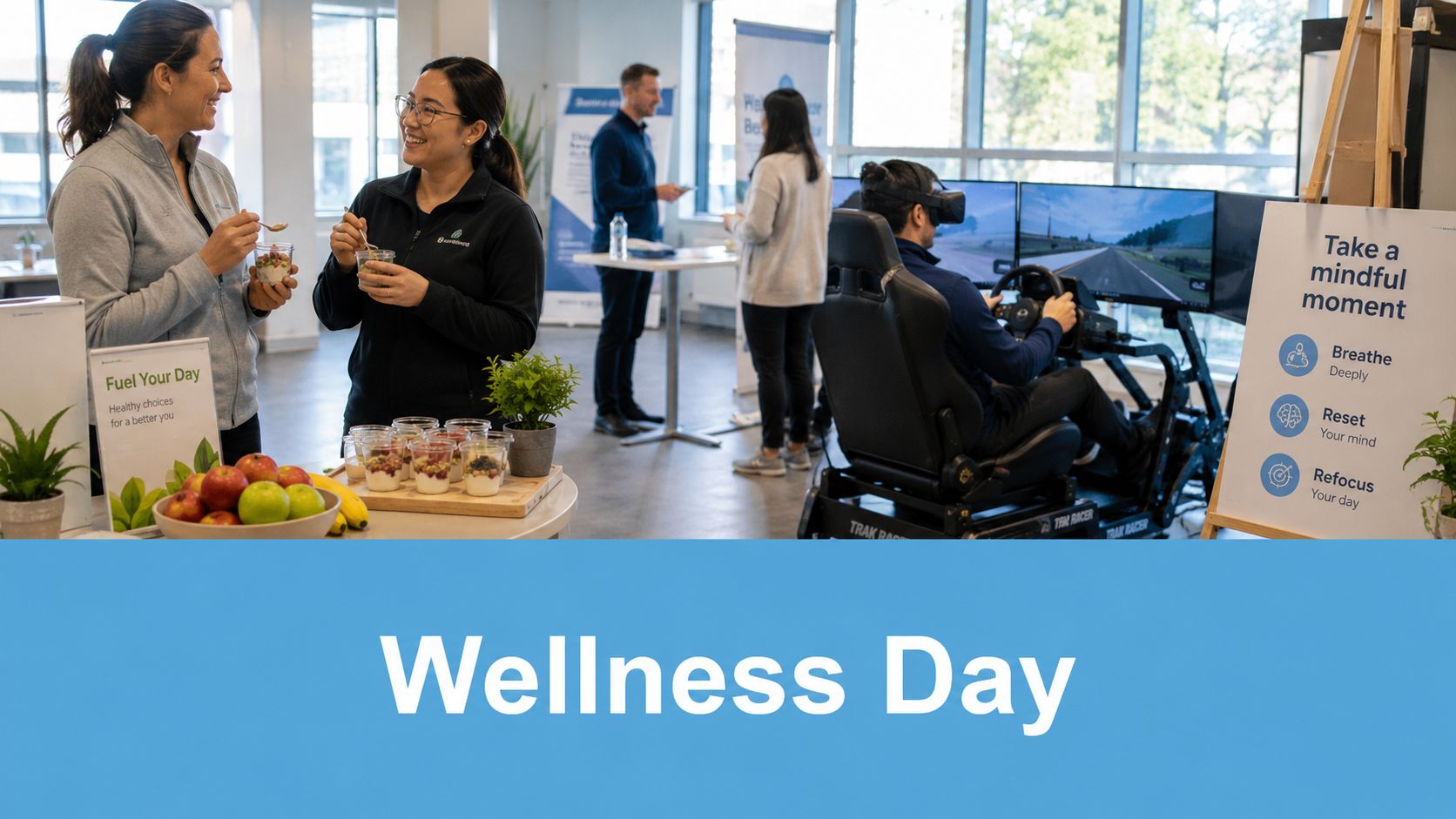
A department wellness day works best when it reduces pressure instead of adding another obligation to the calendar. The format I recommend is simple: run a half-day or full-day schedule with optional stations, short dwell times, and enough range that different energy levels are catered for without forcing anyone into a single idea of wellbeing.
That mix can include a VR mindfulness pod, a simulator station for release and light social interaction, desk-friendly mobility sessions, healthy food people find appealing, and a quiet room with clear rules on noise and device use. The point is not novelty for its own sake. The point is giving employees useful ways to reset during the workday.
What makes this format work
Good wellness programming needs practical balance. If every activity is passive, turnout drops after the first hour. If every station is high-energy, people who need recovery space will avoid the day entirely.
A strong setup usually includes:
- Active and low-stimulation stations: Let employees choose what suits their energy and comfort level.
- Short session design: Ten to twenty minutes per station keeps traffic moving and lowers the commitment barrier.
- Visible staffing and signage: People should know where to go, how long each activity takes, and whether booking is required.
- Accessibility planning: Gather adjustment requests in advance and brief suppliers properly.
- Simple measurement: Track attendance by station, pulse-check feedback, and whether people stayed longer than planned.
Budget matters here. A basic version can be built around internal facilitators, one premium feature such as a simulator or VR setup, and modest catering. A larger version works better with zoned layouts, external practitioners, and timed bookings to prevent queues. I would usually spend more on flow, staffing, and room design than on stuffing the space with too many activities.
Common mistakes
The biggest mistake is timing. Don't place this event in the busiest week of the quarter and then wonder why nobody relaxes.
The second is poor messaging. Skip vague promises about transformation. Tell staff exactly what is available, how long it takes, and that participation is optional. Attendance rises when employees know they can drop in for 15 minutes without losing half a day.
The third is over-competition. A simulator can work well here, but it should be framed as light recreation, not another leaderboard unless the culture clearly wants that.
If you want to connect the event to a wider programme rather than treat it as a one-off, these essential employee wellbeing initiatives are a useful companion read.
The best department wellness days create protected time, real choice, and visible employer intent. That is a stronger outcome than a packed schedule full of worthy activities nobody asked for.
8. Customer and Client Entertainment Hospitality Experiences
Some employee engagement activities work best when staff and clients take part together. Simulator-led hospitality is one of them. It gives account teams, commercial leaders, and guests something to do together that isn't another drink at a high table.
This is especially effective at motorsport venues, conference hospitality suites, private client evenings, and premium brand events. An F1 rig, flight simulator, or sports challenge becomes the shared focal point. Conversations start naturally because people are reacting to the experience in real time.
Keep it premium, not gimmicky
Presentation matters. If cables are exposed, branding is messy, or staff behave like arcade attendants, the whole thing slips downmarket. Good hospitality activations feel polished, briefed, and business-appropriate.
Typical scenarios include key account entertainment during a conference, VIP side events at trade shows, or client appreciation evenings where your commercial team needs an easy social framework. The simulator isn't the whole event. It's the thing that loosens the room.
The best hospitality attractions give people a reason to talk before anyone starts pitching.
This format also helps internal teams. Junior account managers gain an easier opening line. Senior staff can host without forcing awkward small talk. And clients remember the event because they did something, not just attended it.
Use this where relationship depth matters. It's less useful for pure volume lead generation and far stronger for account development, retention, and top-tier guest experience.
9. New Hire Onboarding and Cultural Integration Through Experiential Activities
Poor onboarding shows up fast. New hires may complete the paperwork, attend the presentations, and still finish week one without a single meaningful working relationship. Experiential onboarding closes that gap by giving people a shared task, a reason to talk, and an early read on how the company operates.
I've seen this work best when the activity is structured around cooperation rather than performance. A simulator challenge, timed team problem, or guided group experience gives new starters something more useful than another slide deck. It shows whether your culture is welcoming, cliquey, clear, or confused.
Use the activity to model the culture
The format matters.
Drop new hires into a loud, highly competitive contest with a public leaderboard and you risk reinforcing status gaps on day one. Set up mixed teams, light facilitation, and a short debrief, and the same activity becomes a practical introduction to communication, decision-making, and support.
This approach is especially useful for graduate cohorts, post-merger onboarding, office launches, and distributed teams meeting in person for the first time. It helps people build familiarity before the work gets busy.
A good session usually includes:
- Buddy matching: Pair each new hire with someone outside their immediate team or reporting line.
- Team-based challenges: Use small groups so quieter employees have room to contribute.
- Low-pressure scoring: Keep the energy up without turning the session into an internal ranking exercise.
- Facilitated reflection: Ask what helped the team perform well, where communication broke down, and which behaviours matched company values.
- Visible follow-up: Share a welcome recap internally so the cohort is recognised beyond the room.
Measure whether it changed anything
Onboarding activities should do more than create a pleasant afternoon. Track whether new hires make cross-functional contacts, join internal channels, attend optional events, and report faster confidence in who to ask for help. Those are stronger indicators of integration than whether everyone said the session was “fun.”
Budget is usually manageable because this does not need a full production build. A half-day format with one featured experience, light hosting, and a clear debrief often does the job. Spend the money on facilitation and group design before you spend it on extras.
If people remember one moment from their first week, make it a moment that proves your culture is collaborative, well-run, and worth joining.
10. Charitable Fundraising Events and Community Giving Initiatives
Purpose-based events can generate engagement that perks never will. A simulator fundraiser gives teams something active and social to rally around, while also linking the event to a cause employees care about.
The format can be straightforward. Colleagues pay to enter a racing challenge, gather sponsors for score-based attempts, or join a team simulathon with a local charity partner present on the day. That creates both internal energy and a clearer sense that the event means something beyond entertainment.
Make the cause visible
The weak version of this format uses charity as decorative branding. The strong version explains where funds go, why the cause was chosen, and how employees can contribute beyond taking a turn on the simulator.
Good uses include STEM charity fundraising during a company showcase, a “race for a cause” office event, or community days where staff volunteer as marshals, hosts, and registration support. The event itself becomes a platform for participation, not just a spectacle.
Gallup's workplace reporting is a useful reminder that activities alone won't fix low engagement. It notes that managers account for 70% of the variance in team engagement, and current UK reporting shows 20% engaged, 62% not engaged, and 18% actively disengaged in 2024/25. A charity event works best when managers champion it, join in, and connect it to team identity rather than leaving HR to carry the whole load.
Purpose helps. But visible leadership support is what turns a fundraising day into a real engagement moment.
Employee Engagement Activities: 10-Point Comparison
Use this table to choose the right format for the job, not the noisiest one in the market. In practice, the best activity is the one that fits your objective, your space, your managers, and the level of follow-through the business can support.
| Activity | Implementation complexity 🔄 | Resource requirements ⚡ | Expected outcomes 📊 | Ideal use cases 💡 | Key advantages ⭐ |
|---|---|---|---|---|---|
| Immersive Simulator Team Challenges | Medium to High: tournament structure, scoring, operators, queue control | Medium: multiple rigs, power, event crew, branded leaderboard | Clear participation data, stronger team rapport, useful internal content | Team building days, sales kickoffs, awards events | High recall and broad appeal (⭐⭐⭐⭐) |
| VR Wellness and Mindfulness Experiences | Medium: quiet zone, headset cleaning, safety briefing, session flow | Low to Medium: headsets, content library, light facilitation | Lower stress during the event, stronger wellbeing participation, inclusive access | Wellness programmes, mental health campaigns, recharge spaces | Strong wellbeing signal without a large footprint (⭐⭐⭐) |
| Cross-Functional Department Olympics | High: multi-activity planning, rules, staffing, leadership buy-in | High: venue, equipment, hosts, scheduling, comms support | Company-wide participation, visible culture building, shared stories across teams | Annual staff events, culture reset programmes, large office populations | Big reach and a strong internal narrative (⭐⭐⭐⭐⭐) |
| Executive Flight Simulator Experiences for Leadership Development | Medium: specific scenarios, expert facilitation, structured debrief | High: specialist simulators, instructors, recording setup, premium venue | Better decision-making under pressure, sharper communication, leadership reflection | Leadership offsites, executive development, high-potential cohorts | High-value development experience with real pressure testing (⭐⭐⭐⭐) |
| Interactive Booth Activations at Internal Conferences | Low to Medium: booth placement, queue management, timed sessions | Medium: modular simulator setup, branding, event staff | Higher footfall, longer dwell time, more conversation at the stand | Internal conferences, expos, town halls, product showcases | Flexible format that works well inside a larger event (⭐⭐⭐) |
| Competitive Fantasy League Seasons with Simulator Tournaments | Medium: rules admin, calendar planning, recurring updates | Medium: repeat bookings, leaderboard software, coordinator time | Ongoing engagement, repeat participation, stronger cross-site community | Long-term engagement campaigns, hybrid teams, retention efforts | Keeps momentum going beyond a one-day event (⭐⭐⭐⭐) |
| Departmental Wellness Days with Holistic Activity Stations | High: supplier coordination, accessibility checks, session planning | High: mixed activity stations, facilitators, catering, welfare support | Broad wellbeing impact across physical, mental, and social areas | Employee appreciation days, burnout prevention, wellbeing programmes | Covers multiple wellbeing needs in one event (⭐⭐⭐⭐) |
| Customer/Client Entertainment & Hospitality Experiences | Medium: premium guest handling, venue flow, service coordination | High: premium simulator setup, hospitality staff, food and drink | Stronger client relationships, memorable hosting, useful business development follow-up | VIP entertainment, client hospitality, conference guest programmes | Distinctive premium experience that stands out from standard hospitality (⭐⭐⭐⭐) |
| New Hire Onboarding & Cultural Integration | Medium: HR coordination, cohort timing, facilitator support | Medium: simulator sessions, peer champions, light content capture | Faster social integration, stronger sense of belonging, early engagement signals | Graduate intakes, onboarding days, leadership induction | Helps new starters connect quickly across functions (⭐⭐⭐) |
| Charitable Fundraising Events & Community Giving | Medium: charity coordination, donation handling, event governance | Medium: simulators, volunteers, registration, payment processing | Visible social impact, stronger employee pride, good participation rates | Fundraising drives, CSR events, community engagement programmes | Purpose-led format with measurable outcomes (⭐⭐⭐) |
A simple planning rule helps here. If the goal is visibility at scale, booth activations and department Olympics tend to do more than niche formats. If the goal is behaviour change or leadership development, smaller facilitated experiences usually justify the higher cost per head.
From Activity to Asset Making Engagement Count
The mistake I see most often is treating employee engagement activities as isolated entertainment. A summer party here. A quiz night there. A rushed wellbeing week when stress is already peaking. Those events aren't useless, but on their own they rarely change how people feel about work.
The stronger approach is to choose activities that reinforce the conditions people care about. Interest in the work. A sense of competence. Enough autonomy to contribute properly. Real connection with colleagues and managers. The best formats in this list do that because they create participation, shared memory, and visible follow-through.
That follow-through matters more than the attraction itself. A simulator challenge can energise a team, but the value compounds when managers recognise participation, when internal comms use the content well, and when leaders turn the event into an ongoing conversation about teamwork, development, or wellbeing. Without that second step, even a brilliant event fades into a nice day out.
Budget also needs honesty. Not every company needs a premium leadership simulator or a full departmental Olympics. Sometimes a tight booth activation inside an internal conference is the right move. Sometimes a wellbeing day with a few carefully chosen stations will land better than a loud competition. The right format depends on your workforce, your culture, your space, and your managers' ability to support it.
That last point is the one many planners skip. Poorly supported engagement activity can feel forced, no matter how good the production is. If line managers are overloaded, disengaged, or absent, even polished events struggle to create lasting impact. That's why I'd always tie the event plan to manager briefing, clear objectives, and one visible post-event action.
For corporate event planners and marketing teams, the practical lesson is simple. Don't buy activity for activity's sake. Buy a format that fits the behaviour you want more of. Cross-functional mixing. Recognition. Recovery. Leadership reflection. Client connection. New hire belonging. Once you know the outcome, the event design gets much easier.
Experiential formats have one big advantage over generic perks. People remember them. They create stories, photos, internal conversation, and moments of genuine participation. When they're executed well, they stop being “something we booked” and start becoming part of how employees experience the organisation.
That's where engagement work gets valuable. Not when it fills a calendar slot, but when it becomes a cultural asset.