
Most event teams know the feeling. You've paid for the stand, shipped the graphics, printed the brochures, briefed the staff, and opened the show with a sensible hope that the right buyers will stop. By mid-morning, the stand looks tidy, the team looks polite, and the visitors look busy.
Then you look across the hall and see a crowd forming around an experience people can hear, feel, play, and talk about afterwards.
That difference is the key starting point for immersive experience design. It isn't about bolting flashy tech onto a stand. It's about shaping an environment that pulls people in, gives them something to do, and links that moment to a commercial outcome such as lead capture, product understanding, content creation, or follow-up conversations. When it's designed well, an activation stops being background noise and starts becoming the reason people walk over.
Beyond the Stand A New Era for Corporate Events
A standard stand still has its place. If the job is to host scheduled meetings, display products, and support account conversations, simple can work. The problem starts when teams expect a passive setup to create active demand.
That's where immersive formats change the equation. A racing simulator, flight challenge, reaction game, branded leaderboard, or interactive digital environment gives attendees a reason to engage before they've decided whether they want the sales conversation. The experience opens the door. The brand message follows.
If your current booth feels visually flat, one useful way to transform your booth with video is to think in layers: movement on screens, physical interaction on the floor, and a clear participatory hook that gets people to stay. Screen content on its own rarely creates immersion, but it can become a strong backdrop when it supports action.
What visitors respond to
Visitors usually don't remember a stand because it had more leaflets. They remember what they did there.
- Competition: A timed challenge, score attack, or head-to-head format creates instant energy.
- Participation: Attendees engage longer when they can influence what happens next.
- Social proof: Crowds attract crowds. A visible queue around the right activation can be an asset, not a problem.
- Shareability: People are more likely to capture and share a moment that looks active, branded, and personal.
A lot of the strongest brand activation examples work for the same reason. They don't ask attendees to consume information first. They invite them into an experience, then use that momentum to support the message.
The best activations don't compete with the event environment. They use the noise, movement, and energy of the room as part of the experience.
What Is Immersive Experience Design Really
At its simplest, immersive experience design is the difference between watching something and stepping into it.
Watching a racing film can be exciting. Sitting in a branded simulator, hearing the engine note build through spatial audio, feeling motion through the seat, seeing your lap time hit a leaderboard, and competing against a colleague creates a different kind of attention. You're not observing the idea. You're participating in it.
More than technology
That's why immersion shouldn't be confused with hardware. A headset doesn't automatically make an event experience immersive. Neither does a giant screen. Immersion comes from the way the elements work together so that the attendee feels pulled into a world, a challenge, or a story with a clear role to play.
In corporate events, that usually means combining several things:
- A defined scenario: What is the attendee entering?
- A role: Are they a competitor, explorer, decision-maker, pilot, driver, or teammate?
- A responsive environment: Does the experience react to what they do?
- A commercial purpose: What should this interaction achieve for the brand?
If those pieces aren't aligned, the result may still be entertaining, but it won't feel coherent.
Why it matters in the UK market
Immersive work isn't a fringe experiment in the UK. It sits inside a much larger creative economy. The UK government reported that in 2022 the creative industries contributed £124.6 billion in gross value added, which matters because immersive experience design draws on design, media, technology, and live events in the same production chain, creating a mature base of venues, talent, and technical delivery capacity for corporate activations at scale, as noted in this overview of UK immersive experience trends.
That matters for planners because it changes the risk profile. You're not commissioning something from an untested edge case. You're working inside a market with established suppliers, fabricators, operators, content teams, and event infrastructure.
A lot of successful experiential marketing activations already use this logic. They treat immersion as a strategic design choice, not as a gadget choice. The practical question isn't “Can we add tech?” It's “How do we make the audience feel involved quickly, naturally, and in a way that supports the brief?”
The Five Core Principles of Powerful Immersion
Strong immersive experience design usually holds together around a small set of principles. If one is missing, the activation often feels weaker than it should. It may still attract attention, but it won't sustain engagement.
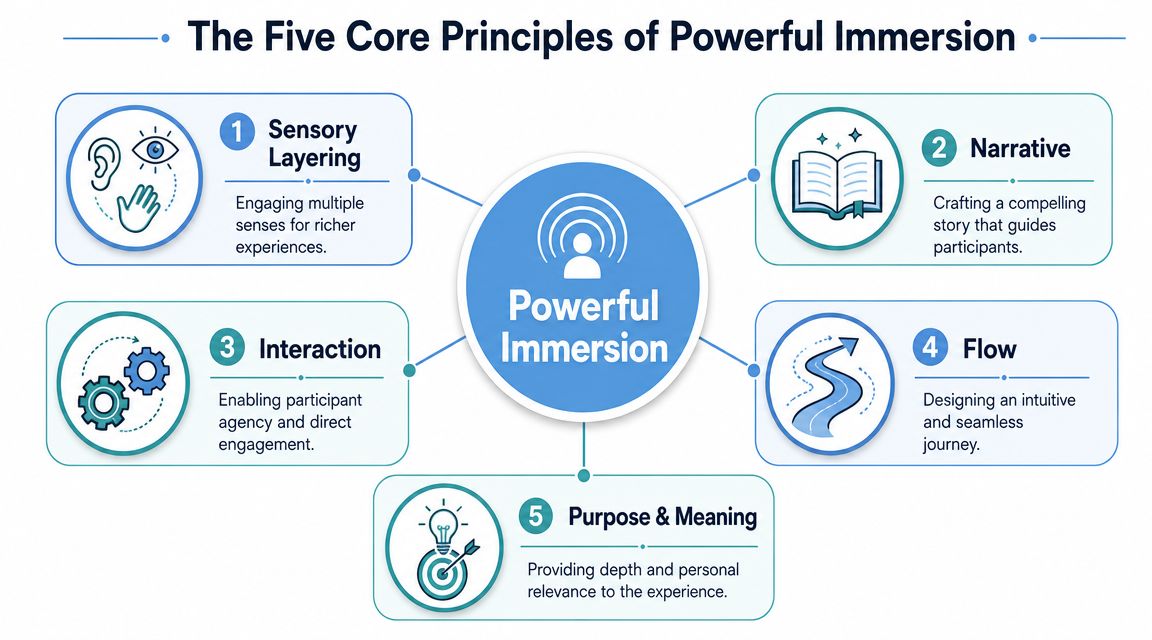
Sensory layering
Immersion improves when attendees receive more than one cue at once. Visuals pull them in, but sound, motion, touch, and physical feedback make the moment feel real.
A racing rig is a good example. The screen carries the world, but the steering resistance, pedal feel, seat movement, and engine audio are what stop it feeling like a game on a monitor. In live environments, sensory layering also helps the experience cut through surrounding event noise.
What doesn't work is piling on effects with no restraint. Too many competing lights, sounds, prompts, and moving elements can confuse people and shorten dwell time.
Narrative
Even short activations need a story. Not a long script. Just a clear frame.
A product launch might position the attendee as the person solving a problem under pressure. A flight simulator might place them in a mission scenario. A reaction game might turn a technical brand promise into a physical test of speed and accuracy. The point is to give the action meaning.
Practical rule: If a visitor can't explain the point of the activation in one sentence after taking part, the narrative is too weak.
Interaction
Passive viewing has limited value on a busy show floor. Strong immersion gives attendees agency. They choose, control, react, compete, or collaborate.
That can happen through:
- Direct control: Driving, steering, aiming, selecting, triggering.
- Decision points: Choosing routes, options, teams, or difficulty.
- Visible outcomes: Scores, rankings, time saved, missions completed.
- Shared play: Team challenges and side-by-side competition.
The useful test is simple. Does the attendee feel like the experience happened because of them, or merely in front of them?
Flow
Flow is where many activations fall apart. The concept sounds good, but the actual journey is clumsy. People don't know where to queue, where to stand, what to do first, or how to exit into the next conversation.
Good flow is mostly operational. It depends on signage, staff cues, visibility, timing, and physical layout. The attendee should understand the invitation, enter cleanly, complete the interaction, and land in a natural post-experience moment where the brand can continue the conversation.
A strong flow usually includes:
- Attraction point that's visible from distance
- Entry cue that explains what's happening
- Main interaction with low friction
- Outcome moment such as score, reveal, or content capture
- Follow-up path to lead capture, demo, or discussion
Accessibility and purpose
Accessibility belongs in the concept stage, not the risk assessment stage. The UK Government's Family Resources Survey estimates that around 16.1 million people in the UK were disabled in 2022/23, about 24% of the population, which makes inclusive design a mainstream event requirement rather than a bolt-on consideration, particularly for simulator and VR-style experiences where posture, motion intensity, controls, and queue setup directly affect participation, as highlighted in this Family Resources Survey reference.
In practice, that means asking better questions early:
- Can this be used seated as well as standing?
- Can motion or audio intensity be adjusted?
- Are controls intuitive for different dexterity levels?
- Can someone participate socially even if they don't use the core hardware?
- Does the queue work for mixed-ability audiences?
Purpose matters just as much. People engage more intensely when the activation has relevance. Spectacle gets attention. Meaning keeps it there.
A Step-by-Step Design Process for Activations
A good activation rarely starts with “We want a simulator” or “We should do something in VR.” It starts with a business objective. That sounds obvious, but it's where many projects drift.

Start with the commercial outcome
Before discussing footprint, screens, branding, or game modes, decide what success looks like in business terms. Do you need lead capture, footfall, product education, content creation, hospitality value, or a reason to bring pre-booked prospects onto the stand?
That question matters because most commentary around immersive events still doesn't connect design choices to proper measurement. As this perspective on immersive experience design and performance gaps argues, planners are often left without rigorous ways to compare formats like VR or racing simulators against real post-event outcomes.
A simple first brief should define:
- Primary objective: The one result that matters most
- Secondary objective: Useful, but not at the expense of the first
- Audience type: Existing clients, prospects, partners, staff, or mixed
- Desired action: Scan badge, book demo, share content, join queue, stay longer
Build around audience behaviour
The same attraction can work brilliantly in one environment and poorly in another because the audience isn't the same. Exhibition visitors behave differently from conference delegates. Hospitality guests behave differently from internal teams. Public audiences tolerate queues differently from senior decision-makers on a B2B stand.
That's why concepting should start with behaviour, not technology.
Useful planning questions include:
- How long will people realistically give you?
- Will they join a queue, or do they need instant access?
- Are they comfortable with competitive play?
- Do they need staff guidance to start?
- What will they be carrying? Bags, coats, coffee, brochures?
A compact reaction game may outperform a deeper simulator if the audience is time-poor. A high-production branded challenge may outperform a generic digital game if the brand needs stronger recall.
Shape the concept and journey
Once the objective and audience are clear, map the activation as a sequence of moments rather than a piece of kit.
A practical format looks like this:
| Stage | Key question | Design focus |
|---|---|---|
| Approach | Why would someone stop? | Visibility, sound, movement, social proof |
| Entry | How do they understand it fast? | Staff line, signage, simple instructions |
| Play | What are they doing? | Controls, pacing, feedback, fairness |
| Outcome | What do they get? | Score, reveal, photo, ranking, reward |
| Follow-up | What happens next? | Data capture, product demo, conversation |
This is where interactive exhibition ideas become useful only if they're filtered through the audience journey. A strong idea on paper can still fail if the route through it is awkward.
Here's a useful visual reference for how immersive environments can be structured in practice:
Select technology last, not first
Technology should support the intended behaviour. If the objective is high throughput and visible competition, a multiplayer simulator or reaction-based installation may make more sense than a headset-based format. If the objective is controlled product storytelling, a guided VR experience may be the better fit.
Prototype thinking helps here, even for temporary events. Walk the space. Time the turns. Watch how quickly a first-time user understands the controls. Test whether bystanders can still enjoy the moment while waiting.
When an activation is hard to explain in the first few seconds, staff end up doing too much work and the experience loses momentum.
Plan the measurement before build
The final design step should happen before anything is printed or shipped. Decide how success will be captured.
That usually means choosing a small number of practical measures, such as:
- Dwell quality: Did people stay and complete the interaction?
- Lead mechanism: How was data captured and qualified?
- Conversation handoff: Did the activation create a natural sales moment?
- Content output: Were there usable photos, clips, or rankings to extend the campaign?
- Post-event review: What will the team compare this against?
If measurement only gets discussed after the event, you'll get stories instead of evidence.
Choosing the Right Immersive Technology
Different technologies create different kinds of attention. The right choice depends less on novelty and more on fit. Footprint, queue behaviour, staffing, onboarding time, and brand message all matter as much as headline impact.
A practical comparison
| Technology | Best For | Footprint | Throughput | Budget |
|---|---|---|---|---|
| Racing or flight simulators | Competitive engagement, visible stand activity, hospitality, branded challenges | Medium to large | Medium | Medium to high |
| VR headsets | Guided storytelling, product visualisation, controlled individual immersion | Small to medium | Lower | Medium to high |
| AR layers on mobile or screens | Product overlays, exploration, hybrid physical-digital journeys | Small to medium | Medium to high | Medium |
| Reaction games and physical interactives | Fast participation, footfall, quick competitions, energetic crowd build | Small to medium | High | Low to medium |
| Large-scale physical installations | Statement moments, audience spectacle, sponsorship visibility | Large | Medium | High |
| Leaderboards and gamification systems | Extending engagement across almost any format | Small | High | Low to medium |
Where each option wins
Simulators work well when you want visible action and a memorable personal challenge. They also create strong spectator value, which matters at exhibitions. People watch before they play, and that helps build natural traffic.
VR offers deeper individual immersion, but it introduces friction. Users need briefing, fitting, supervision, and cleaning between sessions. It can be excellent for the right story-led brief, but it usually isn't the best choice when throughput is the main goal.
Physical interactives such as reaction walls, Batak-style systems, or branded skills challenges often perform better than expected because they're instantly legible. Attendees understand what's happening from several metres away.
Leaderboards are often the most underused layer. They turn a single interaction into a recurring reason to return, compete, and bring colleagues back.
The UK privacy and compliance issue
VR and mixed reality require another planning lens in the UK. Advanced immersive systems may collect detailed body and sensor data, and that creates a privacy question as well as a technical one. The Ada Lovelace Institute notes that these data streams help create smooth immersive experiences but also raise privacy risk, which is why UK-facing deployments using headsets, eye tracking, or body tracking should be designed with data minimisation and clear consent flows from the start, as explained in this Ada Lovelace Institute overview of immersive technologies.
That doesn't mean avoiding these tools. It means asking practical questions early:
- What data does the system collect by default?
- Is any of it retained?
- Who has access to it?
- Does the attendee understand what they're agreeing to?
Technology choice shouldn't just be exciting. It should be operationally sensible, audience-appropriate, and easy to defend internally.
Measuring Success and Avoiding Common Pitfalls
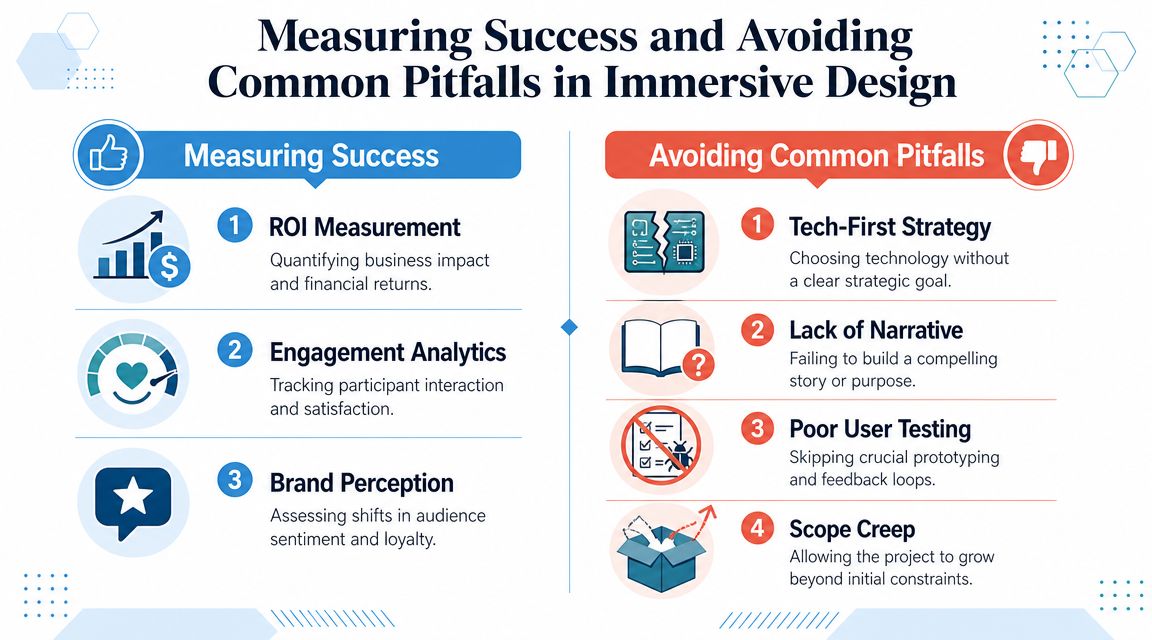
The fastest way to waste budget is to judge an activation by crowd size alone. Crowds can be useful, but only if they lead somewhere. A packed stand with no clean lead path, no staff structure, and no way to connect activity to outcomes may feel successful on the day and underperform afterwards.
Common mistakes that weaken results
Some problems appear again and again in event environments:
- Tech-first decisions: Teams choose the hardware before they decide the purpose.
- Poor throughput planning: The experience is strong, but the queue gets too long.
- Weak staffing: Great equipment still needs hosts who can invite, brief, and convert.
- No handoff moment: Visitors finish the game and walk away with no next step.
- No test under event conditions: An activation may work in a warehouse and fail on a noisy show floor.
A useful way to think about this is similar to operational safety planning. Leading indicators matter because they show whether the setup is working before the final result appears. This safety guide for construction managers is from a different field, but the distinction is helpful for live experiences too. Early signs such as queue abandonment, slow onboarding, or poor staff handoff often tell you more than end-of-day impressions.
Fix friction before the event opens. Once visitors start arriving, even small bottlenecks become part of the brand experience.
What to measure in practice
The good news is that immersive formats can connect neatly to measurement, especially because UK audiences are already highly connected. Ofcom's 2024 UK Adults' Media Use and Attitudes report found that 88% of UK adults owned a smartphone, which makes it easier to build activations around QR-triggered interactions, app-linked game mechanics, and shareable on-site content that can support practical event tracking, as referenced in this summary of digitally connected audience behaviour.
The most useful event metrics are usually simple:
- Engagement quality: Did attendees complete the interaction or drop out?
- Qualified contacts: How many meaningful conversations followed participation?
- Repeat visits: Did people come back with colleagues?
- Content capture: Did the activation create usable branded media?
- Sales relevance: Did the team identify clear post-event follow-up opportunities?
Not every event needs a complex dashboard. It does need a small set of agreed measures that match the original brief. That's what turns an immersive activation from entertainment into a working part of the marketing plan.
Immersive Experience Design FAQs
How much does an immersive activation cost
Cost depends on the format, branding requirements, staffing, transport, venue access, and how bespoke the experience is. A simple interactive game and leaderboard setup sits in a very different budget bracket from a fully branded motion simulator environment or custom VR build. The best approach is to start with the objective and audience, then choose the lightest production that can still deliver the result.
How much lead time do you need
The process often takes longer than generally assumed. Straightforward hires can move quickly, but branded immersive activations need time for concept development, artwork, logistics, approvals, testing, and venue coordination. If the brief includes custom content or multiple stakeholders, earlier is always better.
How do I know if my venue is suitable
Check three things first: access, power, and usable floor space. Then check sightlines, sound bleed, queue room, and whether the venue rules affect rigging, branding, or staff operation. An activation can fit on paper and still fail in practice if the surrounding environment works against it.
Is VR always the most immersive option
No. VR can be highly immersive for the participant, but not always for the stand as a whole. At exhibitions, visible physical experiences often outperform headsets because they attract both players and spectators.
What makes an immersive activation commercially useful
A clear objective, an intuitive user journey, a strong host team, and a defined post-experience action. If those are in place, the experience has a better chance of generating something the business can use after the event.
If you're planning a corporate event, exhibition stand, or branded activation and want an experience that does more than attract a crowd, PSW Events can help shape the right format. From simulators and competitive games to full delivery, staffing, branding, and logistics, the team builds immersive event experiences that are designed to engage audiences and support measurable outcomes.