
You're often trying to solve the same event problem under different names. Engagement. Energy. Dwell time. A reason for people to stop, watch, join in, and remember who created the moment.
A human hamster ball works because it does all of that at once. It's visual from a distance, funny without feeling childish, active without demanding athletic skill, and flexible enough to suit a staff fun day, a campus activation, a public festival, or a trade show campaign with branded competition mechanics.
It also raises immediate practical questions. Is it safe? Can it work indoors? What paperwork should a UK organiser ask for? How do you turn a spectacle into something that supports leads, footfall, or team engagement rather than just giving people a quick laugh and moving on?
Those are the questions that matter. They're also where good events are won or lost.
The Search For Unforgettable Event Entertainment
Most planners have already ruled out the obvious options before they start searching for a human hamster ball. The DJ is booked. The drinks reception is fine. The photo booth has been done repeatedly. What's missing is the centrepiece that changes the tone of the event and gives guests something to gather around.
That's usually the actual brief. Not “find a game”, but “create momentum”.
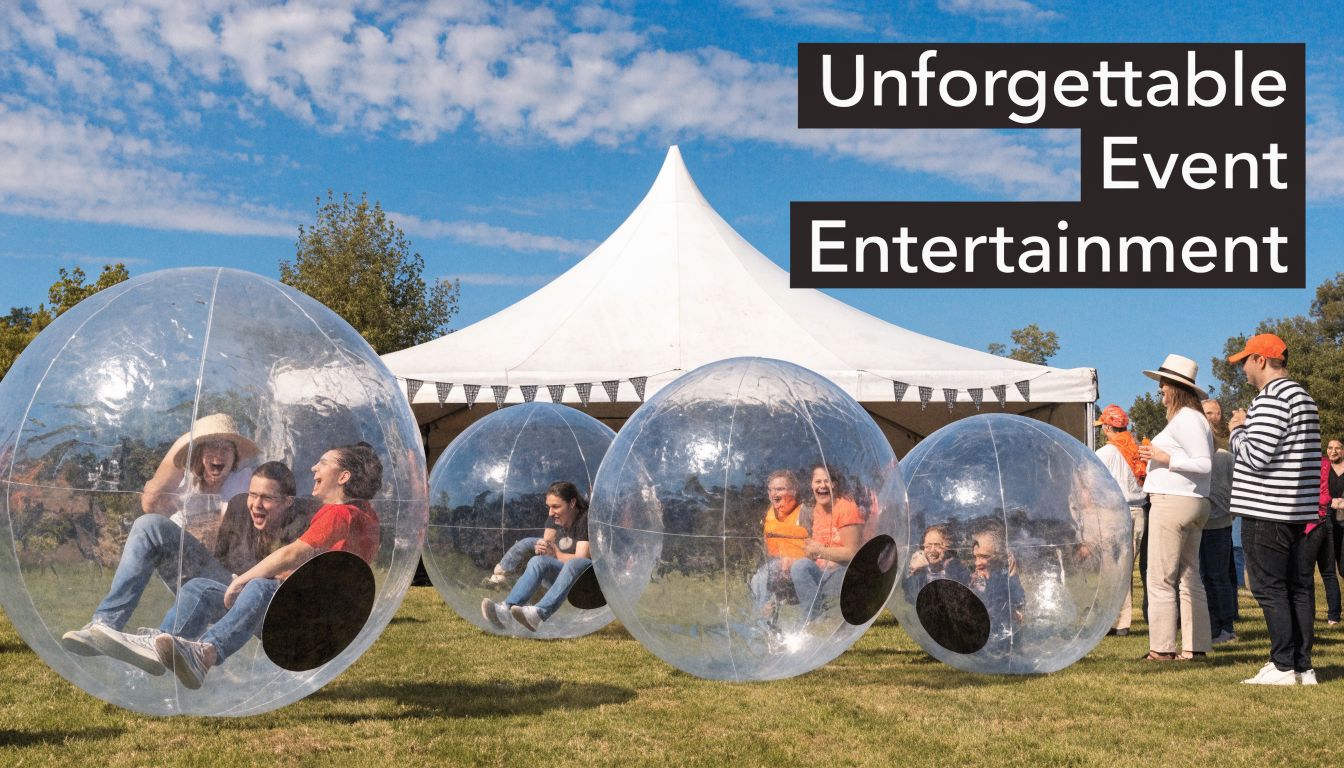
A human hamster ball delivers that first-glance reaction very quickly. Guests see a transparent inflatable sphere, someone climbs in, the crowd starts laughing before the run even begins, and suddenly you've got a live focal point instead of another passive corner of the venue. That's why planners often shortlist it alongside other outdoor party games for adults, especially when they need entertainment that pulls in both participants and spectators.
Why planners keep coming back to visual attractions
The strongest event entertainment doesn't only serve the people taking part. It also works for the people watching, filming, cheering, queueing, and sharing clips with colleagues. Human hamster ball activations do that well because the action reads instantly. Nobody needs a long explanation.
A few practical benefits stand out early in the planning process:
- Fast audience understanding: Guests know what they're looking at within seconds.
- Built-in crowd energy: Even one run creates a mini audience around the activity zone.
- Low social friction: People who wouldn't volunteer for a formal contest often try this because it looks playful rather than intimidating.
- Flexible positioning: It can sit at the centre of a fun day or act as a branded traffic-driver at a larger event.
Practical rule: If an attraction needs too much explanation before people engage, it usually struggles on a busy event floor.
That said, experienced planners don't stop at the “wow” factor. They look at surface conditions, operator quality, insurance, queue flow, and whether the activity fits the event objective. That's the right instinct. A memorable attraction still needs to be professionally managed.
What Exactly Is A Human Hamster Ball
At the booking stage, this is the point where planners need to get precise. “Human hamster ball” is a catch-all term, but suppliers can mean very different products by it, and that difference affects safety paperwork, footprint, staffing, and how the attraction performs on the day.
In practical event terms, a human hamster ball is a large inflatable sphere that contains the participant while they roll, walk, bump, or take part in short games on a managed activity area. The ball absorbs impact around the rider, but the operating format still matters. A product built for a downhill recreational run is not the same as one set up for flat-ground corporate entertainment.
The core idea and where it came from
Commercial zorbing was established in New Zealand in 1994, and the term entered the Concise Oxford English Dictionary in 2001, defined as “a sport in which a participant is secured inside an inner capsule in a large, transparent ball which is then rolled along the ground or down hills”, according to this history of the zorb ball craze.
That definition is a useful starting point, but it is narrower than the way the attraction is used at UK events now. For corporate planners, the primary question is not the dictionary wording. It is whether the supplier is proposing a controlled entertainment activity that suits your venue, your audience, and your compliance requirements.
The main formats planners should know
Harnessed orbs place the rider in an inner compartment with restraints. These are closer to traditional zorbing and suit tightly managed runs where participant position needs to stay controlled.
Non-harnessed orbs give the rider more freedom of movement inside the ball. These are often used for flat-surface entertainment, bumper-style play, relay races, and short competitive sessions at family days or staff events.
Water-walker balls are sealed for use on water and belong in a different category operationally. They need a pool or contained water setup, separate supervision, and a venue that is already suitable for aquatic activity.
That distinction matters commercially as well as operationally. If the brief is an exhibition stand with dwell-time goals, a roaming outdoor festival zone, or a company fun day on a sports field, the right answer is usually a flat-ground format with controlled throughput. If the supplier talks mainly about downhill rides, that is a cue to ask harder questions about suitability, risk assessment, and venue compatibility.
What the experience means for event delivery
For guests, the attraction feels playful and slightly chaotic in a good way. For planners, it is a specification decision.
A harnessed setup usually fits events where one participant or a pair takes a managed turn under close operator control. A non-harnessed setup is often better for sociable gameplay and repeat participation, which can be more useful if the event objective is queue visibility, team interaction, or branded content capture. Water-based versions work for the right leisure venue, but they are rarely the first choice for corporate roadshows, conferences, or exhibitions.
This is also where UK buyers need to be more careful than generic online guides suggest. The product label alone does not tell you enough. Ask what surface the ball will run on, how entries and exits are handled, what age and size limits apply, how long each session lasts, what operator-to-participant ratio is used, and whether the provider has documentation that stands up to venue scrutiny. In the UK, that matters because planners often have to handle HSE expectations and venue sign-off without the clarity some assume comes from AALA licensing.
The useful planning question is simple. Which type of human hamster ball fits the audience, venue rules, activity surface, and the result the event needs to produce?
Why Zorbing Is A Game Changer For Corporate Events
A human hamster ball isn't just participant entertainment. It's live theatre on an event floor.
That matters more than many planners expect. Plenty of activities are fun once someone commits to trying them. Far fewer are compelling enough to stop passing traffic, build a crowd, and create movement around the activation area. Zorbing does that because the action is visible and slightly unpredictable in the best way.
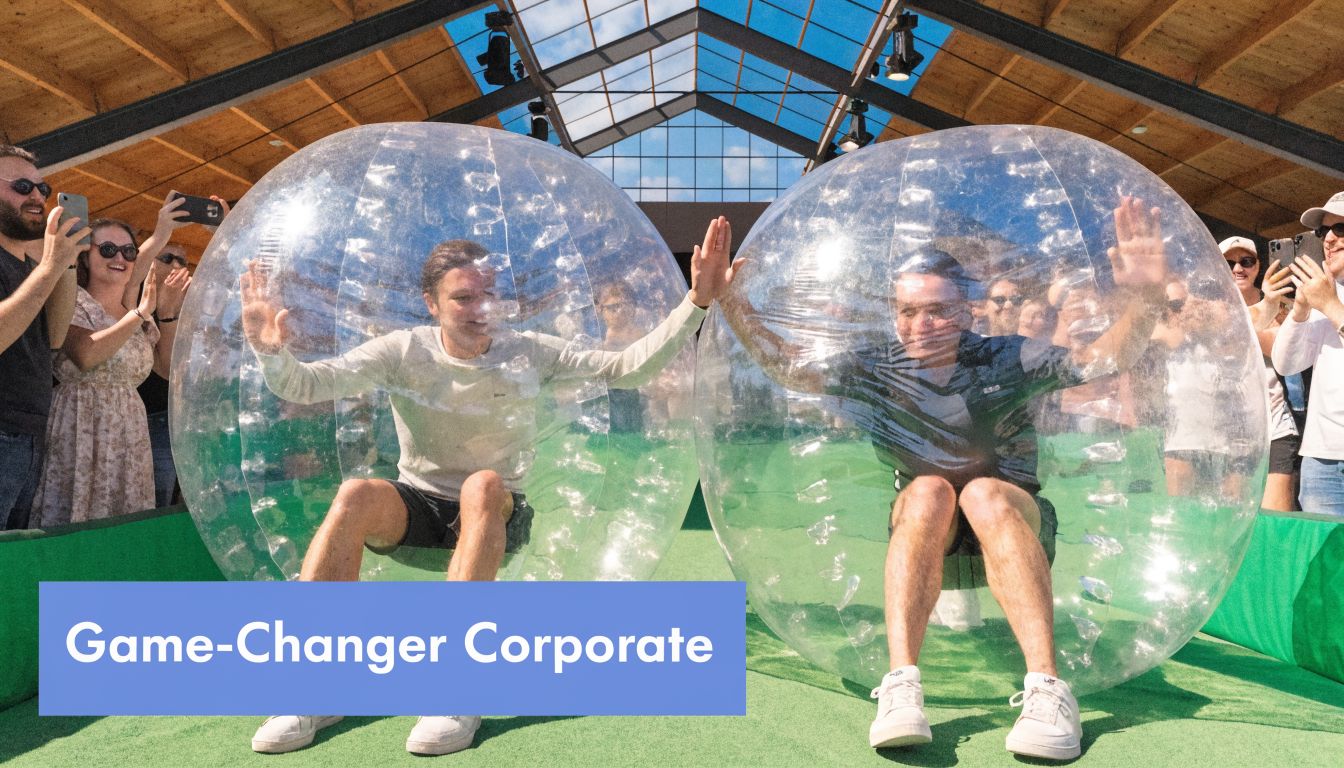
It performs well as a spectator attraction
In a corporate setting, the crowd around the activity can be as valuable as the activity itself. At a conference social, that crowd creates atmosphere. At a family day, it gives non-participants something to watch and talk about. At an exhibition, it acts as a magnet.
That's one reason human hamster ball activations work across very different briefs:
- Team building: relay races, timed challenges, and head-to-head contests
- Family events: playful, low-barrier fun that appeals across generations
- Brand activations: a branded set piece that attracts attention from a distance
- Fan zones and festivals: a high-energy attraction that helps animate large open spaces
It suits the way people actually behave at events
Guests don't all arrive ready to join in. Some want to observe first. Some take photos. Some need to see a colleague try it before they step forward themselves. Human hamster ball activities support that behaviour naturally because they don't require technical knowledge or long onboarding.
That's useful for corporate planners trying to reduce dead zones around activations. A static display can look polished and still fail to draw people in. A live game with movement, laughter, and visible competition usually has a much stronger pull.
A short video gives a better sense of that live energy than any description can:
It's versatile without feeling generic
Some event attractions can be adapted to many briefs, but they lose impact because they feel interchangeable. Human hamster ball hire avoids that problem if the format is matched properly to the goal.
A few examples:
| Event goal | Format that works | Why it works |
|---|---|---|
| Build internal team energy | Relay races or paired challenges | Competition creates cheering and participation |
| Increase stand attention | Branded time trials or bumper-style gameplay | Motion and humour draw footfall |
| Support a summer party | Open-play sessions on grass | Guests can join casually without structure |
| Add family appeal | Gentle gameplay with clear supervision | Parents understand the activity quickly |
The trade-off is that it must be planned properly. If the space is wrong, the staffing is weak, or the game mechanic is vague, the attraction can look chaotic instead of premium. Done well, it lifts the whole event around it.
Planning Your Zorb Activation Site And Logistics
Many otherwise strong ideas fail at this stage. The attraction itself is good, but the site isn't right for it. The best operators treat a human hamster ball booking as a logistics exercise first and an entertainment booking second.
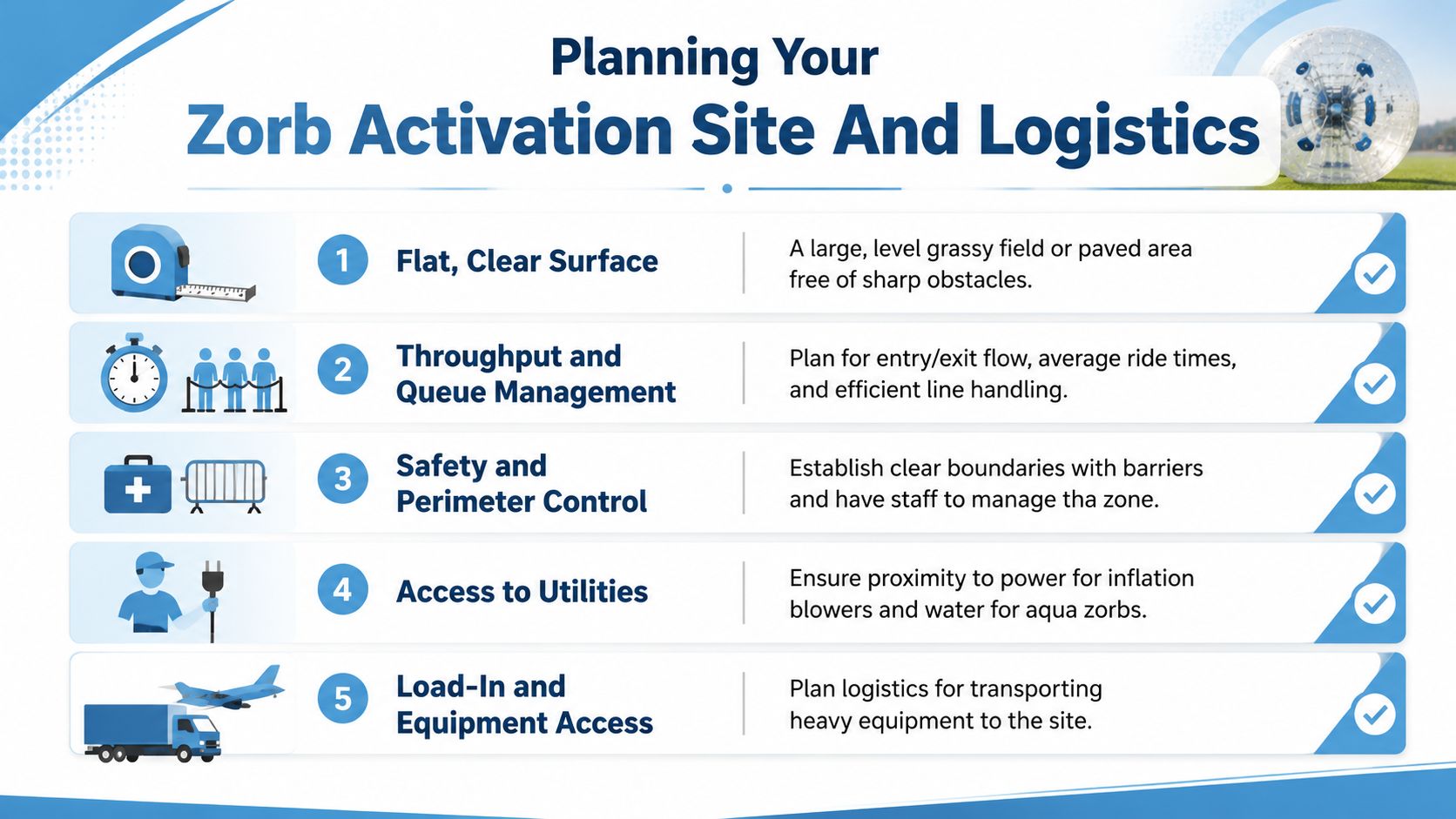
The first check is always the ground. Flat, open, and clear beats picturesque but awkward every time. For free-roaming or competitive formats, organisers need enough room for movement, stopping distance, queueing, and operator control. For any sloped activity, the gradient needs specific review through the event risk assessment rather than guesswork on the day.
Start with the ball design, not the marketing photos
A proper human hamster ball uses a dual-sphere construction. There's an air chamber of about 50cm between the 2.5 to 3.0 metre outer sphere and the 1.8 to 2.0 metre inner sphere, with over 300 nylon threads connecting the structure. That pneumatic suspension acts as a shock absorber, which is one reason it supports duty-of-care and insurance expectations at UK corporate events, as explained by this technical guide to human hamster ball construction.
That engineering matters because it directly affects site planning. The sphere needs room to flex, roll, and decelerate as designed. Tight footprints, uneven edges, and cluttered mixed-use areas undermine the point of the equipment.
Site conditions that usually work best
Some environments consistently perform well, others create unnecessary risk or friction.
- Grass fields: Often the easiest option for outdoor activations if the ground is even and clear.
- Large indoor halls: Good for controlled gameplay when ceiling height, access, and floor condition are suitable.
- Paved areas: Possible in some cases, but only when the surface is smooth and free from sharp debris.
- Mixed public spaces: Harder to manage because pedestrian traffic can interfere with the operating zone.
A good provider will also review access for transport, inflation space, and operating perimeter. If equipment has to be carried long distances through a live venue or public area, load-in timing becomes part of the risk picture.
Throughput and queue management
The attraction can become a victim of its own popularity if the queue isn't designed properly. A visible activity attracts interest quickly, so planners need a defined participant flow from briefing to entry, activity time, exit, and reset.
Nearby support equipment often matters as much as the ball itself. Barrier lines, signage, waiting zones, and a clear marshal position all improve the experience. So does choosing the right surrounding hire stock, especially if you're building a wider activation area with event inflatables for rent.
Operational note: If guests can't tell where to watch, where to queue, and where to enter, they'll create their own flow. That's rarely the flow you want.
Utilities, staffing, and on-site control
The booking also needs practical services. Inflation equipment needs power. Aqua formats need a suitable water setup. Staff need sightlines across the full operating area. Entry and exit points should be obvious before the first participant arrives.
The specifics vary by venue, but a planner should expect the supplier to talk through:
- Power access: for inflation and any supporting activation equipment
- Perimeter control: barriers or managed boundaries around the activity zone
- Equipment movement: realistic load-in and load-out planning
- Operator oversight: trained staff who can brief, monitor, and rotate participants efficiently
When a supplier is vague about any of that, the issue usually shows up on event day.
Navigating UK Safety Compliance And Insurance
This is the part generic entertainment guides often miss. In the UK, the question isn't “Is the equipment safe?” The question is whether the provider can document, operate, and insure the activity in a way that supports the organiser's duty of care.
For human hamster ball hire, that matters because there's a regulatory gap many buyers don't realise exists.
The AALA gap and why it matters
Unlike many adventure-style activities, zorbing is not covered by AALA licensing in the UK. That means planners can't use an AALA licence as a shortcut quality signal when vetting a supplier. The same source notes that a 2023 RoSPA report found 15% of UK inflatable incidents involved zorbs due to inadequate risk assessments, and it states that planners should ensure the provider has bespoke health and safety packs, dynamic risk assessments, and robust public liability insurance, with £5m minimum recommended by HSE, according to this review of human hamster ball safety considerations.
That one point changes the buying process. You're not selecting a novelty product. You're selecting an operator whose paperwork, inspection routines, and event controls stand up under scrutiny.
What a serious provider should be ready to supply
When I review attraction partners, I'm looking for evidence that safety is built into the operating model rather than added after the quote has been accepted.
A professional supplier should be able to discuss, clearly and without delay:
- Public liability insurance: not vague assurances, but current documentation
- Risk assessments and method statements: specific to the venue and activity format
- PAT-tested supporting equipment: especially where inflation equipment or ancillary power is involved
- Operator procedures: who briefs participants, who controls entry, who pauses the activity if conditions change
- Venue coordination: how the supplier works with site rules, production teams, and event control
The questions planners should ask early
Don't wait until the final production meeting to raise compliance. Ask these points during shortlist stage.
| Compliance area | What to ask | What you want to hear |
|---|---|---|
| Insurance | What level of public liability cover do you hold? | Clear figure, current certificate, no hesitation |
| RAMS | Will you provide venue-specific documentation? | Yes, tailored to site conditions |
| Equipment checks | How is equipment inspected and maintained? | A routine process, not ad hoc checks |
| Staffing | Who supervises the activity on site? | Trained operators with defined roles |
| Escalation | What happens if weather or surface conditions change? | A clear stop or modification process |
Good operators make compliance feel straightforward. Poor operators make it feel like an inconvenience.
That distinction matters at major venues, but it matters just as much on a private field, company campus, or temporary festival site. The venue address changes. The organiser's responsibility doesn't.
Maximising Brand Activation And Event ROI
At a busy exhibition, the stand that draws a queue gets noticed. The stand that keeps people engaged for long enough to start a useful sales conversation gets remembered.
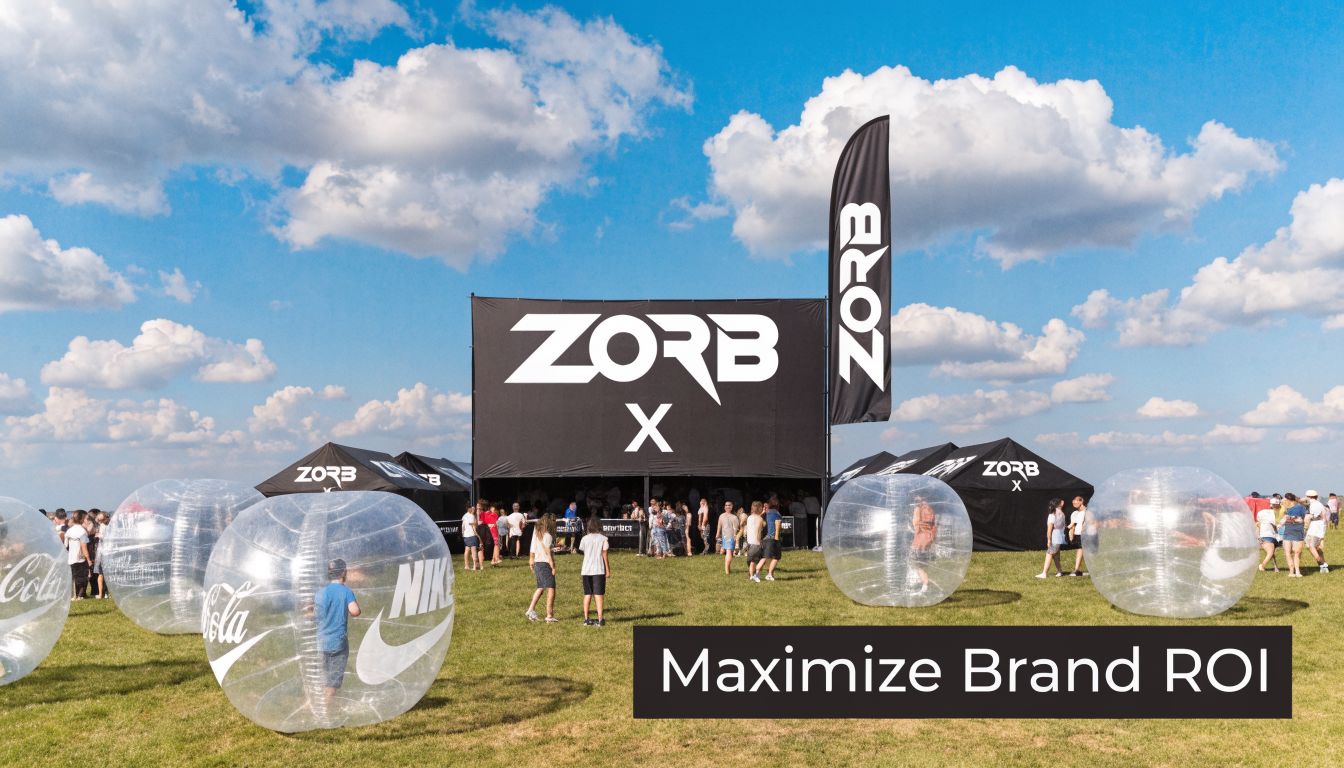
A human hamster ball does that best when it is planned as part of the event objective, not added late as a novelty. Set the commercial goal first. For corporate planners, that usually means one of four things: increasing footfall, extending dwell time, capturing qualified leads, or giving sponsors a branded moment that is easy to photograph and share. The format changes depending on which outcome matters most.
Measure the attraction like a marketing asset
The simplest mistake is judging success by noise around the activity. Noise is useful. It is not a reporting metric.
For a sponsor zone at a county show or a branded space at a venue such as NEC Birmingham or Olympia London, I would track:
- Dwell time: how long participants and spectators stay in the activation zone
- Queue-to-entry rate: how many people who stop take part
- Lead capture rate: how many participants complete registration or scan in
- Content output: how many usable photos, clips, or branded shares the activity generates
- Staff conversations started: how often the attraction creates a genuine opening for sales or brand teams
Those numbers make post-event reporting much stronger. They also help justify future spend to procurement, sponsors, and internal stakeholders who are less interested in atmosphere than outcomes.
Build the mechanic around the result you need
A good zorb activation gives people a reason to do more than watch. Timed runs work well for footfall because they are fast to explain and easy to reset. Leaderboards suit trade shows and internal brand events because they encourage repeat attempts and create a natural data capture point. Head-to-head heats are effective for team building and sponsor hospitality because they raise the energy around the space without requiring a large throughput every minute.
The key trade-off is speed versus data depth. A quick, open-entry format gets more participants through. A scored or registered format usually captures better contact data, but it needs tighter staffing and a cleaner guest journey.
For brands planning building a broader experiential environment, the zorb element should sit inside a wider visitor path rather than operate in isolation. Supporting scenic pieces, staging, and photo moments can strengthen the campaign identity, and this overview of Commercial – Brand Activations is a useful reference for how visual installations can support the main interactive feature.
Put the brand inside the experience
Branding works when participants feel it during the activity, not just when they walk past a logo wall.
| Branding layer | Strong use | Weak use |
|---|---|---|
| Visual identity | Branded entry arch, staff kit, scoreboards, floor graphics | One banner placed beside the arena |
| Lead capture | Registration linked to heat times, prizes, or result delivery | A separate form with no clear benefit |
| Content creation | Planned photo angles, branded replay clips, winner moments | Relying on guests to film everything themselves |
| Repeat engagement | Scheduled finals, daily top scores, team rankings | Single play with no reason to return |
A practical example. If the event goal is lead generation at a public expo, ask guests to register for a timed challenge and send their score by email or SMS. If the goal is sponsor visibility at a summer party, reduce the form filling, increase throughput, and make sure the branding is visible in every photo angle. Different goals need different setups.
The attraction gets attention. The operating plan, staffing model, and measurement approach are what turn that attention into commercial value.
Your Booking Checklist And Provider Vetting Guide
Quotes for human hamster ball hire can look similar on paper. What separates a smooth booking from a stressful one is usually everything behind the quote.
The quickest way to assess a provider is to move past “How much is it?” and into “How do you deliver this safely, clearly, and professionally?” A solid supplier will answer without fluff. A weak one will stay vague, promise flexibility, and avoid specifics.
Provider Vetting Checklist
| Area of Enquiry | Question to Ask | Ideal Answer / Red Flag |
|---|---|---|
| Insurance | Can you send current public liability details now? | Ideal: Current documents sent promptly. Red flag: “We're covered” with nothing attached. |
| Risk paperwork | Will you provide event-specific RAMS and risk assessment documents? | Ideal: Tailored paperwork for the venue and format. Red flag: Generic paperwork for every event. |
| Equipment | How often is the ball inspected, cleaned, and maintained? | Ideal: Clear maintenance process. Red flag: Informal or unclear answer. |
| Staffing | Who will operate the activity on site? | Ideal: Named or role-defined trained crew. Red flag: “Someone from our team will manage it.” |
| Site survey | Do you assess the operating surface and access in advance? | Ideal: Yes, with practical questions about space, load-in, and power. Red flag: No interest in site conditions. |
| Setup scope | What is included in the hire fee? | Ideal: Setup, derig, operators, insurance, briefing, and agreed branding elements listed clearly. Red flag: Key items left open-ended. |
| Weather plan | What happens if conditions change on the day? | Ideal: A defined pause, adapt, or stop procedure. Red flag: “We'll see how it goes.” |
| Queue control | How do you manage participants and spectators? | Ideal: Entry process, briefing flow, and perimeter control discussed. Red flag: No plan beyond the equipment itself. |
How to read the answers
Short answers aren't the problem. Unclear answers are.
A professional operator should sound like someone who's run the activity under pressure before. They'll talk about venue access, participant briefing, operating zones, insurance certificates, and documentation without needing to be pushed. They'll also be realistic about limits.
That realism is a good sign. If a provider claims the setup works anywhere, with any audience, in any conditions, they're selling convenience, not judgement.
A practical buying mindset
Use the quote to compare cost. Use the conversation to compare risk.
When you vet providers that way, you usually end up with a stronger event. The attraction arrives on time, the venue team is comfortable, participants understand the rules, and the client sees a polished activation rather than a hired inflatable dropped onto a patch of grass.
Frequently Asked Questions
Can a human hamster ball be used indoors
Yes, provided the venue gives you enough clear run space, controlled spectator separation, suitable flooring, and practical access for load-in. Exhibition halls, sports halls, and larger indoor event spaces usually work far better than standard function rooms. I would always confirm ceiling height, floor finish, door widths, and the route from the unloading point before the booking is signed off, because indoor use often fails on access and operating space rather than on the attraction itself.
What should participants wear
Keep it simple. Comfortable clothing is best.
Participants should remove jewellery, empty pockets, and avoid sharp items, belts, or anything that could catch or damage the ball. Footwear rules vary by operator and format, so the event team should follow the supplier's briefing rather than making assumptions on the day.
Is there an age range for participants
Yes, but there is no single answer that fits every setup. Age suitability depends on the ball format, supervision level, surface, participant height and weight, and the operator's own risk controls.
For corporate events, the better question is whether the activity suits your audience profile. A family fun day may need child-friendly sessions with clearly separated age groups. A conference activation may work better as an adult-only feature with short, well-managed turns. The provider should define participant criteria in writing and explain how they brief, screen, and supervise each group.
Is it better for team building or public events
It works for both, but the format should change with the objective.
For team building, use structured rounds, timed relays, or supervised head-to-head play that gives teams a clear reason to take part. For public events and exhibitions, focus on visibility, short session times, queue management, and a branded spectator area. That setup usually gives better dwell time and stronger lead capture because people stop to watch before they join.
At venues such as exhibition centres, that distinction matters. A crowd-pleasing attraction is only doing half the job if it creates a queue with no data capture plan, no brand messaging, and no route into the wider stand experience.
Does it need a big footprint
It needs more than the ball itself.
The live activity zone is only one part of the plan. You also need space for briefing, entry and exit, staff positioning, queueing, spectator standoff, and any branding or lead capture point. That is why I advise planners to review scaled layouts with the operator and venue team early, especially where HSE expectations are high and the activity may sit outside the AALA framework. If the supplier cannot show how the full operating area works, the footprint has not been planned properly.
If you're planning a human hamster ball activation and want a partner who can handle branding, logistics, staffing, and compliance properly, PSW Events can help design and deliver the full experience across the UK.