Most couples start in the same place. You know you want a wedding people talk about for the right reasons, but once you start looking at wedding entertainment hire, the choices get messy fast. A DJ looks straightforward. Then someone suggests a live sax set, a silent disco, garden games, a photo booth, maybe even something interactive for the drinks reception. Suddenly you're not choosing music. You're designing the whole feel of the day.
That's where most guides fall short. They treat entertainment as one booking, usually a band or a DJ, when in practice it's a sequence of moments. What guests do while you're having photographs matters. What keeps different age groups engaged matters. What still feels fun after dinner matters. And if you add modern interactive entertainment, the planning changes again because space, power, insurance and setup become part of the decision.
Good entertainment doesn't just fill time. It creates rhythm, gives guests something to do, and keeps the room moving without awkward lulls. Bad entertainment planning usually isn't about a poor act. It's about the wrong act in the wrong slot, at the wrong volume, in the wrong space.
Beyond the First Dance Your Entertainment Vision
A lot of couples begin with one question: band or DJ? That's too narrow.
Start with a more useful one. How do you want the day to feel for the people in the room? A wedding can feel like a packed party, a relaxed social gathering, or a series of surprises that keep guests discovering something new. Each one needs a different entertainment plan.
Think about the moments your guests will actually remember. They'll remember the room lifting when the evening starts properly. They'll remember whether the drinks reception had energy or drifted. They'll remember whether there was something for the couple's uni mates, older relatives, and guests who don't want to dance until midnight.
Sometimes the entertainment vision begins before the reception. If your first dance matters to you, the confidence you bring onto the floor affects the tone of the evening more than most couples expect. For couples who want structured help with that part, best wedding dance lessons in Philadelphia is a useful example of the kind of specialist support that can turn a nervous first dance into a proper moment.
Think in moments, not bookings
A practical way to plan wedding entertainment hire is to split the day into guest-experience windows:
- Arrival and pre-ceremony: What settles people in and sets the tone?
- Drinks reception: What gives guests something to do while photos happen?
- Post-meal transition: What stops the energy from dipping?
- Evening party: What keeps momentum going for the longest stretch?
For some weddings, that's a musician at the ceremony and a DJ at night. For others, it's music plus interactive pieces that work as conversation starters. If you want examples beyond the usual music-first approach, PSW's games for weddings page shows the sort of guest-led entertainment that works particularly well during drinks receptions and evening gaps.
The strongest wedding entertainment plans solve quiet patches before they become awkward.
Your vision doesn't need to be complicated. It does need to be intentional. Couples usually regret entertainment that felt generic, not entertainment that was clearly chosen to suit them.
Choosing Your Wedding Entertainment Style
The easiest way to choose well is to stop comparing everything against everything. Compare by atmosphere instead.

If you're still deciding between music-led formats, this guide on choosing wedding entertainment is a useful starting point because it helps frame the basic DJ versus band decision before you add anything else.
According to wedding entertainment statistics from Entertainment Unlimited, entertainment accounts for 80% of a wedding reception's success, with 81% of guests citing it as the most memorable element. The same source says 65% of couples report higher guest satisfaction with interactive acts like photo booths or simulators compared to static bands. That matters because it shifts the question from “what should we hire?” to “what will guests engage with?”
The classic party
This is the most familiar format, and for good reason. A DJ, live band, or a hybrid music setup gives the evening a clear centre.
This style suits couples who want the dance floor to be the priority and don't need lots of side activities. It works especially well when your guest list already likes dancing, you've got a strong music identity as a couple, or your venue layout naturally pulls everyone toward one room.
What works:
- DJ-led evenings: Good for broad playlists, quick switches in genre, and mixed-age crowds.
- Live bands: Better when you want visual presence and a “main event” feel.
- Live musician add-ons: Useful if you want ceremony or drinks reception music without booking a full second act.
What doesn't work so well:
- A large band in a tight room.
- A DJ set up in a side corner where the dance floor never properly forms.
- Music-only entertainment at a wedding where lots of guests don't dance.
The social mixer
Some weddings need more movement and mingling than one dance floor can provide. That's where photo booths, magic mirrors, casino tables, giant garden games, mini golf and similar guest-led formats do their job.
These options are strong during the drinks reception, during the photo gap, and in that post-meal stretch when not everyone is ready to dance yet. They also help guests who don't know many people. Giving strangers a shared activity is often more effective than hoping they'll naturally start talking.
A useful way to judge this category is simple. Ask whether the activity creates:
- a natural queue,
- an easy conversation starter,
- something people can do in ordinary clothes and formalwear,
- a reason to stay in the space rather than drift to the bar and phones.
For more ideas in this lane, wedding reception entertainment ideas gives a broader view of activities that work outside the standard band-or-DJ model.
A short visual can help when you're trying to picture how entertainment changes the flow of a reception:

The wow factor
Modern wedding entertainment hire has changed most notably with racing simulators, VR experiences, digital graffiti walls and other immersive installations. These are no longer just for corporate events. They work at weddings when they're used in the right slot and not treated as a novelty squeezed into the wrong room.
These options are strongest when:
- you want a talking point guests haven't seen before,
- your crowd includes competitive or tech-curious guests,
- the venue has proper access and technical capacity,
- you want something memorable without relying only on music.
Choose one standout feature and support it properly. Three under-planned attractions are weaker than one well-placed one.
The mistake is trying to make a wow-factor piece do every job. It won't replace the evening music. It won't cover dead air if the room layout is poor. It works best as part of a wider entertainment plan, usually in the drinks reception or as a parallel activity later in the evening.
Setting a Realistic Entertainment Budget for 2026
Budget problems usually start because couples price the headline item and forget the delivery around it. The quote for the DJ or attraction is only part of the cost. Wedding entertainment hire often expands once you add timing changes, transport, setup demands, staffing and venue-specific requirements.
For UK weddings in 2025/2026, Forte Entertainment's wedding entertainment trends data states that a standard DJ package ranges from £450 to £850, an LED dancefloor costs £600 to £1,200, and a silent disco with 100 headsets ranges from £800 to £1,500. The same source says couples are allocating 5% to 10% of their total wedding budget to entertainment.
2026 UK Wedding Entertainment Hire Price Guide
| Entertainment Type | Average Price Range (£) |
|---|---|
| Standard DJ package | £450 to £850 |
| LED dancefloor | £600 to £1,200 |
| Silent disco with 100 headsets | £800 to £1,500 |
| Live musician add-on | £300 to £600 |
| LED furniture package | £400 to £800 |
Those figures are useful, but they're only the starting point.
What the price tag doesn't show
A quote can look reasonable until the operational extras appear. Before you approve any booking, ask what the fee includes and what sits outside it.
Check these points in writing:
- Hours covered: Does the package include setup, performance time and breakdown, or only active performance?
- Travel and access: Is travel included, and what happens if the venue has difficult load-in or restricted parking?
- Extended time: What's the cost if speeches run late or the evening schedule shifts?
- Technical supply: Does the act bring its own sound, lighting, booth, screens or flooring?
- Venue compliance: Are there extra costs if the venue requires specific timing, documentation or onsite coordination?
- Staffing: If it's interactive entertainment, is staffing included for operation and guest management?
Practical rule: If a quote feels noticeably lower than the rest, it usually excludes something important.
Build the budget around the day, not the supplier category
Couples often allocate money by entertainment type. A better method is to allocate by guest-experience job.
For example:
- ceremony atmosphere,
- drinks reception engagement,
- room transition after the meal,
- evening dance floor,
- optional late-night second format such as silent disco.
That stops you from overspending on one slot and leaving another flat. A great band won't fix a dead drinks reception. A visually impressive dancefloor won't matter if there's nothing drawing people onto it.
A simple budgeting approach is to choose one anchor item, then one supporting item. If music is the anchor, the support might be a photo booth or interactive game during cocktails. If an immersive feature is the anchor, the support still needs to be dependable music later on.
Where couples usually overspend
The most common mistake isn't booking too much. It's booking entertainment that duplicates the same job.
A DJ, sax add-on, percussionist and silent disco can all be brilliant, but if they're stacked into the same time window, you're paying for overlap rather than better flow. Spend where the guest experience changes. Save where two bookings would do the same work.
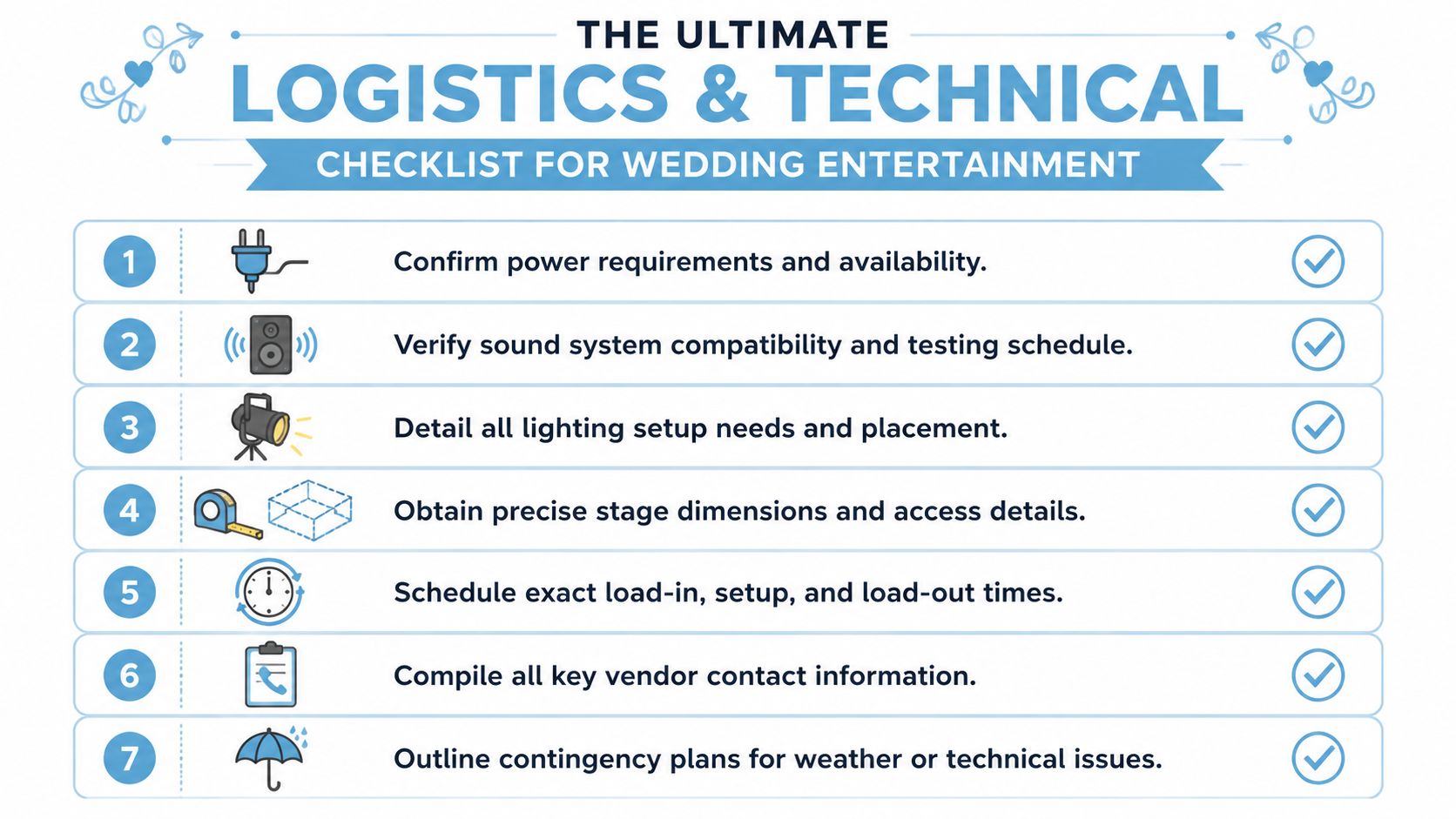
The Ultimate Logistics and Technical Checklist
At this stage, wedding entertainment hire either runs smoothly or starts unravelling. Couples rarely lose money because the entertainment concept was poor. They lose money because nobody pinned down the operational details early enough.
According to Hire Space's guide to measuring event impact, up to 30% of hire issues stem from venue mismatch. The same source gives a practical example: a motion simulator requires a dedicated 32A power supply and a 5m x 5m footprint. That's exactly why interactive entertainment needs a different planning standard from a singer or a straightforward DJ booking.

Start with the room on paper
Before you confirm any supplier, get a proper floorplan. Not a rough verbal description from the venue team. An actual plan with dimensions, door widths, ceiling constraints and access routes.
If you're combining entertainment types, map each one separately and together. A band area might fit on its own. A simulator might fit on its own. That doesn't mean both fit once you add guest circulation space, bar queues, catering routes and sightlines.
For outdoor or mixed-format weddings, a secondary activity such as mini golf hire for weddings can work very well, but only if it sits where guests will naturally pass it and where the ground, shelter and access are already considered.
The checklist that avoids expensive mistakes
Use this before you sign anything.
- Power capacity: Confirm exactly what each supplier needs. Don't ask “do you need power?” Ask how many supplies, what rating, where they need to be, and whether they need dedicated circuits.
- Footprint and clearance: Identify the actual operating footprint, not just the machine or booth size. Include queue space, operator space, safe access and guest viewing room.
- Load-in route: Check vehicle access, nearest unloading point, lift size, stairs, corridors and whether setup crosses guest areas.
- Setup and breakdown window: Confirm when the room becomes available and whether other suppliers are installing at the same time.
- Sound management: Ask where speakers point, whether the venue has sound limiters, and what happens if multiple entertainment pieces operate in adjacent spaces.
- Lighting conditions: Some experiences need low light, some need visibility, some compete badly with uplighting or moving heads.
- Weather plan: Any outdoor entertainment needs a wet-weather decision before the wedding day, not during it.
Blending music with interactive entertainment
The logistics become more demanding when you layer entertainment instead of choosing one format.
A simple example: a live band plus a racing simulator. On paper it sounds easy. In reality you need separate sound planning, clear zoning, power coordination, setup sequencing and an agreement on when each feature is live. If both are competing for attention at the same time, one of them loses.
That's why timing matters as much as selection. Interactive attractions often work best when guests are circulating. Bands and DJs work best when the room is ready to focus. Don't force every element to perform at once.
If an attraction needs explaining, queueing, or operator supervision, give it a dedicated slot where guests have the time and headspace to use it.
The questions to send your venue
Send these as a single email and ask for written replies.
- What power supplies are available in the reception room and outdoors?
- Are there any sound limiters or volume restrictions?
- What are the exact access times for supplier load-in and load-out?
- Are there stairs, narrow doors, lifts or surface restrictions?
- Can equipment remain in place between setup and use?
- What areas are off limits for cabling or guest queueing?
- Who signs off risk assessments and technical riders?
A timeline that works in real venues
Build your schedule backwards from guest arrival, not forwards from supplier convenience.
That means:
- room clear time,
- supplier access time,
- installation time,
- testing time,
- standby buffer,
- guest open time.
If your wedding includes more than one entertainment format, someone must own the master timeline. Without that, suppliers optimise for themselves and not for the day.
How to Vet Suppliers and Decipher Contracts
Price matters. Professionalism matters more.
A polished Instagram feed doesn't tell you whether a supplier turns up documented, insured, tested and ready to work within a live venue environment. That gap gets bigger when the entertainment is interactive, because guest participation changes the risk profile.
According to Encore Musicians' guidance on hiring wedding bands, event hosts are ultimately responsible for guest safety. For interactive entertainment like simulators or games, it's important to verify that the supplier holds adequate insurance, such as £10 million in public liability coverage.

The questions worth asking before you book
Don't ask only for availability and price. Ask questions that tell you how the supplier operates.
- What insurance do you hold? Ask for the certificate, not a verbal confirmation.
- Do you provide a risk assessment? Interactive suppliers should be ready for this.
- Is your equipment PAT tested where relevant? Venues often ask for this.
- Who staffs the attraction or performance on the day? Don't assume equipment arrives with operators.
- What are your exact setup requirements? This should match the venue reality, not a generic promise.
- What happens if the named performer or operator is ill? You need a backup plan in writing.
- Have you worked in similar venues before? Experience with event delivery matters more than a long list of social posts.
Why interactive entertainment needs stricter vetting
A DJ usually brings lower operational complexity than a guest-participation attraction. Once guests are climbing in, putting on headsets, competing, or using physical equipment, there are more moving parts. You need to know who supervises it, how queues are managed, what the exclusion rules are if needed, and what the venue expects in advance.
That doesn't make interactive entertainment risky by default. It means you can't vet it casually.
A good supplier answers compliance questions quickly and clearly. A weak supplier treats them like an inconvenience.
Contract clauses couples skip too often
Read the contract for operational detail, not just the payment amount.
Look for these points:
- Cancellation terms: What happens if you cancel, postpone, or the venue changes?
- Payment schedule: Check deposit timing, balance due date and whether late changes trigger extra charges.
- Delivery scope: What exactly is included? Setup, staffing, consumables, overtime, breakdown?
- Technical rider: Is there a separate document that forms part of the agreement?
- Substitution clause: If the named act can't attend, what replacement standard applies?
- Force majeure wording: Know how the agreement handles events outside anyone's control.
- Damage and responsibility: If the venue causes access delays or denies setup, who bears the cost?
Red flags that should slow you down
Sometimes the issue isn't one bad clause. It's a pattern.
Watch for:
- vague answers on insurance,
- no written technical requirements,
- resistance to sharing documentation,
- a contract that says very little about what's being delivered,
- promises that depend on the venue “sorting it on the day”.
If you're hiring multiple suppliers, compare contracts side by side. You'll quickly see who runs a proper operation and who relies on goodwill and improvisation.
One practical standard
For any interactive element, insist on documentation before final payment is due. That usually includes insurance proof and any venue-required compliance paperwork. If a supplier can't provide that in good time, the wedding day is the wrong place to discover it.
Simplify Delivery with a Turnkey Entertainment Partner
Once you've priced the options, mapped the room, and reviewed contracts, the obvious issue appears. The hard part of wedding entertainment hire often isn't choosing the entertainment. It's coordinating everything around it.
That's why some couples use a turnkey entertainment partner instead of managing several moving parts themselves. One provider can handle multiple attractions, technical planning, logistics, installation, staffing and compliance under one delivery plan. That reduces the chance of crossed wires between separate suppliers, especially when the wedding includes interactive features alongside more traditional formats.
One example is PSW Events, which supplies interactive entertainment for weddings and other events, including simulators, games and managed onsite delivery, with planning, logistics, installation and £10 million products, employee and public liability insurance as part of its operating model. For couples building a wedding that goes beyond a DJ-only setup, that sort of structure can be easier to manage than booking several unrelated vendors and trying to make them work together on the day.
The main advantage is simple. One point of contact. One joined-up logistics plan. Fewer assumptions.
That doesn't mean every wedding needs a single-provider solution. A smaller wedding with one musician and one DJ may be fine with direct bookings. But once you're mixing entertainment formats, the admin load rises quickly. At that point, efficient delivery isn't a luxury. It's what keeps the wedding feeling effortless for guests and stress-controlled for you.
Wedding entertainment hire works best when you treat it as part guest experience, part event operations. Choose the vibe first. Budget for the actual cost. Pressure-test the logistics. Vet suppliers properly. If your plans include modern interactive entertainment, be stricter, not looser. That's how you get a wedding people remember for the fun, not the avoidable problems.