
You’re probably staring at the same event brief most planners get. The stand needs more footfall. Sales wants qualified conversations, not just badge scans. Brand wants something memorable. The venue wants every risk document signed off before build-up. Finance wants to know whether a f1 racing simulator is a smart activation or just an expensive crowd magnet.
That tension is exactly why this category gets misjudged.
Most coverage of simulators focuses on motorsport tech, realism, or what F1 teams use behind closed doors. That’s interesting, but it doesn’t help much when you’re booking a corporate exhibition stand, a client hospitality event, a dealer conference, or a product launch. In live events, the key questions are simpler and tougher. Will it stop people? Will they stay? Can your team turn gameplay into conversations, data capture, and follow-up? Can it pass venue scrutiny without last-minute panic?
A simulator only works when it’s treated as an event system, not a toy. Rig choice, staffing, queue design, branding, lead capture, power, access, risk assessments, and insurance all affect the outcome. Get those right and the simulator becomes the focal point of the space. Get them wrong and even a visually impressive setup can underperform.
Why an F1 Racing Simulator Is Your Ultimate Engagement Tool
A weak exhibition stand is easy to spot. People glance, slow slightly, then keep walking. Your team stands ready, but nobody wants to be the first to start a conversation.
An f1 racing simulator changes that behaviour because it gives people a reason to stop without being sold to in the first few seconds. Noise, movement, competitive tension, and a visible challenge draw attention in a way banners and looping videos rarely do. The activation feels active, not passive.
It creates a crowd with a purpose
Crowds only help if they turn into interactions. A simulator does that well because spectators naturally become participants. Someone watches a lap, comments on a spin, challenges a colleague, then joins the queue. That progression matters. It lowers the barrier to entry.
At trade shows and conferences, that social pull is often what opens the door for the sales team. Staff don’t need a cold opener. They can talk about lap times, the leaderboard, or the prize mechanic, then move naturally into a business conversation.
UK planners also need stronger experience design across the full event, not just one attraction. If you’re mapping the wider attendee journey, these strategies to improve guest satisfaction are a useful reminder that the best activations succeed because the whole guest flow feels considered.
It gives your stand a clear role
A lot of activations fail because they don’t know what they are. They try to be branding, hospitality, lead gen, and entertainment all at once.
A simulator works best when it becomes the centrepiece with a defined job:
- Footfall driver for a busy exhibition aisle
- Conversation starter for a B2B stand
- VIP experience at a hospitality event
- Competition format for internal engagement
- Branded moment for social content and recall
That’s why it sits so naturally inside experiential marketing. It turns brand exposure into participation, and participation into memory.
A static display asks for attention. A simulator earns it.
It changes the energy of the event
The strongest activations don’t just fill space. They change the temperature of the room.
When guests can hear the engine note, watch lap times update, and see someone commit too much speed into a corner, the environment becomes animated. That energy spills outward. Nearby attendees look over. Existing guests stay longer. Staff have something to host around.
That’s the practical reason planners keep returning to this format. It’s fun, yes. But more importantly, it gives the event momentum.
Choosing the Right F1 Simulator Rig for Your Event
The phrase “f1 racing simulator” covers several very different products. That’s where many bookings go off course. A rig that works brilliantly for a hospitality suite can be the wrong choice for a lead capture stand. A setup that looks stunning in a render can create bottlenecks in a real aisle.
Start with the event objective, then choose the hardware.
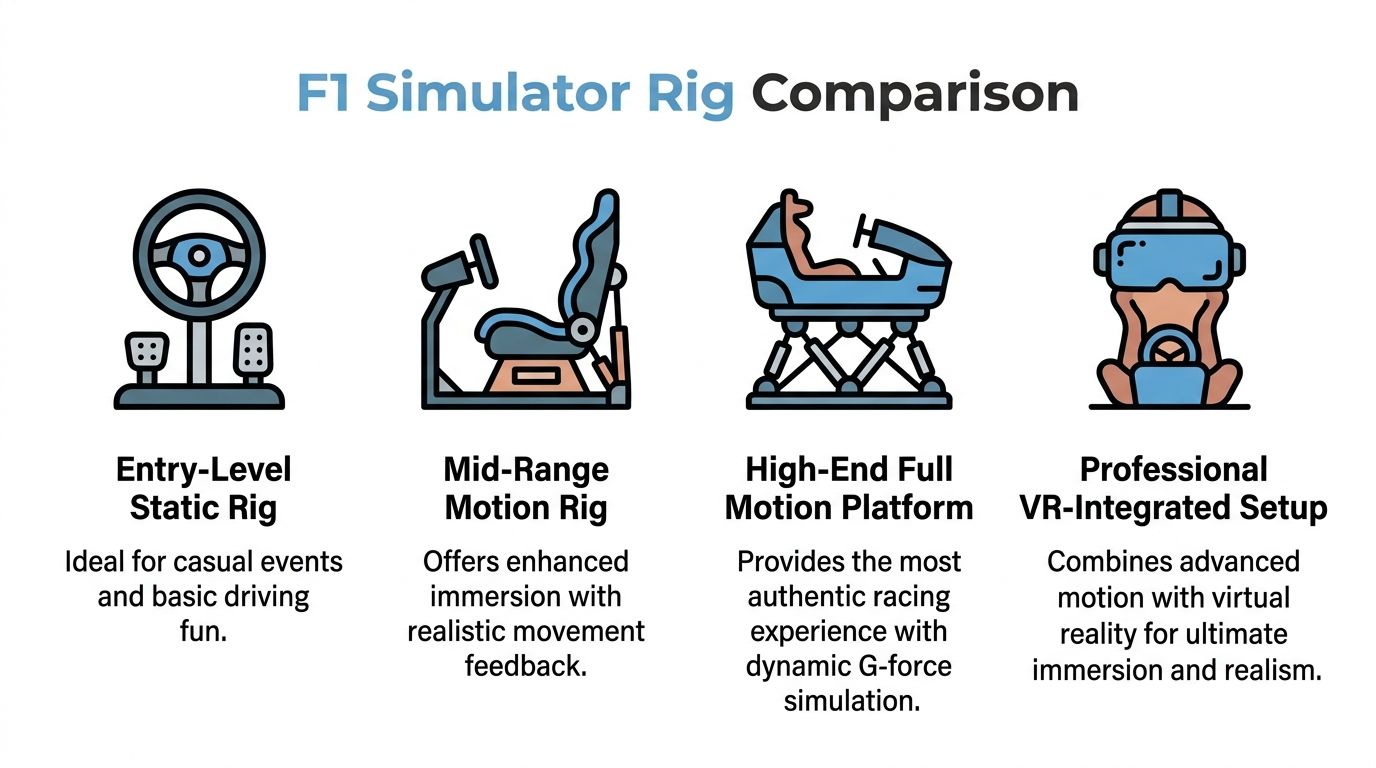
Four common rig types
Some planners ask for “the most realistic one” too early. Realism matters, but throughput, footprint, accessibility, and brand theatre often matter more.
Here’s the practical difference between the main hire categories.
| F1 Simulator Rig Comparison for Event Planners | |||
|---|---|---|---|
| Rig Type | Key Feature | Footprint | Best For |
| Entry-level static rig | Fixed seat with wheel, pedals, and screen setup | Compact | High-throughput stands, casual play, staff fun days |
| Mid-range motion rig | Controlled movement adds physical feedback | Moderate | Conferences, branded competitions, hospitality lounges |
| High-end full motion platform | Strong immersion with dynamic movement and spectacle | Larger | Premium activations, VIP events, hero installations |
| Professional VR-integrated setup | Headset-led immersion with strong novelty value | Varies, but needs managed operating space | Innovation-led launches, smaller audience sessions, curated experiences |
Static rigs suit busy stands
A static rig is often underestimated. It doesn’t move, but that’s part of the advantage.
It’s quicker to cycle players through, easier to place on a tighter stand, and simpler for first-time users. For exhibitions where queue length must be controlled and staff need a steady flow of prospects, static can outperform more complex formats.
Use static rigs when:
- You need throughput: More participants can complete a short session without long reset times.
- Space is tight: Compact stands can still host a strong attraction.
- Your audience is broad: New users and less confident guests find the setup approachable.
- You’re building around lead capture: Faster turns support registration and qualification.
A good example is a shell scheme stand where every square metre matters. In that environment, a smaller rig with bold branding, a visible screen, and a clean leaderboard can do more commercial work than a larger motion platform squeezed into the same footprint.
Motion rigs add theatre
Mid-range motion rigs are often the sweet spot for corporate events. They deliver enough physical feedback to feel special, but they’re still manageable in terms of setup, staffing, and queue control.
Guests notice the movement immediately. Spectators also see it from across the hall, which helps pull people in. For hospitality and brand activations, that visible movement adds polish.
This type of setup fits when:
- The experience needs more theatre than a static pod.
- The audience has time to engage, not just pass by.
- You want a stronger “premium” feel without going fully cinematic.
- The venue and schedule can support a more involved install.
Full motion is a statement piece
High-end full motion platforms are for events where the simulator is one of the main reasons people attend, not just one feature among many.
These rigs create a much bigger impression. They also demand more from the event plan. Access, ceiling clearance, operating perimeter, staffing, and guest briefings all become more important. If your priority is pure spectacle, they’re compelling. If your priority is moving a large number of people through quickly, they can slow you down.
Practical rule: Don’t hire a full-motion rig just because it looks impressive in a brochure. Hire it when the event format gives guests enough time to appreciate it.
Full-size show car style setups win visually
There’s another category worth separating from technical rig type. Some event briefs need an unmistakable F1 silhouette. In those cases, a simulator integrated into a full-size show car or a more visually dominant cockpit can be the right answer.
That choice is less about lap realism and more about presence. It photographs well, anchors branding, and gives sponsors more visible surface area. It’s especially effective for entrance features, gala events, launch reveals, and fan-zone style experiences.
The trade-off is footprint. These setups ask more from the floorplan and usually need careful traffic planning around them.
VR works when the audience is curated
VR can be brilliant. It can also be a queue killer.
When the guest list is curated, the session length is controlled, and staff can guide each participant properly, VR feels distinctive. For open-access public traffic, it can become slower to operate. Headset fitting, hygiene handling, and user confidence all affect pace.
VR is usually strongest in:
- Private demos
- Innovation showcases
- Smaller executive groups
- Invite-only activations
It’s less useful when your success metric depends on processing a long line quickly.
Match the rig to the objective
The easiest way to choose well is to decide what must happen on the day.
If your priority is lead capture, a simpler setup often wins. If your priority is visual impact, scale and branding become more important. If your priority is entertaining senior guests, comfort and staff guidance matter more than volume.
When planners want a clearer picture of available formats, suppliers with event-focused inventory pages, such as racing seat simulator hire, can help narrow the brief before the technical discussion gets too deep.
Use this decision lens before booking:
- Throughput first: Choose static or lighter-motion rigs.
- Brand theatre first: Choose motion or show-car style presentation.
- VIP quality first: Choose a premium cockpit and dedicated staffing.
- Innovation first: Consider VR, but only with controlled user flow.
- Mixed audience first: Keep controls intuitive and onboarding simple.
The best rig isn’t the most advanced one. It’s the one that fits the event mechanics.
Mastering Venue Logistics and Safety Requirements
Most simulator problems don’t happen during the race. They happen in the loading bay, during the venue sign-off, or in the email chain three days before build.
That’s why logistics and safety need to be handled early. A well-run simulator activation feels effortless to guests because the difficult work was done before doors open.
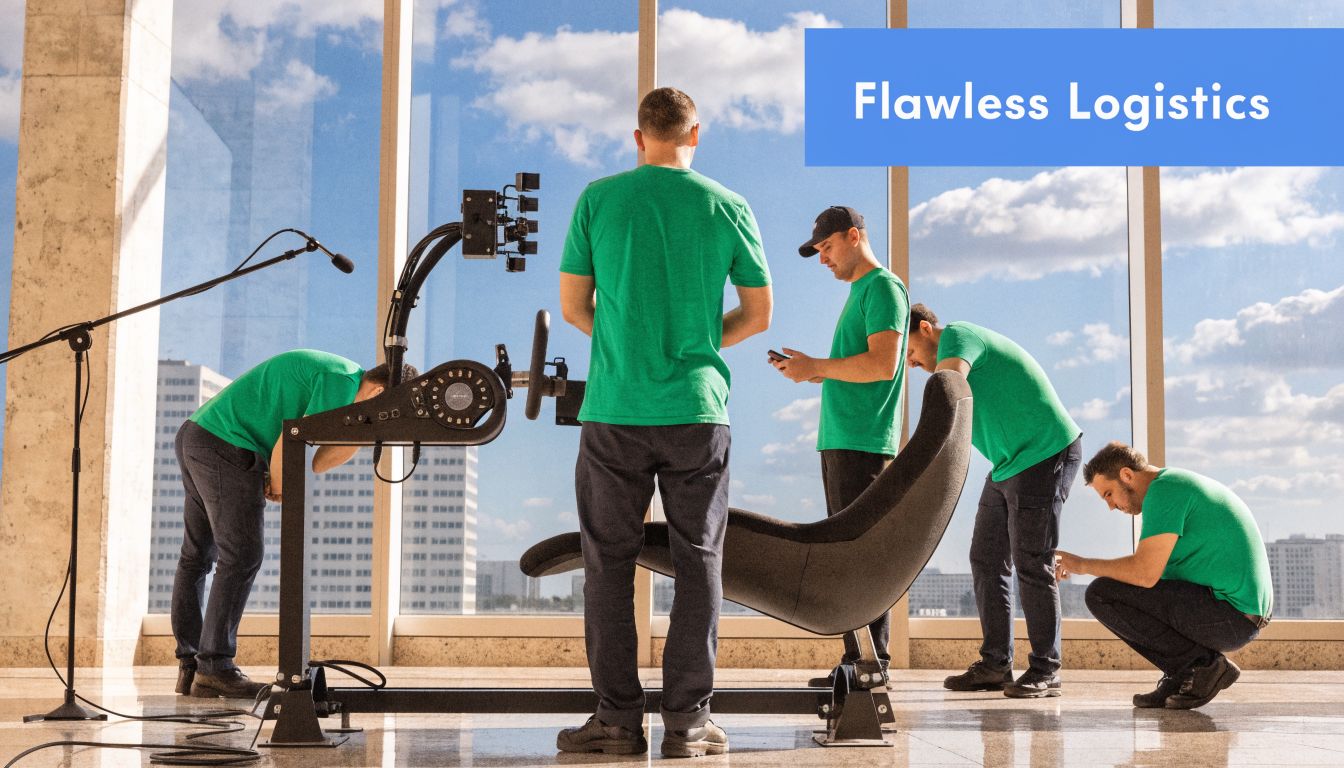
Start with venue reality, not floorplan theory
A CAD drawing can say a simulator fits. The venue may still tell a different story.
Check the full access route, not just the final event space. That means loading dock times, lift dimensions, ramp gradients, double-door clearance, corridor turns, carpet protection rules, and build windows. A rig that fits the stand can still fail at the goods lift.
Ask these questions early:
- Access route: Can the rig travel from unload point to stand without dismantling beyond the agreed plan?
- Ceiling and overheads: Is there enough height for screens, lighting, or motion travel?
- Operating perimeter: How much buffer space is needed around players, staff, and queue lines?
- Build schedule: Do you have enough time for delivery, setup, testing, and sign-off before the event opens?
- Noise policy: Will the venue want volume managed during conference sessions nearby?
Space planning should also account for spectators. The crowd around the simulator is part of the activation. If you only size the footprint for the hardware, you’ll create congestion.
Power and connectivity shape reliability
A simulator can look self-contained, but the live event version usually depends on several linked components. Screen systems, audio, timing displays, branded overlays, registration devices, and leaderboard screens all need planning.
Don’t leave these to assumption.
Confirm:
- Power source location: Is it close enough, or will cable runs need matting and approval?
- Socket availability: Standard supply may be fine for some rigs, but always confirm exact event requirements with the supplier.
- Dedicated circuits: Premium setups may need cleaner power planning to avoid nuisance issues.
- Connectivity needs: If you want cloud-based registrations or live updates, venue internet policy matters.
- Fallback mode: Ask whether the simulator can still operate locally if connectivity drops.
A reliable activation usually has a simple rule. If a feature depends on the venue network, there should be a backup process.
Safety paperwork is part of the product
For UK events, the supplier shouldn’t just deliver the rig. They should deliver the documentation that allows the venue and organiser to approve it confidently.
That usually means RAMS, equipment details, insurance confirmation, operating procedures, and a clear statement on who supervises the activity. For motion-based systems, public operation adds another layer of scrutiny.
The current UK picture matters here. Event-specific Health & Safety is critical. Post-Brexit, UKCA marking is required for new simulator imports, and amendments to PUWER 1998 effective in 2026 mandate specific risk assessments for dynamic motion platforms in public use. With the UK HSE reporting a 22% rise in amusement device incidents in 2025, hiring a supplier with full £10 million public liability insurance is essential to meet venue standards and ensure guest safety (UK safety and simulator compliance context).
That’s not a box-ticking issue. It affects whether the venue signs off the installation at all.
Ask for the paperwork before you pay the balance, not the night before build.
What good onsite operation looks like
The supplier team should know who owns each safety responsibility on the day. That includes setup, testing, player briefing, queue control, and shutdown procedure.
A practical onsite checklist looks like this:
- Pre-opening inspection: The team tests controls, screens, seating, branding, and barriers before guests arrive.
- Clear participation rules: Operators explain who can ride, how to enter and exit, and what to do if a guest feels uncomfortable.
- Managed queue lines: Spectators shouldn’t crowd moving parts or block adjacent stands.
- Continuous supervision: A staffed simulator is safer and runs better than an unattended one.
- End-of-day reset: Equipment is checked again before close or overnight shutdown.
If you need a reference point for the kind of event equipment category this sits within, pages covering car simulator hire in the UK are useful because they reflect the practical reality of public-facing operation rather than pure enthusiast use.
Common mistakes planners can avoid
Some issues repeat across events.
The most common ones are:
- Underestimating queue space: The line spills into the aisle and annoys neighbours.
- Treating safety docs as admin only: Venue approval gets delayed because technical details arrive too late.
- Forgetting staff welfare: Operators need breaks, water access, and a clear handover plan.
- Overcomplicating gameplay: Too many options slow briefing and reduce participation.
- Ignoring spectator sightlines: If nobody can see the action, the attraction loses pull.
Good logistics don’t make the activation more glamorous. They make it viable. For planners, that’s often the difference between a simulator that feels polished and one that feels risky.
Maximising Brand Impact with Customisation
A simulator becomes far more valuable when it stops looking like hired equipment and starts looking like your campaign.
That shift doesn’t require gimmicks. It requires consistent branding across the physical setup, the screen experience, the staff interaction, and the competition mechanic. When those layers line up, guests remember the brand attached to the moment, not just the driving.
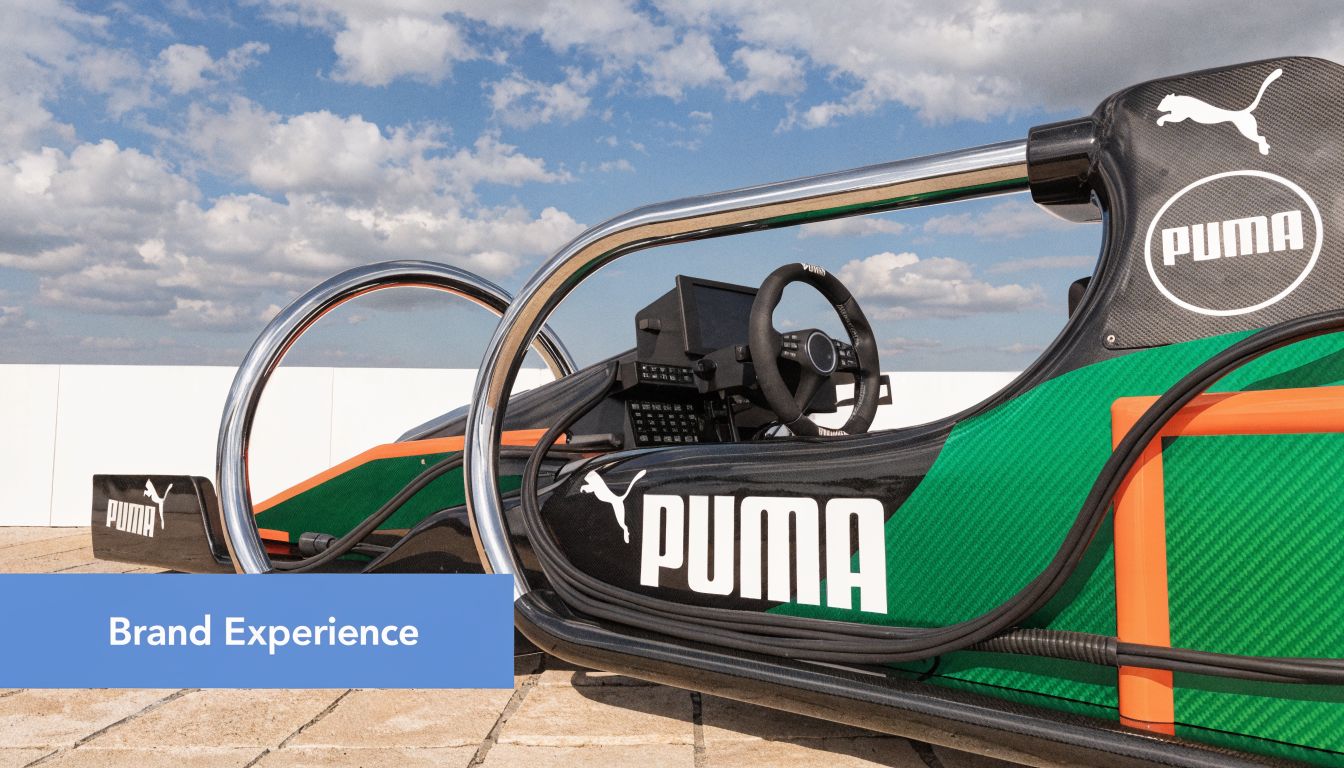
Start with the surfaces guests will actually notice
The first branding decision is physical. Where will guests look before they drive, while they drive, and after they finish?
Usually that means the simulator bodywork, side panels, barriers, leaderboard area, screen surrounds, and any backdrop or gantry. If the event includes photography or social capture, those visible surfaces matter more than subtle touches hidden near the pedals.
The strongest customisation is usually simple:
- Single campaign message: One clean idea beats five competing slogans.
- Recognisable brand colours: Guests should identify the brand from a distance.
- Readable logos: If a logo only works up close, it won’t work in a live event hall.
- Consistent event dressing: The simulator shouldn’t clash with the rest of the stand.
Bring the branding into the experience itself
External branding gets attention. In-game branding and on-screen overlays make the experience feel owned.
This can include custom start screens, branded lap-time graphics, digital banners, podium-style results screens, or a registration interface carrying the campaign identity. If the guest sees your brand only before they sit down, the simulator can still feel generic. If they see it during the race and in the results moment, the activation feels designed around you.
That’s especially useful when multiple sponsors, product lines, or sales messages need structure. One message can appear in the visual environment. Another can appear in the leaderboard or prize mechanic. A third can be reinforced by the host during the queue and debrief.
Branded environments work best when the guest can describe the experience in one sentence afterwards.
Use competition to reinforce recall
A leaderboard isn’t just a score display. It’s a participation engine.
When guests can instantly see where they rank, they stay nearby longer, challenge colleagues, and return later to improve their time. That repeat interaction creates more opportunities for brand exposure and conversation. It also gives your team a natural reason to collect details, announce winners, and keep momentum high through the day.
A few ways to use it well:
- Time-window competitions: Morning and afternoon rounds keep the board fresh.
- Segmented prizes: Separate categories for clients, staff, or VIP guests make the format feel inclusive.
- Hosted callouts: A staff member who announces notable lap times keeps energy up.
- End-of-event reveal: Useful for hospitality and gala formats where winners are announced on stage.
Brief staff on the brand, not just the controls
In many branded activations, value is lost. The simulator looks right, but the host language sounds generic.
If staff can explain the campaign message, the product link, and the reason the simulator is part of the event, the experience feels coherent. If they only say “next driver please”, the branding becomes decorative.
Give the onsite team a short verbal framework:
- what the brand wants guests to remember
- what question to ask while guests wait
- what detail to capture after the race
- what next step to offer
That’s how a simulator becomes part of the marketing strategy rather than a detached entertainment item.
Keep the branding practical
Not every custom idea improves the event.
Overbranding can clutter the visual field, confuse the guest journey, and slow setup. The right standard is simple. If a custom element helps guests recognise, understand, or share the activation, keep it. If it only looks good in a mock-up, question it.
The best branded simulator setups usually have three qualities. They’re visible from a distance, clear at the point of play, and easy to photograph.
The Booking Process and Onsite Operation Tips
The smoothest simulator jobs usually start with a short, honest brief.
A planner sends the event date, venue, access notes, audience type, and what success looks like. From there, the conversation gets practical quickly. Not “what’s your cheapest option?” but “what rig suits this environment, and what will it take to run it properly?”
What a good enquiry looks like
The supplier doesn’t need every detail on day one. They do need enough to stop guessing.
The useful information is usually:
- event date and venue
- indoor or outdoor environment
- audience type and likely volume
- stand size or available floor space
- access restrictions
- preferred branding level
- whether lead capture is required
- whether the simulator is for open play, hospitality, or competition
That last point matters more than people think. Open-play public traffic needs a different operating model from a hosted VIP evening.
From quote to confirmed booking
Once the brief is clear, a good quote should reflect the full scope of the job. That means not just the rig, but delivery, setup, derig, staff, branding, and any event-specific requirements.
If the quote looks light, ask what isn’t included. The hidden gaps are usually where event-day friction appears.
A sensible booking sequence tends to follow this pattern:
- Initial brief and suitability check
- Provisional rig recommendation
- Quote with scope details
- Venue and access review
- Branding sign-off
- RAMS and insurance paperwork
- Final schedule and onsite contacts
This stage is where expectations should be set around player session length, queue handling, and what staff will do onsite.
If a supplier can’t explain how the queue will be managed, they’re still thinking like a rental company, not an event partner.
What happens on the day
A reliable setup day is calm because the team already knows the venue conditions, unloading route, branding plan, and opening deadline.
The install normally starts with unloading, positioning, build, cable management, system checks, and a short operational test. If there’s a leaderboard or registration layer, that should be tested with the same care as the rig itself. Too many activations focus on the driving and forget the data flow.
Once guests arrive, the onsite team has three jobs at once. Keep the simulator running smoothly. Make participation easy. Protect the atmosphere around the stand.
That’s why staffing matters. A good operator doesn’t just reset the game. They welcome people in, explain the format quickly, keep the line moving, and maintain the energy around the competition.
Small operational choices that improve results
The details that work in practice are usually simple.
- Short session format: A concise race window keeps momentum up and prevents queues from stalling.
- Visible rules: Guests join faster when they understand the challenge immediately.
- One clear call to action: Register, race, rank, then speak to the team.
- Hosted transitions: Moving a guest from the simulator to a sales conversation should feel natural.
- Protected peak times: If key clients are expected, reserve moments for them instead of leaving everything to open queue flow.
One useful narrative example is a conference evening where the simulator runs in casual mode during drinks, then shifts to timed competition after dinner. Same equipment, different operating rhythm. The first phase breaks the ice. The second phase creates a focal point.
What to check before sign-off
Before the event opens, the organiser should be able to answer yes to these questions:
- Does the simulator look branded and event-ready?
- Has the team tested controls and displays?
- Does everyone know who manages the queue?
- Is guest registration working as planned?
- Is there a process for pausing operation if needed?
After that, the event should feel simple from the guest side. They step up, race, compare times, talk, and move to the next interaction. If the operational complexity is visible, too much of it is still sitting on the surface.
Measuring Your Event's Success and Calculating ROI
If you can’t measure the result, the simulator stays in the “great atmosphere” category. That’s rarely enough for marketing teams now.
The good news is that an f1 racing simulator is easier to measure than many other live activations because guest participation is structured. People queue, register, play, score, react, and often stay to watch others. That creates several useful points where you can track value.
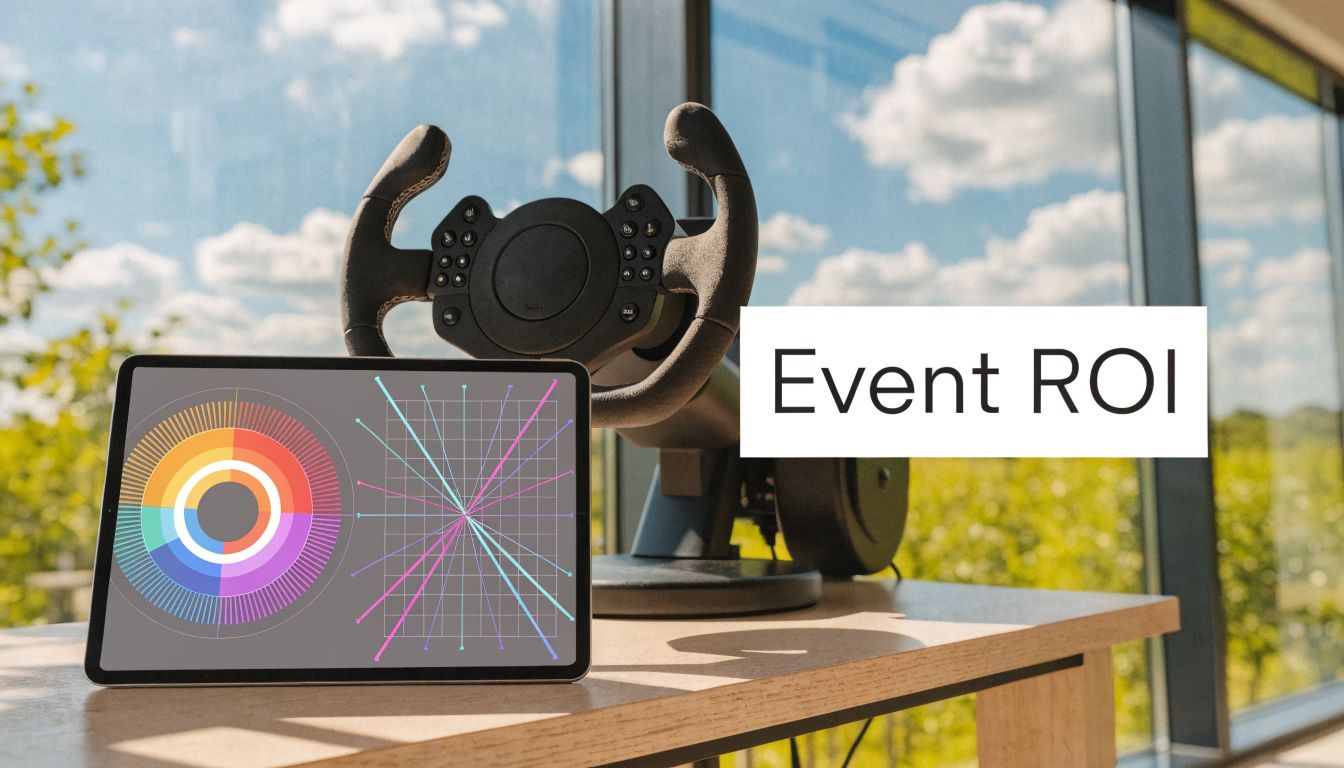
Start with the KPIs that match the event objective
Not every event needs the same dashboard.
A trade show stand may care most about lead capture and cost per lead. A client hospitality event may care more about time spent, repeat participation, and how many key guests engaged. A staff event may focus on participation and sentiment rather than pipeline.
The cleanest KPI set usually includes:
- Footfall attracted to the stand
- Number of participants
- Queue-to-play conversion
- Average dwell time around the activation
- Leads captured
- Qualified conversations generated
- Cost per lead or cost per engagement
The point is to decide these before the event starts. If you wait until breakdown, you’ll have anecdotes instead of evidence.
Use the registration moment properly
Lead capture should feel like part of the experience, not an interruption bolted onto it.
That can mean a pre-race form, badge scan, hosted check-in, or post-race results capture. The right method depends on your audience. At a B2B exhibition, a fast registration step before the race usually works well because guests expect to exchange details. At a hospitality event, a hosted post-race capture may feel smoother.
What matters is clean execution:
- Ask only for information your team will use.
- Make the consent language clear.
- Keep the process short enough that it doesn’t damage queue flow.
- Link the captured data to the result if competition is part of the hook.
- Give sales staff a visible signal when a high-value guest has completed a session.
The benchmark problem is real
Many planners know simulators attract attention, but they struggle to justify them in commercial terms. That’s why event-specific benchmark data matters.
UK exhibition industry reports show interactive simulators can boost attendee dwell time by over 40% and lead capture by 25%. A 2025 survey found 68% of event planners sought racing simulators for footfall but lacked performance benchmarks. Data from activations at venues like ExCeL London suggests a branded simulator can achieve a cost-per-lead of £15-£25, compared with £40+ for static displays (event performance benchmarks for racing simulators).
That gives planners a more credible basis for the business case. It also helps explain why a simulator should be judged against alternative stand tactics, not just against its hire cost in isolation.
A simulator earns its keep when you compare it to what the same floor space would have delivered otherwise.
Three practical event examples
The most useful way to calculate ROI is by event type, because the same simulator can perform differently depending on format.
Trade show stand
This is the clearest commercial case.
The stand uses a timed leaderboard competition. Guests register before driving. Staff speak to people while they wait and again when results appear. The organiser tracks total participants, total leads, and the proportion of those leads that match the target profile.
The post-event review asks:
- how many leads came through the simulator journey
- how many became qualified follow-up conversations
- what the effective cost per lead was
- whether dwell time created more meeting opportunities for the team
Product launch
The role changes here. The simulator supports a message rather than acting as the sole attraction.
Measurement focuses on participation, branded content capture, social sharing mechanics, and how many guests completed the full brand journey around the activation. The strongest result is often not raw lead volume, but message retention and experience recall among invited guests.
In this format, the simulator should tie directly to the product narrative. If that link is weak, the activation may still be enjoyable but commercially fuzzy.
Team-building day
Internal events need a different lens again.
The simulator can support competition, collaboration, and social energy between teams. Success is measured more through participation rates, repeat attempts, and how well the experience sustained engagement through the programme. The organiser may also track which format worked better: free play, head-to-head rounds, or hosted final.
This kind of event rarely needs a strict lead metric. It still benefits from clear reporting, especially if HR, leadership, or culture teams need evidence that the activity held attention and landed well.
A simple ROI framework planners can use
You don’t need a complex model to make the case.
Use four steps:
| ROI measurement step | What to record | Why it matters |
|---|---|---|
| Before the event | Objective, target audience, capture method | Prevents vague success criteria |
| During the event | Participants, leads, dwell behaviour, staff observations | Creates usable evidence |
| After the event | Qualified outcomes and follow-up actions | Connects activation to pipeline or event goals |
| Comparison stage | Compare against static alternatives or prior activations | Shows whether the simulator improved performance |
What doesn’t count as proof
Planners get told “everyone loved it” after almost every interactive event. That’s not enough.
Weak reporting usually sounds like this:
- the stand was busy
- people were taking photos
- the clients enjoyed it
- the atmosphere was good
Those observations are helpful, but they’re not decision-grade. The stronger version is: we captured leads through the simulator flow, we held attention longer, and we generated conversations at a lower acquisition cost than the static alternative.
That’s the standard stakeholders respond to.
The commercial case in plain terms
An f1 racing simulator isn’t automatically worth the spend. It becomes worth it when the event is designed to extract value from attention.
That means:
- the right rig for the brief
- a queue system that supports conversation
- a branded experience that feels intentional
- staff who can host, not just operate
- a lead capture method that doesn’t interrupt play
- reporting that compares the result to another option
When those pieces are in place, the simulator stops being a novelty line item and becomes a measurable event tool.
If you’re planning a corporate event, exhibition stand, or branded activation and need a simulator brief that covers rig choice, logistics, branding, and ROI from the start, build the event plan around the guest journey first. The hardware should support that plan, not try to rescue it.