
Let's be honest, an interactive football game is far more than just a bit of fun. It's a seriously effective way to create a magnetic hub of activity at any corporate event, brand activation, or exhibition stand. Tapping into the UK's massive passion for the beautiful game is a proven way to break the ice, get people talking, and stir up a competitive, social buzz that works wonders for your business goals.
Why an Interactive Football Game Is Your Event MVP
In the cut-throat world of events, creating genuinely memorable moments is everything. An interactive football game pulls this off by getting your audience off the sidelines and into the action. Instead of people passively wandering by, they're stepping up, having a go, and sharing a brilliant experience. That's where the magic happens, turning your stand from just another booth into a must-visit destination.
Picture a heaving exhibition hall at ExCeL London or Manchester Central. Attendees are bombarded with information. A football simulator cuts through all that noise. It's a powerful magnet, pulling in footfall with the simple promise of some friendly competition. It’s the perfect conversation starter, giving your sales team a relaxed, natural way to connect with potential clients.
Driving the Metrics That Matter
Forget seeing this as just an expense. A well-executed game is a smart investment that delivers measurable results. Here’s exactly how it impacts your bottom line:
- Boosts Dwell Time: When people are locked in, trying to beat the top score on a leaderboard, they stick around. Simple as that. This gives you way more time for those all-important conversations.
- Supercharges Lead Generation: The sign-up to play is the perfect, low-friction moment for data capture. Swapping an email address for a shot at glory is a natural way to build your sales pipeline without being pushy.
- Creates Social Media Buzz: The visual appeal of a football game is a gift for social media. Branded backdrops and live leaderboards are practically begging to be photographed and shared, pushing your brand's reach far beyond the four walls of the event hall.
The real power here is the emotional connection. You're not just another corporate stand; you're the host of a shared, fun memory. That makes your brand instantly more relatable and sticks in people's minds long after the event is over.
This isn't just a theory; it mirrors what we've seen in digital fan engagement for years. Just look at the huge weekly participation in the Premier League's own app games. That digital enthusiasm translates perfectly to live events. We've seen clients using football simulators at major venues like Silverstone and Manchester Central report massive jumps in both visitor dwell time and lead capture. It’s this proven track record that makes an interactive football game such a reliable winner for experiential marketing, turning a simple action into a shareable moment that gets people to your stand. You can dig deeper into how football data is used in marketing over at football-data.co.uk.
Choosing the Right Interactive Football Game for Your Venue
Picking the perfect interactive football game can feel like trying to sign a star player – there are tons of options, and the right choice depends entirely on your strategy. You have to match the game format to your event goals, the crowd you're expecting, and the physical space you're working with.
So, where do you start? The first question is always: what’s the main objective? Are you looking to create a massive buzz with some pure, unadulterated fun? Or is the real goal to capture high-quality leads for your sales team?
This decision tree gives you a quick way to see which path makes the most sense for your event, whether you’re chasing engagement or new business.
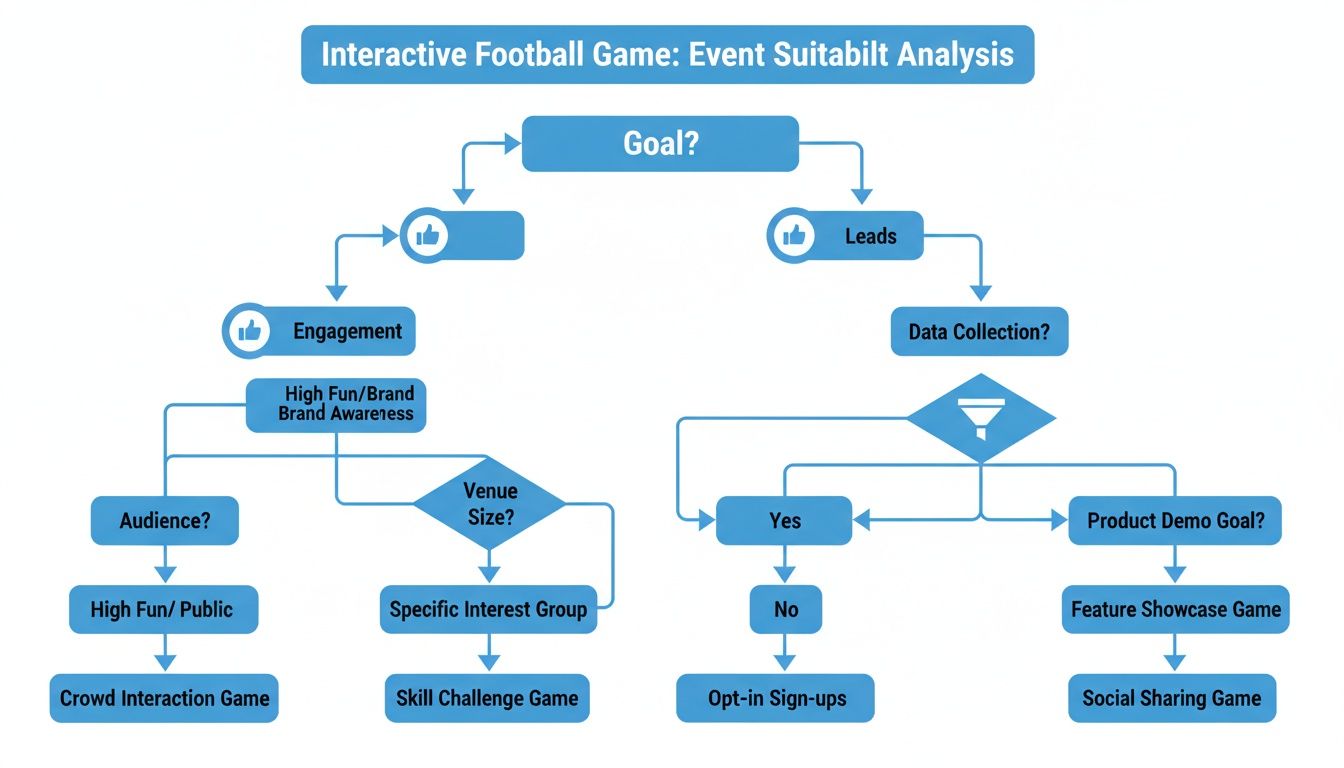
As you can see, both routes can lead to a win, but your primary goal will dictate the kind of game you choose and how you handle things like data capture.
Interactive Football Game Format Comparison
To help you decide, here’s a quick rundown of the most common formats, what they’re best for, and the space they’ll need.
| Game Format | Best For | Space Required (Approx.) | Key Feature |
|---|---|---|---|
| Full-Swing Simulators | In-depth brand experiences, competitions, VIP areas | 4m x 5m with good ceiling height | Realistic gameplay, detailed performance metrics (speed, accuracy) |
| Compact Penalty Shootouts | High footfall areas, quick-play engagement, trade shows | 3m x 4m | Fast throughput, simple and addictive, great for all skill levels |
| Immersive VR Football | Creating a unique 'wow' factor, tech-focused events | 3m x 3m (plus a safety buffer) | Fully immersive experience, transports players onto the pitch |
This table is just a starting point. The real magic happens when you align the format's strengths with your event's specific needs.
Matching the Game to Your Space and Audience
Once you've got your objective sorted, it’s time for a reality check on your venue. You don’t need a pitch the size of Wembley, but different games have different footprints.
Full-Swing Simulators: These are fantastic for an authentic football experience, often tracking everything from kick speed to shot accuracy. They need a bit more room, typically at least 4m x 5m with a high ceiling. This makes them a great fit for larger exhibition stands or dedicated fan zones where you want to make a big impact.
Compact Penalty Shootouts: Ideal for when you're tight on space. These games are all about that one thrilling moment of taking a shot. They're brilliant for high-traffic areas because the turnover is quick, letting more people have a go in less time.
Immersive VR Experiences: Want to literally put your guests on the pitch? VR is the way to go. The physical footprint might be smaller, but you absolutely have to factor in a safe perimeter around the player. They’ll be completely in the zone and totally unaware of their real-world surroundings.
There’s a huge variety of interactive football game platforms out there, and the key is finding that sweet spot between a spectacular attraction and something that’s actually practical for your event.
Recreating That Big Match Atmosphere
Football’s real power is in the shared experience, the roar of the crowd. A great interactive game taps into that energy. Think about it: the 1923 FA Cup Final famously squeezed over 126,000 fans into Wembley. Fast forward to the 2020 final – zero fans in the stadium, but over a million engaged online. This proves the power of interaction, whether physical or virtual.
We've seen it time and again in corporate settings. Simulators that recreate that big-match pressure cooker drive 25% higher engagement during team-building days. It’s about bottling that competitive spirit.
The best game isn't always the flashiest or most complicated one. It’s the one that fits your space, gets your specific audience buzzing, and nails the one thing you need it to do—whether that’s filling a database or just creating a brilliant memory.
By thinking through these factors, you’re not just hiring an activity; you’re making a strategic choice that can become the standout feature of your event. And if you’re looking for other ways to get guests involved, you might want to check out our wider range of party games for hire.
Handling the Logistics and Technical Setup
You've picked the perfect interactive football game. Great. Now the real work begins: getting it installed and running flawlessly on the day. This is where meticulous planning saves you from a world of last-minute stress. The difference between a smooth setup and a chaotic one often boils down to asking the right questions long before the event.
Don't just think about the footprint of the game itself. You have to consider the entire journey of the equipment, from the delivery lorry pulling up to its final spot on your stand. A quick check of the venue's access is an absolute must. Are there stairs? Narrow corridors? Any tight corners to navigate? You’ve got to be certain the simulator components can physically get to where they need to go.
Conducting a Virtual Site Visit
Imagine you're setting up at a huge conference centre like the SEC Glasgow. Before your supplier even thinks about loading the van, a detailed conversation about the venue is essential. Think of it as a virtual site visit; it's your chance to uncover any hidden obstacles and make sure everyone is on the same page for build day.
Here are the critical questions to run through with your supplier and your venue contact:
- Power Requirements: Does the game run off a standard 13-amp socket, or does it need something more heavy-duty, like a 16-amp or 32-amp supply? Getting this wrong can bring your setup to a screeching halt.
- Delivery and Access: What’s the best point of entry? Is there a designated loading bay? It’s vital to get the exact dimensions of all relevant doorways and service lifts to ensure the kit will actually fit through.
- Ceiling Height: Some games, especially the ones with overhead sensors for tracking ball flight, have strict minimum height requirements. You absolutely must confirm the ceiling height in the exact location you plan to set up.
- Internet Connectivity: If your game has a live digital leaderboard or any kind of social media integration, a solid internet connection is non-negotiable. Is there a hard-wired ethernet port nearby, or will you have to rely on the venue's Wi-Fi? Always have a backup plan.
Pro Tip: Always get a detailed floor plan from the venue and send it straight to your game supplier. Mark out your preferred location and a couple of backup options. This simple step lets their technical team spot potential issues with power or player flow before they even set foot on site.
By working through these logistical details, you’re not just hiring equipment; you're orchestrating a professional installation. This proactive approach ensures the technical setup is a non-issue, letting the main event run without a hitch.
A thorough plan is also a cornerstone of your event’s safety strategy. You can learn more about this by reading our in-depth guide to completing a risk assessment for football activities. Taking the time to prepare properly means that on the day, your focus can be entirely on your guests and event goals, confident that the tech is completely under control.
Making it Yours: Branding Your Football Game for Maximum Impact
An interactive football game shouldn't just be an off-the-shelf hire; it's a huge opportunity to tell your brand's story. Simply slapping a logo on the corner of the screen is a missed trick. The real goal is to weave your brand so deeply into the fabric of the experience that it feels completely natural and memorable for every player.
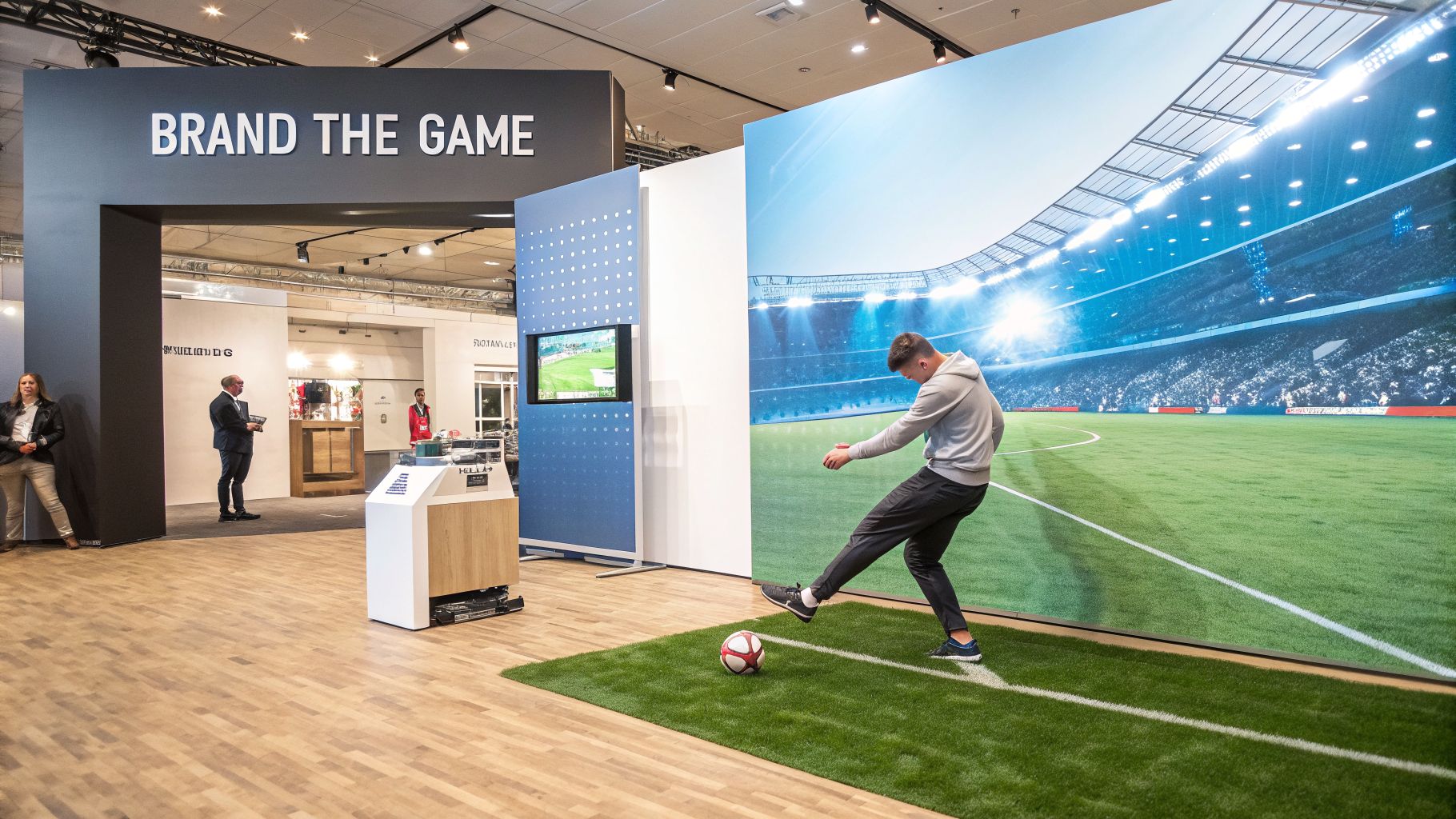
Think about every single visual element. Custom game backdrops can instantly transport players into a virtual stadium, all decked out in your corporate colours. The physical simulator or game structure itself can be wrapped in high-impact vinyl graphics, shouting your campaign message or event theme from across the exhibition hall.
Taking Customisation to the Next Level
Properly effective branding goes way beyond the physical setup and embeds itself right into the gameplay. This is where you can get really creative and directly tie the whole activity to your marketing goals.
- Bespoke In-Game Assets: Let’s say you’re launching a new trainer. Instead of a standard football, players could be 'kicking' virtual models of your new product towards the targets. It's a simple, playful way to create a direct link between your product and the fun of the game.
- Branded Leaderboards: Design an eye-catching leaderboard that shows more than just scores. It should feature your logo, event hashtag, and key messages, turning it into a natural focal point for photos and social media shares.
- Sponsorship Integration: The game is a prime asset to offer to event partners. You can sell branding space on the equipment or leaderboard, giving sponsors a tangible activation and helping to offset your own costs.
The best branding never feels like an advert. It feels like a core part of the experience. When a player is totally focused on beating the high score, your brand messaging just becomes part of the memory, forging a much deeper connection.
This approach taps into the kind of tribal passion you see in real football. We've seen event companies recreate the fierce rivalry of the historic Manchester Derby on simulators. With custom electronic leaderboards, corporate teams can go head-to-head, driving huge engagement and turning a simple game into a fully branded, competitive experience.
By properly thinking through these customisation options, you can elevate your event from a simple gathering to one of the most effective experiential marketing activations in your calendar. The result is a cohesive brand journey that sticks with your audience long after the final whistle.
Nailing the Event Day: Operations and Safety
You've spent weeks planning and customising your football game. Now for the most important part: making sure everything runs like clockwork on the day. This is where your focus should shift from the creative to the practical, and it's where professional on-site staffing is non-negotiable.
It can be tempting to think your own team can manage the game. But trust me, you'll want trained technicians handling this one. They're the secret to a completely stress-free activation.
A professional crew doesn't just show up and plug things in. They manage the entire setup, making sure every sensor is calibrated and the tech is running perfectly. Throughout the event, their job is to keep the energy high, engage with your guests, and encourage even the most hesitant attendees to have a go.
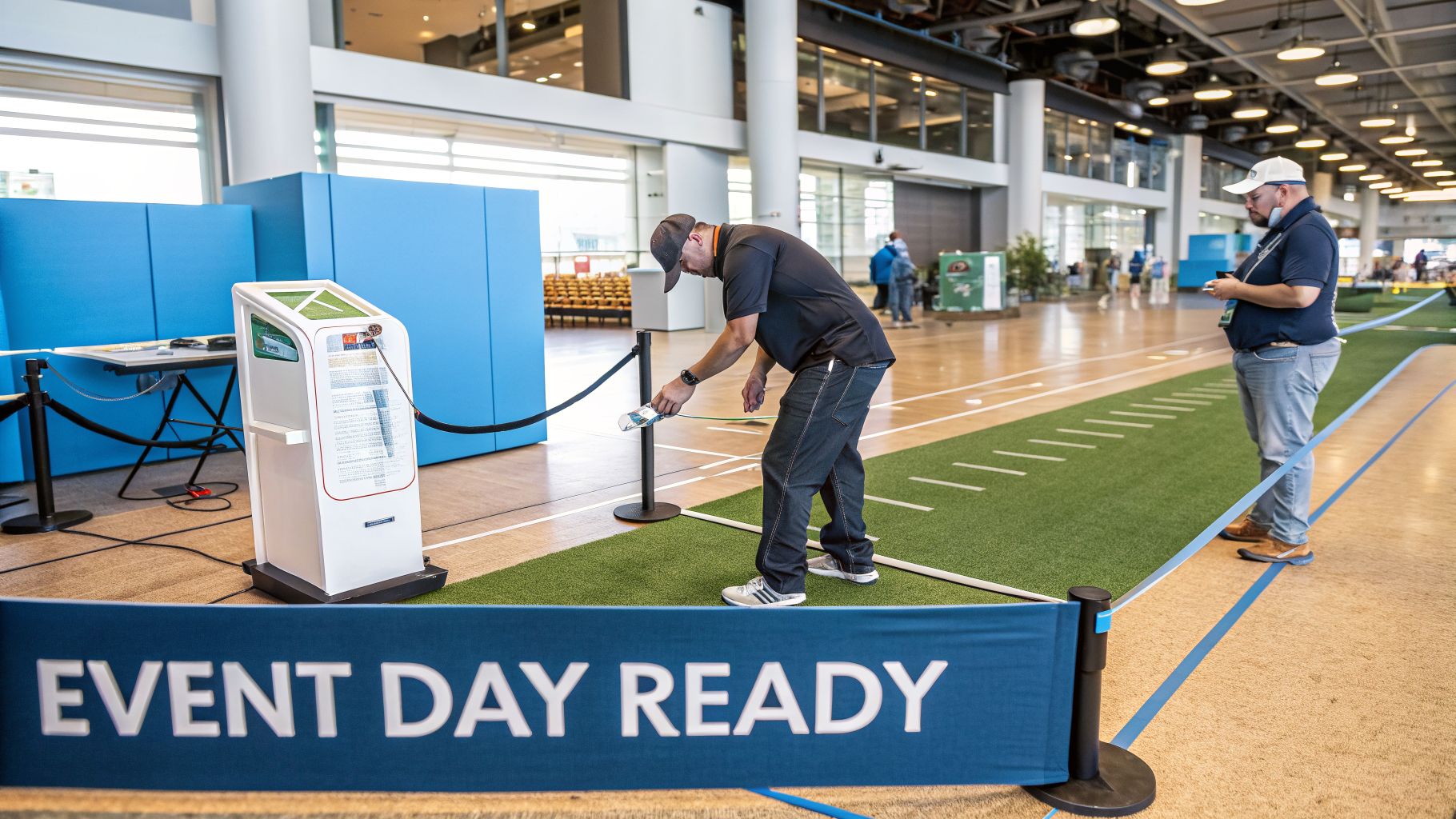
They're also experts at managing queues. In a busy exhibition hall, this is a make-or-break skill. By keeping the flow organised and the atmosphere buzzing, they make sure everyone who wants a turn gets one, without creating a frustrating bottleneck at your stand. This frees your sales and marketing team up to do what they're there for: talking to prospects and building relationships.
Putting Health and Safety First
Beyond the logistics, health and safety has to be your number one priority. Let's be clear: this is a physical activity, and you have a duty of care to everyone who steps up to play. When you work with a professional supplier, this is all baked into their process, but it’s crucial you know what to look for.
First up is creating a safe perimeter. This isn’t just about leaving a bit of empty space. It means having clear barriers or floor markings to keep spectators a safe distance from the kicking zone. This simple step prevents people from accidentally walking into the line of fire and gives the player plenty of room.
The flow of people needs to be managed just as carefully. A well-designed system will guide participants smoothly from the queue, to the game itself, and then away from the exit area. This avoids crowding and keeps a clear, safe path for everyone moving around your stand.
With a professional supplier, you get complete peace of mind. They’ll hand over all the necessary documentation, including risk assessments, method statements, and proof of their £10 million public liability insurance. This ensures you're fully compliant and protected.
Why a Turnkey Solution is Your Best Bet
Ultimately, what you're looking for is a turnkey solution. That's the real value of partnering with an experienced provider. They don't just supply the equipment; they bring the operational know-how and safety protocols that guarantee a flawless event.
Here's what that looks like in practice:
- Pre-event Coordination: They’ll work directly with you and the venue to iron out every logistical detail beforehand.
- On-site Management: The trained staff run the entire activation, from engaging guests to troubleshooting any minor hiccups.
- Safety Compliance: All equipment will be PAT tested, and the entire setup will adhere to strict health and safety standards.
- Post-event Breakdown: Once the show is over, the crew handles the full derig quickly and efficiently.
This all-in-one service takes the technical and operational headache completely off your plate. Instead of stressing about power supplies or player safety, you can focus on your guests and your event objectives, confident that your star attraction is in expert hands.