
An inflatable obstacle course is far more than just a grown-up bouncy castle; it’s a powerful tool for crafting high-energy events that people actually remember. For corporate planners, these attractions are a tried-and-tested way to boost engagement, encourage a bit of healthy team bonding, and make any brand activation stand out from the crowd.
Why Rent an Inflatable Obstacle Course for Your Event
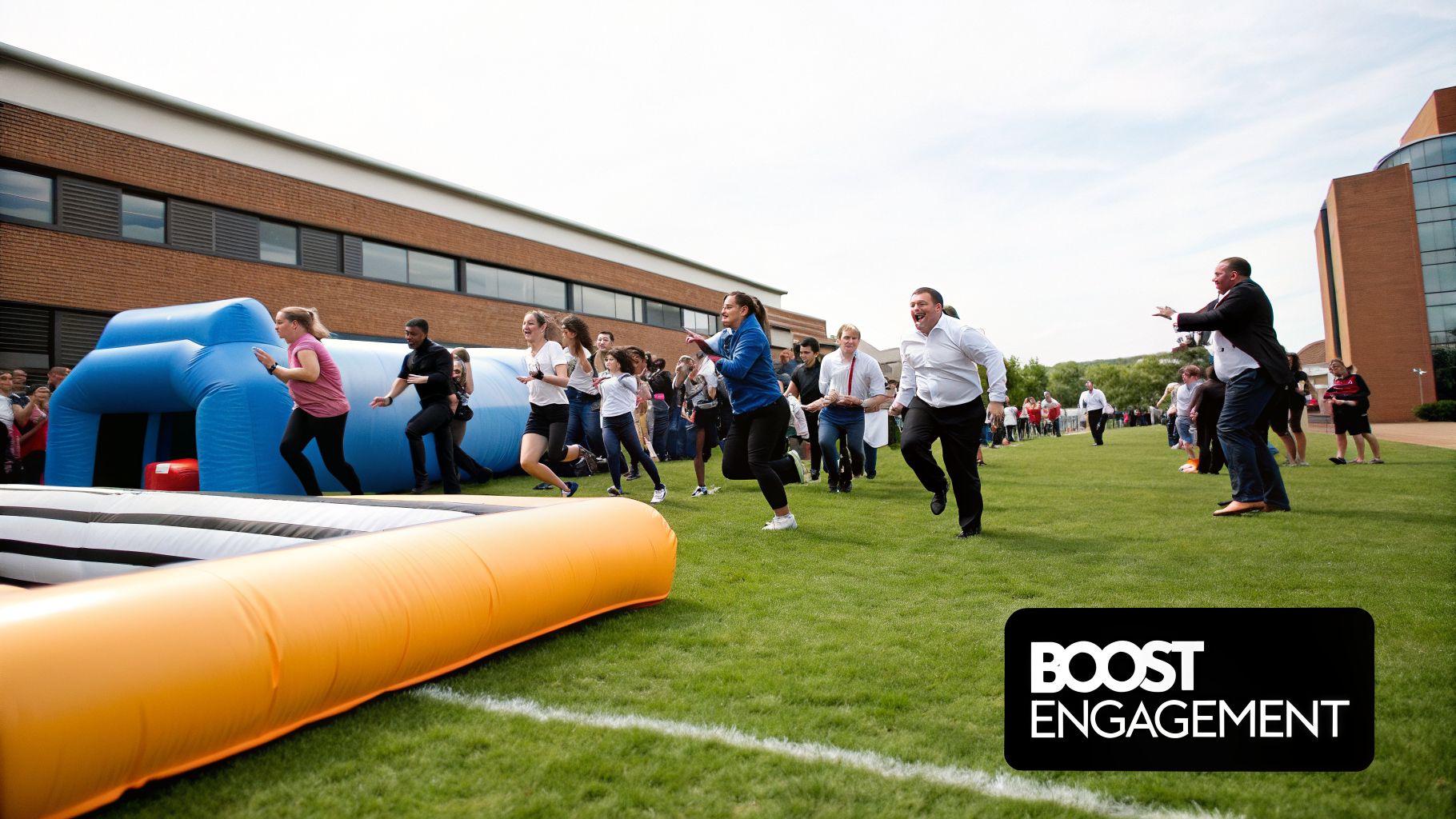
When you're planning a corporate event, the real goal is to create an experience that sticks with attendees long after they've gone home. An inflatable obstacle course delivers on this by injecting a serious dose of interactive fun that gets people moving, talking, and laughing.
Unlike static displays or the usual stuffy networking sessions, an obstacle course instantly becomes the energetic heart of your event. It’s an immediate icebreaker, pulling people in and fostering a genuine sense of shared adventure.
Driving Genuine Engagement and Morale
For internal events like company picnics or team-building days, these courses are brilliant for lifting morale. They get colleagues out from behind their desks and into a setting where teamwork and encouragement just happen naturally. The shared laughs and high-fives from conquering a tricky section build a kind of camaraderie that you simply can't force in a boardroom.
This isn't just about having fun for the sake of it. It’s about building positive feelings around the company culture. A well-chosen course shows you’re invested in your employees’ well-being and are committed to creating a vibrant, supportive workplace.
Boosting Brand Impact and Lead Capture
At external events like trade shows or brand activations, an inflatable obstacle course is a massive magnet for footfall. In a packed exhibition hall, a towering, colourful inflatable is impossible to miss, drawing attendees right to your stand. That immediate visual impact is crucial for making a strong first impression.
The UK events sector, valued at over £42 billion, is seeing more and more interactive inflatables used for both team-building and brand activations. In fact, events featuring inflatables report a 40% increased dwell time per attendee, which is huge for brands looking to capture leads. This trend is backed by a projected 8.5% year-on-year growth in UK inflatable rentals for 2026.
Key Takeaway: Longer dwell time is marketing gold. When attendees stick around to watch or participate, your brand gets more opportunities for meaningful conversations, product demos, and genuine lead generation.
The spectacle of it all creates a buzz that spreads on its own. People gather to watch, snap photos, and share their experiences on social media, amplifying your brand’s reach far beyond the event space itself. This user-generated content is an authentic and powerful endorsement. For more inspiration, have a look at our guide on unique corporate event entertainment ideas.
To help you visualise how this applies to your planning, here’s a quick summary of the objectives and what success looks like.
Obstacle Course Rental At a Glance
| Planning Stage | Key Objective | Success Metric |
|---|---|---|
| Team Building | Foster Collaboration & Morale | Increased employee engagement scores, positive post-event feedback. |
| Brand Activation | Drive Footfall & Engagement | Higher lead capture rates, increased social media mentions. |
| Company Fun Day | Create a Memorable Experience | High participation rates, positive family feedback. |
Ultimately, choosing to hire an inflatable obstacle course is a strategic move. It turns a standard gathering into an active, engaging, and unforgettable brand experience that delivers real, measurable results—whether your goal is to boost team spirit or grab the attention of new clients.
How to Choose the Right Obstacle Course for Your Event
Choosing the right inflatable obstacle course is about more than just picking the one that looks the most impressive. It’s a strategic decision. Get it right, and the inflatable becomes the centrepiece of your event, driving engagement and creating memories. Get it wrong, and it’s just a big, colourful distraction.
Think of it this way: a punishing 45-metre race course built for a competitive corporate away day would be completely out of place at a relaxed family fun day. The key is to match the course to your audience, your venue, and what you’re trying to achieve.
The bounce house rental market is booming, valued at $4 billion in 2024 and projected to climb to $5.62 billion by 2028. This isn't just a trend; it's a reflection of how effective these attractions are. In the UK, it’s estimated that by 2026, 65% of corporate team-building events will feature a physical challenge like an inflatable. You can dig deeper into these figures over at BounceHorizon.com.
Aligning the Course with Your Audience
First things first: who is this for? The answer changes everything. Your choice for a group of sales executives will be worlds away from what you'd pick for their kids.
For Corporate Adults: You want skill-based challenges. Look for courses that feature high walls, tricky balance beams, and complex tunnels. These elements are brilliant for fostering some friendly competition and teamwork.
For Children or Families: The focus has to be on fun and safety. Opt for courses with lower climbing walls, plenty of bouncy areas, and wide, gentle slides. Bright, eye-catching themes are your friend here.
For Mixed Groups: A dual-lane course is often the perfect solution. It lets adults and older kids race side-by-side, creating a fun, interactive dynamic without anyone feeling overwhelmed or under-challenged.
We recently planned a corporate "sports day" for a client and their families. Our solution was a two-part setup: a high-octane, challenging course for the adults and a separate, whimsical "fun run" for the kids. Everyone had something that felt designed just for them, and the feedback was fantastic.
High Throughput vs High Challenge
Next, think about the flow of your event. Are you expecting hundreds of people who need to be kept moving, or a smaller, focused group? This will dictate whether you need a high-throughput or a high-challenge design.
High-Throughput Courses are your best bet for large crowds. They're typically linear—a clear start and a clear finish—designed to get people through quickly. They're ideal for:
- Brand activations at public festivals
- Exhibition stands where you need to attract footfall
- Large-scale company fun days
The aim here is simple, repeatable fun that keeps queues short and energy levels high.
High-Challenge Courses, on the other hand, are built for depth, not speed. They often have more complex sections that demand a bit more thought and effort. These are perfect for structured team-building days, where the goal isn't just to finish, but to work together and solve problems along the way.
Expert Tip: For a proper competitive team event, ask your supplier about adding an electronic leaderboard. When you pair a high-challenge course with real-time scoring, the activity instantly becomes the main event, driving a huge amount of excitement and participation.
Making the Most of Modular Designs
What if your venue isn't a simple, open field? Maybe you're working with an L-shaped courtyard or a long, narrow exhibition hall with pillars. This is exactly where modular inflatable obstacle courses come into their own.
Instead of one single, massive unit, these courses are made up of several sections that can be connected in different ways. This gives you incredible flexibility. A good supplier can work with you to build a custom layout that snakes around obstacles or fits perfectly into an unusual space. You can link a climbing section to a tunnel, then finish with a slide, creating a bespoke experience that doesn't compromise on impact, no matter the venue.
Mastering Your Event Logistics and Site Planning
The difference between a good event and a truly spectacular one often comes down to logistics. While a massive inflatable obstacle course looks like pure fun, its success is built on meticulous site planning long before any guests arrive. Getting this wrong can lead to serious day-of disasters, so a thorough site check isn't just a formality—it's essential.
This visual guide breaks down the three key elements you need to align when picking your inflatable.
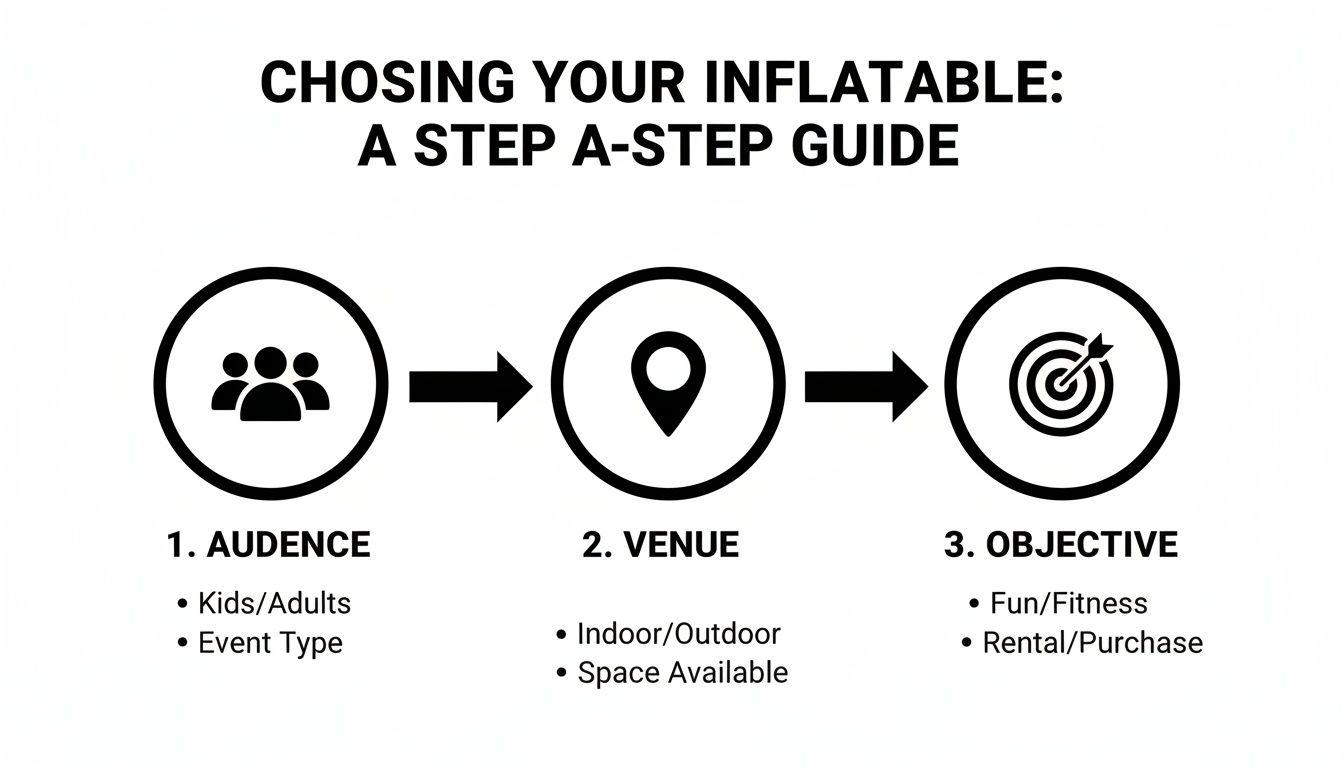
Think of your venue, audience, and objectives as interconnected parts of the same puzzle. They all have to fit together perfectly.
Ground and Gradient Assessment
The first thing you have to lock down is the ground surface. Grass is always the easiest option, as it allows the crew to use long, heavy-duty pegs to anchor the unit securely. Simple and effective.
But don't rule out hard surfaces. Concrete, tarmac, or even an indoor exhibition floor are perfectly fine, as long as your supplier brings the right kit. This means using a ballast system, which usually involves hefty sandbags or water barrels. If a company suggests setting up on hard ground without proper weighting, walk away. That’s a huge safety red flag.
You also need to check the gradient. The ground has to be almost completely flat. A very gentle slope might be okay, but anything more can make the inflatable unstable and dangerous. During a site visit, just pull out your phone—a spirit level app will give you a quick and accurate reading.
Measuring Access Routes and Clearances
I’ve seen this happen more times than I can count: the inflatable arrives, but it can’t physically get to the setup spot. A rolled-up course is incredibly heavy and bulky. You have to walk the entire path from the delivery truck to the final location and measure everything.
Take a tape measure and check:
- Gate Widths: Are they wide enough for the unit, which will likely be on a dolly?
- Corridors and Doorways: This is a classic stumbling block for indoor events.
- Stairs or Lifts: Can the crew even manage it? Don't forget to check the lift's dimensions and weight capacity.
- Tight Corners: Can they manoeuvre the rolled-up unit around them?
A single narrow doorway can throw your whole schedule into chaos. Once you're at the setup spot, look up. Check for low-hanging tree branches, power lines, or any venue features that could get in the way of the inflatable's full height.
A professional supplier will always ask for the 'total space requirement', not just the inflatable's dimensions. This includes a clear safety perimeter of at least 1.5 to 2 metres on all sides for safe entry, exit, and anchoring.
Calculating Your Power Requirements
Inflatables aren't static; they need a constant airflow from electric blowers to stay upright. Getting the power wrong is a non-starter. A standard blower for a large inflatable section will need its own dedicated 13-amp power socket.
If you’re hiring a huge, multi-part course, you’ll need multiple blowers. For instance, a 30-metre course could easily need three separate blowers, which means you need three dedicated 13-amp sockets, each on a different circuit to avoid tripping the breakers. Many newer team building venues have more robust 16-amp sockets, which are even better. You must have this conversation with the venue and your supplier early on.
What if you're in a field with no mains power? That's what generators are for. Your supplier should tell you the exact kVA (kilovolt-ampere) rating you need. This calculation isn't just about running the blowers; it must also account for the 'startup surge'—the initial burst of power they draw. Let your supplier handle this calculation to make sure the generator you hire has enough juice to keep everything running safely all day.
Getting Health, Safety, and Insurance Right
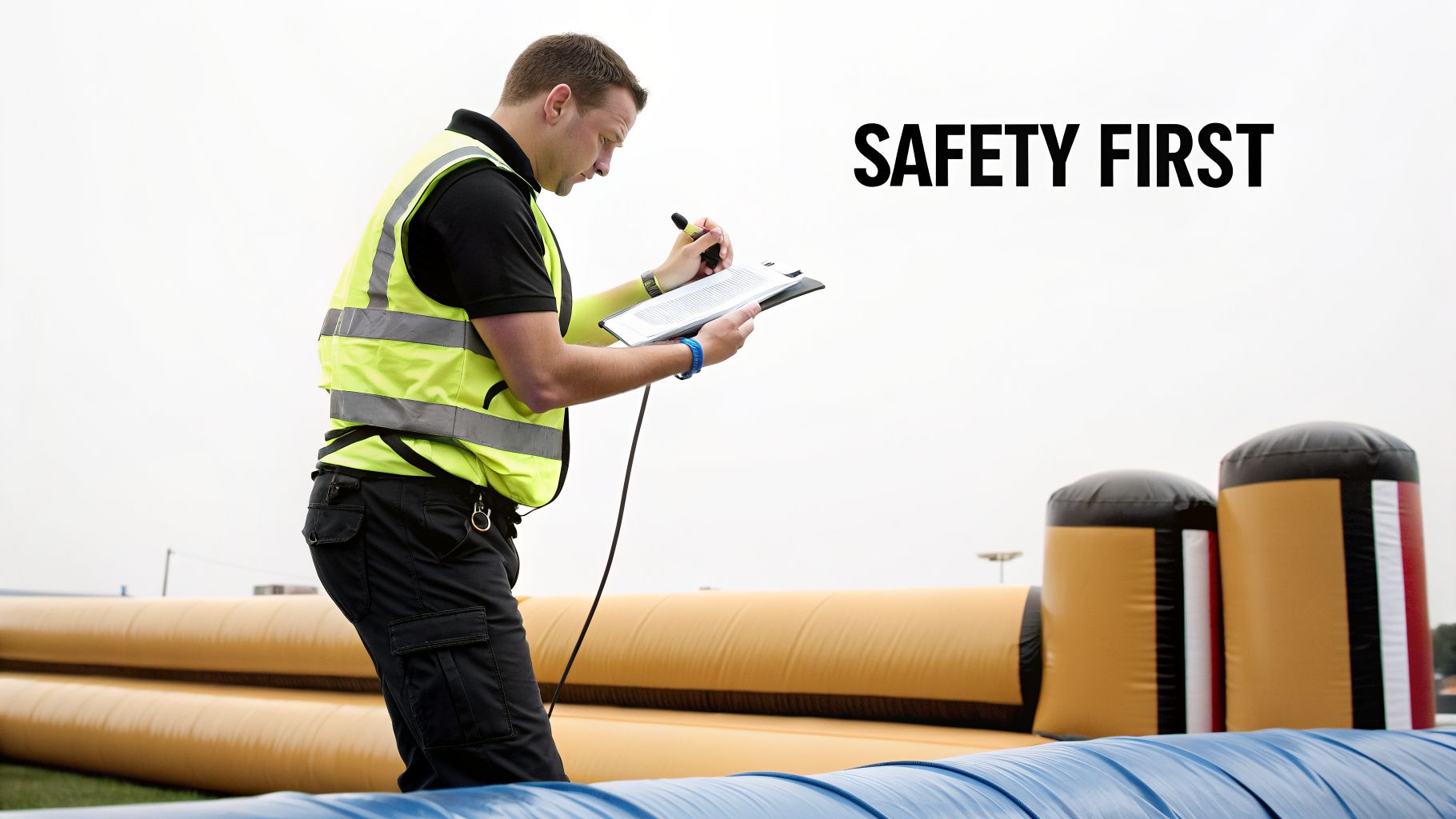
When you're hiring an inflatable obstacle course for a corporate event, safety isn't just about ticking boxes. As the planner, the buck stops with you. Getting this wrong can have serious consequences, so knowing what to look for is your best defence.
The good news is that UK safety standards are incredibly strict, which has massively improved the reliability of professional hire equipment. HSE data shows that major incidents are rare, happening only once in every 500,000 user hours. It's this level of safety that builds trust; a recent market report from BounceHorizon.com found that rental firms can see up to 70% client retention.
That reliability all comes down to a few key certifications and tests. Any professional operator worth their salt will have these ready to go.
Key UK Safety Standards to Know
When your potential supplier sends over their paperwork, you need to know exactly what you’re looking at. These are the non-negotiables for any inflatable being hired for commercial use in the UK.
Here's what you absolutely must see:
- EN 14960 Certification: This is the British and European standard for inflatable play equipment. It covers everything from material strength and seam stitching to anchor points and wall heights. If a unit isn't certified to this standard, it has no place at your event. Simple as that.
- A PIPA or ADIPS Tag: Think of the PIPA scheme as an annual MOT for inflatables. It's a physical, numbered tag (usually blue) on the unit itself that proves it has passed a rigorous safety inspection by a qualified professional. ADIPS is a similar, equivalent scheme. Ask for the tag number and check it's valid on the PIPA or ADIPS website.
- RPII or PIPA Inspector Credentials: The person who inspects the inflatable must be properly qualified. Ask for proof that their inspector is registered with the Register of Play Inspectors International (RPII) or PIPA. This guarantees the inspection meets the required high standards.
Crucial Tip: Any brand-new inflatable needs an initial test certificate. After one year, it must have an annual test certificate from PIPA or ADIPS. Don’t just take a supplier’s word for it—always ask to see the current, in-date documentation.
Reviewing Insurance and Risk Assessments
Beyond the kit itself, you need to see proof of the operator's business credentials. This is what protects your company, your guests, and your reputation if an incident occurs.
A professional supplier will provide these without you even having to chase:
- Public Liability Insurance (PLI): For corporate events, the industry standard is £10 million of cover. Don't settle for less. Ask for the current certificate and make sure it explicitly covers the use of inflatables.
- Risk Assessments and Method Statements (RAMS): This is the supplier’s plan. It shows they've thought through all the potential hazards and know how to manage them, from setting up safely to operating the course during the event. This is a critical process for any event activity, as we cover in our guide to creating a risk assessment for event activities.
On-Site Safety Checks for Event Day
Your due diligence doesn't stop once the paperwork is approved. On the day, you or your event manager need to be able to spot the signs of a professional, safe setup. A good crew will do all this automatically.
Check the anchoring. On grass, this means heavy-duty, long metal stakes at every single anchor point. On hard surfaces like tarmac or concrete, it means using substantial ballast weights—not just a few flimsy sandbags.
The crew should also be using an anemometer (a wind-speed meter) to monitor conditions. Inflatables become dangerous in high winds and must be deflated if gusts exceed 24 mph.
Finally, watch the staff. Are they properly trained, attentive, and actively supervising? They should be managing the flow of participants and enforcing the rules. Their professionalism is what turns a fun activity into a safe and successful one.
Never, ever sign a rental contract without doing your homework. I’ve seen it happen, and it almost always leads to event-day chaos and stress. To protect your event and your budget, you have to vet your suppliers properly. Asking the right questions isn't about being difficult; it's about shifting from a simple customer to an informed partner. It’s how you spot a pro from a risky bet.
When you’re looking to hire an inflatable obstacle course, your focus should be on their safety standards, insurance, and on-the-ground experience. These are the same principles you’d apply when looking at questions to ask before hiring a security company—it's a solid framework for any event vendor. This process is about building confidence, not just getting a price.
To make this easier, I've put together a checklist of the crucial questions we ask every potential supplier.
Vendor Question Checklist
| Category | Key Question | Why It's Important |
|---|---|---|
| Operations | Who is our on-site contact, and are your staff in-house or agency? | You need a single, empowered contact person. In-house staff means more accountability and consistent training. |
| Logistics | What is your site survey process and event day schedule? | This reveals their level of preparation. A detailed plan shows they’ve handled complex setups before. |
| Safety | What is your wet weather and high wind policy? | A clear, fair policy for bad weather is non-negotiable in the UK. It protects both you and the supplier. |
| Contingency | What happens if a blower or other equipment fails? | Professionals carry spares. Amateurs leave you with a deflated heap and disappointed guests. |
| Pricing | Can you provide a fully itemised quote with all potential extra charges? | Avoids nasty surprises. You need to know the total cost for travel, staff, and extras upfront. |
| Insurance | Can we see a copy of your Public Liability Insurance certificate? | This is a deal-breaker. No certificate, no hire. It must be current and have adequate coverage (£5m minimum is standard). |
Getting clear answers to these questions is the first step towards a smooth, successful event. Now, let’s dig a bit deeper into what you should be listening for in their responses.
Getting into Operations and Logistics
Your first questions should drill down into the nitty-gritty of delivery, setup, and staffing. A slick website means nothing if the team on the day is clueless. You need to know their entire process, from the moment they arrive to the moment they leave.
Start by asking about their crew. You’re looking for a clear confirmation that their staff are full-time, trained, and uniformed employees, not just random people hired for the day. This makes a world of difference for professionalism and accountability.
A few logistical questions I always ask:
- Who will be our main point of contact on the event day? Insist on a designated site manager who can actually solve problems, not just a delivery driver.
- What is your process for a site survey? A proper company will offer a physical visit for tricky venues or use detailed forms and video calls to check access, power, and ground suitability.
- Can you provide a detailed event day schedule? This should cover arrival times, setup duration, staff briefings, and the teardown plan.
A company that can provide this level of detail has a solid, repeatable process. It’s proof they’ve managed events like yours and are ready for the unique challenges your venue might throw at them. Vague answers here are a huge red flag.
Drilling Down on Safety and Contingencies
This is what separates the real pros from the cowboys. You’ve already asked to see their safety certificates, but you also need to understand their real-world safety culture and how they react when things go wrong.
The wet weather policy is a big one, especially here in the UK. What happens if it's too windy or rainy to safely operate the inflatable obstacle course for rent? Any good company will have a clear and fair policy ready to go.
A professional wet weather policy should offer flexible options, like rescheduling, offering a credit note for a future event, or a partial refund if a last-minute cancellation is unavoidable for safety reasons.
Ask them directly about their on-site safety rules. They should immediately tell you the maximum wind speed for operation is 24 mph and confirm their staff will use an anemometer to monitor conditions all day. This isn't just a suggestion; it’s a legal requirement under EN14960.
Also, ask about their backup plan. What’s the procedure if a blower gives up halfway through your event? Experienced operators always carry spare blowers, extension leads, and repair kits as standard. Their answer tells you if they’re proactive problem-solvers or if they’ll just shrug their shoulders and leave you stranded.
Uncovering Every Last Cost
Finally, you need absolute clarity on the price. The events industry is notorious for hidden costs, so your job is to sniff them out before you sign anything.
Always ask for a fully itemised quote. A standard, all-inclusive package for an inflatable obstacle course for rent should clearly list:
- The inflatable unit itself
- All required blowers and cabling
- Safety mats for all entrances and exits
- Professional delivery and installation
- Trained supervision staff for the hire duration
- Public Liability Insurance
You also need to confirm if there are any extra charges. Ask about travel, fuel surcharges, or accommodation costs for staff if your event is outside their usual service area. Getting total transparency upfront is the only way to keep your budget in one piece and build a partnership based on trust.
Common Questions About Inflatable Obstacle Course Rentals
You've got the vision for an incredible event, but now it's time for the nuts and bolts. As you get closer to the big day, the practical questions always start to bubble up.
We get it. We've fielded every question imaginable from corporate planners over the years. This is your go-to guide for those final, crucial details that make the difference between a good event and a flawless one.
How Much Space Do I Actually Need?
This is the number one detail people get wrong. The dimensions you see on a supplier's website are just for the inflatable itself – the real footprint you need on the ground is always bigger.
Any professional outfit will talk about the 'total space requirement'. This includes a non-negotiable safety perimeter of at least 1.5 to 2 metres around the entire unit. This clear zone is essential for a few reasons:
- It creates safe entry and exit points.
- It keeps the crowd from getting too close to the action.
- It gives our crew the room they need for proper anchoring with pegs or weights.
Don't forget to factor in the blowers and their connection tubes, which usually sit at the back or side. For a course advertised as 20 metres long, you're likely looking at a total operational area of around 24 metres by 8 metres. Always, always confirm the total required area with your supplier, not just the inflatable's size.
Can an Inflatable Be Used Indoors?
Absolutely. We often set up our courses inside major venues like Manchester Central or the SEC Glasgow. It's a fantastic way to bring high-energy fun to an indoor exhibition or company-wide meeting.
The single most important factor? Ceiling height.
You need to measure the vertical clearance from the floor to the lowest point on the ceiling – that includes any dangling light fixtures, air-con units, or structural beams. To be on the safe side, we always recommend a minimum clearance of 1-2 metres above the inflatable’s highest point.
From Experience: Indoor setups demand a different approach to safety. Since we can't peg into an exhibition hall floor, we use a robust ballast system. This involves placing heavy water barrels or sandbags at every single anchor point, ensuring the unit is completely secure and fully compliant with EN14960 standards.
What Is Included in the Rental Price?
A quote from a reputable supplier should be completely transparent and all-inclusive. The last thing you want are unexpected costs cropping up on event day.
A standard hire package should always cover the core essentials:
- The inflatable obstacle course itself.
- All operational gear: blowers, cables, and safety mats.
- The correct anchoring system (pegs for grass, ballasts for hard surfaces).
- Delivery to your venue and collection afterwards.
- Full installation and de-rig by a trained, professional team.
- Public Liability Insurance – we advise looking for a minimum cover of £10 million.
Staff supervision is sometimes included or offered as a clear, itemised add-on. Make sure you ask for a full breakdown so you know exactly what you're paying for, including any potential mileage charges for venues far afield.
What Is the Wet Weather Policy?
For any outdoor event in the UK, this is a must-ask question. Safety is paramount, and inflatables simply cannot be operated in heavy rain or high winds. The Health and Safety Executive (HSE) sets the absolute maximum wind speed at 24 mph, and any professional crew will stop operations immediately if gusts reach this level.
Your supplier's contract should clearly outline their wet weather policy. What you're looking for is flexibility. A good company will usually offer:
- The option to move your booking to an alternative date.
- A credit note to use on a future hire.
- A partial or full refund if bad weather forces a cancellation on the day.
While some smaller bouncy castles have built-in shower covers, they are only good for a light, passing drizzle. They offer zero protection against proper rain or wind. Get this conversation out of the way early so you know exactly what your options are if the weather turns.