
So, what exactly is a corporate entertainment event? It’s not just about throwing a party. It’s a carefully planned event that uses entertainment to hit very specific business targets, whether that’s firing up your sales team, wowing new clients, or making a huge splash with a product launch.
What Makes a Corporate Entertainment Event Unforgettable?
Think of it this way: a standard business meeting is like a memo. It gets the job done, but it's purely functional. A corporate entertainment event, on the other hand, is like a firm handshake combined with a genuine conversation. It builds a real connection and leaves a powerful, positive impression.
The real difference is the intent behind it. A regular company get-together might just be about sharing information. An entertainment-led event is designed to create an emotional connection. It’s about turning people who are just listening into people who are actively involved, transforming a simple trade show stand into a buzzing hub that everyone talks about for weeks.
More Than Just a Party
This is exactly why the sector is thriving. The UK events industry is on a serious growth trajectory, hitting a market value of USD 86.19 billion in 2025 and is projected to reach an incredible USD 99.0 billion by 2035. That growth is being driven by businesses that understand the power of interactive attractions, especially at big conferences and exhibitions. After years of virtual meetings, there's a real hunger for face-to-face experiences, and that's fuelling the demand.
A great corporate entertainment event isn’t a cost—it’s a carefully built brand experience. The aim is to create a strong, positive memory that people directly link back to your company, boosting loyalty and driving future business.
Getting the fundamentals right is everything. You need the right mix of goals, audience, and venue to create the foundation for something truly memorable. For a deep dive into specific activities, check out our guide on corporate event entertainment ideas.
Corporate Entertainment Event at a Glance
To put it all into perspective, here’s a quick breakdown of the core elements that go into planning a successful corporate entertainment event.
| Component | Description |
|---|---|
| Primary Objectives | Can include everything from generating leads at a trade show and strengthening client relationships to celebrating company wins, rewarding staff, or launching a new product. |
| Typical Audiences | This could be potential B2B clients, high-value customers, your own internal teams, key stakeholders, industry partners, or even the general public at brand activations. |
| Venue Considerations | The venue can be anywhere from a major exhibition hall like ExCeL London or the NEC Birmingham to a boutique hotel, a unique historic building, or even your own office space. |
Nailing these three components is the first step toward creating an event that doesn't just entertain, but delivers real, measurable results for your business.
How to Set Goals That Justify Your Event Budget
Before you book a single simulator or browse a venue, every great corporate entertainment event starts with one question: why are we doing this? Forget the activity for a moment. You need solid, measurable business goals before a single pound is spent. Think of these goals as your event's compass; every decision, from the entertainment you hire to the canapés you serve, must point directly towards a tangible outcome.
Without that sharp focus, your budget is an easy target for cuts. Stakeholders see an expensive party, not a strategic investment. When you define your goals first, the conversation shifts from "How much will this cost?" to "What return can we expect?".
From Vague Ambitions to Specific KPIs
Saying you want to "improve brand awareness" is a decent start, but it’s far too vague to get a budget signed off. The trick is to drill that ambition down into a specific Key Performance Indicator (KPI). A strong KPI is precise, measurable, and tied directly to what happens at the event itself.
This diagram shows how your core objectives, your audience, and your venue choice are all interlinked. They form the strategic foundation of your event.
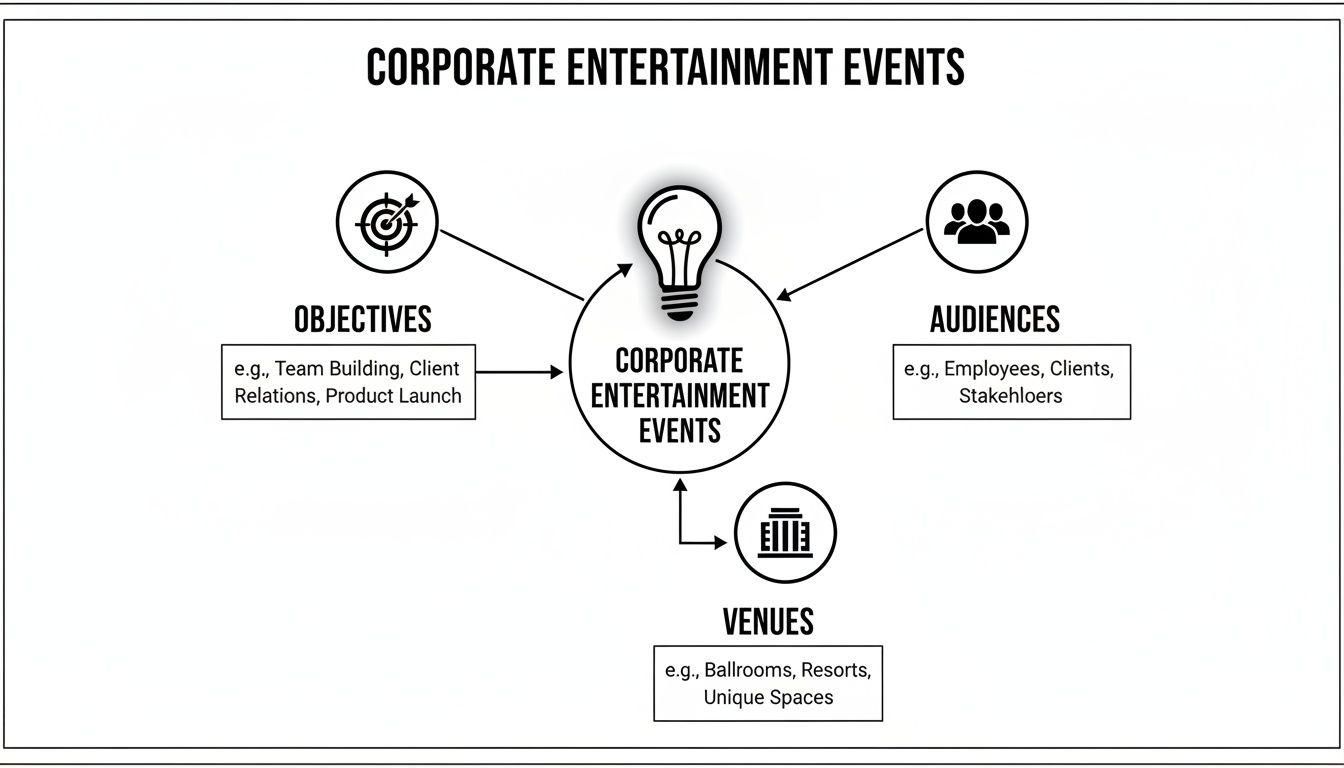
As you can see, every element has to work together to get results. If your goal is lead generation, for example, you absolutely need an audience of potential clients and a venue layout that makes it easy to chat and capture their details.
Let’s look at how to turn those common business goals into concrete, event-specific KPIs:
Vague Goal: Improve brand awareness.
Specific KPI: Generate 1,000+ social media mentions using our event hashtag, #BrandFest2025, which we'll track with monitoring software.
Vague Goal: Boost employee morale.
Specific KPI: Achieve a 15% increase in employee satisfaction scores in our post-event survey compared to the pre-event baseline.
Vague Goal: Generate more leads.
Specific KPI: Capture 200 qualified leads by running a ‘Top Gear’ style leaderboard challenge on an F1 simulator, with people entering their details to compete.
This approach gives you a clear definition of success. It's no surprise that 82% of top-performing B2B marketers say their success comes down to a deep understanding of their audience and goals.
Common Business Goals for Corporate Entertainment
Your corporate entertainment can be shaped to hit a huge range of business targets. Whether you're planning a massive product launch or an intimate client dinner, tying the experience to a measurable goal is what matters. If you're launching something new, you might find our guide on planning a successful product launch event useful for refining this strategy.
Here are three main types of goals that are a perfect fit for an entertainment-led event.
Lead Generation and Sales Acceleration
This is a classic objective for trade shows and exhibitions. Interactive entertainment, like a golf simulator or a Batak Pro reaction game, is a magnet for footfall. It draws people to your stand and creates a natural way for your sales team to start a conversation.Client Retention and Relationship Building
Keeping your existing clients happy is almost always more cost-effective than finding new ones. A VIP hospitality event—think a private box at a major sporting event or an exclusive simulator racing night—creates a memorable experience that shows you value their business and builds real loyalty.Employee Engagement and Team Building
A happy, motivated team is a productive team. Period. Internal events built around fun and friendly competition are brilliant for breaking down department silos, improving communication, and giving morale a serious boost. Think of a company fun day packed with interactive games that get people working together.
By defining these goals with real precision, you give yourself the data you need to prove the event's value long after the lights go out.
Exploring Interactive Corporate Entertainment Ideas
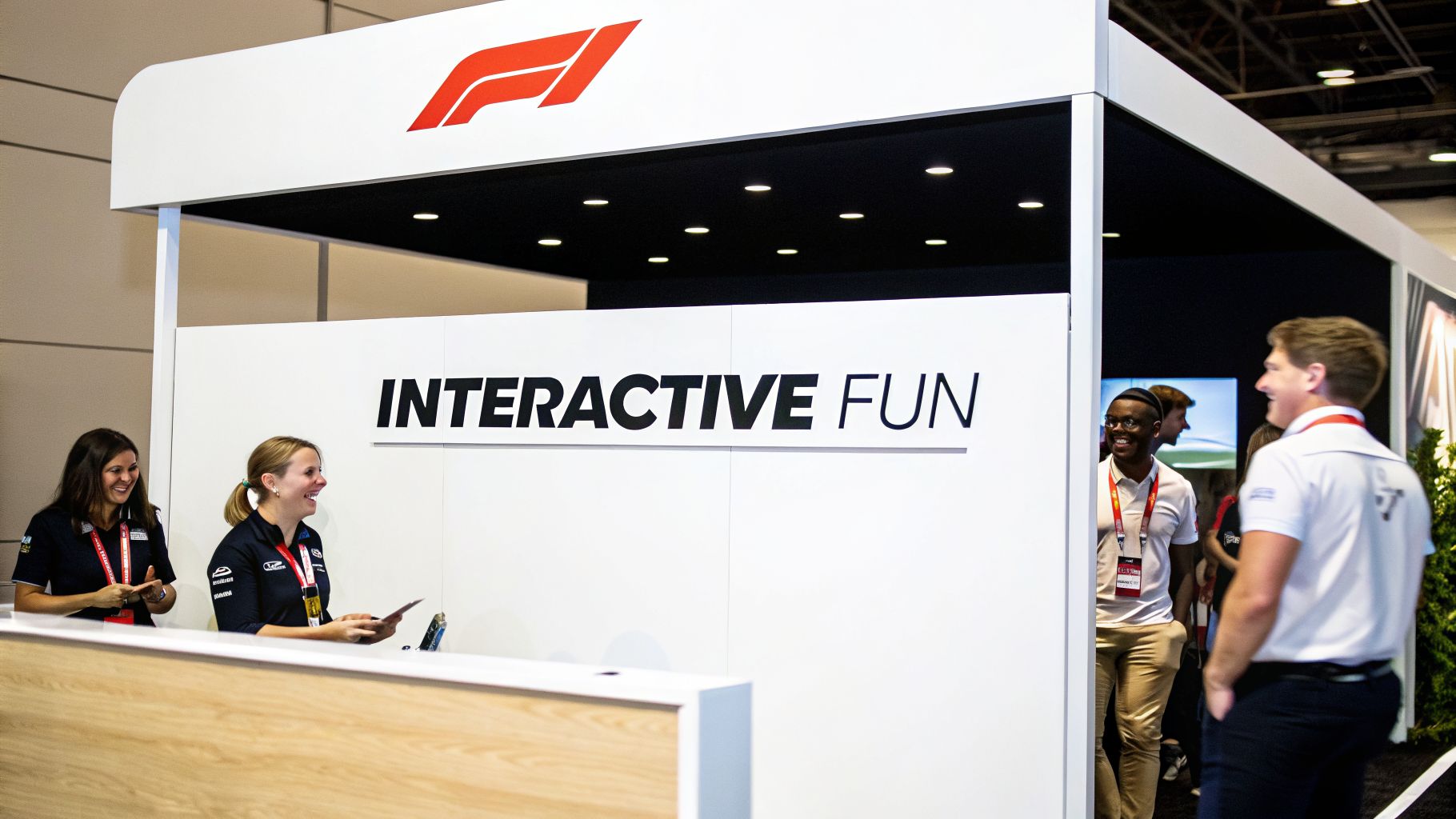
Let's be honest, a musician quietly playing in the corner is pleasant, but it’s not what people will be talking about weeks later. If you want to create a real buzz, you need to get your guests involved. This is where interactive attractions come in – they pull people out of their shells, get them talking, and inject the kind of energy that makes an event truly stick in the memory.
The secret isn’t just picking something 'fun'; it's about matching the activity to your audience and your goals. Need to stop traffic at a packed trade show? A high-octane simulator will do the trick. Looking to get your team connecting on a development day? Nothing works better than some friendly competition. Let's look at the options that consistently deliver.
High-Energy Sports Simulators
Picture this: the roar of an engine cuts through the noise of an exhibition hall as attendees line up for their shot at a Formula 1 lap record. Sports simulators are more than just a game; they’re a high-octane experience and a powerful magnet for drawing a crowd.
They are also brilliant for lead generation. Set up a ‘fastest lap’ competition with a live digital leaderboard, and you’ve created a natural, compelling reason for attendees to share their contact details. It’s a world away from a hard sell.
Popular simulator options include:
- F1 Racing Simulators: A guaranteed showstopper at major venues like ExCeL London or the NEC Birmingham. Perfect for driving footfall and creating an unforgettable brand activation.
- Virtual Golf Simulators: A more relaxed, but just as engaging, choice. It’s ideal for client hospitality days where the goal is to chat and build relationships in a low-pressure environment.
- American Football or Rugby Simulators: Fantastic for fan zones or brand activations tied to big sporting events, giving guests a chance to test their own skills.
Competitive Interactive Games
Nothing breaks the ice quite like a bit of friendly competition. Interactive games are built to be quick to learn, incredibly addictive, and great for getting people laughing and engaging. They’re a solid choice for team-building days, office parties, or as a secondary activity at a conference.
These games tap directly into our competitive nature. They create a shared experience that gets colleagues communicating and working together, all while they think they’re just having fun.
A recent study found that 83% of event planners see their entertainment providers as crucial to an event's success. Interactive games are a straight line to achieving that, delivering pure engagement that leaves a lasting positive mark on your guests.
Consider these crowd-pleasers for your next corporate event:
- Batak Pro Reaction Walls: A brilliant test of speed and reflexes that always draws a crowd and sparks some good-natured rivalry.
- Giant Scalextric Tracks: This taps right into nostalgia. These large-scale, brandable tracks are perfect for getting big groups of people involved at the same time.
- Digital Graffiti Walls: A creative and modern option that lets guests make their mark on a large digital canvas. The result is a unique piece of art that’s easy to share online.
Immersive Tech Experiences
Technology is completely changing what’s possible for corporate entertainment. Immersive tech like virtual reality (VR) and augmented reality (AR) can literally transport your guests to another world, creating a powerful sensory experience they won't forget. If you're exploring the latest interactive options, have a look at this guide to an augmented reality event.
These aren’t just novelties; they deliver serious business results. The UK’s immersive entertainment market, which includes VR and motion simulators, hit USD 8,934.6 million in 2025 and is projected to explode to USD 68,549.0 million by 2033. The data shows these experiences can boost interaction rates by 40-50% compared to a static display.
Examples of immersive tech include:
- VR Roller Coasters: A full-sensory thrill ride that takes up very little floor space but delivers a massive impact. It’s a perfect attention-grabber.
- Flight Simulators: Offer a deeply realistic experience that’s ideal for premium client events or exhibitions in the aviation or technology sectors.
- Augmented Reality (AR) Treasure Hunts: A clever way to get attendees moving around your venue, guiding them to explore different stands or zones.
By thinking strategically about these categories, you can choose an experience that doesn't just entertain but actively helps you hit your business goals. For even more inspiration, check out our detailed list of interactive exhibition stand ideas to find the perfect match for your brand.
Your Essential Event Planning Checklist
Planning a high-stakes corporate event is all about managing the details. To deliver a flawless experience, every single element—from budget to staffing—needs to be locked down. A methodical approach is non-negotiable.
This checklist is your blueprint. Think of it as the structured process that gets you from A to B without any last-minute panics. We’ve broken it down into five critical stages to make sure nothing gets missed.
Stage 1: The Budgeting Blueprint
Your budget is the absolute foundation of your event. It sets the parameters for your venue, your entertainment, and the overall quality of the guest experience. It’s no surprise that 75% of event planners name cost control as a major challenge; getting this right from the start is crucial.
A common mistake is to only account for the big-ticket items. Instead, you need to break your budget down into detailed categories for a true picture of your total spend.
- Venue Hire: This is often your single biggest cost. Go beyond the basic hire fee and check for add-ons like security, cleaning, or overtime charges.
- Entertainment and Attractions: This includes the hire fee for your main attraction (like a simulator), plus any associated costs for branding, transport, and on-site operation.
- Staffing: Allocate funds for the technical crew, brand ambassadors, and any event managers needed on the day.
- Catering: Food and drink costs can add up quickly. It's vital to get detailed quotes locked in early.
- Contingency Fund: Always set aside 10-15% of your total budget for the unexpected. This buffer is your safety net for handling problems without derailing the entire event.
Stage 2: The Creative Brief
With your budget outlined, it's time to create a detailed creative brief. This document is your North Star, defining precisely what you need to achieve and aligning every supplier and team member to that goal. It’s how you turn business objectives into a tangible event concept.
A strong creative brief is the bridge between your strategic objectives and the guest experience. It answers the fundamental questions of 'who, what, and why' before you even think about the 'how'.
Your brief needs to clearly define three core elements:
- Target Audience: Who are you trying to connect with? A brief for a C-suite client event will look completely different from one for an internal team-building day.
- Core Objectives: Go back to your KPIs. Is the goal lead generation, brand exposure, or boosting employee morale? Your brief must state this clearly.
- Brand Message: What is the one key takeaway you want every guest to leave with? Everything from the décor to the entertainment has to reinforce this message.
Stage 3: Logistics and Venue Selection
Once your brief is locked in, you can get into the practical logistics. This stage is all about the details—from power sockets to parking—and a single oversight here can cause huge headaches on the day. When you're checking out a potential venue, conduct a thorough site visit to vet it against your key logistical needs.
For example, if you're hiring high-tech equipment like a motion simulator, you must get its technical rider. This document specifies non-negotiable details like power requirements (e.g., a 32-amp supply), access dimensions for delivery, and the exact floor space needed. Ignoring this could mean your star attraction can't even get through the door.
Stage 4: Health and Safety Compliance
Health & Safety (H&S) isn't an optional extra—it’s a legal and ethical responsibility. Cutting corners here can lead to serious consequences, damaging your guests, your staff, and your company's reputation.
Your H&S checklist must include:
- Risk Assessments: You need to identify every potential hazard related to your venue and entertainment choices, then document exactly how you'll mitigate those risks.
- Public Liability Insurance: Confirm that your company and all third-party suppliers have adequate cover. Any professional entertainment vendor should hold at least £5 million in public liability insurance as standard.
- Staff Training: Make sure all on-site staff are fully briefed on emergency procedures, including fire exits and first aid points.
Stage 5: Staffing and Briefings
Ultimately, your on-site team is the face of your event. They are the ones interacting with guests and making sure everything runs like clockwork. From the technical crew setting up the gear to the brand ambassadors managing the guest experience, clear communication is everything.
Hold a full pre-event briefing with all staff. Walk them through the schedule, key brand messages, and their specific roles. A well-briefed team is an empowered team, ready to solve problems on the fly and deliver the exceptional experience your guests expect.
How to Select the Right Entertainment Vendor
Choosing your entertainment partner is one of the most important calls you’ll make. This isn't just about hiring an activity; you're selecting the people responsible for delivering your guest experience. The right partner ensures your event is seamless and memorable, while the wrong one can lead to logistical headaches and damage to your reputation.
It's tempting to just compare prices, but you need to dig deeper. You're looking for a reliable, professional outfit that works like an extension of your own team. To help you sort the experts from the amateurs, we’ve put together a ‘Vendor Scorecard’—a simple framework of criteria to make sure you find a partner who truly delivers.
Portfolio and Specialisation
First, get a feel for their portfolio. Does the supplier specialise in the kind of high-impact, interactive attractions that match your goals? A true specialist will have a focused collection of equipment designed for engagement, not just a random assortment of party games.
You want to see a range that includes things like high-energy simulators, competitive games, and immersive tech. It shows they understand different crowd dynamics and can advise you on the perfect fit for your specific event, whether you’re aiming for lead generation or a team-building day.
Turnkey Service Model
A professional vendor should provide a complete, turnkey service. This is critical. It means they handle every single detail of the entertainment, freeing you up to concentrate on your guests and the overall event.
Be direct and ask them:
- Do you manage all the logistics, including transport and delivery?
- Is professional, on-site staffing included to run the attraction?
- Do you handle the full setup and breakdown?
If they answer "yes" to all three, you're talking to a partner who understands the pressures of event management. To make sure nothing gets missed on your end, a comprehensive event planning checklist template is a lifesaver for keeping all the moving parts organised.
Safety and Insurance
This is non-negotiable. Any vendor you consider must provide solid proof of their health and safety compliance. This means detailed risk assessments for their equipment and, crucially, proof of significant liability insurance.
For any corporate entertainment event, your supplier must hold comprehensive insurance. A professional standard is at least £5 million in public liability cover, though premier suppliers like PSW Events carry £10 million to protect clients at major UK venues.
Never just take their word for it. Always ask to see the documents. It’s a simple step that protects your guests, your company, and your brand from any potential liability.
Branding and Customisation
Your entertainment shouldn’t feel like an afterthought. It needs to look and feel like an integrated part of your brand experience. A top-tier supplier will offer extensive branding options, letting you customise the equipment with your company’s colours, logos, and key messages.
This is how an activity becomes a powerful brand activation tool. Whether it’s a fully wrapped F1 simulator or a digital Batak leaderboard displaying your logo, customisation makes the experience uniquely yours and reinforces your brand.
A Proven Track Record
Finally, look for hard evidence of a proven track record. The best suppliers are proud of their work and will have plenty of case studies and glowing testimonials from brands and venues you recognise. Ask for examples of events they’ve run at places like Silverstone, Wembley, or ExCeL London.
A supplier with experience at major venues is a safe bet. PwC’s research predicts the UK’s Entertainment & Media market—which includes corporate events—will hit £97 billion by 2029. This growth is driven by demand for live experiences at key hubs, proving that a vendor with a history of success is your best asset.