
A staff day is eight weeks away. Someone on the engagement committee has circulated a clip of the big red balls, the venue has confirmed a paddock with level ground, and the words "Total Wipeout hire" now sit in a spreadsheet next to the catering line. Then the questions arrive: what does the price include, who inspects the thing on the morning, and what happens if it's blowing a gale?
That gap between a television format everyone recognises and a bookable event product is where the work sits. The fun is easy to sell. The document set, the wind limit, the question of who operates the course and the fee if weather stops play are what decide whether the day runs cleanly.
What a Total Wipeout Hire Is
A hire course can bring the familiar challenge of Total Wipeout to an event, but it is a recreation rather than the television set. The original BBC One game show ran from 3 January 2009 to 31 December 2012, presented to UK audiences by Richard Hammond and Amanda Byram, according to the BBC programme record for Total Wipeout. Its standard format put 20 contestants on a purpose-built obstacle course in Argentina, with the winner competing for a £10,000 prize. Across a regular 12-episode series, that meant up to 240 contestant places and £120,000 in potential episode prizes.
The franchise also produced Winter Wipeout. In 2020, BBC One broadcast the six-part Total Wipeout: Freddie and Paddy Takeover, with newly recorded commentary over classic episodes, from 8 August to 12 September.
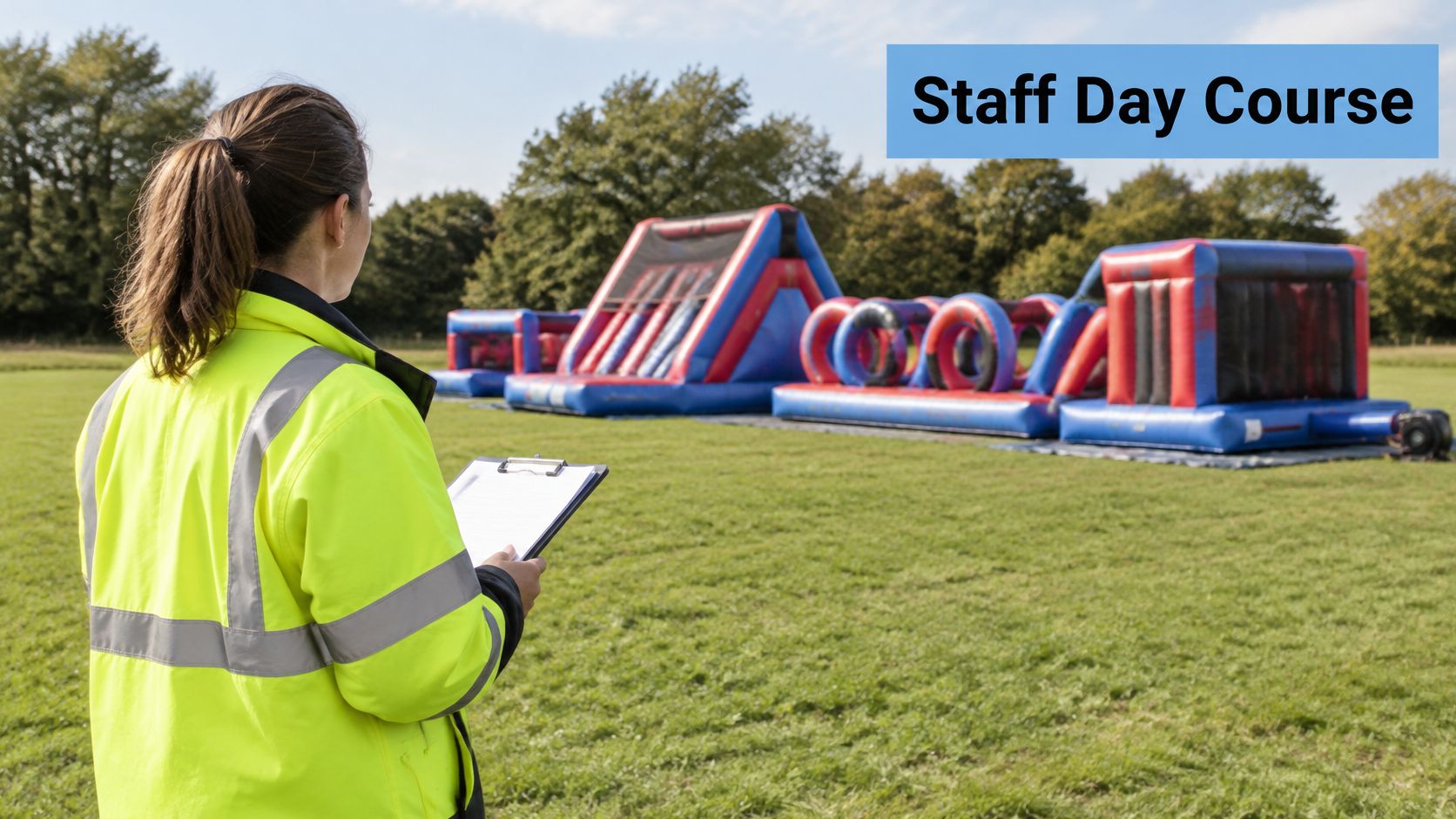
A Total Wipeout-style hire is a physical, spectator-friendly obstacle course, usually inflatable, that adapts the show's challenge format for an event. The hire does not include the original broadcast set, a presenter, a fixed cast of 20 contestants or a £10,000 prize. Instead, the organiser books a course for an agreed period of use, with rules and supervision determined as part of the hire arrangements. Like a sporting fixture, it needs a defined format and clear operating terms before participants start.
Which Events Suit a Total Wipeout Course
A course can draw a crowd at a corporate away day, yet be a poor fit for a tight exhibition stand. Match the format to the event first, then check whether the venue can support it.
| Event type | Typical format | Setting | Main planning check |
|---|---|---|---|
| Corporate away day | Four-player team rounds | Outdoor or large indoor space | Wind and staffing plan |
| Brand activation or exhibition | Spectator-friendly rounds with branded scoring | Indoor exhibition hall or outdoor stand | Viewing areas and queue management |
| Festival or fan zone | Continuous rounds through the day | Outdoor and weather exposed | Wind limits and suspension plan |
| Family fun day | Mixed-age sessions split by age, height and weight | Outdoor or indoor | Height and weight rules |
| Private party | Shorter sessions with a smaller course | Garden or indoor hall with level ground | Supervision and user limits |
For a corporate away day, four-player team rounds give participants a clear turn while colleagues watch or queue. At an exhibition or fan zone, visible scoring can help passers-by follow the competition, but the layout needs room for both the queue and spectators.
Who can take part, and who can't
Plan access around the people attending, not just those using the course. Consider whether guests can reach the start and viewing area, follow the rules, and take part in another way if the course is unsuitable for them. Agree participant restrictions with the supplier before booking, including any age, height or weight limits.
- Accessible viewing area: Provide a level spot with a clear view of the finish, away from the queue.
- Alternative challenges: Reaction-based games let guests compete without using the course.
- Team leaderboards: Groups can score together, including when some members do not take part on the course.
- Quieter booking windows: A scheduled lower-traffic period can give guests more choice about when to visit.
A narrow access route, uneven ground or limited space around the course can make a venue unsuitable. Check the route into the site, the available footprint and the event layout before requesting prices. For mixed family audiences, family fun day hire options can provide activities for guests who prefer not to use the course.
How the Original Stages Translate to a Hire Course
The UK version ran a four-stage competition, and that structure is the most useful thing you can hand a supplier, because it turns "obstacle course" into a specification (UK Game Shows' format description). The blueprint below shows the sequence an event course usually follows.
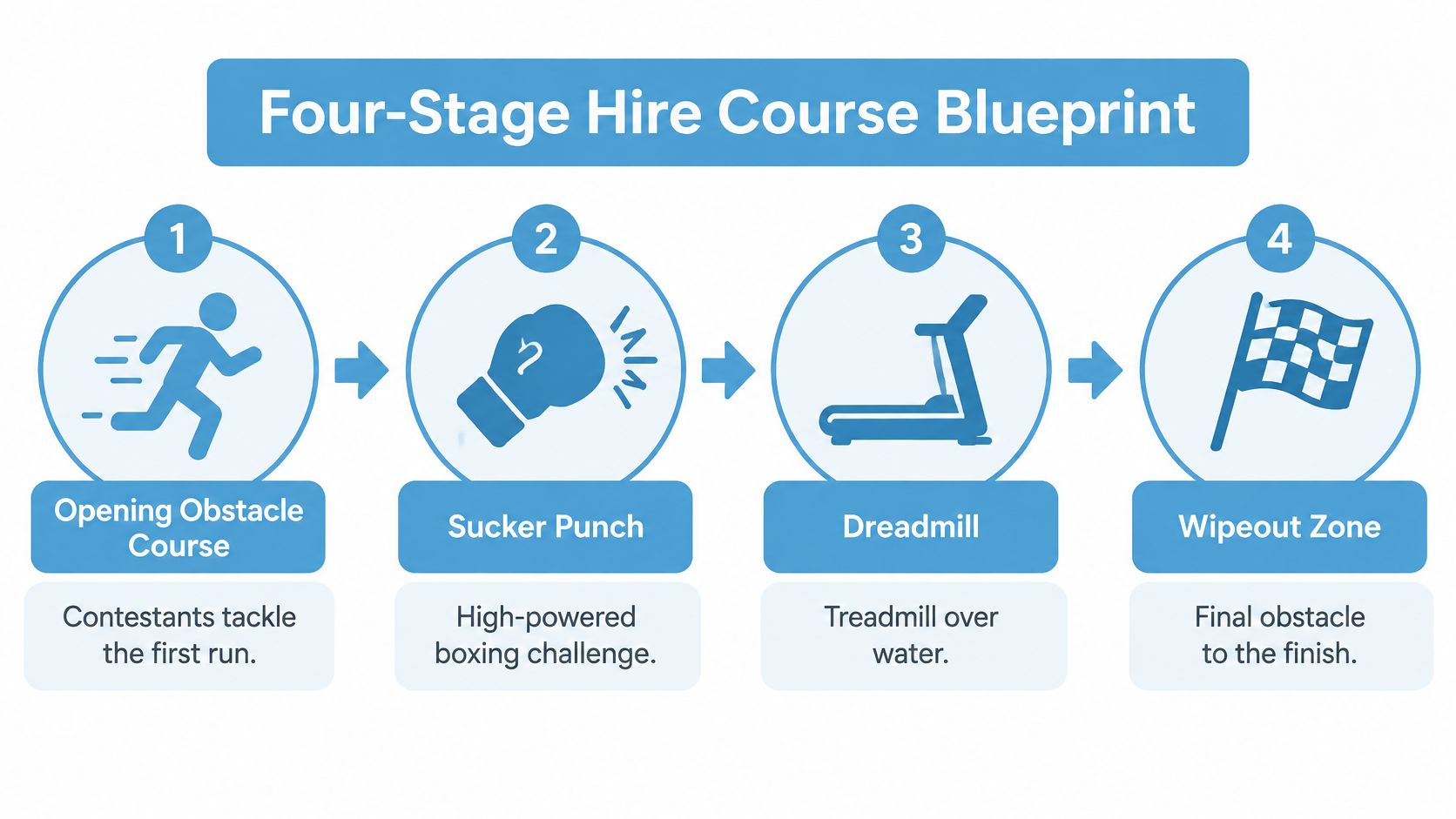
- Opening obstacle course. Contestants tackle the first run. What the operator sets up is a clear start line, a defined end to the stage and padding at the entry and exit. What the organiser decides is whether the clock starts at the first step or on a whistle.
- Sucker Punch. High-powered boxing gloves emerged randomly from a wall while contestants tried to cross a narrow ledge. This stage needs an attendant with no other job, a soft landing area and spacing so the next runner can't enter while someone is on the beam.
- Giant red balls. Contestants jumped between two platforms using four large red foam balls. The setup need is secured, correctly spaced balls and mats on both sides; the decision is how many attempts count before a time penalty.
- Wipeout Zone. Contested by the three remaining competitors, with the winner determined by fastest completion time. That makes it the stage where you need one finish line and a timing method you trust, because this settles the result.
Where the event version departs from the broadcast
The broadcast attached a fixed cast and a single prize. An event version usually keeps the visual identity and the challenge mechanics and rewrites everything around them: the number of rounds, team size, scoring, prize and whether a final exists at all. The organiser decides those, not the show, and the supplier builds to them.
Decide before you book: rounds per session, how teams are scored, whether a final round is included, who keeps time, and what the winning team gets.
Leave those five unanswered and the day drifts into a dispute about who touched the water first. Written down, they're also what your host or compère reads out, which is the difference between a queue and a crowd.
What Delivery Covers From Dry Hire to Full Service
Hire doesn't mean one thing. Two quotes for a similar course can describe completely different jobs.
| Service level | Who operates | What the client handles | Typical user |
|---|---|---|---|
| Dry hire | Client team, no operator supplied | Insurance, installation, safe use and job sheet sign-off | In-house events teams with experience |
| Full event management | Supplier team with trained staff | Briefing and sign-off of the event plan | Venues, brands and agencies wanting a turnkey service |
Dry hire puts the equipment in your hands. You install it, run it, take it down and sign the job sheet, and you hold appropriate insurance and sole responsibility for the equipment from installation until collection or return. That suits an in-house team with its own crew and public liability cover already in place, and it suits nobody who has never anchored an inflatable.
Full event management moves the operational weight to the supplier's team, which plans, delivers, installs and staffs the course and carries the compliance evidence with it. Our own service levels run from dry hire, where no operator is required, up to a full event management service, and our team delivers and sets up all premium equipment and helps with the running of the entire event.
Quote test: if the paperwork doesn't say who stops the session when the wind picks up, you haven't been quoted a full service.
Three questions expose which level you're being sold: which service level is priced, who is the named responsible person on the day, and whose signature closes the job sheet. A quote that lists delivery times but names nobody on site is incomplete, and the gap surfaces at eight in the morning with a queue forming. These answers also change the budget and the insurance you need, so settle them before you compare figures.
What Total Wipeout Hire Costs in the UK
A hire price and an entry ticket measure different things. Published prices vary by service level, format, duration and location, so two UK examples can help set the context without acting as a rate card.
| Source example | Price | Basis |
|---|---|---|
| Norfolk-based Total Wipeout Sweeper, nationwide UK hire (2026) | from £695 for three hours | Hire quote |
| South Yorkshire Total Wipeout-style inflatable water park (2024) | £19 advance online, £20 on the day, per person | Per-person 60-minute session including 10-minute safety briefing |
The first example is an equipment hire quote: a Norfolk-based Total Wipeout Sweeper attraction advertised for nationwide UK hire in 2026 from £695 for three hours (Connections Entertainment). The second is pay-per-session entry at a South Yorkshire inflatable water park, priced at £19 per person for advance online bookings and £20 on the day. Each session lasted 60 minutes and included a 10-minute safety briefing (The Star's report on the park).
At the 2024 advance rate of £19, roughly 37 paid entries would equal a £695 hire fee. That is an arithmetic comparison only: the hire quote covers three hours of equipment, while the entry price covers one person's session on a different product.
For a meaningful quote comparison, check what each price includes and calculate the cost against the course's usable hours and expected headcount. Confirm the delivery, staffing, insurance, wind monitoring and collection arrangements rather than relying on the headline price. For PSW Events' equipment hire options and rates, see the rates page.
Compliance Documents to Request Before You Book
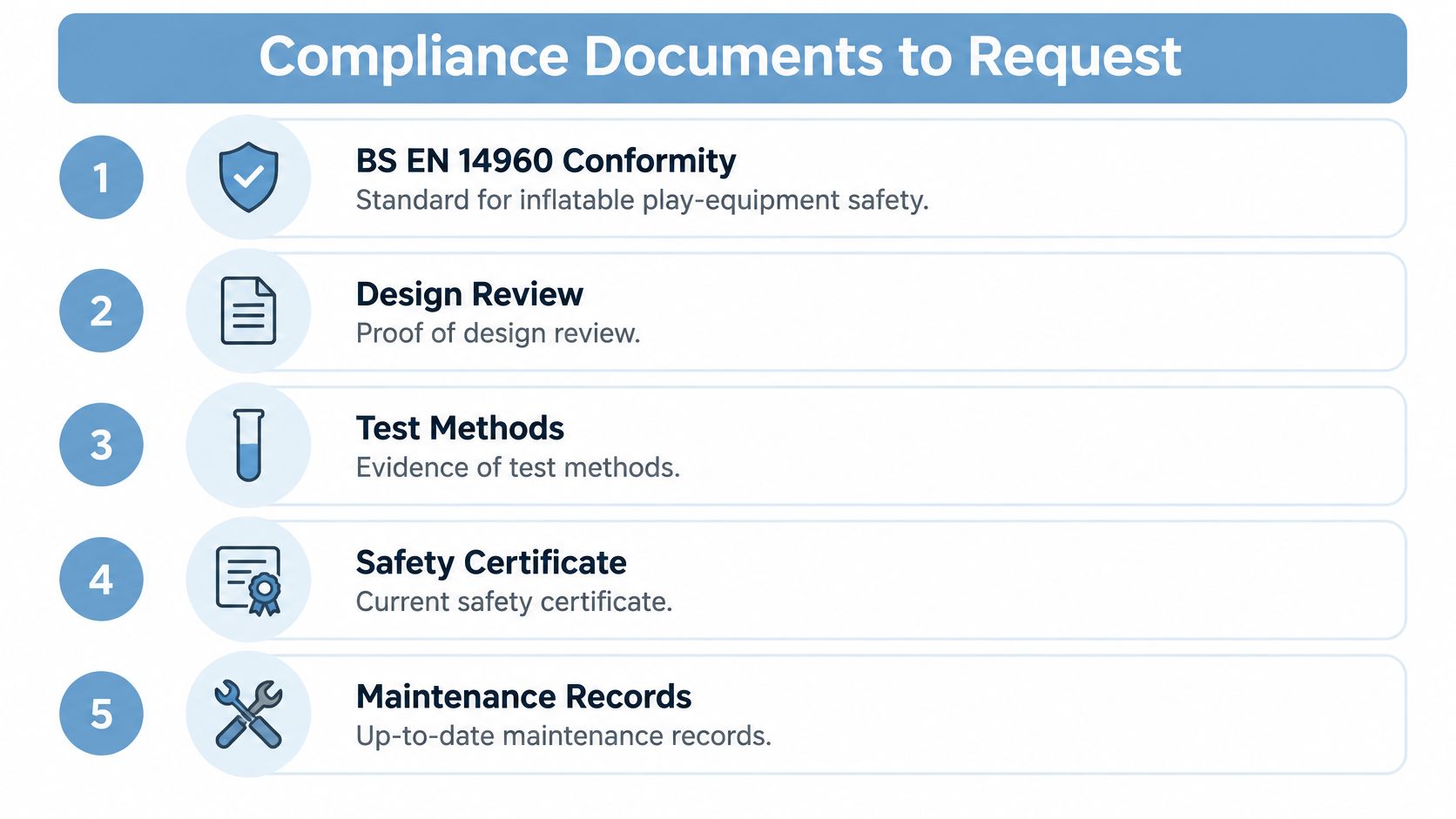
A course can look ready on site while its paperwork leaves key questions unanswered. Before booking, ask the supplier for documents covering the specific inflatable, its inspection history and how it must be operated. The HSE guidance on inflatable documentation describes records such as a design review, initial physical test evidence, an up-to-date annual inspection or Declaration of Operational Compliance, and operating and maintenance manuals. HSE also identifies health and safety requirements for commercial inflatable use, including the relevance of BS EN 14960:2013.
The document set, and what each one proves
- PIPA tag or ADiPS Declaration of Compliance: check that the evidence identifies the individual unit being hired, not only its model.
- Operating and maintenance manuals: these set out the manufacturer's instructions and limits. Use them to inform the event's risk assessment.
- Documented operating procedure: ask how the course is set up, operated and stopped, and who is responsible for each stage.
- Public liability and products cover: PSW Events holds £10 million Products, Employee and Public liability insurance. Ask any supplier for its insurance details and confirm the cover suits your event.
- Staffing and supervision levels: establish how many attendants will be present and what each is responsible for during operation.
- Maximum user limits and emergency deflation: confirm how many people may use the course at once and what the procedure is if it must be brought down.
- Recorded pre-use checks: ask how checks are recorded before operation and who completes them.
Read the paperwork before signing, so you can resolve gaps while there is still time to change the plan. A safe work method statement can set out the work sequence for setup, anchoring, supervision and pack-down. PSW Events' health and safety compliance information is another point of reference when preparing the event safety file. Keep the relevant inspection evidence, insurance details and operating procedure together for the venue's safety review.
Wind, Weather and Supervision on the Day
Wind can determine whether an outdoor course operates. Hastings Borough Council's event guidance states that inflatables should not be operated above 24 mph (38 km/h), equivalent to Beaufort Force 5. Put the limit in the event plan, while checking the specific unit's operating instructions and the supplier's documented stop-use procedure.
Ask how wind will be monitored: where the anemometer will be placed, who will take readings during sessions, and what steps the stop-use and evacuation procedure requires. A weather app forecast is not a live reading at the course.
Use every available anchor point. Correct anchoring helps limit movement, but does not make it safe to operate above the stated wind limit.
Supervision turns the written plan into action. Confirm the number of attendants, the maximum number of users allowed on the course at once, and who can clear it. Also plan how spectators and other event traffic will be kept clear of the run-off area. For general context on fencing, see ABCO Security Services on crowd fencing.
Wet-weather decisions depend on the particular unit. Follow its operating manual and the supplier's documented stop-use procedure for wet conditions and any restart. PSW Events says its team dries equipment affected by rain once the clouds pass so the event can continue; agree in advance who decides whether and when use can resume.
| Condition | Required action | Who decides |
|---|---|---|
| Wind above 24 mph (38 km/h) | Stop use and follow the evacuation procedure | Supplier operator |
| Wind rising towards the limit | Check live anemometer readings and prepare to suspend | Supplier with event lead |
| Rain on the equipment | Follow the unit's operating manual and the supplier's documented stop-use and restart procedure | Agree with the supplier before the event |
Confirm These Points Before You Book
Before paying a deposit, confirm that the event suits the format, the service level is clear, the paperwork is in place and the weather plan names who can suspend use. These checks help you understand the responsibilities and costs before committing.
- Damage and theft liability: The client takes full liability for damage to or theft of equipment while it is hired to them. Check that your insurance covers this.
- Fees if the event cannot run: If circumstances outside the supplier's control, such as weather, terrorism, vandalism, theft, damage on site or poor crowd control, prevent use at the venue, the full fee remains payable.
- Cancellation terms: To cancel, contact PSW Events immediately by phone. A cancellation charge applies; the full list of charges is in the Terms & Conditions.
- Service level in writing: Confirm which service level you have booked, who will be on site and who signs the job sheet.
Before booking, ask what documents apply to the specific equipment and confirm the wind and suspension arrangements in writing. Agree how scoring and rounds will work, whether the equipment will arrive staffed or as dry hire, and what venue access it needs. These details determine who is responsible for operation and whether the equipment can reach its planned location.
PSW Events supplies interactive attractions, including sports and racing simulators, with delivery, staffing and event support. The company holds £10 million products, employee and public liability insurance, and offers service levels from dry hire to full event management. Share your date, venue and expected headcount through PSW Events to discuss availability, access and a quotation.