A brand manager is a fortnight from launch at a major UK venue. The stand is approved and the build is on schedule, but a final run-through exposes the problem: the interactive attraction could sit under almost any exhibitor's logo. It may draw a queue, but the team can't yet explain what that queue should lead to.
That's where event brand activation plans often falter. The issue isn't always the budget or the equipment. It's the missing connection between the audience, the experience and the outcome. A well-built attraction can still produce shallow conversations and a lead list nobody can use.
The UK events sector gives brands a substantial setting for live engagement. The UK Events Report 2024 estimated its annual value at £61.653 billion, with conferences contributing £16.3 billion (UK Events Report 2024 coverage). That scale creates opportunity, but opportunity alone doesn't make an activation effective. A stand has to work as a system that turns passing footfall into relevant interaction and, where appropriate, qualified commercial outcomes.
The Activation Problem Most UK Planners Underestimate
The brand manager in that launch scenario doesn't need another attraction added to the floor plan. They need a reason for the right visitor to stop, an experience that expresses the brand's value, and a clear next step once the interaction ends.
A generic game can create activity without creating meaning. If participants focus only on beating a score, they may remember the challenge but not the company behind it. If staff are occupied managing the attraction, they may miss the chance to understand what brought a visitor to the stand. And if the data capture asks for contact details without a relevant reason, the resulting list may be large but commercially weak.
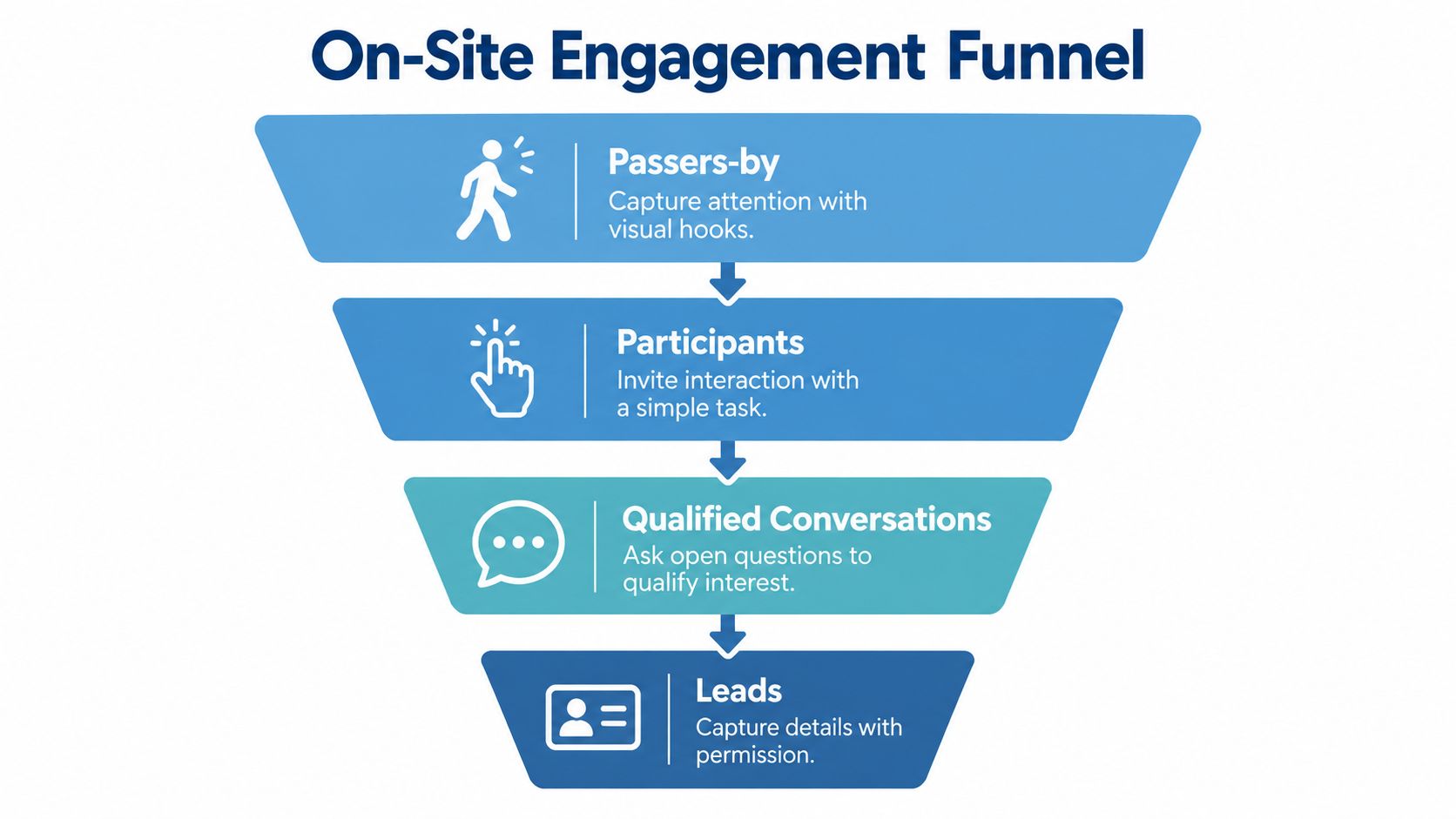
The distinction matters because an activation isn't just a display with an activity attached. It's an engineered engagement funnel. The visual hook earns attention; the interaction gives the visitor a reason to participate; the conversation connects that experience to the brand; and a permission-based next step makes follow-up possible. Each part needs to support the next.
Treat the attraction as part of the system
A polished stand can still underperform if its attraction doesn't suit the audience or if the team can't manage demand. Equally, a simple, well-run activity can work hard when it demonstrates a product benefit, encourages a useful conversation or creates a memorable association.
Before approving the concept, ask what a visitor should understand or do after taking part. If the answer is only “have fun” or “see the brand”, the idea needs more definition. Those outcomes might be appropriate for a broad consumer audience, but they don't automatically serve a sales-led exhibition or a product launch.
Practical rule: Don't buy an attraction until you can describe the visitor journey from first glance to next action.
A workable plan therefore starts with the outcome, not the equipment catalogue. The following decisions build that plan in order: define what success means, match the format to the audience, engineer the on-site funnel, and decide how results will be measured.
Defining Objectives and Building the Concept
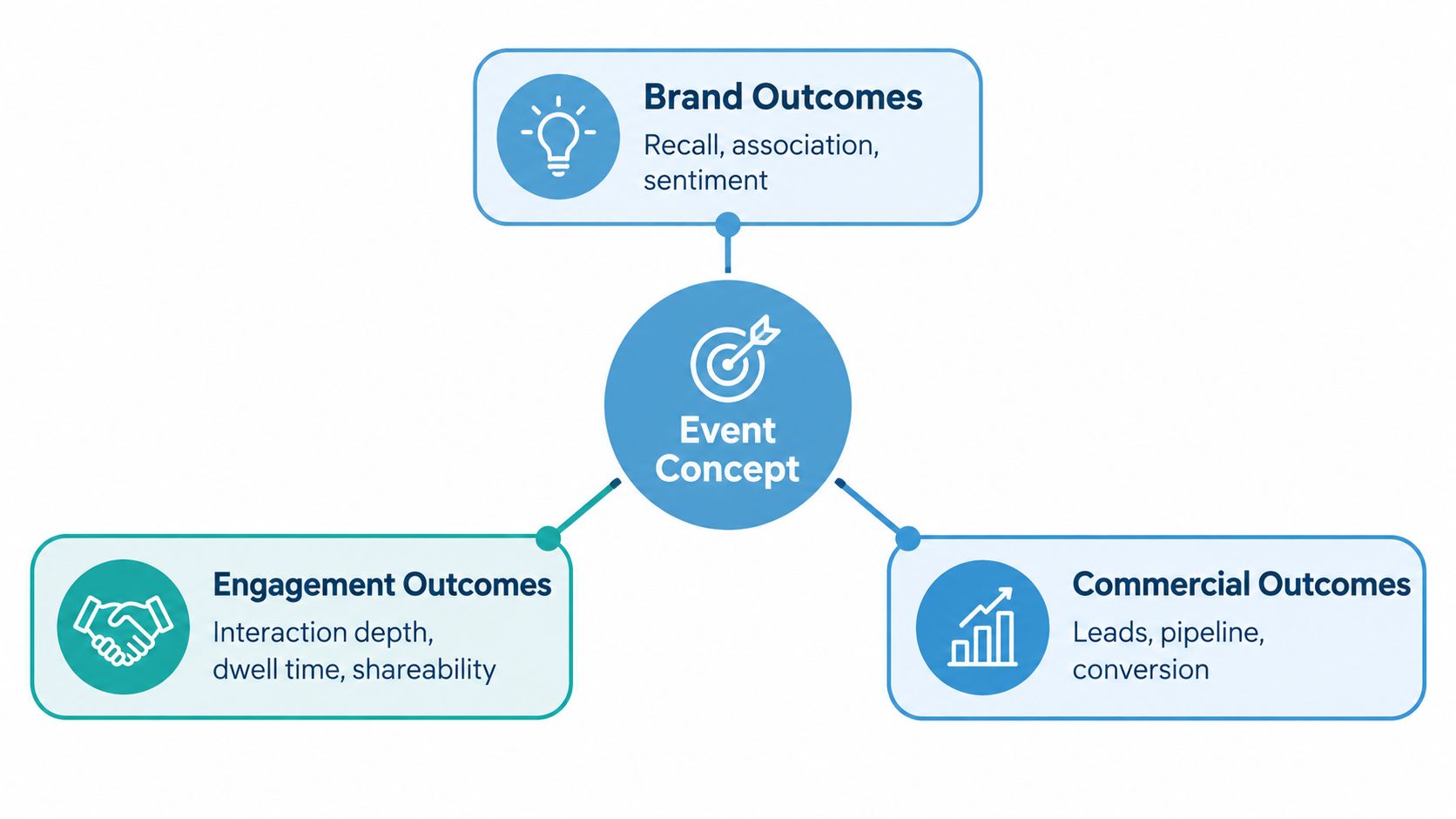
A useful brief separates brand, engagement and commercial outcomes. They can support one another, but they aren't interchangeable. Attendance is an activity count, not proof that the audience remembered the message, had a meaningful interaction or took a sales-relevant step.
UK experiential and activation marketing spend was estimated at more than £5.7 billion in 2023. The same industry summary reports Bellwether budget growth of 17.2% in Q2 2024 and 23.1% in Q1 2024, described as the fastest growth in that dataset's 11-year history (UK activation-industry summary). More spending makes a clear objective more important, not less. A larger or more novel installation won't resolve a vague brief.
Set the objective before choosing the format
Start by writing down the audience and the intended change. Then work across three layers:
- Brand outcomes: What should people remember, associate with the company or feel about its offer?
- Engagement outcomes: What interaction would show genuine interest, such as completing a demo, staying for a conversation or sharing a challenge?
- Commercial outcomes: What action matters to the business, such as a qualified lead, meeting request or opportunity advanced?
Be realistic about what the activation can influence. A live experience may help create recognition or open a conversation; it can't promise that every participant will become a customer. For sales-led activity, agree how leads will be qualified and how any later opportunity will be connected to the campaign.
Turn a vague ambition into a concept
Consider a B2B technology company whose brief says, “increase our presence at the exhibition”. That gives the delivery team no audience priority, message or useful action. A more workable version identifies a target group, a problem the product solves and an interaction that can surface interest.
For example, a competitive timed challenge could lead into a short discussion about how the attendee currently handles a related task. The challenge attracts participation; the follow-up question reveals context; the product conversation becomes relevant rather than scripted. This is a concept because the activity and the commercial purpose reinforce one another.
Finish the brief in one paragraph: name the audience, the brand idea they should take away, the interaction that expresses it, and the next action the team will invite. If those details don't fit together, refine the concept before approving production.
Choosing Attractions That Match the Audience and Venue
Attraction choice is a design decision, not a novelty contest. A format that creates a long dwell time may suit a product demonstration but restrict participation in a busy hall. A fast game may keep a queue moving but leave little time for a conversation. Compare formats against the job they need to do, the available space and the people who'll use them.
| Attraction type | Typical dwell | Lead capture ease | Accessibility profile | Best objective fit |
|---|---|---|---|---|
| Racing or sports simulator | Medium to long | Medium, with a clear follow-up prompt | Controls, seating and transfer access need planning | Product association, dwell and conversation |
| Motion or VR experience | Medium to long | Medium; capture after use to avoid interrupting | Sensory load and mobility access need careful review | Immersion and brand storytelling |
| Batak Pro or reaction game | Short to medium | High when paired with a simple qualifier | Standing and reach requirements may need alternatives | Fast participation and competition |
| Giant Scalextric | Medium | Medium, especially with a leaderboard | Track layout, reach and queue access matter | Shared play and spectator engagement |
| Climbing wall | Medium to long | Medium; staffing and consent need thought | Not suitable for every visitor, so offer an alternative | Physical challenge and spectacle |
| Casino table | Short to medium | High with staffed conversation | Seated play can help, subject to table setup | Social interaction and hospitality |
| Sampling route | Short | Low to medium unless a relevant data route is planned | Dietary, sensory and non-digital options matter | Trial and broad consumer reach |
| Low-sensory or seated activity | Flexible | Medium | Can widen participation when designed around varied needs | Inclusion, consultation and accessible engagement |
“Typical dwell” describes the planning trade-off, not a guaranteed duration. Actual session length depends on briefing, participant choices, reset time, queue conditions and staff support. Build the attraction around the visitor journey, then check whether it can run reliably in the venue.
Match the shortlist to practical constraints
Ask how many people can participate, how much staff attention each session requires and whether the activity leaves room for a conversation afterwards. Check the footprint, power and connectivity requirements, installation route, sound levels and sightlines. An attraction that works in a spacious fan zone may crowd a compact exhibition stand.
Accessibility needs to be assessed against the specific controls, seating, approach route and sensory conditions, not inferred from a product label. Provide a meaningful alternative for anyone who can't or doesn't want to use the main activity. For broader inspiration beyond simulator-led formats, The Ten District's activation guide offers examples of street-level ideas that can prompt different approaches to public engagement.
For a structured way to compare audience, space and practical requirements before committing, use this guide to choosing event attractions. PSW Events is one UK supplier option for branded simulators and interactive games, with planning, logistics and on-site staffing available as part of delivery. Whatever the provider, choose on fit and run-of-show reliability, not spectacle alone.
Engineering the Engagement Funnel On Site
On event day, the team needs a shared sequence for turning attention into action. That sequence starts with a visible hook and ends with a prompt follow-up. Without clear roles, the attraction can become a busy island: people participate, staff stay occupied, and nobody connects the activity to a useful conversation.
The capacity model should be agreed before booking. Theoretical throughput equals available operating minutes divided by the average session cycle time. Include the briefing, activity, reset, accessibility support and safety checks in that cycle, rather than calculating from the activity time alone. Then apply a realistic utilisation factor to account for peaks, staff breaks, technical interruptions and visitors who leave the queue.
Run the sequence deliberately
- Attract: Use a clearly branded visual hook or an easy-to-understand challenge. Visitors should be able to tell what's happening from the aisle.
- Qualify: Ask a permission-based question that helps staff understand relevance, rather than turning entry into an interrogation.
- Deliver: Keep the experience dependable and easy to explain. The operator should be able to manage the activity without improvising safety or access procedures.
- Connect: Link the experience to the brand or product. A short, relevant conversation is more valuable than a sales pitch delivered to every participant.
- Capture: Ask for consent and collect only information the follow-up team can use. Explain what the visitor is agreeing to.
- Follow up: Agree ownership and timing before the event. Validate records and pass qualified leads to the right person promptly.
For branded giveaways, the item should reinforce the interaction rather than act as a substitute for it. A practical resource on how to make merch kits can help teams think through useful, coherent takeaways.
Protect quality when the stand gets busy
UK event-marketing reporting indicates that 68% of B2B marketers view events as their most effective lead source and 79% report sales generated from event marketing. Treat those figures as directional benchmarks, not predicted results for a particular activation (UK event-marketing reporting). Sector, audience, offer and follow-up all affect what a campaign achieves.
Don't assign one operator responsibility for both safety and sales when the attraction needs active supervision. Model staffing around expected demand, and make sure someone can manage the queue while another person qualifies visitors. Track the conversion chain from passers-by to participants, qualified conversations, leads and meetings. For capture mechanics and permissions, see this practical guide to lead capture at events.
Branding, Wayfinding, Logistics and On-Site Compliance
The attraction doesn't operate in isolation. Its signage, position, power supply, crew and safety arrangements all shape the experience. Good production work is often invisible to attendees, but a missed access window, unclear queue route or poorly placed sign can quickly become visible.
Industry-backed commentary drawing on UK attention research reports that live viewing generates 21% of UK media revenue despite representing less than 1% of consumed hours (UK attention-research commentary). For planners, the practical implication is to make live engagement easy to notice and easy to approach. Branding should work from a distance and remain consistent once a visitor is at the activity.
Put the operational checks in writing
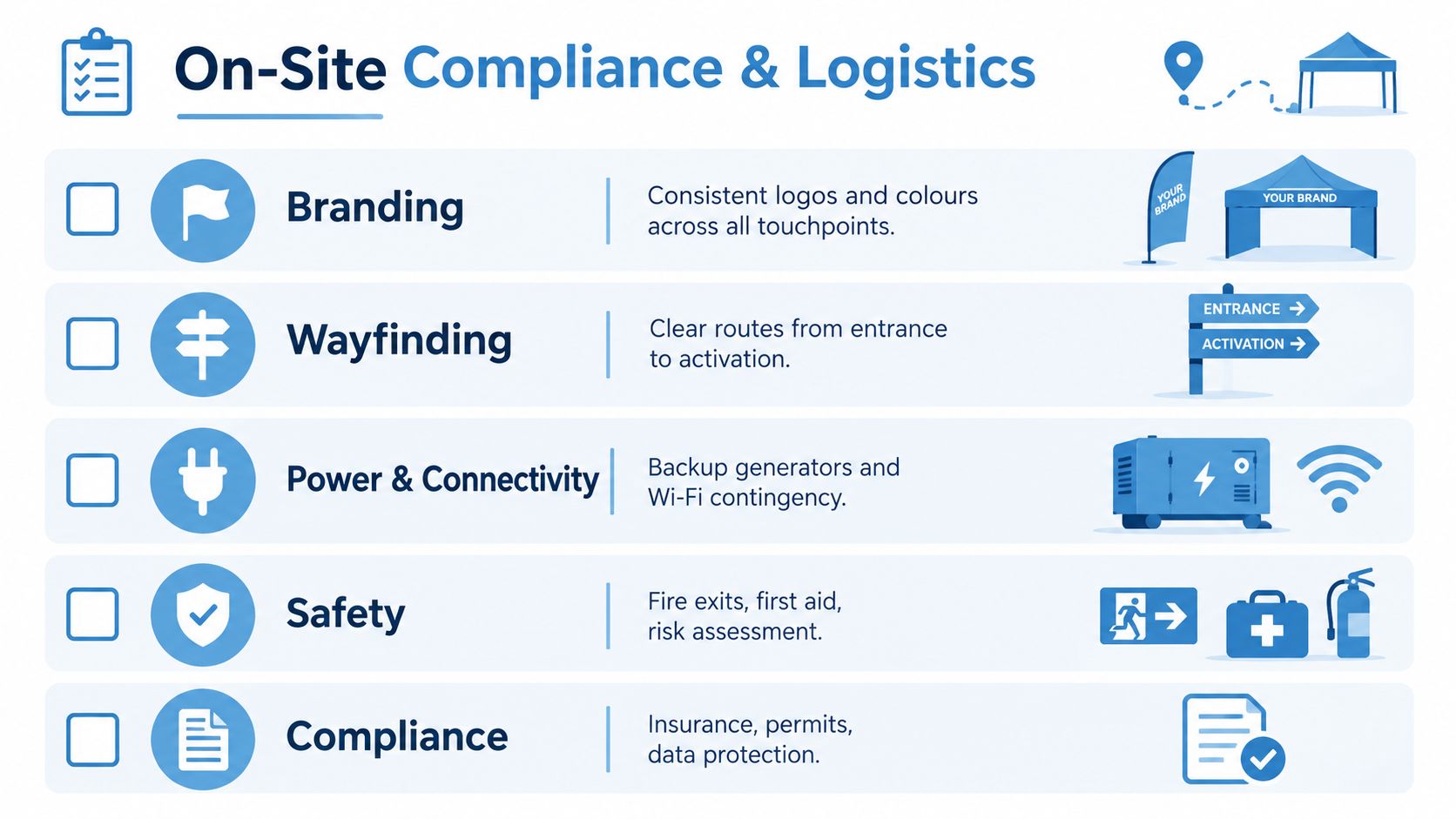
Use this pre-event checklist with the project manager and venue contact:
- Branding and wayfinding: Confirm sightlines, logos and colours across the attraction, signage, queue barriers and any leaderboard. Map the route from the entrance to the activity.
- Venue access: Confirm vehicle schedules, loading arrangements, installation and removal windows, storage and waste handling.
- Power and connectivity: Confirm the supply, cable routes and any internet dependency. Agree a contingency if connectivity fails.
- Crew and run-of-show: Brief operators on the schedule, queue management, escalation contacts, breaks, visitor welcome and handover procedures.
- Safety and compliance: Prepare risk assessments and method statements; check equipment requirements, insurance, permits, emergency arrangements and data-protection processes.
- Accessibility and safeguarding: Review routes, controls, seated alternatives, sensory conditions and support for under-18s where they may attend.
Don't treat a printed sign or a branded machine as a complete visual system. Visitors need to know where to queue, what they can do and where the activity ends. If lighting is part of the production, coordinate its effect on visibility, photography and neighbouring activity. This guide to lighting production for live tribute shows offers relevant context for thinking about lighting as an integrated production choice.
Compliance should be evidenced, not assumed. Ask the supplier and venue to confirm their responsibilities, insurance documentation and working arrangements before load-in. Clear ownership reduces last-minute disputes and gives the crew a practical reference on site.
Measuring Beyond Footfall and Lead Volume
A useful measurement plan separates brand, engagement and commercial results. Footfall describes who passed the stand; it doesn't show whether the intended audience stopped, understood the message or took a meaningful next step. Lead volume has the same limitation if the records are incomplete or irrelevant.
Recent UK experiential data records 321 brands and agencies delivering 3,493 live activation days across 360 venues and 90 towns and cities in 2025 (UK experiential activity reporting). Those activations don't share one audience, objective or sales cycle, so comparing raw totals without context can mislead. Set a baseline and measurement method before production begins.
Build evidence around the objective
For brand outcomes, agree what recall, association or sentiment means and how it will be assessed after the event. For engagement, record completed sessions, repeat participation, dwell observations and conversation quality. For commercial outcomes, use consented registration, QR or NFC interactions and CRM-compatible lead fields, then track meeting requests, opportunities and revenue against campaign IDs and an agreed attribution window.
Calculate efficiency against meaningful outputs, such as cost per qualified lead or cost per hour of qualified audience attention, rather than footfall alone. Where direct revenue attribution isn't possible, use exposed-versus-control surveys, matched audience comparisons, brand-lift studies or agreed proxies such as qualified meetings and pipeline movement. Each method has limits, so state what the evidence can and can't establish.
A high-volume activity may be weaker than a smaller one if participation is shallow or poorly matched to the buying journey. Avoid counting prize-driven entries as buying intent, and don't report social impressions without deduplication or a link to meaningful action. For a practical framework to connect event outcomes to business measures, see this guide to experiential marketing ROI.
A Practitioner Summary You Can Brief Against
A successful event brand activation is a working system, not a piece of equipment. The concept, audience, attraction, staffing, venue plan and measurement method need to reinforce one another. If one part is missing, the activity may still look busy while producing little the business can use.
Put the following decisions in writing before approving delivery: the objective mix; the reason the attraction suits the audience and venue; the throughput and utilisation model; the staffing and follow-up plan; the compliance evidence; the accessibility and sustainability specification; and the measurement framework. Ask how materials will be reused, how transport and power will be managed, and how participation barriers will be identified rather than relying on a general claim of suitability.
PSW Events provides simulator-led experiences for exhibitions, conferences and brand activations, with branding, logistics, installation and on-site staffing available for short- or long-term hire. Treat any supplier's proposal as a delivery plan to test: ask what happens on site, who owns each task and what proof you'll receive afterwards.
PSW Events can help UK planners deliver branded simulator and interactive game activations, from planning and logistics through installation and on-site staffing. If you're developing an experience that needs to turn attention into meaningful participation, visit PSW Events to discuss your event requirements.