
You're staring at a booking email and a floor plan, and the whole decision comes down to one thing. Do you put people outdoors at a driving range, or do you bring the golf experience inside with a simulator and keep the event moving no matter what the weather does?
| Criterion | Golf Simulator | Driving Range |
|---|---|---|
| Venue fit | Works in indoor event space with power and floor space | Needs outdoor land, safety zones and suitable conditions |
| Audience fit | Strong for mixed groups, non-golfers and short-format play | Strong for golfers who want live ball flight and outdoor feel |
| Feedback | Measures shot data and repeatable performance | Shows real ball flight, with more value when tracking tech is installed |
| Weather | Weather-independent | Weather-dependent |
| Event use | Better for exhibitions, conferences and branded activations | Better for golf-centre visits and outdoor social sessions |
| Best outcome | Repeatable, scoreable, venue-flexible golf | Authentic outdoor practice and natural rhythm |
The right answer in the UK isn't “simulator” or “range” in the abstract. It's the one that fits the people, the room, the weather and the result you need from the day. That's why a planner comparing golf simulator vs driving range should think like an event producer, not like a golfer chasing the perfect strike.
Choosing Between a Golf Simulator and a Driving Range
A planner usually makes this call late, after the venue is fixed and the golf idea still has to work in the venue you have booked. The outdoor option looks simple, but it only works if you have the land, the safety buffer and decent conditions. The indoor option looks more flexible, and that is why it gets chosen for brand events, hospitality suites and exhibition stands.
The wrong debate is “which is better?”. The right question is which format fits the audience in front of you. A corporate room full of mixed-ability guests needs a different answer from a golf club running a practice session.
Judge it on six things, cost, training value, accessibility, weather, data and event fit. If your priority is getting people involved quickly, especially non-golfers, the indoor option usually wins. If your priority is live ball flight and an outdoor feel, the range still has the edge.
UK demand is large enough for both formats to matter. More than 3.5 million people used a driving range in Great Britain in the R&A's 2021 report R&A participation report. A separate club survey shows that many members' and proprietary clubs still provide a range or practice ground, though not every site does. That matters because the choice is not whether golf has an audience. It does. The choice is which format reaches that audience cleanly in your venue.
If you are also planning the visual layer of the event, custom flag designs for Arizona lawns is a useful example of how branded golf details can support the wider experience without changing the core format.
What Each Format Is in the UK
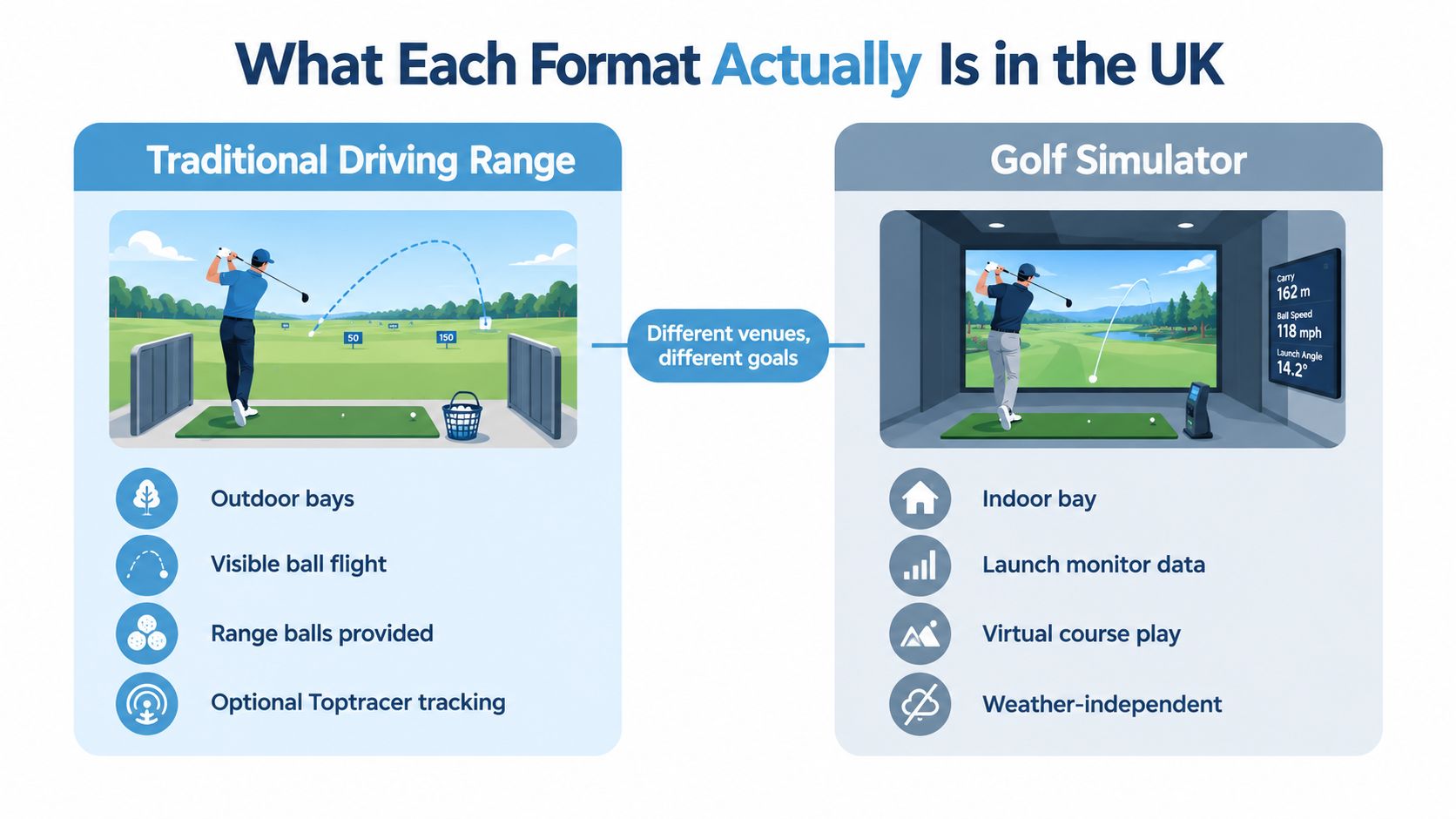
A traditional driving range is an outdoor hitting setup. Players stand in bays, strike range balls into open space, and judge the shot by the flight they can see. Some ranges add tracking systems, but the core experience stays the same. It is still outdoor ball flight, daylight, turf feel and weather exposure.
A golf simulator works differently. The player hits indoors, usually into a screen, while a launch monitor captures the strike and software turns that data into a playable experience. That can mean virtual courses, target games, distance challenges or straightforward shot analysis. It fits into a compact indoor footprint and brings golf to venues that do not have outdoor space.
The UK scale matters because both formats sit inside normal golf behaviour, not niche behaviour. The R&A's 2021 Great Britain Golf Participation Report recorded more than 3.5 million driving range users R&A participation report. That is a large practice audience already comfortable with range sessions. Off-course golf also includes simulator use and other indoor play England Golf participation figures.
Club infrastructure backs that up. The 2025/26 Members' and Proprietary Golf Clubs Survey found 79% of members' clubs had a driving range or practice ground, while 78% of proprietary clubs did Hillier Hopkins golf clubs survey. The range is established, but it is not universal. That gap is why simulators matter for corporate events and mixed audiences. They deliver a golf experience without asking guests to travel to an outdoor golf site, and that makes conversion of non-golfers easier than most planners expect.
The short version
A range gives you ball flight and outdoor feel. A simulator gives you measurement, repeatability and venue flexibility.
Side-by-Side Comparison Across the Six Criteria
A corporate planner does not need a golf debate. They need the format that fits the audience, the venue, and the job you want the session to do. If the room is full of mixed abilities, clients, or people who do not already play golf, the simulator is the safer bet. If the group already wants an outdoor practice session and the site can support it, the driving range wins.
Cost is where people get trapped by the headline number. The range can look cheaper, but only if you ignore transport, weather cover, and the need for the right site. A simulator often bundles more into one hire quote, especially for events where staffing, scoring, and branding matter.
Training value depends on what you want participants to leave with. A simulator gives diagnostic detail and repeatable feedback. A range gives live ball flight and a more natural practice rhythm. That makes the range a better fit for golfers who want to hit real shots outdoors, while the simulator serves mixed groups better because it reduces the barrier to entry.
Accessibility is straightforward. The simulator goes to the venue. The range makes the audience travel to the golf site, which narrows the pool before the event even starts. That matters more than many organisers admit, because conversion of non-golfers usually decides whether the activation feels inclusive or cliquey.
Weather is an easy call. Indoor wins. Data follows the same logic. A launch monitor gives the simulator a clean edge unless the range has tracking technology installed, and if you are comparing that route, the guide to top driving range monitors is useful context.
Event suitability is where the simulator pulls ahead for corporate work. It is easier to brand, score, and run in a conference room or exhibition shell scheme. The range suits a group that already wants golf first and foremost, not a wider audience that needs a lower barrier.
Practical rule: if the audience is mixed and the venue is fixed, choose the simulator. If the audience already wants golf and the venue already has outdoor space, choose the range.
A meaningful minority of UK clubs still have no range or practice ground, which is exactly the gap a mobile simulator fills.
| Criterion | Golf Simulator | Driving Range |
|---|---|---|
| Cost | Often higher upfront for hire, but bundled and venue-flexible | Usually lower headline cost, but outdoor logistics can add friction |
| Training value | Stronger for diagnosis, repeatability and structured scoring | Stronger for live ball flight and outdoor rhythm |
| Accessibility | Fits indoor venues with floor space and power | Requires outdoor space and travel to a golf site |
| Weather | Fully weather-independent | Weather can stop or blunt the session |
| Data | Captures shot metrics directly | Best with added tracking technology |
| Event suitability | Better for branded activations and mixed groups | Better for golfers who want a real practice setting |
Cost Analysis for Personal and Corporate Use
The wrong way to compare cost is to stop at the hire fee. The right way is to ask what each participant gets done in the time you've paid for. A cheaper booking that underperforms is still expensive.
For a consumer practising weekly, a range usually keeps the spend lower and the habit simpler. You pay for balls, a bay and a visit, and you get an outdoor session with visible feedback. A home simulator setup changes the economics completely because the launch monitor becomes the first real expense, and UK technical guidance places mid-range systems around £1,000 to £3,000, with premium systems above £3,000 UK launch-monitor guidance. That's the sort of purchase that makes sense only if the user will practice often enough to justify it.
For a corporate buyer, the comparison is cleaner. Range hire can be cheaper in headline terms, but the venue must work, the weather must hold and the safety envelope must be right. A simulator hire usually costs more as a package, yet it brings branding, scoring, staffing and setup into one controlled delivery. PSW Events' golf simulator price guide is a sensible starting point if you're comparing indoor event budgets.
Hidden costs are where outdoor events often drift. Transporting clubs, managing weather contingency, covering safety zones and staffing the space all add friction. Indoor hire shifts more of that burden into one controlled specification, which is why planners often prefer it for exhibitions and hospitality suites.
The cheapest option on the quote is not always the cheapest option in the room.
A simulator wins on usable participant-hour when the room matters more than the location. A range wins when the venue is already set up for golf and you want straightforward ball striking without extra event layers.
Training Value and the Data Each Setup Delivers
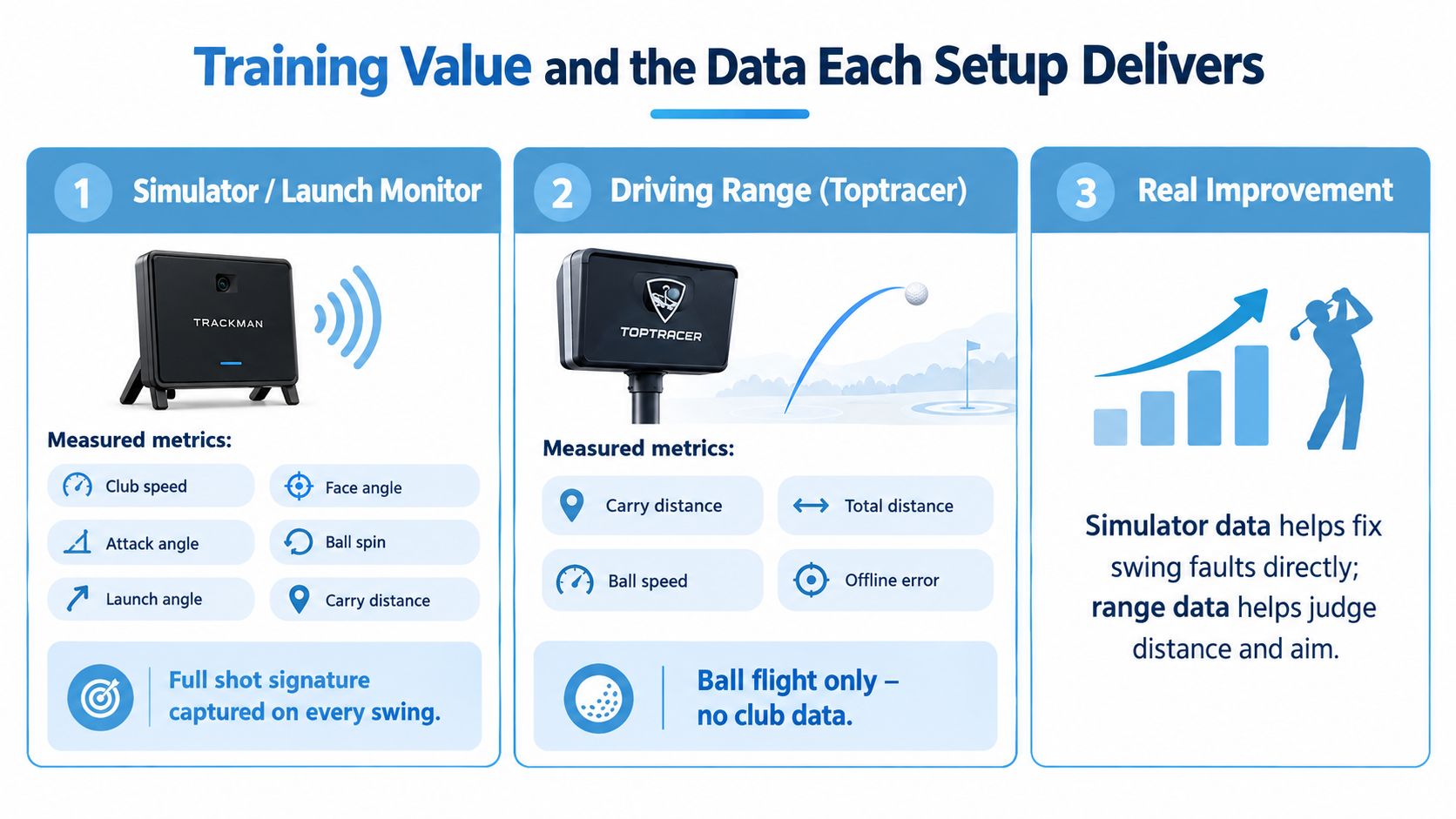
A simulator is stronger because it turns every swing into usable information. A premium launch monitor tracks the shot signature, not just the outcome, which is why coaches use it for diagnosis and gapping. UK facilities using TrackMan technology advertise measurements including club speed, club path, face angle, attack angle, dynamic loft, ball speed, launch angle, launch direction, spin rate, spin axis, carry, total distance, apex, landing angle, smash factor, low point, dispersion and distance gapping TrackMan facility data.
That data matters because it tells you why a shot behaved the way it did. A player can see whether the club arrived too open, whether the strike lost efficiency or whether the dispersion pattern is widening. The point isn't just feedback, it's repeatable diagnosis.
A driving range gives a different kind of value. Untracked, it shows ball flight and landing area, which is useful but limited. Add tracking and the story improves. A tracked range can measure carry, total distance, ball speed, launch angle, peak height, side deviation and hang time, which narrows the gap between outdoor practice and a simulator session.
That still doesn't make the experiences identical. The simulator is better for repeatable skills testing, while the range is better for outdoor rhythm and the feel of open space. A lot of serious golfers need both, but they need them for different reasons.
The range tech story is not theoretical. A 2024 report on UK Toptracer installations described Playsport Golf Range near Glasgow recording a 52% increase in range balls hit and 90% revenue growth after adopting the technology, with more than 2.3 million additional balls hit in the first 12 months Toptracer range report. That doesn't mean every range performs the same way. It means the right technology can turn an outdoor practice venue into something more engaging and more measurable.
If you want visible feedback indoors, a branded ball line such as high-visibility golf ball options can make screen and flight tracking easier to follow for participants. It doesn't change the core format, but it improves the experience for event groups who need immediate visual clarity.
Accessibility, Weather and Audience Fit
Choose the format people will use. A technically better setup that puts first-timers off is a poor event choice.
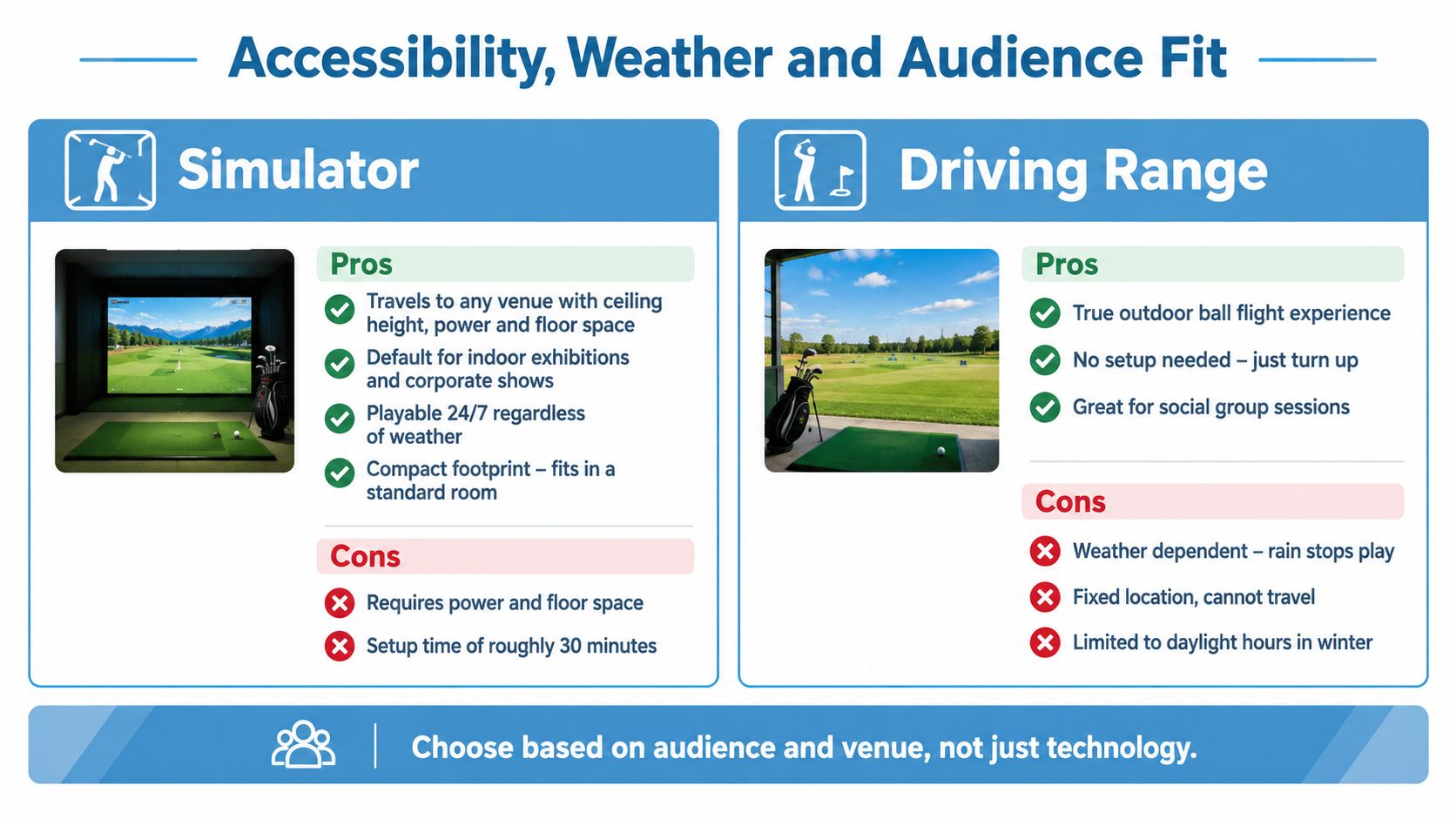
A simulator fits indoor exhibitions, conferences and branded activations because it goes to the venue. If you have ceiling height, power and enough floor space, you can run a golf experience in places that were never built for golf. A driving range cannot do that. It needs outdoor land, safe ball flight and weather that lets guests stand comfortably and swing without distraction.
The deciding factor is conversion of non-golfers, not swing purity. England Golf participation figures show 5.3 million people played an off-course format such as a driving range or simulator, while 7.3 million played on a nine- or 18-hole course England Golf participation figures. Those groups overlap, but the point stands. A large off-course audience already accepts golf-adjacent experiences, and in corporate settings the format that lowers hesitation and gets people to return is the one that wins.
Serious golfers are the exception. Outdoor course play still gives a social and wellbeing experience that range practice and home-based formats do not fully match, so a simulator should be sold as a controlled practice tool, not a substitute for course golf Abertay and York St John wellbeing study.
Use the venue and audience to make the call:
- Rainy exhibition: choose the simulator. Indoor control beats a weather gamble every time.
- Summer product launch: choose the range if the site has the land and the crowd wants an outdoor social feel.
- Mixed-ability team day: choose the simulator for simple scoring and quick inclusion, or a tracked range if the group already plays golf.
If your goal is to get non-golfers relaxed and taking part, the simulator has the edge. A format such as PSW Events' mobile golf simulator works well for that because it brings golf into venues with no golf infrastructure. If your goal is to give committed golfers a more natural first contact with club and ball, the range feels more familiar.
Which Option to Choose and When
For corporate planners, brand activations and indoor venues, the simulator is the default choice. It's weather-proof, repeatable, instantly scoreable and built for a standard exhibition bay or conference room. If the brief is to draw a crowd, keep them engaged and capture branded moments without worrying about outdoor logistics, don't overthink it.
For serious golfers building a long-term practice habit, the driving range is still the better weekly choice, especially when it has tracking technology. A range gives you live flight, natural rhythm and the kind of outdoor feedback that matters when you're preparing for course golf. A simulator is the right add-on in winter or when you need structured data.
For non-golfers and mixed-ability groups, the answer depends on the event shape. A range can feel more natural as a first contact with a club. A simulator with targets, games and leaderboards often does a better job of getting people to try, score and return.
PSW Events' mobile golf simulator is the sort of format that fits this use case neatly, because it brings golf into venues that don't already have golf infrastructure. That's the practical advantage buyers are really paying for.
Choose the format that matches the venue, the audience and the goal. Don't choose the one that produces the most data if nobody in the room cares about the data.
Booking, Setup and Frequently Asked Questions
A proper UK simulator booking starts with the room, not the game. Check ceiling height, floor space and power first, then confirm where branding goes, whether you need leaderboards, who staffs the setup and what insurance sits behind the hire. If those details are clear, the event tends to run smoothly.
For golf-centric activation work, a hire package should also specify the scoring mode, whether the session is coached or open play, and how participants enter and exit the space. If you're comparing suppliers, that level of detail matters more than glossy screenshots. PSW Events' hire golf simulator page is a practical reference point for how this sort of booking is typically structured.
Does a simulator match outdoor carry?
Not automatically. UK guidance recommends calibrating against monitored outdoor carry, because temperature, altitude, ball type and normalisation settings affect calculated flight. Once calibrated, a good simulator should be close enough for event scoring and practice, but it still isn't the same as watching the ball fly outdoors.
Does a Toptracer range close the data gap?
It closes part of it. A tracked range adds useful flight data and makes the session more engaging, but it still doesn't capture the full club-and-ball signature that a simulator can record. It's a better range, not a simulator in disguise.
Which works better for mixed-ability groups?
Usually the simulator. Games, targets and leaderboards make it easier to include first-timers without slowing the group. A range can still work well, but it relies more on the participants already feeling comfortable with outdoor golf.
Which is better for corporate hospitality?
If the venue is indoors or the brief is branded engagement, choose the simulator. If the venue is already a golf site and the audience wants a more traditional practice feel, choose the range. The decision rule stays the same, match the venue, the audience and the goal.
If you're planning a golf activation, exhibition feature or corporate hospitality day, PSW Events can supply the simulator, set it up, staff it and adapt it to the room you've booked. Visit PSW Events to check mobile golf simulator hire and build the right format around your venue, your audience and your event goal.