
You've booked the venue, announced the date and promised families a brilliant day. Then the practical questions arrive. Where will queues form? What happens if it rains? Can a child using a wheelchair take part? Who stops an attraction when something goes wrong, and who is still on site when the last vehicle leaves?
That's the difference between hiring a few popular activities and delivering a well-run family fun day hire experience. The strongest events are built around visitor flow, safe supervision, inclusion and a credible fallback plan, with entertainment selected to support that operation rather than dictate it.
The Reality of Planning a Family Fun Day
At a busy family event, small omissions become visible quickly. A bouncy castle draws a queue across an access route, a racing simulator becomes popular with adults as well as children, and a sudden shower sends everyone towards the same covered area. Parents want to know where to go, children want to get involved immediately, and the event team has to keep movement safe without making the day feel over-managed.
That demand is substantial. Government-supported data recorded an average of 586 million annual visits to England's natural environment by adults accompanied by children during 2009–2012, demonstrating that family-oriented recreation represents a major part of the leisure economy (Outdoor Recreation data). A family fun day therefore deserves the same operational discipline as any other public-facing event.

Entertainment is only one part of the plan
Start with the visitor journey, not the supplier catalogue. Trace how guests arrive, register or enter, find toilets, reach attractions, pause for food and leave the site. Then identify the points where children may run, adults may stop suddenly, buggies may narrow a route or queues may spill into another activity.
A workable plan usually assigns clear ownership for:
- Arrival and information: Someone must answer practical questions and direct families before queues develop.
- Attraction supervision: Each activity needs a competent operator who understands capacity, restrictions and emergency procedures.
- Movement and queuing: Staff should watch the shape and behaviour of queues, not just count people inside the venue.
- Incident communication: The event team needs a shared method for reporting stoppages, injuries, lost children and weather changes.
A useful companion to formal risk planning is this guidance on crowd management at events, particularly when you're assessing how people gather, move and disperse.
Practical rule: If the plan only describes what guests will do while using an attraction, it isn't an event plan yet. It needs to describe how they reach it, wait for it, leave it and find an alternative.
Selecting Attractions That Fit Your Audience
A family fun day usually starts to go wrong at the attraction shortlist. The inflatable looks great in a brochure, the simulator sounds impressive, and the craft table feels like an easy add-on. On site, the test is whether those choices work for toddlers, teenagers, grandparents, buggy users, and parents who do not want to spend the day standing in queues.
Choose attractions by audience, footprint, throughput and participation style. That mix matters more than booking the biggest item on the hire list. A good programme gives different age groups something meaningful to do at the same time, without forcing everyone into the same pace or noise level.
Start with behaviour, not just age bands. Younger children often need short sessions, clear supervision and activities they can join without hesitation. Older children usually stay engaged longer if there is challenge, competition or a skill element. Adults also need a reason to take part. Racing simulators, Batak, giant Scalextric and accessible creative stations tend to work because they let families join in together rather than splitting into watchers and participants.
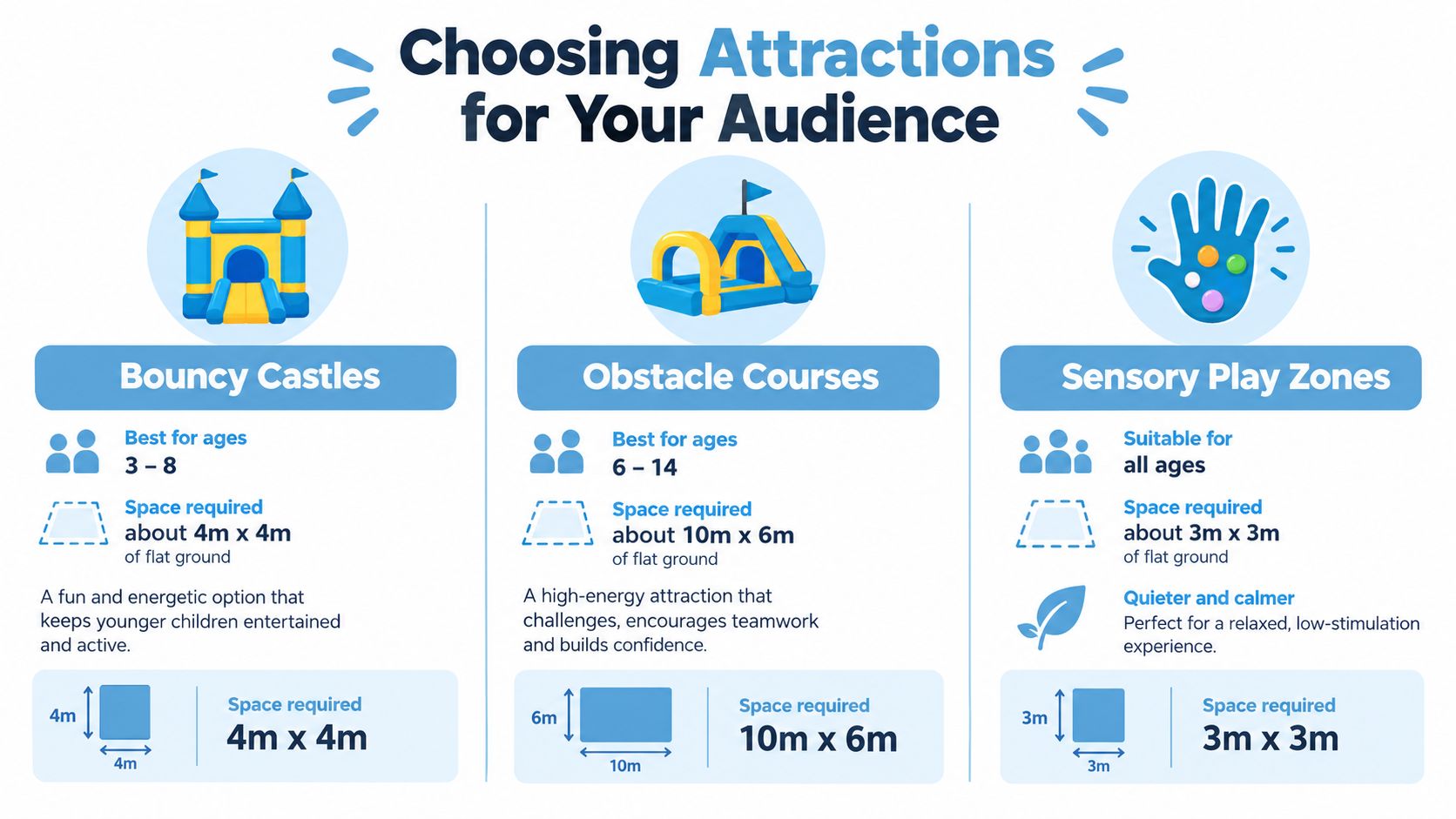
A practical selection check helps avoid expensive mistakes.
First, confirm who can use each attraction. Ask about age, height, mobility, confidence level and the supervision needed. If one activity rules out a big part of the audience, place an equivalent option nearby so siblings and carers are not left waiting around.
Then check the true operating footprint. Suppliers often quote unit size first. The usable space is larger. You need room for access, queue lines, operator positions, emergency clearance and any power or cable routes.
Finally, check dwell time against location. A high-demand attraction with slow turnover can create frustration if it sits near toilets, catering or the main entrance. That is an audience-fit problem, not just a layout problem.
The strongest event plans separate energy levels. Put louder, faster activities where noise and movement will not disrupt food service or quieter experiences. Keep sensory play, crafts and seated stations away from inflatables and amplified audio. Indoor venues need extra checks on ceiling height, ventilation, fire routes, cable protection and floor loading before equipment is approved.
Lower-intensity attractions still earn their place. A booth for shared photos can break up waiting time and give mixed-age groups something to do together. This piece on why a photo booth at your event covers the participation case well. For a wider comparison, review the family fun day activities available from PSW Events and test each option against your actual site, staffing and audience mix.
Evaluating Supplier Options and Packages
Supplier packages vary less by the headline attraction than by what happens around it. An equipment-only hire may appear simple, but it leaves you responsible for delivery timing, installation, operating checks, supervision, queue control and breakdown. A staffed package costs more to scope, yet it can remove several operational risks from the organiser's team.
| Supplier model | Where it can work | What you must control |
|---|---|---|
| Equipment only | A small, familiar activity with your own trained supervisors | Setup, inspections, staffing, incidents and public use |
| Delivered and installed | A venue with a capable event team | Site access, handover, power and operating boundaries |
| Staffed attraction hire | Busy events or technically complex equipment | Briefing, breaks, escalation and performance monitoring |
| Managed activation | Multi-attraction programmes and corporate family days | Scope, branding, schedule, reporting and venue coordination |
Compare the service behind the equipment
Ask for evidence rather than broad assurances. Confirm public liability insurance, relevant inspection or testing records, operator competence, weather limits, setup requirements and the process for dealing with faults. For simulators and interactive games, ask about power demand, cable protection, session duration, reset time and the number of operators supplied.
The contract should name the equipment, operating location, hire period, delivery window and cancellation terms. It should also explain what happens if the venue isn't ready, access is delayed or weather makes an outdoor attraction unsuitable. A low headline price can become poor value if the organiser must hire extra staff, source cover or redesign the layout at short notice.
Accessibility belongs in the supplier conversation from the outset. A UK-wide Family Fund poll found that 79% of families wanted to spend more time on days out and short breaks, while only 26% said they could obtain the accessibility information they needed before deciding whether a destination was suitable (Family Fund poll). Ask suppliers for plain-language access details, not just a statement that an attraction is “inclusive”.
Use a structured vendor selection criteria checklist to compare service scope, documentation and delivery risk consistently. PSW Events, for example, provides interactive attractions such as racing and flight simulators, Batak Pro, VR and giant Scalextric, alongside planning, installation and on-site staffing.
Navigating Legal and Safety Requirements
At 8am, the inflatables are on site, the catering van is reversing into position, and someone asks whether the music licence is covered. That is the point legal and safety work starts to hurt, because fixes made on the day are usually expensive, slow or impossible.
If the family fun day is on unlicensed premises in England or Wales and includes licensable activity such as regulated entertainment, alcohol sales or late-night refreshment, you may need a Temporary Event Notice. The limits are specific. Fewer than 500 people can be present at any time, including staff, performers and guests, and the event cannot run for more than 168 hours, or seven days (government guidance on Temporary Event Notices). A standard TEN must be submitted at least 10 clear working days before the event, with copies sent to the police and the local authority's environmental health service. Do not assume a venue's existing permissions cover your format just because the site hosts events.
The bigger risk on family days is often not licensing. It is crowd behaviour meeting a layout that looked fine on paper. A wide venue can still fail operationally if buggy parking narrows an entrance, if queues spill across an accessible route, or if one high-demand attraction pulls families into a pinch point near an exit.
Build the site plan around movement, supervision and intervention. Start with a realistic attendance forecast based on registrations, past events and the draw of specific activities. Then test how people will arrive, queue, circulate and leave, including step-free routes and emergency vehicle access. Name who is responsible for each area, who can stop an activity, and how issues are escalated between stewards, suppliers, control and first aid.
For attractions with moving parts, power demand or headsets, details matter. Record session length, throughput, queue shape, reset time, operator coverage, emergency stop arrangements, cable protection, age or height restrictions, weather exposure and the nearest accessible alternative. I also want a live log on the day. Queue times, incidents, near misses and downtime show where the operating plan is failing before complaints start.
Setup and breakdown need the same discipline as live hours. Delivery routes, vehicle-marshalling, install sequencing, waste removal and strike windows should be written into the working plan. If part of the event is outside, planning your outdoor event helps frame the site conversation, but the final controls must match your venue, supplier mix and audience.
First aid should be visible in the layout and in the radio plan, not buried in a risk assessment. Set out posts, access routes, call signs and escalation clearly, and use these event first aid requirements as a practical reference.
Designing for Inclusivity and Weather Resilience
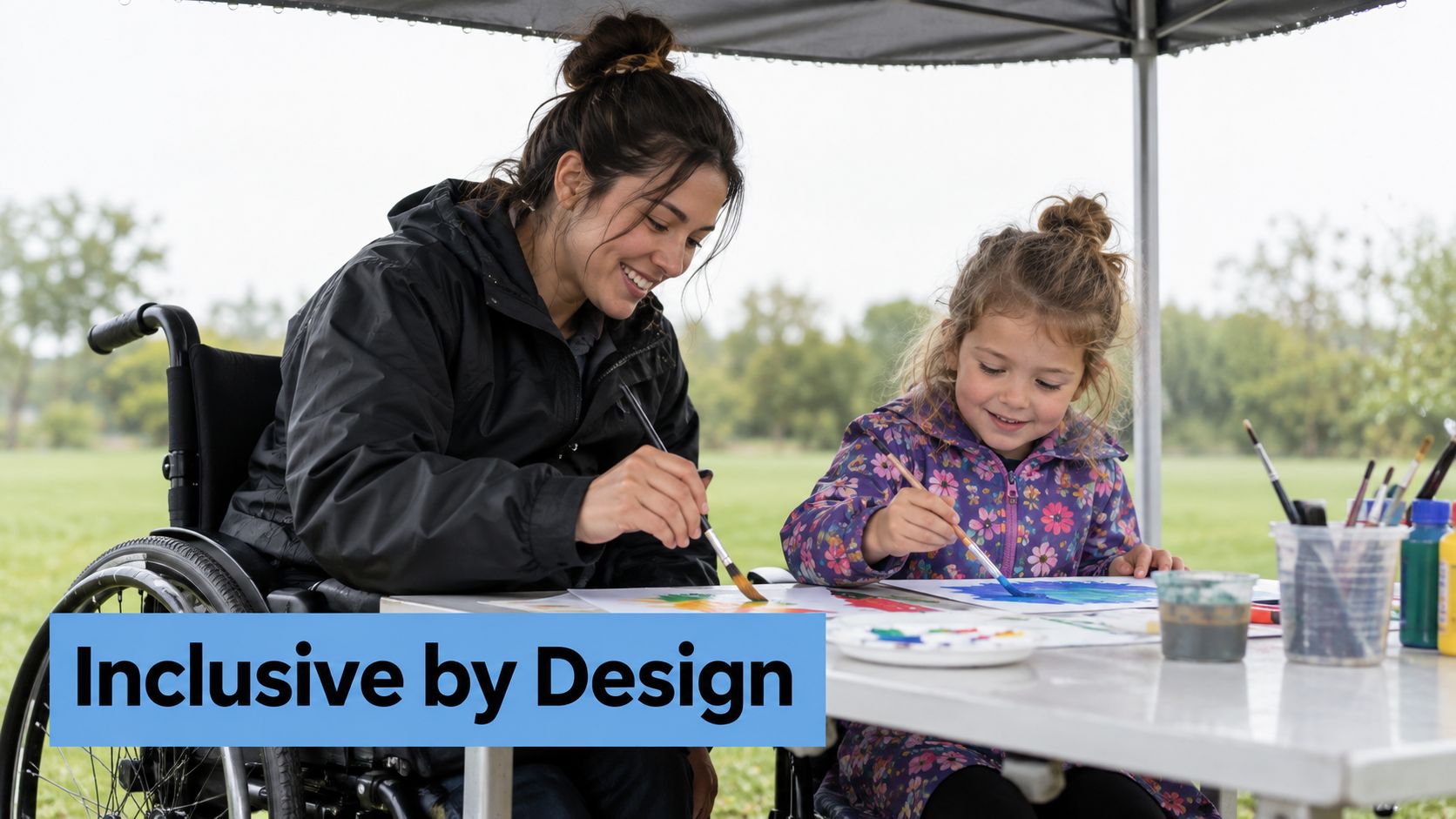
Accessibility works best when it shapes the operating plan rather than appearing as a facilities checklist at the end. Publish access, transport, age, participation and attraction information before booking, then make sure the information matches what guests will find on site.
Design the journey for different needs
Provide step-free routes, an accessible toilet and a quiet or low-stimulation area. Use visual and audible announcements, allow comfort breaks and give families enough transfer time between sessions. Staggered arrivals or distributed activity zones can reduce long waits, but they must be communicated clearly so families know when and where to go.
Equivalent participation matters. If a simulator seat, climbing activity or physical game isn't suitable for someone, offer another route to the same sense of involvement. That could mean a co-driver role, a seated version, a creative station, a spectator position with meaningful interaction or a calmer challenge nearby.
Measure more than attendance. Track participation by attraction, average and 90th-percentile wait time, abandonment, assisted-access uptake, incidents and repeat participation. A high footfall figure can hide a poor experience if families leave queues, can't find accessible facilities or have no alternative when an activity doesn't suit them.
Plan for the forecast you wish you had
Weather resilience means deciding in advance what changes when rain, cold, darkness or wind arrives. UK government research found that 57% of parents expected children's activity levels to fall during autumn and winter, with cold or wet weather identified as a barrier by 60% (UK government research on children's activity).
Build an indoor fallback layout where possible, cover queues, protect power and cables, and set clear conditions for postponement or cancellation. Shorter timed rotations can work better than leaving families outside a long queue. Include non-competitive challenges and spectator options, because not every child wants a tournament or leaderboard.
Operational test: Ask, “What does this family do next if the attraction closes, the queue becomes uncomfortable or the child doesn't want to compete?” If the answer isn't visible on the site plan, the programme isn't resilient yet.
Finalising Contracts and On-Site Execution
At this stage, paperwork either matches the live event or it creates problems on the field. A signed hire agreement needs to reflect the version you are delivering, with the final equipment list, exact positions, delivery access, operator cover, power load, wet-weather arrangements, cancellation terms, and who carries the risk for damage, delay, or aborted setup. If any of that still sits in email threads, it is not under control.
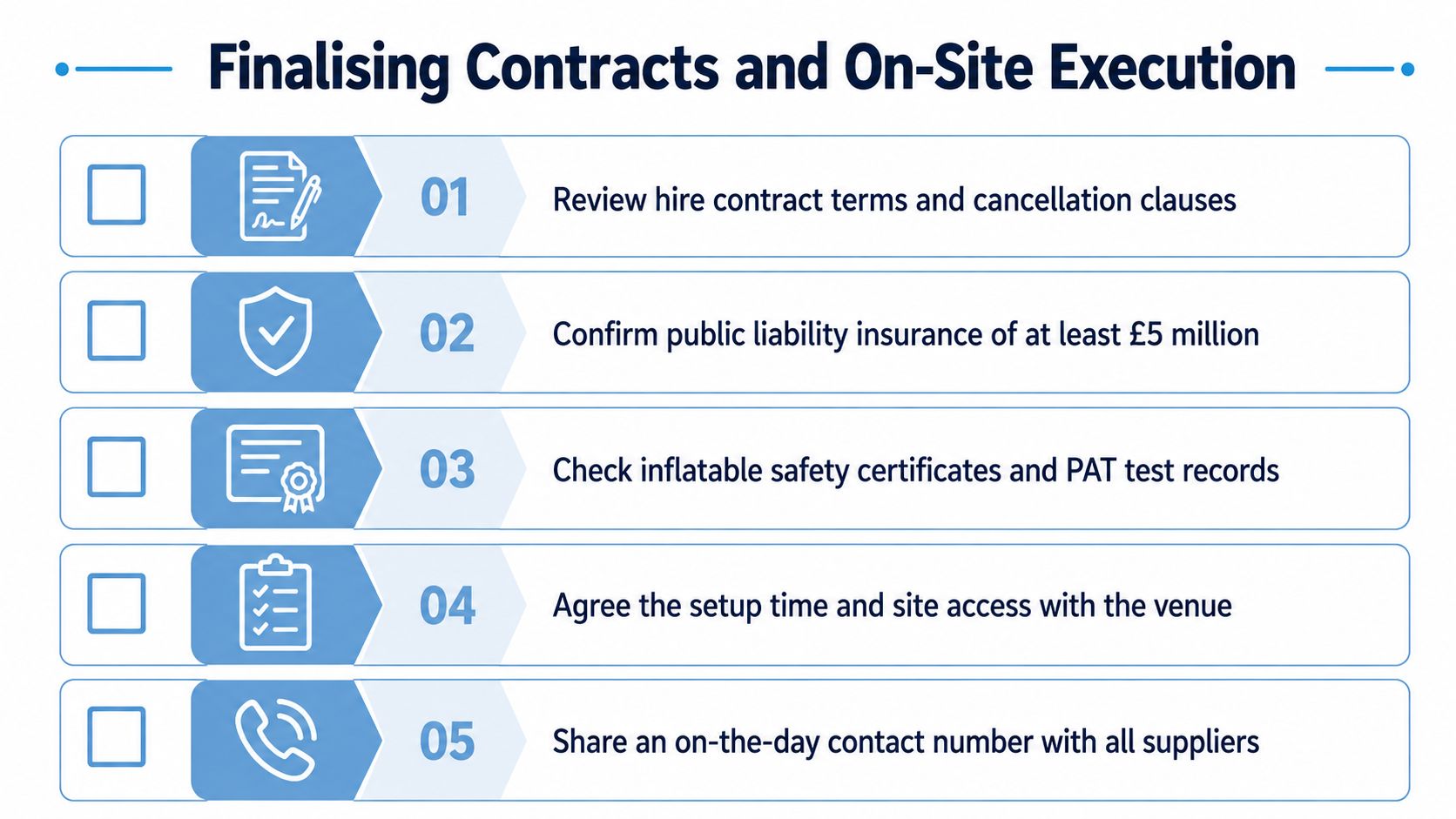
Treat supplier handover as an operational exercise, not an admin task. Send a scaled site plan and a concise briefing pack before the event day, then check that each supplier has read it properly. The pack should show vehicle routes, unloading points, attraction footprints, public barriers, power sources, toilets, first aid, quiet areas, emergency exits, and the event control point. A supplier who arrives with the right kit but the wrong assumptions can still delay opening.
The last checks are usually simple, but they need named owners. Confirm access windows, parking location and who authorises entry. Confirm how each unit will be anchored, where cables cross public space, what inspection standard applies and who signs handover. Name the lead operator, the event contact and the escalation route. Share the primary on-the-day number and a backup if signal drops. Set who makes the weather call, and when.
Then brief the people who will run the day.
Operators need clear boundaries, break arrangements, stop procedures and incident reporting. Venue teams need to know which queues they manage, when to intervene, and when to call the attraction lead rather than improvising. The event manager should stay mobile, checking pressure points, access routes and fallback areas, not getting pinned to one popular activity.
Keep a live record during the event. Note downtime, queue build-up, incidents, near misses, assisted-access requests and any weather-related changes. If a unit is repositioned or a cable route changes, update site control straight away. Verbal updates get missed.
The organiser remains responsible for protecting people during setup, breakdown and attendance, not only while attractions are operating, as set out in HSE event management guidance. Contracts, briefings and staffing arrangements should reflect that from the start.
Conclusion Creating Memorable Family Experiences
A successful family fun day rarely depends on having the largest attraction list. It comes from matching the programme to the audience, placing activities where people can use them safely, giving operators the information they need and planning credible alternatives for access, weather and participation.
The difference is noticeable on the day. Families find the entrance without confusion, queues move without blocking routes, children can choose between energetic and calmer activities, and parents aren't forced to solve operational problems themselves. Staff have a clear escalation path, suppliers know their responsibilities and the event manager can make decisions from live information rather than guesswork.
Family fun day hire should create connection, not just fill a site with equipment. When the plan includes mixed-age participation, inclusive routes, weather fallback, documented crowd controls and a proper supplier handover, entertainment becomes part of a coherent visitor experience.
Review the site plan with the venue, suppliers and access representatives before opening. Walk every route, test every communication point and ask what happens when the most popular attraction is unavailable. Those checks turn a promising booking into a day families can enjoy with confidence.
PSW Events provides family fun day activations with interactive attractions, delivery, installation, on-site staffing and event-management support across the UK. Explore PSW Events to discuss a programme that fits your venue, audience, access requirements and weather plan.