
Your small group has arrived at a UK corporate event, and the brief sounds simple: keep everyone involved, create genuine interaction and avoid an activity that feels forced. In practice, the right choice depends on the outcome you want, the available space, participant confidence, the level of competition people will enjoy and how much time you have for rotations. The strongest small group team building activities give each person a meaningful role, not just a turn at the edge of the room. This guide compares seven practical formats, from quick reaction games to immersive simulator tournaments, so you can match an activity to a team day, corporate event or private function. Each option includes a workable format, equipment and space considerations, variations, objectives and suitability guidance, with relevant PSW Events options mapped to different scenarios.
1. Racing Simulator Challenges
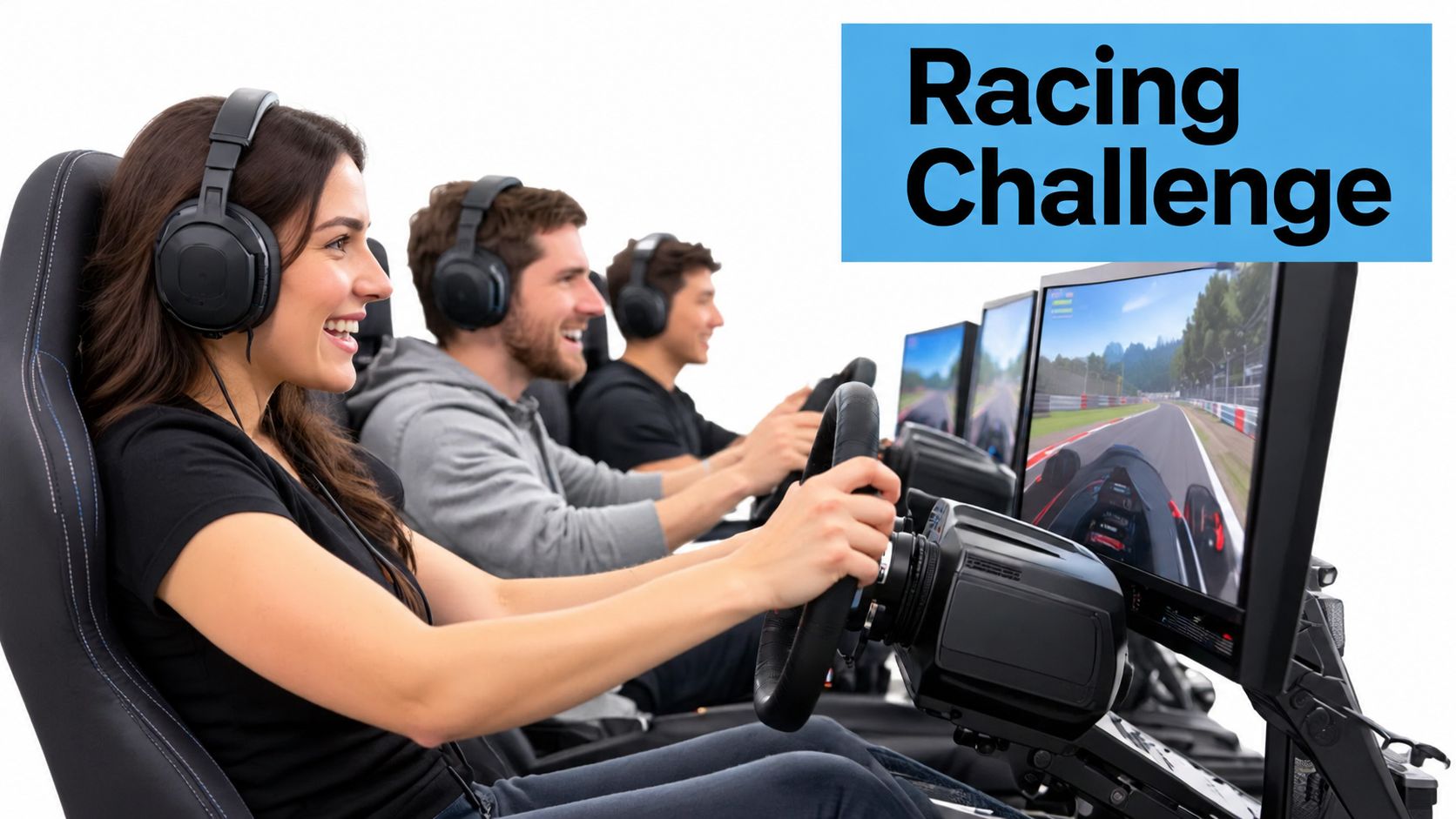
Racing simulators create immediate focus. Participants sit in racing seats, handle steering and pedals, and compete on virtual circuits while teammates watch lap times and encourage better lines. A session can use well-known circuits such as Silverstone or other digital tracks, with an electronic leaderboard showing individual and team performance.
The format works best when organisers avoid turning the event into a test of previous driving experience. Divide the group into small teams, give everyone an equal practice and racing opportunity, then add the scores together. A host can explain the controls, call out lap progress and keep spectators engaged while each driver competes.
Fairness rule: Equal track time matters more than finding the fastest individual driver.
A practical event setup includes the simulator rigs, a clear viewing area, leaderboard display and enough room for safe movement between stations. For a compact team session, use head-to-head heats. For a larger corporate event, run qualifying rounds followed by a team final. Mixed-ability groups can use team scoring so experienced players support less confident colleagues rather than dominating the result.
Best fit and useful variations
Racing challenges suit teams that enjoy friendly rivalry, product launches with a motorsport theme and corporate hospitality at venues such as Silverstone. They also work well as one station in a broader simulator programme. Add professional commentary for a more theatrical atmosphere, or combine racing with flight, golf and reaction games when the event needs varied levels of physical and technical challenge.
PSW Events can configure a racing simulator experience for head-to-head sessions, relay races or a championship format. Brief participants before the first heat, publish the scoring method and make the final result depend on collective performance.
2. Flight Simulator Experiences
Flight simulators build interaction through shared missions rather than simple turn-taking. A small team might rotate between commercial aircraft, helicopter or fighter-jet scenarios, with one participant flying while others interpret instructions, encourage the pilot or help the group complete a defined objective. The controlled environment keeps the challenge accessible without the risks of real flight.
Start with a short briefing covering the controls, scenario and expected roles. A 10 to 15-minute flight slot lets several people participate during a compact event, while an instructor can adjust the difficulty for beginners. The strongest format gives the group a shared mission, such as reaching a destination or handling a simulated situation, rather than rewarding only the person holding the controls.
The equipment needs a simulator station, instructor or host, seating for observers and enough clearance around the motion system. Check venue access, ceiling height, floor loading and power requirements before booking. PSW Events' flight simulator requirements provide a useful starting point for that conversation.
Turning technical challenge into team learning
Use instructor feedback during the debrief. Ask what helped the pilot, how the team communicated and whether quieter participants had a chance to contribute. Certificates or achievement badges can give the session a clear ending, especially at a leadership programme, conference or employee reward event.
A financial services firm might use a shared navigation mission for leadership development, while a technology company could frame a helicopter scenario around coordination and decision-making. Professional services teams can also use flight simulators as a conversation-led activation at a UK conference. For further technical context, this Redbird flight simulator guide explains the type of simulator environment participants may encounter.
Avoid making the activity feel like an exam. Let people practise, explain that mistakes are expected and use the instructor's observations to highlight different strengths.
3. Batak Pro Interactive Reaction Game
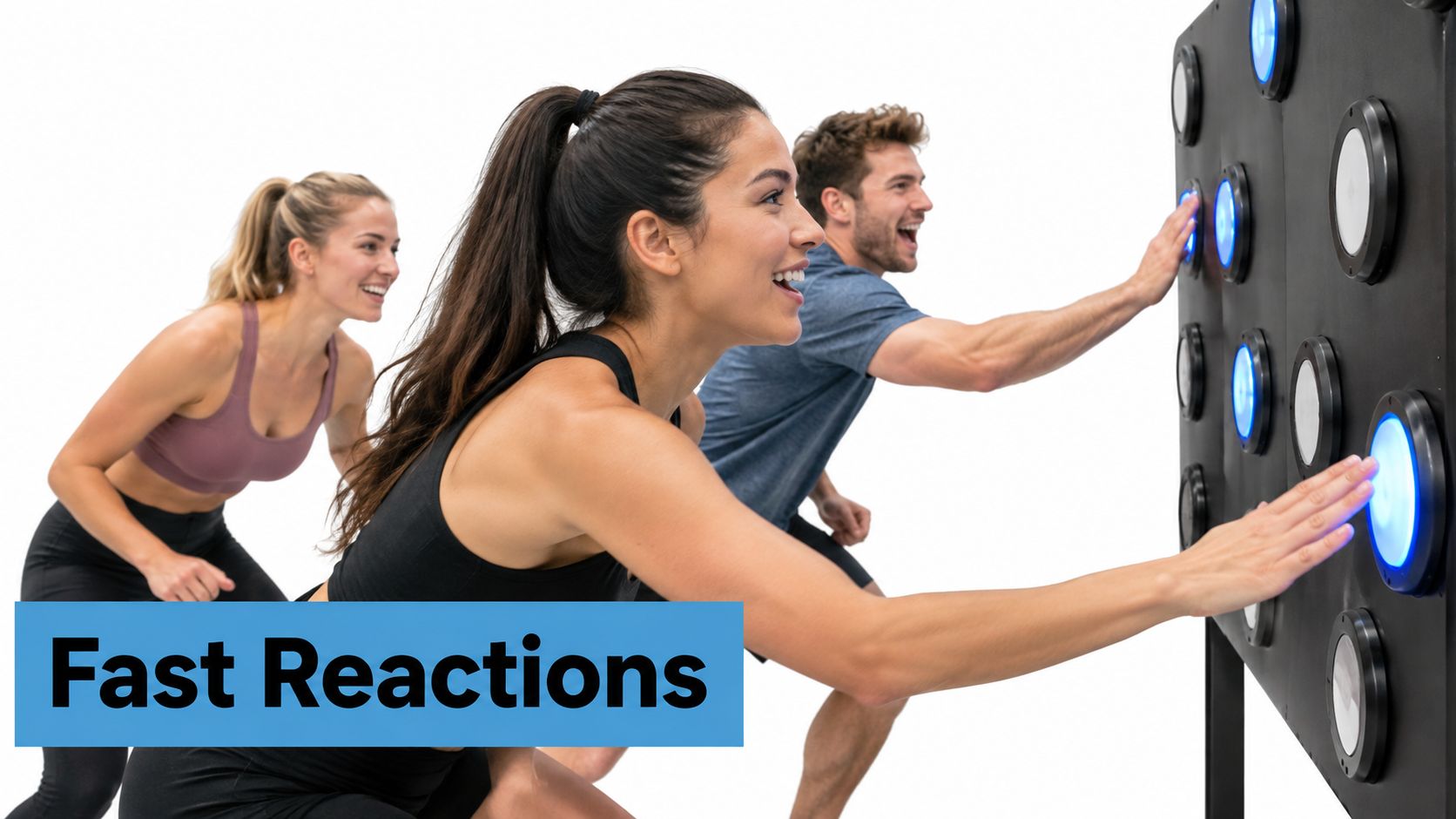
Batak Pro is built around speed, concentration and visible feedback. Players respond to illuminated targets on an interactive board, using hand-eye coordination and fast reactions while colleagues watch the score build in real time. Because each turn is short, the format creates a natural rhythm of participation, cheering and quick rematches.
It needs less space than a full simulator, making it suitable for exhibition stands, recruitment fairs, conference areas and team events with several attractions. Set the board where spectators can see the action, provide a clear demonstration and publish the scoring rules before the first round. A host should explain that the game tests reaction and timing, not general athletic ability.
A format that includes mixed abilities
Run a team tournament rather than a sequence of individual attempts. Each team nominates players for different rounds, then combines the scores. A handicap system or skill-based bracket can prevent the same confident players from representing their team every time. The approach keeps the leaderboard exciting without making participation feel like a public ranking exercise.
Use the audience: Spectators should have a role, whether they're tracking team points, encouraging players or predicting the next result.
The Batak Pro reaction game can sit between longer activities to maintain energy. It also pairs well with racing, VR or sports simulators when an event needs a balance of technical focus and immediate play. A sports brand could use it at a UK trade show, while a technology company might place it at a recruitment fair to create a low-barrier first interaction.
For accessibility, ask privately about standing, reach and fatigue requirements. Offer alternative scoring roles or seated participation where possible, and never assume that the quickest player should carry the whole team.
4. American Football and Rugby Simulator Challenges
Sports simulators give teams a shared challenge even when participants have different levels of sporting knowledge. Players can attempt field goals, passes, tackles or tactical plays through an immersive digital environment, with performance feedback that gives the group something specific to discuss. The entertainment comes from trying the task together, not from expecting everyone to understand every rule before starting.
Begin with a simple demonstration. Explain the basic scoring and let people try an easy challenge before introducing more difficult plays. Divide participants into teams and rotate roles such as player, coach, commentator and scorekeeper. That structure prevents the most confident participant from taking every attempt and gives non-players a useful way to contribute.
Turning sport into a team format
A US-headquartered company might use an NFL-themed challenge at a UK corporate event. A rugby organisation could focus on passing and tactical decisions, while a sports marketing agency might use both formats for a brand activation at Wembley Stadium or another major venue. The same equipment can support a private celebration when the host wants a compact, spectator-friendly competition.
Capture selected video highlights for internal communications, but obtain permission before filming. A professional host can explain what's happening, keep the pace moving and turn strong attempts into shared moments rather than isolated scores.
Use the performance data as a debrief prompt. Ask which instructions were clearest, how the team responded after an unsuccessful attempt and whether people changed roles effectively. These questions connect the activity to communication and resilience without pretending that a simulator alone changes workplace behaviour.
For participants who don't want a physical role, provide commentary, tactics, timekeeping or team selection duties. The activity becomes more inclusive when those roles carry genuine influence over the result.
5. Golf Simulator Competitions
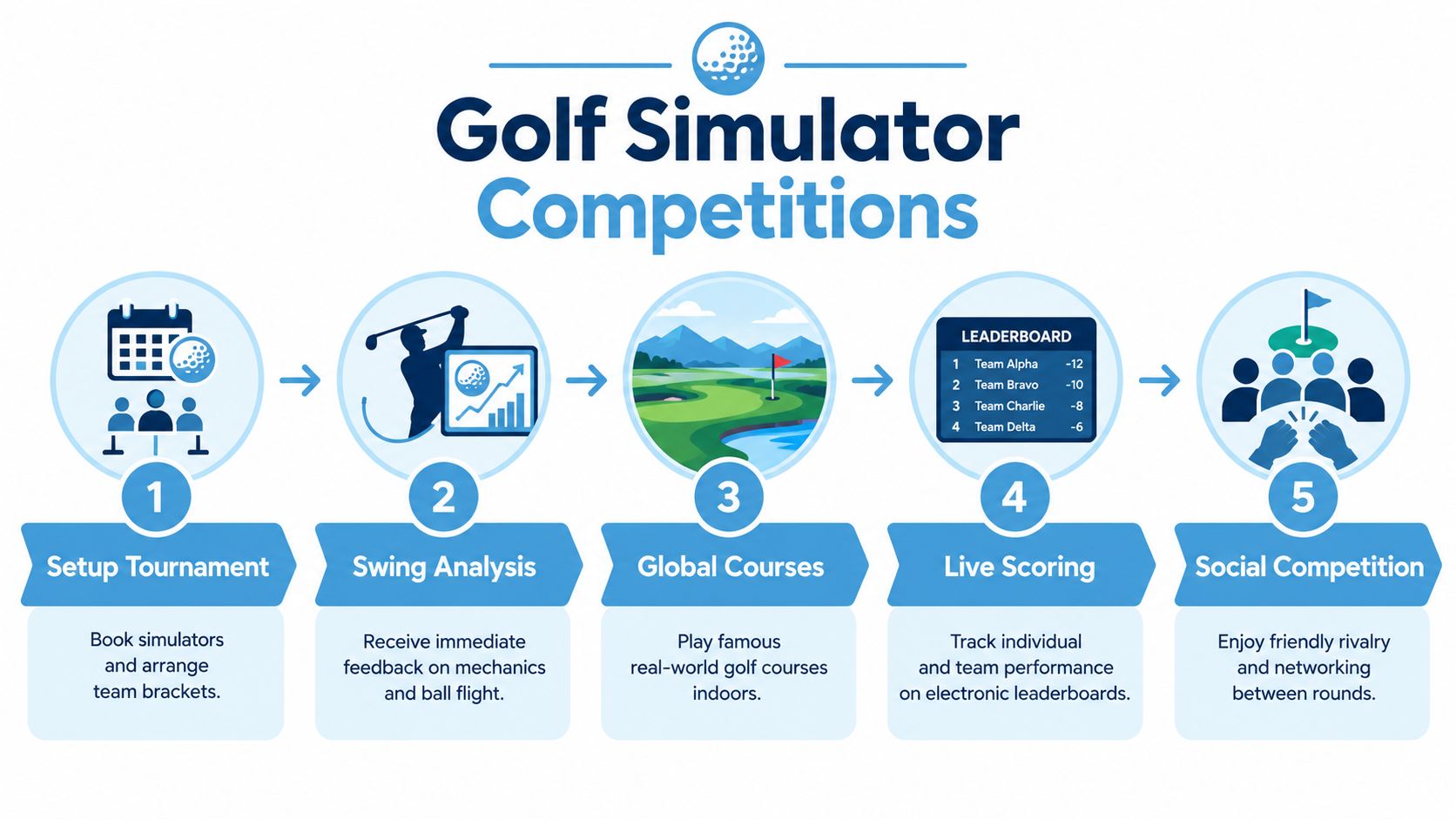
Golf simulators suit teams looking for a polished indoor competition with space for conversation. Participants can play digital versions of recognised courses, receive feedback on ball flight and compare scores without travelling to an outdoor course. The social format works particularly well when the event combines a sporting challenge with food, drinks or client hospitality.
Choose a tournament structure that keeps observers involved. Four-player teams can nominate players for different holes, or participants can take alternate shots while a host records the team result. A handicap-adjusted format helps balance experienced golfers and complete beginners. Provide a short swing demonstration before play, then let novices contribute through club selection, course strategy and encouragement.
Where the format works best
Financial services firms may use golf simulators for client entertainment or team rewards. Executive clubs and hospitality venues can place the simulator beside dining areas, while corporate venues can include it in a premium programme alongside racing or flight stations. A single round golf voucher can also provide a separate reward for a winner or participant, subject to the organiser's chosen supplier terms.
The main trade-off is pace. Golf can become slow if every player takes unrestricted shots, so set a clear limit for each round and use a host to keep the group moving. Display the leaderboard, announce notable shots and allow teams to discuss tactics between turns.
A golf simulator isn't automatically inclusive. Check seating, reach, club handling and sensory needs in advance. Offer roles that don't depend on a full swing, and make the team result more important than individual distance.
6. Multi-Activity Simulator Packages and Tournaments
A multi-activity programme is useful when one format can't suit everyone. Teams rotate between racing, flight, reaction games, golf, sports simulators and VR, collecting points across different challenges. A driver may excel at racing, another colleague may lead a strategy round and a third may contribute through communication or decision-making.
The organiser's schedule determines whether this works. Create team names, assign starting stations, publish rotation times and leave enough space for movement between activities. Every station needs the same clarity around scoring, safety and participation. A professional host or commentary team can announce results and maintain energy while staff reset equipment.
A workable tournament design
Use team-based scoring and equal time allocations. A station might assess speed, accuracy, cooperation or problem-solving, but the scoring should be simple enough for participants to understand immediately. Include awards for the overall team and, where appropriate, recognitions such as best communicator or strongest comeback. That broadens the definition of success beyond raw performance.
The format suits annual away days, trade shows, conferences at ExCeL London, Manchester Central or SEC Glasgow, and client events that need structured entertainment. PSW Events can combine simulator hire with planning, branding, logistics, installation, on-site staffing and health and safety delivery. Add catering, photography and branded leaderboards when the event also needs hospitality or content for internal communications.
Avoid cramming too many stations into a short booking. People need time to understand each challenge, participate and talk afterwards. A smaller number of well-facilitated activities will usually create better interaction than a rushed circuit.
7. Virtual Reality Team Challenges and Escape Experiences
VR team challenges place participants inside a shared digital environment where they solve puzzles, complete missions or escape from a scenario together. The strongest experiences require people to communicate what they can see, divide tasks and make decisions with incomplete information. That makes VR particularly useful for teams that need an intense collaborative task rather than a casual drop-in game.
Start with a low-intensity scenario for participants who haven't used a headset before. Explain the objective before immersion, then keep teams small enough for clear communication. If the equipment supports rotations, let observers track the mission and prepare advice for the next group. Clean headsets between users and follow the supplier's health and safety process.
Comfort and psychological safety
Screen participants privately for motion sensitivity and explain opt-out routes without drawing attention to anyone. Some people may prefer a non-headset role, such as navigator, clue coordinator or timekeeper. Those roles should influence the team's decisions, not just wait for the next turn.
A technology company could use a VR escape experience to encourage collaborative problem-solving, while an international organisation might use it as a memorable session for distributed colleagues who rarely work together in person. A trade show activation can use a short mission to attract visitors, but a corporate team event should allow time for the debrief.
Ask the group what information they shared, who made decisions and where communication broke down. Link the answers to real work without overclaiming that a single game proves anything about performance. VR is most effective when the facilitator turns the shared experience into a practical conversation about trust, listening and interdependence.
7-Activity Team-Building Simulator Comparison
| Activity | Implementation Complexity (🔄) | Resource & Space Requirements (⚡) | Expected Outcomes (📊) | Ideal Use Cases | Key Advantages & Tips (⭐ 💡) |
|---|---|---|---|---|---|
| Racing Simulator Challenges | High, 🔄🔄🔄🔄 | Very high, ⚡⚡⚡⚡ | 📊 Strong competitive engagement; measurable performance metrics | Corporate rewards, trade shows, team tournaments; 4–12, 30–90 min | ⭐ Immersive spectacle, measurable; 💡 Rotate participants, use prominent leaderboards, provide briefing |
| Flight Simulator Experiences | High, 🔄🔄🔄🔄 | High, ⚡⚡⚡⚡ | 📊 Memorable confidence-building; improved communication and teamwork | Leadership development, executive events; 6–20 (rotating), 2–4 hrs | ⭐ Unique, instructional; 💡 Schedule short flights, use instructor debriefs, capture media |
| Batak Pro Interactive Reaction Game | Low, 🔄 | Low, ⚡⚡ | 📊 High-energy short-form engagement with quick throughput | Exhibitions, recruitment fairs, event energizers; 8–30+, 30–120 min | ⭐ Highly accessible and compact; 💡 Run team tournaments, use handicaps/brackets, display leaderboards |
| American Football & Rugby Simulator Challenges | Medium-High, 🔄🔄🔄 | High, ⚡⚡⚡⚡ | 📊 Skill development, team spirit, social content opportunities | Sports activations, stadium events, brand marketing; 6–24, 1.5–3 hrs | ⭐ Sport-specific appeal and technique feedback; 💡 Brief rules, start with easier challenges, capture highlights |
| Golf Simulator Competitions | Medium, 🔄🔄🔄 | Medium-High, ⚡⚡⚡ | 📊 Social bonding, swing feedback, premium client engagement | Client entertainment, executive hospitality, tournament formats; 4–20, 2–4 hrs | ⭐ Premium and inclusive; 💡 Use handicap formats, pair with hospitality, structure as tournaments |
| Multi-Activity Simulator Packages & Tournaments | Very high, 🔄🔄🔄🔄🔄 | Very high, ⚡⚡⚡⚡⚡ | 📊 Broad engagement; equitable participation and strong ROI for full groups | Large away days, conferences, full-day tournaments; 20–200+, 4–8 hrs | ⭐ Comprehensive and customizable; 💡 Detailed schedules, professional hosting, balanced rotations |
| Virtual Reality Team Challenges & Escape Experiences | Medium, 🔄🔄🔄 | Medium, ⚡⚡⚡ | 📊 Intensive collaboration, memorable shared experiences | Remote/distributed teams, innovation-focused groups, trade shows; 8–30 (rotating), 2–3 hrs | ⭐ Highly immersive and collaborative; 💡 Screen for motion sensitivity, enforce headset hygiene, start with gentler scenarios |
Turn Participation Into Team Progress
Choosing among small group team building activities starts with the team's objective. If you need quick energy and easy spectator involvement, Batak Pro works differently from a VR escape mission, which demands sustained communication. Racing and sports simulators support friendly competition, while golf offers a slower hospitality-led format. A multi-activity tournament gives people several ways to contribute, but it also needs the most careful scheduling and facilitation.
Check participant comfort before you confirm the format. Conventional team-building activities can create negative reactions when they feel forced or irrelevant. In March 2025, Acas reported that 31% of employees in Great Britain disliked team-building activities such as workshops, compared with 20% who disliked regular after-work social events. The finding came from an online YouGov survey of 1,052 employees and reinforces a practical point for organisers: participation alone doesn't demonstrate effectiveness. The Acas finding on disliked workplace social activities supports voluntary choice, sensitive facilitation and a clear explanation of purpose.
Then check the space and rotation time. Hybrid and distributed teams need equivalent participation routes, not a remote colleague placed passively in front of a video call. 28% of working adults in Great Britain hybrid-worked between January and March 2025, according to the Office for National Statistics analysis of hybrid working. Venue access, sensory information, seating, travel, equipment clearance and quiet alternatives should be agreed before invitations go out.
Finish with a short debrief. Ask what helped communication, how the team made decisions and which behaviours should carry into everyday work. For a more deliberate evaluation, collect pre-event and post-event ratings for communication, trust and cross-team collaboration, then repeat the pulse survey after the team has had time to apply what it discussed. Immediate enjoyment and lasting change aren't the same outcome. A UK survey of more than 1,000 office workers found that 62% associated team building with improved communication, while only 29% said communication improvements lasted long term. The team-building communication and collaboration findings make the case for structured follow-through.
Brief PSW Events with your group size, venue, timing, access requirements and desired atmosphere. The team can shape racing simulators, VR, Scalextric, Batak Pro or wider event delivery around a clear UK event plan rather than forcing every group into the same activity.
PSW Events provides interactive racing, sports and flight simulators, Batak Pro, VR, Scalextric and complete event delivery for corporate teams, exhibitions and private functions across the UK. Visit PSW Events with your group size, venue and preferred atmosphere to discuss a practical small-group format.