
You're standing on a windy concourse outside a League One ground. Generators hum behind the hoarding, stewards string out crowd-calming barriers, and the production manager is on the radio because the screen feed has slipped. The match hasn't started, yet the football fan zone is already behaving like a live event with its own safety, service and commercial pressures.
That's the point many planning teams miss. A fan zone isn't a big screen, a bar and some branded flags. It's a managed event product that must balance dwell time, repeat visits, accessibility, sponsor value and crowd safety while fitting the venue licence and the surrounding transport network. UK examples show the model has matured, from a Manchester fan park reported at roughly 9,000 spectators for an England semi-final screening to a Carlisle event listing a 2,500-person capacity and a £2 ticket price (Carlisle United fan-zone information).
What a Football Fan Zone Really Is
A football fan zone is a managed, ticketed or free-to-access event space beside a stadium, within a fan park, at a broadcast hub or in a town-centre activation. Supporters gather there to watch live football together, but the viewing experience sits inside a wider operation involving entry, stewarding, food and drink, entertainment, sponsor activations and dispersal.
At a stadium, the zone might occupy a plaza before turnstiles open. In a city centre, it may use a fenced public square with temporary screens, licensed bars and controlled access points. A hospitality enclosure will add table service, premium sightlines and networking, while a broadcast party may prioritise presenter-led content, cameras and sponsor integration over supporter rituals.
The features that make it an event
A pub with a projector can create atmosphere, but it usually doesn't have the same operating brief. A credible fan zone has:
- A defined perimeter: Organisers know where the event starts and ends, including service gates and emergency routes.
- A stewarding plan: Staff manage queues, movement, behaviour and access rather than reacting only when problems appear.
- A licensed bar: Alcohol service sits within the relevant Premises Licence or Temporary Event Notice.
- Accessible routes and facilities: Disabled supporters can enter, view the screen, use facilities and leave without relying on improvised assistance.
- Sponsor inventory: Brands receive planned, measurable spaces rather than random logo placement.
- Named operational ownership: A Safety Officer or another accountable person can make decisions when the screen feed, weather or crowd profile changes.
The UK's controlled approach is visible in the Bolton Wanderers FC fan zone model, which uses designated capacity, steward-controlled entry and exit, security checks, queueing systems and click-in/click-out monitoring (academic research on football fan zones). City-centre zones may use more open streetscape integration, passive surveillance and stewarding, but they still need a clear operating boundary.
Practical rule: Treat the fan zone as a standalone venue that happens to sit within a football event. If you plan it as stadium overflow, the gaps will appear in licensing, staffing, access and evacuation.
That framing affects every later decision. Screen position determines crowd density, bar placement influences queue length, and the location of a sponsor activation can either extend dwell or obstruct a route. A successful zone gives the audience a reason to arrive early, stay comfortably and disperse in an orderly way.
Core Objectives and KPIs That Prove It Worked
A football fan zone earns approval when its outcomes are defined before the stage, screens and bars are specified. The board may need a commercial return, sponsors need evidence of meaningful engagement, the council needs confidence in public management, and supporters need an enjoyable visit without avoidable friction.
Write each objective in plain language, then assign one primary KPI and a dependable data source. A short scorecard that prompts decisions is more useful than a dashboard crowded with figures.
| Objective | Primary KPI | Data Source |
|---|---|---|
| Revenue | Spend per head | Cashless POS data from bars and merchandise |
| Brand reach | Qualified activation interactions | Scan data, registration records and approved media reporting |
| Fan experience | Average dwell time | RFID, Wi-Fi counters or timed observational sampling |
| Repeat engagement | Return visits or repeat intent | Entry data and post-event survey |
| Operational resilience | Peak density and incident profile | Occupancy monitoring, steward logs and control-room reports |
| External crowd management | Zone Ex completion time | Steward observations, transport coordination and police liaison |
Use a KPI tree to connect commercial performance with the operating plan. The headline outcome might be profitable, safe and repeatable matchday engagement, supported by four branches:
- Revenue: Bar takings, merchandise, ticket upgrades and hospitality conversion.
- Brand reach: Sponsor interactions, qualified leads, content usage and sentiment.
- Fan experience: Footfall, dwell time, repeat intent and recommendation scores.
- Operational resilience: Peak density, queue duration, incidents, evacuation performance and accessibility uptake.
Teams can compare their planning against relevant sports fan engagement principles, alongside Football Association, Sport England and local authority guidance. Consistent collection matters. Wi-Fi dwell data from one event cannot be compared confidently with a rough headcount from another.
A one-page scorecard should report total footfall, peak occupancy, average dwell, spend per head, sponsor interactions, complaints, incidents and notable access outcomes. Add a short explanation for each variance. Lower dwell may follow poor shelter, a delayed screen feed or a family audience leaving after the main match. The number needs its operational context.
Zone Ex completion deserves its own review. Record when the final supporter leaves, whether transport demand remained manageable, and where stewards or police intervention changed the plan. That measure links the fan zone to the wider crowd-management operation rather than treating dispersal as an afterthought.
Social reach is a weak standalone measure. A large campaign figure does not show that people entered the zone, watched the match or completed a sponsor interaction. Pair digital activity with physical behaviour, including dwell, repeat entry and activation completion, so the next budget review can assess value on evidence rather than visibility alone.
Designing the Audience Experience from Gate to Final Whistle
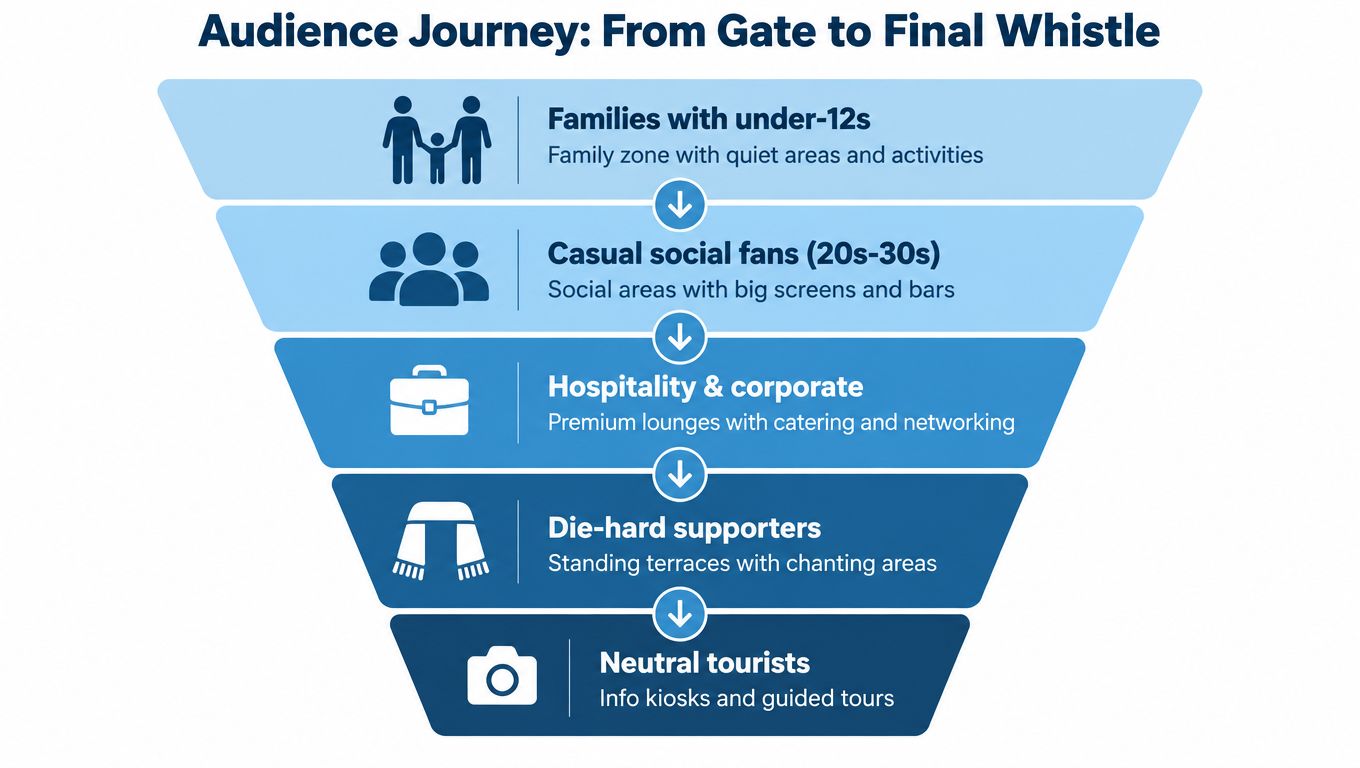
A mixed football crowd isn't one audience. It's a set of groups with different reasons for attending, different tolerances for noise and alcohol, and different requirements at every stage of the journey.
Match the environment to the segment
Families with under-12s need shaded seating, visible low-height screens, simple food choices and activities that don't place them beside a high-intensity drinking area. A quiet corner and an alcohol-free buffer can keep the family offer credible rather than cosmetic.
Casual social fans in their 20s and 30s respond to music, quick service, photogenic backdrops and food that can be eaten while standing. They may arrive for the social occasion as much as the match, so a good photo moment or short interactive challenge can extend their visit before kick-off.
Hospitality and corporate guests need a different rhythm. Viewing decks, dedicated bars, host-led tables and clean sightlines support conversation and networking without forcing premium guests into the busiest public queue.
Die-hard supporters often want chanting space, an unobstructed screen and rituals that feel authentic. Neutral tourists need orientation, clear information and an easy way to understand the fixture, venue and transport options. The break room experience guide offers useful thinking on how comfort, social interaction and purposeful activity can shape a shared environment, even outside a matchday setting.
Walk the journey, not just the floor plan
The experience begins before the gate. Search points, bag checks and ticket validation need enough space to prevent the queue from folding into the public footway. Wayfinding should answer three immediate questions: where do I enter, where can I watch, and where are toilets and first aid?
Pre-match rituals should sit away from the main entry stream. Put skills challenges, food and photo points where they encourage circulation, not where they create a static crowd in front of the screen. At half-time, service points need to absorb a short, intense demand spike, while accessible toilets and viewing platforms must remain reachable without crossing a dense bar queue.
Full-time is a separate operating phase. Winning supporters may stay for music or interviews, while others want immediate transport access. A controlled dispersal plan, clear exit messaging and steward presence at the interface between the fan zone and the stadium can prevent a celebratory crowd from becoming a transport problem.
The right design follows the audience need, not a single generic “fan atmosphere” brief. Accessibility should include viewing platforms, hearing loops, BSL interpretation where appropriate, quiet rooms and step-free routes planned for the crowd profile, not only minimum-code compliance.
Interactive Attractions That Earn the Footfall
An attraction earns its place when it changes behaviour. A simulator, skills lane or reaction game can bring visitors in before kick-off, hold them during quieter periods and encourage repeat visits. The test is operational as well as creative: measure queue length, dwell time, throughput and return play, then compare those results with the space, power and staffing required.
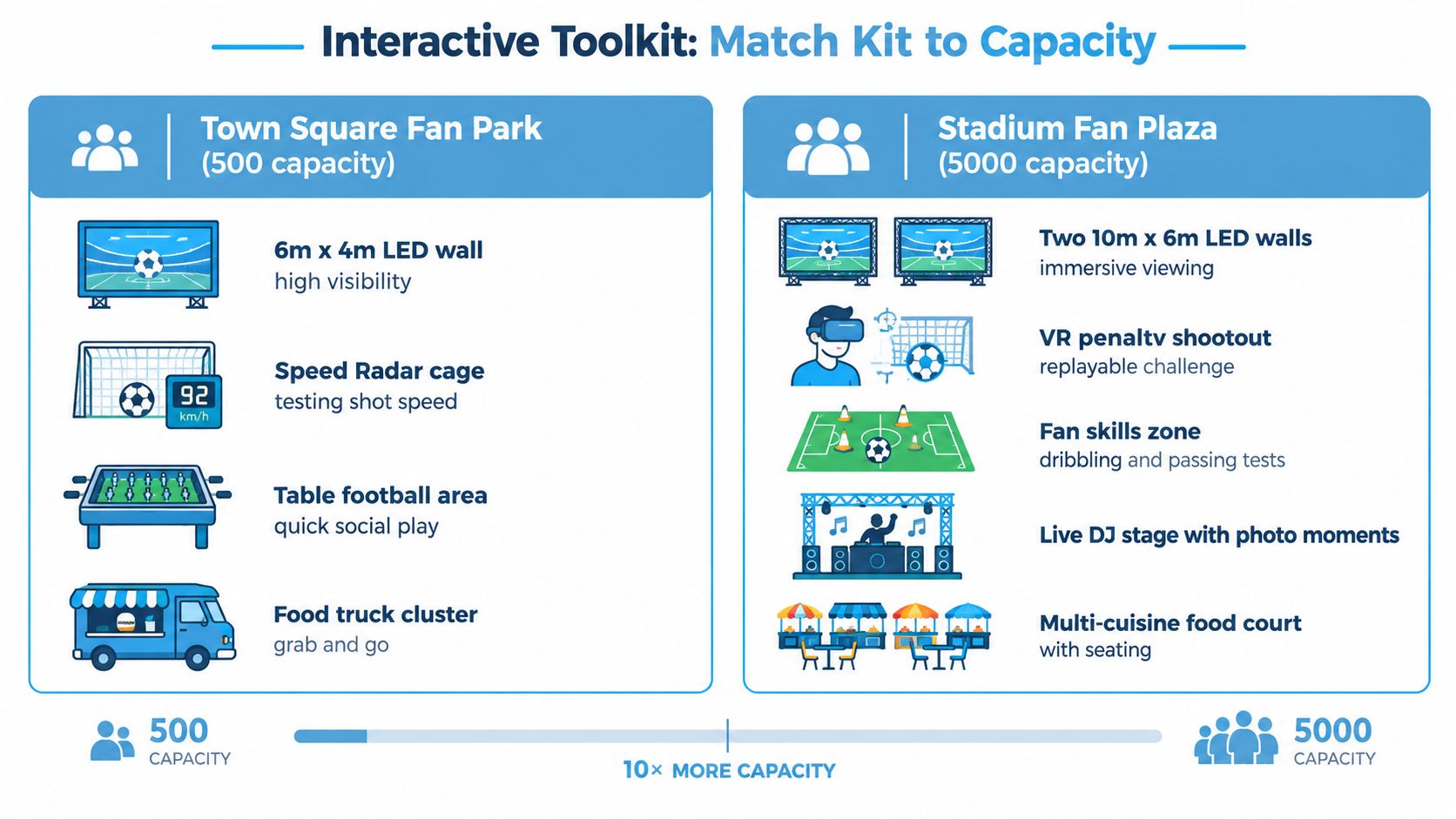
For a 500-capacity town-square fan park, keep the offer concentrated. One 6m x 4m LED wall, a Speed Radar cage and an inflatable skills circle can anchor the programme, supported by table football, a compact food-truck cluster and clear queue rails. Visitors should be able to see the attractions from the main route. That visibility helps the team manage queues and stops activities forming isolated crowd pockets.
A large stadium plaza needs distinct activity zones. Penalty-wall reactive targets, VR goalkeeper rigs, F1-style reaction benches and a presenter-led stage can serve different dwell patterns. Place the loudest, most competitive attractions away from the main viewing sightline. A second screen can support an overflow area and protect the viewing offer if the primary pitch feed develops a technical fault.
Approve each attraction against three practical questions:
- Will people accept the queue? Simulators and beat-the-keeper games work when each attempt is quick, visible and easy to repeat.
- Can a passer understand it immediately? A passing lane or foam-ball dribble course needs little explanation and keeps casual visitors moving.
- Will it operate in British weather? Shelter and shaded structures help protect equipment, surfaces and throughput when rain or glare changes conditions.
Families also need a low-threshold activity, such as a foam-ball dribble course or mascot meet-and-greet. Keep these away from high-energy competition so younger children and visitors who do not want to compete have a clear option.
For lighter-touch participation, mystery box football fan ideas can inform reveal, prediction and prize mechanics. Give every mechanic a defined queue, operating boundary and sponsor outcome.
PSW Events provides football simulator hire for corporate activations, exhibitions and branded fan zones. Visible scoring can support queue measurement and sponsor integration. Confirm installation space, power, staffing, reset time and wet-weather cover before listing the attraction in the programme.
Ride-style inflatables require valid PIPA or PERSS certification. They also need a plan for pressure loss, stoppages and queue control. A popular activity that shuts down or blocks a route quickly affects safety, dwell time and sponsor value.
Logistics and Venue Considerations for UK Fan Zones
Most fan zones are reduced at the planning desk rather than ruined on the event day. The site has to work on paper first, with a valid licence, realistic ground conditions, controlled capacity and routes that separate public movement from operations.
Begin with the venue's Premises Licence or Temporary Event Notice. Confirm that alcohol, regulated entertainment and late-night refreshment are covered for the proposed operating window. Bring the Safety Advisory Group into the process early, with a pre-event meeting targeted at least 90 days before the event where the local process requires that lead time.
Design movement around the whole site
Capacity is more than the number of people facing the screen. Trafalgar Square's EURO 2020 fan-zone plan capped match-screening days at 12,500 people across Trafalgar Square, North Terrace, Pall Mall East and Morley's Hill, excluding staff, performers and media. It set a tighter limit of 5,000 people for the permitted activation day in Trafalgar Square and North Terrace, again excluding staff and performers (official ground regulations and fan-zone planning material).
Set ingress and egress against the Green Guide, including a 1,650mm minimum clear width per flow where the relevant guidance applies. Keep fan routes separate from operational vehicle routes, protect stages from pinch points and use a fenced exclusion zone with hostile-vehicle mitigation aligned to current UK guidance.
The external approach matters just as much as the event footprint. The Sports Grounds Safety Authority identifies Zone Ex, or the “Last Mile”, as the pedestrian and vehicle movement area outside sports-ground legislation, managed jointly by organisers, police and local authorities (UK crowd-management coordination update). Police and agencies also use fan zones to absorb ticketless supporters, so a poorly placed queue can affect stadium-adjacent safety.
Plan the technical spine
Generators need bunding and separation from the public, with fuel fire separation planned at 30 minutes where required by the risk assessment. LED screens commonly need 20 to 32A three-phase feeds, so power schedules should be designed with the AV supplier rather than added after the site plan.
Finally, check sightlines. A sponsor backdrop that blocks steward visibility, or a stage that creates a blind corner beside a bar, is a bad trade. Commercial real estate only has value when the control room can still see the crowd.
Branding and Sponsorship Opportunities Worth the Pitch
Sponsorship works best inside the dwell loop, the sequence that brings a visitor into the zone, gives them something to do, encourages them to stay and creates a reason to return. A logo on a perimeter hoarding sits outside that loop. A branded skills challenge, by contrast, can generate a measurable interaction without interrupting the match.
Compare the main sponsorship formats
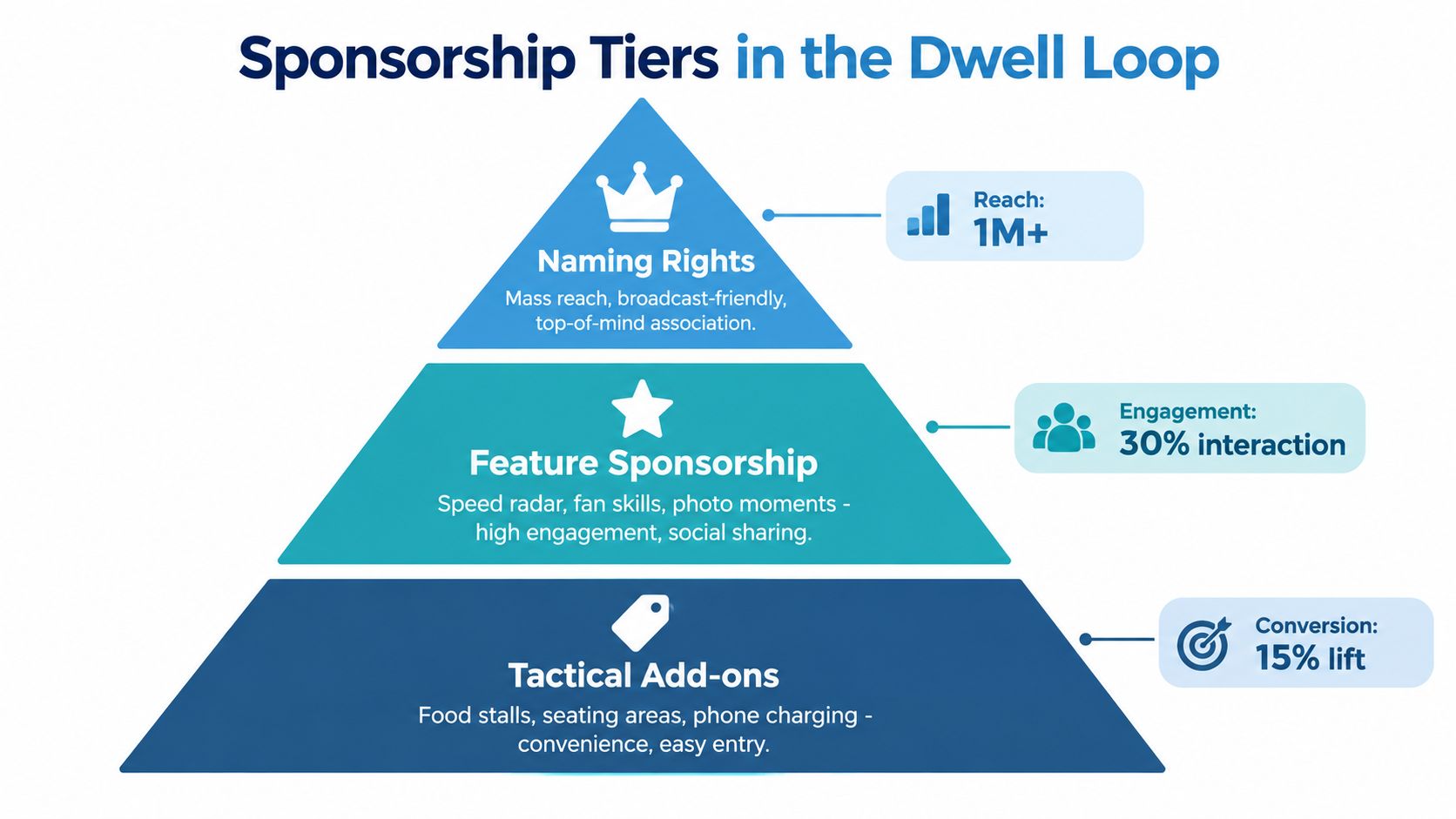
Naming rights offer the broadest association. The brand can own the zone name, appear across entrance graphics and receive broadcast-friendly footage, but the package must justify its premium through reach, content rights and documented footfall.
Feature sponsorship gives a brand a defined environment, such as a family area, speed-radar cage, fan-skills zone or photo moment. This format usually produces stronger engagement evidence because the visitor takes an action, completes a challenge or shares a result.
Tactical add-ons include food stalls, seating, phone charging and wayfinding. They're easier to enter and can improve convenience, but they need a clear conversion or sampling mechanic or they become ordinary infrastructure with a logo attached.
On-screen takeovers can work at kick-off, half-time and full-time because attention is naturally concentrated at those moments. They should be scheduled with the broadcast and production teams, not sold as unlimited logo rotation. Over-stacking the LED with sponsor messages can reduce viewing quality and breach clean-feed expectations around live broadcast content.
Sampling units belong in the walking flow, not at the perimeter where visitors have already decided to leave. A pour-rights partner will also look more credible within a hospitality structure with seating and service control than beside a folding table.
Every tier should map to the same scorecard used by the organiser: footfall, dwell time, completed interactions, leads, repeat visits and sentiment. Sponsors don't need more decorative inventory. They need evidence that the activation changed behaviour.
Staffing, Health and Safety, and Compliance Reality
A fan zone can have strong programming and still fail at the gates, during half-time, or at dispersal. Build the staffing plan around those pressure points rather than the average number of people in the footprint. At loading, some organisers use one steward per 100 attendees as a starting assumption, subject to the risk assessment and guidance from the relevant venue and safety authorities. The final deployment must reflect the site, licence conditions, audience profile, Zone Ex pinch points and the agreement reached with the Safety Advisory Group.
The control room should hold one operational picture. Give supervisors a clear radio structure and a single command channel, then define who can stop an attraction, close a gate, pause alcohol service or change an evacuation route. Door supervisors need SIA licensing where the licence or council requirements call for it. Brief stewards on escalation routes before visitors arrive.
A written risk assessment should sit alongside the event method statement and Purple Guide principles. It should cover:
- Fire loading: staging, drapes, temporary structures and waste.
- Power and fuel: generator position, bunding, cable protection and separation.
- Surface changes: rain, mud, trip hazards and slippery temporary flooring.
- Screen-bank density: forward pressure from people seeking a better view.
- Welfare incidents: lost children, intoxication, dehydration and distress.
- Access needs: step-free movement, accessible toilets and evacuation assistance.
The plan must also connect to licensing, capacity control and Zone Ex arrangements. A route that works on paper can fail once vehicles, queues, accessible movement and emergency access share the same space. Test those interfaces with the venue, police, local authority, transport teams and contractors before build.
Verify that each supplier carries adequate cover. PSW Events, for example, operates with £10 million products, employee and public liability insurance. Check the current documents and the policy conditions for your specific activity rather than relying on a generic venue certificate.
Use this risk assessment guide for football events alongside venue procedures and local authority requirements. Toilets, free drinking water, a lost-child protocol and a welfare-trained responder are operating infrastructure, not optional extras.
The paperwork protects the experience. It keeps the screen on, the queue moving and the event open after kick-off.
Putting It All Together with a Practical Planning Checklist
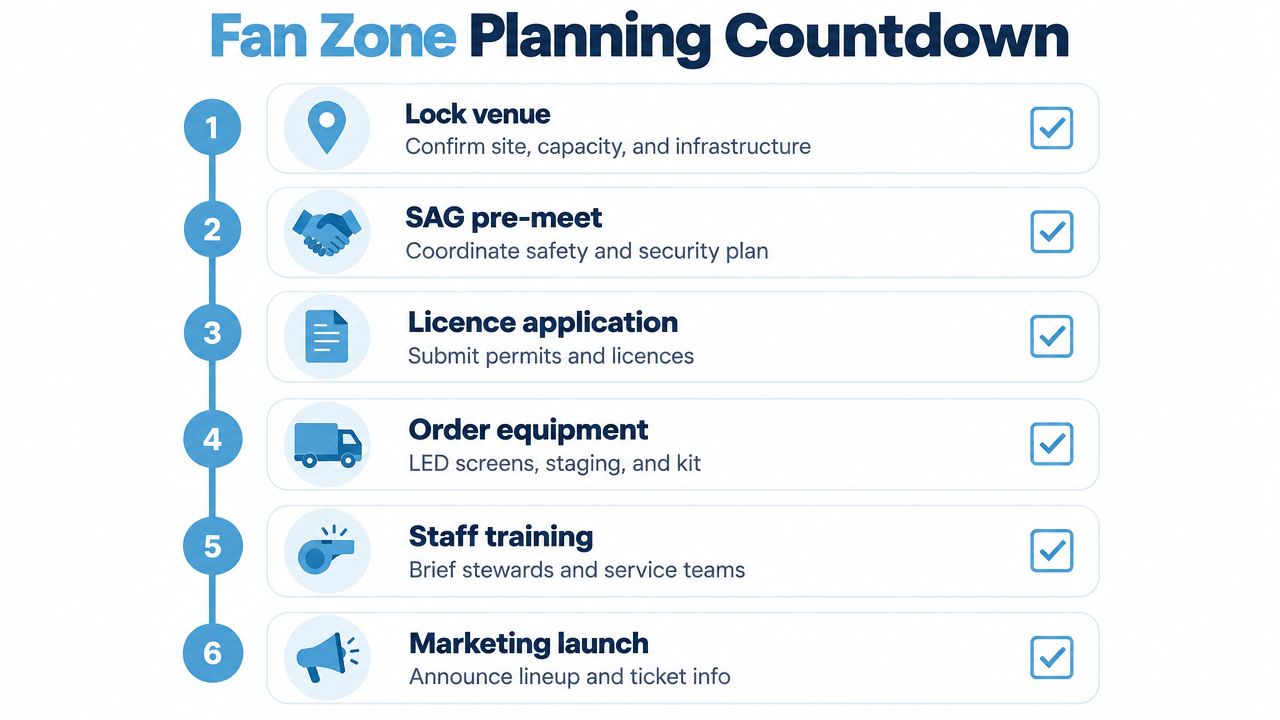
A useful checklist follows the countdown because dependencies determine whether the plan is deliverable. Licensing affects the layout, the layout affects capacity, capacity affects staffing, and staffing affects the budget presented to the sponsor.
Work backwards from opening
Around six months out, lock the venue, confirm the site capacity and infrastructure, arrange the SAG pre-meet and begin licence applications. Check ownership of the public realm, stadium access priorities and any transport restrictions before the creative concept becomes too expensive to change.
Around two months out, confirm Zone Ex corridors, operational vehicle routes, stadium-priority access and the approach to ticketless supporters. Reconcile the final footprint with police, local authority, transport and venue teams.
Four to six weeks out, finalise attractions, AV, catering, sponsor activations and accessible facilities. Confirm power, screen redundancy, staff roles, POS arrangements and the wet-weather pivot. For hygiene planning, these event venue hygiene tips provide a useful checklist for high-touch areas, service points and cleaning routines.
The day before gates open should include a full technical rehearsal with stewards. Test the match feed, backup feed, radio channels, access routes, queue barriers, sponsor content, first-aid post and emergency announcements under realistic operating conditions.
On the event day, the control checklist should cover:
- Steward briefing: Roles, escalation routes, access support and dispersal.
- Radio check: Batteries, channel discipline and command ownership.
- First aid posting: Visibility, route access and handover procedure.
- Signal test: Main screen, overflow screen and audio delay.
- Sponsor load-in: Branding, activation kit and approved content.
- Cashless POS: Terminals, connectivity, refunds and service cut-offs.
- Weather pivot: Shelter, flooring, attraction closures and revised queueing.
The UK government expects UEFA EURO 2028 to generate £3.2 billion in socio-economic benefits across the UK (government assessment reported in the UK event context). The tournament's nine-host UK and Ireland model will put more pressure on regional cities to integrate fan zones with policing and travel, while the 2026 FIFA World Cup is already shaping UK broadcaster pre-tournament activations.
The operational standard is moving away from “good atmosphere” as the main success measure. A strong football fan zone proves that people arrived, stayed, interacted, felt included and left safely.
PSW Events can support UK fan zones with football simulators, sports skill attractions, branded installations, logistics, on-site staffing and health-and-safety delivery. Visit PSW Events to discuss your venue, audience profile and matchday objectives, then build a fan-zone package around measurable footfall, dwell time and engagement.