
You're planning a London event for an audience that could respond very differently to the same format. A trade show crowd may need a reason to stop, play and share contact details. Important clients may value privacy, thoughtful hospitality and a polished setting. Employees may want an inclusive experience that doesn't feel like another presentation.
The strongest corporate event ideas in London start with the business outcome, then account for venue type, floor space, power, access requirements, seasonality, audience expectations and measurement. London offers 1,653 listed venues, with a median advertised starting price of £220 and verified average day delegate rates ranging from £254 to £464 across 1,593 venues, according to London venue market intelligence. That range reflects a market with room for board meetings, conferences, launches and large experiential builds.
The ten formats below connect each idea to a distinct outcome. Each includes practical budget direction, venue guidance, timing considerations, participation design and ways to use PSW Events' turnkey simulators, branding, staffing, logistics and compliance support. For broader event planning context, see this guide to sports event planning.
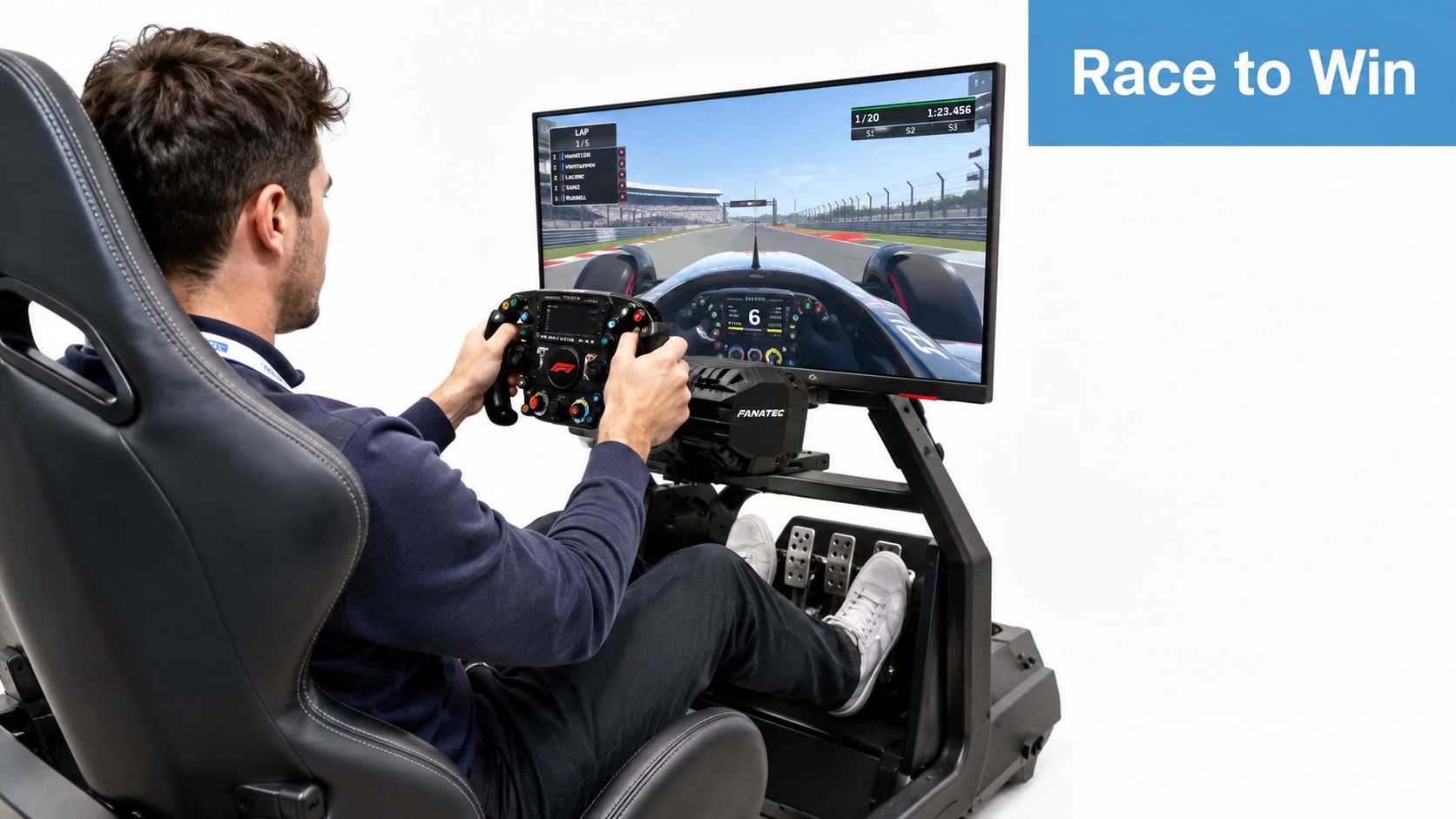
1. Interactive Simulator Racing Experiences for Brand Activations
A racing simulator works when your activation needs to stop people quickly and give them a reason to stay. F1 and multi-racing rigs create an immediate visual signal, particularly in exhibition halls, product launches and corporate hospitality areas where passive displays compete for attention.
ExCeL London is a natural reference point for large-scale delivery. It opened in November 2000, has hosted more than 4,100 events, and was expanded by 50 percent in 2008. The venue also hosted seven Olympic and six Paralympic events in 2012, illustrating the scale and event heritage available in the capital. Business Destinations' history of ExCeL London provides that background.
For a modest activation, budget for a focused simulator footprint, branded panels, one or more operators and a simple leaderboard. A larger automotive launch may require multiple rigs, a scenic structure, product display, queue management, data capture and extended staffing.
Make the race part of the campaign
Position rigs near an exhibition entrance or a natural traffic route, but don't block fire exits or create an unmanaged queue. Tournament heats encourage repeat visits, while QR codes can connect scores to a mobile leaderboard, consented email capture or a product page.
- Automotive launches: Link the driving environment to the vehicle's performance story.
- Technology exhibitions: Use the race as an approachable entry point to a more complex product conversation.
- Lifestyle campaigns: Pair competition with sampling, merchandise or social content.
- Hospitality events: Move from racing into food, networking or client conversations.
Operators need a concise briefing on the brand message, not just the controls. For a managed racing simulator experience, PSW Events can support the attraction, branded presentation, installation, staffing and event logistics.
2. Virtual Reality and Flight Simulator Team Building Events
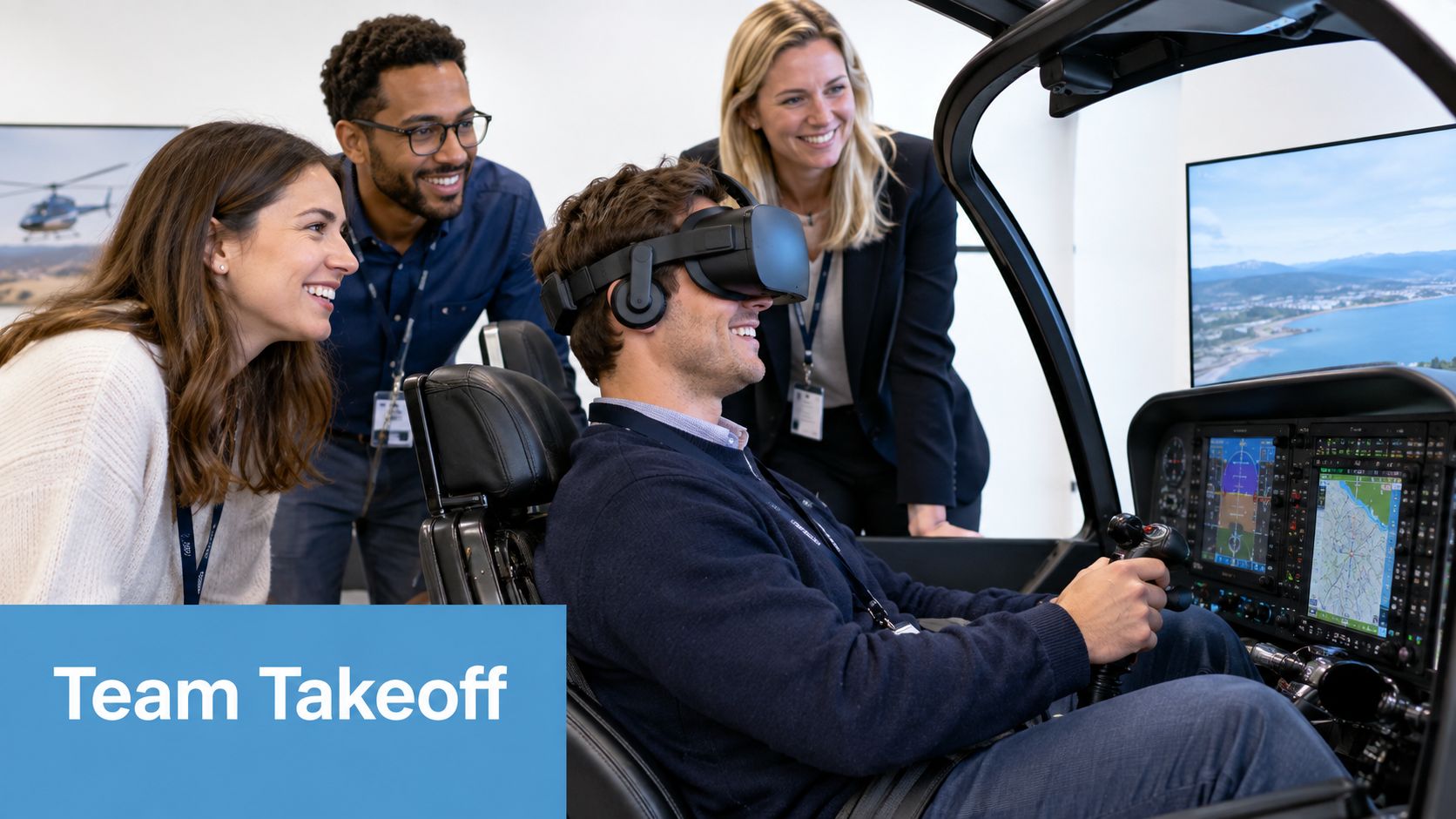
A London team can complete a shared flight challenge without leaving the city for a country retreat. VR and helicopter simulator sessions suit programmes that need a defined activity, manageable travel and a clear link to communication or decision-making.
Choose the venue around the group and the working day. Canary Wharf gives financial services teams access to offices and transport links, while conference centres and flexible event spaces can provide separate briefing, simulator and debrief areas for technology companies, professional services partnerships and sales teams. Check lift access, door widths, floor loading, lighting, power, noise and sightlines before confirming the room plan.
The activity should assign responsibility, not just place participants in front of equipment. Split the group into teams, rotate people through the stations and give observers a useful role, such as monitoring instructions, recording decisions or preparing the next crew. A flight scenario can test communication under pressure. A VR exercise can introduce an innovation workshop or a structured problem-solving task.
Plan the session around participation and outcomes
Use fewer stations with timed rotations when budget or floor space is limited. A larger booking can operate several stations at once, reducing queues and fitting more activity into the agenda. Allow time for briefing, water breaks and a facilitated reflection. Without that discussion, the session remains entertainment rather than evidence for conversations about teamwork, leadership or communication.
Mid-week afternoons may offer more flexibility from the venue and supplier. Confirm accessibility requirements early, including transfer arrangements, seated participation, headset alternatives and assistance for participants who experience motion discomfort. For executive groups, use one focused challenge and a concise discussion. For larger teams, set a rotation plan so each person has a defined turn. Hybrid programmes can combine the simulator with workshops or dining, while internal communications teams should obtain consent before capturing photographs or video.
PSW Events provides flight simulator hire with delivery support that may include operators, logistics and safety planning. Compare the format with ABC Hire's team building event ideas when building a wider programme.
3. Sports Simulator Tournaments for Corporate Entertainment
Choose the sport from the business outcome and venue, not from the equipment catalogue. Golf suits a measured client or staff competition, while rugby, American football and boxing create faster, more physical participation. The format gives an activation a defined start, scoring system and finish without requiring every guest to follow the same schedule.
Wembley can support American football or football-related engagement that reflects the setting. A London golf club can place a simulator tournament within a corporate day. A fitness brand may gain stronger relevance from boxing than racing. At a trade show, different sports stations can widen participation across ages, abilities and interests.
The format needs one operating system. Use a shared tournament name, consistent signage and one visible leaderboard, even when several sports are running. Reset scores at planned intervals so an early high score does not control the entire day.
Design the tournament around participation
Set the rules before each attempt, keep explanations short and give operators authority to move a queue forward. Modest branded prizes, vouchers or merchandise can reward participation without making the activation feel like a professional sporting event.
Build the scoring around the objective:
- Broader participation: Offer different sports rather than one fixed challenge.
- Repeat visits: Use elimination rounds, scheduled resets or team scoring.
- Qualified leads: Link leaderboard entry to a clear form with consent.
- Useful reporting: Track players, repeat attempts, busy periods and completed data captures.
A golf simulator may require more clearance and depth than a boxing station. Confirm ceiling height, power, floor protection and audience circulation before finalising the equipment mix. PSW Events can provide sports simulator hire with turnkey delivery, operators and event support, allowing the tournament to be planned around the venue and measurement requirements rather than assembled on site.
4. Executive Client Hospitality and VIP Experiences
A private client dinner at a London hotel, members' club or conference venue demands controlled pacing, discreet service and enough room for conversation. A simulator can support that setting when it is one element of a wider programme, alongside welcome drinks, dining, private networking and planned follow-up.
Investment banks, law firms, consultancies and insurance brokers can choose a premium racing, golf or flight experience for client appreciation. Match the format to the audience. Competitive guests may want timed attempts, while others may prefer to watch, talk or move between activities. The simulator should reinforce the relationship, not take over the evening.
Begin with the venue constraints and guest profile. A site visit should confirm entrance access, privacy, acoustics, ceiling height, accessible routes, dining layout and the room's visual standard. Reserve premium dates early. The stated programme requirements identify six to eight weeks as a practical minimum for planning.
Collect dietary, mobility and sensory information before the event. Brief operators on names, timings, guest preferences and the assistance each person may need. For a private dinner, a discreet leaderboard often suits the room better than a large public scoreboard.
Shape the package around four decisions:
- Personalised welcome materials: Keep branding restrained, and provide useful information instead of excessive merchandise.
- Curated competition: Set challenge length and difficulty according to guest confidence and interest.
- Complementary hospitality: Pair the simulator with dining, a tasting or private networking.
- Follow-up content: Send professional thank-you messages with approved photographs or scores.
PSW Events can deliver a turnkey simulator package, including equipment, operators and event support, so the entertainment can be configured around the venue and guest journey.
Allow the budget to cover premium venue hire, catering, presentation, staffing and access planning. Reducing operator coverage or accessibility support to protect the entertainment line can weaken the hospitality objective and disrupt the experience for high-value guests.
5. Product Launch Experiences with Interactive Demonstrations
A product launch succeeds when guests can explain the product after using it. Interactive simulators add a practical demonstration layer for products linked to performance, sport, technology, mobility or immersive media.
An automotive brand could reveal a vehicle before moving guests to a racing simulator that reflects its performance story. A technology business might use VR to demonstrate gaming, fitness or connectivity features. A sports equipment company could connect a golf, rugby or boxing challenge to the product being introduced.
The demonstration must earn its place. If the simulator has no clear connection to the product, guests may remember the game while missing the launch message.
Design the experience around the business outcome
Start with the outcome, then set the format. Media coverage needs controlled journalist and creator slots. Product education needs time with trained specialists. Qualified leads require a clear handover and consent-based data capture. Customer conversion may justify a more detailed demonstration and a quieter conversation area.
Build a route from welcome and presentation through demonstration, participation and follow-up. Operators should have approved talking points, concise answers to common questions and a defined handover to sales or product specialists.
- Content alignment: Match the simulator environment to the product benefit.
- Media access: Reserve demonstration slots for journalists, creators and partners.
- Lead capture: Place QR codes or digital forms at the interaction point.
- Social amplification: Prepare shareable leaderboard content, branded photography and a campaign hashtag.
- Post-launch follow-up: Segment contacts by participation, interest and consent.
A polished scenic build may suit a major London launch, while a compact branded installation can work for a smaller press event. Venue choice affects floor space, power, lighting, guest flow and accessibility. Seasonality and audience profile should also influence indoor capacity, session length and staffing.
Confirm content approvals, photography permissions and data governance early. PSW Events can provide a turnkey simulator delivery with equipment, operators and event support, allowing the installation to be configured around the venue, audience and measurement plan. Track participation, qualified conversations, media activity and follow-up actions against the chosen objective.
6. Trade Show and Exhibition Interactive Booths
A London exhibition stand competes with every nearby exhibitor for attention, time and qualified conversations. A simulator gives visitors a clear reason to stop, but its business value depends on how well the activity connects to the offer and the follow-up process.
Start with the venue and footprint. ExCeL London can support larger, high-throughput builds, while Olympia and central London conference venues may suit a smaller installation. Compare available floor space, power, sightlines, access routes and expected visitor volume before confirming the format. The interactive exhibition stand ideas from PSW Events offer useful examples for fitting interactive attractions into a broader stand concept.
Place the simulator where aisle traffic can see it without blocking the entrance or neighbouring stands. Explain the challenge in a few seconds through signage, then show why the activity relates to the exhibitor's product or service. A short demonstration may work better than a complex game when the audience has limited time.
The strongest booths operate to a defined handover plan. An operator can manage instructions and safety, while a brand representative discusses requirements, applications and next steps. Where staffing is limited, schedule demonstration periods and protect breaks across the exhibition day.
Measure the format against the intended outcome:
- Reach: Count unique players, not every repeat attempt.
- Lead quality: Separate consented records from general participation.
- Demand: Review busy periods and adjust staffing or session timing.
- Commercial relevance: Record whether conversations involve the intended customer profile.
- Follow-up: Link contacts to agreed sales or marketing actions.
Use pre-event promotion to direct existing prospects to the stand, and define participation rules before doors open. Explain data collection clearly and collect only information the follow-up process requires. A leaderboard can encourage return visits, but it should support the conversation rather than replace it.
Digital leaderboards and lead forms also require dependable connectivity. Review Splash Access temporary internet services when the venue network cannot reliably support the installation. PSW Events can provide turnkey simulator delivery, including equipment, operators and event support, with the setup configured for the venue, audience and measurement plan.

7. Corporate Wellness and Team Fitness Activation Events
A London wellness activation has to work for different fitness levels, confidence levels and access needs. Boxing, climbing walls and golf simulators can attract competitive participants, while health workshops, nutritious refreshments and quieter activities give others useful ways to take part. The business outcome may be employee connection, wellbeing education or a stronger work-life balance programme, so the activity mix should reflect that purpose.
A technology company might combine climbing and boxing stations with team challenges. A professional services firm could schedule a fitness activation within working hours to support participation, while an insurer might link the programme to health benefits and employee education. The trade-off is clear: one headline attraction simplifies delivery, while several stations widen participation but require more space, facilitators and scheduling.
Before booking a London venue, check the practical setup. Provide warm-up and cool-down areas, changing or storage space, hydration points and clear routes between activities. Promote sign-ups early so employees can select suitable sessions, and confirm access requirements before finalising equipment, floor surfaces, routes and staffing.
Build participation around choice
Use instruction or a practice round before any scored activity. Participants should be able to observe, coach teammates or take a non-competitive role without feeling excluded. Offer different difficulty levels and supported participation, then use feedback to assess satisfaction and attendance rather than presenting entertainment data as a medical outcome.
- Low-pressure entry: Begin with guidance and practice.
- Flexible roles: Include observation, coaching and team support.
- Wellness integration: Add stretching, workshops, healthy food or recovery areas.
- Access planning: Test routes, surfaces and equipment against confirmed requirements.
- Internal communication: Share approved results and photographs after the event.
Budget depends on whether the format uses one attraction or a wider programme with facilitators, food and workshops. A simulator can provide a controlled, measurable activity in limited space. PSW Events can deliver turnkey simulator setups with equipment, operators and event support, configured for the venue, audience and measurement plan. The strongest format feels like one employee experience, not unrelated fitness machines placed around a room.
8. Experiential Brand Activations and Guerrilla Marketing Events
A pop-up in Shoreditch can suit a sports or technology audience looking for an unexpected experience. Canary Wharf supports a polished, business-facing activation, while a busy shopping district may give a consumer brand wider public reach. Choose the location for the audience and the business outcome, whether that is trial, lead capture, content or direct engagement.
Racing simulators, VR installations and sports challenges create an immediate visual draw. Public delivery requires planning before promotion. Confirm permissions with the relevant council, property owner or venue, then check noise, crowd control, queue layout, weather exposure, power, insurance, accessibility and emergency access.
Design for participation and measurement
The experience must make sense without a long sales pitch. Set one clear challenge, display the brand consistently and give participants a result they can share. Record useful measures such as entries, completed sessions, qualified leads, opt-ins and content permissions. Influencers and local press may extend reach, but the activation should work without guaranteed coverage.
- Location fit: Select a site where the intended audience already gathers.
- Permission planning: Confirm approvals, trading restrictions and public safety requirements.
- Staffing: Match operators to expected attendance and queue volume.
- Content capture: Secure consent for photography and user-generated content.
- Follow-up: Contact participants only through channels they have agreed to use.
A compact pop-up can require less investment than a scenic build with several attractions and extended staffing. Outdoor formats need a stronger seasonal plan because London weather changes quickly. Allow space for shelter, protect equipment and define the wet-weather operating decision before opening. PSW Events can provide turnkey simulator delivery with equipment, operators and event support when a branded racing format needs controlled setup and measurable participation.
9. Charity Fundraising Galas and Benefit Dinner Events
A formal London gala can include a simulator without losing its tone. Reception drinks and the post-dinner period usually offer the best operating windows. Position the attraction where guests can find it, while protecting the stage, auction area, dining layout and accessible routes.
The format should support a defined fundraising outcome. A children's hospital charity could offer an exclusive simulator session as an auction lot. A sports foundation might host a celebrity racing challenge. An education or medical research charity could use a hosted VIP experience to recognise sponsors and major donors.
Set the giving mechanic before production begins. General access may suit attendees, with reserved sessions for major donors or auction winners. Tie the challenge to the charity's message through host briefing, signage and sponsor presentation. The simulator should add participation, not compete with speeches or the cause.
Build the attraction around the donor journey
Include the experience in auction communications, sponsorship packages and event updates so guests understand its purpose before arrival. A sponsor can receive branded recognition around the simulator, provided the design matches the gala's visual standards and does not overwhelm the room.
- Placement: Keep the attraction discoverable, away from dining service, speeches and restricted routes.
- Auction design: Offer private sessions, hosted challenges or limited access with clear redemption arrangements.
- Operator briefing: Explain the charity story, donor sensitivities and the appropriate engagement approach.
- Content: Arrange professional photography for donor recognition and approved social updates.
- Guest care: Confirm dietary, mobility and sensory requirements with the venue and event team.
The main cost pressure will often come from the venue, catering and formal production. Scope the simulator within the full guest journey, including installation, staffing, insurance, safety checks and breakdown. PSW Events can provide turnkey simulator delivery, with equipment, operators and event support, when the gala needs a controlled setup and a managed guest experience. Record participation, auction conversions and sponsor engagement where those measures support the event's reporting requirements.
10. Multi-Day Festival and Fan Zone Installations
Multi-day festivals and fan zones need attractions that sustain participation beyond one visit. Racing, football, boxing and climbing simulators can anchor a programme when organisers combine open play with scheduled competitions and clear reasons to return.
Match the format to the London setting. A Silverstone F1 event could centre racing rigs in its fan zone. Wembley events may suit football challenges, while a London summer festival or music event could place several sports attractions in a dedicated entertainment area. Outdoor delivery requires weather planning, power protection and a surface suitable for safe equipment access.
Design the visitor flow before confirming the equipment footprint. Put the main attraction beside an entrance or obvious route, then use signage for queueing, rules and session times. A daily leaderboard creates short-term competition, while an overall festival ranking supports repeat visits.
Treat the installation as temporary event infrastructure
Multi-day operation needs planned operator breaks, equipment checks, cleaning, storage, backup coverage and a defined breakdown schedule. Connect results to a festival app only after checking connectivity, data handling and technical support.
- Competition format: Run daily sessions alongside an overall event ranking.
- Peak programming: Reserve selected sessions for sponsors, VIPs or headline periods.
- Queue control: Use barriers, timed slots or a host to protect safe circulation.
- Staffing: Cover every opening period, including breaks and contingency requirements.
- Content capture: Record approved footage for highlight reels and post-event media.
Budget for the whole operating period, including delivery, installation, staffing, insurance, safety checks and removal. PSW Events can provide turnkey simulator delivery with equipment, operators and event support when the organiser needs one managed setup across several days.
The UK events sector recorded an estimated 1.08 million conferences and meetings in 2024, with 95.4 million delegates, 144.8 million delegate days and £19.3 billion in direct expenditure in venues and destinations, according to the Events Industry Alliance UK events report. Sustained attractions can earn space in busy event environments when throughput, accessibility and measurement are planned alongside the concept. Track participation, repeat visits, queue times and sponsor engagement against the festival's reporting requirements.
Top 10 London Corporate Event Ideas Compared
| Offering | Implementation Complexity 🔄 | Resource Requirements ⚡ | Expected Outcomes ⭐📊 | Ideal Use Cases 💡 |
|---|---|---|---|---|
| Interactive Simulator Racing Experiences for Brand Activations | High 🔄: motion rigs, calibration, on-site tech setup | High ⚡: dedicated floor space, power, trained operators, branding | ⭐ High engagement: long dwell time, social content, measurable leads 📊 | 💡 Automotive launches, exhibitions, product launches |
| Virtual Reality & Flight Simulator Team Building Events | Medium–High 🔄: VR/flight-specific safety briefings and H&S | Medium ⚡: indoor venue, ventilation, insurance, multiple stations | ⭐ Strong team cohesion: shared experiences, trackable performance 📊 | 💡 Mid-sized corporate team-building, executive workshops |
| Sports Simulator Tournaments for Corporate Entertainment | Medium 🔄: multi-sport setups, tournament management | Medium–High ⚡: multiple stations, host/commentary, leaderboard systems | ⭐ Broad appeal: high participation, repeat visits, social sharing 📊 | 💡 Trade shows, brand activations, client entertainment |
| Executive Client Hospitality & VIP Experiences | High 🔄: bespoke itineraries, premium service coordination | High ⚡: private spaces, catering, photography, account management | ⭐ High impact: strengthened client relationships, increased retention 📊 | 💡 VIP hospitality, client reward programmes, executive events |
| Product Launch Experiences with Interactive Demonstrations | High 🔄: custom content, narrative integration, technical operators | High ⚡: multi-station setups, digital displays, media capture, content dev | ⭐ Very high visibility: extended interaction, media and lead generation 📊 | 💡 Product reveals, influencer previews, tech and automotive launches |
| Trade Show & Exhibition Interactive Booths | Medium 🔄: compact install, quick setup/breakdown, operator training | Medium ⚡: booth-optimised rigs, power/network, multi-day support | ⭐ High ROI: increased booth traffic, qualified leads, measurable metrics 📊 | 💡 B2B exhibitions, sales pipeline development, industry conferences |
| Corporate Wellness & Team Fitness Activation Events | Medium 🔄: health screening, certified instructors, safety protocols | Medium ⚡: fitness stations, staff, health metrics tracking | ⭐ Positive wellbeing impact: higher engagement, employer branding 📊 | 💡 Wellness days, corporate retreats, employee engagement events |
| Experiential Brand Activations & Guerrilla Marketing Events | Medium 🔄: location scouting, permits, rapid setup | Medium ⚡: mobile rigs, visual installations, influencer coordination | ⭐ High PR value: earned media, viral social reach, buzz 📊 | 💡 Street pop-ups, high-footfall areas, influencer-led campaigns |
| Charity Fundraising Galas & Benefit Dinner Events | Medium–High 🔄: elegant integration, donor experience planning | Medium–High ⚡: premium installs, VIP access, auction tie-ins | ⭐ Increased fundraising: higher per-attendee revenue, memorable donor experiences 📊 | 💡 Galas, benefit dinners, charity auctions |
| Multi-Day Festival & Fan Zone Installations | High 🔄: festival logistics, weatherproofing, multi-day staffing | High ⚡: durable stations, insurance, extended technical support | ⭐ Major footfall driver: repeat visits, sponsorship value, sustained engagement 📊 | 💡 Festivals, sport fan zones, multi-day public events |
Turn the Idea Into a Measurable London Event
Start with one primary outcome. A lead-generating exhibition booth, an executive hospitality evening and an employee wellness day may all use a simulator, but they shouldn't share the same layout, staffing model or success criteria.
London planners also need to make a deliberate venue decision. Central locations offer strong recognition and convenient access for some audiences, but cost pressure can make well-connected Zone 2 or Zone 3 areas more practical. Recent London-focused planning coverage describes that shift, alongside bookings reported as 15–20% lower than Q1 2024 and lead times shortening by 4%, in corporate event trends for 2026. Treat those figures as context from that coverage, not a universal forecast for every event.
A second source of pressure is value per attendee. Recent UK venue coverage reports broadly flat average budgets, 8% higher per-person spend, 91% of organisers ranking location and accessibility above price, and 40% of planners expecting visible sustainability measures. Those figures appear in UK venue expectations for 2026. The practical implication is clear. A cheaper venue isn't automatically better if poor access reduces attendance or an invisible sustainability plan weakens stakeholder confidence.
Use this selection sequence:
- Define the outcome: Choose lead capture, footfall, dwell time, client relationship, staff participation, fundraising or brand awareness.
- Shortlist the venue type: Compare exhibition halls, conference centres, hotels, heritage spaces, sports venues, pop-ups and festival sites.
- Confirm the physical specification: Check floor space, ceiling height, power, loading access, storage, noise, lighting and audience circulation.
- Map audience needs: Account for mobility, sensory, dietary, language, age, confidence and participation preferences.
- Choose the participation format: Decide between open play, timed sessions, team rotations, tournaments, VIP access or a mixed model.
- Agree measurement targets: Select relevant indicators such as footfall, dwell time, participants, unique players, leads, leaderboard activity, donations or satisfaction.
- Lock delivery controls: Confirm permissions, accessibility provisions, staffing, installation windows, risk assessments, insurance, H&S procedures and breakdown arrangements.
- Plan the follow-up: Decide how scores, photos, leads, feedback and content will be used after the event.
Practical rule: A simulator is not a strategy by itself. It becomes valuable when the activity, message, data capture and follow-up all support the same business outcome.
PSW Events can suit programmes where interactive attractions need to arrive as one coordinated delivery. Its portfolio includes racing, flight, sports and VR simulators, alongside attractions such as Batak Pro, giant Scalextric, electronic leaderboards and climbing walls. The company states that it provides planning, branding, logistics, installation, on-site staffing and H&S compliance, with £10 million in products, employee and public liability insurance and over 50 years' combined experience. These details are available through PSW Events' corporate event services.
The right event doesn't necessarily need the biggest build. It needs a format that suits the audience, a venue that can support safe participation and a measurement plan that distinguishes activity from impact. Confirm those decisions early, then brief the supplier on the outcome rather than just asking for equipment.
PSW Events provides turnkey racing, flight, sports and VR simulator experiences for London exhibitions, conferences, launches, team building, hospitality and fan zones. Visit PSW Events to discuss your venue, audience, access requirements and the measurable outcome you want the event to deliver.