
Your stand plan is open on one screen, the venue manual is open on another, and the marketing team is asking the same question: what will make visitors stop here rather than walk past the next exhibitor? Exhibition games hire can provide that moment, but only when the attraction fits the stand, the venue, the build schedule, and the lead process behind it.
A simulator or competitive game isn't a complete activation on its own. The useful work happens in the planning around it, from selecting an attraction with enough throughput to arranging compliant power and briefing staff to turn play into a relevant sales conversation.
Why Exhibition Games Matter for UK Stands
The busiest aisle is already claimed, the stand graphics are competing with familiar promises, and the team has only a short build window to make the space work. Exhibition games hire can create a visible reason to stop, but the attraction must earn its footprint by supporting conversations, lead capture and the practical limits of the venue.
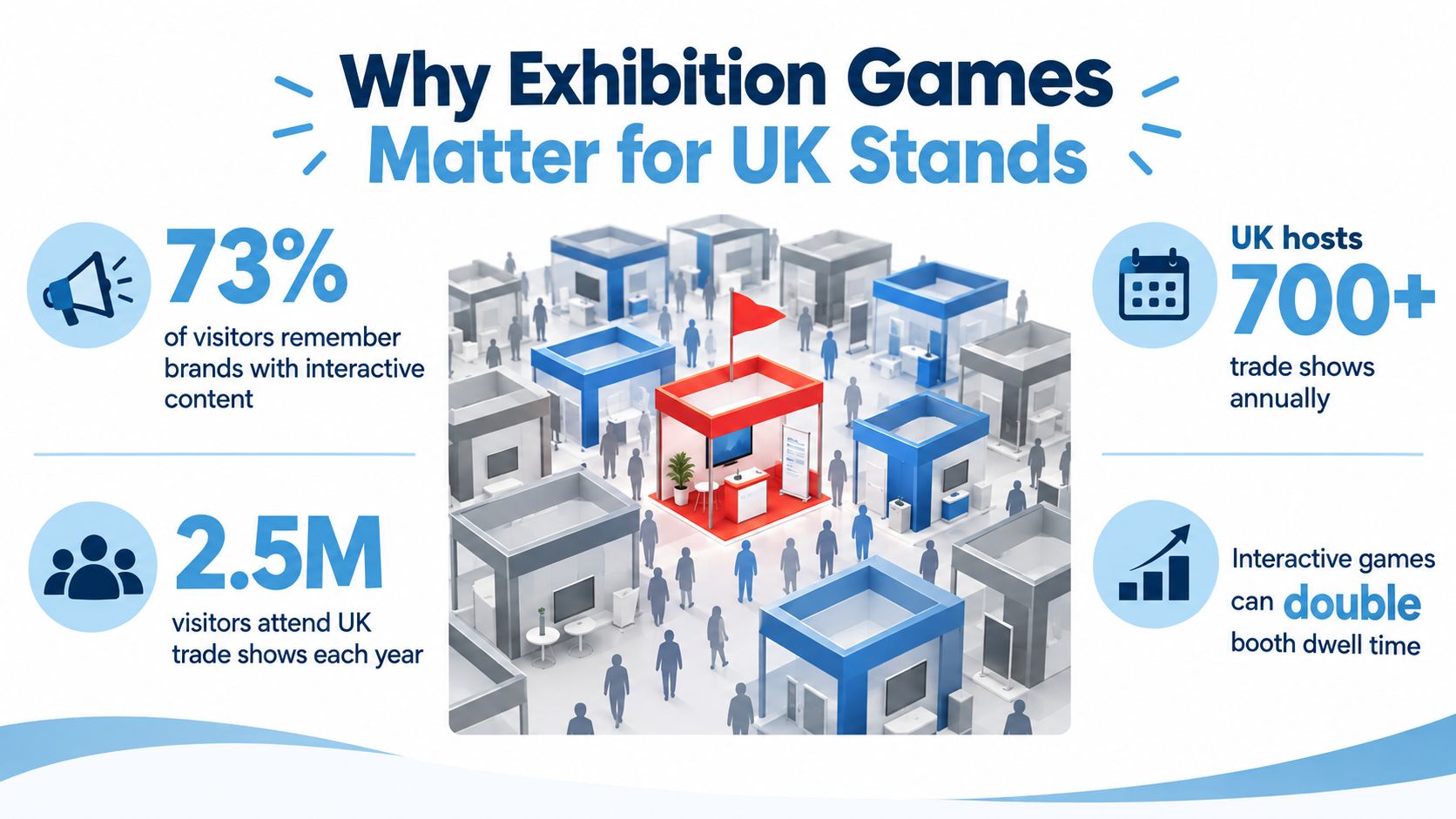
The UK market gives that problem real scale. The Size and Scale Index for Exhibitions 2024 recorded 1,145 exhibitions and conferences at the country's main exhibition venues, generating about 7.2 million visits in 2024. The median event attracted 2,400 visitors, compared with an average of 6,300. Every stand is therefore competing for attention among a substantial moving audience.
Interactive hire is part of the visitor journey
A game works best when its operation is designed around the commercial purpose of the stand. A quick-play format can pull visitors from the aisle and keep the queue moving. A simulator can hold attention while a trained colleague asks qualifying questions. A leaderboard may encourage repeat visits, but staff still need to connect the result with the brand, product or customer problem. Otherwise, the stand has installed an unbranded arcade.
Consumer exhibitions represented 62% of visits, while primary venues represented 65%, according to the same index. That concentration makes visible formats useful at large public-facing events, where a branded game or simulator can help increase dwell time and stand traffic.
Lead capture needs the same attention as the attraction. Guidance on B2B lead generation strategies from Lead Printer supports a practical starting point: agree what sales needs before visitors begin playing. A name collected without context has limited value. A result connected to product interest, a business challenge or a buying timeframe gives the follow-up team a clearer reason to make contact.
The operational detail affects performance. A game with a long reset, unclear rules or one operator serving several players creates a queue that looks busy but processes few useful conversations. A short session, visible instructions and a simple handover to staff make the same footprint work harder.
Why timing affects the outcome
The UK exhibition sector has rebuilt strongly after disruption. Visits reached 8.91 million in 2019, fell during the disruption, then recovered to 6.11 million in 2022, 6.92 million in 2023 and 7.2 million in 2024. The 2024 total was 91% of 2019 levels, according to the UK sector trade shows and exhibitions analysis. As calendars fill, experienced operators and popular attractions are less likely to remain available at short notice.
Late decisions also expose practical risks. The chosen game may obstruct the visitor route, the venue power order may have closed, or the supplier may be unable to meet the access window. Treat experiential marketing and its role in live engagement as part of the stand strategy from the first floor-plan review, with space, power, staffing and lead capture agreed before the design is signed off.
Choosing the Right Attraction for Your Goals
The right game depends on the job it must perform. A racing simulator can create spectacle and a natural queue, but it needs more careful space, power and supervision than a compact reaction game. A golf simulator may suit a premium brand environment, while a quick-play arcade format can process more visitors when the objective is broad awareness.
UK experiential activity is already distributed beyond traditional stand entertainment. In 2025, 321 brands and agencies took part in 3,493 live activation days across 360 venues in 90 UK towns and cities, with sampling representing nearly 49% of bookings, up 6% year on year, according to the 2025 live activation data shared by Andrew Bodwick. That context matters because an exhibition game can play two different roles. It can support a qualification conversation, or it can operate like a sampling attraction that generates broad footfall.
| Attraction Type | Best For | Throughput | Space Needed | Branding Potential |
|---|---|---|---|---|
| Quick-play reaction or arcade game | Broad footfall and simple prize mechanics | High, if reset is fast | Low to moderate | Strong on fascia, screen and leaderboard |
| Multiplayer racing rig | Competition, spectacle and repeat visits | Moderate | Moderate to high | Strong through liveries, race graphics and results |
| Sports simulator | Product relevance, premium engagement and conversation | Moderate | Moderate | Strong through targets, scoring and branded challenges |
| Flight or motion simulator | Immersive spectacle and premium positioning | Lower | High | Strong, but requires careful queue and safety management |
| Physical challenge attraction | Energy, audience participation and visual theatre | Moderate | Moderate to high | Strong through branded scoring and staff interaction |
Match the format to the audience
For a B2B exhibition, the attraction must leave room for a useful conversation. A game that consumes the visitor's entire interaction without creating a handover to a sales colleague may produce impressive activity but poor commercial value. Use a short challenge, collect a meaningful preference or business need, then move the visitor to a quieter area.
Consumer shows allow more playful formats, particularly when the attraction is visible from the aisle and the prize or leaderboard gives visitors a reason to return. Even there, don't assume a long queue equals success. A queue can block neighbouring stands, frustrate visitors and make the activation look inaccessible.
Practical rule: choose the attraction by its intended handover, not by the photograph in the supplier catalogue.
Before booking, write down the desired outcome in one sentence. If it's “start qualified conversations with technical buyers”, prioritise a controlled simulator or challenge with staff support. If it's “make the stand visibly active”, prioritise a high-visibility format with fast resets. If it's “collect opted-in contacts”, confirm how the game platform records consent, results and follow-up fields before signing.
PSW Events supplies exhibition attractions including sports, racing and flight simulators, Batak Pro, giant Scalextric, VR and electronic leaderboards, alongside delivery, branding, installation and on-site staffing. Those capabilities illustrate the wider point: the hire item, the operator and the data workflow should be planned as one service, not three disconnected purchases.
Planning Timeline and Booking Windows
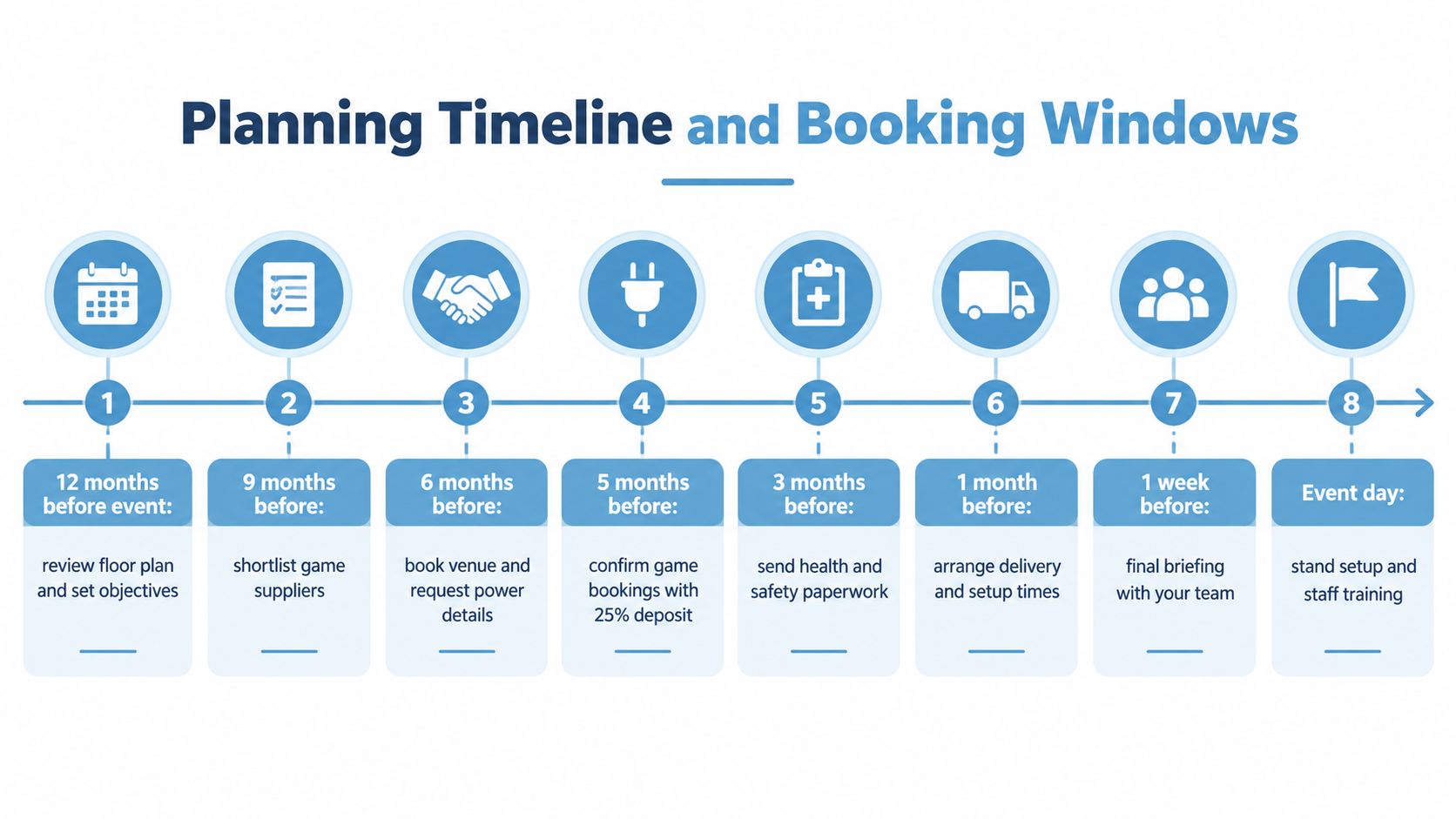
Exhibition games hire works best when planned backwards from the first visitor opening, not forwards from the day someone approves the budget. A practical planning sequence starts with the floor plan and ends with staff training, equipment checks and a clear collection plan.
The dates below provide a useful working model for a standard UK exhibition:
- Twelve months before: review the floor plan, define the commercial objective and identify the visitor route you want to influence.
- Nine months before: shortlist suppliers, checking attraction dimensions, access requirements, staffing and previous venue experience.
- Six months before: confirm the venue and request power, loading, rigging, noise and access details from the organiser.
- Five months before: secure the attraction, agree the scope of branding and confirm the deposit and cancellation terms.
- Three months before: send risk assessments, method statements, insurance evidence and any venue forms requested by the organiser.
- One month before: agree delivery, build and collection times, including who meets the crew and where equipment will be stored.
- One week before: brief stand staff on the game rules, lead questions, queue behaviour, escalation process and data consent.
- Event day: install, test, clean, brand-check, train the team and run a controlled rehearsal before the hall opens.
Build around the real venue window
Don't treat the exhibition hall as an empty warehouse. The supplier may have a narrow access slot, the stand contractor may still be finishing graphics, and the venue may restrict vehicle movements or require advance registration. A rig that looks easy to assemble in a warehouse can become difficult when it must pass through a service door, lift or congested aisle.
The 2025 Size and Scale Index for Exhibitions reported that total venue hire and open days increased in the UK during 2025, driven by more events and slightly longer exhibition durations, while average hire days were slightly down. That combination favours modular attractions and suppliers who can deliver a reliable setup without requiring an unnecessarily long hire period.
Use a practical event planning timeline alongside the venue's own manual. Confirm the exact handover point, not just the event date. Your supplier needs to know when the stand is safe to enter, when power will be live, when graphics will be ready and when the equipment must be removed.
Budget Breakdown and Hidden Cost Factors
The headline hire fee rarely represents the full activation cost. A proper budget separates the attraction from the work required to transport it, install it, operate it, brand it and leave the venue without damage or paperwork outstanding.
Start with the commercial value of the activity, then build the operational line items beneath it:
- Equipment hire: the game, simulator, screens, control systems, protective cases and standard accessories.
- Transport: delivery, collection, crew travel, parking, waiting time and any venue-specific handling.
- Installation: assembly, testing, cable management, floor protection and dismantling.
- Staffing: trained operators, queue hosts, lead qualifiers and relief cover for breaks.
- Branding: wraps, overlays, fascia graphics, leaderboard design, signage and replacement artwork.
- Compliance: risk assessments, method statements, insurance documents, electrical testing and venue submissions.
- Data handling: tablets, software configuration, consent wording, export format and post-show handover.
The provided cost visual includes indicative ranges such as £2,500 to £15,000 for hire, £800 to £3,000 for delivery and collection, £500 to £2,000 for venue logistics and installation, £1,000 to £4,000 for staffing and training, and £200 to £1,000 for insurance and compliance. These figures should be treated as planning references from the visual, not as a universal supplier tariff. Ask each supplier to state exactly what is included and what can trigger an additional charge.
Where savings create risk
Removing an operator can reduce staffing cost, but it can also leave visitors unsure how to begin, allow queues to become disorganised and disconnect play from lead capture. Cutting branded surfaces may save production time, yet a generic machine can look like a separate attraction rather than part of the stand.
Venue charges deserve particular attention. Power may be ordered through the organiser rather than the game supplier. Floor protection, carpet cleaning, waste removal and late collections can also sit outside the initial quote. If the stand is in a venue with restricted access, delivery planning may require more crew time than a simple kerbside drop.
Ask for an all-in scope: equipment, crew, transport, installation, power assumptions, branding, compliance documents, operating hours, data export and collection should each appear in writing.
Spend more where failure would damage the visitor experience. A trained operator, tested lead form and reliable cable management usually protect the activation better than an unnecessary layer of decorative customisation. Conversely, don't pay for a complex software feature if staff won't use the resulting data in the sales process.
Venue Logistics and Electrical Compliance
Power planning should begin before the attraction is confirmed. UK exhibition stand installations use single-phase 230V/50Hz or three-phase 400V/50Hz supplies, and the electrical regulations state that each stand should normally receive a separate mains cable. One cable may serve up to six adjoining stands only when the licensor approves it, as set out in the Electrical Regulations for Exhibition Stands.
That requirement affects more than the simulator itself. Screens, lighting, scoreboards, charging equipment and networking hardware all contribute to the practical setup. Give the supplier the stand plan, equipment list and venue power order early enough for the electrician and organiser to resolve conflicts before build day.
Compliance checks before installation
Use this checklist with the venue, stand contractor and attraction supplier:
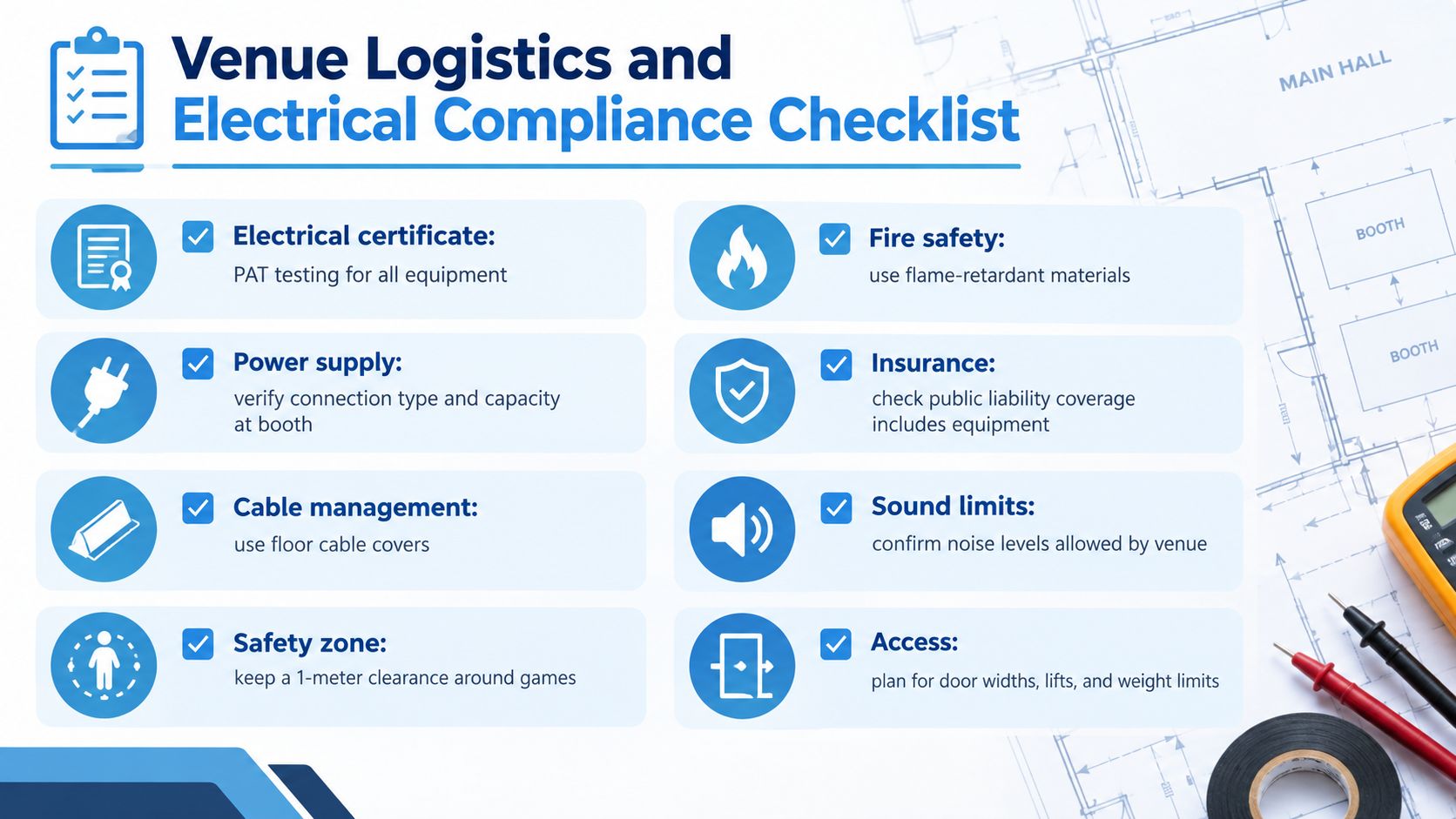
- Supply confirmation: verify whether the stand has single-phase or three-phase power and confirm the available capacity.
- Distribution plan: establish where the supply enters and how equipment will be distributed without creating trip hazards.
- Qualified installation: ensure electrical work is completed by qualified electricians rather than event staff improvising connections.
- Protection: confirm that circuits are earthed and insulated and protected by Residual Current Devices with a 30 mA trip, as required by the relevant UK exhibition safety rules.
- Testing paperwork: collect the required certificates, equipment test records, risk assessment and method statement before the venue deadline.
- Cable protection: route cables away from visitor paths and use suitable covers where crossings are unavoidable.
- Physical clearance: keep the attraction's operating area clear, including space for entry, exit, supervision and emergency access.
- Venue restrictions: check sound levels, ceiling height, door widths, lift dimensions, loading limits and floor loading requirements.
Working on live circuits isn't permitted under the cited exhibition safety rules. The same rules require proper earthing, insulation and qualified electrical work. These aren't administrative details to be completed after the game arrives. They determine whether the attraction can be commissioned safely and on time.
Opening and closing power windows
Venue power may not run continuously by default. At some British venues, mains supply is switched on no later than 30 minutes before opening and switched off no later than 30 minutes after closing. 24-hour power must be requested separately where required, according to the Business Design Centre rules and regulations manual.
That affects overnight charging, refrigeration, servers and any equipment that needs a long startup. Confirm the daily operating window, standby arrangement and shutdown responsibility with the venue and supplier. A short pre-opening test is useful, but it isn't a substitute for requesting the correct power service.
Branding Activation and On-Site Operations
A game becomes a marketing asset only when the visitor can connect the experience to the exhibitor. Branding should appear where people look during play, not only on a panel behind the equipment. Consider the simulator shell, steering wheel area, screen frame, score display, start prompt and prize message, while keeping instructions readable.
The staff workflow matters just as much. One person can welcome and explain the challenge, another can qualify interest or manage the data capture, and a sales colleague can handle the follow-up conversation. On smaller stands, one trained operator may combine those roles, but someone must own the transition from play to conversation.
Build a repeatable operating rhythm
Before opening, the team should check the equipment, screens, controls, branding, floor condition, consent wording and lead system. Run a short test from start to finish, including the data export path. Don't wait for the first visitor to discover that a tablet has lost its connection or the leaderboard is displaying yesterday's branding.
During the session, keep the challenge easy to understand. Staff should explain the rules in one short instruction, manage the queue without blocking the aisle and use a clear handover question such as, “Would you like to see how this relates to your current project?” The wording can change by sector, but the principle stays the same: make the next step relevant.
Turn play into useful data
The capture form should collect only information the sales team can act on. A visitor's score may create a reason to follow up, but it doesn't replace a business qualification field. Depending on the campaign, useful fields might include product interest, current supplier, project stage or permission for follow-up.
Leaderboards need moderation. Show scores only where consent and privacy arrangements allow it, and remove entries that contain inappropriate text. Give staff a simple response for technical faults, disputes and visitors who want to play without sharing details. Respectful handling protects the brand more effectively than forcing every participant into a form.
At close, download or verify the day's data, charge or safely shut down equipment, check the stand for damage and record recurring faults. For multi-day exhibitions, a short debrief with the crew can improve queue flow and staff handovers before the next opening.
Measuring Success with Meaningful KPIs
A busy stand can still produce weak commercial results. Set the measurement plan before the attraction arrives, then agree which figures marketing and sales will review after the show.
Use a focused KPI set:
- Qualified leads: count contacts matching the agreed audience and information criteria, rather than every participant.
- Cost per qualified lead: divide the complete activation cost by qualified leads, using the final invoice, staffing and delivery costs, not just the equipment fee.
- Dwell time: sample how long visitors stay engaged and compare it with the planned experience length.
- Lead-to-opportunity conversion: connect captured contacts to CRM stages, with clear ownership and follow-up timing.
- Repeat participation: record return visits where a leaderboard or progressive challenge encourages another attempt.
- Brand response: review consented social mentions, campaign codes and post-show feedback alongside sales outcomes.
Compare results by audience, stand position, attraction type and staff coverage. A raw play count is useful for judging demand, but it cannot show whether the right visitors engaged or supplied usable details. Keep the reporting fields consistent across events so the commercial team can identify genuine changes.
For the post-show report, use this guide to experiential marketing ROI. Include the activation objective, KPI definitions, raw exports, qualified lead total, sales owner and follow-up status. Record queue observations and technical interruptions too, since poor throughput or downtime can reduce opportunities without appearing in play totals.
PSW Events provides exhibition games hire across the UK and worldwide, including racing, sports and flight simulators, VR, Batak Pro, giant Scalextric and electronic leaderboards. Its service includes planning, branding, logistics, installation, staffing and health and safety support. Visit PSW Events to discuss an attraction and delivery plan matched to your stand, venue and lead-generation objectives.