
You've probably had this brief drop into your inbox already. A London team is arriving, the client wants something memorable but not chaotic, and you've got six weeks to turn Edinburgh into a piece of structured group activity that people will talk about on the train home.
That's where an Edinburgh scavenger hunt makes sense, provided it's treated as an activation rather than a novelty. Edinburgh has the visitor base to support it, with the city drawing around 3.27 million visitors in 2010 and 3.85 million by 2015, while visitor expenditure rose from just over £1 billion to £1.32 billion in the same period, and tourism supported around 30,000 jobs plus about £400 million in wages and salaries (ETAG facts and figures guide). More recently, the city's occupancy rate reached 85.4% in 2024, the highest in seven years, after moving through 13.7% in 2020, 32.7% in 2021, 66.4% in 2022, and 81.4% in 2023 (Edinburgh by Numbers). That's a strong sign that city-centre footfall and visitor activity are not fringe conditions here, they're the operating environment.
What an Edinburgh Scavenger Hunt Really Involves
A planner with forty colleagues and six weeks doesn't need a tourist checklist. They need a format that gets people moving, keeps them talking, and doesn't collapse the moment a group misses one clue or the weather turns sideways. In Edinburgh, that usually means a timed, team-based route through the city's walkable core, with stops that can be reached, recognised, and completed without turning the day into a marching exercise.
Why Edinburgh fits the format
The city's Old Town gives you something many UK cities can't. Its density works in your favour, because you can build a route that feels varied without asking teams to travel far between checkpoints. That matters for corporate groups, since the activity has to hold attention across different ages, fitness levels, and levels of familiarity with one another.
For a practical starting point on broader team formats, see PSW Events' team building activities in the UK. The useful insight is that the hunt is not really about solving clues in isolation. It's about pace, shared decisions, small wins, and the way a route gives a group reasons to interact.
Practical rule: in Edinburgh, the city centre is the asset, not the obstacle. A compact route can feel richer than a long one if the checkpoints are chosen well.
That's why an Edinburgh scavenger hunt works best when it is designed like a live session, not a sightseeing list. The city's visitor numbers and current occupancy trend show there's already a strong base of people in motion, which makes footfall-driven activations safer to plan than in quieter destinations. Edinburgh is busy enough to feel vibrant, but compact enough to keep the experience controlled.
Defining Goals and Measurable Outcomes
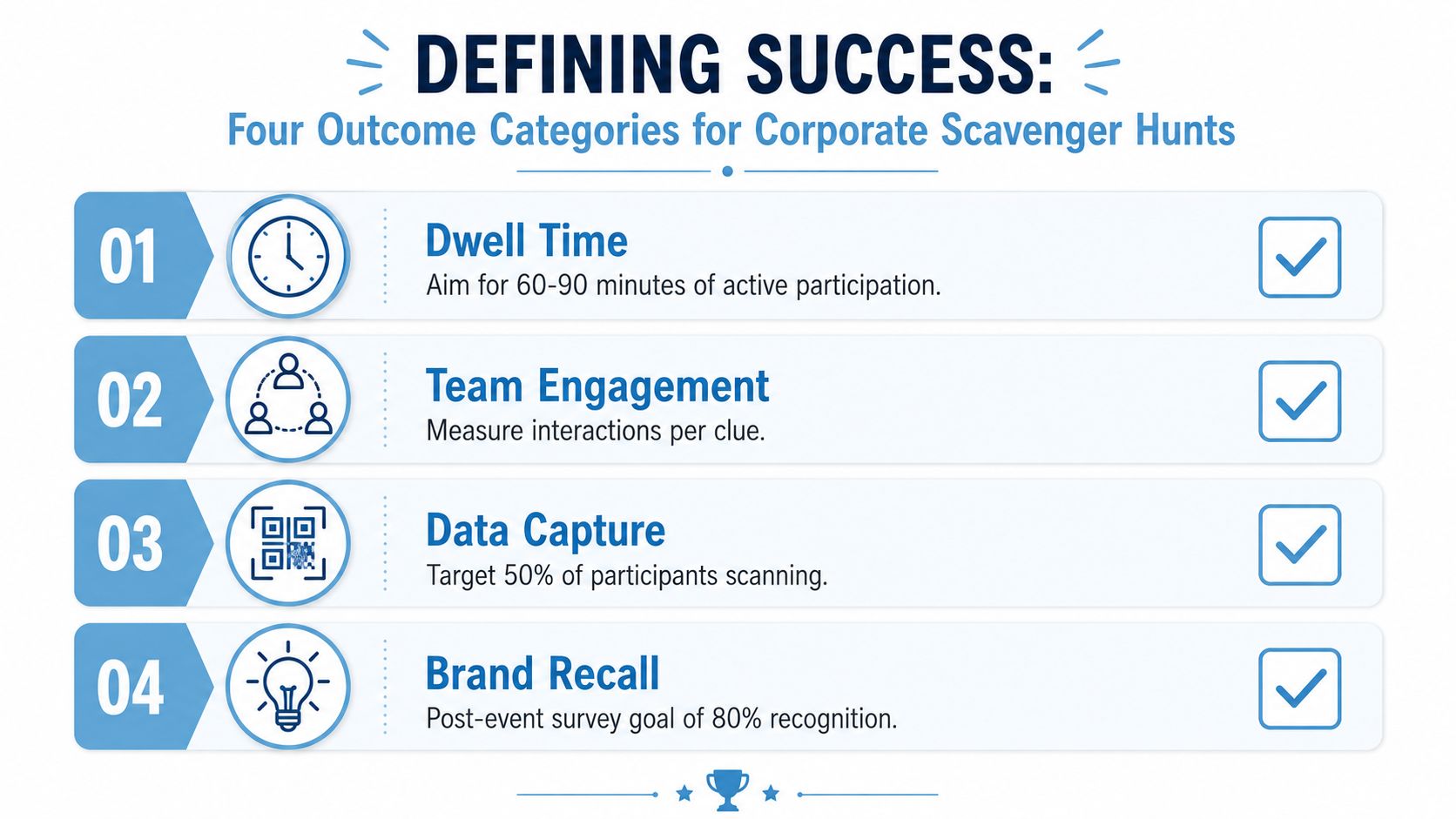
Before a single clue is written, the planner has to decide what success means. In practice, corporate scavenger hunts usually fall into four buckets, dwell time, team bonding, lead capture, and brand recall. If those are not defined early, the activity becomes a nice afternoon instead of a useful business asset.
What to put in the outcomes brief
A simple one-page brief is enough. Write down the audience, the date, the route type, the number of teams, and the primary outcome. Then add the evidence you'll use afterwards, such as finish times, completion rates, photo-task submissions, or a short survey.
For the engagement metric, EventMobi's implementation guide defines it as the median number of challenges completed by all attendees divided by the total number of challenges, and says first-event results can land anywhere from 20% to 80% (EventMobi scavenger hunt implementation guide). That range is useful because it stops teams from treating the first run like a polished benchmark. The first event is the baseline, not the victory lap.
If you want a broader framework for event ROI, PSW Events' experiential marketing ROI resource sits neatly alongside this planning mindset. The point is to move the conversation from “Was it fun?” to “What did the activity do for the client?”
A clean brief might include these prompts:
- Dwell time: How long should teams stay active before the energy drops?
- Team bonding: What behaviour should we see, more discussion, more shared decisions, more laughter?
- Lead capture: If there's a sponsor or client objective, where does data collection happen?
- Brand recall: What should participants remember when they leave?
Write those answers before route design. Otherwise the clues will drift, and the event will start serving the scenery instead of the brief.
Choosing Between App, QR, and Paper Formats
A format choice changes the operating burden as much as the participant experience. App-led hunts suit teams that want live scoring, on-screen prompts, and less manual coordination. QR or paper-based formats work better when signal is inconsistent, device access is mixed, or branding needs tighter control. In Edinburgh, that decision has to factor in weather, route density, and how much friction the group can tolerate without losing momentum.
| Edinburgh scavenger hunt format comparison | Stops | Distance | Duration | Cost basis |
|---|---|---|---|---|
| App-led, myCityHunt | 8 to 12 spots (myCityHunt Edinburgh) | Not stated on the page | Shared high score shown after about 3 hours (myCityHunt Edinburgh hunt page) | £11.99 per person |
| App-led, scavengerhunt.com | 10 stops (scavengerhunt.com Edinburgh) | 1.82 miles or 2.94 km | 1.5 to 2 hours | Not stated on the page |
| Self-guided walking tour, Tourist Scavenger Hunt | Distance listed as 2.7 km or 1.7 mi (Tourist Scavenger Hunt Edinburgh) | Route length given as 2.7 km | Not stated on the page | Not stated on the page |
How to choose the right format
App-led hunts work well when you want scoreboard energy, role-specific prompts, and lighter on-the-day admin. myCityHunt is clear on the operational setup, it prices at £11.99 per person, uses a ticket code plus an internet-enabled connection, and builds the experience around 8 to 12 must-see spots with a shared high score visible after about 3 hours. That makes it easier to brief a corporate group, set expectations with the client, and decide whether the format suits a shorter internal activation or a longer team session.
Another app-led option, scavengerhunt.com, sets out a different pacing model, with 10 stops over 1.82 miles or 2.94 km, and an estimated runtime of 1.5 to 2 hours (scavengerhunt.com Edinburgh). That kind of route length is useful when you want the team moving, talking, and finishing before attention starts to dip. For event producers, the trade-off is straightforward, shorter routes are easier to control, but they leave less room for extended clue interactions or brand messages.
Paper-led or lightly digitised formats make more sense when reliability matters more than interactivity. If weather, network access, or tight brand control are the main concerns, a simpler format can reduce failure points on the day. For teams weighing richer digital layers, AR development for businesses is a useful reference point, because it shows how immersive features can be added without turning the hunt into a technical burden.
Operational trade-off: the more the hunt depends on live tech, the more you need to plan for battery drain, signal gaps, and mixed device confidence.
For organisers using PSW Events' event coordination software, the practical question is whether the format supports the stakeholder outcome without adding avoidable failure points. In many cases, the best choice is the one the group can complete comfortably and the client can measure cleanly.
Designing the Route Through Edinburgh
Route design is where Edinburgh scavenger hunts are won or lost. The city rewards good planning, but it punishes lazy assumptions. Cobbles, closes, stairways, traffic pinch points, and crowded historic streets can all turn a neat route into a bottleneck if the map is drawn without a rehearsal walk.
Build the loop around the city's natural flow
A sensible route usually starts from a public, obvious point such as City Chambers or the Scottish Parliament Building, then loops through the Old Town without forcing teams to retrace their steps too often. The trick is to use the Royal Mile spine as an anchor, not as a prolonged standing area. Clues should pull people off the busiest line and back again, so teams spread out rather than bunching together.
Keep regrouping space in mind at every stop. Narrow streets can be atmospheric, but they're poor places to pause, explain, or photograph a team. If someone has to stop while another group passes, you've already lost rhythm.
The best Edinburgh route feels inevitable when you walk it, but it usually took several compromises to get there.
Check the practical constraints early
Liaise with any venue or building security team near your start, finish, or enclosed clue points. Confirm what happens if a team arrives early, arrives late, or needs help. During the festival season, you also need to account for tram works, temporary closures, and crowd density, especially near the busiest parts of the centre.
A rehearsal walk should flag two or three obvious risk points, no more. If you're seeing more than that, the route is probably too ambitious. A route that is meant to be walkable in 90 minutes for the slowest team is usually the right shape for a mixed corporate group, because it gives the planner a buffer without making the experience drag.
The goal is not to use every picturesque street. It's to build a clean loop that survives real conditions on the day.
Calibrating Clue Difficulty and Team Sizing
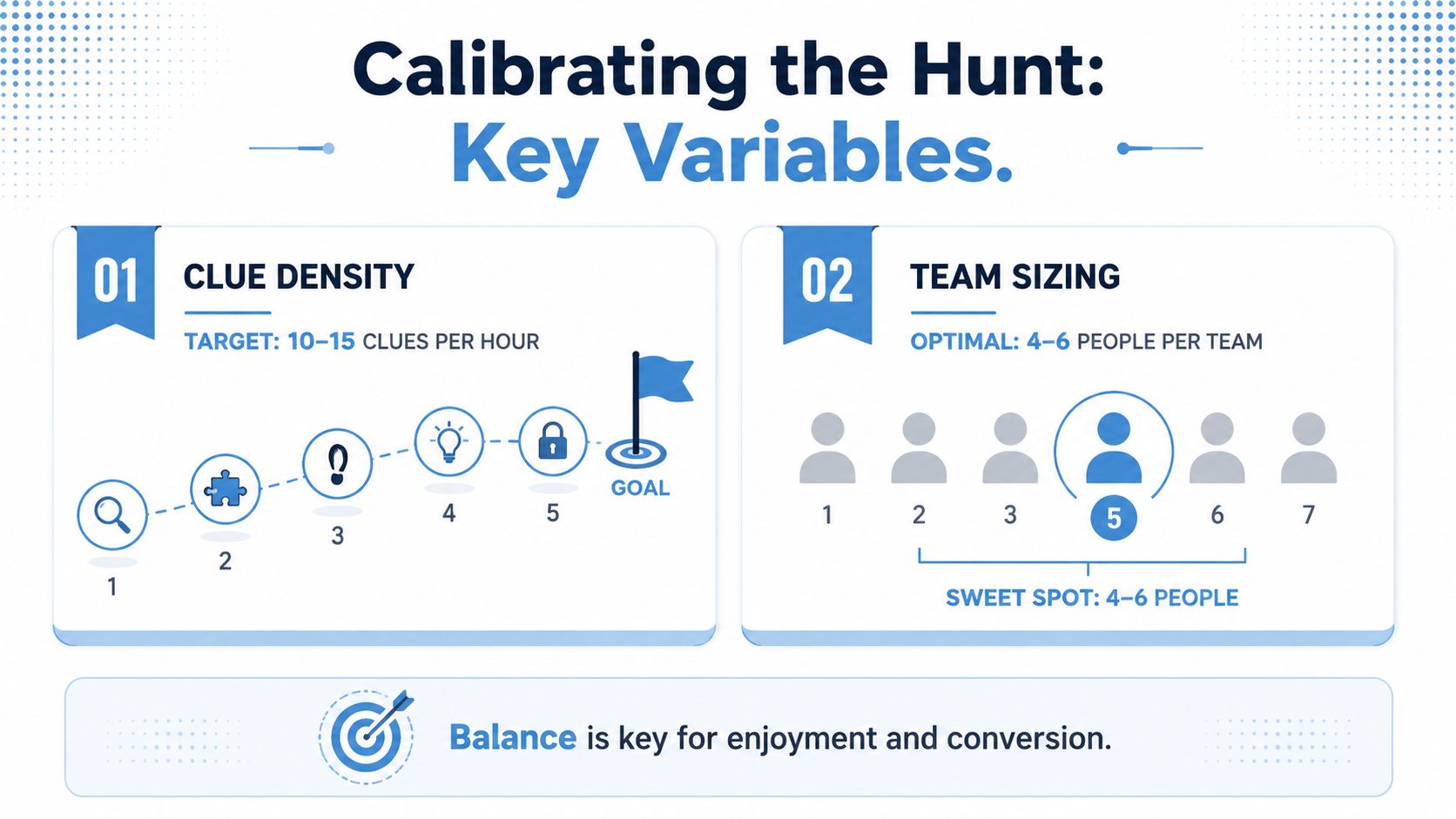
Two variables decide whether a hunt works in practice, clue density and team size. Too many challenges, and teams start guessing under pressure and burning time on dead ends. Too few, and the pace drops before the final checkpoint. In Edinburgh, that balance matters even more because the city already gives you strong visual cues. The clues have to add value, not just fill space.
What the completion data suggests
Published scavenger-hunt research gives a useful pacing range. Analysts at education scavenger hunt research reported 92% final completion after a single reminder, with a 38 to 57 minute completion window and a mean of 46 minutes, while 33% of completing groups made at least one error. That is a clear sign that completion depends on pacing, not just clue quality.
The same study also shows why reminders matter. If teams stall, a nudge can rescue the activity without changing the route. In a live corporate setting, that can be the difference between a strong finish and a few people dropping out.
Set the hunt up for mixed corporate groups
A separate Edinburgh teaching project adds a useful operational clue. It recorded 36 active teams submitting 746 tasks during a 90-minute activity, and the average outcome was roughly two-thirds of missions completed from the same study. Route complexity and task volume clearly change how far groups get.
For mixed corporate groups, aim for roughly 8 to 12 challenges over 2 to 3 km, and keep teams at four to six people so everyone has a role. That gives enough variety to support a leaderboard without overloading slower walkers or quieter participants. It also fits the fact that a six-person team can split tasks and still stay coordinated.
Rule of thumb: if one person can solve every clue alone, the hunt is too easy. If the team needs to stop every minute, it is too hard.
Staffing, Safety, and Weather Contingency
Edinburgh can switch from bright to wet to windy without warning, and any hunt that ignores that reality is taking a gamble with the participant experience. The safest way to run it is to build the staffing and contingency plan before the route gets locked.
Staffing that actually works on the day
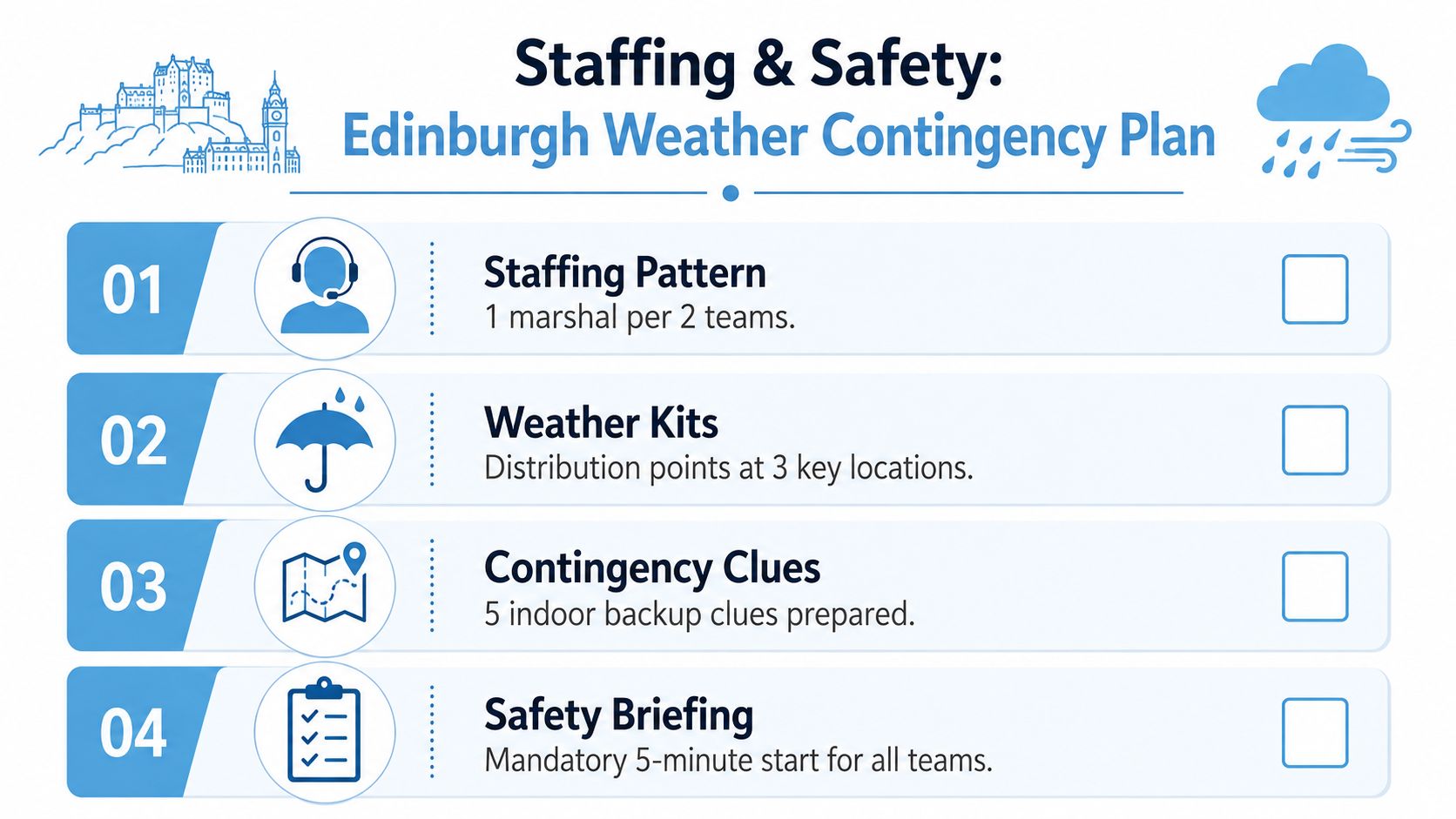
For groups of up to 100, a practical pattern is one marshal per three to four teams, plus a sweeper at the rear and a fixed control point for lost phones or medical issues. That gives you enough oversight to support pacing without turning the hunt into a supervised school trip.
A written risk assessment should sit at the centre of the plan. If you want a useful refresher on how a formal process is structured, the approach described in Safety Space's risk assessment guidance is a solid reference point. It's relevant because the event needs the same discipline as any managed public activity, even if the tone is lighter.
Weather and safety controls
Your lead should be first-aid trained, and every team should get a short safety briefing before start. That briefing needs to cover where to regroup, what to do if a phone dies, and what happens if the weather shifts badly enough to change the route.
Use a wet-weather plan that swaps an outdoor leg for a covered courtyard or partner venue. That gives you a clean fallback without killing the game. Keep weather kits at distribution points if the group is large enough, and make sure your marshals know the exact rendezvous times.
A workable checklist looks like this:
- Start control: confirm every team has the same briefing and start signal.
- Rear coverage: keep a sweeper close enough to catch drift without slowing the front runners.
- Backup clues: pre-write indoor alternatives for the most weather-sensitive leg.
- Participant welfare: stop the route if visibility, footing, or crowding becomes a safety issue.
Branding, Measurement, and the After-Action Review
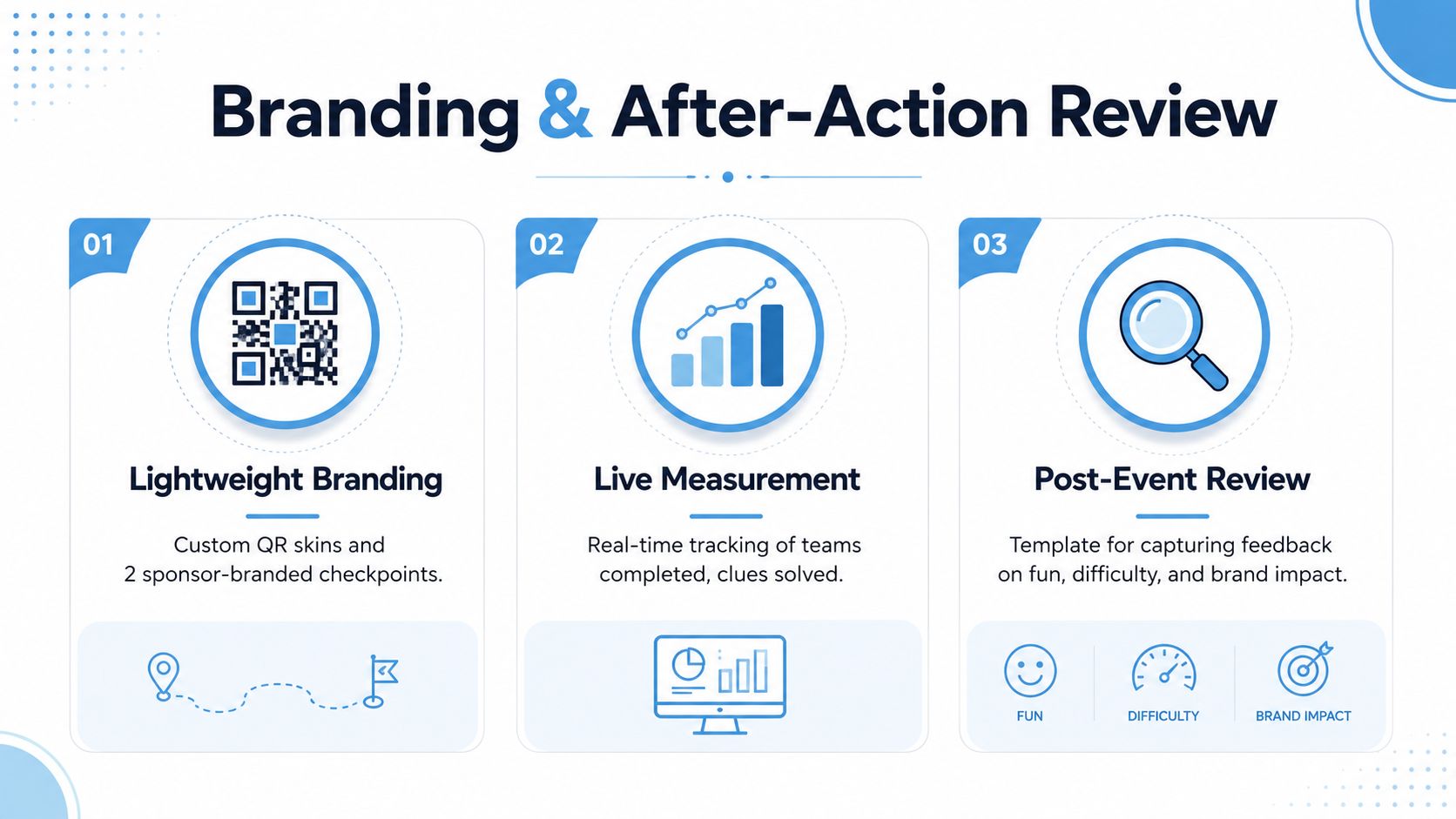
Light branding works best when it supports the game rather than sitting on top of it. That means subtle QR skins, a sponsor-branded leaderboard at the finish, or a visual finish-point backdrop rather than heavy-handed signage that makes the hunt feel like an ad. The strongest formats let the brand be discovered through the flow of the activity.
What to measure after the event
Track completion rate by team, average finish time, photo-task submissions, and a short survey on fun, difficulty, and brand impact. That gives you enough signal to decide whether the hunt should be repeated, shortened, or made more competitive next time.
If you need branded takeaway items or finish-point giveaways, Custom Mark's logo product expertise is relevant because it sits in the same practical space as low-friction event branding. The key is consistency, not clutter.
Use the first run as the benchmark
Your after-action review should be short. Capture what teams enjoyed, where they slowed down, which clue caused confusion, and whether the route length felt right. Then note one thing to change and one thing to keep.
A simple template works:
- What completed cleanly
- Where teams stalled
- Which brand moment participants remembered
- What the next run should change
The best Edinburgh scavenger hunt becomes a repeatable format only when the first one is measured properly. If you want a corporate activation that delivers footfall, dwell time, and a clean story for stakeholders, talk to PSW Events about building a hunt that fits your audience, route, and objectives, not just the city.